Archive for the ‘International Governments’ Category

Mongolia ratifies cooperation agreement with DPRK

Friday, February 7th, 2014

According to Xinhua:

The Mongolian government ratified a cooperation agreement Friday with the Democratic People’s Republic of Korea (DPRK) in the areas of industry and agriculture.

Under the agreement, Mongolia will provide livestock husbandry support to the DPRK and, in return, the DPRK will develop light industry using raw materials and resources of Mongolia, such as sheep wool and coal.

The agreement was finalized during a visit by Battulga Khaltmaa, Mongolian minister of industry and agriculture, to the DPRK last October.

Both countries hope the deal will expand reciprocal economic ties between the two countries.

Mongolia is rumored to be involved with the DPRK’s Sepho Tableland project.

Read the full story here:
Mongolia ratifies cooperation agreement with DPRK
Xinhua
2014-2-7

Share

A new electronic entry system launched for the Kaesong Industrial Complex

Thursday, February 6th, 2014

Institute for Far Eastern Studies (IFES)
2014-2-6

A pilot operation of the new electronic entry system, or radio frequency identification system (RFID), to facilitate the travel to and from the Kaesong Industrial Complex (KIC) was completed on January 15 and pilot operation began from January 28, 2014.

According to a Ministry of Unification (MOU) official, “The construction of the system began from December 11 last year and it was completed this month on the 15th. The trial operation period will begin from the 28th.”

The RFID system was agreed upon last September at the second meeting of the South-North Joint Committee for the Kaesong Industrial Complex in order to improve the South Korean companies’ access to the KIC.

The new RFID system will replace the paper document inspection with an electronic card system and personnel screening will be reduced to 5 seconds from 13 seconds while vehicle screening time will be reduced to 7 seconds from 15 seconds.

In particular, the reduced inspection time will facilitate the travel and ease the heavy traffic during Monday mornings and Friday afternoons: for personnel screenings, from 17 minutes to 5 minutes; for vehicle inspections, from 19 minutes to 8 minutes.

However, the existing personnel and vehicle access to the KIC which requires a 3-day advance notice still remains in effect, and the mobility of personnel and vehicles will still be strictly monitored and chaperoned by the North Korean military.

On the other hand, the fourth round of the sub-panel meeting was held on January 24 to discuss the operation of the RFID system, Internet connectivity, and simplification of customs process at the KIC.

In regards to the streamlining of the customs process, the two countries agreed to change it from ‘complete’ to ‘selective’ examination, but differences still remain over the ratio to be applied to the selective probe.

As for the issue of Internet connection, it is still in the infant stage and the two sides agreed to resume the negotiation on February 7.

Share

UN Central Emergency Response Fund

Tuesday, February 4th, 2014

According to Yonhap (via Korea Herald):

The United Nations humanitarian fund created to speed up relief efforts around the world said it allocated $15.1 million for aid to North Korea in 2013.

The Central Emergency Response Fund said on its website that it provided emergency food assistance, as well as vaccines and essential medicines, to people in the flood-affected regions especially children and women in the communist North through the World Food Program and other U.N. organizations.

In 2012, the U.N. humanitarian fund allocated $12.9 million to North Korea.

The CERF provided a total of $482 million to 45 countries across the globe last year, with North Korea being the 11th-largest recipient.

The North has relied on international handouts since the late 1990s when it suffered a widespread famine that was estimated to have killed 2 million people.

Read the full story here:
U.N. fund gives $15.1 mln to N. Korea in 2013
Yonhap (via Korea Herald)
2014-2-4

Share

China – DPRK trade data (January 2014)

Sunday, February 2nd, 2014

Yonhap reports that China – DPRK trade appears unaffected by the purge of Jang Song-thaek. According to the article:

Despite North Korea’s stunning execution of the leader’s uncle in December, its trade with China remained solid in January, up 16 percent from a year earlier, data showed Friday.

Jang Song-thaek, the country’s No. 2 man and leader Kim Jong-un’s uncle, had played an important role in dealing with Beijing before being executed late last year on treason charges. The political upheaval raised concerns over a possible instability that could spill over into other areas of the reclusive country’s moribund economy and society.

Still, trade volume between North Korea and its major trading partner China came to US$546 million in January, compared with $471 million from a year earlier, according to the data compiled by the Korea International Trade Association (KITA).

North Korean exports to China jumped 18 percent on-year to $223 million, with imports rising 14.5 percent to $323 million, the data showed.

Anthracite was the No. 1 export item for the impoverished country to its communist neighbor, selling some $101 million worth of the natural resource last month, up 21.3 percent from a year ago.

North Korea’s anthracite exports are a major source of income, and China is virtually the only destination for the shipments.

Inbound shipments of China-made cell phones soared 28 percent on-year to $14.4 million in January, the data showed.

“Trade volume between the two countries is expected to rise further given China’s growing demand for minerals for its project to develop its three northeastern provinces of Heilongjiang, Jilin and Liaoning,” said Lim Eul-chul, a research professor at Kyungnam University.

“Such political variables as Jang’s execution would not likely affect the trend,” he added.

The heavily sanctioned North Korea has been increasingly reliant on China, though the Asian giant has become frustrated with its wayward neighbor, particularly after Pyongyang’s third nuclear test early last year.

In 2013, trade volume between the two reached a record $6.45 billion last year, up 10.4 percent from the previous year, according to KITA data.

The Wall Street Journal notes:

“Bilateral trade has probably yet to feel the impact of Mr. Jang’s execution,” said Cho Bong-hyun, research fellow at Seoul-based IBK Economic Research Institute.

“Both sides are still acting on trade contracts that have already been signed and usually take effect for six months,” Mr. Cho said.

Mr. Cho said he expects the impact from Mr. Jang’s purge will begin to appear in the data from the second quarter of this year. North Korea may also increasingly turn to trade with South Korea following a thawing of ties and the reopening of a jointly run Kaesong industrial park, he said.

The KITA data show inter-Korean trade volume shrank 42% to an eight-year low of $1.15 billion last year, when the Kaesong complex was closed for several months after North Korea pulled out its workers.

North Korean-Chinese trade volume hit a record high of $6.54 billion last year, according to KITA, as North Korea exported natural resources such as coal and iron ore, while importing fuel and electronics goods.

The Korea Trade-Investment Promotion Agency, Seoul’s state-funded trade agency, said in a report last year that North Korea’s bilateral trade with China accounted for 88% of Pyongyang’s entire external trade in 2012, up from 53% in 2005.

Read the full stories here:
N. Korea, China trade unaffected by stunning execution: data
Yonhap
2014-2-28

Jang Purge Yet to Hurt North Korea-China Trade
Wall Street Journal
Kwanwoo Jun
2014-2-28

Share

DPRK-china trade at record US$6.45b in 2013

Friday, January 31st, 2014

According to Yonhap:

Trade volume between North Korea and its major trading partner China reached a record US$6.45 billion last year, up 10.4 percent from a year earlier, data showed Saturday.

North Korean exports to China jumped 17.2 percent on-year, while imports from China increased 5.4 percent, according to the data from the Korea International Trade Association.

Pyongyang’s trade deficit recorded $721 million, a 25 percent decrease compared with the previous year, the data showed.

North Korea’s major export items were minerals, with $1.37 billion worth of anthracite and $294.1 million of iron ore shipped to China last year.

North Korea’s anthracite exports are a major source of income, and China is virtually the only destination for the shipments.

The isolated socialist state heavily relied on China for crude oil, buying $598.1 million from its sole financial and diplomatic backer.

Inbound shipments of China-made cell phones fell to $44 million last year, shrinking by 26.6 percent from a year ago.

The latest data showed the heavily sanctioned North Korea is increasingly reliant on China, even though the Asian giant has become frustrated with its wayward neighbor, particularly after Pyongyang’s third nuclear test early last year.

Since these numbers are aggregated, we cannot observe if the purge of Jang song-thaek and his patronage network had any effect on DPRK/China trade at the end of the year.

The DPRK also increased oil imports from China in 2013. According to Yonhap (2014-2-10):

Shipments of crude oil to North Korea from China increased 11.2 percent on-year in 2013, a South Korean government report showed Monday, the latest sign that Beijing still gives Pyongyang access to the vital commodity despite its defiant pursuit of nuclear weapons.

North Korea imported a total of 578,000 tons of crude oil from China last year, compared with 520,000 tons in 2012, according to the report based on China’s customs data.

Monthly shipments of crude oil from China to North Korea were absent in February, June and July last year, but Beijing exported “a large amount of crude oil” to Pyongyang in the second-half of last year, the report said.

In 2013, trade between North Korea and China rose 8.9 percent on-year to reach US$6.54 billion, with the North’s exports to China jumping 18 percent to $2.91 billion, the report showed.

“Our overall analysis is that international sanctions against North Korea’s nuclear and missile programs have not reduced or shrunk the North’s trade with China,” a South Korean diplomat said on the condition of anonymity.

Here is coverage in the Daily NK.

Additional information:
1. Imports of grain were up. Food aid imports from UN were down.

2. Coal exports to China up.

3. DPRK visitors to China up.

Read the full stories here:
Trade between N. Korea, China hits record $6.45 bln in 2013
Yonhap
2014-1-31

N. Korea’s crude oil imports from China rise 11.2 pct in 2013
Yonhap
2014-2-10

Share

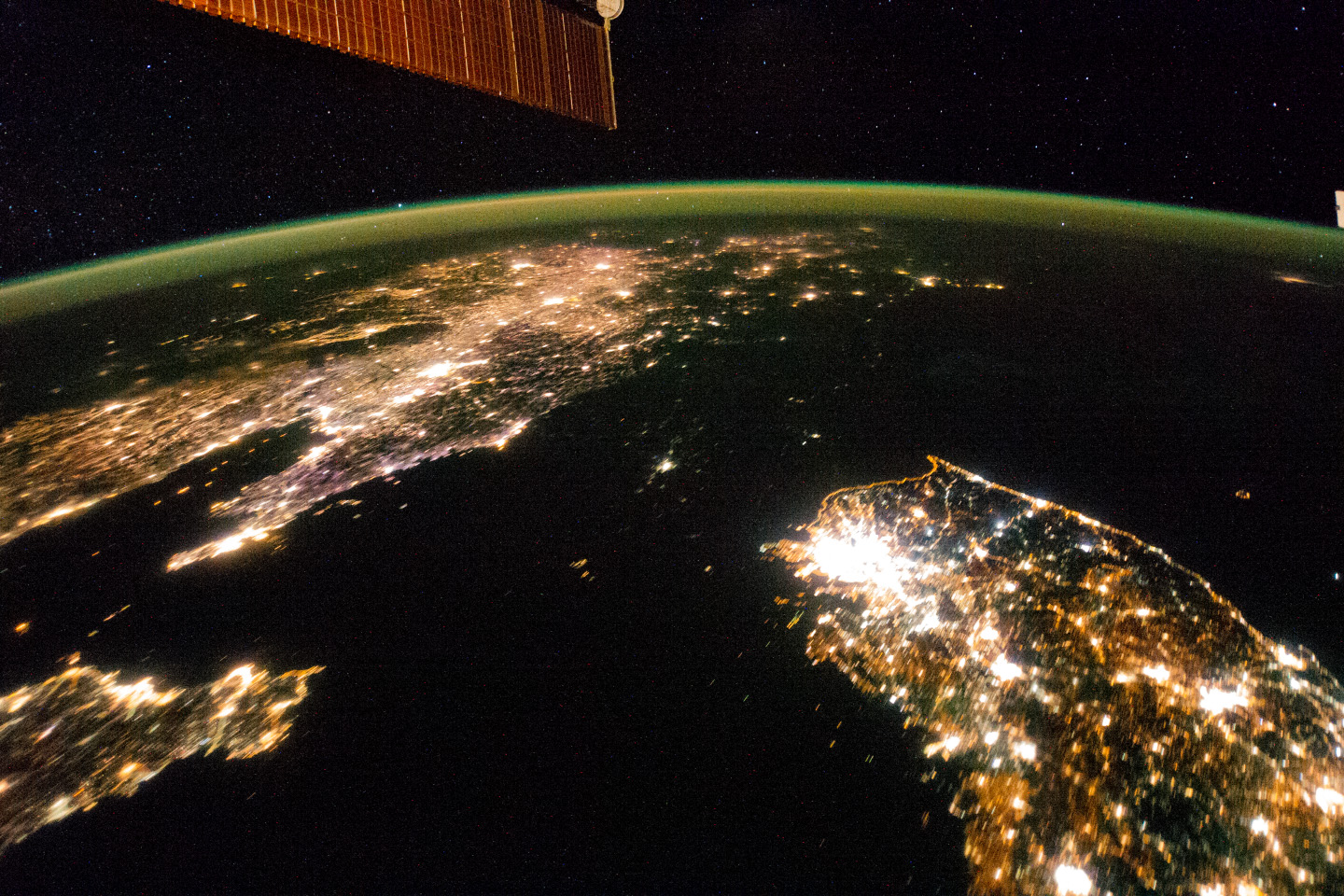
North Korea at night (2014-1-30)

Thursday, January 30th, 2014

NASA has released another iconic photo of the Korean peninsula taken at night:

NASA-2014-1-30

Image date: 2014-1-30

Here is the source. Here is video.

Here is a NASA photo from 2012-9-24.

Share

DPRK Restaurant opens/closes/opens in the Netherlands

Monday, January 27th, 2014

UPDATE 2 (2014-1-27): The North Korean restaurant has re-opened in Amsterdam. According to NK News:

While the Pyongyang Restaurant [See Below] shut down the same year as it opened – allegedly due to a dispute between the Dutch owner Remco Van Daal and its North Korean staff – the Haedongwha staff will now be managed in cooperation with an ethnic Korean manager named John Kim.

Kim, who has lived in the Netherlands for most of his life, also runs a business in Pyongyang exporting sand to Singapore, a source familiar with his background told NK News.

Unlike Haedangwha restaurants in China, which are run directly by the North Korean government, the Netherlands branch is unique in having non-North Korean ownership but a North Korean staff.

You can read more about the restaurant in Het Parool.

Michael Madden tracked down the location.

Here is the official web page of the restaurant.

Learn more about the “other” Haedanghwa here.

UPDATE 1 (2012-9-6): The restaurant has closed. According to the Associated Press:

A North Korean restaurant in Amsterdam staffed by cooks and waitresses from the isolated country has closed its doors.

Dutch newspaper De Telegraaf reported Thursday that Pyongyang Restaurant’s closure was permanent and stemmed from a disagreement between its Dutch owners and North Korean staff.

The restaurant was an oddity, believed to be the only of its kind in Western Europe, though there are similar restaurants in Asia. Dutch labor authorities say North Koreans can get work visas for Europe under standard rules, but few do.

A woman who answered the phone at the restaurant said the establishment was closed. She couldn’t say for how long because she was not authorized to do so. Its website says it is closed “due to holidays.” Phone calls to the owner Thursday went unanswered.

See more here at North Korea Leadership Watch.

ORIGINAL POST (2012-2-5): According to Yonhap:

A North Korean restaurant has opened in the Dutch capital of Amsterdam in what could be the communist nation’s latest attempt to earn hard currency and foster closer ties with Europe.

The “Pyongyang Restaurant” was launched late last month under a joint venture between North Korea and two Dutch businessmen. While North Korea is known to operate dozens of restaurants across Asia, it is the first time a North Korean restaurant has opened in Europe, with the exception of a canteen that briefly operated near the North Korean Embassy in Vienna in the mid-1990’s, according to a local source, who spoke on the condition of anonymity.

The restaurant is staffed by nine North Koreans, including the director and manager, Han Myong-hee, who worked for 15 years at a North Korean restaurant in Beijing operated by the North’s ruling Workers’ Party.

Pyongyang Restaurant, which seats 24 people, has its walls covered with pictures of Pyongyang and North Korean nature, while its menu consists solely of a nine-course meal priced at 79 euros (US$104).

Han said there are plans to offer more affordable dishes such as Korean noodles and dumplings after the restaurant’s official opening on Feb. 17.

“After our official launch, we plan to gradually serve a variety of dishes and during lunch hours as well,” she said. The restaurant currently serves only dinner.

The opening ceremony is expected to be attended by the North Korean ambassador to Switzerland, other North Koreans, and key figures from the Netherlands and different European nations, Han said.

Analysts said the restaurant is likely to serve not only as a source of much-needed cash but also as a bridge to Europe for the isolated North.

“North Korea has been putting a lot of effort into normalizing relations with European nations since 2000,” said Yang Moo-jin, a professor at the University of North Korean Studies in Seoul. “The opening of North Korea’s first restaurant in Europe can be seen as the North’s attempt to improve ties with the West through exchanges at the civilian level.”

Read the full story here:
N. Korean restaurant opens in Netherlands
Yonhap
2012-2-5

Share

DPRK imports of Chinese grain up 5.9% in 2013

Monday, January 27th, 2014

According to Yonhap:

North Korea’s imports of Chinese grain increased 5.9 percent in 2013 from a year earlier, a South Korean think tank said Monday.

The Korea Rural Economic Institute said Pyongyang’s imports of Chinese flour, rice, corn and other grain products reached 298,257 tons in 2013, compared with 281,633 tons a year earlier.

North Korea’s food production is estimated to have been at about 5.03 million metric tons in 2013, up 5 percent from the previous year, the U.N. World Food Program said in November.

Still, the food security situation is still serious, with 84 percent of all households having borderline or poor food consumption, the U.N. food agency said in a report posted on its website.

Food aid from the UN is down in 2013.

Read the full story here:
N. Korean imports of Chinese grain up 5.9 pct last year
Yonhap
2014-1-27

Share

DPRK reorganizing rents in Rason

Monday, January 27th, 2014

When Jang Song-thaek was purged, the North Korean prosecutors provided a laundry list of offenses committed against the nation. Among his crimes, Jang was specifically criticized for his management of assets in the Rason Economic and Trade Zone. The public accusation stated, “Jang made no scruple of committing such act of treachery in May last as selling off the land of the Rason economic and trade zone to a foreign country for a period of five decades under the pretext of paying those debts.”

The unnamed “foreign country” in the quote is obviously China, and the subtext of the quote implies that Rason contracts signed under Jang’s protection are in danger of being violated as the North Koreans reorganize the allocation of rents among key leadership organizations. This has to be unnerving to the Chinese business partners that signed these contracts and have been investing in the zone. In a best-case scenario for the investors, the reorganization of patronage would simply mean that they are just making payments to different organizations, but otherwise, business is pretty much unchanged. However, if the North Koreans are taking the drastic step of invalidating contracts and confiscating property, then we would expect to see a significant slow down in development of the zone in the future.

Following news of Jang’s purge, initial reports indicated that both DPRK and Chinese members of the Rason Management Committee had departed the SEZ and that most activities have come to a complete halt. But there are not enough reports to firmly conclude this is the case. Now New Focus has published information on some of the changes taking place in the Rason SEZ. The usual caveats apply:

The Kim Il-sung villa in Rajin-Sonbong is no longer available for hire, according to a reliable source in the area. The de-listing happened in the course of a Ministry of State Security (MSS) surveillance operation in North Korea’s Rajin-Sonbong special economic zone.

The operation was instigated under orders from the Organisation and Guidance Department (OGD) of the Workers’ Party, as it tightens its grip on the zone in the aftermath of Jang Song-thaek’s purge and execution. Nevertheless, the operation is being conducted in a relatively discreet manner so as not to startle Chinese businessmen in the zone.

The talk among senior DPRK cadres is that although Rajin-Sonbong’s Party Secretary, Party Committee Chair and MSS Supervisor are Jang Song-thaek’s associates, they are being left alone for the time being because of their close personal relations with Chinese investors; but that following the Supreme People’s Assembly elections in March, they will be replaced.

Nevertheless, the highest ranking female cadre in Rajin-Sonbong, the Tourism Director, was taken away. This prompted rumours that she was Jang Song-thaek’s lover, but her circumstances make this very unlikely.

The International Club in Rajin-Sonbong closed after the purge of Jang Song-thaek and the coming and going of Chinese businessmen has also decreased. The Kim Il-sung holiday villa in Rajin-Sonbong, which had been rented by HK investing company Emperor Group, has now been confiscated.

This villa is a 70s construction built as a getaway for Kim Il-sung and was a prized landmark in Rajin-Sonbong, with even a commemorative monument to mark the villa’s location. When the Emperor Group set up a casino in the area, they asked for permission to hire the villa for its VIP guests. At first, the Rajin-Sonbong Party Committee refused because it was considered a sacred landmark related to Kim Il-sung.

The person who secured the deal for the Emperor Group was an ethnic Korean Chinese named Ri Bong-hui, director of a fuel oil company. He donated US$1 million as a brokerage fee and the rental permit was granted. Rumours have now been spread that this fee had gone personally to Jang Song-thaek.

Existing land lease agreements in the Rajin-Sonbong special economic zone have also been affected. These originally stipulated that at US$20 / m2, plots of land could be leased for 20-50 years, depending on their location. The agreements have now been invalidated on the grounds that the details had been mismanaged by Jang Song-thaek.

Further, personnel tax and operating tax have been re-calculated and a request has been made by Party authorities in Rajin-Sonbong for the appropriate payments to be made in yearly groupings. As the Rajin-Sonbong authorities have asked for ten years back payment, many small investors from China are complaining about their losses.

The fact that the new rulings are being applied only to smaller companies is said to be exacerbating their disgruntlement. Chinese firms making larger investments are currently exempt, but some are still worried that the new measures might be applied to the bigger investors in a second phase of rulings.

Share

DPRK coal exports to China up 15.1% in 2013

Friday, January 24th, 2014

According to Yonhap:

North Korea’s exports of anthracite coal to China grew 15.5 percent in 2013 from a year earlier, data showed Friday.

North Korea shipped a total of US$1.37 billion worth of anthracite to China last year, compared with $1.19 billion sold to the neighbor a year earlier, according to the data from the Korea International Trade Association.

North Korea exported only $162.6 million worth of the coal to China In 2007, but the figure has grown every year since then, according to the data.

The total anthracite exported to China last year was measured at 16.5 million tons, up 39.7 percent from what was exported in 2012, the data also showed, indicating that the North sold the coal to China at cheaper prices last year.

In December alone last year, the North shipped $118.06 million worth of anthracite, almost the same amount as November’s $121.45 million.

This means North Korea continued anthracite exports to China after executing leader Kim Jong-un’s once-powerful uncle Jang Song-thaek in early December for allegedly attempting to overthrow the regime and committing anti-state crimes, including selling North Korean natural resources abroad at excessively low prices.

North Korea’s anthracite exports are one of its major income sources and China is virtually the only destination for the shipments.

Read the full story here:
N. Korea’s coal exports to China up 15.1 pct in 2013
Yonhap
2014-1-24

Share