Archive for the ‘International Governments’ Category

US increases sactions on North Korea

Wednesday, December 9th, 2015

According to Yonhap:

The United States slapped sanctions Tuesday on North Korea’s “strategic rocket force” and others for weapons proliferation amid growing concern about the communist nation’s ballistic missile capabilities.

The rocket force, which is charged with overseeing the North’s ballistic missile program, was accused of “engaging in activities that have materially contributed to the proliferation of weapons of mass destruction or their means of delivery.”

“The Strategic Force conducted multiple ballistic missile launches during 2014. Specifically, it conducted the launches of two short-range Scud-class ballistic missiles on March 3, test-fired two medium-range No Dong-class ballistic missiles on March 26, and conducted the launch of a short-range ballistic missile on July 26,” the Treasury Department said in a statement on its website.

“The launches of these missiles materially contributed to North Korea’s ballistic missile program,” it said.

Technically, it is the State Department that blacklisted the rocket force, though the announcement was included in the Treasury Department release.

Also sanctioned were six individuals and three shipping firms.

The individuals were Choe Song-il and Kim Jung-jong, Tanchon Commercial Bank officials based in Vietnam; Jang Bom-su and Jon Myong-guk, Tanchon Commercial Bank officials in Syria; Ko Tae-hun, a Tanchon Commercial Bank representative; and Kim Kyong-nam, an official of the North’s Foreign Trade Bank in Russia.

The three firms were Haejin, Pyongjin and Yongjin ship management firms.

“North Korea threatens international peace and security by expanding its nuclear program and continuing its proliferation of weapons of mass destruction and conventional weapons,” said Acting Under Secretary for Terrorism and Financial Intelligence Adam J. Szubin in the statement.

“Treasury is committed to exposing North Korea’s global proliferation network and excluding these facilitators from the international financial system,” he said.

Under the sanctions, any property or interest in property of the designated persons in the possession of U.S. persons or within U.S. jurisdiction must be frozen and transactions by U.S. persons involving the designated persons are generally prohibited, it said.

But the measures are seen only as symbolic as those sanctioned are not believed to be holding any assets in the U.S. or engaged in any dealings with U.S. persons.

Read the full story here:
U.S. sanctions N. Korea’s strategic rocket force
Yonahp
2015-12-9

Share

Rajin – South Korea water shipment

Monday, December 7th, 2015

According to Yonhap:

Containers carrying bottled water produced near North Korea arrived in South Korea on Monday via a North Korean port as part of a three-way logistics project involving the two Koreas and Russia, government officials said.

Ten containers full of bottled water produced at Erdaobaihe in northeastern China arrived at Busan, South Korea’s southeastern port city, earlier in the day after leaving from the North Korean city of Rajin bordering Russia, officials said.

The mineral water was produced at a factory run by Nongshim, South Korea’s largest noodle maker, in Erdaobaihe, a town close to Mount Baekdu in North Korea, the highest peak on the Korean Peninsula.

The shipment is part of the two Koreas’ third pilot operation of the project, which calls for shipping some 120,000 tons of Russian coal to three South Korean ports from the North Korean port city of Rajin.

The coal, which was transported from Russia’s border city of Khasan on a re-connected railway, arrived in South Korea in late November.

The so-called Rajin-Khasan logistics project is a symbol of three-way cooperation and an exception to Seoul’s punitive sanctions against Pyongyang following the North’s deadly sinking of a South Korean warship in 2010.

In November 2014, the first shipment carrying 40,500 tons of Russian coal arrived in South Korea without incident in the first test run of the project. The second test was conducted in April.

The project is also part of President Park Geun-hye’s vision for a united Eurasia, known as the Eurasia Initiative, which calls for linking energy and logistics infrastructure across Asia and Europe.

Read the full story here:
Containers carrying bottled water arrive in S. Korea via N. Korean port
Yonhap
2015-12-7

Share

Mansudae ODG building Angkor e-museum

Sunday, December 6th, 2015

Angkor-emueum-3

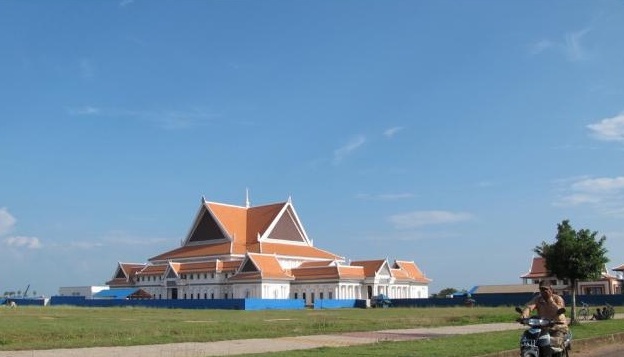
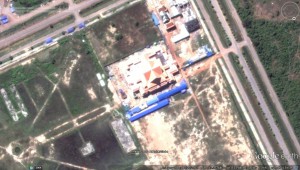
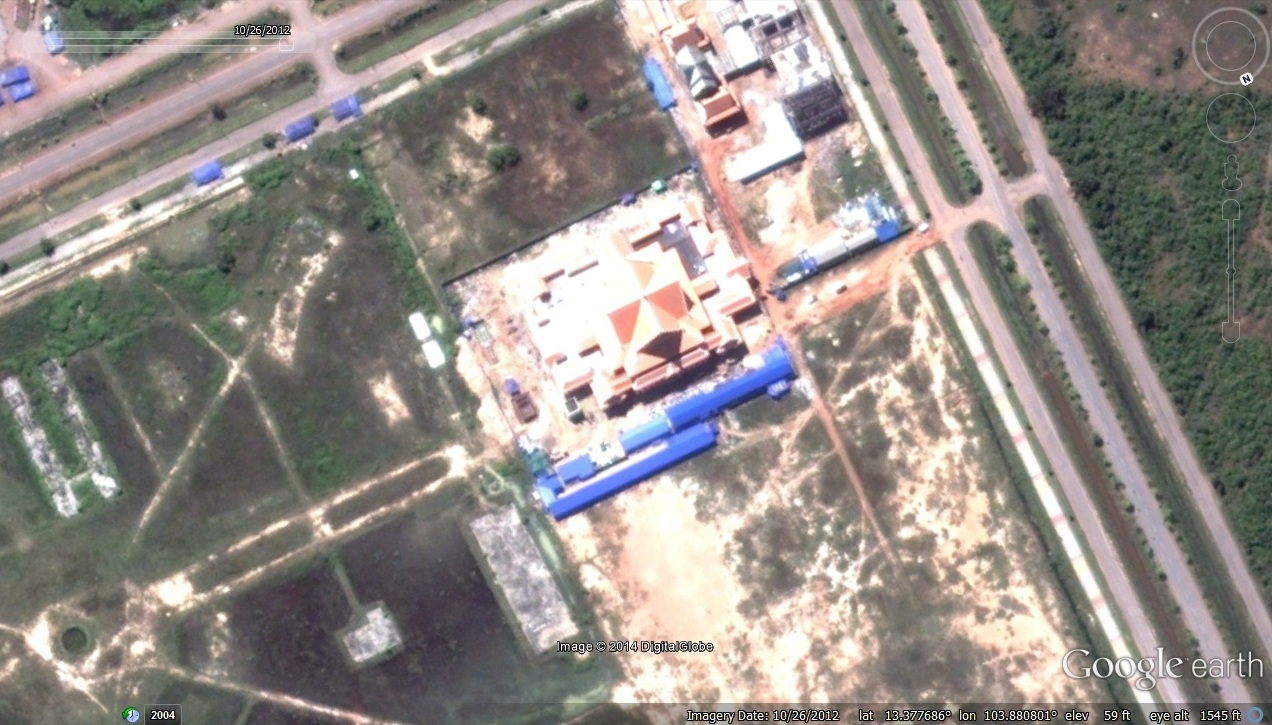
Pictured Above (Google Earth, 2012-10-26): An image of the Angkor E-Museum under construction in Siem Reap Cambodia

UPDATE 7 (2016-2-1): The Guardian publishes more information on the museum.

UPDATE 6 (2015-12-6): The museum opens! According to the Khmer Times:

After five years of building and delays, the $24 million Angkor Panorama Museum in Siem Reap was opened on Friday by Deputy Prime Minister Sok An, cementing growing ties between the Kingdom and North Korea, especially in Siem Reap.

Mr. Sok An said the 6,000 square meter building reinforced both cultural and economic ties.

The project was signed in 2011, under which North Korea’s Mansudea Overseas Project Group will run the museum with the government under a build-operate-and-transfer operation for 10 years until it is handed over to the Apsara Authority.

In the meantime, profits will be split evenly.

“We did not sell this land. We have a joint committee and we studied the investment project on all fronts before the government approved it. We treat foreign investment equally,” said Mr. Sok An.

“We need more tourist products such as this to attract visitors to Cambodia. The museum… is another tourism attraction that features, through the painting [mural] inside the museum, how our Khmer ancestors went about their daily activities during Angkorian time,” he said at the opening ceremony attended by an estimated 1,000 people, including South and North Koreans.

The project caused concern with South Korea, fearing it could be used for propaganda in the province, which is the country’s biggest tourist attraction. The Angkor Wat temple complex was listed for protection by the UN cultural organization UNESCO in 1992.

The new museumincludes work from 63 North Korean artists.

North Korean ambassador Hong Ki Chol told the crowd: “It was well built in a picturesque place, surrounded by Angkor temples – the pride of Khmers. We are proud that this museum was built to show Cambodian culture in the prestigious era of Angkor.”

“I am confident the museum will make a positive contribution to giving a comprehensive understanding of ideas about all the Angkor temples and promote tourism,” he said.

Cambodia received 4.5 million tourists last year, a 20 percent increase on the previous year and accounting for about 16 percent of the country’s gross domestic product. The Kingdom is targeting 8 million tourists by 2020.

“We want to see tourists stay longer in Cambodia,” said Mr. Sok An, who is also chairman of the Apsara Authority. ”The longer they stay, the more it benefits our people and the economy.”

UPDATE 5 (2014-6-14): The museum is still not open. According to an article in the Phnom Penh Post:

Siem Reap is home to North Korea’s first overseas museum, a $15 million tribute to Angkor set in a Khmer-style building which is not yet open to the public.

Although construction began in August 2011, the doors have still not opened and the car park has not been built.

The operations manager, who gave his name only as Kim, said the museum would open in three or four months, and blamed the delay on the unfinished car park and ticketing booth.

But sources within the South Korean community say the slow progress is due to the plan to build an information centre about the temples, which has caused a rift with the Apsara authority, which manages the complex.

UPDATE 4 (2104-1-20): It is January 2014, and the Museum still has not opened. A recent visitor, however, offers images of the museum and some details. According to the article:

The Grand Panorama Museum is a gift to cement the “glorious friendship between Korea and Cambodia”, says a young translator from Pyongyang, capital of the hermit state.

The building site is still strictly off-limits as I visit but, despite the secrecy, the man in charge relents and provides a short tour.

The museum is right next to the new ticket booths for the temple complex. The avowed aim is to take visitors back to the heyday of Khmer culture, which flourished in Angkor between the 12th and 15th centuries.

The museum’s interpretation is not so much scholarly as glitzy, with otherworldly music and coloured lights. It also showcases the North Korean style of ultra-realist painting. A huge face of the Buddha looms at the entrance.

“A true-scale copy of the stone-hewn figures at the Bayon Temple,” says the building chief. The giant painting looks remarkably like a photograph. “Exactly,” beams the official. “But it’s not a photograph – it’s Korean art.”

The big Buddha is a product of the Mansudae art factory in Pyongyang, which employs a thousand artists turning out paintings in oil, acrylic and watercolours in the “social realist” style. Abstraction is not allowed.

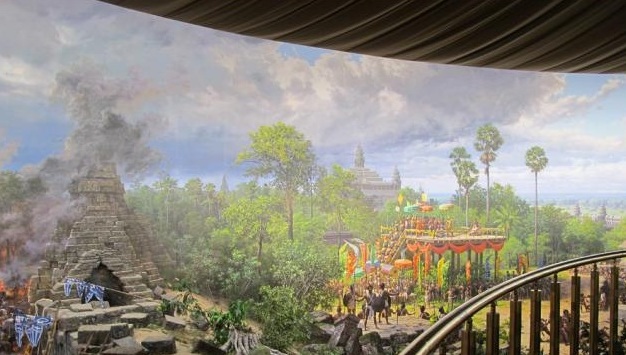
The panorama is viewed from a platform in the centre of a circular room. The entire wall is a single vast picture, 13 metres tall and 130 long. It depicts the many temples and everyday scenes from the 12th-century Khmer era – or at least daily life as imagined by North Korean artists.

The official word is that all the scenes were painted “following consultations with Cambodian historians”, the site supervisor is anxious to point out. The finished product is strong on battles, with lots of bloodshed.

“We have a panoramic museum like this in Pyongyang too,” says the supervisor. Is it about ancient Korean history? “No, it’s about the Americans’ war.”

The illusion of being at the centre of the Khmer empire is extended by all manner of fake walls, cannons and plastic trees between the raised platform and the panorama wall. The models carefully match the objects visible in the painted panorama.

“We will have wind and fog-making machines so that the trees will rustle,” says the young translator.

The museum also offers scale models of the sprawling temple complex and a 3D theatre where films depicting temple construction will be screened.

North Korean art is on sale in the foyer, along with cute souvenir dolls dressed in what the North Koreans say is the authentic Khmer national costume.

One huge oil painting in the shop is definitely not for sale. It depicts a snow-covered landscape in Korea’s mountains with a little hut in the foreground highlighted by a shaft of sunlight.

“That is the birthplace of our Great Leader,” the supervisor says reverently. “The picture is here on loan.” The late North Korean founding father Kim Il-sung is revered like a god.

The article offers some pictures as well:
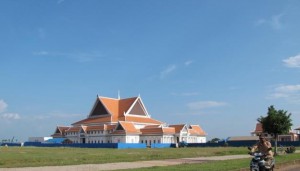
Angkor-emuseum-1

Angkor-emuseum-2

UPDATE 3 (2013-1-8): NK News explains some of the features the museum will contain and reports that it will open in April 2013.

UPDATE 2 (2011-11-26): Accoridng to AKP (Cambodia):

Cambodia has allowed the Democratic People’s Republic of Korea to build a cultural information centre (or welcome centre) in Siem Reap, the home of Angkor, as part of the government’s effort to attract more tourists, according to the Press and Quick Reaction Unit of the Council of Ministers.

In a meeting on Thursday, Deputy Prime Minister H.E. Dr. Sok An told the North Korean Ambassador H.E. Ri In Sok that Cambodia’s Apsara Authority is working with North Korean experts to build the centre, which will serve as a welcome centre for tourists who want information about Cambodia’s Angkorian history.

Officials of the Apsara Authority for the Protection and Management of Angkor and the Region of Siem Reap are working with 60 Korean experts and concerned institutions to ensure that the building design will feature the cultural values of both Cambodia and Korea.

The building, 70 metres in diameter and 124 metres in height, will be decorated with artistic works and drawings. Korean officials say that the world’s biggest artistic drawing will be displayed at the centre.

Dr. Sok An, who is also Minister in Charge of the Office of the Council of Ministers, told the ambassador that the centre will represent not only the image of the Democratic People’s Republic of Korea but also the good bilateral relations of the two Asian nations.

The outgoing North Korean Ambassador Ri In Sok, who is leaving Cambodia on Nov. 26 after a four-year term, told Dr. Sok An that North Korea wants unification with South Korea as soon as possible.

The ambassador was grateful to the deputy prime minister and the Royal Government of Cambodia as a whole for facilitating his diplomatic mission in Cambodia.

“I am pleased with the bilateral cooperation. I am pleased with the tremendous progress made by Cambodia over the past years,” said Ambassador Ri In Sok in the meeting.

The ambassador said the Democratic People’s Republic of Korea continues its good relations with the Royal Government of Cambodia thanks to the diplomatic legacy of the relations between His Majesty King Norodom Sihanouk, now retired, and the late Kim Il-Sung, leader of the Democratic People’s Republic of Korea.

Additional information:

1. Voice of America also picked up this story

2. NK Leadership Watch also covered the story.

3. The Mansudae Overseas Development Group (MODG) is also building/has already built an e-museum in Siem REap. Learn more here.

4. Here are previous posts on the DPRK and Cambodia.

UPDATE 1 (2011-8-3): Construction is underway on the project.  According to the Global Post:

A wall of royal blue sheet metal obscures the North Koreans’ operation from public view. When I approached the entrance, a man in a fedora and a tank top rushed over to slam the gate shut. A furtive look inside revealed fewer than a dozen scrawny workers and a scrub grass field still void of much construction.

Though local reports vary, North Korea will be paid between $10 and $17 million for some sort of monument or museum near the temples. The head of Cambodia’s culture ministry, Khem Sarith, confirmed construction of an “e-museum” but could not confirm the cost.

Nor could he explain why a country that offers its citizens scant electricity should win an “electronic museum” contract, especially after its monuments abroad have drawn both condemnation and ridicule.

The full story is well worth reading here:
North Korea propaganda unit builds monuments abroad
Global Post
Patrick Winn
2011-8-3

ORIGINAL POST (2010-4-27): According to the AFP (Via the Straits Times in Singapore):

A controlversial North Korean construction company is in talks to build an ‘e-museum’ of Cambodia’s famed Angkor temples, a senior official said on Monday.

Mansudae Overseas Projects wants to build a museum close to the temple complex that will feature a computer-generated simulation of the ancient monuments, Cambodian Culture Ministry secretary of state Khem Sarith told AFP.

‘They have plans to build an electronic museum detailing the history of Angkor Wat temples,’ he said, adding he supported the plans after discussions last week with a company delegation and North Korean ambassador Ri In Sok.

Previous work by the North Korean company building major monuments in African countries has been criticised for lack of transparency. Its 49-metre bronze Monument for the African Renaissance has caused outrage in Senegal over the sale of government land to finance the project and the president’s plan to keep 35 per cent of any profit it generates.

Mr Khem Sarith said the so-called e-museum would be ‘good for tourists to view the temples and then select the one that they want to see’. Studies and more discussion were still needed before construction could start on the digitally-rendered overview, Khem Sarith said. He said he would meet again with officials from the company in June to discuss the project further.

The 12th century Angkor Wat temple complex is Cambodia’s main tourist attraction. It is located in the northwestern province of Siem Reap, where the ancient Khmer empire built some 1,000 temples spread over 160 square kilometres.

I have pretty extensive list of Mansudae Overseas Development Group projects from across the planet.  If you are aware of a North Korean built project in your country, please let me know.

(Thanks to a reader)

Read the full story here:
‘e-museum’ of Angkor temples
AFP (Straits Times)
4/26/2010
John Cosgrove

Share

DPRK food imports from China down

Tuesday, December 1st, 2015

According to UPI:

North Korea drastically reduced grain imports from China in 2015, and a South Korean analyst said the decrease is a sign North Korea’s food situation could be improving.

Kwon Tae-jin, director of East Asia research at GS&J Institute in South Korea, said grain imports were down 71 percent between January and October 2015, Voice of America reported.

South Korean newspaper Segye Ilbo reported Kwon used data from China’s customs authorities – which indicated imports of Chinese corn, rice, flour and soybeans had fallen to 42,000 tons, down from 144,000 tons in 2014.

Soybeans, or legumes, were the only category of grain imports that did not register a decrease, tripling in volume to 5,640 tons in 2015. Wheat flour imports dropped 80 percent, but it was unclear why some imports were more in demand than others.

The value of total grain imports was down 72 percent from the prior year, to $2.04 million, according to Kwon.

Imports of fertilizer used to grow crops also were down 41 percent between January and October, a trend that shadowed overall China-North Korea trade and investment activities, which have declined for two consecutive years, VOA reported.

China is North Korea’s No. 1 trading partner, but Pyongyang has been working to move away from economic dependency.

Kwon said that inside North Korea grain prices are very stable, and the food supply situation is not bad, judging by the numbers.

“This year [North Korea] did not need to import much grain, or receive a lot of support from the international community, in order to stabilize food prices,” Kwon said.

The South Korean analyst said the stable prices could be a sign the North Korean market has confidence in the regime in Pyongyang. The drop in demand for imported grain also indicates the supply situation is quite stable in North Korea.

Kwon said that North Korea’s dry spell in 2015 could have had a negative impact on the country’s harvest, but overall the situation is “probably not as dire as many fear.”

The researcher said the market also prices in future uncertainty into grain value, and stable prices indicate buyers are less concerned about future scarcity.

Here is similar coverage in NK News.

Read the full story here:
North Korea imports of Chinese grain decline 70 percent
Elizabeth Shim
UPI
2015-12-1

Share

Sinuiju International Economic Zone

Tuesday, December 1st, 2015

No sooner do I publish an article on the Sinuiju International Economic Zone (read it here at 38 North) than the DPRK releases more information on it.

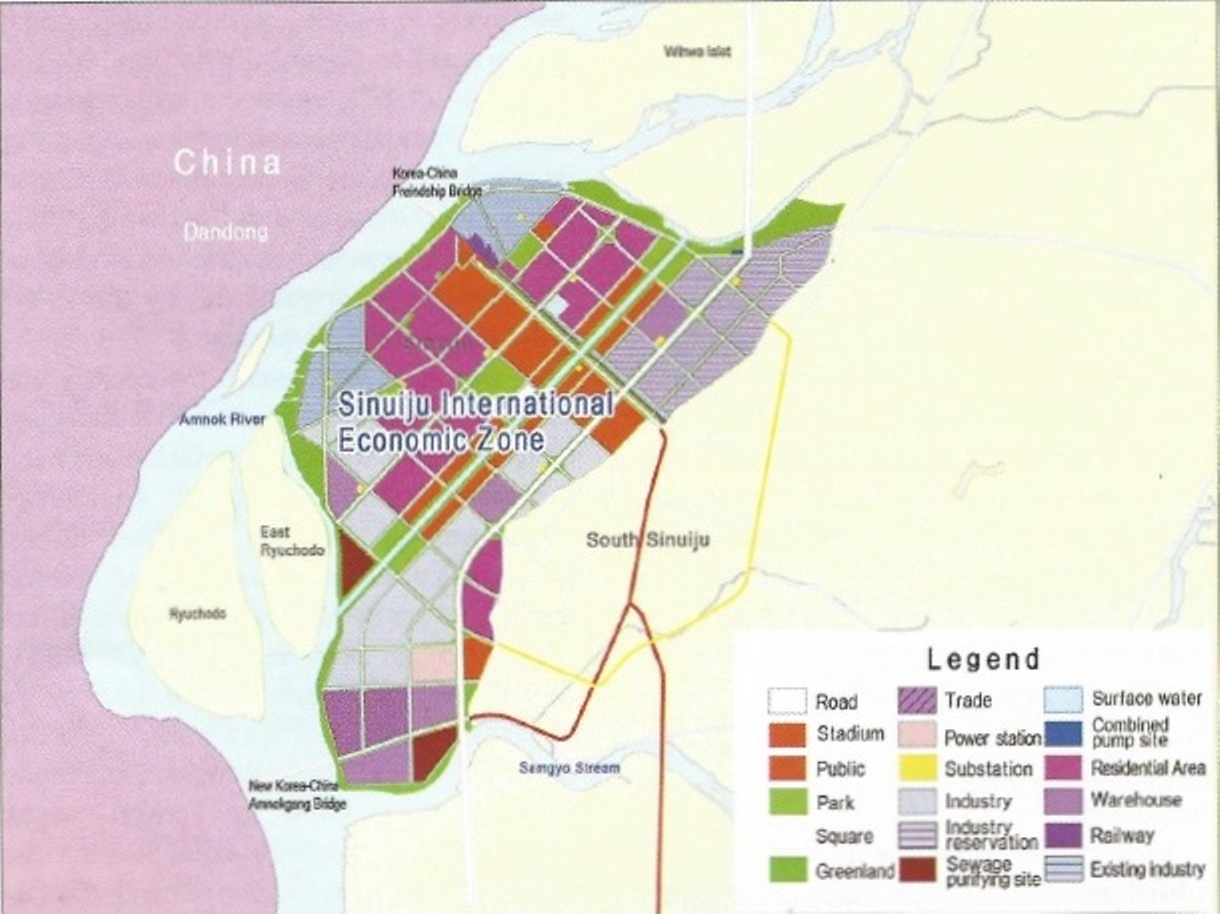
In the December issue of Foreign Trade (2015 No.4), the DPRK includes information on the zone, including this map:

Sinuiju-SEZ-Foreign-Trade-2015-4-scan

UPDATE: Dr. Haggard uploaded a nicer version of the image which you can see here.

The map indicates that the downtown area of Sinuiju and the western coast down to the new Amnok River Bridge will constitute the first phase of development. Space has been allocated for trade, industry, sewage, warehousing, and other designated areas. The map also indicates a new road is to be built linking the Wihwado Economic Zone (to the north east of the Sinuiju SEZ) with the new Yalu River Bridge (which has yet to be opened for business) and Ryongchon County.

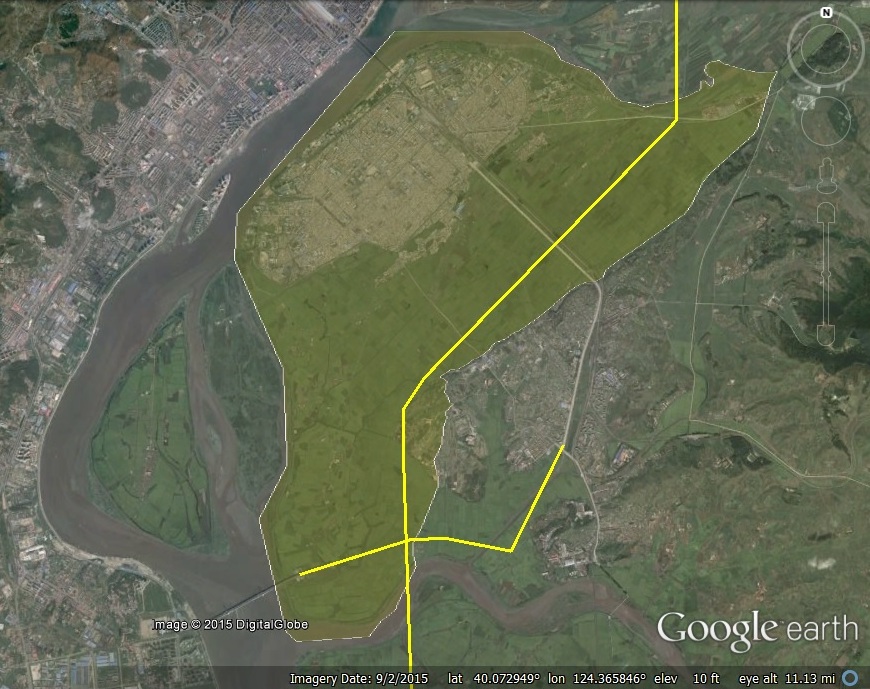
Here is a satellite image of the specific areas being designated for the first phase of the zone with proposed roads added for visual effect:

Sinuiju-SEZ-Google-Earth-2015-12-1

This is what the article had to say about the zone:

Sinuiju International Economic Zone

Located in a border area, the zone has a bright prospect for the development of water and marine transport. Its development area is 40km2.

The Zone is a flat area composed of deposits of organic fine sand in the mouth of the Amnok. The average height of ground inside the bank is 45m, geomorphology is 0-.7% and the average height above the sea level is up to 100m.

Its annual average duration of sunshine 2,427 hours, annual percentage of sunshine is 58% and annual average precipitation is 1001.5 mm.

The first and second annual main winds are northeast and and north winds respectively. It has the northeast and north winds in winter and southwest wind in summer in the main.

The Sinuiju International Economic Zone will provide opportunity for bonded processing, bonded transportation, trade and financial business, tourism, hi-tech industry, and various other business activities.

To this end, it is planned to develop the zone into a comprehensive economic zone with a large-sized latest IT industry area, competitive production area, exports processing area, cargo area, trade and financial area, public service area, tourist area and a bonded port, and into an international city with an airport and trade port.

Encompassing the whole of Sinuiju and two ri surrounding it, the zone is already furnished with infrastructure. However, it is necessary to upgrade the existing infrastructure and expand its capacity and build in its suburbs on a preferential basis.

The items of the construction of infrastructure include port, airport, railways, roads, power station, heating, and gas-supply system, telecommunications (international, domestic, mobile and computer network), and water supply, sewage-treating and garbage disposing systems.

As the zone has rich and good workforce whose education level is higher than secondary education, and many competitive heavy- and light-industry factories and enterprises around it, the investment by foreign business will be cost-effective and conducive to its development.

Previous posts on the Sinuiju International Economic Zone can be found here. Previous posts on the Sinuiju Special Administrative Region can be found here.

The North Koreans have also set up the Sinuiju-River Amnok Tourist Zone which you can read about here.

The JoongAng Ilbo has additional information here.

Share

Koreas, Russia start third test run for Rason coal shipments

Tuesday, November 17th, 2015

According to Yonhap:

South and North Korea kicked off another test operation Tuesday of their joint logistics project to ship Russian coal to the South through a port near the border with Russia, government officials said.

Some 120,000 tons of Russian coal will be delivered to three South Korean ports on a ship from the North Korean port city of Rajin after being transported from Russia’s border city of Khasan on a re-connected railway in the third run of the so-called Rajin-Khasan logistics project. The trilateral project will be carried out until Nov. 30.

It is a symbol of three-way cooperation at a time when inter-Korean exchanges have become stagnant following the deadly sinking of a South Korean warship by the North in 2010.

In November 2014, the first shipment carrying 40,500 tons of Russian coal smoothly arrived in South Korea in the first operation of the project. The second test was conducted in April.

The initiative involves three South Korean firms — top steelmaker POSCO, shipper Hyundai Merchant Marine Co. and state train operator Korail Corp.

A group of some 20 government and company officials are set to cross the border between Russia and North Korea on a bus later in the day after they departed from Vladivostok a day earlier, according to the Unification Ministry.

They will stay in the North’s city till Friday to check the Rajin port’s capacity to handle shipments and to see how smoothly vessels can be berthed there, the ministry said.

The South Korean firms will decide on whether to clinch a formal contract based on the outcome of the pilot operation. It is highly likely that the signing of a formal deal could be delayed into next year.

“It is unclear when the formal contract could be signed,” said a ministry official, asking not to be named.

The project is also part of President Park Geun-hye’s vision for a united Eurasia, known as the Eurasia initiative, which calls for linking energy and logistics infrastructure across Asia and Europe.

The project is regarded as an exception to South Korea’s punitive sanctions on the North, which has suspended almost all trade and exchange programs, apart from a joint factory park project in the North’s border city of Kaesong.

Read the full story here:
Koreas, Russia start third test run for logistics project
Yonhap
2015-11-17

Share

Tumen Triangle tribulations: The unfulfilled promise of Chinese, Russian and North Korean cooperation

Thursday, November 12th, 2015

Andray Abrahamian has published a report with the US-Korea Institute on developments in the Tumen Triangle.

Here is the report description:

The Tumen Triangle region-where North Korea, China and Russia meet-is, in many ways, the story of regional integration being held back by the political concerns of Pyongyang, Beijing and Moscow. There are long-term forces at work here, such as Moscow’s concerns over Chinese dominance in the sparsely populated Russian Far East. This legacy of mistrust frames cross-border interactions and despite recent warm relations, major cross-border cooperation remains limited.

In this USKI Special Report, Andray Abrahamian, Director of Research at Choson Exchange examines historical legacies, contemporary relations and shifting strategic priorities between the three countries. The report then focuses trade and investment in the Tumen Triangle region, particularly how the Yanbian Korean Autonomous Prefecture and Primorsky Krai interact with and affect Rason Special City, the center of the Rason Special Economic Zone.

You can download the report here (PDF).

Share

North Korean food shortage news roundup: October and November (updated)

Tuesday, November 10th, 2015

By Benjamin Katzeff Silberstein

This summer and fall has seen a somewhat contradictory stream of information about the North Korean food situation. First there were the drought warnings, which were closely followed by regime sources claiming that harvests were actually getting better thanks to agricultural reforms. During the fall, however, the picture painted by multilateral institutions like the Food and Agriculture Organization (FAO) and the World Food Program (WFP) has been one of dire and continued problems.

In early October, the FAO said that North Korea’s staple food production could go down by 14 percent during the year compared to last year, as AFP reported:

North Korea’s staple food production could plummet by 14 percent this year because of bad weather, sparking fears of exacerbating chronic food shortages in the impoverished nation, according to the UN agricultural agency.

The gloomy forecast from the Food and Agriculture Organization comes as the reclusive communist country prepares for a lavish military parade Saturday to mark the 70th anniversary of the ruling Workers’ Party.

The North is expected to produce 3.7 million tonnes of rice and corn this year, down from 4.3 million tonnes last year, according to a report from the FAO early warning system.

Pyongyang plans to import 500,000 tonnes of rice and corn from abroad, the FAO said, but it will not be enough to feed its 25 million people.

The country, plagued by regular droughts, will face a total shortfall of 1.2 million tonnes of its staples.

State media reported in early June the country’s main rice-growing areas had been badly hit by the “worst drought in 100 years”.

North Korea saw significant rainfall later, but analysts said the prospects for this year were still grim.

Full story here:
North Korea food production could drop 14%: FAO 
Yahoo News/AFP
10-9-2015

Later last month, the FAO reiterated its concerns over North Korea in its yearly report on the state of agriculture in the world. Voice of America:

More than 26 percent of children in North Korea’s countryside are underweight, a U.N. Food and Agriculture Organization report says.

The agency, in its recently released “State of Food and Agriculture 2015” report, also estimated that there are twice as many undernourished children in the communist country’s rural areas as in its cities.

Andre Croppenstedt, an FAO researcher who wrote the report, told VOA that “it’s normal to have a much higher percentage of children underweight in rural areas as opposed to urban areas,” but that the gap “is perhaps a little larger than usual” in North Korea.

The North Korean ratio is the 24th highest among the 123 low-income developing countries. Among East Asian countries, North Korea’s ratio ranked fifth, after East Timor, Cambodia, Papua New Guinea and Laos.

Read the full story here:
FAO: 1 in 4 Rural North Korean Children Underweight
Kim Hyunjin
Voice of America
10-22-2015

And last month, WFP announced it was extending its aid to North Korea over next year due to expected food shortages. Voice of America again:

The United Nations’ food agency plans to extend aid to North Korea amid reports that the communist country is facing food shortages next year.

Damian Kean, a regional spokesperson for the World Food Program (WFP), told VOA this week the agency plans to extend the current food aid program for another six months.

“This current program cycle is supposed to be finished this December. What we decided to do is to extend the program until the middle of next year,” said Kean.

He added that the agency needs an additional $23.3 million to fund the extension.

The WFP is conducting an assessment of the nutritional status of North Koreans to determine if further assistance is needed after June of next year, Kean said.

The agency launched a two-year food aid program in July 2013, and it had already extended the program through the end of this year.

According to Kean, the food shortages are affecting the most vulnerable groups, including young children and pregnant women.  More than 30 percent of North Korean children under five are experiencing stunted growth because of malnutrition, and more than a third of pregnant women and breastfeeding women are suffering from anemia.

Full story here:
UN to extend aid to North Korea
Kim Hyunjin
Voice of America
11-03-2015

This all suggests, as one might have expected, that North Korean claims of successful agricultural reforms may not have been the whole truth. At the very minimum, had such reforms had a strong and positive impact, harvests shouldn’t be declining compared with last year. Or harvests could just be stronger than what they would have been after the drought absent economic reforms. In any case, North Korean claims of a growing harvest do not seem to have held out.

UPDATE 10-10-2015:

Marcus Noland at the Peterson Institute’s Witness to Transformation Blog offers an interesting theory on these numbers: they aren’t that bad when compared with output over the last decade.

Last week Yonhap ran a story titled “N.K. may suffer severe food shortage next year: S. Korean expert” in which Kwon Tae-jin, formerly of the Korea Rural Economics Institute and now at the GS&J Institute, argued that North Korea may be facing its greatest food shortage of the Kim Jong Un era. Numerous articles, citing reports from the UN system, have highlighted high rates of malnutrition, particularly among vulnerable groups such as children.

The problem is that while the situation appears to be deteriorating relative to last year, as shown in the chart above, the FAO forecast of actual food availability per capita for 2015-16 actually represents a slight improvement over conditions for most of this decade.

Detailed data from the FAO displayed in the table below confirm that while production is forecasted to decline for coarse grains, maize, and rice, only in the case of rice is output forecasted to be below the 2011-13 average, and in this case, increased imports are expected to offset most of the shortfall.

Full story here:
Is North Korean food insecurity being hyped? 
Marcus Noland
Witness to Transformation
10-10-2015

What I wonder still is what this says about the progress of reforms, even if the figures aren’t particularly alarming. Also, the trend has been an increase in harvest figures over the past few years. So even if these figures aren’t particularly out of range, they still go against a trend of growth.


UPDATE (11-27-2015): Daily NK interviews one person in the country who says that this year saw a bumper harvest despite weather conditions, but not thanks to state reforms. The article says it’s not thanks to increases in collective farm harvests that things are going better, but because those tending individual plots have found better farming methods:

However, the number of people working hard to ensure the success of the rice harvests on collective farms is dropping. This is in large part due to the fact that despite reassurances from the state that farmers will receive sizable allocations of the harvest for their own use, for the past several years this has not been the case.

After “repeated failures by the authorities to fulfill stated promises,” he asserted, farmers have concluded that it makes no difference to them personally whether the collective farms do well or not.

Read the full article:
Despite Mother Nature, a bumper year for rice harvest
Lee Sang Yong
DailyNK
11-26-2015

Share

Civilian inter-Korean exchanges up in latter half of 2015

Monday, November 9th, 2015

According to Yonhap:

The number of South Koreans visiting North Korea has shot up since the two Koreas reached a deal in August to spur inter-Korean civilian exchanges, government data showed Monday.

The number of South Koreans who traveled to the North reached 418 in the January-September period, excluding those who moved in and out of the joint industrial park in the North’s border city of Kaesong, according to the data by the Unification Ministry.

But in October alone, the number of such people came in at 880 as the two Koreas held several joint events such as an inter-Korean project to excavate the ancient palace site and a workers’ football friendly.

The October tally did not include the South Koreans who crossed the border for the reunions for families separated by the 1950-53 Korean War, held on Oct. 20-26.

The increase in such exchanges is due to the two Koreas reaching a landmark deal on Aug. 25 to defuse military tension.

The value of humanitarian assistance to North Korea has also increased, according to the ministry.

In April, the government gave approval to Ace Gyeongam, a foundation run by bed maker Ace, to send fertilizer to North Korea for the first time since 2010, when Seoul imposed sanctions on the North over a deadly warship sinking that year.

Ace Gyeongam also provided a small amount of fertilizer and other assistance needed for a greenhouse project in North Korea last month.

South and North Korea saw more vibrant civilian exchanges, but there has been no progress over high-level talks as the North has not responded to South Korea’s proposal to have preparatory contact for such inter-Korean dialogue.

Read the full story here:
Civilian inter-Korean exchanges on the rise: data
Yonhap
2015-11-9

Share

DPRK-China trade through 2014

Thursday, October 29th, 2015

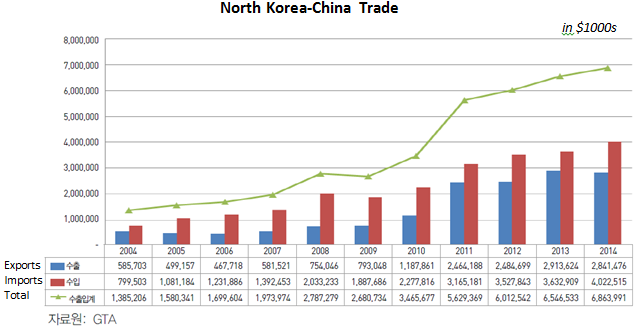
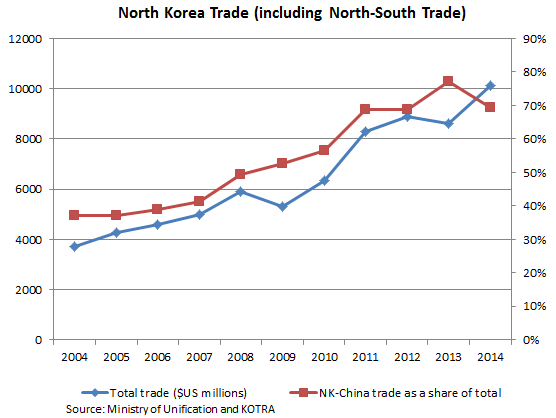
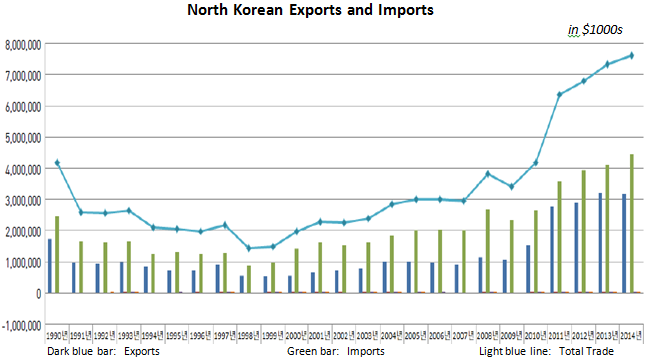
Stephan Haggard posted some charts of DPRK-China trade taken from KOTRA:

North-Korean-China-Trade-from-KOTRA

North-Korean-Trade-including-North-South-Trade

North-Korean-Exports-and-Imports-from-KOTRA


Share