Archive for the ‘International Governments’ Category

Russia secretly offered North Korea nuclear technology

Sunday, July 9th, 2006

From the Daily Telegraph, via NKZone:

Russia is facing criticism after secretly offering to sell North Korea technology that could help the rogue state to protect its nuclear stockpiles and safeguard weapons secrets from international scrutiny.

Russian officials touted the equipment at an IT exhibition in Pyongyang a fortnight ago – just days before the Communist state caused international alarm by launching a salvo of short and long-range missiles into the Sea of Japan.

In what appear to have been unguarded comments, Aleksei Grigoriev, the deputy director of Russia’s Federal Information Technologies Agency, told a reporter that North Korea planned to buy equipment for the safe storage and transportation of nuclear materials, developed by a Russian government-controlled defence company.

The company, Atlas, also received interest from the North Koreans in their security systems and encryption technology – which were kept from display at the exhibition for security reasons.

In remarks made to the Russian Itar-Tass news agency – hastily retracted after publication – Mr Grigoriev said that the main aim of the June 28 exhibition was “establishing contacts with the Korean side and discussing future co-operation”. Last week Russia, along with China, opposed a draft UN Security Council resolution, proposed by Japan and backed by America, that would bar missile-related financial and technology transactions with North Korea because of the missile tests.

As tensions over the missile tests mounted, the US government yesterday deployed its USS Mustin, equipped with so-called Aegis missile-tracking technology that is geared towards tracking and shooting down enemy missiles, to Yokosuka, home port to the US Navy’s 7th Fleet.

On Friday, George W Bush called for the issue of the missile tests to be put before the Security Council. He said he wanted to make clear to Kim Jong Il, the North Korean leader, “with more than one voice” that the rest of the world condemned Wednesday’s launches.

Sources close to the proposed sale of the equipment – which would have civil and military uses – said that it was evidence of Russia’s secret support for its Soviet-era ally, which was once a bulwark against Chinese influence in the Far East. It was reported that the North Korean military interest in the exhibition stemmed from the dual purpose of many of the products and technologies on display.

After the show, which led to plans for further meetings between the Russian and North Korean delegations, Mr Grigoriev said Pyongyang’s primary interest in buying the equipment was to combat the “threat posed by international terrorism”. However, the Russian embassy in Pyongyang immediately denied the report, claiming that it was “disinformation”. Mr Grigoriev subsequently denied ever having spoken to the journalist concerned.

Disclosures of a possible deal are at odds with official Russian policy towards North Korea’s nuclear programme. On June 22, North Korea’s ambassador to Russia, Park Yi Joon, was summoned to the foreign ministry in Moscow and informed that -Russia “strongly objects to any actions that can negatively influence regional stability and worsen nuclear crisis on the Korean Peninsula”.

There was also some anger domestically at Russia’s opposition to the UN sanctions resolution. Although the Russian foreign ministry expressed anger that Moscow had not been notified of the launches, it went no further than issuing an anodyne statement expressing concern that the tests endangered Pacific Ocean shipping and “violated the commonly accepted world practice of giving a warning”.

Western experts were not surprised that the two countries might be discussing sensitive military deals.

Nicholas Eberstadt, a North Korea expert at the American Enterprise Institute, a think tank in Washington, said that Russian policy towards North Korea had long been influenced by the desire to restore its Cold War-era influence.

“Russia often seems more ambitious to restore that influence than to play a positive role in international affairs,” he said. “We’ve got no reason to doubt that Moscow is playing a double game with North Korea. It’s not entirely surprising considering Vladimir Putin himself came up with the harebrained suggestion some years ago that Moscow, as a protector and provider for the North Korean regime, launch a North Korean satellite.”

Mr Eberstadt suggested that any controversial business deals would be politically costly for the Kremlin. “If Moscow wishes to be on the record as the sole defender and apologist for the world’s remaining revisionist and nuclear-proliferating regimes, then it would be interesting to see how its European friends would react.”

Share

ROK suspends aid until missle issue resolved

Saturday, July 8th, 2006

From the Joong Ang Daily:

Flows of aid to stop until crisis abates
South willing to meet North only on missiles, weapons
July 08, 2006

A senior government official said that Seoul would withhold promised aid to the North until the missile crisis is over. That decision did not include a delay in the provision of the last promised fertilizer shipment to North Korea, however; a ship left port yesterday bound for North Korea with the last 20,000 tons of that assistance.

Although the Unification Ministry said that it would not cancel the ministerial talks, which are to be held in Busan from Tuesday through Friday, there is no guarantee that they will actually be held. A former senior ministry official noted that Pyongyang could well boycott the talks themselves in a tit-for-tat response to Seoul’s rejection of working-level military talks it proposed two days before it launched seven missiles on Wednesday. In response to those launches, Korean conservatives have also publicly burned the North Korean flag, another sore point with Pyongyang.

The additional promised 100,000 tons of fertilizer and 500,000 tons of rice aid would not be sent to the North. “We made public what we want to address at this meeting so that the North will hear it,” he said. Echoing the former official’s comments, he added, “It is difficult to say whether the North will actually come.”

While Seoul was pondering how to respond to the missile launches, Pyongyang warned against retaliatory sanctions. Kyodo News Agency reported yesterday that Song Il-ho, the North’s representative for normalization talks with Japan, demanded that Japanese sanctions imposed after the missile tests be lifted. From Yonhap:

North Korea warned on Saturday that Japan could face “stronger physical measures” after it banned a Pyongyang ferry from entering its ports for six months in response to the communist state test-firing seven missiles last week.

Song Il-ho, North Korea’s ambassador in charge of normalizing diplomatic ties with Japan, told a pro-Pyongyang newspaper in Japan that, “If anyone tries to put us under pressure, we will have no choice but to take stronger physical measures.”

Regarding the sudden ban on the North Korean ferry Mangyeongbong 92, he said, “Such (an) anti-humanitarian measure is causing a significant anti-Japanese sentiment among our people,” Song was quoted as saying by the Chosun Sinbo.

Share

Missle test could affect ROK aid to DPRK

Thursday, July 6th, 2006

From Joong Ang Daily:

One ROK official said yesterday that shipments of 100,000 tons of fertilizer and 500,000 tons of rice, the remainder of assistance promised this year, would be suspended at least temporarily.

“There should be no misunderstanding on this,” the official said. “We told the North that actions would be taken if they fired a missile.”

Other projects, such as manufacturing at the Kaesong Industrial Complex and tours to the resort area of Mount Kumgang, will probably not be touched. Mr. Lee, the Unification Minister, said the two projects had long-term goals and involved private capital, and so were not appropriate instruments of retaliation.

Share

Missle prompts Japan to tighten trade with DPRK

Thursday, July 6th, 2006

Washington Post
Colum Lynch and Anthony Faiola
7/06/06

Japan imposed limited economic sanctions on the North, including a measure prohibiting its officials, ship crews and chartered flights from entering Japan.

A draft U.N. resolution, formally introduced by Japan, would also require states to prevent the transfer of money, material or technology that could “contribute” to Pyongyang’s ballistic missile program or advance its capacity to develop nuclear explosives or other weapons of mass destruction.

In addition, Japanese officials indicated they might be prepared to halt millions of dollars in remittances that are sent annually to North Korea from Koreans living in Japan.

As for China’s response:

Several observers warned that even if Beijing agreed to some form of censure, it would remain reluctant to impose tough economic sanctions out of fear that such measures could destabilize North Korea and spark a crisis on their shared border.

“I don’t think China will take at this moment stronger political or economic action against North Korea,” said Chu Shulong, a political science professor at Tsinghua University and expert in international security. “We Chinese believe basically, fundamentally it is not our problem, the missile launch problem. It’s a problem between North Korea and the U.S., it’s a problem between the DPRK and Japan, it might be a problem between North Korea and South Korea. But basically it’s not a China problem.”

North Korea experts said the options for the Bush administration remain limited, particularly if the Chinese and South Koreans were reluctant to impose tough economic sanctions. Instead, many said, it was more likely that Japan and the United States would seek to continue isolating North Korea by slowly tightening economic sanctions.

Share

DPRK missle wont affect ROK bond rating

Thursday, July 6th, 2006

From the Korea Times:

Missile Tests Won’t Have Major Impact on Korean Ratings: S&P
By Yoon Ja-young

Standard & Poor’s (S&P) said that North Korea’s test launches of missiles earlier in the day will not drastically affect South Korea’s economic prospects.

“At this stage, it (North Korea’s missile launch) will not directly and significantly affect the macroeconomic outlook and fiscal position of South Korea,” Takahira Ogawa, a sovereign credit analyst and director at S&P said.

“Politically, the launches are likely to make negotiations in the six-party talks more difficult, and could possibly lead to further economic sanctions by the U.S. and Japan beyond a six-month freeze on the ferry service between North Korea and Japan announced this morning,” Ogawa added.

The U.S. ratings agency noted that its baseline scenario on the North Korea issue remains that “a peaceful solution will be found, although it could be protracted and may not be comprehensive.”

It also hinted that the North Korean nuclear issue has been taken into account in the credit assessment of Asia’s fourth-largest economy, noting that it “has long assumed that relations with North Korea would remain difficult.”

“Geopolitical risks have figured as the most critical risk factor weighing on South Korea’s credit standing,” S&P said.

Share

Missle test does not stop last shipment of ROK aid

Thursday, July 6th, 2006

from the Joong Ang Daily:

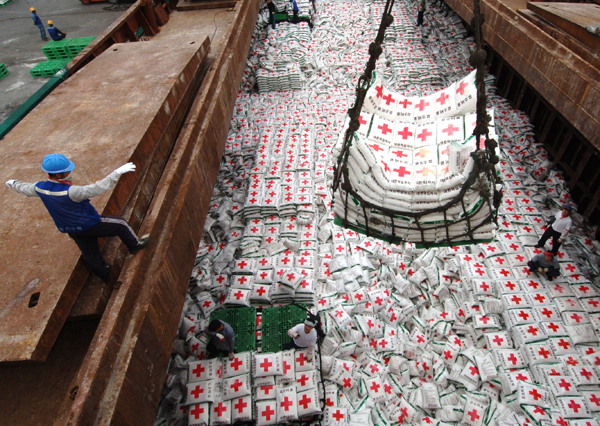
fertilizer aidSouth Korean workers loading fertilizer sacks yesterday at a dock in Ulsan. The ship and another ship from Yeosu, South Jeolla province, will head today to Haeju Port and Nampo Port to transport the last 20,000 tons of 200,000 tons of fertilizers South Korea promised to send to North Korea. Despite North Korea’s missile tests, the South Korean government decided to send the last fertilizers as a humanitrian aid.

Share

Can I have the train also?

Wednesday, July 5th, 2006

This is weird.  (Hat tip to Lost Nomad)

China sends the DPRK food aid via train.  The DPRK keeps the train and sends the crew back across the border  sans-train.

[F]ood and fuel supplies sent to North Korea have been halted, not to force North Korea to stop missile tests or participate in peace talks, but to return the Chinese trains the aid was carried in on. In the last few weeks, the North Koreans have just kept the trains, sending the Chinese crews back across the border. North Korea just ignores Chinese demands that the trains be returned, and insists that the trains are part of the aid program. It’s no secret that North Korean railroad stock is falling apart, after decades of poor maintenance and not much new equipment. Stealing Chinese trains is a typical North Korean solution to the problem. If the North Koreans appear to make no sense, that’s because they don’t. Put simply, when their unworkable economic policies don’t work, the North Koreans just conjure up new, and equally unworkable, plans. The Chinese have tried to talk the North Koreans out of these pointless fantasies, and for their trouble they have their trains stolen. How do you negotiate under these conditions? No one knows. The South Koreans believe that if they just keep the North Korean leaders from doing anything too destructive (especially to South Korea), eventually the tragicomic house of cards up north will just collapse. Not much of a plan, but so far, no one’s come up with anything better.

Share

Kumgang contracts with foreign companies

Wednesday, July 5th, 2006

Kumgang resort goes international
 
Emerson Pacific Group, a Korean company that is now building a golf and spa resort at North Korea’s Mount Kumgang, said yesterday that it had reached an agreement with a British resort operator to co-manage those facilities.

A spokeswoman for Emerson Pacific said that her company would be responsible for development planning for the resort and fund it entirely; the British company, General Hotel Marketing, would oversee the resort’s construction and interior design, operating systems, staff training and global marketing. General Hotel Management operates 16 resorts around the world, including at Langkawi and Bali in Asia.

The agreement gives an international polish to the formerly inter-Korean project to develop tourism at Mount Kumgang, widely acclaimed from antiquity as the Korean Peninsula’s most scenic area.

Ralf W. Ohletz, the executive vice president of General Hotel Management, told the press yesterday that he was convinced that the resort “has the potential to become a global-scale tourist attraction.” He added that the locale ― North Korea ― made the project both challenging and attractive.

Emerson said it would spend about 80 billion won ($85 million) on the resort, which is scheduled to open next year. It is already selling memberships in the golf course there for 17 million won each.

Hyundai Asan, which is the overall operator of the tourism project at Mount Kumgang, said yesterday that the beach there will be open for swimming and picnicking beginning Saturday.

The tour operator also said the Oegeumgang Hotel, on the mountains’ eastern slope, has been remodeled and will be open on July 11. The 11-story building, with 179 rooms, was formerly a retreat for senior North Korean officials. 

Share

Russia to trade DPRK electricity for natural resources

Tuesday, July 4th, 2006

In the old days, the DPRK nurtured its independence by alternating its allegiance between China and Russia, playing the big boys off each other.  Today, China clearly holds more influence in the DPRK in terms of trade and direct political influence.  In fact, China and the DPRK are involved in several hydro-power projects on the Yalu river.  Perhaps energy subsidies are a way for Russia to regain a foothold in the DPRK and protect its direct link to Pyongyang and potential land links to Seoul. 

On an economic note, this kind of behavior is typically called “dumping” in the west and it is not allowed under WTO rules.  But both parties are clearly better off if the deal goes through.  This should tell us something about our Anti-dumping trade rules in the west as well. 

But this is all just silly speculation on my part.  Here is the article from the Joong Ang:

July 04, 2006
KHABAROVSK, Russia ― Russia has been in discussions with North Korea to supply it with surplus electricity, Russian officials at a state-owned electric power company recently told the JoongAng Ilbo. In return, North Korea would provide Russia with natural resources.

“We have been discussing exporting surplus electricity from the far eastern district of the country to North Korea,” Victor Minakov, president of Vostokenergo, the far eastern branch of the United Energy System of Russia, said in an interview last week in Khabarovsk.

“The fastest and most efficient way to resolve North Korea’s electricity problem is to supply electricity from Russia,” Mr. Minakov said.

According to Mr. Minakov, negotiations have been delayed because Russia initially asked North Korea to pay cash for the electricity, and then asked it to cover the expenses for building power transmission lines, neither of which the North could afford.

However, the negotiations resumed after Pyongyang offered to pay for the electricity with natural mineral resources. “Representatives from the Russian energy company will visit Pyongyang at the end of this month for further discussions on detailed matters,” Mr. Minakov said.

The far eastern area of Russia, reportedly has around 300,000 kilowatts of surplus electricity, and the government plans to further improve productivity there by building more power plants. Russia and North Korea has been negotiating on the supply of electricity since 2001.

Russia plans to build a 370-kilometer (229-mile) power transmission line between Vladivostok, Russia, and Chongjin, North Korea, to supply 300,000 to 500,000 kilowatts of electricity. Building power transmission lines and converters would take three years, and cost at least $200 million.

“It costs much less to supply electricity from Russia to North Korea than from South Korea to the North or through the programs of the Korean Peninsula Energy Development Organization,” Pavel Korovko, vice president of Vostokenergo, said on June 27 at a seminar in Khabarovsk.

The Korean Peninsula Energy Development Organization was dissolved recently after failing to build light water reactors in North Korea under the terms of a 1994 agreement between North Korea and the United States.

Share

UNESCO naming world heritage sites in DPRK

Saturday, July 1st, 2006

UNESCO has listed a series of Koguryo burial sites on the world heritage list.

Here is a link to the list approved in 2004 (with coordinates for Google Earth):
http://whc.unesco.org/en/list/1091/multiple=1&unique_number=1269

Here is a list of accepted and “wait-listed” projects:
http://whc.unesco.org/en/statesparties/kp

Here is a nice video of the sites on the UNESCO web page:
mms://stream.unesco.org/culture/nhk/north_korea.wmv

Here is a story in the BBC about North Korea’s additions to the World Heritage List.

Here is another great resource about the history of the move in the Korea Foundation Newsletter.

Apparently the job of overseeing these tombs is in the hands of the Management Bureau for Cultural Property Conservation (MBCPC) in the Korean Cultural Preservation Agency (KCPA)

Share
