Archive for the ‘International Governments’ Category

US might not have a DPRK envoy, but…

Sunday, February 1st, 2009

US slaps sanctions on DPRK companies
According to the Associated Press (Via CBS):

The United States is imposing sanctions on several Chinese, Iranian and North Korean companies for violating arms export regulations governing missile technology and other proliferation activities.

The sanctions are largely symbolic as they bar the companies from trade with the U.S. that they were not likely involved in. Although they were in the works for some time, the Obama team signed off on the sanctions on Jan. 21, a day after it took office, signaling a continuing tough stance from Washington on weapons technology transfers.

U.S. Slaps Sanctions On Overseas Companies
Associated Press (via CBS)
2/2/2009

Here is a link to the text from the US Federal Register
Below is a summary:

SUPPLEMENTARY INFORMATION: Pursuant to Section 73(a)(1) of the Arms Export Control Act (22 U.S.C. 2797b(a)(1)); Section 11B(b)(1) of the Export Administration Act of 1979 (50 U.S.C. app. 2410b(b)(1)), as carried out under Executive Order 13222 of August 17, 2001 (hereinafter cited as the “Export Administration Act of 1979”); and Executive Order 12851 of June 11, 1993; the U.S. Government determined on January 15, 2009 that the following foreign entities had engaged in missile technology proliferation activities that require the imposition of missile sanctions described in Section 73 of the AECA (22 U.S.C. 2797b)  and Section 11B of the EAA (50 U.S.C. Appx 24710b) on these entities:

Korea Mining and Development Corporation (KOMID) (North Korea) and  its sub-units and successors
–Mokong Trading Corporation (North Korea) and its sub-units and successors
–Sino-Ki (North Korea) and its sub-units and successors

And from the Donga Ilbo:

This is the eighth time for the mining company, which has been closely watched by Washington as an exporter of Pyongyang’s ballistic missiles and conventional weapons, to get U.S. sanctions.

The company was slapped with sanctions in 1992, 1998, 2000, 2003, January and August in 2007, and August last year.

Ex-IRA figure faces US counterfeiting charge
According to the Associated Press:

Irish police arrested former Workers Party leader Sean Garland, 74, outside the entrance of the fringe party’s Dublin headquarters — more than three years after he jumped bail in the neighboring British territory of Northern Ireland while facing a similar U.S. extradition warrant there.

Garland had been living openly in the Republic of Ireland — which typically refuses to extradite citizens to face criminal charges outside the European Union — since he left Belfast and abandoned a bail of 30,000 British pounds (about $53,000 at the time) following his October 2005 arrest.

U.S. authorities that year indicted Garland with receiving, smuggling and laundering millions in “superdollars” — so called because of their expert design — that the government of North Korea allegedly began distributing in the late 1980s to weaken the American currency. If extradited and convicted, Garland could face up to five years in prison and a $250,000 fine.

Only one of the past two-dozen extradition requests from the U.S. Justice Department has been approved by Irish judges, who generally oppose extradition, citing America’s harsher sentences and penal system.

Under [Garland’s] leadership, the Workers Party appealed in 1986 to the Communist Party of the Soviet Union for funds. According to the 2005 U.S. indictment, Russian officials encouraged Garland and other Official IRA activists to take counterfeit U.S. $100 bills produced by North Korea.

Read the full story here:
Ex-IRA figure faces US counterfeiting charge
Associated Press
Shawn Pogatchnik
1/30/2009

NK Defectors’ Groups to Get US Gov’t Aid
According to the Korea Times:

The U.S. Department of State will directly provide groups organized by North Korean defectors here with financial support for the first time, according to reports Sunday.

Thus far, Washington has funded local groups working for improvement of North Korean human rights via the National Endowment for Democracy (NED), a private organization supporting freedom around the world.

The move was construed as part of increased U.S. efforts to shed light on humanitarian issues in the Stalinist state.

The State Department posted a notice on the Human Rights Democracy Fund (HRDF) last September and about 50 organizations reportedly applied for the program.

Among the beneficiaries, Free North Korea Radio and the Coalition for North Korean Women’s Rights were granted $500,000 and $300,000, respectively.

The groups will receive a certain amount of money every month for two to three years in accordance with their performance.

Kang Su-jin, founder and representative of the coalition, said she thinks that the U.S. department aims at nurturing North Korean defectors as future leaders through the direct funding.

An official of the department was quoted as saying on condition of anonymity by Radio Free Asia (RFA) that a total of $3 million has been set aside for the program.

But the official refused to elaborate on grantees, saying the issue was “very sensitive.”

Read the full story here:
NK Defectors’ Groups to Get US Gov’t Aid
Korea Times
Kim Sue-young
2/1/2009

Share

North Korean party delegation visits Britain amid hopes for restart of dialogue

Friday, January 30th, 2009

By Michael Rank

asha_centre.jpg

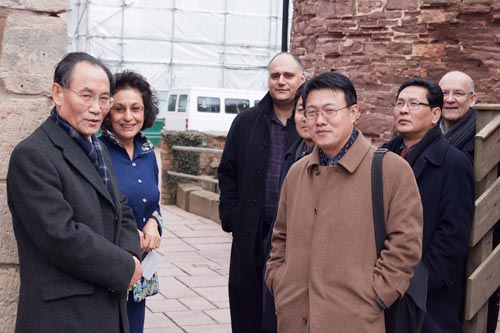
Pictured above on the left: Pak Kyong Son, Vice Department Director of the Korean Workers Party Central Committee.  Pictured on the right: Glyn Ford, Member of the European Parliament.
Photo by Irina kalashnikova, [email protected]
www.irinakalashnikova.com

LONDON – Britain is hosting the first ever delegation from the Workers’ Party of Korea (WPK) amid hopes that this will help to restart a dialogue between Pyongyang and the European Union on human rights, denuclearisation and other issues and lead to transfers of renewable energy technology to North Korea.

Labour Party member of the European Parliament (MEP) Glyn Ford, one of Europe’s top North Korea experts who has visited Pyongyang a dozen times, told NKEW that he was pressing the delegation to agree to reopen the dialogue that was broken off in 2005 after the EU sponsored a resolution at the United Nations in Geneva that was highly critical of North Korea’s human rights record.

He said it was hard to tell whether the four-member delegation would recommend reopening of the dialogue to decision-makers in Pyongyang. “It’s not the style of North Korea to make decisions on the spot,” Ford noted. He said he personally had opposed the resolution, which was supported by the US and Japan, because it was almost certain to result in suspension of the highly sensitive dialogue which had only just begun.

The four-man delegation is visiting Britain for a week and they are also going to Bristol and Cambridge. Ford accompanied the group to Bristol as this west of England city lies in his Euro-parliamentary constituency, and it is close to the possible site of a giant barrage across the river Severn which is currently being considered as a source of generating green electricity.

He said a deal on the nuclear issue and on reviving the human rights dialogue could result in the EU agreeing to provide wind, tidal and other renewable technology to North Korea, just as the EU has provided €500 million ($640 million) in humanitarian aid over the last eight years.

The delegation includes a scientist with a background in renewable energy, added Ford who has an MSc in marine earth science. He said the west coast of Korea has a tidal range of 11 metres (36 feet), which could make it highly suitable for an electricity-generating barrage. The Severn has a tidal range of 14 metres, the second highest in the world.

Tidal barrages are an attractive means of generating electricity because tides, unlike wind, are highly predictable, but the environmental cost of building a barrage over the Severn, up to 10 miles long, could be huge and there is considerable public opposition to the plan. But such factors are likely to loom less large in North Korea.

Ford said he had met three of the four-man delegation on previous visits to Pyongyang, and that he knew two of them fairly well. He is hoping to visit Pyongyang again with a European Socialist delegation at the end of March.

The group have already had a meeting with Foreign Office officials, who Ford said had presumably also pressed the North Koreans on human rights and the nuclear issue.

Apart from the North Korean visit to the UK, Britain’s Lord Alton, a veteran campaigner for human rights in North Korea, is due to visit Pyongyang early next month. Alton, a devout Catholic, is scheduled  to meet the chairman of Korean Religion Association and visit the Russian Orthodox church and the Jangchung Catholic church in Pyongyang. He will be one of the first Western visitors to the Russian Orthodox church, which opened in 2006 amid considerable official fanfare.

The WPK delegation’s visit to Britain has received little if any media attention so far. In fact hardly anyone would have known about it if the generally extraordinarily uninformative North Korean news agency KCNA had not announced on January 27 that “A delegation of the Workers’ Party of Korea led by Pak Kyong Son, vice department director of its Central Committee, left here today to visit the UK.”

Share

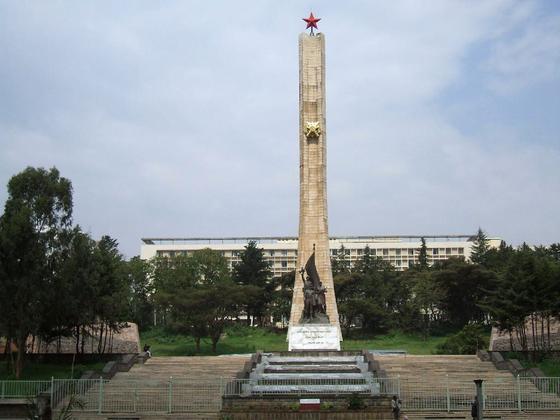
DPRK relic in Ethiopia

Thursday, January 29th, 2009

dergmonument.jpg

The Dialachin Monument (a.k.a. Victory Monument, Derg Monument) was a gift from Pyongyang to Addis Ababa’s Derg regime in the 1970s.

You can see the location of the monument in Wikimapia here.

You can learn more about the Derg here.

See more photos of the monument here.

*This location will be added to the next version of North Korea Uncovered (North Korea Google Earth).  If readers are aware of other construction projects the DPRK has supported, please let me know.  I am especially interested in locating the North Korean restaurants in China, Thailand, Cambodia, Vietnam, and Bangladesh.  Are there others?

Share

CFR: US must prepare for potential instability in DPRK

Wednesday, January 28th, 2009

Council on Foreign Relations
1/28/2009

Download report here (PDF)

Continuing uncertainties about the health of North Korean leader Kim Jong-Il and possible succession arrangements “warrant heightened attention and preparation” by U.S. policymakers, says a new Council on Foreign Relations report. “The risks are too great and the stakes too high” for U.S. policymakers “to rely on last-minute improvisation for a peaceful and stable outcome” in nuclear-armed North Korea, says the report sponsored by CFR’s Center for Preventive Action (CPA).

In preparing for sudden change, the report recommends that the United States “continue to promote behavioral change within the current regime rather than actively seek to overthrow it unless extreme circumstances dictate otherwise.” But it cautions that: “The United States should not support efforts to prop up the current regime beyond the point at which it has clearly ceased to govern effectively.”

The report also warns against “high-handed U.S. action,” advocating that the United States “defer to South Korean wishes and leadership in the management of change in North Korea,” except if “overriding national interests compel unilateral action.” The report was coauthored by CPA Director Paul B. Stares and Joel S. Wit of the Weatherhead East Asia Institute at Columbia University.

The report also stresses that the potential political, economic, security, and humanitarian challenges presented by instability in the Korean Peninsula as a result of sudden change demand U.S. cooperation with the region’s principal powers. “Failure to accommodate [these powers’] national interests… could have profoundly negative consequences for the evolution of Korea, the stability of northeast Asia, and U.S. relations with major allies and other countries in the region,” says the report.

The report, titled Preparing for Sudden Change in North Korea, examines three potential succession scenarios, each of which poses its own set of challenges to U.S. policymakers:

1) Managed succession: the current regime, which has ruled North Korea since 1948, maintains power but under new leadership.

2) Contested succession: different factions vie for power in Pyongyang, resulting in regime change and a new policy direction. “How a power struggle would play out and who the eventual winner or winners might be is obviously impossible to predict, but a prolonged, divisive, and potentially even violent succession struggle is not out of the question,” says the report.

3) Failed succession: changes in North Korean leadership produce no clear and effective national leader, fatally weakening the state’s ability to function and leading to its eventual demise. In this scenario, North Korea’s “rapid absorption by South Korea is widely viewed as the inevitable next step.”

Regardless of how succession transpires, the report offers specific policy recommendations on how the United States can improve its ability to manage sudden change in the peninsula. These include:

1. Enhancing U.S. readiness: “The United States should upgrade its ability to discern and comprehend domestic political, economic, and other developments in North Korea.” For example, the report recommends enhancing U.S. intelligence to take advantage of a variety of new sources of information; establishing broader contacts with Pyongyang during ongoing denuclearization negotiations; and reestablishing the working relationship between the U.S. and North Korean militaries to recover the remains of American soldiers missing or killed in action during the Korean War.

2. Promoting allied coordination and preparedness: “The United States should work closely with South Korea and Japan to improve allied coordination and preparedness for contingencies in North Korea… The current joint military planning between the United States and South Korea needs to be augmented with a coordinated political, diplomatic, economic, and legal strategy to tackle the core issues likely to arise.”

3. Fostering regional transparency and capacity-building: “To reduce the risk of misunderstanding and friction in a crisis involving North Korea, the United States should pursue a quiet dialogue with the People’s Republic of China to discuss issues of mutual concern… The aim of such talks would be not only to raise potential concerns and discuss possible responses but also to minimize misunderstandings that might arise and seriously exacerbate a crisis.” The United States also should open discussions with South Korea and Japan, UN agencies, European counterparts, and nongovernmental organizations.

4. The report concludes: “Improving contingency planning, sharing the results of this planning, improving consultation on the future of the Korean peninsula, and taking concrete steps to build up generic, potentially useful capabilities—though certainly not sufficient in and of themselves to cope with these challenges—will establish a much firmer foundation for the future.”

The report is coauthored by Paul B. Stares, the General John W. Vessey Senior Fellow for Conflict Prevention and Director of the Center for Preventive Action at the Council on Foreign Relations, and Joel S. Wit, Adjunct Senior Research Fellow at the Weatherhead East Asia Institute, Columbia University, and a Visiting Fellow at the U.S.-Korea Institute at the Paul H. Nitze School of Advanced International Studies (SAIS) at Johns Hopkins University.

Download report here (PDF)

UPDATE: Information from the Korea Times:

South Korea and the United States should maintain about 460,000 troops to deal with any unusual situation on the Korean Peninsula that results from internal instability in North Korea, says a new report published by a private U.S. foreign policy organization Wednesday.

The figure represents a three-fold increase in the number of U.S. troops currently deployed to Iraq.

The authors believe Pyongyang possesses six to eight nuclear weapons as well as several ballistic missiles and 4,000 tons of chemical weapons. China might also try to secure the North’s WMDs in the case of an emergency, they forecast.

The South Korea-U.S. Combined Forces Command drew up a conceptual action plan to respond to sudden changes in North Korea, codenamed CONPLAN 5029, in 1999.

The plan includes outlines for joint military responses by South Korean and U.S. troops to various levels of internal turmoil in North Korea, according to sources.

Contingencies include a mass inflow of North Korean refugees, a civil war provoked by a revolt or coup, South Korean hostages being held in the North, and natural disasters such as earthquakes and floods.

The plan also includes measures to prevent Pyongyang’s weapons of mass destruction from being smuggled out of the country, if the regime was involved in a domestic crisis or suddenly collapses.

In 2005, the Roh Moo-hyun administration, which pursued a policy of greater independence from the United States, rejected a U.S. proposal to develop the conceptual plan to an operational plan involving more specific scenarios.

Read the full article here:
‘460,000 Troops Needed to Stabilize NK Collapse’
Korea Times
Jung Sung-ki
1/28/2009

Share

The evolving clandestine leaflet market

Wednesday, January 28th, 2009

UPDATE 3: February 26, 2009. According to Yonhap:

Prosecutors on Thursday questioned two activists who brought in North Korean bills for their leaflet campaign criticizing North Korea, allegedly in violation of South Korean law.

The South Korean government has not restricted the controversial leaflet campaign, which criticizes North Korean leader Kim Jong-il as “the most vicious dictator and murderer,” saying there was no law to stop it.

But the Unification Ministry requested a probe for the first time last week, after the activists attached North Korean banknotes to their flyers to encourage North Korean citizens to pick them up. 

Bringing North Korean money into South Korea is permitted only for trade purposes or for personal possession. Violations can result in up to three years in jail or 10 million won (US$6,562) in fines, according to the law on inter-Korean exchange and cooperation.

A North Korean defector, Park Sang-hak, and Choi Sung-yong whose fisherman father is allegedly being held in North Korea, flew scores of North Korean banknotes attached to some 20,000 propaganda leaflets toward North Korea via gas-filled balloons on Feb. 16, Kim’s birthday. Most of the flyers never reached the North, however, because of unfavorable winds.

Prosecutors said they questioned the activists about how the North Korean money was brought in. Other details were not available.

“They asked us how we acquired the North Korean bills and how much we have,” Park said. 

UPDATE 2: February 16, 2009.  Kim Jong Il’s official birthday.  The activists called Seoul’s bluff and sent the flyers across the DMZ with DPRK won in tow.  Nothing has happened. Pyongyang has not yet complained in the press (as of 2/24). 

UPDATE: South Korean government declares the use of DPRK won by groups is illegal:

“It is against the law for civic groups to bring in North Korean currency [into the ROK] without Unification Minister authorization and enclose it in leaflets,” ministry spokesman Kim Ho-nyeon said at a news briefing.

“It is the related ministries’ position that such a request for authorization, if it comes, is likely to harm the order of South-North cooperation and thus will not be granted.”

In other words: “You need permission to do this and we will not give it to you.” But according to Yonhap:

Defying the announcement, organizations of North Korean defectors and families of abducted South Koreans vowed to go ahead with a plan to fly a fresh batch of propaganda leaflets across the heavily fortified border in February. They said the new leaflets will be flown with North Korean bills attached to encourage people to pick them up.

If they go through with this plan, the stage will be set for what I assume will be a well-publicized showdown between the police and North Korean defector groups.

ORIGINAL POST:
South Korea-based human rights groups garnered headlines last year by sending hundreds of thousands of leaflets about Kim Jong il’s lifestyle into the DPRK attached to balloons.  (A copy of the leaflet and a rough English explication can be found here).  Not only did these leaflets promt repeated public complaints from Pyongyang, but they were also blamed for the North’s unilateral “renegotiation” of inter-Korean cooperation projects in Kaesong—which reduced cross border civilian traffic to 880—about 20% of the 4,200 licensed to enter the Kaesong Complex.  Of course closing down these projects was also a goal of the human rights groups, so in the end Pyongyang delivered its most vocal critics a double victory: South Korean subsidies to the North via Kaesong have been drastically curtailed and the balloons, which were temporarily suspended, have resumed. 

As an aside, there is evidence that the Kaesong projects were curtailed for other reasons, most notably internal political concerns and/or the politics of North-South relations.  No matter the true cause(s), Pyongyang publicly blamed the leaflets.

Although Pyongyang has discovered it had little political leverage over the supply side of the leaflet market, it retains significant leverage over the demand side.   Quoting from Yonhap:

North Korea is arresting citizens who possess U.S. one dollar bills as a way to crack down on packages of anti-Pyongyang propaganda leaflets sent by South Korean activists that include the currency, an activist here said Wednesday.

The North’s spy agency, the State Security Agency, issued the directive in early November to stop citizens from collecting the leaflets that criticize leader Kim Jong-il and his communist regime, said Park Sang-hak, a North Korean defector and leader of Fighters For Free North Korea in Seoul. 

So now we move to round three.  How will the human rights groups respond?

South Korean activist groups will attach N. Korean currency to anti-Pyongyang leaflets sent into North Korea, replacing US$1 bills, following rumors that citizens found with the notes are punished, an activist said Thursday.

Seoul’s National Intelligence Service confirmed that North Korean authorities arrest and interrogate those who possess U.S. dollars that allegedly came with the leaflets from South Korea. But the spy agency declined to comment on what kind of punishment they face.

To prevent further arrests, Park Sang-hak, a North Korean defector and head of Fighters for Free North Korea in Seoul, said his organization and another activist group will send 5,000 won North Korean notes — the highest denomination in the country — when they fly a fresh batch of balloons into North Korea next month.

The amount is just enough to purchase about 2kg of rice, officials and aid workers say, and is a little more than the average monthly salary for urban workers. A North Korean household needs at least 20,000 won a month to survive, they added.

This is an interesting move as it increases the demand for leaflets in the DPRK in two important ways.  The first, is that low-level workers and cadres will find it much easier to possess and spend DPRK won (compared to $US), particularly in the southern provinces.  Secondly, the DPRK-US$ exchange rate is about W3,000/$1, so the switch represents a 66% increase in purchasing power per collected note! 

Of course this raises the question of where they will get the DPRK won:

Park refused to elaborate on how he acquired the North Korean bills, except to say that they passed through China’s border region with North Korea.

South Koreans can bring North Korean money into the country only for trade purposes and must first receive government approval to do so. Failure to abide by these restrictions can result in three years in jail or a 20 million won (US$15,198) fine. The ministry is reviewing whether the activists’ possession of North Korean bills was legitimate.

But other than creating routine problems for North Korean state security, I am not sure what specific results human rights groups seek from these activities.  North Korea’s information blockade cracked over a decade ago—even in the southern provinces where the balloons drift.  Although people in these areas might possess little positive information about the outside world, they probably have a general sense that the state of global affairs is not as their leaders portray.  So, breaking the information blockade is a necessary but not sufficient condition for social change in the DPRK.  

Unfortunately, the information on the leaflets is predominately non-actionable.  Rather than condemning Kim Jong il’s lifestyle, the leaflets should provide instructions on accessing foreign radio and television broadcasts, tactics for clandestine organization, case studies in successful defection, business and smuggling opportunities, local prices, and even mundane news like sports scores, movie reviews, etc.  This would likely be much more valuable to the North Koreans than political propaganda. 

This is an interesting tactic, however, and I look forward to seeing what the next moves will be from players in both the North and South.

Read the full articles here:
N. Korea arresting carriers of $1 bills to stop anti-Pyongyang leaflets: activist
Yonhap
Kim Hyun
1/7/2009

Activists to send N. Korean currency with anti-Pyongyang leaflets
Yonhap
Kim Hyun
1/8/2009

North Korea cash sent with leaflets illegal: Seoul
Reuters
Jack Kim
1/27/2009

Seoul bars activists from bringing in N. Korean currency
Yonhap
1/28/2009

Share

UNDP to return to DPRK

Monday, January 26th, 2009

UPDATE (h/t Mike):
According to this UNDP board meeting in September 2008 (p.13):

84. The President of the Executive Board chaired an informal consultation on the Democratic People’s Republic of Korea. He invited statements by the Associate Administrator and by the Assistant Administrator and Director, Regional Bureau for Asia and the Pacific, UNDP.

85. The Regional Director presented a proposed ‘road map’ for the possible resumption of UNDP activities in the Democratic People’s Republic of Korea. He detailed a proposed five-step process to be completed by early 2009, including: first, dialogue with Member States on the best way forward; second, technical discussions with the Democratic People’s Republic of Korea on human resources, finance and programmatic issues, which would build on preliminary discussions on the recommendations emerging from the independent investigative review (the Nemeth report), as well as the report of the external Board of Auditors and relevant Board decisions; third, the dispatch of a technical team to Pyongyang, following Board endorsement of the road map, to reach agreement on the modalities and content of the UNDP programme; fourth, following the successful completion of detailed discussions, submission to the Board for approval of a package of measures and a country programme to facilitate resumption of UNDP activities; and fifth, subject to approval by the Board, mobilization and recruitment of staff and establishment of physical facilities to initiate programme activities. 

86. Delegations expressed support for the resumption of UNDP activities as proposed. Some suggested that three extensive reviews had failed to confirm the initial allegations of wrongdoing, and one delegation asserted that the cessation of activities without the approval of the Executive Board had been inappropriate. While acknowledging that the reviews had revealed grounds for improvement in accountability and oversight throughout the organization, several delegations urged the Board to weigh the human development needs of the local population against the severity of those shortcomings. Most recognized the proposed road map as a viable means of moving from discussion to action, while others expressed support for further consultations on implementation of the ‘road map’.

87. Delegations encouraged UNDP to heed the findings and recommendations that had emerged from the investigations. Many urged the Board to bring the matter to a prompt resolution.

88. One delegation put forth a list of procedural questions regarding the overall management of the process of suspending, discussing and possibly resuming activities in the Democratic People’s Republic of Korea.

89. The President recommended that UNDP proceed with the agreed ‘road map’. The Board approved the inclusion of the Democratic People’s Republic of Korea under the country programmes agenda item in the tentative work plan for the first regular session 2009. 

I am not sure about the specifics in the above mentioned “road map.”  Here are a couple of strategy documents from the recent past: September 2006, Summer 2008.

ORIGINAL POST:
According to Reuters:

The U.N. Development Program’s executive board “authorizes the resumption of program activities” in the reclusive and impoverished communist state, said a board document dated Thursday and obtained by Reuters.

The decision came after an external review last year cleared the agency of major financial wrongdoing, although it found fault with some practices.

The report said programs that UNDP would resume included rural energy development, wind power promotion, seed production and reduction of post-harvest losses in North Korea, which has suffered from flooding and famine in recent years.

The executive board also authorized the head of UNDP to approve other projects on a case-by-case basis. UNDP officials said it would take some months for the agency to resume operations in North Korea and gave no exact date.

So why did the UNDP leave the DPRK in the first place?  That is a long story…but here are links to three previous posts on the topic:

1. Here is a link to a previous post on the US Senate investigation of the UNDP’s activities in the DPRK.

2. Here is a link to the UNDP’s response to the US Senate report.

3. Here is a link to a post on the UN’s Nemeth Report which exonerated the UNDP.

How did US concerns influence the management strategy of the UNDP’s DPRK portfolio?

The UNDP report approved by the board this week said recruitment of local staff in North Korea would in future take place “on a competitive basis” and not depend on appointments by Pyongyang. Such staff would be paid directly and not through the government.

The report made clear, however, that the North Korean government would continue to have a role in finding local recruits, although UNDP would make the final decision. Agency officials said the proportion of international staff would be higher than before.

The report said under an agreement with Pyongyang, UNDP payments to the government and to local staff and vendors would be made in a convertible version of the national currency.

UNDP would bank with the state-run Korea Foreign Trade Bank, but this would have to meet the agency’s global standards for the services it provided.

When the agency’s board considered a possible return to North Korea at a previous meeting last year, diplomats said U.S. and some other representatives had expressed continuing concerns about UNDP management failures.

While the new report appeared aimed at allaying those concerns, the board’s approval, which officials said was unanimous, came just after the inauguration of the Obama administration, widely expected to have warmer ties with the world body. UNDP officials said that was coincidental.

If a reader out there has a copy of the minutes or a board report from UNDP Executive Board meeting please forward it/them to me. 

Read the more here:
Summary of UNDP activity in the DPRK from the UNDP web page

Censured U.N. agency to return to North Korea: officials
Reuters
Patrick Worsnip
1/23/2009

Share

Sinuiju SAR: Take 4

Friday, January 23rd, 2009

sinuiju2.JPGOn September 20, 2002, the DPRK’s Supreme People’s Assembly announced the creation of the Sinuiju Special Administrative Region (SAR) (KCNA announcement here).

The project was to be headed by a Chinese-born, naturalized Dutch citizen, Yang Bin…who was arrested by Chinese authorities shortly after the Sinuiju SAR was announced.  Western analysts interpreted this move as a signal that China was not supportive of either the project or the selection of Mr. Bin as its chief executive.  Needless to say the future of the project lay in doubt.

However, according to a Yonhap report (here), as of March 2007 the North Koreans still seemed interested in launching some kind of SAR/SEZ in Sinuiju, though the location had been moved from the city proper to two islands in the Yalu River, Bidan and Wihwa.

In August 2007, IFES and the Choson Ilbo reported that preparations were already underway in Sinuiju to convert the city center into a SAR/SEZ.  However, after this initial media hit, most of the news coming out of Sinuiju was related to Jang Song Taek’s 2008 anti-corruption campaign which brought most of the trading companies along the Chinese border back under the control of the Ministry of Finance.

This week, Japan’s Yomuri reports from Shenyang, China, that the Sinuiju SAR is still on and will be located on Wihwa Island:

“The zone will only cover Wi Hwa Island, which will be much easier to control, and only Chinese will be allowed to freely visit,” one of the sources said. “The plan solely aims at expanding trade with China. North Korea isn’t planning any measures that would involve a dramatic opening up.”

According to Chinese statistics, the total value of trade between China and North Korea from January to October last year was 2.12 billion dollars, up 31.7 percent from a year earlier.

Meanwhile, a diplomatic source said, “The move to beef up border trade with China is also aimed at putting pressure on South Korea.”

(FYI: Use of the phrase “beef up” is a pretty good sign that the diplomatic source was an American.)

I know the story of “The Boy Who Cried Wolf.”  I will remain skeptical about the new SEZ until I see evidence of construction myself.

You can read the full Yomuri article here:
N. Korea plans free trade zone on island
Daily Yomuri
Toru Makinoda
1/23/2009

Share

DPRK looks to sell (un)spent fuel rods

Wednesday, January 21st, 2009

UPDATE:  A reader points out in the comments that the DPRK is in fact looking to sell its remaining UNUSED fuel rods…so I made a fairly substantial mistake here.  My confusion on the subject seems to have come from my reading of the Joong Ang Ilbo‘s coverage, but I take full responsibility for not paying close enough attention to the other stories.

Here is the specific quote: “The North asked us to focus on discussing how to handle the spent fuel rods as much as possible” (Joong Ang Ilbo)

The revised facts:

1. The DPRK has 14,800 fresh fuel rods—equivalent to just over 100 tons of uranium (RIA Novosti)
2. The materials are reportedly worth over US$10 million (Yonhap). 

ORIGINAL POST:
Hwang Joon-gook, a South Korean diplomat in charge of the denuclearization talks with Pyongyang, led a team of South Korean officials and civilian nuclear experts on a fact-finding mission to the DPRK  to decide whether to buy Pyongyang’s spent fuel rods.

The facts:
1. The DPRK has 14,800 spent fuel rods (Joong Ang Ilbo)
2. This is equivalent to just over 100 tons of uranium (RIA Novosti)
3. The materials are reportedly worth over US$10 million (Yonhap). 
4. The rods are apparently up to 15 years old (Yonhap).
5. The US alleges that the DPRK is enriching uranium as well.  Richardson has more information here.

Just last week, Selig Harrson reported that the DPRK told him “it has already weaponized the 30.8 kilograms (67.8 pounds) of plutonium listed in its formal declaration and that the weapons cannot be inspected.” This amount of plutonium could fuel four or five warheads.

According to NTI:

“Even if the D.P.R.K.-U.S. diplomatic relations become normalized, our status as a nuclear-armed state will never change as long as the U.S. nuclear threat to us remains, even to the slightest degree,” said the [DPRK’s] Foreign Ministry, which issued a similar message several days earlier.

For its own reasons, Russia does not consider the DPRK a nuclear power despite the fact that they have detonated a nuclear device—a fact that would raise eyebrows across the DPRK if reported by the local media. In fact, it was the Russians who supplied the DPRK with the Yongbyon reactors in the first place!

In support of Russia’s position, however, Yonhap offers the following:

North Korea detonated its first atomic device in 2006. The relatively small underground test had less than a kiloton in yield, below what is considered a successful nuclear test.

Share

Jeju to offer pig farm to DPRK

Monday, January 19th, 2009

The people of Jeju Island have shipped tangerines to the DPRK for about 10 years.  Now they are offering a pig farm:

According to Yonhap:

South Korea’s Jeju Island will send equipment to build a pig farm in Pyongyang on Friday to raise the island’s local specialty, black pigs, officials said.

Black pigs, or “heuk-doe-ji” in Korean, are native to the semi-tropical island. They are covered in black hair, and the meat is popular for being chewy and rich in nutrients.

Jeju will send farm equipment worth 220 million won (US$159,190), such as pens, feeders, heat lamps and ventilators, later on Friday aboard a ship also carrying tangerines and carrots as part of the island’s annual aid to the North. When the farm is completed, possibly by May, the island will ship 100 black pigs that can farrow.

“We expect this will help provide nutrition for children and the elderly in the North and pass down our breeding expertise. Jeju Island is a clean area free from animal infectious diseases,” Kang Won-myoung, a provincial official handling the pig project, said over the telephone.

The Jeju provincial government set up the “South-North Black Pig Breeding Cooperation Project” with North Korea when a group of Jeju citizens and officials visited Pyongyang in late 2007. The project was suspended for about a year amid frozen inter-Korean relations until North Korea formally requested to start the farming last September, the island officials said.

The “Jeju Black Pig Farm” will be built inside Pyongyang Pig Farm, North Korea’s largest such facility, established in 1972.

A Norwegian company recently tried to invest in a pig farm in the DPRK.  Unfortunately it did not work out.  Read their story here starting on page 86.  

The DPRK is working to increase meat production as part of its 2012 “Kangsong Taeguk” campaign

Read the full story here:
S. Korea’s Jeju Island to build ‘black pig’ farm in Pyongyang
Yonhap
1/16/2009

Share

More from Taiwan

Monday, January 19th, 2009

Although the P.R. of China and the DPRK are supposed to be as close together as “lips and teeth,” we have seen a couple of interesting stories emerging from Taiwan in the last few days.

Case 1: On Jan 8, the Straits Times reported that former Taiwanese president Chen Shui-bian embezzled money intended for the DPRK.

Case 2: Last Friday, the AFP reported that the US Treasury Depratment was moving on a Taiwanese couple who were allegedly facilitating shipping to the DPRK:

The US Treasury moved Friday to freeze the assets of a Taiwanese couple and their companies, linking them to North Korean weapons proliferation.

Alex HT Tsai and his wife Lu-chi Su were accused of providing support to the Korea Mining Development Trading Corporation (KOMID), identified by Washington as a proliferator four years ago, the Treasury said in a statement.

Tsai was last year indicted by Taiwanese authorities for forging shipping invoices and illegally shipping restricted materials to nuclear-armed North Korea, it said.

“He has been involved in shipping items to North Korea that could be used to support North Korea’s advanced weapons program,” the statement said.

The companies controlled by the couple Global Interface Co and its subsidiary Trans Merits Co. were sanctioned by the Treasury action.

“Proliferators depend on access to the international financial and commercial systems to support their dangerous trade,” said Stuart Levey, Treasury under secretary for terrorism and financial intelligence.

“Our action today exposes a North Korean procurement channel, and we urge governments and companies worldwide to cut this channel off entirely,” he said.

Rad the full story here:
US freezes assets of Taiwanese couple and their companies
AFP
1/16/2009

Share