Archive for the ‘International Governments’ Category

Doing Business with North-Korea Seminar

Wednesday, February 18th, 2009

Wednesday 4 March, 14:00 – 17:30
KVK The Hague, Randstadzaal
Koningskade 30, 2596 AA  Den Haag

This event is sponsored by GPI Consultancy (see previous posts here).

Speakers include:

Willem Lobbes, boardmember of the Dutch Korean Tradeclub, Director of Lobbes Insurance Consultants

Representative of the DPRK Embassy in Bern, Switzerland

Egbert Wissink, CEO of NovolinQ BV

Professor Evert Jacobsen, University of Wageningen

Kees van Galen, CEO VNC Asia Travel
 
Paul Tjia, Director of GPI Consultancy

The AGENDA can be found here (PDF).

The REGISTRATION FORM can be downloaded here.

Share

UK parliamentarians visit Pyongyang churches, urge US normalisation

Monday, February 16th, 2009

By Michael Rank
Link to full report by Lord David Alton and Baroness Caroline Cox  at the bottom of this story

changchung.jpg

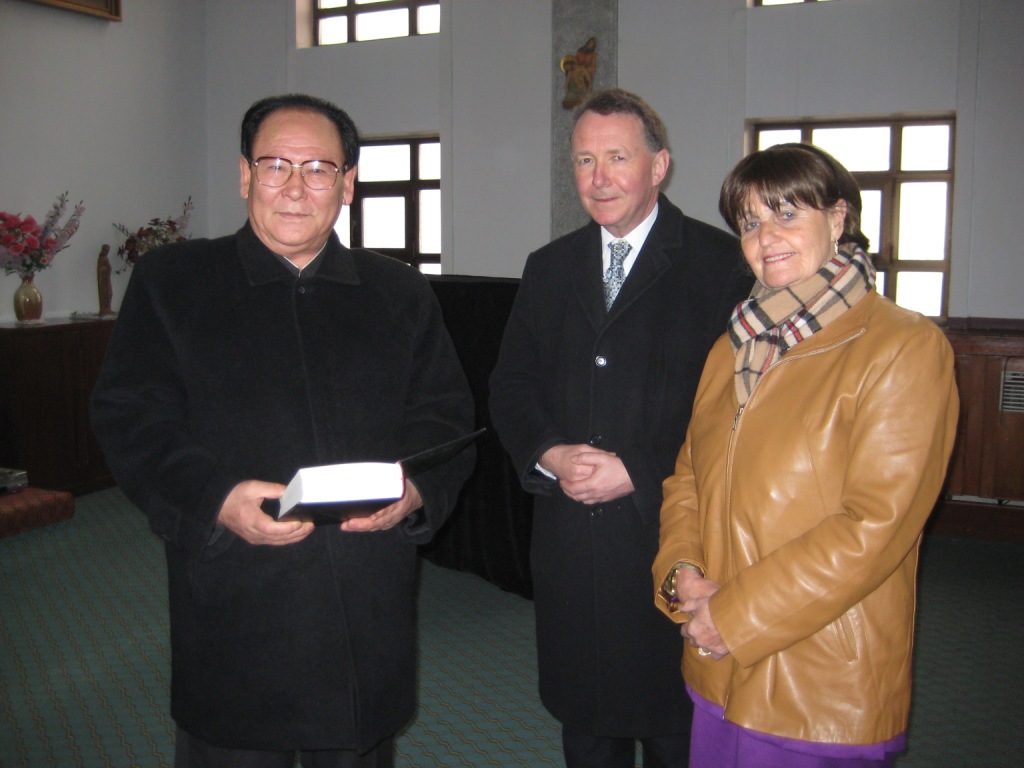
Above: Alton and Cox present a Bible to Jang Che On, chairman of the Korean Consultative Society of Religious Believers
Photo by Mark Rowland
http://mnrowland.blogspot.com/

A British politician who visited North Korea this month to investigate the country’s human rights record and promote dialogue said she had been pleasantly surprised to come across an active Protestant seminary in Pyongyang with about 10 students and a church with a Bible on every pew.

Baroness Caroline Cox, who visited Pyongyang as vice chairman of the All Party Parliamentary Group for North Korea, also urged the United States to end hostilities with North Korea and open an embassy in Pyongyang, just as Britain did 10 years ago.

Cox, a devout Christian, said she was sure the congregation at the Protestant Pongsu church included many genuine worshippers as well as some officials and informers, and that the church was not simply a propaganda showcase for the regime.

She told NKEW that the church was “surprisingly big” and that the attached seminary had been opened with South Korean support and that South Koreans had apparently provided the Bibles. She was told that about 300 people regularly attend Sunday services.

She said she that although “there is a show element in it”, she did not believe the seminary could be written off simply as an empty showcase, as she had to push quite hard to visit it and some officials did not seem aware of its existence.

Cox said Choe Thae Bok, chairman of the Supreme People’s Assembly, repeated an official invitation to the Archbishop of Canterbury, Dr Rowan Williams, to visit the DPRK. Choe met Williams when he visited London in 2004.

Cox and the Parliamentary Group’s chairman, Lord Alton, a fervent Catholic, also visited the recently opened Russian Orthodox church which she described as “extremely beautiful” and where they met two North Korean priests, Fathers Thaddeus and Theodore.  She said the Moscow-trained Father Thaddeus was particularly warm and open, but she added that the congregation appeared to consist entirely of Russian diplomats and business people rather than North Koreans.

The delegation also, somewhat surprisingly perhaps, called for senior North Korean military officials to be invited to visit Sandhurst, Britain’s premier military academy.

Cox said their visit, their second to Pyongyang, was aimed at building “bridges not walls” and that she believed there are “people [in North Korea] who genuinely want to dig themselves out of the hole they have been dug into by the Great Leader.” She and Alton first visited North Korea in 2003.

The two said in a statement that they were were “less than encouraged by our visit to Changchung Catholic Cathedral and our meeting with Mr Jang Jae On, Chairman of the Korean Consultative Society of Religious Believers.

“The delegation expressed their dismay at the continued failure to provide a resident Catholic priest and the lack of progress in normalising relations with the Holy See.

“The delegation emphasised to Mr Jang that if the DPRK wishes to send a positive message about its respect for religious freedom, as enshrined in its Constitution, it would address these two fundamental issues.

“Concerns were also raised about why the importing of Bibles should remain a serious offence, which has been treated in some cases as a capital offence. The delegation gave Korean Bibles to their hosts as a sign of respect and we hope these were received in the spirit in which they were given.”

On the political side, the group’s recommendations include:

1. “a call to the incoming Administration of President Barack Obama to instigate a formal cessation of hostilities and normalisation of relations with the Democratic Peoples republic of North Korea (DPRK). The United Kingdom established a diplomatic mission in the Pyongyang ten years ago; this would be an opportune moment for the United States to do the same.

2. “a recognition of the error of not linking human rights and security concerns in the six-party talks – constructive critical engagement with Pyongyang is recommended: a ‘Helsinki Process with a Korean Face.’

“a call for renewed concerted international pressure to grant access to Professor Vitit Muntarbhorn – the United Nations Special Rapporteur on Human Rights, access to the DPRK. He has estimated that 400,000 people have died in the camps in the last 30 years.

3. “encouragement of the DPRK to allow greater freedom of information for its citizens and access for aid agencies to carry out their work – in particular in the areas of capacity building and health care.

Their principal findings include:

1. deep concerns over human rights, humanitarian and security issues – issues they raised during high level meetings with DPRK government ministers and officials.

2. the consequences of deteriorating relations between North and South Korea which could jeopardise a historic opportunity for progress.

3. observations about political and religious liberties, including some positive developments which were noted and appreciated.

Their full report can be read  at the London/Korea Links web page.

Share

Kaesong goods to find export market in India

Saturday, February 14th, 2009

The South Korean and Indian governments are finalizing a trade concession agreement that will lower Indian import tariffs on some goods produced in the Kaesong Zone. According to India’s Economic Times:

Sounds odd, but some select North Korean goods may soon get special trade concession in India after New Delhi signs a trade pact with South Korea. In fact, the North Korean city of Gaesung will emerge as a major beneficiary as part of the terms and conditions of the India-South Korea comprehensive economic partnership agreement (CEPA), which is likely to be signed soon, sources close to the development told SundayET. The North Korean city is located just 60 km north of Seoul, the capital of South Korea.

Though Indian negotiators initially showed reluctance to such a deal, South Koreans were very keen as many of their companies have invested heavily in the region and set up many factories in that city, using cheap North Korean labourers. Goods produced at Gaesung include low-end engineering products, leather goods, jewellery, chemicals and textiles.

When contacted, commerce secretary GK Pillai confirmed to SundayET that India would extend the same concession to goods produced at Gaesung too. “It’s a matter of 30-40 products which are not very high-end. Those are not cars or steel. Yes, Gaesung is in North Korea, but it’s very much a part of South Korea’s economic co-operation plan. Both the Indian and the Korean (South Korean) governments have agreed to the CEPA, and it should be coming into effect from June or July this year,” he said.

Once the partnership agreement is signed, it will be the first such instance in which India recognises the outward processing concept and gives the same status to goods produced outside the negotiating country with those produced inside. Though Mr Pillai said there was no issue regarding Gaesung, sources close to the development added that India was not very keen on allowing those products.

“India was opposed to the idea as other countries too may demand the same model later. What if a country entering into a trade agreement with India chooses a place in Bangladesh or Pakistan for outward processing,” said a senior government official.

The trade volume between India and North Korea is quite insignificant if it’s compared with that of India-South Korea. During FY08, India’s import from North Korea was worth a mere $161 million, which was 2.6% of that from South Korea. In case of exports, the figures are somewhat better. The total export from India to North Korea was $850 mn in FY08 which was 29% of India’s export to South Korea.

The Bank of Korea, the South’s central bank and most cited source of DPRK economic statistics, estimates North Korea’s gross exports (to all countries except South Korea) in 2006 and 2007 at $950 and $920 (USD in millions) respectively.  They estimate the DPRK’s imports in these years at $2,050 and $2,020 (USD in millions) respectively

According to the data in this article, North Korea’s exports to India ($161 million) are a non-trivial 17.5% of its total exports (assuming the 2007 number is approximately current and changes in inflation and exchange rates are trivial).  The DPRK’s imports from India, $850 million in 2008 (according to the article), are a whopping 42% of North Korea’s estimated 2007 total imports.  Either India is now one of the DPRK’s major trading partners, or there was a short-term spike in DPRK-India trading activity, or these numbers are fishy.

Setting this debate aside, a further question arises—how will these transactions be recorded?  Since the DPRK has a trade relationship with India, will goods from Kaesong be flown/shipped from the DPRK to India and counted as North Korean trade, or will goods be shipped from Kaesong to South Korea and then sent to India—to be counted as South Korean trade? 

My suspicion is that the Kaesong goods will be counted as South Korean merchandise trade since this is a South Korea-India trade deal.  If the goods are recorded as South Korean, agreements of this sort will make it much more difficult in the future to determine the DPRK’s trade volume using mirror statistics.  This is because the country of origin records kept by the DPRK’s trading partners will show goods produced in the Kaesong zone as originating in South Korea.  As a result, the DPRK’s merchandise exports could go underestimated.

Read the full story here:
Ever heard of Gaesung? Gear up for its products
The Economic Times
Shantanu Nandan Sharma
2/15/2009

Share

Teach English in Pyongyang

Saturday, February 14th, 2009

As reported last year, the British Council in Beijing is recruiting English teachers to work in Pyongyang.  According to Yonhap, the number of expats living in Pyongyang to teach English was recently increased from 3 to 4. According to the story:

Last September, North Korea moved up the start year of English education to the third grade from the sixth, Seoul officials said.

“The DPRK government continues to support this program, and we take this as evidence that they give importance to raising the standard of English in DPRK schools and universities,” Bilbow said in an email interview with Yonhap. DPRK is the acronym of the North’s official name, the Democratic People’s Republic of Korea.

With access to native English speakers scarce in the communist state, North Korea asked Britain for assistance after the two countries established diplomatic relations in 2000. The British Council started the teacher trainer program two years later.

British instructors, recruited among those who have a diploma in Teaching English as a Foreign Language with at least three years of work experience, teach a small group of elite university students and local English teachers who will later be deployed to provincial education universities and schools.

Bilbow said the program is now available at three of the top North Korean universities in Pyongyang — Kim Hyong Jik University, the Pyongyang University of Foreign Studies and Kim Il Sung University. About 150 students and in-service teachers are taking the courses at each university, he said.

The program, the only one offered in the North by native English speakers, has the full support of the Pyongyang government, Bilbow said.

In a show of such support, Choe Thae-bok, chairman of the North’s parliament, Supreme People’s Assembly, told a visiting British parliamentary delegation last week that his granddaughter was learning English from British native speakers and asked the delegation to help enlarge the program, according to Radio Free Asia on Tuesday.

“In DPRK, exposure to the wider English language teaching community has been scarce, though the project has done much to bridge the gap,” Bilbow said.

“In time, it will mean improved English language education which in turn will allow DPRK citizens to access the educational resources and opportunities that are available to competent English users worldwide,” he said.

Cho Jeong-ah, an analyst with the state-run Korea Institute for National Unification in Seoul, said the North Korean government closely monitors global educational trends and adjusts its education system. Pyongyang believes English education will help enhance its relations with other countries and boost its economic drive, Cho said.

“North Korean natural resources are limited, and its relations with the United States, which can draw economic assistance, won’t be resolved overnight. North Korea seems to be trying to reach its goal by developing human resources,” Cho said.

Learn more about the British Council’s English education program herePDF here.

Read the full Yonhap story here:
N. Korea welcoming native English teachers with open arms
Yonhap
Kim Hyun
2/13/2009 

Share

Orascom attracting competition

Thursday, February 12th, 2009

According to Telegeography:

Vietnamese military-owned telco Viettel has announced plans to expand its network to North Korea, Cuba and Venezuela, according to reports in local paper Thanh Nien Daily. Tran Phuoc Minh, deputy director of Viettel, said the company is hoping to hold negotiations with the three countries in order to gain a foothold in their still relatively underdeveloped wireless markets. The cellco expanded its network to Cambodia last year, where it signed up 100,000 wireless subscribers after two months of pilot operations, as well as Laos, where it hopes to attract 50,000 subscribers this year. According to TeleGeography’s GlobalComms database, Viettel had a subscriber base of 28 million at end-2008.

Read the full story here:
Viettel plans network expansion to North Korea, Cuba, Venezuela
TeleGeography
2/6/2009

Share

North Korean defectors learn media isn’t always best guide to life in South

Wednesday, February 11th, 2009

Herald Tribune
Lee Su-hyun
2/11/2009

After she defected here from North Korea in 2006, Ahn Mi Ock was shocked to learn that most South Koreans lived in small apartments and had to struggle to buy one.

Ahn, 44, had fully expected that once in the South she would enjoy the same luxurious lifestyle portrayed in the television dramas she had watched on smuggled DVDs. It had not occurred to her that the fashionably dressed characters sipping Champagne in the gardens of stylishly furnished houses were not, well, average South Koreans.

That disappointment aside, she and many other North Korean defectors find themselves plunging into the unaccustomed wealth of South Korea’s entertainment and news media, fascinated by the astonishingly free flow of information and critiques of political leaders, but also searching for tips as to how to navigate this strange new society.

“When I first came here, I was glued to the TV screen every waking moment,” said Ahn, a former art teacher who now works in a restaurant.

Most newly arrived North Koreans spend up to three months at government settlement centers, taking crash courses in capitalism and democracy. They are also taught basic skills like how to use ATMs and home appliances.

But many say they still feel insecure about moving into the real world. With no previous exposure to a free press and 60 years of separation between the South and the North, they sometimes feel they are speaking different languages.

“I was so surprised when I first saw a music video here and didn’t understand a word of a rap song – in Korean,” said Yu Chong Song, 27, who is studying Chinese at Dongkuk University.

That’s where close study of South Korean media comes in.

Recent defectors say that in North Korea, the typical resident might watch half an hour of television news about how Kim Jong Il, the national leader, spent his day. They might spend another hour watching popular dramas, often involving the fate of the nation – assuming the electricity supply allows.

As for newspapers, the 20 former North Koreans interviewed said home delivery was only for the privileged. Those who did have access said the contents were boringly predictable, and that a better use of newsprint was for rolling cigarettes.

But in their first 6 to 12 months in South Korea, they said, they spent at least three hours a day watching television: talk shows, reality shows, quiz shows. (When they first arrived, they had few acquaintances and no jobs, and so had a lot of time on their hands.)

They said they paid closest attention to news and dramas, because they thought these provided the most useful portrayals of South Korean society. The hope was that by using television to study the differences between the two countries before daring to face actual South Koreans, they could reduce the chances of embarrassment.

Kim Heung Kwang, 49, a former computer science teacher who now works in an organization that finds jobs for defectors, said it was only by watching a television movie that he learned that a host should offer his guests a drink.

“Not only must I offer something to drink,” he said, “but ask if they want coffee or tea and whether they want sugar or milk, and then how many spoonfuls.”

Still, there are limits on media study as a learning tool. It is not always clear how much of what they are viewing is truly representative of South Korean life, and how much is fantasy.

“I stopped watching television dramas, because it was getting in the way of my relating to the South Korean people,” said Kim Heung Kwang, who said he still was not sure whether South Korea was a place where mistresses were bold enough to tell their lovers’ wives to get lost.

Ahn, for her part, was concerned about how her 19-year-old daughter might cope with the lust-consumed South Korean men, who apparently devote much of their daily routine seeking unencumbered romance – or so television dramas had led her to believe.

To alleviate their confusion, a Newspaper in Education program to encourage young people to read was introduced a year ago at Setnet High School, an alternative school for North Korean defectors. There, they can ask an instructor to explain concepts they encounter in newspaper pages.

“What is business and sales?” asked Park Jeong Hyang, 18, during a Setnet class.

“Amateur? Is that something to do with sports?” asked Mah Gwang Hyuck, 23.

“Can you explain what marketing is again?” asked Kim Su Ryun, 18.

Especially troublesome are the loan words, mostly derived from English, used in almost every sentence, and South Korean words not used in the North. But perhaps even more difficult to understand is the media’s role in South Korea.

The defectors express shock that the media can point a finger at a head of state. “I don’t know how President Lee Myung Bak can continue running the country after getting so much criticism,” said Cho Eun Hee, 23, a Setnet student.

All those interviewed agreed that freedom to challenge the government is desirable but felt uncomfortable seeing so much of it.

“Television even broadcasts scenes of politicians fighting in the National Assembly. That can’t be good for the image of the country,” Ahn said.

Still, Kim Heung Kwang saw some merits. He was impressed to see his modest apartment complex featured in a television news report about tenants of a nearby prayer house complaining about construction noise. He was familiar with the dispute and felt the reporters were relaying the facts fairly.

Cha Eun Chae, 20, said that in North Korea, there was no way of knowing how the economy was performing, because every story was upbeat: “They would always say, ‘The harvest was good this year.’ But we saw our neighbors starving.”

Over time, as the newcomers learned to read and understand them, the local media became more relevant to their everyday lives. Noticing that self-promotion is important in South Korea, one university student aspiring to a career in business scrutinizes newspaper columns and editorials for hints.

“I want to learn how to articulate my ideas while accommodating others’ opinions,” he said. “And I see that in the way editorials here are written – for example, on the controversy over embryonic cloning.”

Not everyone succeeds in applying media models to interaction with South Koreans.

Kim Keum Hee, 38, who works as a cleaner at a public bathhouse, tried to mimic a hotelier she had seen in a television drama.

“But I just couldn’t do it,” Kim said. “I’m still not used to being friendly when I don’t mean it.”

Share

Remittances to DPRK grow

Tuesday, February 10th, 2009

From the Choson Ilbo:

The number of North Korean refugees who remit money to their families in the North is rising. “Some 15,000 North Korean refugees have settled in the country, and over 6,000 of them are remitting money to North Korea,” a government official said. “We understand the size of the remittances is also growing.” An official with a refugee organization said there must be more than 10,000 who remit money to their families in the North.

If some 6,000 North Korean refugees here send money North, and a refugee remits US$1,000 a year, some $6 million is sent to North Korea per year. To that should be added 20,000-30,000 of the 100,000 North Koreans estimated to live in China.

Remittance routes are clandestine. Money is remitted to a Chinese broker, who contacts another in North Korea, who pays the recipient with his own money and settles the account with the Chinese broker later, leaving no documentary trail.

Currencies are usually American dollars and Chinese yuan. Commissions range between 15 and 20 percent, according to sources. “Remittances through brokers designated by North Koreans generally reach the recipient without a hitch, but Chinese brokers contacted in China are liable to steal the money,” a refugee said. The brokers handle tens of millions of dollars and are linked to organized gangs.

In the past, remittances required enormous bribes. First a man had to be sent to North Korea to bribe guards, with commissions exceeding 40 percent. But with the emergence of remittance brokers and the establishment of an organized system, the amount of money that reaches North Korean families has increased substantially.

The North Korean won is practically worthless in international exchange. A North Korean workers’ average salary was between W2,500 and 3,000 as of the end of 2008. Given that US$1 is traded at W3,200, $1,000 is the equivalent of 100 years’ worth of earnings and buys two apartments in places like Chongjin, North Hamgyeong Province, or Hamhung, South Hamgyeong Province.

In the past, the DPRK has promoted remittances—particularly to Koreans repatriated from Japan and their families.  The DPRK government then extracted its share of these funds by offering western goods for sale in hard currency shops at inflated prices.

The DPRK could do worse at promoting its legitimacy than to adopt the same policy in regards to remittances from every other country.  If the DPRK allowed remittances to flow through official channels, the government could simply extract a service fee equal to or slightly below the black market rate.  That is a win-win (except for the smugglers).

UPDATE: Japanese goods were (are?) historically sold at the Ragwan Deaprtment Store next to the Changwang Hotel (North-West of the Central District).

Another point to consider is the unfortunate role of politics in preventing the adoption of efficiency-enhancing economic reforms.  In the case of remittances, the DPRK would certainly have political problems with letting defectors send money to their relatives back home.  Under this particular constraint smuggling might be the next best option.  Since the operation is clandestine, the government does not have to acknowledge it exists, yet at the same time people can receive their remittancs and (some part of) the governance structure collects “taxes”.  

What “taxes”? The few people who are carrying out the financial transactions will have pay decent protection money to a sponsor high in the food chain.  The work is risky for numerous reasons, but we know some important people are behind it becuase the operation requires managers to keep enough hard currency on hand to cover the monthy/anual remittance payments from 6,000+ defectors. 

Read the full article here:
Refugees’ Remittances to N.Korea ‘Growing’
Choson Ilbo
2/10/2009

Share

The USSR’s market for used lightbulbs

Saturday, February 7th, 2009

Writing in Marginal Revolution, Tyler Cowen points out a rather unique market in the Soviet Union—the market for burned-out light bulbs:

For most of us, it is hard to fathom the rationale for a market in burnt-out light bulbs. But in the scarcity-driven Soviet economy, the market was entirely reasonable. Light bulbs were rarely available to individual consumers, but were obtainable for state-sponsored activities. Thus, it would be difficult to purchase a light bulb for a new lamp in one’s home, while burnt-out bulbs in state-run offices or factories were routinely replaced. So if someone purchased a new lamp and needed a bulb, he would buy a used light bulb for a small fee and replace a functioning bulb at work with the dud. He would then take the functioning bulb home for the new lamp, while the burnt-out bulb at the office/factory would be replaced with a new functioning bulb. Meanwhile, the maintenance person at the office/factory would take the used bulb and sell it on the used light bulb market.

I have no problem believing similar markets exist in the DPRK.  If any readers from current or formerly communist countries have similar stories, please add them in the comments.

Share

Korea Business Consultants Newsletter (1/09)

Wednesday, February 4th, 2009

Korea Business Consultants has published their January newsletter.

Here is a link to the PDF.

Topics covered:
New Year Joint Editorial
Year of DPRK-China friendship
UNDP to resume DPRK operations
Buddhist Leader to Head DPRK’s ROK Affairs
DPRK Railroad Engineers Study in Russia
Housing Construction Progresses Apace
Orascom Opens Bank in Pyongyang
DPRK Tackles Clothing Shortage
“DPRK Harvest Best in Years”
China to Invest in NK Coal
US$ 3.75 Million in Australian Aid for DPRK
The Principles of the DPRK’s Foreign Trade
ROK Farmers Send Rice to DPRK
New SNG Kaesong Plant Idle
“Inter-Korean Trade Slides Due to Weak ROK Won”
ROK to Build Nursery in Kaesong Complex
DPRK Opens Consulate in Dandong
DPRK, China Foreign Officials Meet
Seoul Forum Highlights DPRK Films
“NK Martial Arts Team Best in World”
PUST Opening Delayed
DPRK TV Takes Note of Park Ji-sung
The Korean War

Share

DPRK relic in Zimbabwe

Tuesday, February 3rd, 2009

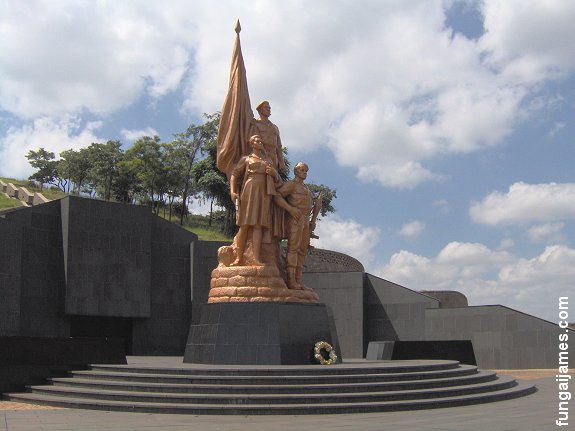
heroes-acre-harare.jpg

National Heroes Acre is a burial ground in Harare, Zimbabwe for all Zimbabweans who have been declared a hero by the Government.

The Government started work on the Heroes Acre in 1981, one year after Independence. The design and artwork used at the site was done by seven artists from the Democratic Peoples Republic of Korea and ten Zimbabwean Artists.

Over 250 local workers were involved in the project at the height of construction. The black granite stone used for the main construction was quarried from Mutoko; a rural area situated about 140km Northeast of Harare. The Heroes Acre is protected under the Natural Resources Act.

See the Site on Wikimapia here

Learn more about the site here.

*This location will be added to the next version of North Korea Uncovered (North Korea Google Earth).  If readers are aware of other construction projects the DPRK has supported, please let me know.  I am especially interested in locating the North Korean restaurants in China, Thailand, Cambodia, Vietnam, and Bangladesh.  Are there others?

Share