Archive for the ‘International Governments’ Category

Malaysian farmers adopt DPRK agriculture technology

Thursday, March 4th, 2010

According to Bernama (Malyasia):

Farmers in Pahang will soon be able to use North Korean technology to commercially grow paddy, after an alliance was formed between North Korea and Syarikat Sungai Duri Plantations Sdn Bhd.

Sungai Duri Plantations managing director Datuk Normala A. Kahar said the technology acquired from North Korea was used countries like China, Uganda, Angola and the Philippines successfully.

Normala said five experts from North Korea who would be involved in a project that covers an area of 263 hectares in Sungai Pelak, Pekan, would conduct a study and research to help soil enrichment and identify pest that can be a problem to the growth of paddy.

She added that an area of 60 hectares in Mambang, Pekan had already been planted with the MR219 type of seeds produced by Mardi and would be ready for harvest in May.

“The results have been very encouraging and we are optimistic that the project will be a success,” she told reporters after sealing an agreement with the North Korean government here on Thursday.

Normala said through the technology, farmers can reap up to seven tonnes of paddy per hectare a season.

Malaysia has an interesting relationship with the DPRK.  I have been told that Malaysia does not require entry visas for North Koreans.  If this is not true, please let me know.  There are also a couple of North Korean restaurants in Kuala Lumpur.  Finally, the Mansudae Overseas Projets Group built the Rice Museum (“Muzium Padi” located here) in northern Malaysia.

Pahang is here.

Share

RoK improving health care in DPRK

Thursday, March 4th, 2010

According to the Associated Press (via the Washington Post):

North Koreans are getting better medical treatment as the result of a joint program between the two Koreas that has trained thousands of doctors, provided modern equipment and renovated hospitals, the World Health Organization said Thursday.

Maternal mortality has declined by over 20 percent since 2005, and diarrhea cases and deaths in operations have also dropped, said Dr. Eric Laroche.

The World Health Organization has helped in the wide-ranging program, which started in 2006 and is funded by South Korea. It has cost a total of $30.2 million so far.

The program has trained more than 6,000 doctors and nurses in emergency obstetric care, newborn care and child illnesses, said Laroche, who assessed its progress in a four-day visit to North Korea.

The specialization marks a change in health strategy in North Korea, which has about 90,000 family doctors who care for about 130 families each, according to Laroche.

“They know each family one by one,” he said. But, he added, “they’re extremely keen to be trained.”

Laroche said hospital staff have been trained in hygiene and clinics have received better material for operations, blood transplants and other medical interventions.

Numerous hospitals have been renovated, and material has also been distributed to 1,200 rural clinics.

Between 2007 and 2009, the number of patients dying in operations fell 73.4 percent, said Laroche, citing a study by the University of Melbourne.

He declined to give an overall view of the health system in the isolated communist nation. But he said services were well-spread among cities and communities.

Read the full article here:
WHO: Korean cooperation boosting health in north
Associated Press (via Washington Post)
Elaine Engler
3/4/2010

Share

Donor fatigue affects DPRK food aid

Thursday, March 4th, 2010

According to the Financial Times:

“The WFP can continue to support around 1.4m children and pregnant women with fortified foods until the end of June. However, new contributions are required now or the operation will come to a standstill in July. We are hopeful that donors will come forward with contributions, given the situation,” he told the Financial Times.

In 2008 the WFP hoped 6.2m people would receive such aid but found it increasingly hard to get donations. Annual aid to North Korea is equivalent to $4.50 (€3.30, £3) per person across the population. The average across other low-income countries is $37 per person.

The WFP has survived such funding crunches in the past, but UN officials fear donors have now become exasperated with North Korea, which expelled US non-governmental organisations last March. Pyongyang has severely restricted aid workers’ access, has demanded they give longer notice periods before rural visits and has barred teams from using their own Korean speakers.

Rocky relations with the US and South Korea after Pyongyang launched a long-range missile last April and tested an atomic warhead in May have further discouraged donations.

The US, once the leading food donor, has said it will not supply cereals until North Korea resumes proper monitoring, allowing aid agencies to track the final recipients.

North Korea’s harvests cannot feed all its people and in recent years the annual food deficit was about 1m tonnes. People are chronically malnourished and as many as 1m are believed to have died during famine in the 1990s.

It is hard to determine the scale of malnutrition but Kim Jong-il, the country’s dictator, made a very rare apology this year for failing to deliver “rice and meat stew” to the people. Food markets were thrown into disarray late last year by a currency redenomination but Mr Due, based in Pyongyang, said these seemed to be returning to normal.

Read the full article below:
Donor fatigue threatens aid for North Korea
Financial Times
Christian Oliver and Anna Fifield
3/3/2010

Share

UN Says N. Korea’s Exposure to Toxic Chemicals Is Result of Isolation

Thursday, March 4th, 2010

Voice of America
3/4/2009

Decades after most countries signed on to global bans of highly toxic chemical agents, North Korea continues to make widespread use of them — putting its people and those of other countries at risk. The North’s self-imposed isolation has kept people there ignorant for decades of the dangers they face.  The United Nations is trying to remedy the problem.

United Nations officials say decades of isolating itself has left North Korea ignorant about some of the world’s most dangerous chemicals — and that it is taking a heavy toll.

Craig Boljkovac manages the chemical and waste program for  the United Nations Institute for Training and Research.

“The environment-related problems that exist in North Korea, I just have to say right now, I think they’re much more serious than in many other countries in the world,” Boljkevac said.

A team of U.N. envoys managed by Boljkovac is in Pyongyang this week, teaching officials about decades-old global chemical bans Pyongyang ignored completely until just a few years ago.  The world body is especially concerned by North Korea’s use of two chemicals, known as DDT and PCBs.

DDT was once a widely used insecticide.  American soldiers even sprinkled it in their helmets to kill head lice during World War Two.  Adverse health effects caused it to be banned in most countries — but not North Korea.

“So today in the world, DDT is only allowed one use, and that’s to kill the mosquito that carries malaria… But turn the clock back 50 years, and you have North Korea,” Boljkevac said. “They use DDT for everything.”

PCBs are a cooling agent, once critical in power grids to help keep electrical circuits from overheating.  Other countries now use much safer chemical alternatives, but Boljkevac says his team has made some unsettling discoveries in the North.

“It looks like there is something on the order of 40,000 metric tons of PCBs in North Korea presently,” Boljkevac said. “And, all you need are a few molecules in your body to cause irreversible harm to your health, or that of your children.”

Boljkevac and his team were not allowed to make a visit to North Korea until 2005.  He was struck by the lack of otherwise common chemical knowledge there.

“The look and the feelings of surprise from the officials that we deal with in North Korea, when they realized how harmful these chemicals were — I witnessed them personally, myself,” Boljkevac said. “They were quite stunned.”

Boljkevac says women are especially vulnerable to the effects of toxic chemicals, because they can be stored in fatty tissue and mother’s milk.   He also says it is also impossible to confine the dangers of toxic chemical use to North Korean territory.

“North Korea’s problem with these chemicals is the world’s problem,” Boljkevac said. “Once they’re used and released into the environment, they travel all over the world.  North Koreans cannot travel outside their country very easily or frequently — these chemicals can, and do, on a daily basis.”

Boljkevac says North Korea is providing his teams with full access and cooperation.   He says his job is made easier by the fact that none of the chemicals he is seeking to eliminate have anything to do with weapons production.

Share

US doctors help DPRK open TB lab

Monday, March 1st, 2010

UPDATE: Some additional informtaion from Paul Costello:

Stanford researcher Sharon Perry PhD, an infectious disease specialist, has been working in North Korea with a team of American health specialists to develop the country’s first diagnostic laboratory to test drug-resistant tuberculosis. The Democratic People’s Republic of Korea, as the hermit country is formally known, witnessed a resurgence of TB in the 1990s after famines plagued the country.

The TB Diagnostics Project is being led by the Bay Area TB Consortium, which Perry directs, and the Nuclear Threat Initiative, a Washington nonprofit group working to strengthen global security. The program came about after a team of North Korean health officials visited California and met with Stanford and Bay Area tuberculosis experts in 2008.

It’s unusual for any outsiders to visit North Korea, but extremely rare for Americans. Safe to say that it’s an unprecedented partnership between U.S. researchers and health officials in North Korea. So far, Perry has ventured there three times and is soon to return for a fourth visit.

I spoke with Perry for a 1:2:1 podcast about her work in North Korea. It’s a candid, revealing interview that pulls back the curtain a bit from this most mysterious nation. I found it fascinating to hear Perry describe the work there and talk about collaborating with officials from the Ministry of Health on this significant health crisis for the nation. The porous nature of geographical borders and the ability of disease to spread easily from one country to another clearly illustrates that we’re one planet and all in this together.

ORIGINAL POST: According to the New York Times:

With help from scientists from Stanford University’s medical school, North Korea has developed its first laboratory capable of detecting drug-resistant tuberculosis, scientists involved in the project said last week.

Tuberculosis surged in the Democratic People’s Republic of Korea during the famines of the 1990s. (Starvation suppresses the immune system, allowing latent infections to grow.) But the country cannot tell which cases are susceptible to which antibiotics, meaning more dangerous strains could push out strains that are easier to kill, as has happened in Russia and Peru.

The project began after John W. Lewis, an expert on Chinese politics at Stanford participating in informal diplomatic talks over North Korea’s nuclear threat, realized how serious a TB problem the country had. In 2008, doctors from North Korea’s health ministry visited experts in the San Francisco Bay area. Last month, a Stanford team began installing the new diagnostics lab at a hospital in the capital, Pyongyang.

The project “represents an unprecedented level of cooperation” between North Korean and American doctors, Professor Lewis said. It is supported by the Nuclear Threat Initiative, a nonprofit global security group led by former Senator Sam Nunn, Democrat of Georgia, and by Christian Friends of Korea, a humanitarian group.

Although it will soon be able to grow and test TB strains, North Korea right now has none of the more expensive antibiotics that attack drug-resistant TB, said Sharon Perry, the epidemiologist leading the Stanford team. Without outside help it will also run out of routine first-line antibiotics by July, she said.

Read the full article here:
Tuberculosis: North Korea Develops TB Laboratory With Help From American Doctors
New York Times
Donald McNeil, Jr.
3/1/2010

Share

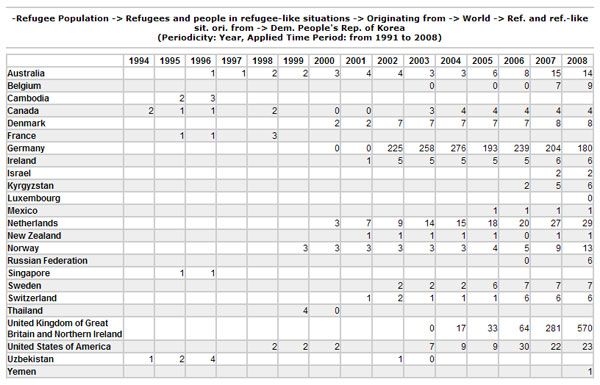
DPRK emigration data

Monday, March 1st, 2010

Josh points out this table from the UNHCR (originally published by RFA):

refugee_table-800.jpg

Click image for larger version.

Share

N.Korea still expects payment for summit

Friday, February 26th, 2010

Choson Ilbo
2/26/2010

North Korea is still demanding rice and fertilizer in return for an inter-Korean summit, even as it keeps sending increasingly urgent messages to Seoul to bring such a summit about.

Since a secret meeting between South Korean Labor Minister Yim Tae-hee and Kim Yang-gon, the director of the North Korean Workers’ Party’s United Front Department, in Singapore in October, “North Korea has kept asking us for a huge amount of economic aid in return for arranging a meeting” between President Lee Myung-bak and North Korean leader Kim Jong-il, a South Korean government source said on Thursday.

But the North seems to have no interest in giving in to South Korean demands to put denuclearization and the repatriation of prisoners of war and abduction victims on the summit agenda. “The North basically wants economic gain in return for letting us make political use of an inter-Korean summit for the upcoming local elections” on June 2, the source said. “It seems that the North still feels nostalgic for the Sunshine Policy,” which netted it huge benefits over the past decade.

The first inter-Korean summit in 2000 was announced only three days before the general election and was bought through a secret payment of billions of won. The second summit in 2007 was announced two months before the presidential election. Since 2000, the North has received more than 300,000 tons of rice and the same amount of fertilizer almost every year worth more than W1 trillion (US$1=W1,163) a year.

In another secret meeting between South Korea’s Unification Ministry and the North Korean Workers’ Party’s United Front Department in November, the North again insisted on specifying humanitarian aid in an agreement to be signed at an inter-Korean summit.

A “tree planting campaign for North Korea” initiated recently by the Presidential Committee on Social Cohesion also reportedly went awry because the North demanded a huge aid of food in return for letting South Korea plant trees there.

Kim Jong-il is apparently not aware that Seoul is serious about ending this cash-for-summits policy. A South Korean government official with experience in inter-Korean talks said, “At secret meetings, each side often had its own way of interpreting agendas. Maybe North Korean delegates who are accustomed to the Sunshine Policy are trying to interpret the current government’s messages the way they did with past governments.”

It seems the North has attempted to earn economic aid worth W1 trillion by prevaricating over the issue of the POWs and abduction victims, offering to handle it like part of reunions of separated families, and discussing the nuclear issue only with the U.S. 

Whether the attitude will change remains to be seen. The North is now in a worse economic situation than before in the wake of a recent disastrous currency reform on top of international sanctions and a severe food shortage.

Prof. Cho Young-ki of Korea University said, “The North is in dire need of support from the outside including South Korea to stabilize the regime for a smooth transition of power” to Kim’s son Jong-un. “It is possible that the North will reluctantly accept our request depending on progress in the six-party nuclear talks.”

The government believes that a dramatic turning point in inter-Korean relations could be reached if the North makes “big decisions” in the nuclear or POW issues, according to Kim Tae-hyo, the presidential secretary for foreign strategies.

Share

South Korea’s trade with the north falls into the red

Thursday, February 25th, 2010

Institute for Far Eastern Studies
NK Brief No. 10-2-25-1
2/25/2010

Inter-Korean trade, in which South Korea recorded surpluses throughout the Kim Dae Jung and Roh Moo Hyun administrations, has now fallen into the red under the current government.

According to customs statistics released on February 25, Seoul ran a trade deficit with North Korea under the Kim Young Sam administration until 1997, then was in the black through the Kim Dae Jung and Roh Moo Hyun administrations, almost until the end of 2007. Seoul has fallen back into the red, however, during the last two years of the current government. In other words, the People’s Government (under Kim Dae Jung) and the Participatory Government (under Roh Moo Hyun) exported more to the North than they imported, while this trend has now been reversed under Lee Myung-bak.

South Korea’s surplus in inter-Korean trade grew 11-fold from 37.9 million USD in 1998 to 417.7 million USD by 2005, then fell to 262.2 million USD in 2007. This trend occurred because exports grew at a much quicker rate than imports, from 128.9 million USD in 1998 to 1.0286 billion USD by 2007. However, as the current administration came into power, inter-Korean trade statistics dropped in to the red, with a 54 million USD deficit in 2008 and a 200.9 million USD deficit last year.

South Korean exports to the North grew considerably from the time of the People’s Government until 2008, but have fallen considerably over the past two years. In 2008, exports to North Korea amounted to 883.4 million USD, down 14.1 percent from the previous year. Last year, exports fell another 17.1 percent, to 732.6 million USD.

Last year, electrical products made up the majority of exports, at 24.8 percent (182 million USD). Following electrical products were short, synthetic ‘staple fiber’ (160 million USD) and cotton fabrics (67 million USD), followed by computers and other electronic devices (60 million USD).

On the other hand, clothing (390 million USD), fish (131 million USD), and electrical goods (122 million USD) were the top three imports. While South Korea is in the red, overall trade continues to grow, despite the international financial difficulties. This growth is driven largely by processing-on-commission manufacturing and products from the Kaesong Industrial Complex.

[NkeconWatch: I have a personal probelm with the way “the media” generally reports trade deficits as if they are somehow equivalent or comparable to budget deficits.  They are not.  Additionally, bilateral comparisons of trade deficits are silly. Bilateral comparisons are usually published by someone seeking to generate some kind of political response, but really they don’t tell you anything about what is going on in the economies of the countries involved.] 

Share

N.Korea received 300,000 tons of food aid in 2009

Wednesday, February 24th, 2010

According to the Choson Ilbo:

North Korea is believed to have been given 300,000 tons of food either on credit or as aid last year, mostly from China, the Unification Ministry told the National Assembly’s Foreign Affairs, Trade and Unification Committee on Tuesday. That is enough to feed the entire population of North Korea for a month.

The UN Food and Agriculture Organization on Monday said North Korea faces a shortage of 1.25 million tons of food, but that did not take into account the amount provided by China and other countries. Unification Ministry Hyun In-taek said, “North Korea has been suffering from problems in food supply and distribution since its currency reform and has been taking measures to deal with the situation.”

Read the full article here:
N.Korea Took 300,000 Tons of Food Aid Last Year
Choson Ilbo
2/24/2010

Share

Chosen Soren schools face image problem

Wednesday, February 24th, 2010

According to Park Ju-Min writing in the Los Angeles Times:

The portraits of North Korean leader Kim Jong Il have been taken down from the classrooms in the run-down Tokyo Chosen No. 2 Elementary School.

But a quick look into the teachers lounge reveals the Dear Leader in all his glory.

The school for ethnic Koreans in Japan, one of about 60 in the country that are funded by North Korea, faces a delicate balancing act as money from the reclusive regime has decreased amid economic turmoil there.

Since the 1950s, the schools have been run by the General Assn. of Korean Residents in Japan, or Chosen Soren, whose Tokyo headquarters acts as North Korea’s unofficial embassy.

At Chosen No. 2, the eight teachers and 54 students face a life of political isolation as they try to preserve their ethnic identity in Japan, a country many people believe is in the sights of North Korea’s nuclear missiles.

Former Principal Song Hyon-jin knows the school spreads what many Japanese consider communist propaganda. Activists have surrounded the school with megaphones shouting for students and teachers to leave the country, threats that increased after North Korea tested a nuclear device last year. A student at another Chosen school was accosted on the subway, her traditional hanbok robe, worn by many North Koreans, ripped by her attacker.

“Even though the Korean community has changed much in the past 20 years, it’s still tough to live as a Korean in Japan,” said Song, a longtime Chosen member.

The schools get no funding from the Japanese government, which doesn’t officially recognize them.

….

Because there are no diplomatic ties between Tokyo and Pyongyang, the ethnic Koreans cannot apply for North Korean passports. They must be content to send their children to Chosen schools.

Since the 1970s, enrollment in the schools has fallen to less than 12,000 from 40,000, and fees have risen dramatically. In an effort to improve the schools’ image, administrators removed portraits of Kim Jong Il and his father, Kim Il Sung, from classrooms. They also added South Korean history to the curriculum, along with Japanese language and history.

Another change was softening the emphasis on North Korean propaganda, relying instead on a more straightforward history. To avoid undue attention, middle and high school students were ordered not to wear traditional Korean school uniforms after class.

“Schools have to be more open and acceptable for non-Chosen Soren affiliates for the sake of their existence,” said Han Young-hae, an associate professor at the Graduate School of International Studies at Seoul National University. “They need to reestablish their historical views and educational direction.”

As a result, the atmosphere here has lightened. South Korea also has begun taking up the financial slack, donating computers.

“I hope to teach here forever,” said Lee Young-sim, a 25-year-old art teacher who is a product of Chosen schools.

Song is heading a fundraising drive to build a new wing at the school, in hopes of stemming the defection of ethnic Koreans to Japanese schools.

“It is difficult to protect the school when many Korean kids are going to Japanese schools,” said Song, whose two children attend Chosen schools. “But I will do my best until the good day comes.”

Read the full article here:
North Korea-funded schools in Japan have an image problem
Los Angeles Times
Park Ju-Min
2/23/2010

Share
