Archive for the ‘International Governments’ Category

DPRK delivers Kasavubu statue to Kinshasa

Friday, August 13th, 2010

UPDATE: Google just updated their satellite imagery over Kinshasa.  Now we can see where the statue is located:

ORIGINAL POST: The DPRK’s Mansudae Overseas Development Group has designed and built many buildings and statues across the Middle East, Africa and Asia.  I have been trying to map out these projects on Google Earth.

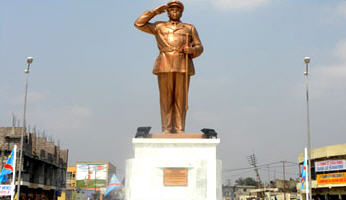
The most recent project appears to be the statue of Joseph Kasavubu in the DR Congo.  June 30th 2010 was the DRC’s 50th independence day and the statue of its first president was unveiled as part of the celebrations:

Here is a story in French about the unveiling of the new statue.

Using Google Translate, I pulled out the following blurbs:

(June 29, 2010) President Joseph Kabila unveiled Tuesday in Kimpwanza Square in the town of Kasavubu, to the cheers of the people, the monument to the first president of the Democratic Republic of Congo, Joseph Kasavubu.

It is a bronze monument of 5 tons, 5.45 meters high.

The story incorrectly notes that the statue was made in South Korea.

I have so far been unable to locate the square where this statue is located.  Help appreciated. A reader called “NKObserver” identifies the location here: 4° 20′ 17.19S 15° 18′ 18.38″E.

Additional information:

1. Here is a set of photos of the statue taken by a visitor.

2. Here is an interesting video clip of a Chinese protest of Kasavubu in 1961 featuring Zhou Enlai.

3. Here are previous posts on the Mansudae Overseas Development Group.  They do not reflect all the projects I have identified, but if you know of any others, please pass the information to me.

Share

Nosotek developing popular software in DPRK

Thursday, August 12th, 2010

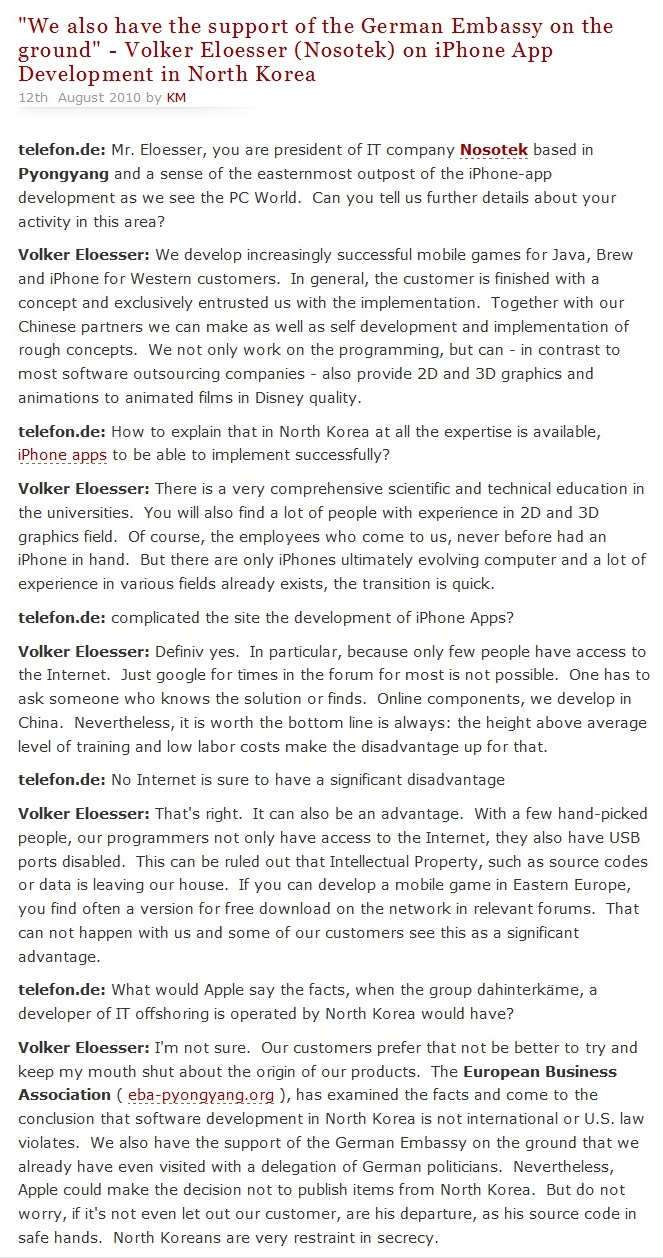
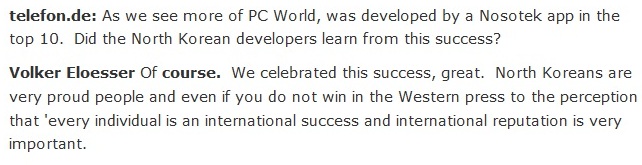
Volker Elosser of Nosotek gives an interview in German here.

Here is a translation of the article by Google Translate:

Click on the images to read the article.  I apologize for using these awkward images, but Google Translate only allowed me to copy/paste the original German.  This was the only fast/easy solution I could come up with.

The article references an article in PC World by Martyn Williams.  You can read this here.

Share

Inter-Korean trade hits record high

Thursday, August 12th, 2010

According to Yonhap:

Inter-Korean trade soared to a record high in the first half of this year despite escalating tensions caused by the sinking of a South Korean naval ship in late March, a government report said Thursday.

Two-way trade jumped 52.4 percent on-year to US$983.2 million in the January-June period, according to report by the Korea Customs Service (KCS). It also represents a six-fold increase from the $161.6 million tallied in the same period in 1999.

Outbound shipments spiked 66 percent on-year to $430.5 million, with imports from the North surging 44 percent to $552.7 million for a deficit of slightly more than $122.2 million.

The report, however, said that with most cross-border exchanges being cut off by Seoul in retaliation for the sinking of the South Korean warship Cheonan, inter-Korean trade is expected to drop about 30 percent on-year in the second half.

A Seoul-led multinational investigation team found the North responsible for the sinking of the 1,200-ton warship that resulted in the deaths of 46 sailors. The North countered that it was in no way in involved.

Only the Kaesong Complex, located just north of the DMZ that separates the two countries, has not been affected by the fallout from the ship sinking. The complex accounts for roughly 70 percent of all inter-Korean trade and is home to 120 South Korean companies that make products with the help of North Korean laborers.

The customs office, meanwhile, said trade between the two Koreas rose from $328.6 million in 1999 to $1.08 billion in 2005 and peaked at $1.82 billion in 2008. Last year, the trade volume fell to $1.66 billion after Pyongyang detonated its second nuclear device.

According to the Choson Ilbo:

In spite of strained inter-Korean relations following the March sinking of the South Korean Navy corvette Cheonan, trade volume between the two Koreas hit a record high in the first half of this year.

According to data from the Korea Customs Service, the total value of exchanged goods reached over US$983 million in the January to June period, up more than 52 percent from $645 million a year ago.

The latest figure tops the previous record of $885 million in 2008, and is six times higher than the $162 million recorded in 1999.

The South’s cross-border exports jumped 66 percent to $435 million, and inbound shipments 44 percent to $553 million.

Amid the ever-changing atmosphere on the Korean Peninsula, inter-governmental efforts to spur North-South trade and the expansion of the joint Kaesong Industrial Complex have fueled a gradual yet continuous growth in trade activity.

The annual trade volume, which amounted to nearly $329 million in 1999, peaked at over $1.8 billion in 2008 before dropping slightly to $1.67 billion in the wake of North Korea’s second nuclear test in 2009.

Experts, however, forecast the trade volume to drop by as much as 30 percent on-year in the second half of this year, reflecting Seoul’s suspension of all trade with Pyongyang, except for operations at the Kaesong Industrial Complex, in response to the sinking of the Cheonan.

Much attention is focused on the future of business at the industrial park, which produces 70 percent of the goods traded between the two sides.

Read the full stories here:
Inter-Korean trade hits record high in H1: report
Yonhap
8/12/2010

Inter-Korean Trade Reaches Record High
Choson Ilbo
8/13/2010

Share

China supporting DPRK border crackdown

Thursday, August 12th, 2010

According to Reuters:

China said Thursday it had offered to help North Korea tackle cross-border crime — two months after North Korean soldiers killed three suspected Chinese smugglers, raising tensions between the allies.

Beijing, Pyongyang’s most important ally and trading partner, said it had handed over military equipment to North Korea’s National Defence Commission during a visit by China’s Deputy Public Security Minister Liu Jing on Sunday.

China said in a statement that it was willing to work with North Korea in cracking down on cross-border crime and building up its law enforcement forces.

The statement gave o details of what type of equipment China had provided or which type of crimes could be targeted.

Read the full story here:
China offers to help N.Korea crack down on crime
Reuters
8/12/2010

Share

Chongryun on YouTube?

Thursday, August 12th, 2010

UPDATE: As noted in the comments and in this post, Uriminzokkiri is run by the North Koreans, not the Chongryun.

ORIGINAL POST:

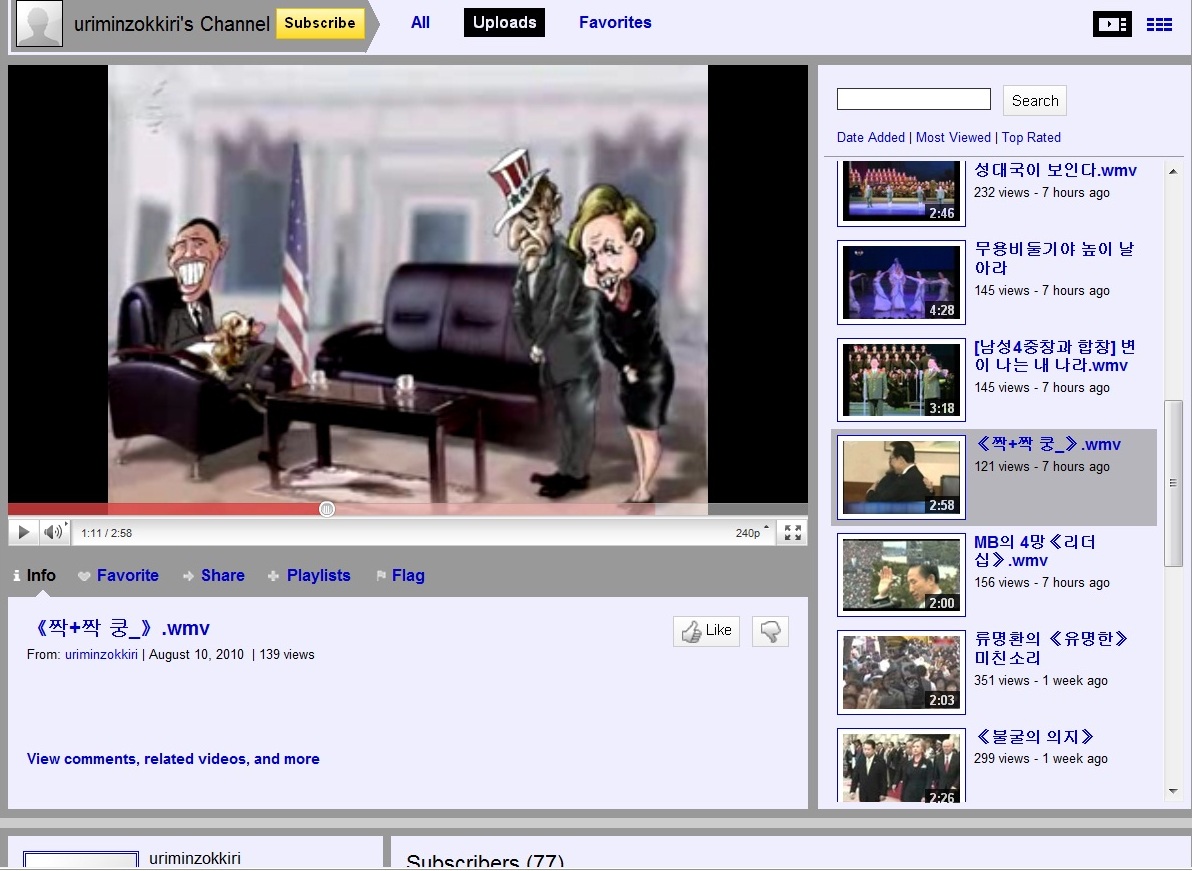
The pro-Pyongyang ethnic Korean community in Japan (Chongryun, Chosen Soren) has apparently opend a YouTube channel named “uriminzokkiri” (“On our own as a nation”) where they are uploading pro-DPRK and DPRK-made videos.

The Chongryun operate a number of web pages on behalf of themselves and the North Korean government (Chongryon.com, Naenara, elufa.net, uriminzokkiri.com, and more) all of which host video content.  So why open a YouTube account?  All these web pages are blocked in South Korea—so I am wondering if South Korean readers see these YouTube videos? 

UPDATE: Gag notes the following in the comments: “The ‘uriminzokkiri’ account is presumably run by the website of the same name, which links to it. The uriminzokkiri.com homepage lists two email addresses on silibank.com, so I doubt that it’s run by the Chongryon either. (elufa.net, which is in Japanese, has an email address on its own domain.)

I wonder also whether it is just a matter of time before the US Justice Department/Treasury Department goes knocking on YouTube’s door.  If this account is sponsored by the official Chonryon organization, the US government might have a problem with that.  I suspect, however, that the account is “maintained” by a “private” individual so that it cannot be construed as engagement in a business trade with the DPRK.  In the past, on line chat services owned by Yahoo and Linkedin have been asked to close accounts of individuals in sanctioned countries like the DPRK.  

As of now, the account hosts nearly 40 videos.  Unfortunatley not a single one is of the North Korean evening news.  The North Korean news is usually posted on Elufa.net, but has not been updated since July 26. Rather than running 10 pages poorly, they might consider consolidating and running 2 pages well!

According to Yonhap:

North Korea has apparently registered an account with the iconic U.S. video-sharing site YouTube, uploading clips that praise the isolated regime and defend itself against accusations that it attacked a South Korean warship.

The name in Korean means “on our own as a nation” and was registered July 14.

The uploaded footage contain regurgitations of official cant that honor the North’s leader, Kim Jong-il, and the usual South Korea bashing. The Aug. 2 upload contained an elaborately produced three-minute clip lashing out at South Korea’s foreign minister.

Another clip, uploaded the same day and also produced in Korean, ridicules Seoul for its failure to stop the U.N. Security Council from placing Pyongyang’s denial in its statement deploring the deadly March sinking of the Cheonan warship.


Share

US teenager to visits DPRK to pitch tree idea

Wednesday, August 11th, 2010

UPDATE 2 (11/22/2010): Apparently the boy has not given up on his dream and is now protesting in China (well for one minute).  Really.  According to the AP:

A 13-year-old American boy campaigning to turn the demilitarized zone between North and South Korea into a peace park tried to get the Chinese president’s attention Monday, staging a brief protest near Tiananmen Square before being led away by police.

Jonathan Lee unfurled a sign saying “peace treaty” and “nuclear free DMZ children’s peace forest” as he stood outside Tiananmen Gate just north of the square in central Beijing.

The scene of numerous demonstrations over the years, the gate and square remain some of the most tightly controlled public spaces in China and all protests on it are quickly snuffed by security agents, sometimes violently. In 1989, tanks and troops rolled into the square to crush a student-led pro-democracy movement, killing at least hundreds of people.

Less than a minute after Lee began his demonstration, a man presumed to be a plainclothes police officer grabbed the boy’s sign and waved away watching journalists, who had been contacted by Lee’s family ahead of time. Three or four uniformed police officers then hurriedly escorted Lee and his mother away without commotion.

Police held the pair and a few hours later Lee and his mother, Melissa Lee, returned to their hotel where they were joined by the boy’s father and sister. The family arrived unaccompanied at Beijing airport Monday evening to catch a Korean Airlines flight to Seoul, but declined to comment to The Associated Press.

The Lees’ treatment by Chinese authorities was relatively mild compared with the often rough handling and swift, forced deportation given to most foreigners who try to stage protests in China. It was not clear if they were forced to leave the country or had already planned to do so.

The boy, from Ridgeland, Mississippi, is trying to persuade the leaders of North and South Korea, China and the United States to work for reunification of the two Koreas.

“Hopefully my picketing will touch them in a way, so they’ll really consider peace, you know, between North and South Korea,” Lee said in an interview Friday with Joel Clark, a documentary filmmaker who traveled to China with the Lees, that was provided to the AP. “I guess I’m just trying to do, you know, what God would want, making peace.”

His Korean-born father, Kyoung Lee, said in a written statement Monday that his son has sent letters to President Barack Obama and South Korean President Lee Myung-Bak but had not been able to give a letter to Chinese President Hu Jintao. That, the father said, made the Tiananmen protest necessary.

Passionate and strong-willed, Lee is the latest, and perhaps youngest, activist to try to bring peace to the heavily militarized Korean peninsula, divided since the 1950-53 Korean War in which both the U.S. and China fought. The U.S. is Seoul’s ally, stationing troops in the well-off nation, while China is the main economic and diplomatic backer of the isolated, impoverished North.

Lee made a rare visit to North Korea in August to propose his idea of a “children’s peace forest” in the demilitarized zone and was taken on a tour of the 2.5-mile (four-kilometer)-wide buffer zone, which is sealed off with electric fences and studded with land mines. A hoped-for meeting with North Korean leader Kim Jong Il did not materialize, although Lee said the officials forwarded to Kim a letter from him.

A U.S. Embassy spokesman declined to comment on the case, saying Lee family members had not signed privacy waivers.

UPDATE 1 (8/19/2010): According ot the AFP:

A US teenager who spent a week in North Korea to promote an idea for a peace forest on the tense Korean border said Thursday his trip had given him “hope” for the future of the peninsula.

Jonathan Lee, a 13-year-old ethnic Korean, said he felt safe and had been treated well during his visit to one of the most secretive states in the world.

Lee said that he headed to Pyongyang with a letter for North Korean leader Kim Jong-Il, proposing the creation of a “children’s peace forest” in the demilitarised zone (DMZ) dividing North and South.

The trip comes amid high cross-border tensions, which grew after South Korea and the United States accused the North in May of torpedoing one of Seoul’s warships with the loss of 46 lives.

“My letter suggesting this (idea) was passed on to Chairman Kim Jong-Il along with my book as a gift to him,” Lee told reporters at Beijing airport, where he stopped for a layover with his parents before flying to Seoul.

“I went to several places but the place that made the biggest impression on me was the DMZ,” said Lee, who hails from the southern US state of Mississippi.

“While at the DMZ, I spoke of my hope of having a children’s peace forest. My suggestion for the motto is ‘Above politics, above conflicts, above borders, above ideology’.”

Lee has sent letters to South Korean President Lee Myung-Bak, US President Barack Obama and China’s President Hu Jintao, explaining his idea for the peace forest of fruit and chestnut trees on the world’s last Cold War frontier.

The surrounding area is heavily fortified with concrete, barbed wire, land mines and soldiers from both North and South Korea.

His visit recalled the efforts of 11-year-old US schoolgirl Samantha Smith, who in 1983 travelled to the Soviet Union at the height of the Cold War, after writing to then leader Yuri Andropov to ask if he planned a nuclear war against the US.

“It’s all about giving hope to the people and children around the world,” said Lee, the founder of a global youth environmental group called I.C.E.Y. H.O.P.E.

“On this trip, I discovered that both sides want reunification, and that Korea is one, so I see hope on the Korean peninsula.”

He told South Korea’s Yonhap news agency that North Korean officials had given a “good” response to his proposal, and that the country’s people were “quite lively”.

The teen also said officials had told his family that progress could be made on his idea only if the United States were to help transform the armistice that ended the 1950-53 Korean War into a full-fledged peace treaty.

North Korea, which has no diplomatic relations with the United States, approved Lee’s trip despite a tense stand-off between the countries over the detention of four American citizens for illegal entry.

Three have been released but but Aijalon Gomes, a 30-year-old former English teacher in Seoul, is still being held in prison there.

Gomes was arrested in January and sentenced to eight years’ hard labour for an illegal border crossing. The North said in July that Gomes had tried to commit suicide and was being treated in hospital.

Lee has previously said his idea was inspired by former South Korean leader Kim Dae-Jung, who died in August last year.

As president from 1998-2003, Kim Dae-Jung held a landmark summit with North Korea’s Kim in 2000 that paved the way for inter-Korean reconciliation and earned him a Nobel peace prize.

ORIGINAL POST (8/11/2010): According to Yonhap:

A teenage American boy says he is traveling to North Korea this week with a letter urging leader Kim Jong-il to allow the creation of a peace forest that would grow over the heavily armed border between the Koreas.

“You may be wondering why a 13-year-old boy wants to go into North Korea, especially right now when there are a lot of problems,” Jonathan Lee, a Korean-American from Mississippi, wrote in his letter.

“Well, I’ve been talking about planting chestnut trees in North Korea for the past three years. The reason I have is because I want to help the environment and help the people at the same time. Now is the right time because many wish for peace right now on the Korean peninsula.”

A youth environmental activist who founded in Mississippi the International Cooperation of Environmental Youth – Helping Our Polluted Earth, Jonathan was first moved to pursue the idea of planting chestnut trees on the Korean Peninsula when he met with former South Korean President Kim Dae-jung three years ago.

“His wish for peace between the two Koreas made an impression on me,” he wrote in his letter, recounting the meeting at a celebration of the anniversary of the two Koreas’ 2000 summit.

“Korea has been divided for 60 years and has been officially at war during this time. The children of these countries have never met or interacted with each other. Personally, I think this is sad,” he said.

Jonathan was scheduled to leave Seoul for China on Tuesday, where he will deliver the same letter to Chinese President Hu Jintao. He has already sent the proposal to South Korean President Lee Myung-bak and U.S. President Barack Obama.

Jonathan’s eight-day trip to the communist nation will start Thursday and will include a meeting with a North Korean government official, his father, Kyoung Lee, says. He declined to elaborate.

Kyoung Lee believes that safety for his son and his family was guaranteed because their visit was made possible through the North’s U.N. representative in New York.

The family says that they also requested a meeting between Jonathan and the 68-year-old North Korean leader, Kim Jong-il. But the North has only mentioned the possibility of a meeting with a “senior” official.

If Jonathan’s wish to plant a forest of chestnut trees in Panmunjom, along the border between the two Koreas, did come true, it would be a stark contrast to the surrounding area heavily fortified with barbed wire and military personnel, he believes.

Panmunjom, the village where the truce that ended the 1950-53 Korean War was signed, lies within the Demilitarized Zone, a four-kilometer-wide swath of land bisecting the peninsula.

Jonathan says his chestnut trees would “not only help the environment, but would also provide food for the North Koreans.” The North has been suffering from decades of food shortages and deforestation — a consequence of people cutting down trees to plant crops for their survival.

“Above politics; Above conflicts; Above borders; Above ideology; It’s all about giving hope to people and children around the world,” Jonanthan says, referring to his motto for the forest.

“This is the most important part of the letter that Jonathan would like to emphasize,” his father said.

Jonathan’s group, also known as I.C.E.Y.-H.O.P.E., raised funds in South Korea last year and delivered them to the North for use in planting chestnut trees.

Read the full story here:
Teenage U.S. environmentalist to visit N. Korea on bold peace mission
Yonhap
Lee Haye-ah
8/10/2010
Share

RoK to feel effects of DPRK policies

Wednesday, August 11th, 2010

According to the Joong Ang Daily:

The northern Gyeonggi area, sharing the border with North Korea, is vulnerable to malaria because the mosquitoes with malaria parasites come from the North. Without vector controls in North Korea, our quarantine efforts are limited.

The spread of malaria had been expected because South Korea has stopped all North-bound shipments of aid, including pesticides and malaria drugs, as part of the sanctions against North Korea following its attack against the naval vessel Cheonan in March.

Health authorities warned in April about a possible breakout of malaria along the border regions. Although they saw the disease coming, nothing could be done about it.

On June 24, the Unification Ministry belatedly permitted a local civilian group to send quarantine aid to North Korea, but shipments have not taken place because of procedural difficulties. Even if the aid is delivered, it will be too late to contain the disease. Any action should have taken place before May.

If the Unification Ministry had seriously considered preventing the spread of malaria from the North, it should not have stopped at approving a delivery of local aid, but instead should have sought support from international groups. From 2001 to last year, the government had been shipping anti-malaria supplies to North Korea via the World Health Organization. This aid protects our people as much as it does North Koreans.

Malaria is not the only adverse result from severed ties with North Korea. The government announced on May 24 that it would cease all inter-Korean trade.

The measure, though understandable, dealt a heavy blow to 800 small- and mid-sized companies whose business primarily involves trade with North Korea. It was motivated by revenge and generated the same adverse fallout as that suffered by the people who have been infected by malaria from the North.

The tardy response to the problems created also proved of little help. The government on July 26 announced it will offer special aid loans to the Kaesong firms to save them from possible bankruptcy. The loans, though cheaper than regular corporate loans, will nonetheless have to be repaid and it may have come too late.

The May announcement of sanctions against North Korea should have included help to our companies to compensate for the damage from the trade sanctions.

Read the full story here:
Hard-line policies affect us, too
Joong Ang Daily
http://joongangdaily.joins.com/article/view.asp?aid=2924376
Cho Dong-ho
8/10/2010

Share

DPRK trade bank sued for failure to settle debt

Monday, August 9th, 2010

UPDATE 8/9/2010: According to Yonhap:

A state-run North Korean bank has lost a lawsuit for not paying back a loan it borrowed from a Taiwanese bank nine years ago, the New York district court said Friday.

The District Court of New York confirmed it ordered the Foreign Trade Bank of Korea to pay compensations of just under US$6.77 million to the Mega International Commercial Bank (MICB) in a ruling made earlier in the week.

And as Josh notes: “By which they really mean the U.S. District Court for the Southern District of New York.”

Some additional case information may be found here.

As an aside, North Korea also recently lost another court case in the US.  Read more here.

ORIGINAL POST (5/6/2010): According to KBS:

The Taiwanese bank filed its lawsuit to claim some five million dollars in interest and principal on August 25th, 2001.

It is unclear whether the North Korean bank will repay the Taiwanese plaintiff, but North Korea experts say this will at least add to the crunch on North Korean finances.

Some reference information can be found here.

According to the Korea Times:

A state-run North Korean bank is facing trial in the United States for failing to pay a $5 million loan that it borrowed from a Taiwanese bank in 2001, according to sources Wednesday.

The District Court for the Southern District of New York ordered the Foreign Trade Bank (FTB) of North Korea to make a court appearance on May 17 and submit a proposed case management plan and scheduling order.

The FTB reportedly borrowed $5 million from the Mega International Commercial Bank (MICB) in Taiwan on Aug. 25, 2001 on the promise to amortize the principal and interest in three installments by Sept. 15, 2004.

No repayment was made until December 2008, when the FTB paid the MICB $100,000 to cover some of the interest. The North Korean bank has thus far paid off a total of $462,000 to the MICB, still owing $1.78 million in interest and $4.7 million in principal.

“It has been almost unprecedented for North Korea to be sued in a commercial dispute, though there were occasions that the North was asked to stand in U.S. courts for terrorist activities,” an official of the South Korean Consulate General in New York told Yonhap News.

The official said the litigation will hamper Pyongyang’s recent move to aggressively attract foreign investment in an effort to revive its flagging economy, given that obviously doubt will arise over its debt repayment capacity.

Despite a recent currency reform, the North’s economy remains in a parlous state as the U.N. sanctions have cut off virtually all sources of foreign currency.

Seoul has also suspended tours to the North’s popular tourist destination of Mt. Geumgang, following the shooting death of a South Korean tourist in the mountain resort in July 2008. The tours were a cash cow for the North, generating more than $500 million between 1998 and 2008.

On May 1, the FTB’s official exchange rate was 96.9 won per dollar, but it was traded at 180 won in Pyongyang and higher in other areas, demonstrating the instability of the North’s economy, according to the sources.

Since established in 1959, the bank has served as the reclusive regime’s main foreign exchange bank, they said. It has branch offices in France, Australia, Kuwait, Hong Kong and Beijing.

Read the full story here:
NK trade bank sued for failure to settle debt
Korea Times
5/5/2010

Share

DPRK seizes ROK fishing ship

Sunday, August 8th, 2010

UPDATE 3 (9/6/2010): The DPRK has announced the release of the fishing crew.  According to Reuters:

North Korea said on Monday it was releasing the seven-man crew of a South Korean fishing boat, including three Chinese, after they illegally entered its waters last month.

State news agency KCNA said the crew would be sent back South Korea “taking into consideration the fact that they admitted the seriousness of their act and gave assurances that they would never repeat such an act”.

Tensions have mounted on the peninsula this year after the sinking of a South Korean warship — Seoul says it was sunk by a North Korean torpedo — and a series of recent military drills by the United States and South Korea.

UPDATE 2 (8/18/2010): The DPRK has acknowledged that it has the ship and crew.  According to Bloomberg:

North Korea confirmed it seized a South Korean fishing boat last week off the communist country’s east coast for violation of the maritime border.

North Korea is investigating the four South Korean and three Chinese crew members, who had “confessed that they intruded into the economic waters,” the state-run Korean Central News Agency reported. The North Korean navy captured the boat on Aug. 8 at around 10:15 a.m. local time, the report said.

South Korea has sent a message to North Korea, urging a swift return of the 41-ton Daeseung and its crew. The incident came amid heightened tensions between the two countries after the South accused the North of torpedoing one of its warships in March, killing 46 sailors.

North Korea fired a barrage of artillery shells into the water off its west coast on Aug. 9 after repeated threats of “retaliation” against South Korea’s joint naval drills with the U.S. The U.S. and the South held anti-submarine exercises off the Asian country’s east coast last month and plan to hold more in the coming months.

UPDATE  1  (8/11/2010): According to Yonhap:

South Korea said Wednesday it sent North Korea a message urging the prompt release of the crew of a South Korean fishing boat the communist state seized three days ago amid high military tensions.

North Korea accepted the message delivered through a western military hotline between the two countries at 10 a.m., Unification Ministry spokeswoman Lee Jong-joo said in a briefing.

The message, addressed to the North’s top Red Cross official, contains a call by his South Korean counterpart to free the seven crew members of the Daeseung “promptly in line with international law and customs and on humanitarian grounds,” Lee said.

South Korea is investigating whether the 41-ton boat, which had left for a joint fishing area off the east coast of the Korean Peninsula on Aug. 1, trespassed into the North’s exclusive economic zone. Pyongyang has yet to offer any word on the state of the crew that included four South Koreans and three Chinese.

“We have also asked the North to explain in detail how the fishing boat was seized,” Lee said, adding the Red Cross channel is often used in inter-Korean issues involving civilian boats.

The seizure came amid high tensions between the two Koreas in the wake of the deadly March sinking of a South Korean warship near their western sea border. On Monday, North Korea fired more than 100 rounds of artillery along the Yellow Sea border near the area where South Korea had just ended five-day-long naval drills.

A government source said South Korea and China have been discussing the issue.

“An official at the South Korean embassy in China met with a Chinese government official a few times recently” to discuss the seizure and share information, the source said on condition of anonymity. “The seized crew include Chinese … If negotiations for their release begin in the future, we plan to cooperate with China where necessary.”

In July of last year, a South Korean fishing boat, the Yeonan, accidentally crossed into North Korea’s waters and was towed to a nearby port. The boat was released about a month later.

And according to Reuters:

Chinese diplomats in North Korea were trying to check the reports, said China’s official Xinhua news agency.

“If the report is confirmed, the DPRK should treat the Chinese crew members well with humanitarianism, guarantee their rights and interests, and inform the Chinese side of their conditions, the (Chinese) officials said,” according to Xinhua.

ORIGINAL POST: Surprisingly not anywhere near the NLL

According to the New York Times:

North Korea  seized a South Korean fishing boat in waters near their eastern sea border, the South Korean Coast Guard said Sunday, straining already high tensions between the two Koreas.

The 41-ton squidding boat was believed to have been detained after entering the North’s exclusive economic zone, where foreign fishing boats are banned, the coast guard said in a statement.

Four South Koreans and three Chinese crew members were on board. South Korea’s national news agency, Yonhap, quoting an unnamed coast guard official, said that the ship was being towed to Songjin, a port on the eastern coast of North Korea, for interrogation of the crew.

“Our government hopes for the safe return of our ship and crew according to international laws,” the coast guard’s statement said.

The South Korean squid ship left Pohang, a port on the east coast of South Korea, on Aug. 1 and was scheduled to return to port on Sept. 10. It made its last daily radio report to the South Korean Coast Guard on Saturday evening.

UPDATE via the Washington Post:

According to one report in the South Korean media, the boat was operating in a maritime area shared by North Korea and Russia, about 160 miles off the North Korean coast.

Additional thoughts
1. Well it is probably a good thing there was a Chinese crew aboard the ship as this will make it difficult for the DPRK to claim the fishing vessel was attempting  espionage.  If Chinese fishermen can protect South Korean ships from DPRK espionage accusations we might be able to predict that an escalation in tensions between North and South Korea will result in increased employment of Chinese fishermen in the ROK….Chinese fishermen index?

2. Songjin is known in North Korea as KimchaekSee a satellite image of it here.

Share

UN report explains sanctions decisions

Friday, August 6th, 2010

According to the Daily NK:

The 1718 Committee of the UN Security Council has published the final version of its “Report to the Security Council from the Panel of Experts established Pursuant to Resolution 1874,”

In the report, of which the Daily NK has obtained a copy, the 1718 Committee revealed North Korean overseas accounts which had likely been used for North Korea’s illicit activities such as conventional weapons transactions and luxury goods, and the names of entities and individuals involved in those activities. The lists were submitted by UN member states.

The report singles out 17 North Korean officials thought likely to violate UN Resolutions 1718 and 1874, and outlines the reasons why they were designated by the UN member states.

They are Jang Sung Taek, Vice-chairman of the National Defense Commission and the closest associate of Kim Jong Il, Vice-chairman of the National Defense Commission Oh Keuk Ryul, Kim Young Chun, the Minister for the People’s Armed Forces, Director of No. 39 Department Kim Dong Woon, Military Supplies Secretary in the Central Committee of the Party Jeon Byung Ho, former Yongbyon technical director Jeon Chi Bu, First Vice-director of the Ministry of the Munitions Industry Chu Kyu Chang, Standing Vice-director of the People’s Army’s General Political Department Hyun Cheul Hae, President of the Tanchon Commercial Bank Kim Dong Myung, Member of the National Defence Commission Baek Se Bong, Deputy Director of the General Political Department of the People’s Armed Forces Park Jae Kyung, President of the Academy of Science Byeon Youong Rip, Director of the General Bureau of Atomic Energy Ryeom Young, Head of the Department of Nuclear Physics of Kim Il Sung University Seo Sang Il, President of Kohas AG Jacop Steiger and Alex H.T. Tsai, who is known to have provided financial, technological and other support for KOMID, and his wife, Su Lu-chi.

It also released a list of autonomous designations provided by member states, covering 19 North Korean entities. That list was made based on information collected as of April 30th this year.

They are Amroggang Development Banking Corporation, Global Interface Company Inc., Hesong Trading Corporation, Korea Complex Equipment Import Corporation, Kohas AG, Korea International Chemical Joint Venture Company, Korea Kwangson Banking Corp, Korea Kwangsong Trading Corporation, Korea Pugang Trading Corporation, Korea Pugang Mining and Machinery Corporation ltd., Korea Ryongwang Trading Corporation, Korea Ryonha Machinery Joint Venture Corporation, Korea Tonghae Shipping Company, Ponghwa Hospital, Pyongyang Informatics Centre, Sobaeku United Corp., Tosong Technology Trading Corporation, Trans Merits Co. Ltd., and Yongbyon Nuclear Research Centre.

13 out of the 19 have direct or indirect links to Tanchon Commercial Bank and Korea Mining Development Trading Corporation (KOMID).

Amroggang Development Banking Corporation is the financial arm of KOMID and related to Tanchon Commercial Bank, which has also been designated by the 1718 Committee. Additionally, Global Interface Company Inc. is owned by Alex Tsai, who is thought to have provided, or attempted to provide, support to KOMID.

Sobaeku United Corp. is involved in activities related to natural graphite, producing graphite blocks that can be used in missiles.

The report points out, “North Korea has established a highly sophisticated international network for the acquisition, marketing and sale of arms and military equipment, and arms exports have become one of the country’s principal sources for obtaining foreign exchange,” and goes on to say, “Agencies under the National Defense Commission (NDC), the Workers’ Party of Korea (WPK) and the Korean People’s Army (KPA) are most active in this regard.”

The report explains, “The Second Economic Committee of the National Defense Commission plays the largest and most prominent role in nuclear, other WMD and missile-related development programs as well as in arranging and conducting arms-related exports.”

It adds, “The General Bureau of Surveillance of the Korean People’s Army is involved in the production and sale of conventional armaments.”

The report points out that North Korea has opened 39 accounts with 18 overseas banks in 14 countries. 17 of which are held with Chinese banks.

Besides China, 11 banks in eight European and former Soviet countries (Russia, Switzerland, Denmark, Hungary, Poland, Italy, German, Belarus and Kazakhstan) hold 18 North Korean accounts. There is one account in Malaysia.

“The DPRK also employs a broad range of techniques to mask its financial transactions, including the use of overseas entities, shell companies, informal transfer mechanisms, cash couriers and barter arrangements,” the report notes.

According to experts on North Korea, since North Korean overseas illegal activities are all led by the loyal group surrounding Kim Jong Il, U.S. financial sanctions in accordance with UN Security Council resolutions 1817 and 1874 and also U.S. Executive Order (E.O.) 13382 have the potential to be a great pressure on the Kim Jong Il regime.

The Panel of Experts, which was appointed by the UN Secretary-General on 12 August 2009 to author the report, are David J. Birch (United Kingdom of Great Britain and Northern Ireland, coordinator), Masahiko Asada (Japan), Victor D. Comras (United States of America), Erik Marzolf (France), Young Wan Song (Republic of Korea), Alexander Vilnin (Russian Federation), and Xiaodong Xue (People’s Republic of China).

Read the full story here:
Report Explains Sanctions Decisions
Daily NK
Kim Yong Hun
8/6/2010

Share