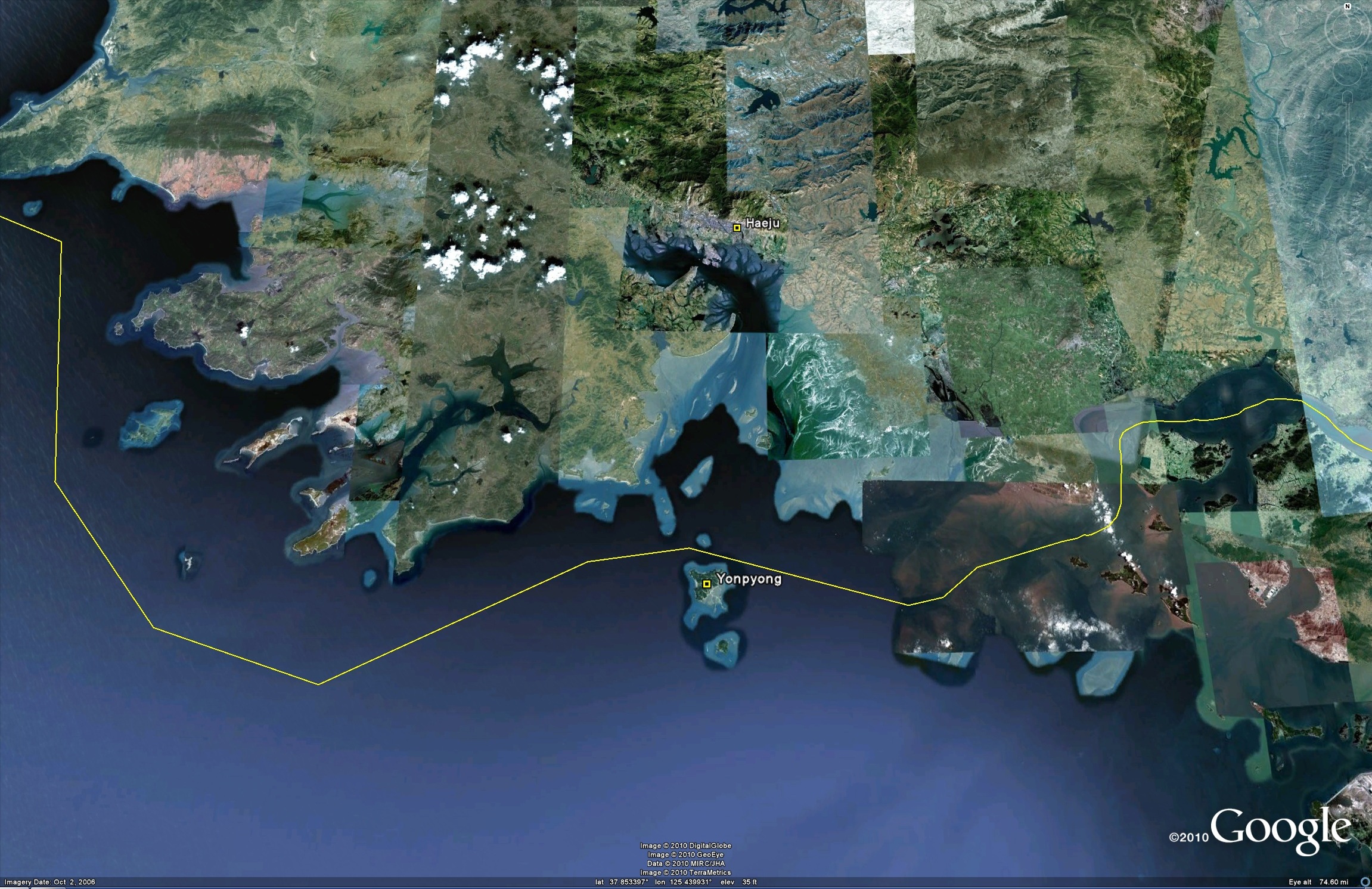
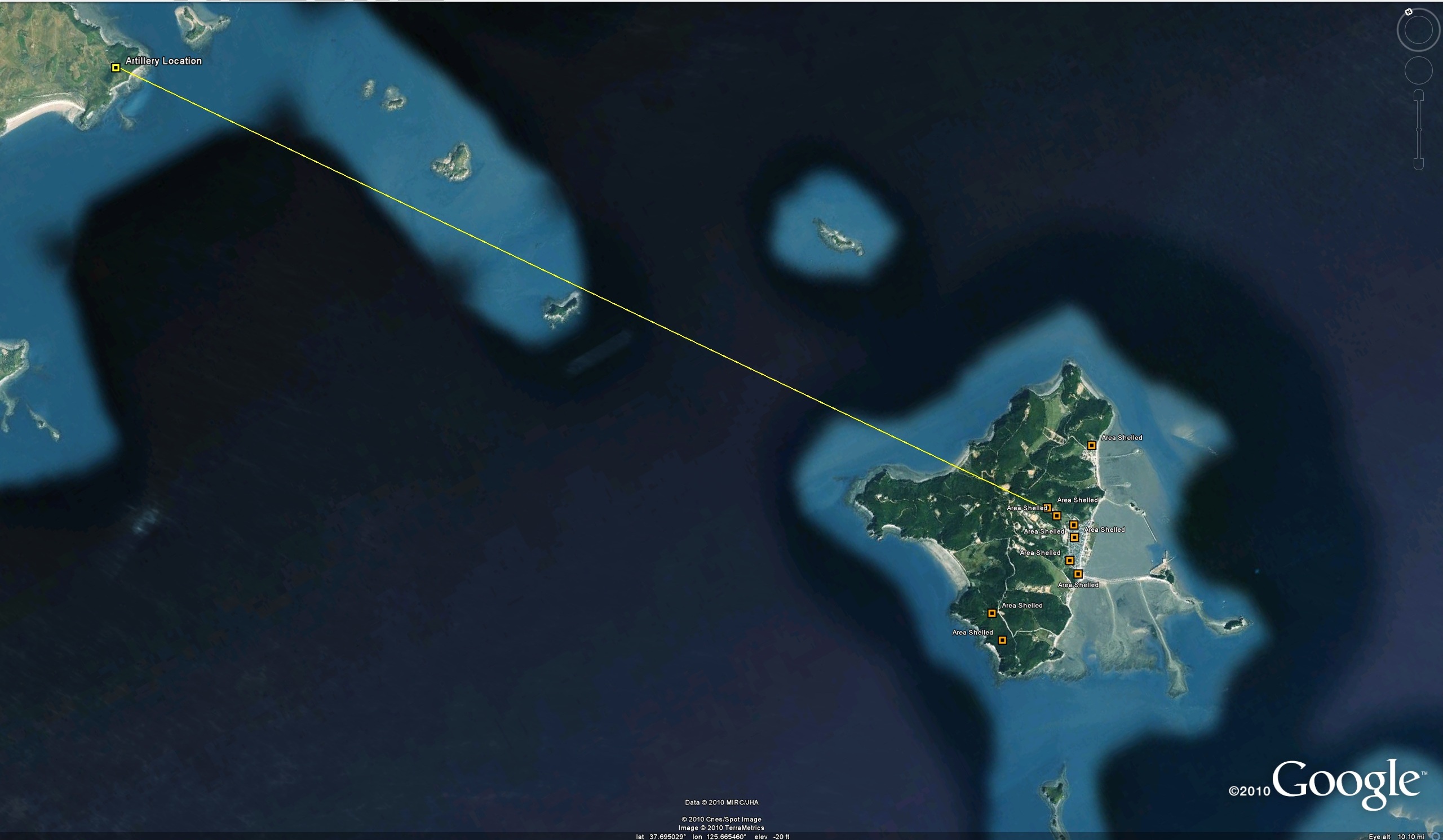
Click image for larger version
UPDATE 70 (2012-3-6): According to Yonhap, the DPRK has replaced the KPA commander responsible for the shelling of Yonpyong:
The head of a North Korean army unit responsible for shelling South Korea’s Yeonpyeong Island in 2010 has been replaced by the country’s vice defense minister, the North’s state media confirmed Tuesday.
General Kim Kyok-sik, who headed the 4th Army Corps of the Korean People’s Army starting in February 2009, is believed to have led the deadly attack on Yeonpyeong that killed four South Koreans, including two civilians.
The front-line unit near the inter-Korean sea border in the Yellow Sea is now headed by Pyon In-son, vice minister of the People’s Armed Forces, according to North Korean media reports of his appearance on state television Monday.
Kim has often been spotted at events unrelated to the unit since late last year, spurring speculation that he may have been replaced.
During the broadcast by the (North) Korean Central Broadcasting Station, Pyon was introduced as commander of the 4th Army Corps, in effect confirming the replacement. Pyon served as vice defense minister starting in December 2010, and was included in the North’s 232-member commission for the funeral of former leader Kim Jong-il last December.
“The hearts of my corps’ soldiers are boiling with hatred for the Lee Myung-bak group of traitors and determination to get revenge,” Pyon was quoted as saying on air. “Be it Cheong Wa Dae or Incheon, we will immerse them all in a sea of fire and not let a single member of the group of traitors survive.”
North Korea has frequently denounced South Korea’s conservative President Lee Myung-bak as a “traitor,” accusing him of aggravating inter-Korean ties.
UPDATE 69 (4/1/2011): A group of US lawmakers are working to add the DPRK back to the US list of state sponsors of terror. According to Yonhap:
A bipartisan group of congressmen will soon submit legislation to re-designate North Korea as a state sponsor of terrorism for its torpedoing of a South Korean warship and shelling of a South Korean border island that killed 50 people last year, sources said Friday.
“I understand Rep. Ileana Ros-Lehtinen has almost completed drafting the legislation, and she is likely to submit the legislation as soon as possible,” a congressional source said, adding several other Republican and Democratic congressmen are expected to sponsor the legislation.
Ros-Lehtinen (R-FL), chairwoman of the House Foreign Affairs Committee, introduced similar legislation in May last year but it didn’t pass.
In June, she had wreaths laid at the tombs of the 46 South Korean sailors killed in the sinking of the warship Cheonan in waters near the western sea border with North Korea.
UPDATE 68 (3/31/2011): KCNA publishes statement by NDC.
UPDATE 67 (1/26/2011): Int’l Criminal Court asks North Korea for info in war crimes probe
UPDATE 66 (1/14/2011): Joseph Bermudez in 38 North discussing the island shelling.
UPDATE 65 (1/12/2011): DPRK opens Red Cross hotline to ROK
UPDATE 64 (1/6/2011): South Korea’s Military Lowers Surveillance Alert to `Normal,’ Yonhap Says
UPDATE 63 (1/4/2011): Japan, South Korea to discuss defense ties and N.Korea
UPDATE 62 (12/29/2010): ROK to create joint forces command
UPDATE 61 (12/29/2010): ROK’s President Lee calls for return to talks.
UPDATE 60 (12/29/2010): North Korean Air Force increases training flights
UPDATE 59 (12/25/2010): DPRK airs television show about Yonpyong shelling. The LA Times has more. They have reportedly also distributed other domestic propaganda.
UPDATE 58 (12/21/2010): North Korea makes gestures toward calm after South’s drills
UPDATE 57 (12/23/2010): Joseph Bermudez analyzes the attacks in the two most recent issues of KPA Journal: November 2010, December 2010. Bermudez was also interviewed by the Wall Street Journal.
UPDATE 56 (12/22/2010): ROK prepares for largest ever artillery drill
UPDATE 55 (12/21/2010): DPRK deploys more missiles along west coast — including decoys.
UPDATE 54 (12/16/2010): Gordon Flake on the DPRK shelling of Yonpyong and LEU program: Part 1, Part 2
UPDATE 53 (12/21/2010): Yonpyong residents return home
UPDATE 52 (12/21/2010): White House Rejects New Talks With North Korea
UPDATE 51 (12/20/2010): DPRK agrees to allow nuclear inspectors back into country. A chronological listing of stories related to the DPRK’s LWR and LEU facilities is here.
UPDATE 50 (12/20/2010): South Korea concludes military drill. DPRK does not immediately respond.
UPDATE 49 (12/20/2010): UNSC meeting deadlocked. Russia distanced itself from China.
UPDATE 48 (12/18/2010): DPRK warns it will attack ROK if it test-fires artillery from Yonpyong.
UPDATE 47 (12/18/2010): UN Security Council Schedules Emergency Meeting on North Korea
UPDATE 46 (12/19/2010): Bill Richardson reports on his trip to the DPRK. KCNA reports he brought gift.
UPDATE 45 (12/16/2010): Andrei Lankov offers thoughts on the escalating tensions between the two Koreas. Here too.
UPDATE 44 (12/16/2010): South Korea announces new military drill
UPDATE 43 (12/16/2010): Bill Richardson goes to North Korea
UPDATE 42 (12/15/2010): South Korea Practices for worst-case attack
UPDATE 41 (12/14/2010): Victor Cha calls for increasing US troop levels
UPDATE 40 (12/13/2010): NDPRK threatens ROK with nuclear war
UPDATE 39 (12/13/2010): ROK’s army chief resigns
UPDATE 38 (12/13/2010): ROK resumes live-fire drills
UPDATE 37 (12/11/2010): DPRK made few concessions to Chinese envoy
UPDATE 36 (12/10/2010): NKorea sends top diplomat to Russia amid tensions. DPRK announces 2011-2012 plan for exchange between the foreign ministries of the DPRK and Russia.
UPDATE 35 (12/10/2010): Gas Masks for All Residents in 5 West Sea Islands
UPDATE 34 (12/10/2010): China affirms DPRK ties with ‘candid’ official visit
UPDATE 33 (12/09/2010): S.Korea council plans to turn ruins of shelling into park
UPDATE 32 (12/8/2010): DPRK claims waters around Yongpyon
UPDATE 31 (12/6/2010): Victor Cha sees war as a possibility
UPDATE 31 (12/8/2010): Japan to raise armed forces mobility to boost defense
UPDATE 30 (12/8/2010): NK Fires Artillery Shells into Own Yellow Sea Waters
UPDATE 29 (12/7/2010): International Criminal Court (ICC) reviewing actions by DPRK
UPDATE 28 (12/7/2010): ROK to make islands near DPRK ‘fortresses’
UPDATE 27 (12/6/2010): ROK, US, Japan reject 6-party talks on DPRK
UPDATE 26 (12/6/2010): ROK to spend 30 billion won to support artillery-hit islanders
UPDATE 25 (12/6/2010): ROK government advised to expand military forces.
UPDATE 24 (12/6/2010): South Korea Begins Firing Drills Amid North Korea’s War Threat
UPDATE 23 (12/2/2010): US and Japan conduct joint military drills. More here.
UPDATE 22 (12/3/2010): SKorean jets will bomb North if it attacks again. Apparently the South Korean army soldiers are terrible shots.
UPDATE 21: (12/2/2010): Kaesong businessmen urge support for the industrial zone.
UPDATE 20 (12/2/2010): Satellite imagery of Yonpyong.
UPDATE 19 (12/1/2010): Choe Thae-bok in China.
UPDATE 18 (12/2/2010): DPRK boosts military capacities near DMZ
UPDATE 17 (12/2/2010): ROK Military suggests counterfire caused ‘many casualties’ in N. Korea.
UPDATE 16: Lankov on the shelling.
UPDATE 15 (12/1/2010): UNSC unable to pass resolution condemning attack.
The standoff over what language on North Korea that China, Russia, the United States, Britain and France — and South Korea and Japan — could accept highlights the way Beijing’s increasingly aggressive defense of its allies may lead nations to bypass the Security Council as a forum for action.
UPDATE 14 (11/29/2010): DPRK strengthens coastal battery
UPDATE 13 (11/29/2010): ROK government mulls making Baeknyeong a forward deployment base
UPDATE 12 (11/29/2010): After issuing warning, Seoul cancels artillery drill on disputed isle
UPDATE 11 (11/30/2010): 49 ROK trucks allowed to restock Kaesong Industrial Zone on 11/29.
UPDATE 10: ROK will abandon policy of not responding militarily to the DPRK’s activities.
UPDATE 9: DPRK accuses ROK government of using Yonpyong Island residents as human shields and deploys surface to surface missiles in the Yellow Sea as US/ROK military drills underway.
UPDATE 8: Yeonpyeong Island designated as ‘control zone’ for military. Military pushes to increase budget for defending western islands.
UPDATE 7: China calls for summit of 6-party talk nations (CNN). South Korea cool to proposal.
UPDATE 6: US response:
1. US calls on China to reign in DPRK
2. US sends aircraft carrier to the West Sea
3. US and ROK begin military exercises
UPDATE 5: South Korea’s response:
1. South Korean defense minister let go. The new defense minister will have new duties.
2. South Korea reassesses its defenses
3. South Korea reassesses rules of engagement with DPRK
4. Residents evacuate Yonpyong. More from the Wall Street Journal.
5. South Korea retrieves DPRK aid from China. You can read more about this aid here.
6 South Koreans photographed new construction of NK artillery site.
7. South Korea bans workers from entering DPRK
8. Moddy’s keeps ROK credit rating at A1
9. ROK bond buyers switching to corporate notes after yield on sovereign debt fell below inflation
UPDATE 4: North Korea’s response:
1. North Korean Envoy to the UN: They [South Korea] Started It
2. (KCNA) KPA Supreme Command Issues Communique
3. (KCNA) Statement Released by Spokesman of DPRK Foreign Ministry
4. Kim Jong-il and Kim Jong-un visited Ryongyon County just before shelling
5. Uriminzokkiri demands revival of Kumgang tours
UPDATE 3: Andrei Lankov offers his opinion in CNN:
This time, North Korean leaders merely reminded Seoul that they are capable of making a lot of trouble if their demands are ignored.
This is a reaction to the current U.S. policy which is known as a “strategic patience,” and to somewhat similar approach of Seoul.
…
In essence, the “strategic patience” policy implies that the U.S. will not provide any concessions until North Korea demonstrates its “sincere willingness” to denuclearize — something which is not going to happen, actually.
The right-leaning government of South Korea has adopted the same approach. It decided not to increase the amount of unilateral and unconditional aid to the North — which has grown dramatically under the earlier leftist-nationalist administrations — unless North Korea makes some concessions, too.
Washington and Seoul expected that sooner or later the international sanctions will start making an impact on North Korea, so it will have to accept their demands and become a bit more reciprocal. Otherwise, they were in no hurry to deal with Pyongyang.
However, Pyongyang leaders have grown quite impatient with “strategic patience.”
Sometimes this is explained as a testimony that sanctions are beginning to bite, but this seems to be a wishful thinking: If anything, the food situation in North Korea is better than it has ever been in the last 16 years (albeit still bad by the standards of the modern world), and the North Korean military is not short of money, as their new and shiny uranium enrichment facility demonstrated.
Nonetheless, it appears that North Korea would like to squeeze more aid from Washington and Seoul largely because they do not want to be too dependent on China which now is the nearly sole provider of aid.
So, North Korean strategists chose to hit the weakest spots of both major donors. Americans worry about proliferation, so they were shown that Pyongyang’s nuclear program is advancing fast.
The South Koreans have a different vulnerability. Their efficient but outward-oriented economy depends on the whim of the international markets. Incidents like Yeonpyeong Island shelling are likely to scare markets, which damages the economy, and voters are likely to eventually blame the government for this damage.
The South Korean voters are remarkably indifferent to North Korea, but they are not going to be happy about economic troubles, so a government must know how to keep North Korean regime reasonable or face problems during the elections.
It is often stated that the incident has a lot to do with the succession issue in Pyongyang. Perhaps, the unusually violent nature of shelling is indeed related to North Korea’s domestic policy. Kim Jong Eun, recently promoted to four-star general, needs the support of the old generals (real ones,) so this might be his way to show himself as a tough warlord, not a spoilt brat who spent his youth in Swiss schools.
However, this is not the major reason: The succession politics might have made the incident more violent than it would be otherwise. But something like this was bound to happen.
This fits well into North Korean established pattern of actions. When Pyongyang believes that more aid and concessions can be extracted, it first manufactures a crisis and then, when tensions are sufficiently high, suggests talks in order to get paid for returning to less dangerous behavior.
Will the crisis lead to a war or prolonged confrontation? Most certainly, not, and North Koreans know it. Neither the U.S. or South Korea are going to start a war. They will win, but the price – especially for Seoul — will be prohibitively high.
Surgical strikes against military installations will not help, either. The lives of common North Korean soldiers are expendable, and their death will have no impact on Pyongyang’s policy.
So, it seems that South Koreans will bite the bullet and, after a healthy portion of the face-saving rhetoric, return to the business of usual.
But it is also likely that in few months time the North Koreans will repeat the lesson. They want to show that “strategic patience” is not an option in the long run, and they seem to be right.
UPDATE 2: CNN publishes theories on why the DPRK has behaved in this manner.
UPDATE 1: BR Myers notes that this is the first artillery attack on a civilian population since the Korean War (NPR).
According to the Wall Street Journal:
North Korea fired artillery rockets at a South Korean island near a disputed western maritime border Tuesday, in a clash that killed two South Korean marines and set numerous buildings on fire.
A South Korean military unit on the island, called Yeonpyeong, returned fire, while military officials scrambled fighter jets. In addition to the deaths, at least 16 more were injured, military officials said. Three civilians were injured, and the island’s 1,200 residents were sent scrambling for bomb shelters.
“The whole neighborhood is on fire,” island resident Na Young-ok said from a bomb shelter about an hour after the shelling began. “I think countless houses are on fire, but no fire truck is coming. We have a fire station but the shots are intermittently coming.
Video captured by closed-circuit monitoring cameras on location showed people scrambling out of buildings as explosions rocked the island.
The attack comes after relations soured dramatically between the two Koreas over the past two years, as North Korea’s totalitarian regime became angered at South Korea’s decision to cut off economic assistance unless it ends its pursuit of nuclear weapons. The issue of North Korean nuclear weapons intensified over the weekend after the revelation that Pyongyang had already installed thousands of centrifuges to produce nuclear fuel at its Yongbyon nuclear facility
The exchange of fire also comes less than two months after North Korean dictator Kim Jong Il began a process of transferring power to his son Kim Jong Eun, a process that analysts have said is likely to be volatile as the younger Kim grapples for authority over the North’s military.
“The attack is a sheer act of provocation. Moreover, shooting indiscriminately on civilians cannot be forgiven,” said Hong Sang-pyo, spokesman for South Korean President Lee Myung-bak. “Our military reacted immediately according to our combat rules. We will act sternly against any more provocation. North Korea should take the responsibility for this.”
North Korea’s official media late Tuesday said South Korea’s military fired artillery into water on the North’s side of the maritime border while conducting a drill, and that it fired the artillery at Yeonpyeong island in response.
The U.S. condemned the attack and called on North Korea to “halt its belligerent action.” “The United States is firmly committed to the defense of our ally, the Republic of Korea, and to the maintenance of regional peace and stability,” the White House press secretary said in a statement, referring to South Korea by its formal name.
The European Union also condemned the North Korean attack. Catherine Ashton, the EU’s foreign policy chief, called on the “North Korean authorities to refrain from any action that risks further escalation and to fully respect the Korean Armistice Agreement.”
A spokesman for the Ministry of Foreign Affairs in China, North Korea’s main benefactor, called for peace and stability. “We hope all involved parties will do more to promote peace on the Korean Peninsula,” Hong Lei said during a regular news conference.
Japanese Prime Minister Naoto Kan ordered the government “to do their best to collect information on the situation and be prepared for any kind of unexpected incidents.”
The attack roiled financial markets in Asia, briefly sending the U.S. dollar sharply higher before it gave back some gains, on a flight from what are considered riskier investment. The Bank of Korea convened an emergency meeting to discuss the effect of the attack. Several financial analysts quickly issued reports that said they didn’t expect South Korea’s stock market to be impacted.
A spokesman for South Korea’s Joint Chief of Staff said “scores of rounds” were fired by the North. The artillery was fired from positions south of the North Korean city of Haeju.
The attack came without warning at 2:34 p.m local time and lasted for 65 minutes, military officials said. About 250 residents escaped the island in fishing boats and arrived in the port city of Incheon two hours later. As the sun set three hours after the attack, fires continued burning in numerous homes and buildings and smoke covered the island, according to people there and on a nearby island called So-yeonpyeong.
The attack adds to a list of more than 30 fatal or life-threatening attacks by the North against the South—including plane bombings, assassinations and naval skirmishes—since the two countries fought the Korean War in the 1950s. Most recently, a South Korean warship sank in March about 40 miles west of the island struck Tuesday. South Korea blamed North Korea for the sinking, citing an exploded torpedo it found and other evidence.
Some units of the South Korean military had been training in waters near the two islands. However, the North routinely complains about the South’s exercises.
The attack shocked South Koreans, who have become accustomed through the years to brash statements and other provocations by North Korea.
“If this leads to any other provocation, it really will be disturbing in many ways,” Song Young-min, an insurance consultant who is in the military reserve, as he watched the news on his cellphone in downtown Seoul.
“It was shocking, scary as well. I even thought of a possible war,” said Park Jung-jin, a banker. “I still believe it won’t go that far, but the news on all that firing and shooting was definitely the most striking North Korean provocation that I’ve heard of so far.”
Lee Eui-sup, who works at South Korea’s National Pension Service, said he immediately suspected the firing was caused by the instability inside the North’s leadership due to the succession process. “It is a serious problem but will soon disappear as it usually does, I believe,” Mr. Lee said.
From the island of So-yeonpyeong, residents watched as the rockets hit the larger Yeonpyeong island. Some sent photos and cellphone videos of the attack to South Korean TV stations. “When I heard the artillery, I thought it was a usual military exercise, but then I noticed the fire and smoke,” said Lee Seung-yeon, a resident on the smaller island.
The two Yeonpyeong islands are the easternmost of five small islands that are within close firing range of North Korea. All are just a few kilometers away from the maritime border known in South Korea as the Northern Limit Line, or NLL, that was drawn up by the United Nations after the end of the Korean War in 1953.
The North has objected to the line since the early 1970s, arguing in part that the line forces its ships to take lengthy detours to international shipping lanes. Its objections intensified in the 1990s and led to two deadly skirmishes in the area in 1999 and 2002.
In 2007, leaders of the two Koreas agreed to turn the area into a “peace zone.” That vaguely worded agreement was struck just ahead of a South Korean election by an outgoing government and never implemented. It was interpreted in North Korea as erasing the maritime border and in the South as keeping it.
And China’s response according to Bloomberg:
China expressed “concern” over reports that North Korea fired artillery shells that struck South Korean territory and called for parties involved to work harder to promote peace and restart multinational talks.
“We have taken note of the relevant report and we express concern over the situation,” Foreign Ministry Spokesman Hong Lei told reporters in Beijing today. “We hope the relevant parties do more to contribute to peace and stability on the Korean peninsula.”
Hong said that officials are aware of claims by a U.S. scientist that North Korea had revealed to him a “stunning” new uranium-enrichment plant. The descriptions by the scientist underscore the need to restart six-nation talks on dismantling North Korea’s nuclear weapons program, Hong said.
“China unswervingly promotes denuclearization on the Korean Peninsula,” Hong said. “We have taken note of the relevant report. It is China’s consistent and firm position to realize denuclearization on the Korean Peninsula through dialogue and consultation. What is imperative now is to restart six-party talks.”
South Korea scrambled fighter jets and returned fire after North Korea lobbed dozens of shells into its territory, injuring four soldiers, Yonhap News reported today.
A South Korean Defense Ministry official, who declined to be identified, confirmed the shelling, without giving any further details. The military has been put on high alert and will “respond strongly” to further provocation, he said.
Stocks were down slightly in response to the news. According to Bloomberg:
Stocks sank, dragging the MSCI Emerging Markets Index down the most in five months, while the dollar and the Swiss franc rallied as fighting broke out between North and South Korea and concern grew Europe’s debt crisis will spread. Metals slid as China’s banks approached lending limits.
The MSCI gauge of stocks in developing nations lost 2.3 percent as all 10 industry groups retreated, while the Standard & Poor’s 500 Index slid 1.1 percent at 9:39 a.m. in New York. The dollar and franc appreciated against most peers. South Korean won forwards slipped the most in six months. Ten-year Treasury yields sank six basis points, the Irish yield jumped 27 basis points, and a gauge of European sovereign debt risk rose to a record. Copper and zinc slumped more than 1.6 percent.
U.S. equities followed European shares lower after South Korea scrambled fighter jets and returned fire following North Korea’s shelling of Yeonpyeong island. China’s biggest banks are close to reaching annual lending quotas and plan to stop expanding their loan books, according to four people with knowledge of the matter. Greece will need to make an “extra effort” to cut its deficit to receive more emergency aid, European Union and International Monetary Fund officials said.
“We’re in this very fragile growth state,” said Matthew Kaufler, a Rochester, New York-based money manager at Federated Investors Inc., who helps oversee $341.3 billion. “When you have these other issues — the sovereign-debt crisis in Europe, concern about Chinese growth, geopolitical unrest in North Korea and a massive insider trading scandal — that’s going to undercut confidence. That all is overshadowing the latest economic data points in the U.S.”
On a related note, I have done my best to keep up with Cheonan stories here.
Read the full stories here:
North Korea Fires Rockets at Island
Wall Street Journal
Evan Ramstad and Jaeyeon Woo
11/23/2010
China Voices Concern on N. Korea Artillery; Calls for Dialogue
Bloomberg
Michael Forsythe
11/23/2010
Stocks Fall on Korea Clash, Europe Debt, China Lending; Dollar Strengthens
Bloomberg
Stephen Kirkland
11/23/2010

