Archive for the ‘International Governments’ Category

Kaesong output up 10% between Sept and Oct

Sunday, December 19th, 2010

According to Yonhap:

Output at an inter-Korean industrial complex in the North Korean border city of Kaesong rose by over 10 percent in October from the previous month, data released by the Unification Ministry said Sunday.

In October, companies in the Kaesong complex produced goods totaling US$29.41 million in value, up by $2.72 million, or 10.2 percent, from $26.69 million in September, according to the data.

The figure increased by 8.9 percent from the same month last year, they showed.

Total output for the Kaesong complex had been on the decline since the Cheonan incident in March, in which 46 sailors died in a torpedo attack blamed on North Korea. The figure hit $26.41 million in July.

The data also showed that the number of North Korean workers in the border town complex marked 44,958 in October, rising steadily from 42,397 in March.

Although the North shelled Yeonpyeong Island on Nov. 23, North Korean workers have been on the rise,” said a ministry official. “According to unofficial statistics, 45,300 North Koreans are working in Kaesong today.”

The Kaesong industrial park is considered the last remaining major symbol of reconciliation efforts between the two Koreas, whose relations have been tense over the past three years. The park began operating in 2004 as a product of the first inter-Korean summit held four years earlier.

Read the full story here:
Output for Kaesong industrial complex increases 10 pct in October
Yonhap
12/19/2010

Share

North Koreans reportedly enjoy US films

Sunday, December 19th, 2010

According to the Choson Ilbo:

Young North Koreans apparently prefer American soaps and films to South Korean ones, and they can now watch both easily. A defector who gave his name as Kim (43) and used to sell TV sets in the North said, “Used color TVs imported from China have both PAL and NTSC options, so there’s no problem receiving South Korean TV signals,” even in remote South Hamgyong Province.

North Korea and China use the PAL format to receive TV signals, while South Korea and Japan use the NTSC format. Some European countries and the Middle East favor SECAM. Most models manufactured after the 1990s allow users to shift formats.

“In South Hamgyong Province, only a few households are able to capture TV signals, but reception is quite good in Hwanghae or South Pyongan provinces,” Kim said. “People there look forward to the evenings when dramas are broadcast.” He said North Koreans also enjoy watching news and current events programs as well and power their TVs with their car batteries during power outages.

Another defector surnamed Yoo (40), who used to sell DVDs in the North and came to South Korea late last year, said North Koreans have grown tired of South Korean TV soaps with their stereotypical plots. “Nowadays, ‘Rambo 4,’ ‘007 Casino Royale,’ and other American action films or TV dramas like ‘Prison Break’ are popular,” she added.

According to Yoo, South Korean TV soaps like “Winter Sonata,” “All In” or “Autumn in My Heart” were popular in the early 2000s, while “Jewel in the Palace” and other historical dramas grew popular in the late 2000s. Recently, action movies are gaining more attention.

North Koreans also prefer American movies to Korean ones. “Practically everyone knows ‘Titanic.'” The movie classic “Gone with the Wind” is popular among upper-class North Koreans in Pyongyang, while young people enjoy action films. “DVDs of American movies or TV dramas fetched the highest prices,” she said. “But now USBs with American TV programs are more popular than DVDs.”

Additional information:
1. Titanic is rumored to have been screened in Pyongyang cinemas.

2. Also, Tom and Jerry was shown on North Korean television in the 1980s. See here and here.

3. We have heard conflicting reports about just how tolerant the North Korean government is of foreign films.

Read the full story here:
N.Korean TV Viewers Favor American Shows
Choson Ilbo
12/18/2010

Share

DPRK still not happy about propaganda leaflets from ROK

Sunday, December 19th, 2010

UPDATE 2: And also on Monday the South Korean government lifted the ban on South Koreans visiting the Kaesong Industrial Zone.

UPDATE 1: As of Monday, the DPRK has not retaliated against either the balloons or the ROK naval drill that took place on Yonpyong.  As a precaution, the ROK government has prevented South Korean workers from entering the Kaesong Zone.

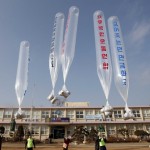
ORIGINAL POST: For several years activists in the ROK have periodically floated balloons across the DMZ which contain cash, propaganda leaflets, and even radios. You can learn yet more about the leaflets here.

The DPRK has complained about these balloons on many occasions, and has at least twice threatened to cut off access to the Kaesong Industial Zone in retaliation.  The first time was in November 2008. The second time was in May 2010.

Well last weekend activists launched balloons from Yonpyong Island (recently shelled by the DPRK):

North Korea now claims it will fire at the South Korean islands used to launch these balloons.  According to Yonhap:

North Korea lashed out Friday at South Korea for allowing anti-Pyongyang propaganda leaflets to be sent across their border, as activists vowed to send more from a South Korean island devastated by North Korean shelling last month.

The leaflets, often mixed with U.S. dollar bills, DVDs and radios, are sent in giant balloons across the 4-kilometer-wide Demilitarized Zone between the Koreas.

The North’s official Web site, Uriminzokkiri, said the bills are “nothing more than waste paper” and that the leaflets do little to undermine the pride of its people in the communist regime.

“Such confrontational madness will only snap up the extraordinary alarm and ire of our army and people,” it said in a commentary.

North Korea’s military has warned it would shell South Korean sites used to send propaganda leaflets and broadcasts. On Nov. 23, the North shelled the western South Korean island of Yeonpyeong, killing two marines and two civilians in its first direct attack on an inhabited region in the South since the 1950-53 Korean War.

North Korea cited the South’s live-fire drills that day as a reason for its shelling, saying its territorial waters were infringed upon. The South denies shooting toward the North.

In a related development, a group of North Korean defectors have entered Yeonpyeong Island this week and are preparing to send about 200,000 leaflets denigrating the North Korean leadership.

Park Sang-hak, head of Fighters for Free North Korea, told Yonhap News Agency that should wind conditions turn favorable, his group will send the leaflets as early as Saturday.

The South Korean military plans to hold one day of live-fire exercises on Yeonpyeong between Saturday and Tuesday despite the North’s threat of retaliation. North Korea says any shells fired from Yeonpyeong are bound to violate its waters because it does not respect the Yellow Sea border drawn by a U.S. general at the end of the Korean War, which ended in a truce.

In an act of support for the propaganda activities, Shin Ji-ho, a ruling party member, told Yonhap that he and other legislators plan to send 100,000 leaflets in “truth balloons” on Jan. 8, the date North Korea’s 20-something heir apparent, Kim Jong-un, was born.

Read the full story here:
N. Korea slams S. Korea over propaganda leaflets as activists vow to send more
Yonhap
Sam Kim
12/17/2010

Share

Recent papers on DPRK topics

Friday, December 17th, 2010

Forgotten People:  The Koreans of the Sakhalin Island in 1945-1991
Download here (PDF)
Andrei Lankov
December 2010

North Korea: Migration Patterns and Prospects
Download here (PDF)
Courtland Robinson, Center for Refugee and Disaster Response, Bloomberg School of Public Health, Johns Hopkins University
August, 2010

North Korea’s 2009 Nuclear Test: Containment, Monitoring, Implications
Download here (PDF)
Jonathan Medalia, Congressional Research Service
November 24, 2010

North Korea: US Relations, Nuclear Diplomacy, and Internal Situation
Download here (PDF)
Emma Chanlett-Avery, Congressional Research Service
Mi Ae-Taylor, Congressional Research Service
November 10, 2010

‘Mostly Propaganda in Nature:’ Kim Il Sung, the Juche Ideology, and the Second Korean War
Download here (PDF)
Wilson Center NKIDP
Mitchell Lerner

Drug Trafficking from North Korea: Implications for Chinese Policy
Read here at the Brookings Institution web page
Yong-an Zhang, Visiting Fellow, Foreign Policy, Center for Northeast Asian Policy Studies
December 3, 2010

Additional DPRK-focused CRS reports can be found here.

The Wilson Center’s previous NKIDP Working Papers found here.

I also have many papers and publications on my DPRK Economic Statistics Page.

Share

DPRK defectors face 9% unemployment rate in ROK

Thursday, December 16th, 2010

According to KBS:

A new survey shows that more than nine percent of North Korean escapees living in South Korea are unemployed and are suffering from serious financial difficulties.

According to a survey of 12-hundred North Korean escapees between the ages of 20 and 60, 42-point-six percent of respondents were economically active, while nine-point-two percent of those who are economically active were unemployed.

Some 37 percent of the respondents cited physical problems as a reason for their lack of a job. More than 24 percent said they chose to remain unemployed in order to raise their children.

The survey was conducted by an organization supporting North Korean escapees.

It would have been helpful if the results were broken down by gender as well as a few other control variables.

Read the full story here:
Survey: 9% of NK Escapees are Unemployed
KBS
12/16/2010

Share

Chinese trade undermining DPRK information blockade

Thursday, December 16th, 2010

According to the Korea Herald:

Although not so explicitly, the communist North Korea appears to be becoming more aware of capitalist cultures and trends, a change the Kim Jong-il regime has feared the most and tried to prevent for decades.

Not only the social upper crust, but the majority of the general public has seen popular South Korean TV series through copies that flow in from China and is aware of the financial gap between the two divided states, North Korean defectors said during a recent forum in Seoul.

According to the defectors ― among hundreds of others who attempt to abandon their impoverished state and escape to the wealthier South each year ― such changes are causing a headache for the North Korean leader trying to secure internal unity before handing over the regime to his youngest son.

“It is difficult to fend off South Korean products and TV shows from entering the country so as long as China remains to be its main trade partner and financial donor,” said Ju Seong-ha, a North Korean defector who graduated from the North’s top Kim Il-sung University.

“The recent phenomena may result in North Koreans choosing South Korea over their own country when the time comes for them to decide.”

North Korea, which is one of the world’s last remaining totalitarian states and also one of the most secretive nations, keeps its people largely isolated from outside news and strictly forbids them from possessing goods that are not distributed by the ruling Workers’ Party.

But the impoverished state’s heavy dependence on Beijing for food and other commodities is inevitably opening up its people to goods and cultures from capitalist nations, particularly South Korea.

China has emerged as the world’s second largest economy after abandoning Stalinist policies and is one of the largest markets for South Korean pop culture, also widely known as “hallyu.”

Most copies of popular South Korean TV series and news that flow into North Korea are produced in China, which is notorious for illegally making cheap, low-quality copies of copyrighted materials.

A 20-something North Korean who escaped to Seoul last year said he had been “shocked” at the sight of South Korea the first time he saw a soap opera starring the country’s top celebrities.

“We had been told South Korea was an underdeveloped country full of beggars,” the defector said, requesting not to be named for safety reasons. “What I saw were beautiful, trendy people living in a glamorous city.”

“I say 90 percent of North Koreans have seen a South Korean TV series at least once,” he said.

Even security and judiciary officials watch popular South Korean soap operas in secret, another unnamed defector told the Dec. 10 forum in Seoul.

“Because the DVD players are sold at a relatively cheap price in North Korea, many households possess them and share CDs among themselves,” the defector said. “Seeing for themselves how well-off and happy people in the South seem, many people build up admiration for the country.”

The apparent popularity of South Korean culture in North Korea coincides with President Lee Myung-bak’s recently made remarks during his trip to Malaysia.

“No one can possibly stop the changes brewing among the general North Korean public,” the South Korean president had said.

Read the full story here:
Changes brewing in ‘not so isolated’ North
The Korea Herald
Shin Hae-in
12/15/2010

Share

ROK church to light Christmas tree for DPRK near Kaesong

Wednesday, December 15th, 2010


UPDATE: The “tree” was lit December 21.

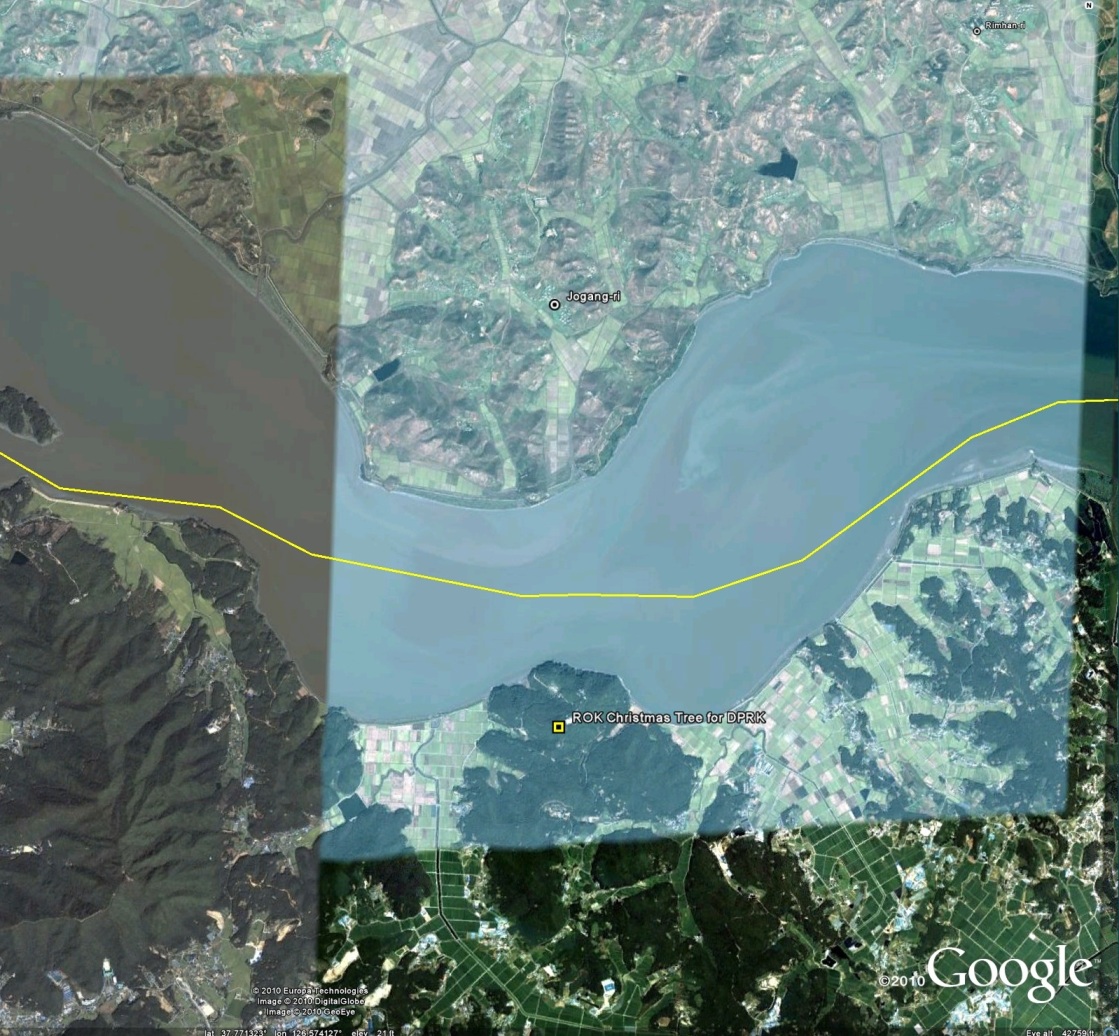
ORIGINAL POST: South Korea plans to construct a “Christmas tree” on a hilltop tower across the river from Jogang-ri, in Kaesong (37.752445°, 126.593120°).

According to Bloomberg:

South Korea will allow a local church to turn a 30 meter (100 foot) tower at its border with North Korea into a brightly lit Christmas tree as part of “psychological warfare” between the two countries, the JoongAng Ilbo reported.

The tower hasn’t been lit up since 2004, according to the Korean-language newspaper report. North Korea, which suffers from energy shortages and relies on outside handouts to feed its 24 million people, had demanded the tower be demolished, JoongAng said.

Here is a link to the original story in the Joong Ang Ilbo (Korean).

Read the full Bloomberg story here:
South Korean Christmas Tree to Provoke North, JoongAng Says
Bloomberg
Bomi Lim
12/14/2010

Share

DPRK claims waters around Yonphyong Island

Wednesday, December 8th, 2010

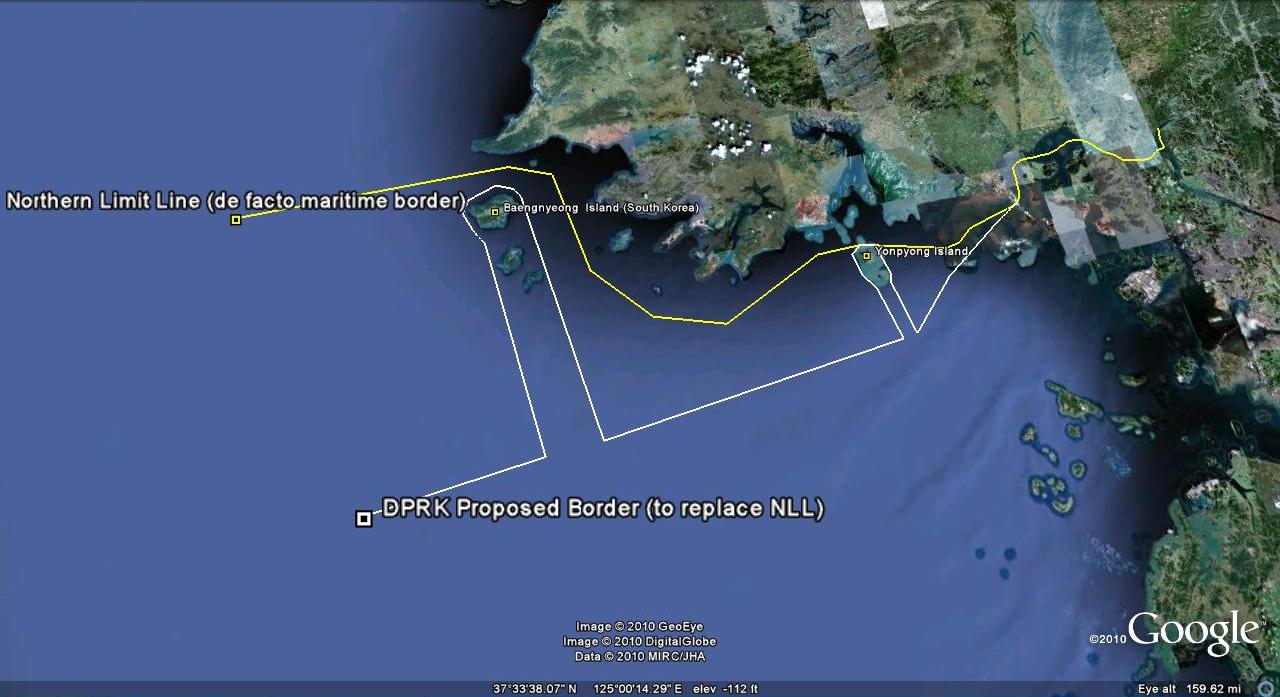
Pictured above (Google Earth): The NLL and the DPRK’s alternative maritime border in the West Sea

Evan Ramstad writes in the Wall Street Journal:

North Korea state media on Thursday issued a statement that claimed possession of all waters around South Korea-controlled Yeonpyeong Island, clarifying for the first time that its Nov. 23 attack of the island was motivated by a different view of the inter-Korean maritime boundary in the Yellow Sea than is widely held.

North Korea has said since the attack that it was motivated because shells from an artillery test South Korea conducted on the island that day fell into its waters.

Military officials in South Korea have said that its test-firing that day was routine and was directed into South Korean waters south of the island. South Korea has long understood the maritime boundary to be in several miles north of the island and, as a result, directs its tests southward.

But officials and analysts who have watched North Korea’s evolving statements since Nov. 23 have noticed that Pyongyang didn’t claim that South Korea fired northward, raising questions about just what territory North Korea was claiming.

The new statement carried by Korea Central News Agency wiped out the ambiguity.

“The above-said island is located deep inside the territorial waters of the DPRK side from the maritime demarcation line,” the statement said, using an acronym for North Korea’s full name, the Democratic People’s Republic of Korea.

“If any live shell firing is conducted from there, shells are bound to drop inside the territorial waters of the DPRK side no matter in which direction they are fired because of these geographical features of the island,” the statement added.

North Korea has long disputed the inter-Korean maritime border in the Yellow Sea, or West Sea, which was drawn up by the United Nations when hostilities in the Korean War ended with a ceasefire in 1953.

In recent years, North Korea has grown more vocal and belligerent in its claim of a different maritime border, one that runs many miles to the south of the one drawn by the U.N. and known in South Korea as the Northern Limit Line, or NLL.

In North Korea’s claim, five islands that have long been controlled by South Korea lie within its waters. However, North Korea has not claimed possession of the islands.

As it exists, the U.N.-drawn border forces military and fishing vessels from the North Korean city of Haeju and other points along its southern coast to make a coastline-hugging journey westward for 30 miles or more before they can reach open water.

Here is the DPRK’s statement in full from the new KCNA page (for those who do not want to visit the new page):

Pyongyang, December 9 (KCNA) — The Secretariat of the Committee for the Peaceful Reunification of Korea released a detailed report on Wednesday laying bare the truth and nature of the Yonphyong Island shelling incident in the West Sea of Korea. It clarified internally and externally who was the provocateur and who was to wholly blame for it.

The report said:

The Yonphyong Island covers just 6.8 square km and it has nearly 18 km in circumference. But this small island has been fortified as such core military stronghold that the puppet forces call it “area for top class guard.” A brigade of the puppet marine corps and “K-9” self-propelled artillery pieces of more than one company are deployed on the island and it has a dense network of detection means and intelligence-gathering and communication facilities.

It was waters not far from Yonphyong archipelago that patrol ship of the puppet forces “Cheonan” sank in March this year. The puppet warmongers have persistently escalated the tension in this area, crying out for seeking “revenge,” and at last went the lengths of perpetrating direct shelling under the pretext of a military exercise.

The motive of the incident and the background against which it occurred make it clearer that it was a deliberate provocation of the puppet forces.

The above-said island is located deep inside the territorial waters of the DPRK side from the maritime demarcation line. If any live shell firing is conducted from there, shells are bound to drop inside the territorial waters of the DPRK side no matter in which direction they are fired because of these geographical features of the island.

The puppet warmongers fired as many as thousands of shells into the territorial waters of the DPRK side after deliberately fixing those waters as a target of sighting firing. This reckless act was obviously a deliberate provocation to prompt the DPRK to take a military counter-action.

No matter what rhetoric the south Korean conservative group may use in a bid to shift the responsibility for the incident onto the DPRK like a thief crying “Stop the thief!” it cannot hide the truth.

The above-said incident was an inevitable product of the puppet conservative group′s vicious moves to escalate the confrontation with fellow countrymen and ignite a war.

The inter-Korean dialogues and visits which had been brisk since the adoption of the June 15 joint declaration were totally suspended and an atmosphere of reconciliation, unity and reunification rapidly got cool due to the puppet group.

The conservative authorities of south Korea have persistently mocked at the DPRK′s sincere efforts to improve the inter-Korean relations and turned away their faces from them.

Since the puppet warmongers′ seizure of power, they have staged an increasing number of exercises for a war of aggression against the DPRK and they assumed more dangerous nature.

They have staged more frequent military exercises in waters off Yonphyong Island, in particular.

When the puppet group′s all policies to escalate the confrontation with the DPRK and war moves against it proved totally bankrupt in face of the domestic and foreign public′s rebuff and condemnation, it orchestrated such hideous shocking incident as the Yonphyong Island shelling incident as its last-ditch effort.

While the conservative group of south Korea was the direct provocateur of the said incident, the U.S. was a wire-puller and chieftain of the incident as it egged the puppet warmongers onto the military provocation.

The above-said incident was triggered off because of the illegal “northern limit line” fixed by the U.S. in the West Sea of Korea.

Military clashes and disputes have not ceased in waters of the West Sea of Korea since the cease-fire due to this bogus line having no ground in the light of international law as it was unilaterally drawn by Clark, the then UN forces commander on August 30, 1953.

The U.S. sidestepped the DPRK′s fair and aboveboard proposal for fixing a military boundary line in the West Sea. And it instigated the puppet conservative group to totally scrap the June 15 joint declaration and the October 4 declaration, claiming that the setting up of a special zone for peace and cooperation in the West Sea would bring the “northern limit line” to naught.

The U.S. in league with the puppet warmongers have run the whole gamut of schemes to make the “northern limit line” an established fact at any cost.

Not only the warship “Cheonan” case in March but the recent Yonphyong Island shelling incident were cooked up according to this sinister scenario of the U.S. and under its backstage manipulation.

Since the above-said shelling incident the U.S. has massively supplied the latest weapons to the puppet group while zealously egging it onto carry out what it called “retaliation plan.” This fact goes to clearly prove that the U.S. was the arch criminal who orchestrated and wire-pulled the incident behind the scene.

Additional Information:
1. I have been keeping up with the Yonpyong shelling saga here.

2. Google Earth/Maps now has high resolution imagery of Yongpyong and the DPRK peninsula where the attack originated.  Check it out at 37°39’44.04″N, 125°42’9.71″E and 37°46’21.28″N, 125°36’16.97″E

3. Sorry, Josh, no “Brigandish” this time.  Josh Stanton (One Free Korea) gets credit for inventing the KCNA drinking game.  Every time KCNA mentions “Brandish” behavior, you take a drink.  For those who like to imbibe more frequently, here is a link to every single KCNA story that mentions “Briganish”–all 738 of them. This is courtesy of the indispensable STALIN search engine.

Read the full Wall Street Journal story here:
North Korea Claims Waters Around Shelled Island
Wall Street Journal
Evan Ramstad
12/8/2010

Share

Iranian defector ‘saw North Korean technicians’ in Tehran

Tuesday, December 7th, 2010

Image via Arms Control Wonk

According to AFP (via Zawya):

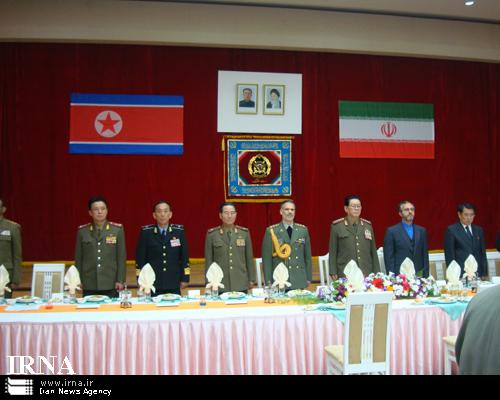
A former Iranian diplomat who defected to the West said on Tuesday that he had regularly seen North Korean technicians at Tehran airport between 2002 and 2007.

Western intelligence agencies suspect North Korea may be helping Iran to develop long-range ballistic missiles and nuclear weapons technology. Tehran insists it simply wants to develop civilian nuclear power.

Mohammed Reza Heydari, Iran’s former consul in Norway, sought political asylum in December amid protests in his homeland in the aftermath of Iranian President Mahmoud Ahmadinejad’s disputed re-election.

On Tuesday he told reporters at a meeting organised by the Paris-based think tank the Centre of Political and Foreign Affairs that he had seen North Koreans when he had been a foreign ministry official at Tehran airport.

“I saw them with my own eyes,” he said. “They were treated in a very discreet manner, in order to pass through without being seen.”

Heydari said he was “100 percent certain” that these contacts continue and alleged he had spoken to members of Iran’s hardline Revolutionary Guards Corps who confirmed that Iran plans to build a bomb.

“I was able to confirm that Iran has two goals — to develop the range of its ground-to-ground missiles and to obtain a nuclear weapon with the help of North Korea,” he said.

Since defecting, Heydari has sought to convince more Iranian diplomats to abandon the regime and form an opposition movement in exile.

Describing his view of the political scene back in Tehran, Heydari said a group of conservatives around the speaker of parliament Ali Larijani were increasingly opposed to a more religious faction backing Ahmadinejad.

According to the defector, while Larijani’s group wants to govern Iran, Ahmadinejad’s supporters have a more “global agenda” and are awaiting the return of the “hidden imam”.

Some Shiite Muslims believe that the 12th Imam, known as the Mahdi, who disappeared in the year 874, will return to bring justice to the world.

Heydari said Ahmadinejad’s faction is pushing Iran’s nuclear agenda. “According to our information, this inner circle believes that with only two bombs they can ensure the survival of the country and of Islam,” he said.

The usual defector caveats apply.  According to Bob Baer, Iran’s nuclear program has been an intelligence black hole.  Of course so was the DPRK’s—and they managed to surprise everyone by bulding a LEU facility right in the middle of Yongbyon.  There is no shortage of evidence that the two countries are working together on a number of political, economic, and military initiatives, however, so it is entirely possible that this Iranian defector is telling the truth.

As an aside, many Americans are nervous about visiting both Iran and the DPRK, but having visited nearly 45 countries, I can tell you that Iran and the DPRK are in the top three for me.  Of course, I live on the beach and prefer to “rough it” on vacation.

Read the full story here:
Iranian defector ‘saw North Korean technicians’ in Tehran
AFP (via Zawya)
12/7/2010

Share

No yachts for you (UPDATE)

Tuesday, December 7th, 2010

UPDATE (12/7/2010): Austrian convicted for yacht sale to DPRK.  According to Reuters:

A Vienna court has fined an Austrian man 3.3 million euros ($4.4 million) over the sale of luxury goods, including yachts, believed destined for North Korean leader Kim Jong-Il, a court official said Tuesday.

The businessman, who was not named, was also handed a nine-month suspended sentence late Monday for the dealings which violate an international trade embargo against Kim’s impoverished state, court official Christian Gneist said.

“The amount was 3.3 million euros because this was the amount he received as payment,” Gneist said. The trade violated U.N. sanctions against North Korea imposed over its nuclear bomb tests.

Working with a North Korean intermediary close to Kim, the Viennese man tried to procure two yachts and received payment for them, Gneist said.

Prosecutors also accused him of lining up eight top-end Mercedes-Benz S-Class cars and musical instruments including a Steinway grand piano for Pyongyang, Austrian daily Kurier reported.

The Austrian man pleaded guilty and told the court he had not realized what he was getting into, Kurier said.

“It doesn’t have anything to do with atomic bombs. I am not interested in politics. I am a businessman,” the paper quoted him as telling the court.

Italian financial police helped to break up the sale of the yachts last year, which prosecutors believed to be a birthday present for Kim. The Austrian bought them from the Azimut-Benetti boatyard, one of the world’s leading yachtmakers. Azimut-Benetti was not accused of wrongdoing and had cooperated fully in the investigation, Italian police have said.

The sale of luxury goods to North Korea is banned under a U.N. resolution in retaliation for the country’s nuclear testing program. The U.N. Security Council unanimously voted to widen its sanctions after North Korea’s nuclear test in May last year.

ORIGINAL POST (7/23/2009): According to Reuters (via Washington Post), UN sanctions have prevented the sale of two Italian yachts to the DPRK.  To top it off, the DPRK purchaser lost the deposit!  According to the article:

Financial police in the city of Lucca in central Italy said the vessels were worth nearly 13 million euros ($18 million) and had been purchased by an Austrian intermediary from the Azimut-Benetti boatyard, one of the world’s leading yachtmakers.

The Austrian intermediary then ceded the contract to a Chinese company, which in turn paid a Hong Kong business to take delivery of the vessels, police said.

“The difficulty was tracing it back to a violation of the sanctions,” said Colonel Antonio Leone, the Finance Police’s commander in Lucca. Asked if Kim was the intended final recipient of the vessels, he said: “It is an irrefutable fact.”

“There has been a thorough investigation, partly in Austria, backed up by confessions and investigative breakthroughs.”

The yachts were initially confiscated by Italy’s Economic Development Ministry but have since been returned to the boatyard, which has been allowed to keep the deposit.

Azimut-Benetti is not accused of wrongdoing and has cooperated fully in the investigation, police said.

The sale of luxury goods to North Korea is banned under a U.N. resolution in retaliation for the country’s nuclear testing program. The U.N. Security Council unanimously voted to widen its sanctions after North Korea’s May 25 nuclear test.

Given the complex chain of front companies involved in carrying out this transaction, the application of the UNSC resolution is a great illustration of what Haggard and Noland call “whac a mole“.  The North Koreans will now attempt to reconstitute their trade and proliferation networks using new front companies.  According to Haggard and Noland:

As a small country dependent on foreign trade and investment, North Korea should be highly vulnerable to external economic pressure. In June 2009, following North Korea’s second nuclear test, the UN Security Council passed Resolution 1874, broadening existing economic sanctions and tightening their enforcement. However, an unintended consequence of the nuclear crisis has been to push North Korea into closer economic relations with China and other trading partners that show little interest in cooperating with international efforts to pressure North Korea, let alone in supporting sanctions. North Korea appears to have rearranged its external economic relations to reduce any impact that traditional sanctions could have.

Given the extremely high priority the North Korean regime places on its military capacity, it is unlikely that the pressure the world can bring to bear on North Korea will be sufficient to induce the country to surrender its nuclear weapons. The promise of lifting existing sanctions may provide one incentive for a successor government to reassess the country’s military and diplomatic positions, but sanctions alone are unlikely to have a strong effect in the short run. Yet the United States and other countries can still exercise some leverage if they aggressively pursue North Korea’s international financial intermediaries as they have done at times in the past.

Read Haggard’s and Noland’s complete analysis here.

Read the full stories here:
Italy blocks sale of yachts to North Korea’s Kim
Reuters (via Washington Post)
7/23/2009

Sanctioning North Korea: The Political Economy of Denuclearization and Proliferation
Peterson Institute Working Paper 09-4
Stephan Haggard and Marcus Noland

Share