Archive for the ‘Construction’ Category

Expansion of Pyongyang’s east market

Monday, February 23rd, 2009

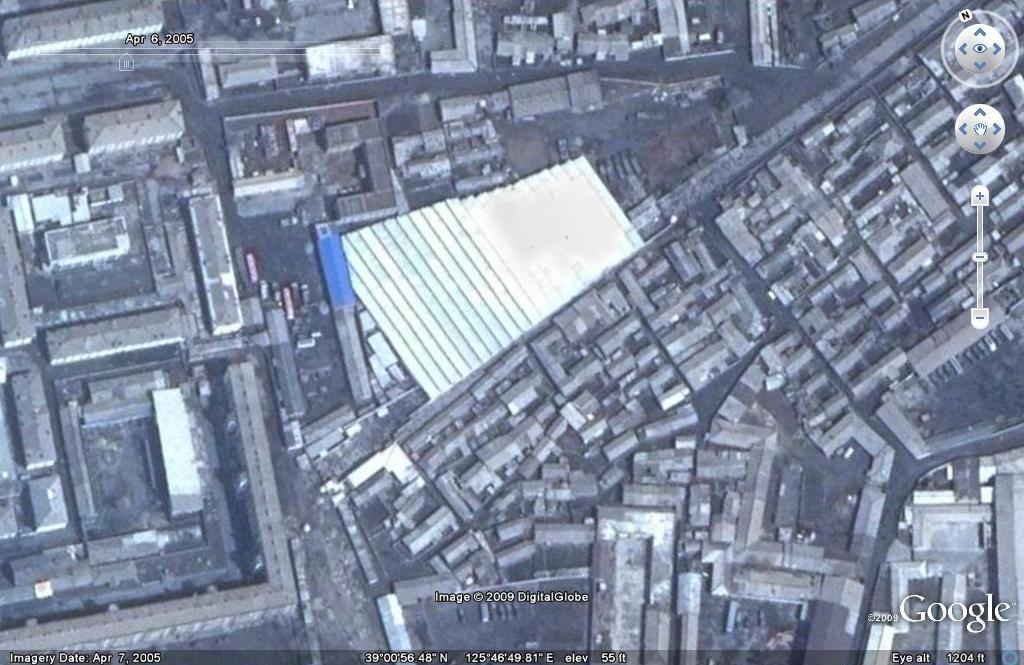
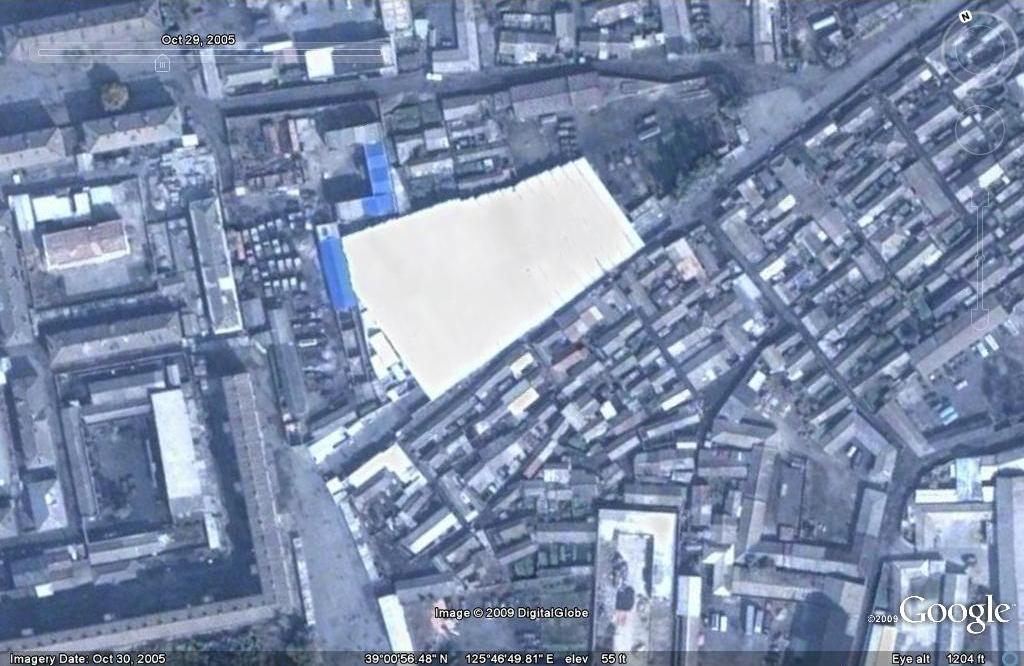
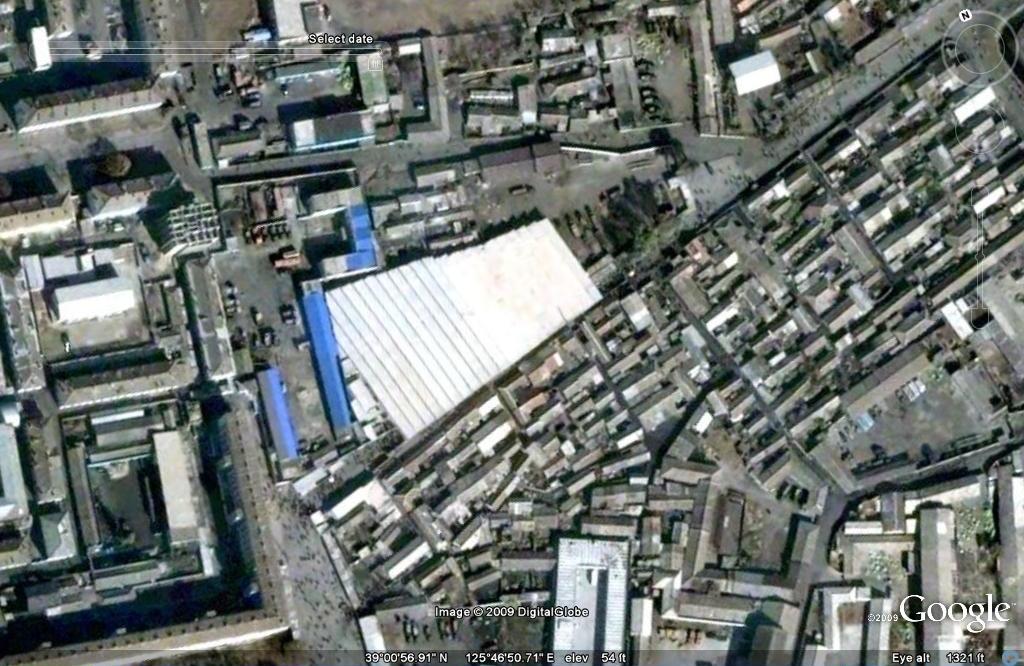
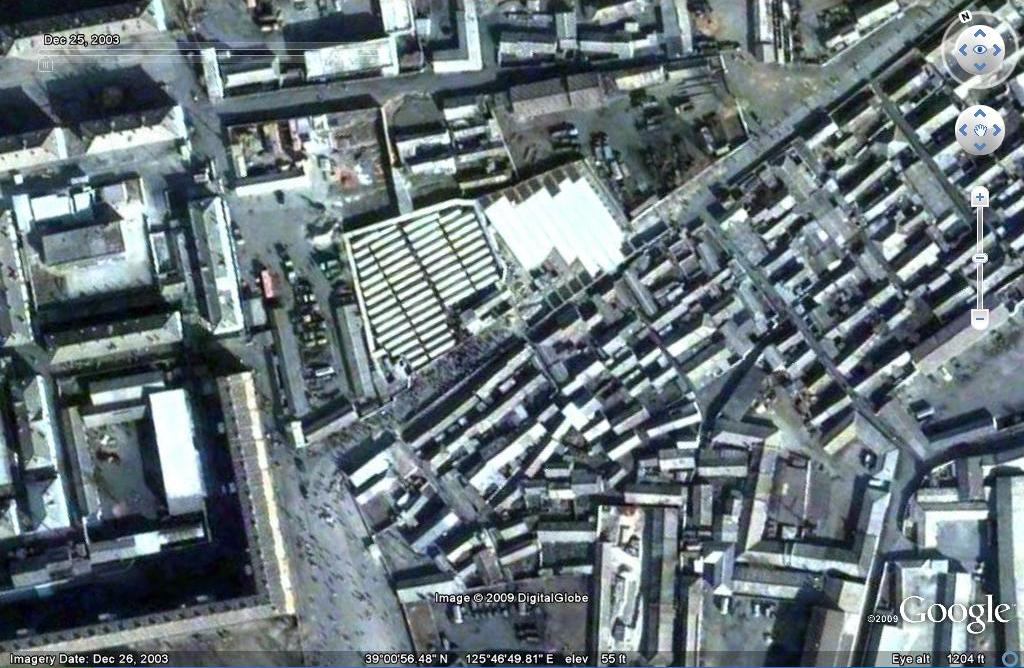
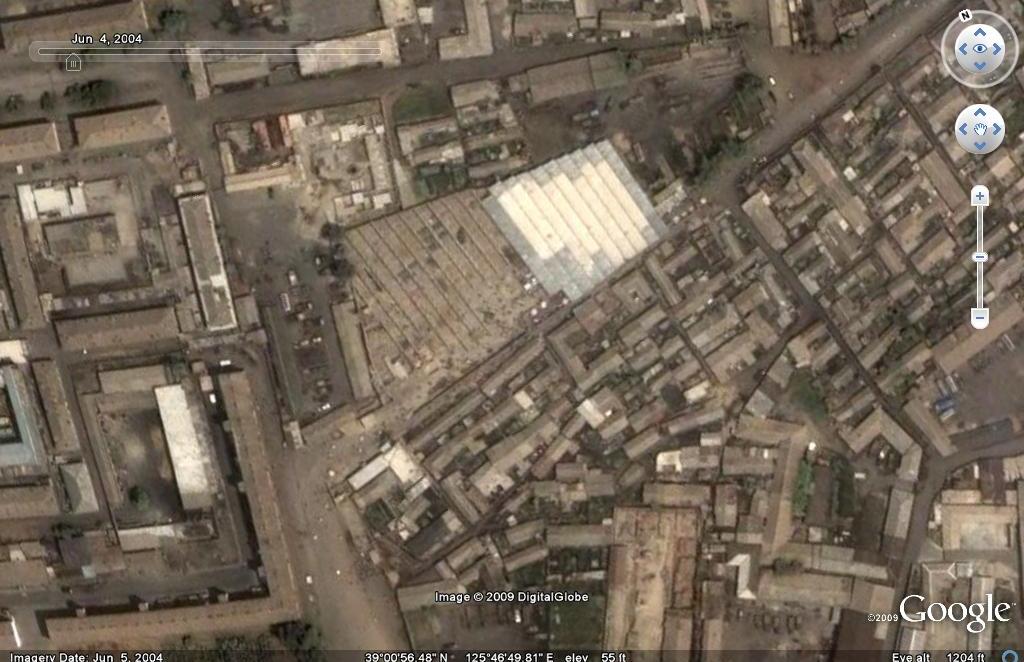
The newest version of Google Earth allows the user to scroll backwards in time to see how a specific area has changed over the years.  Although the satelite imagery available for North Korea needs to be expanded, by utilizing the current stock of photos we can uncover some interesting developments.

Below is an example—a bird’s eye view of the expansion of Pyongyang’s eastern market (click on images for full size):

pyangeastmarket-12-25-2003.JPG

December 25, 2003

pyangeastmarket-6-4-2004.JPG

June 4, 2004

pyangeastmarket-4-6-2005.JPG

April 6, 2005

pyangeastmarket-10-29-2005.JPG

October 29, 2005

pyangeastmarket-most-recent.JPG

Most recently

If any readers out there discover other interesting developments please let me know.

Share

DPRK relic in Zimbabwe

Tuesday, February 3rd, 2009

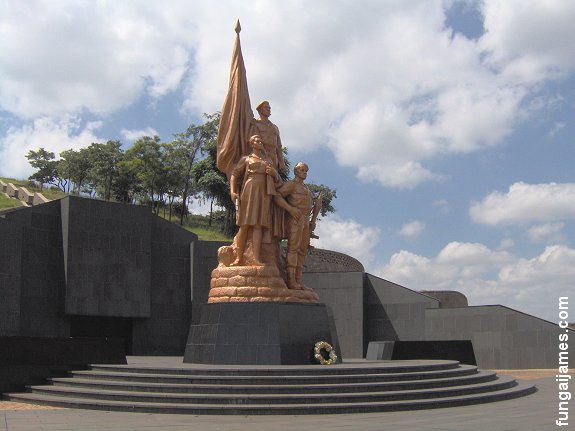
heroes-acre-harare.jpg

National Heroes Acre is a burial ground in Harare, Zimbabwe for all Zimbabweans who have been declared a hero by the Government.

The Government started work on the Heroes Acre in 1981, one year after Independence. The design and artwork used at the site was done by seven artists from the Democratic Peoples Republic of Korea and ten Zimbabwean Artists.

Over 250 local workers were involved in the project at the height of construction. The black granite stone used for the main construction was quarried from Mutoko; a rural area situated about 140km Northeast of Harare. The Heroes Acre is protected under the Natural Resources Act.

See the Site on Wikimapia here

Learn more about the site here.

*This location will be added to the next version of North Korea Uncovered (North Korea Google Earth).  If readers are aware of other construction projects the DPRK has supported, please let me know.  I am especially interested in locating the North Korean restaurants in China, Thailand, Cambodia, Vietnam, and Bangladesh.  Are there others?

Share

Assessment of the 2008 DPRK economy, outlook for 2009

Monday, February 2nd, 2009

Institute for Far Eastern Studies (IFES)
ICNK Forum No. 09-2-2-1
2/2/2009

ASSESSMENT OF THE NORTH KOREAN ECONOMY FOR 2008

In the 2008 North Korean New Year’s Joint Editorial, Pyongyang established the year 2012 as “The Year of the Perfect Strong and Prosperous Nation,” while labeling 2008, “The Year of Turnabout,” and, “The Year of the Betterment of the Livelihoods of the People.” As the year marked the 60th anniversary of the establishment of the Democratic People’s Republic of Korea (DPRK), the regime projected a highly motivated façade, but there was no sign of new changes in the North’s economic policies.

Faced with the inability to produce any substantial results in the realm of international economic cooperation, North Korean authorities focused on how to put a positive spin on international conditions that were tied to the progress of 6-Party Talks. However, no visible measures appeared to emerge. Internally, North Korea’s chronic supply shortages drove further disparities between official and market pricing and monetary exchange rates as authorities were unable to stabilize the domestic economy. The growing global economic instability also caused economic policy makers to act more conservatively.

In 2008, North Korea’s food production in 2008 amounted to 4.31 million tons, recording a 7.5 percent increase over the previous year, while energy production is estimated to have grown by approximately 10 percent. Through joint development projects for North Korea’s underground resources, the North received raw materials for light industries (soap and shoes) amounting to 70 million USD in 2007, and 10 million last year. In addition, DPRK-PRC trade and inter-Korean economic cooperation both grew (DPRK-PRC trade increased significantly, while North-South cooperation grew only slightly), but it is difficult to measure the extent to which these increases impacted the North’s economy.

It appears that overall, North Korean trade and industry has improved since 2007, and the 2008 economic growth rate was positive. However, when estimating the North’s economic growth rate in light of the quickly rising exchange rate for South Korean won, DPRK economic growth for 2008 could be seen as a negative value.

While North Korea’s overall industrial production grew in 2008, when compared to previous years, and the primary reason for such was the refurbishment of equipment in most stable industries, development assistance and heavy oil aid as part of the 6-Party Talks, the provision of raw materials for light industries by South Korea, and the rise in prices on goods internationally.

Because of favorable weather conditions and increased production of fertilizer in the North, the agricultural sector showed a relative increase in production in 2008, despite the suspension of fertilizer aid from South Korea. Grain production was up 300 thousand tons, for an estimated total of 4.31 million tons last year. Boosted energy production was helped by improvements in hydroelectrical production and heavy oil tied to 6-Party Talks, and the provision of parts and materials for power plants, which considerably increased power production, at least in the first half of the year. This played an important role in the increase in industrial operations, as well. As electrical supply is the biggest obstacle to raising the operating rate of production facilities, more power resulted in overall production increases.

The construction sector has focused efforts on Pyongyang, and in particular on efforts to improve the lifestyles of its residents. Housing (averaging 20,000 family dwellings per year), restaurants, waterworks, roads, and other construction and repair projects have been aggressively undertaken.

North Korean authorities emphasized the science and technology sector in 2008, although it appears that the actual impact of this campaign topped out at the supply of some practical technology and the at production facilities, power plants, and other factories, and the promotion of modernization and normalization of industrial production.

At the mid-point of 2008, inter-Korean trade had grown by 1.2 percent compared to the same period the year prior, reaching 1.82 billion USD. The freeze on the annual supply of 400 thousand tons of rice and between 300~350 thousand tons of fertilizer from the South had a negative impact on the North’s food situation. On the other hand, DPRK-PRC trade from January-November 2008 jumped by 29.3 percent over the same period in 2007, considerably more than the 14.9 percent recorded in 2005, the 14.9 percent seen in 2006 and the 16.1 percent rise last year.

The increase natural resource development and improvements in core industries, the possibility of expansion of markets, and the advantage of low-cost labor give China, Russia, and other adjacent countries positive perceptions regarding investment in the North, and as Pyongyang continued to expand economic cooperation with these countries last year, it also improved economic relations with Europe as well as Egypt and other Middle Eastern countries.

PROSPECTS FOR THE NORTH KOREAN ECONOMY IN 2009

If one looks at North Korea’s domestic economic policies, one will see that basically, in the 2009 New Year’s Joint Editorial, North Korea’s domestic and international economic policies have not undergone any significant changes. However, in order to accomplish the goal of establishing a Strong and Prosperous Country by 2012, it is expected that all efforts will be poured into reviving the economy. Based on the Joint Editorial, this year, the North’s economic policy is not one of reform due to transformation of the outside environment, but rather a revival of pas, conservatively grounded economic policy. Regarding international economic relations, the 2008 Joint Editorial specifically stressed the building of an economically strong nation based on the principle of the development of external economic relations, but there was no particular reference to this in 2009.

In 2009, resolution of agricultural problems was again prioritized as the task most necessary for the realization of a Strong and Prosperous Nation by 2012. Along with this, the North’s economic policy for 2009 will prioritize the modernization and normalization of the economy’s ‘vanguard sector’, and it is expected to continue to strengthen efforts to revive the economy. As it continues to work toward creating an environment in which it can concentrate efforts on the building of an ‘Economically Strong Nation’, North Korean authorities are expected to issue new measures to strengthen the economic management system, including the planned industrial system, the distribution and circulation framework, and an effective market management system. The North is also expected to further emphasize efforts to modernize the People’s Economy, as it considers modern vanguard science and technology to be the answer to recovery from its current economic crisis.

There is a possibility North Korea’s foreign trade, including that with China, will shrink in the future, as its external economic activity is hit by the current international economic situation and the rising value of the U.S. dollar and Chinese Yuan. Just as was seen in 2008, with the shrinking growth of the Chinese economy, DPRK-PRC trade will be hit negatively. Progress on the rail link being promoted between Rajin and Hasan, as well as the redevelopment of the Rajin Harbor is also expected to face difficulties. This is likely to lead to further efforts by the North to expand economic cooperation with the EU and Middle Eastern countries.

Despite North Korea’s removal from the U.S. list of terrorism-sponsoring states, because sanctions against North Korea still remain, the North will need to make progress in non-proliferation, human rights improvement, and marketization in order to see real economic benefits from improved relations with the Obama administration. However, because of a lack of confidence regarding market reform, differing stances between the U.S. and DPRK on denuclearization, and deeply rooted mistrust, there is a more than a small chance that progress on the nuclear issue will be stretched out over the long term.

Looking at prospects for the main domestic economic sectors of North Korea, firstly, the amount of development in the energy and mining sectors could take a favorable turn if there is movement on the nuclear issue, and this would have an overall positive effect on the entire industrial sector. The drop-off of demand due to the international financial crisis could have a considerable impact on the North’s mining sector, making it difficult to see much growth past the levels seen in 2008.

In 2009, the supply-demand situation regarding North Korean grains is expected to improve over last year. North Korea requires 5.2 million tons of grain, and is expected to harvest 4.9~5 million tons, falling only 200~300 thousand tons short. This is an improvement over the 790 thousand ton shortfall the North suffered in 2008. However, the actual amount of grains distributed to the people may not increase, because some of the 2008 shortage was relieved through the release of emergency rice reserves, and so some portion of the 2009 harvest will need to be set aside to restock that emergency reserve.

In the manufacturing sector, the increase in electrical production and increase in large-scale equipment operations in metalworks, chemicals, construction materials, and other heavy industries, the supply of materials for light industries as well as fertilizer will be extended, but the reduction of inter-Korean economic cooperation and foreign capital will mean a reduction in the ability to import equipment and materials, making it difficult to meet 2008-level growth in industrial production numbers.

In the construction sector, housing construction in Pyongyang and other areas will not fall off suddenly, but with the anniversary of the founding of the Party Museum upcoming and the impact of the furious construction activity that has been underway, it is likely to slow down in 2009. With North Korean authorities restricting private-sector economic activity, controlling the size of markets, and other measures controlling commerce in the North are expected to strengthen, which will considerably restrict anti-socialist commercial activity. To what extent official commerce networks will absorb this activity will be pivotal.

Trade between North Korea and China is expected to shrink as the global economic crisis drives down the price of raw materials that the North exports to the PRC. Following the North Korean authorities’ enforcement of a measure reducing inter-Korean economic cooperation on December 1, 2008, without improvement in the North Korean nuclear issue, and in U.S.-DPRK relations cooperation between Seoul and Pyongyang will gradually shrivel. Trade with other countries is also expected to fall as a result of the current global economic situation. Therefore, reduction of inter-Korean economic cooperation, North Korea’s principle provider of foreign capital, and sluggish trade between Beijing and Pyongyang will weaken the North’s foreign reserves supply-and-demand situation.

As for the investment sector, if North Korea is to succeed in its push to build a Strong and Prosperous Nation by 2012, it must attract foreign investment through aggressive policies of opening its economy. In order to improve the investment environment, Pyongyang must work more aggressively to resolve the North Korean nuclear issue, but despite the demands of the surrounding countries, it is likely North Korea will insist on recognition as a nuclear power, making it difficult to expect progress on this front. Therefore, foreign investors’ interest in North Korean markets, and North Korea’s assention into international financial institutions through improved relations with the United States, appears to be a long way off.
Share

DPRK relic in Ethiopia

Thursday, January 29th, 2009

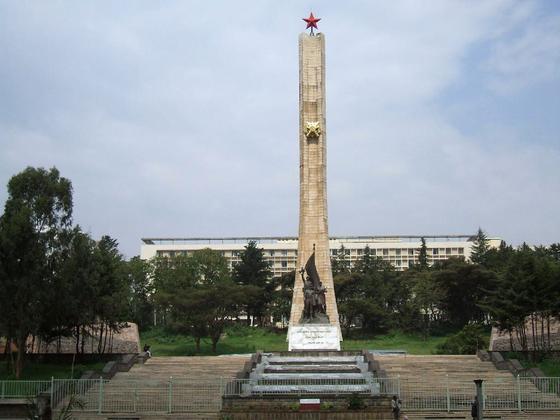
dergmonument.jpg

The Dialachin Monument (a.k.a. Victory Monument, Derg Monument) was a gift from Pyongyang to Addis Ababa’s Derg regime in the 1970s.

You can see the location of the monument in Wikimapia here.

You can learn more about the Derg here.

See more photos of the monument here.

*This location will be added to the next version of North Korea Uncovered (North Korea Google Earth).  If readers are aware of other construction projects the DPRK has supported, please let me know.  I am especially interested in locating the North Korean restaurants in China, Thailand, Cambodia, Vietnam, and Bangladesh.  Are there others?

Share

North Korea’s real estate black market

Sunday, January 25th, 2009

Some great qualitative information on the DPRK’s underground real estate market from Radio Free Asia:

Central authorities are investigating the practice in all of North Korea’s major cities and have confiscated the homes of “dozens” of local officials in the city of Chongjin, one well-informed source who asked not to be named said.

Private ownership or sale of homes is forbidden by the North Korean state, which assigns dwellings to its citizens based on its own determination of need.

“Most government officials build their residences in the North Korean equivalent of suburbs, in areas that are close to the city but still have a rural flavor,” the source, a Chinese merchant who does business in North Korea, said.

“They sell them when they retire.”

“If someone sells a 50-pyong (1,800-square foot) house in such an upscale neighborhood, he can then buy a house that is three or four times bigger in a different area,” the merchant said.

Party and state officials receive permits and order state-run construction companies to build homes in suburban areas near the sea, the merchant said.

He added that the value of real estate privately sold in North Korean port cities is now appreciating at twice the rate of real estate sold elsewhere in the country.

High-quality materials, including expensive appliances and wallpaper, are often used in the building of officials’ homes, according to a North Korean defector originally from Chongjin but now living in South Korea.

“Small but elegant” patios are sometimes also included, he said.

To justify the construction and occupancy of a larger space, local officials build multi-unit structures and fill them with relatives or people of more modest means, the defector said. 

When the officials retire, they pay the other occupants to move and then sell the entire structure.

North Korean authorities have now sent “task forces” to each of North Korea’s major cities to investigate real estate deals by local officials, the border merchant said, adding that a 40-member group was recently sent to Chongjin, where the homes of dozens of officials were seized.

An official in the city’s Songpyong Ward has reportedly been demoted and reassigned to a more backward part of the country, and fines equal to the actual value of transactions have been imposed on citizens who bought or sold homes.

Some thoughts:
1. IFES reported that private real estate transactions were quite common last september.

2. This report, combined with previous accounts, indicates that, although illegal, the DPRK’s real estate market is quite rational.  Construction quality and location influence housing prices.  According to the Daily NK, the qality of the chairman of the neighborhood people’s committee also influences the price.

3. Could the effort to crack down on these transactions be part of the plans to achieve a “Strong and prosperous nation” by 2012?

Read more here:
North Korean Economy Watch: real estate posts

North Korea’s Black-Market Housing
Radio Free Asia
Jung Young
1/23/2009

Private sector real estate activity booming in the DPRK
Institute for Far Eastern Studies (IFES)
NK Brief No. 08-9-4-1
9/4/2008

Who Is the Chairperson of the People’s Unit?
Daily NK
Moon Sung Hwee
8/18/2008

Share

DPRK outlines region-specific economic growth plans

Saturday, January 24th, 2009

Institute for Far Eastern Studies (IFES)
Nk Brief No. 09-1-23-1
1/23/2009

Following the recent North Korean New Year’s Joint Editorial and its calls for economic measures, on January 5, more than 100,000 people attended a rally in Pyongyang at which customized economic tasks were presented for each of the North’s provinces, taking into account each region’s particular industrial concentration or specialty.

According to North Korean media reports on January 20, Pyongyang stressed reforms in steel, power, coal, railway, and other sectors it considers ‘Priority Sectors of the People’s Economy.” It also presented tasks for the promotion of housing construction, refurbishment of pig farms, and the increase in production of farms and light industries providing daily necessities to the people of the North.

South Pyongan Province was tasked with increasing the production of ‘Juche’ steel’ at the Chollima Steel Complex, which kicked off the “new revolutionary upsurge” late last year during an on-site inspection by Kim Jong Il, as well as full operation of the newly built ‘superpower electric furnace’, and called on all the people of the province to increase production of organic fertilizer in order to boost food production.

For North Pyongan Province, “mass reforms” for the metalworks sector and concentrated efforts to increase electrical production at the Supung and Taechon power plants were called for. In addition, increased production at the Kujang Earth Colliery Complex, Rakwon Machinery Complex, and the Sinuiju Cosmetics Factory were ordered, as was the institution of advanced agricultural management methods.

Efforts in South Hwanghae Province are to be focused on increasing iron ore mining and scrap iron collection at sites such as the Eunryool and Jaeryung mines, and agricultural production goals are to be met through the introduction of high-yield crops and double-cropping.

North Hwanghae Province was ordered to focus on increasing production at the Hwanghae Iron Complex, the Yesong River Youth Power Plant No. 1, the 2.8 Madong Cement Factory, the Sariwon Poultry Farm, and the Sariwon Pig Farm. In addition, high-yield crops are to be introduced and construction of irrigation systems is to begin, as land management efforts are to be implemented in order to expand agricultural land in Mirubol. North Hwanghae Province is also to build a new library, a new arts theater, and a new housing.

In South Hamgyung Province, efforts are focused on construction of the Keumya River and Keumjin River Guchang power plants, as well as improving mining capacity at the mines in the Danchun area while renovating production facilities at the Sudong Mines. Aggressive promotion of construction on the second stage of the 2.8 Vinylon Complex was also emphasized. Provincial authorities were also ordered to complete the initial stage of refurbishment in the Heungnam Pharmaceutical Plant, improve production at the Kwangpo Duck Farm and the Hamju Pig Farm, and accelerate home construction in Hamheung City.

North Hamgyung Province was tasked with perfecting ‘North Korean-style steel production methodology’ at the Kim Chaek Iron Complex and Sungjin Steel Complex, and modernizing exploration, mining and processing equipment at the Musan Mining Complex in order to boost output, along with bringing the Seodusu Power Plant and Chungjin Thermoelectric Power Plant fully on-line. Another important task prioritized was the completion of the second stage of the Urangchun Power Plant.

In Kangwon Province, construction of the Wonsan Army-People Power Plant, increased production at the Munchon River Ironworks, modernization of the Wonsan Shoe Factory and the Wonsan Textiles Factory, and the refurbishment of the Munchon Poultry Processing Plant were emphasized, along with the diversification of management in farming communities in order to resolve food shortage problems.

Ryanggan Province, in the northern Gosan region, was tasked with improving management of the Samsu Power Plant, which entered service in May 2007, and construction of the Baekdu Mountain Military-first Centennial Power Plant and other electrical facilities, and the establishment of a ‘hometown of potatoes’ for the quick increase in potato cropping.

The Jagang Province was tasked with modernizing its metalworks sector and increasing electrical production at the Gangye Youth Power Plant and Janga River Power Plant, construction of small and medium-sized power plants, and increasing its logging production. Jagang Province was also tasked with normalizing production in its pig, duck, and chicken factories, and software development for local organizations was emphasized as a priority task for the Electronic Business Research Institute in Ganggye City, which was visited by Kim Jong Il after its grand opening last year.

Share

More on Pyongyang’s facelift

Wednesday, January 21st, 2009

As mentioned earlier (here, here, here, and here) the DPRK is pursuing the goal of achieving a “strong and prosperous country (Kangsong Taeguk)” by 2012 (Kim il Sung’s 100th birthday).

Today the Choson Sinbun (via Yonhap) fills us in on some new policy details:

Choson Sinbun, a pro-Pyongyang paper published by Korean residents in Japan, said the People’s Committee of Pyongyang plans to plant 300,000 trees and build several “modern” parks across the capital under its 2009 urban management plan.

“The plan is characterized by the construction and modernization of parks and recreational gardens, and coincides with North Korea’s key aim of enhancing the cultural life and morale of its workers,” it said.

A greenspace will be built along the residential Mansudae area, where many apartment buildings are under construction, according to the report. A “folk park” and a “modern park” are also being planned for other areas in the city.

Antiquated facilities at a pond park at the edge of Pyongyang will be replaced by statues, recreation facilities and a beverage store, it said.

The urban remodeling project is being spearheaded by Jang Song-thaek, brother-in-law of leader Kim Jong-il, who reportedly wields nearly unrivaled power.

Read the full article here:
Pyongyang beefs up remodeling drive with more parks
Yonhap
1/21/2009

Share

North Korea on Google Earth

Thursday, October 2nd, 2008

North Korea Uncovered: Version 12
Download it here

mayday.JPGAbout this Project: This map covers North Korea’s agriculture, aviation, cultural locations, markets, manufacturing facilities, energy infrastructure, political facilities, sports venues, military establishments, religious facilities, leisure destinations, national parks, shipping, mining, and railway infrastructure. It is continually expanding and undergoing revisions. This is the 12th version.

Additions include: Tongch’ang-dong launch facility overlay (thanks to Mr. Bermudez), Yongbyon overlay with destroyed cooling tower (thanks to Jung Min Noh), “The Barn” (where the Pueblo crew were kept), Kim Chaek Taehung Fishing Enterprise, Hamhung University of education, Haeju Zoo, Pyongyang: Kim il Sung Institute of Politics, Polish Embassy, Munsu Diplomatic Store, Munsu Gas Station, Munsu Friendship Restaurant, Mongolian Embassy, Nigerian Embassy, UN World Food Program Building, CONCERN House, Czech Republic Embassy, Rungnang Cinema, Pyongyang University of Science and Technology, Pyongyang Number 3 Hospital, Electric Machines Facotry, Bonghuajinlyoso, Second National Academy of Sciences, Central Committee Building, Party Administration Building, Central Statistics Bureau, Willow Capital Food House, Thongounjong Pleasure Ground, Onpho spa, Phipa Resort Hotel, Sunoni Chemical Complex (east coast refinery), Ponghwa Chemical complex (west coast refinery), Songbon Port Revolutionary Monument, Hoeryong People’s Library, Pyongyang Monument to the anti Japanese martyrs, tideland reclamation project on Taegye Island. Additionally the electricity grid was expanded and the thermal power plants have been better organized. Additional thanks to Ryan for his pointers.

I hope this map will increase interest in North Korea. There is still plenty more to learn, and I look forward to receiving your contributions to this project.

Version 12 available: Download it here

Share

Download glitch fixed: North Korea Google Earth (version 11)

Thursday, August 14th, 2008

The most authoritative map of North Korea on Google Earth
Download it here

This map covers North Korea’s agriculture, aviation, cultural locations, markets, manufacturing facilities, railroad, energy infrastructure, politics, sports venues, military establishments, religious facilities, leisure destinations, and national parks. It is continually expanding and undergoing revisions. This is the eleventh version.

Additions include: Mt. Paegun’s Ryonghung Temple and resort homes, Pyongyang’s Chongryu Restaurant, Swiss Development Agency (former UNDP office), Iranian Embassy, White Tiger Art Studio, KITC Store, Kumgangsan Store, Pyongyang Fried Chicken Restaurant, Kilju’s Pulp Factory (Paper), Kim Chaek Steel Mill, Chongjin Munitions Factory, Poogin Coal Mine, Ryongwun-ri cooperative farm, Thonggun Pavilion (Uiju), Chinju Temple (Yongbyon), Kim il Sung Revolutionary Museum (Pyongsong), Hamhung Zoo, Rajin electrified perimeter fence, Pyongsong market (North Korea’s largest), Sakju Recreation Center, Hoeryong Maternity Hospital, Sariwon Suwon reservoir (alleged site of US massacre), Sinpyong Resting Place, 700 Ridges Pavilion, Academy of Science, Hamhung Museum of the Revolutionary Activities of Comrade Kim Il Sung, South Hamgyong House of Culture, Hamhung Royal Villa, Pork Chop Hill, and Pyongyang’s Olympic torch route. Additional thanks go to Martyn Williams for expanding the electricity grid, particularly in Samjiyon, and various others who have contributed time improving this project since its launch.

Disclaimer: I cannot vouch for the authenticity of many locations since I have not seen or been to them, but great efforts have been made to check for authenticity. These efforts include pouring over books, maps, conducting interviews, and keeping up with other peoples’ discoveries. In many cases, I have posted sources, though not for all. This is a thorough compilation of lots of material, but I will leave it up to the reader to make up their own minds as to what they see. I cannot catch everything and I welcome contributions.  Additionally, this file is getting large and may take some time to load.

Share

labor constraints at Kaesong

Wednesday, July 9th, 2008

According to the Korea Times, the end of official North-South dialogues has put plans on hold to expand housing for workers in the Kaesong Industrial Zone. 

From the article:

Officials at the complex expressed concerns that South Korean companies intending to set up operations there may be unable to do so as a lack of housing will likely see manpower shortages.

According to the Gaesong Industrial District Management Committee, the number of North Korean workers at 72 companies operating in the site totals 30,084 and the figure could reach 40,000 by late this year.

Besides, approximately 80,000 to 100,000 workers would be needed by 2010 when 450 companies are expected to settle in the industrial park.

However infrastructure projections show that less than 60,000 North Korean workers will likely be able to commute to the industrial site.

Currently, North Korean workers head for their workplaces by 88 commuter buses and bicycles and the authorities promised to provide an additional 100 buses until the year’s end.

South and North Korea agreed last December to build dormitories to accommodate 15,000 North Korean workers.

The two sides were to conduct a geological survey early this year and start construction work in the first half of the year following the agreement but the suspended talks have hindered the plan.

After conservative President Lee Myung-bak vowed a tougher line toward the North, the communist North kicked South Korean officials out of its territory in March and cut off official communication channels.

The Seoul government recognizes the lodging problem as urgent. Yet, it admitted it cannot find a solution at the moment since the North is rejecting any talks.

Read the full story here:
Gaeseong Complex Lacks in Lodgings for N. Korean Workers
Korea Times
Kim Sue-young
7/9/2008

Share