Archive for the ‘Communications’ Category

Friday Fun: DPRK cards, inside Air Koryo, images, and more

Friday, December 7th, 2012

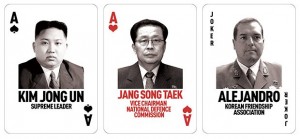
NK News gets creative: The innovative and informative NKNews.org is selling goodies this holiday season to fund its operations (I wish I had thought of that).  When I saw these playing cards, I laughed out loud:

I think I need these. You can order them here.

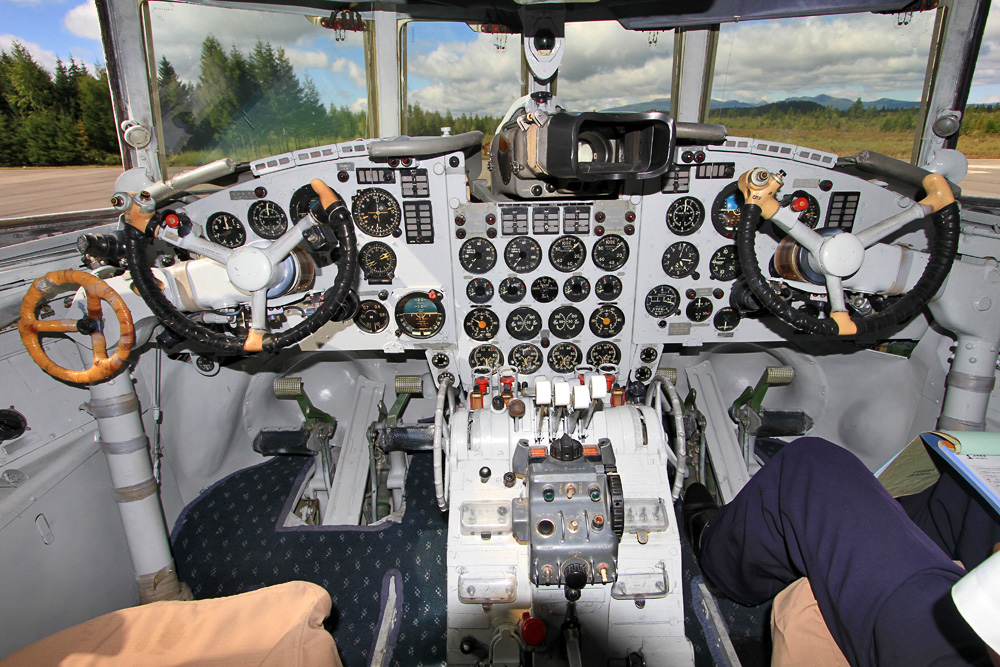
Inside Air Koryo: Martyn Williams notified me of this web page put up by tourists that took an aviation tour in the DPRK. Some incredible photos to be seen.  Here is just one:

The photo set also includes interior pictures of the “famous” Ilyushin-14 given to Kim Il-sung. UPDATE: The source claims that Stalin gave the plane to Kim Il-sung in 1955, however, as a reader points out, Stalin died in 1953.

Here is a flickr set put up by another member of the group.

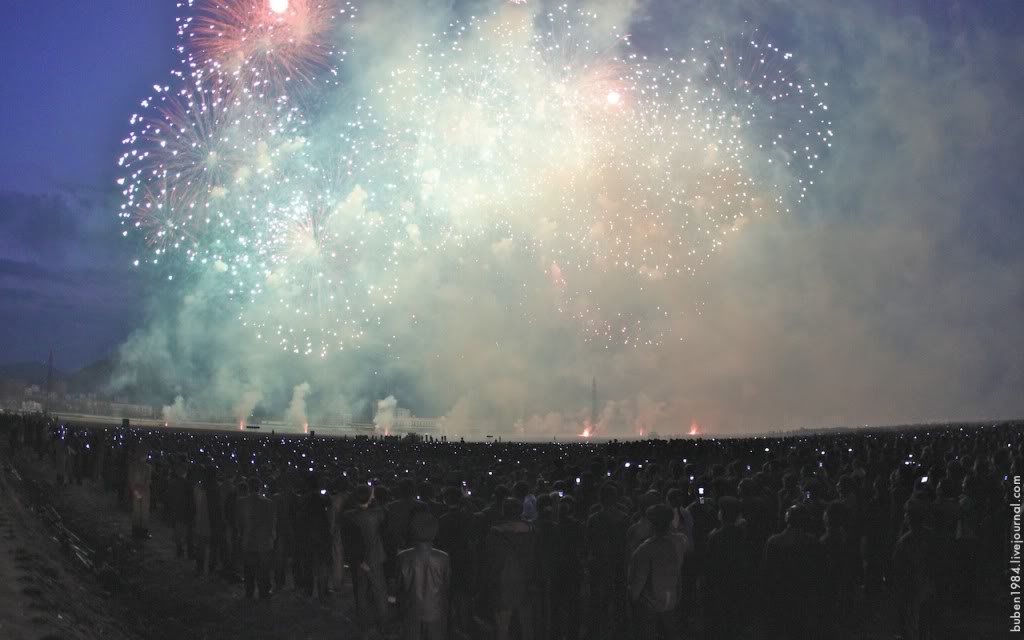
Mobile phones: A few days ago, NK News posted a link to these photos taken by Russian tourists to the DPRK. Among the lot was this great photo of North Koreans filming/photographing fireworks in Pyongyang with their mobile phones:

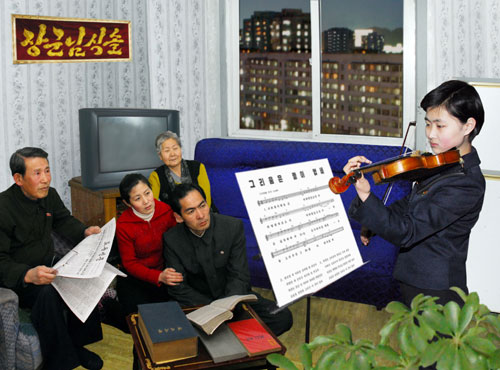
Rodong Sinmun photoshop: Perhaps it is unfair to hold Rodong Sinmun to the highest standards of professional journalism, but if you are going to photo-shop a picture, at least put some effort into it:

Click picture for larger version.

I am unsure why Rodong Sinmun felt compelled to badly photoshop what would otherwise have been a lovely photo.  Is it really so hard to get a photo of a girl playing a violin in front of her (very loyal) family?

Rodong Sinmun has inspired me to coin a  new word: Frankenphoto. Here is a working definition: When all of the compositional elements of a single photo were originally copied from separate pieces and painfully (badly) rendered together into a new image that at times seems to violate the laws of nature.

Just weird [revised]: Below is a very strange act that appeared on North Korean television. I did not understand it at all. After posting it, however, a reader informs me that is is a knock off of an act that appeared on  Soviet Television.  The original Latvian actor was named Arkady Raikin (Аркадий Райкин). See video of Raikin here. Wikipedia page here.

In this North Korean version, skip to the 3:26 mark.  New characters emerge at 5:26, 7:08, 8:17, 10:06.


Share

KoryoLink update

Sunday, November 18th, 2012

Although KoryoLink’s corporate performance no longer appears in Orascom shareholder reports, Naguib Sawiris has given an interview in Forbes in which he offers some business details:

Sawiris has a 75% stake in Koryolink via his Orascom Telecom Media & Technology (OTMT) unit, with the remainder held by a company under the Ministry of Post & Telecommunications. He says revenues in 2012 should reach around €186 million ($145 million), with an average revenue per user of €8.6. The network only permits domestic calls and locally hosted data services. A separate cell network is available for foreigners in North Korea.

FORBES: How many subscribers does Koryolink have? How extensive is your coverage in DPRK?

NAGUIB SAWIRIS: Koryolink currently has more than 1.5 million subscribers. Coverage includes the capital Pyongyang in addition to 15 main cities, more than 100 small cities, and some highways and railways. Territory coverage is around 14%, and more than 90% population coverage. The subscriber base has been increasing at a very healthy rate from 950,000 at [year-end] 2011 to an estimated 1.7 million at [year-end] 2012.

FORBES: Under your joint venture with the Ministry of Telecommunications, when will Koryolink lose its exclusivity? What will happen after this period ends?

NS: Exclusivity was granted for a period of 4 years from launch. After the expiry of exclusivity in Dec. 2012, Koryolink received written confirmation that for an additional period of 3 years (until 2015) no foreign investors will be allowed in the mobile business. However, we are continuing to expand our network and services to further solidify our position [in order] to be ready for any possible competition.

FORBES: What is your role in the construction of the Ryugyong Hotel? What other real estate interests do you have in DPRK?

NS: This is a special investment that we are maintaining through our banking subsidiary in the DPRK, where Orascom has the right to operate this facility. The construction, repair and facade installations have all been completed last summer. We are planning to relocate Koryolink headquarters into the tower very soon to bring life to the building. There are no other real-estate investments in the DPRK, however, Orabank, our banking arm in DPRK, is actively working towards developing mobile-related businesses and projects.

Chris Green offers some great information (about which I have long wondered)  on the process required to acquire a cell phone:

First, the individual wishing to obtain a cell phone must go to his or her local Communications Technology Management Office (통신통화관리국 or CTMO; in provincial capitals only) or a subordinate arm of the same (in smaller cities) to obtain a three page application form. This form, once filled in, must be stamped by the Ministry of Public Security officer assigned to the individual’s workplace or, for those without official workplaces, attached to his or her local people’s unit.

Having paid off the public security official in cigarettes or cash (more often the former, according to this author’s sources, because it arouses less friction) he or she must submit the stamped form to the CTMO or equivalent, whereupon it is sent, with all the speed one would expect of the North Korean transportation network, to the Ministry of Communications in Pyongyang. At this point there is little else to be done but go away and pitch the proverbial tent, because at best it takes a month for the staff in the revolutionary capital to process the application.

Assuming, and it should not be assumed, that those checks done in Pyongyang don’t yield any incriminating evidence of wrongdoing (don’t forget, the North Korean legal system makes every adult a criminal in one way or another, something which can come back and haunt any individual whenever “rents” are desired), the individual will eventually be ordered back to his local communications office, whereupon he will be handed a payment form. He or she must then take this form to a bank, and engage with the separate, and no less inefficient, bureaucracy therein in order to pay the majority (though not all) of the cost of a phone and Koryolink network activation fee.[1]

The payment form, duly stamped by a functionary at the bank, must then be taken back to the CTMO or equivalent, whereupon it can be exchanged for half the stamped application form originally sought from the ministry in Pyongyang. Here, finally, the individual reaches a watershed moment: this form can actually be exchanged for a cellular telephone!

However, the pain is actually quite a long way short of being over. In a moment of uncharacteristic efficiency, the actual cell phone shop is often directly outside the communications office, but in a moment of karma-balancing inefficiency, it doesn’t open much, carries a limited amount of product and is pitifully understaffed. As a result, queues are long, as are waits. Assuming an individual lives long enough to reach the front of such a queue, he or she is finally offered the opportunity to hand over another $70-$100 and depart the scene with a brand new phone.

Writing in the Daily NK, Kim Kwang-jin explains how people are getting around this burdensome regulatory process:

Therefore, the source said, “Middlemen in larger cities are getting multiple phones activated in random people’s names and then taking them to smaller cities to sell. Alternatively, households that don’t have any problem getting that kind of approval are mobilizing the names of their entire families to get phones, which they are then selling on to the middlemen.”

“The end users are buying these cell phones for $300 to $500 from the middlemen or from private sellers. This saves them having to go to the trouble of applying to Koryolink,” he added.

A basic Koryolink phone can be purchased officially for roughly $270- $300, excluding bribes and extraneous costs. The price of one of these semi-legal phones depends on duration of use and model. The best product, the T1, a clamshell design, is the latest and costs more than $500. The next mid-range model is the T3, another clamshell; there is also a similarly priced phone with a slide design. The budget offerings are the T95 and T107. Differences in price are mostly attributable to differences in sound quality rather than the designs, sources assert.

In addition, there are also phones available for use within individual provinces. These products, which are similar to the so-called “city phones” that were briefly permitted in the late 90s but soon got withdrawn, cost just $70 at the time of writing.

Geoffrey See of Choson Exchange also offers some insight on Ora Bank’s mobile-related business projects:

However, it appears that Naguib, Chairman of Orascom, might have other ideas. In his words, “Orabank, our banking arm in DPRK, is actively working towards developing mobile-related businesses and projects.” The 3G network provides a platform for a range of other services that emerging market economies would need including remittances and payments through mobile banking and mobile payments. Given the primitive development of the services sector, mobile provides an opportunity for Orascom to upend the services industry in North Korea.

This was something I was originally looking at in North Korea. Payments are currently messy in the country. On a previous trip, I remembered an account of a North Korean trying to pay the handphone bill. Apparently the payment went to the wrong account, and the North Koreans spent the morning calling and shouting at some people to make the mistaken beneficiary return the money so that the payment could go to the right account. For what mobile banking and payments could potentially look like in North Korea, check out M-pesa.

Read the full story here:
Pyongyang Calling For Egyptian Telecoms Tycoon Naguib Sawiris
Forbes
Simon Montlake
2012-11-18

Share

DPRK improving short wave radio broadcast qualtiy

Wednesday, October 31st, 2012

According to the Daily NK:

According to the Northeast Asian Broadcasting Institute (NABI), the authorities made their first move in March this year, replacing the shortwave transmission equipment at Kanggye Transmission Station in Jagang Province with modern equipment made by Beijing BBEF Electronics Group Co. Kanggye Transmission Station is one of three high output shortwave transmission facilities in North Korea, with the other two being at Pyongyang and in Gujang County, North Pyongan Province.

The measures come pursuant to a June 2011 agreement signed between the North Korean Ministry of Communications and BBEF, under which the latter is required to provide North Korea with modern radio and television transmission equipment and training in its use.

North Korea has two shortwave broadcasters; Chosun Central 1st Broadcast and Pyongyang Broadcast. The first is for the domestic and international audience while the latter serves the international audience only, leading to the assumption that North Korea is replacing its existing transmitters in order to improve its broadcasts targeting South Korea. With the sort of modern equipment arriving from BBEF, North Korean broadcasts will be receivable anywhere in South Korea, no matter where in the North they are broadcast from.

According to NABI, North Korea’s shortwave broadcasting capacity was previously very weak due to worn out and broken equipment. Signal strength was particularly weak, meaning that listeners tended to receive a different channel even when tuned directly to the intended broadcast frequency. According to one defector from Pyongyang who arrived in South Korea in June 2011, the signal strength of Chosun Central 1st Broadcast was so weak at times that it was even unlistenable in most regions of North Korea.

However, the quality has recently improved dramatically, as Park Sung Moon of NABI explained to Daily NK, saying, “Recent analysis of North Korea’s shortwave Chosun Central 1st Broadcast and Pyongyang Broadcast reveal that they are being broadcast clearly and consistently, without interference or signal shifting.”

“In particular, Pyongyang Broadcast is much better than it used to be, but the overall broadcast situation has gotten a lot better,” Park added, going on, “It looks like they have imported the Chinese transmission equipment to improve their South Korea broadcasting.”

Professor Choi Hyung Jin of Sungkyungwan University Information and Communications Department agreed, adding, “If a transmitter is old and worn out then it either takes excessive power to function or the signal strength weakens. Either way, the effect of the broadcast system itself is detrimentally affected. Notably, listeners often cannot hear the broadcast. If you want people to listen, you have to improve your transmitters.”

The other side of the coin is that improved shortwave transmission strength stops incoming signals from reaching listeners.

According to one defector who used to be a part of the Party Propaganda and Agitation Department, “They know that when the Chosun Central 1st Broadcast signal strength is weak, it regularly arrives with outside broadcasts mixed in. I think they want to stop this happening.”

Though I have located many communications towers on satellite imagery of the DPRK, I have yet to definitively identify any of the DPRK’s short wave radio broadcast towers (Pyongyang, Kujang, Kanggye). If you have any information on them, please let me know.

I have located this massive broadcast center in Myohyangsan, but its purpose is unknown to me.

Read the full story here:
North Korean Shortwave Getting Stronger
Daily NK
Mok Yong Jae
2012-10-31

Share

KoryoLink update (sort of)

Friday, August 17th, 2012

It is getting harder to know specific information about the DPRK’s mobile phone network…such as how many subscribers have signed up or how revenues/profits are doing.

In December 2011 Orascom Telecom finalized a demerger and the KoryoLink portfolio (the DPRK’s 3G mobile phone network) was transferred to a new holding company, Orascom Telecom Media and Technology Holding S.A.E. (OTMT).

According to the Orascom Q1 2012 shareholder report (p15):

Under the terms of the VimpelCom transaction, VimpelCom, Weather II and OTH agreed on a demerger plan (the Demerger”) pursuant to which the Company‟s investments in certain telecom, media and technology assets (the “SpinOff Assets”), which were not intended to form part of the VimpelCom business going forward, would be transferred to a new company, Orascom Telecom Media and Technology Holding S.A.E. (“OTMT”). The Demerger was performed in accordance with the guidelines of the Egyptian Financial Supervisory Authority and in particular decree no. 124 of 2010 and was completed in December 2011. The split of OTH shares by the way of the Demerger resulted in OTH shareholders holding the same percentage interest in OTMT as they held in the Company. The Demerger plan was initially approved in a shareholders meeting dated 14 April 2011 and subsequently on 23 October 2011. Approval from the Egyptian Financial Supervisory Authority was received in December 2011.

As a result of the Demerger, during November and December 2011, ownership of the following Spin-Off Assets was  transferred from the Company to OTMT:

[…]

75% ownership in CHEO Technology Joint Venture Company, together with all other assets and businesses located in
North Korea;

95% ownership in Orabank NK;

[…]

Other than the reference above, the Q1 report does not mention KoryoLink or even the DPRK. As you would expect, KoryoLink is not mentioned in Orascom’s Q2 2012 Shareholder Report either.

OTMT (the new holding company) has a web page, however it contains remarkably little information. Here is what it has to say about KoryoLink:

Koryolink

A joint venture between OTH [Orascom Telecom Holdings] and the state-owned KPTC [Korea Post and Telecommunications Company] and included as part of the assets held by OTMT following the demerger. OTMT holds, a 75% stake in [Cheo Technology Joint Venture Company] with KPTC. The company is North Korea’s only 3G Mobile operator. By June 2011, Koryolink’s network covered more than 75% of North Korea’s population (estimated at 24.5 million).

Being the first company of its kind and scale in North Korea, koryolink established many precedents; a first of its kind call center to provide customer service; a launch announcement in major newspapers and on radio despite almost non-existent marketing and advertising industries; and the implementation of a koryolink advertising billboard, the first of its kind in Pyongyang.

KPTC is the “Korea Post and Telecommunications Company” which is nominally controlled by the DPRK’s Ministry of Post and Telecommunications.

This OTMT page shows five financial reports for the year, however, only one of them is in English (an audit by Deloitte in June 2012). All the other reports are in Arabic. The audit report includes aggregate financial information from “CHEO Technology (KoryoLink)”; however, it does not contain any detailed company information. Hopefully this will change in the future.

The OTMT web page does not mention OraBank at all.  According to this organization chart, however, it appears to be held by a separate holding company under the OTMT umbrella, the Oracap Holding Co./Oracap Far East Ltd.  I have not been able to find out much more than that.

Additional information welcome.

Share

Lankov on the North Korean economy

Saturday, July 7th, 2012

Andrei Lankov highlights in a recent Asia Times article some observations (qualitative data) that indicates the DPRK has seen significant growth in recent years. He is careful to qualify his observations with caveats that the level of growth in the country as a whole (as opposed to Pyongyang) remain more difficult to determine.

More expensive shops stocking luxury goods are becoming more numerous as well. Gone are the days when a bottle of cheap Chinese shampoo was seen as a great luxury; one can easily now buy Chanel in a Pyongyang boutique; and, of course, department stores offer a discount to those who spend more than one million won on a shopping spree. One million won is roughly equivalent to US$250 – not a fortune by the Western standards but still a significant amount of money in a country where the average monthly income is close $25.

The abundance of mobile phones is much talked about. Indeed, North Korea’s mobile network, launched as recently as late 2008, has more than one million subscribers. It is often overlooked that the old good landline phones also proliferated in the recent decade. A phone at home ceased to be seen as a sign of luxury and privilege, as was the case for decades. Rather, it has become the norm – at least, in Pyongyang and other large cities.

The capital remains badly lit in night, but compared with the norm of some five or 10 years ago, the situation has improved much. The electricity supply has become far more reliable, and in late hours most of the houses have lights switched on.

Of course, this affluence is relative and should not be overestimated: many people in Pyongyang still see a slice pork or meat soup as a rare delicacy. The new posh restaurants and expensive shops are frequented by the emerging moneyed elite, which includes both officials and black/grey market operators (in some cases one would have great difficulty to distinguish between these two groups). In a sense, Pyongyang’s prosperity also reflects the steadily growing divide between the rich and poor that has become a typical feature of North Korea of the past two decades.

Nonetheless, those foreign observers who have spent decades in and out of Pyongyang are almost unanimous in their appraisal of the current situation: Pyongyang residents have never had it so good. It seems that life in Pyongyang has not merely returned to pre-crisis 1980s standards but has surpassed it.

And how can we explain these developments? Lankov offers three theories:

The first seems to be the growth of private economic activity. Estimates vary, but most experts agree that the average North Korean family gets well over half its income from a variety of private economic activities.


The second reason is the gradual adjustment of what is left of the state-controlled economy. Nowadays, North Korean industrial managers do not sit by helplessly when they cannot get spare parts or fuel from the state – as was often the case in the 1990s. Instead, they try to find what they need, often getting the necessary supplies from the private market.


The third reason is, of course, Chinese economic assistance and investment.

Read the full story here:
North Korea’s pools of prosperity
Asia Times
Andrei Lankov
2012-7-7

Share

Consumer culture changing DPRK

Wednesday, May 30th, 2012

Arirang News has posted a video on the changes in consumer culture in the DPRK. It highlights just how much things have changed since the days of Kim Il-sung:

Share

Kim Jong-un: urban planner [Book on land management]

Tuesday, May 8th, 2012

UPDATE 2 (2013-9-10): According to Yonhap:

A speech made by North Korea’s young leader Kim Jong-un last year that detailed his plan on land management has been published in Chinese, a state media report said Tuesday, in what is believed to be his first Chinese-language publication.

The Chinese-version of Kim’s speech, titled “On Brining About a Revolutionary Turnabout in National Land Management Work to Meet the Demand of Building a Powerful Socialist State,” was published on Sept. 3 in Dandong, China’s border city with North Korea, China News Service reported.

According to the report, the speech by Kim was published by a Chinese printing firm named “Longshan,” but it did not give other information, including the name of its publisher or whether the publication is being sold.

Kim, who took power in late 2011 following the death of his father, Kim Jong-il, made the speech on April 27 of last year, while convening a meeting of key members of the North’s Workers’ Party of Korea and economic organizations.

During the April 27 meeting, Kim said, “Land management is a patriotic work for the eternal prosperity of the country, and a noble work for providing the people with better living conditions,” according to a report by the North’s state media at the time.

Kim also ordered officials to improve water management, including the improvement of rivers and streams as well as dams, lock gates and “gravity-fed waterways and irrigation channels.”

Read the full story here:
N. Korean leader’s plan on land management published in Chinese
Yonhap
2013-9-10

UPDATE 1 (2012-11-19): Aidan Foster-Carter has sent me a Naenara link to Kim Jong-un’s full remarks (published in English).

I have put the entire speech into a PDF which you can view here.

ORIGINAL POST (2012-5-8): On 2012-5-8 KCNA posted two articles citing a publication by Kim Jong-un on “land management”. The paper, titled “On Effecting a Drastic Turn in Land Management to Meet the Requirements for Building a Thriving Socialist Nation”, was not posted but will no doubt be offered for sale to Pyongyang tourists before too long. However until I receive a copy, the two KCNA articles below will have to do:

(more…)

Share

DPRK cooking web page launched

Thursday, March 15th, 2012


This week, KCNA announced the following:

The Korean Association of Cooks has opened “Korean Dishes”, an Internet homepage.

The homepage deals with common knowledge and theories on variety of dishes and how to cook them.

It also offers such data as origins and anecdotes about dishes and global trend in cooking development.

It has a distinctive catalogue for serving housewives’ convenience. When a visitor chooses any food material in the
catalogue, she can get detailed information about lists of dishes prepared with it and their cookery.

The homepage contains multimedia on national and foreign dishes. Through homepage visitors can exchange their knowledge and views with each other and acquire a wide-ranging cooking.

An official of the Korean Association of Cooks told KCNA that this homepage serves as a close companion for cooks and housewives.

Although the KCNA story does not mention the URL, it is nearly visible on the screen shot taken in the top left photo.  I talked about it with Martyn Williams (check out his database of North Korean web pages here)  and we agreed that it is http://www.cooks.org.kp/index.php. This web page, however, is not actually available on the “world wide web”. It appears to be available only to readers of the DPRK’s intranet, Kwangmyong, which is available through domestic computer terminals and I believe partially through the KoryoLink 3-G phone network.

Some other points of interest:

1. The screen shots indicate that that the North Korean intranet web pages are compatible with the Mozilla Firefox browser.

2. The North Korean intranet pages are prefixed with “http://www.” indicating that though they are not currently on the global Internet, it would be very simple to make them so. This means that the computer programmers in the DPRK are building the network with an infrastructure that would not preclude eventual unification with the global Internet.

Additional Information:

1. Read Martyn William’s analysis of the web pages here.

2. The indispensable STALIN Search Engine provides past KCNA articles on the “Korean Association of Cooks“.

Share

DPRK steps up efforts to develop smartphone applications

Saturday, February 4th, 2012

According to Yonhap:

North Korea is stepping up efforts to develop smartphone applications, a move that underscores its commitment not to be left behind in the fast moving world of information technology.

Choe Hyok-chol, a North Korean professor, said research projects are under way to introduce Android smartphones, according to a video clip posted on YouTube.

He explained a bar code application on Android smartphones has improved the time it takes to recognize information contained in bar codes. The video appears to have been recorded on Oct. 27 when the North held an exhibition on programs.

The move comes as more than 1 million North Koreans are subscribed to mobile phone services provided by Egypt’s Orascom Telecom, according to a news report, in a sign of growing mobile penetration in the reclusive country.

The Android operating system is the most widely used smartphone software around the world with hundreds of manufacturers building handsets based on the free and open platform.

You can see the video clip on YouTube here.

Read the full story here:
N. Korea steps up efforts to develop smartphone applications
Yonhap
2012-2-4

Share

Sawaris second DPRK trip and KoryoLink subscription data

Friday, February 3rd, 2012

The CEO of Egypt’s Orascom Telecom, Naguib Sawiris, has made his second visit to the DPRK. You can read about his first visit in January 2011 here.

Pictured above (KCNA): Naguib Sawiris meets with Kim Yong-nam.

KCNA reported that Mr.Sawiris arrived on February 1 (video here):

Pyongyang, February 1 (KCNA) — Naguib Sawiris, executive chairman of the Orascom Telecom Media and Technology Holdings SAE, and his companion arrived here on Wednesday.

On February 2, KCNA reported that Mr. Sawiris met with Kim Yong-nam (video here):

Kim Yong Nam, president of the Presidium of the DPRK Supreme People’s Assembly, met and had a friendly talk with Naguib Sawiris, executive chairman of the Orascom Telecom Media and Technology Holdings SAE of Egypt, and his companion who paid a courtesy call on him at the Mansudae Assembly Hall Thursday.

KCNA reported that Sawiris left on February 3, however, before leaving he praised Kim Jong-il and offered a gift to Kim Jong-un. Accoridng to KCNA:

Naguib Sawiris, executive chairman of the Orascom Telecom Media and Technology Holdings SAE of Egypt, was interviewed by KCNA before his departure from here.

Expressing profound reverence for leader Kim Jong Il, he said:

The Korean people lost a great leader. I also lost the most friendly man. General Kim Jong Il was a great father of the people.

I can never forget the day when I had the honor of being received by him.

While meeting him, I was totally attracted by his humanity.

He was the greatest man possessed of the noblest virtue.

His untimely passing was a great loss not only to the Korean people but to progressive humankind.

He devoted his all to his people with ardent love for the people.

While staying in the DPRK I was deeply moved to visit the Pyongyang Children’s Foodstuff Factory honored with the leadership provided by Kim Jong Il.

He paid deep attention to the operation of the factory.

The tireless efforts made by him for the happiness of the people will be conveyed to posterity for all ages.

The Korean people are energetically pushing forward socialist construction under the sagacious leadership of supreme leader Kim Jong Un.

I sincerely rejoice over the achievements made by the Korean people.

I wish the Korean people greater progress.

I would like to make a positive contribution to boosting the exchange with the DPRK.

His gift to Kim Jong-un remains unknown for now:

The dear respected Kim Jong Un, supreme leader of the Workers’ Party of Korea and the Korean people, received a gift from the executive chairman of the Orascom Telecom Media and Technology Holdings SAE of Egypt.

Chairman Naguib Sawiris handed it to an official concerned on Thursday.

While in the DPRK, Orascom holding announced that it had reached 1 million mobile phone subscribers in the DPRK. According to Bloomberg:

Orascom Telecom Media & Technology Holding SAE, an Egyptian mobile-phone operator headed by billionaire Naguib Sawiris, said its subscribers in North Korea exceeded 1 million.

The Cairo-based company made the annoucement in a regulatory filing today.

The Economist offers some business statistics:

Koryolink earns a gross margin of 80%, making North Korea by far the most profitable market in which Orascom operates. The company has worked hard to court the regime, its chairman travelling to Pyongyang last year to meet the late supreme leader, Kim Jong Il.

North Korean mobile-phone users spend an average of $13.90 a month on calls and text messages, and they tend to pay in hard currency. According to a foreign diplomat, many customers turn up at Koryolink shops with bundles of euro notes. There are even incentives for paying in euros, such as free off-peak calls. This provides foreign currency for a government that craves it.

Mobile-phone customers obtain the hard currency from the informal private trading on which many North Koreans depend. Such business is forbidden, but the government has failed to feed its people, forcing it to turn a blind eye to some capitalist practices. Many insiders benefit: Pyongyang’s “golden couples” consist of a government-official husband and an entrepreneur wife.

Mobile usage now appears to be spreading beyond Pyongyang. The gadgets are a common sight in other cities such as Nampo, not far from the capital, and increasingly are owned by non-officials. As yet, though, only a sixth of the country has a mobile signal.

Martyn Williams has specifics on the corporate structure of the service and service statistics:

The company is operated by Cheo Technology, which is a joint venture between Egypt’s Orascom Telecom Media And Technology Holding (OTMT) and North Korea’s Ministry of Posts and Telecommunications. OTMT holds a 75 percent stake and the North Korean government owns the remaining 25 percent.

Koryolink’s service has popularized cell phones and visitors to Pyongyang say they are now a common site on the city streets. The Koryolink network covers the capital city in addition to 14 major cities, 86 smaller cities, and 22 highways. That equals 14 percent of the landmass but about 94 percent of the population, according to Orascom.

Share

An affiliate of 38 North