Archive for the ‘Communications’ Category

U.S. denies North Korea diplomatic ties report

Monday, November 26th, 2007

Reuters
11/26/2007

A U.S. embassy spokesman on Monday denied a report by South Korea’s biggest daily that the State Department has stationed an employee in Pyongyang to lay the groundwork for opening a permanent liaison office in North Korea.

The State Department has an employee in Pyongyang but only to manage equipment for a team that is overseeing the disablement of North Korea’s nuclear facilities. The employee will be in the North through the disablement process.

“This is not for normalisation,” spokesman Max Kwak said.

There has been a rise in exchanges between the two countries after reclusive North Korea agreed this year to a multinational deal to freeze and then roll back its nuclear arms programme in return for massive aid and better international standing.

The Chosun Ilbo newspaper quoted an unnamed source in Washington as saying: “A U.S. State Department diplomat who handles administrative affairs has checked into a room in Koryo Hotel and has been using it as an office and accommodation.”

The State Department employee has been acting as an administrative liaison between the United States and North Korea, the source said.

The Koryo is one of the few hotels in Pyongyang open to foreign guests.

The United States has said if North Korea completely ends its nuclear weapons programme, Washington is willing to establish diplomatic ties with Pyongyang.
U.S. Diplomat ‘Permanently’ Stationed in Pyongyang
Choson Ilbo (h/t One Free Korea)
11/26/2007

A U.S. diplomat has been stationed permanently at the Koryo Hotel in Pyongyang since mid-November, a source said Sunday. The development comes as U.S.-North Korea relations are improving as Pyongyang implements its promise to disable its nuclear facilities at Yongbyon by the end of the year.

A source in Washington said that the U.S. plans to dispatch another permanent diplomat to Pyongyang soon, with the Koryo Hotel likely to serve as a de facto U.S. liaison office in North Korea. This is the first time the U.S. has ever stationed a permanent diplomat in Pyongyang, and it suggests the possible normalization of relations between the two sides.

The Washington source said, “A foreign service officer in charge of administrative affairs from the U.S. State Department has been staying at the Koryo Hotel in Pyongyang, using his room as both an office and living quarters. He is mainly carrying out administrative liaison efforts between the U.S. and North Korea.”

The diplomat is apparently serving as a liaison officer for U.S. delegations to Pyongyang and figuring out their staying expenses there. The temporary U.S. office at the Koryo Hotel is said to be fitted out with exclusive telephone and fax lines and a computer with an Internet connection.

The U.S. is expected to dispatch a senior diplomat to Pyongyang who will handle political affairs when North Korea completes the disablement of its nuclear facilities. This senior diplomat will also participate in talks with Pyongyang and visit the nuclear sites at Yongbyon on a non-regular basis to inspect the progress of the disablement and dismantlement of the facilities.

Washington and Pyongyang agreed on this through meetings between chief U.S. negotiator to the six-party talks Christopher Hill and his North Korean counterpart Kim Kye-gwan and through “a channel in New York,” the source said.

The U.S. is expected to operate its temporary office in Pyongyang with a staff of two diplomats for the time being, with a view to upgrading the office to a regular liaison office or a permanent mission if North Korea clearly shows its intention to fully dismantle its nuclear programs.

The agreement to operate a de facto U.S. liaison office in Pyongyang suggests that the two sides strongly intend to improve their relations. Washington and Pyongyang agreed at the 1994 Geneva Accords to open a liaison office in Pyongyang upon concluding talks on the first North Korean nuclear crisis, but that agreement was never realized.

Share

Internet to Open inside Gaeseong Site

Friday, November 16th, 2007

Korea Times
Yoon Won-sup
11/16/2007

The prime ministers of the two Koreas have agreed to set up Internet, wire and mobile phone services including mobile phones in the Gaeseong Industrial Complex in North Korea.

They also agreed to allow free movement of people and vehicles of the South in the complex starting next month in order to expand inter-Korean economic cooperation.

The agreement was made between Prime Minister Han Duck-soo and his North Korean counterpart Kim Yong-il Friday.

The rare talks between the prime ministers, the first in 15 years, went smoothly.

The North Korean delegates were very favorable to suggestions made during the three-day talks in Seoul, according to sources.

Particularly, Han and Kim took a stroll together in the morning and toasted each other with soju at dinner, Thursday, boasting of their friendship.

President Roh Moo-hyun hosted a lunch for the delegations, Friday, and thanked them for reaching an agreement. The North Korean delegates returned to Pyonyang by plane afterwards.

The two prime ministers issued a joint statement after the talks, which were aimed to follow up agreements reached at the second inter-Korean summit held in Pyongyang from Oct. 2-4.

They agreed to create a committee for a special zone of peace and cooperation in the West Sea coastal area under which five subcommittees will be set up to deal with an economic zone in Haeju, North Korea; the common use of Haeju port and the southern part of the Han River estuary in South Korea; the safe passage of private ships near Haeju; and a common fishing area in the West Sea.

The first committee meeting, chaired by a minister-level official, will be held in Gaeseong next month.

They also agreed to have a premier-level meeting and vice premier-level economic cooperation committee’s meeting every six months, one in Pyongyang in the first half of 2008 and the other in Seoul.

A cross-border freight and cargo railway linking Munsan in the South and Bongdong in the North will start operation from Dec. 11.

Working-level talks will be held in Gaeseong for two days from Tuesday to finalize the agreement on the cross-border train service, according to the statement.

As part of reconciliation measures, South Korea will help North Korea repair the Gaeseong-Sinuiju railway and Gaeseong-Pyongyang highway in 2008.

Han and Kim agreed to start the construction of shipyards in Anbyeon and Nampo next year.

For family members displaced since the 1950-53 Korean War, the two Koreas will allow exchanges of video calls starting next year and complete the construction of a family reunion center at Mount Geumgang next month.

A series of talks will be held next month to discuss the launch of a tourism program to Mount Baekdu, as well as the use of the North’s Pyongyang-Shinuiju railway to transport a joint supporters group from the two Koreas to the 2008 Beijing Olympic Games.

“The agreement is the first step toward enhancing inter-Korean relations through the virtuous circle of peace and economy,” Unification Minister Lee Jae-joung said.

Lee said the joint statement contained implementation measures for the summit accords, except the military measures that guarantee the cooperative plans.

Apparently mindful of the importance of these, he added: “The coming inter-Korean defense ministers’ talks will deal with the implementation.” The military talks are slated for Nov. 27-29 in Pyongyang.

Share

Surfing Net in North Korea

Monday, November 12th, 2007

Korea Times
Andrei Lankov
11/12/2007

Kim Jong-il loves to surf the net. In 2001 he asked the U.S. Secretary of State for her e-mail address, and in 2002 he told a visiting North Korean dignitary that he spent much time going through South Korean sites. He repeated this statement during the recent summit describing himself as ”an internet expert.”

Despite his relatively advanced age, Kim Jong-il takes the IT industry seriously. He obviously believes that the IT industry might become a wunderwaffen (super weapon) which one day will save the ailing North Korean economy (Kim Jong-il has always believed in simple, one-step, technology-based fixes for problems).

Now and then, news agencies report on North Korean efforts to train software specialists, or on a technology firm established by the North Koreans, or even on Kim Jong-il’s plans to create a large industrial complex which would become the North Korean reply to the Silicon Valley.

Efforts to create a computer industry go back to the late 1970s. In those days, the U.N. Development Program helped the North build a small pilot integrated circuit plant. Its history was plagued by one misfortune after another: the plant’s building proved to be badly insulated, the electricity supply was unreliable, and the engineers who were sent overseas for training arrived too late (most of them did not speak English, anyway). However, by late 1985 the plant was operational, producing ICs, an essential component of a computer.

By the early 1990s, the North was producing some 20,000 computers a year. Not much, but enough to provide for the military and even earn some money from export (over 60 percent of them were said to be exported).

In the early 1990s the North Koreans developed their own software, including a word processor. The latter had, among others, a peculiar function: it could automatically insert the names of the Great Leader and Dear Leader through a specially designated hot key.

In the North the PC was never meant to be a personal computer. It is reserved for office or industrial use, not for home – not least because the Internet is unavailable. For a regime which (correctly) assumes that its survival depends on its ability to keep the populace ignorant about outside world, the internet presents a mortal danger. Matters are further exacerbated by the unique success of the South Korean internet. If North Koreans were allowed to surf the numerous Southern sites at will, the carefully constructed picture of the world would instantly fall apart.

Thus, the internet is outlawed – but not completely. In recent years, foreign embassies have been allowed to connect to Chinese internet providers, but they have to pay the exorbitant fee for an overseas call (currently, $2 a minute). The connection is unreliable, but if your bills are paid by your country’s taxpayers, you probably can check your email… Access to email through business centers and even Internet cafes is becoming possible as well _ as long as one is a foreigner and is willing to pay exorbitant prices.

Only the privileged few have unlimited high-speed access to the Internet. But these trusted people are numbered in the hundreds or, perhaps, count a few thousands. Access is provided for the military, intelligence, and few privileged research centers only. Rooms where the internet-connected computers are installed are considered off limits for the North Korean personnel, and only people with proper security clearance can access this source of dangerous knowledge.

Less privileged institutions have access to local networks with limited connections to the World Wide Web. Their task is to let scientists and engineers retrieve the data they need without unduly exposing them to the dangers of overseas decadence.

There have been attempts to make money through IT. None of the grand plans for selling locally developed software on the international market have come to fruition, but there are easier ways to make a buck. In 2002 the North Koreans started an on-line gambling site in cooperation with a South Korean company. It targeted South Koreans, since gambling is illegal here. Its message board attracted much popularity since it was a place where the Southerners could exchange messages with the North Korean staff. The ability to chat with the Northerners was exciting (even though the largely young participants probably did not realize to which extent their interlocutors were controlled). The combination of gambling and propaganda obviously terrified Seoul, and the site was closed down.

Another area where North Koreans are trying their luck (and obviously not without moderate success) are game development and computer animation. Indeed, even major studios are sometimes inclined to outsource their animation work to North Korea.

The Internet remains a hot potato for the North Korean leaders. They understand its importance, but they do not know what to do about its political dangers. While facing such a choice, they have always opted for political security.

Share

Google Earth North Korea (version 6)

Sunday, November 11th, 2007

The most authoritative map of North Korea on Google Earth
North Korea Uncovered: Version 6
Download it here

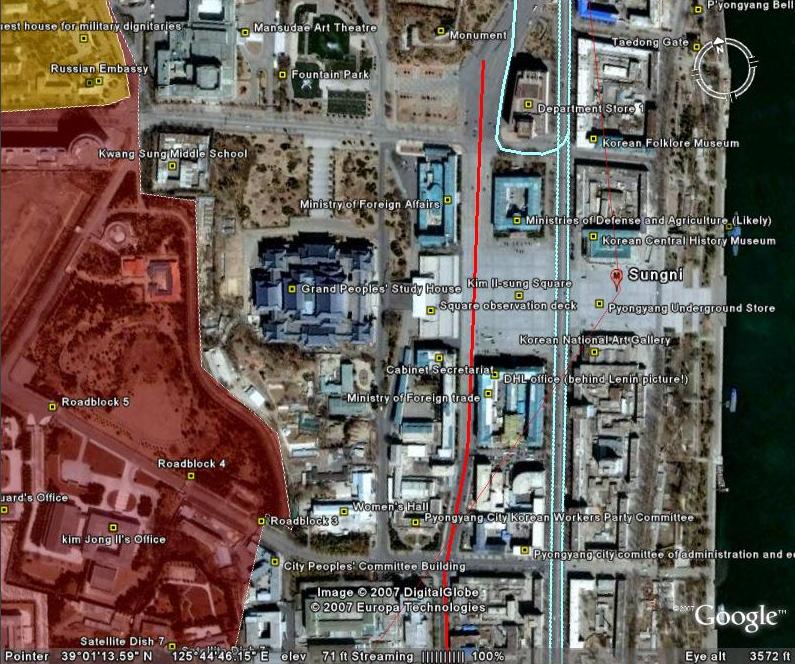
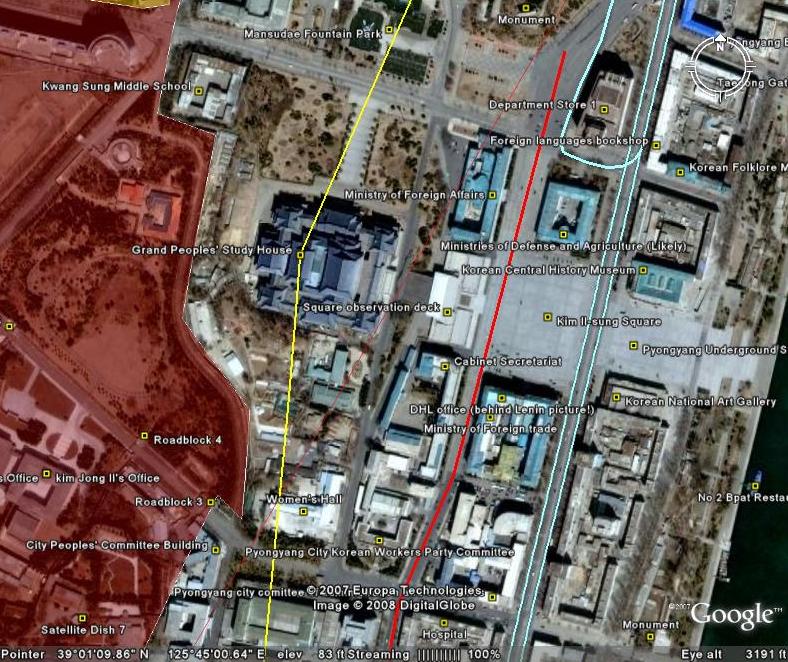
kissquare.JPGThis map covers North Korea’s agriculture, aviation, cultural locations, manufacturing facilities, railroad, energy infrastructure, politics, sports venues, military establishments, religious facilities, leisure destinations, and national parks. It is continually expanding and undergoing revisions. This is the sixth version.

Additions to the newest version of North Korea Uncovered include: Alleged Syrian nuclear site (before and after bombing), Majon beach resort, electricity grid expansion, Runga Island in Pyongyang, Mt. Ryongak, Yongbyon historical fort walls, Suyang Fort walls and waterfall in Haeju, Kaechon-Lake Taesong water project, Paekma-Cholsan waterway, Yachts (3), and Hyesan Youth Copper Mine.

Disclaimer: I cannot vouch for the authenticity of many locations since I have not seen or been to them, but great efforts have been made to check for authenticity. These efforts include pouring over books, maps, conducting interviews, and keeping up with other peoples’ discoveries. In many cases, I have posted sources, though not for all. This is a thorough compilation of lots of material, but I will leave it up to the reader to make up their own minds as to what they see. I cannot catch everything and I welcome contributions.

Share

No More Old-fashioned Chinese Stuff. We like South Korean Culture

Wednesday, November 7th, 2007

Daily NK
Moon Sung Hwee
11/7/2007

A source inside North Korea reported on November 5th that the North Korean Ministry of Education lately directed every school to stress the importance of the Korean language education and to encourage the use of the mother tongue.

In a phone interview with DailyNK, the source said, “At workplace, there are those who read out to the workers a handbook titled ‘Let’s maintain our superior morals and actively promote the use of our mother tongue!’”

In the March 2007 edition of “Learning Culture & Language,” Jong Soon Ki, the most well-known linguist in North Korea and a professor at the Institute of Linguistics of Social Science Center, urged the public to stop admiring English and Chinese language, saying, “The difference of our mother tongue between North and South Korea has been getting larger since the division of Korean.”

The source said that the North Korean authorities started to place high importance on the native tongue in an attempt to stop the surge in the use of the Chinese and foreign languages which have been spread to the country through the circulation of South Korean soap operas since 2000.

After the food crisis in the mid-1990s, the number of defectors, border traders, and Chinese businessmen investing in North Korea have increased, which helped the Chinese culture spread into the country. Many young North Korean began to display interest in Chinese movies, Chinese products and the Chinese language. It became popular among them to read out the brand names of Chinese products in Chinese.

In North Korea, people use the Chinese words “yaoyunji (搖運機)” or “yaoyun (搖運)” for a remote control. They do not use its Korean name “wonkyuk-jojonggi,” translated and adopted by the North Korean authorities.

As for a cell phone, people use its Chinese name “Dakeda (大可大)” or “Souji (手機)” rather than its North Korean name “Sonjeonhwa (literally meaning a handphone).” Blue jeans are called “Niuzaiku,” in the border areas, a refrigerator is called its Chinese name “Bingxiang (冰箱)” and VCD “Woicidie.” Indeed, many products or medical supplies are called their Chinese names such as “Kouhong” for a lipstick.

The use of foreign languages has become more prevalent across the country especially since 2003 when the frenzy over Chinese culture was replaced by its South Korean counterpart. It is particularly noticeable that North Korean people no longer call South Korea “South Chosun” as they used to but call it “Hankuk (meaning the Republic of Korea).” In these days, the young people in Pyongyang look down on those who still use the old name, “South Chosun.”

The source said, “South Korean culture is taking over the Chinese one, and the demand for the South Korean films and products is increasing. People learn new words from South Korean soap operas and these words are becoming popular.”
The source added, “I guess this is because South Korea is better off than China, and people have a sense of homogeneity towards South Korean people.”

“Nowadays, when people go to restaurants, they do not use the words “siksa annae” or “siksa pyo,” a Korean name for a menu. Instead, many people just call it “menu” as it is pronounced in English and widely called so in South Korea,” said the source.

The source continued, “We can see how rapidly the South Korean culture has spread into the country by the fact that many people no longer use the Chinese name for a cell phone, Shouji (手機) and instead use the name ‘Hyudaephone’ as it is called in South Korea.” The source said, “At Jangmadang (markets), people casually say the names of South Korean products as they are such as “Cuckoo (rice cooker)” or “Color TV.”

When asked about the popular words adopted from South Korean culture, he listed following words: “diet,” “wellbeing,” “music video,” “sausage,” “single,” “wife,” “dress,” “pop song,” and “fast food.” (See that all of them are English words. In South Korea, people use many English words like the one listed here in everyday life)

32-year old Kim Kyung Wuk (pseudonym), who defected from Kyungsung county of North Hamkyung Province and recently came to South, also confirmed this phenomenon.

Kim said, “In the past when people feel distressed, they expressed their feeling using the word, ‘uljukhada’. But now many young people use the words ‘jajeong’ or ‘stress’ as South Korean people do.” Kim added, “The North Korean people did not know the word ‘stress’ when they first heard it from South Korean movies they watched only three years ago. But now even the old people know the new word.”

Many defectors say that many new words adopted from South Korean TV dramas are being spread into the country especially among the young people such as “miss-Korea (a beautiful woman),” “show (fake),” “ssonda (I will treat you),” “hwakeun (passionate),” “single” and “wife.”

Kim said, “Those who watch South Korean dramas and listen to its music take a great interest in everyday language of the South, and try to adopt it as long as they could escape the state’s regulation.”

Defectors said that the current phenomenon illustrates that North Korean people admire the South Korea and greatly hope for reforms and open-door policy.

Lee Chul Min, the operating manager at the Association of the North Korean defectors said, “For those who live in a closed society, exposure to foreign cultures can be a really fresh experience. It is natural of them to admire more advanced societies and cultures.” Lee added, “The current frenzy over South Korean culture will help bring a change into North Korea and overcome the differences between two Koreas.”

Share

South Korean Dramas Are All the Rage among North Korean People

Friday, November 2nd, 2007

Daily NK
Yoon Il Geun
11/2/2007

“Foreign Films That Are Circulating at More Than One Million CDs”

Despite the North Korean authorities’ strict control, foreign films and South Korean drama Video Compact Disks (VCDs) circulating around North Korea is reportedly over 1 million copies since 2000.

Defector Choi Young Bum (pseudonym, 38), who has circulated South Korean and foreign movie VCDs among North Korean citizens said, “If one goes to a large city market, not only Pyongyang, but Pyongsung, Chongjin, Hamheung, Wonsan, and Shinuiju, hundreds or thousands kinds of movie and drama CDs can be obtained through black marketeers.”

According to Mr. Choi, foreign movie CDs inside North Korea have become significantly more mainstream.

Mr. Choi said that the largest market for the North Korean VCD business is the Pyongsung market. He said, “In Pyongsung market alone, merchants who sell South Korean dramas or foreign movie CDs while avoiding regulations, are sufficiently over 100. One person has several hundred copies at the least while another person has over 2,000 copies on the higher end. The authorities are stepping forward for inspections, but VCDs that have been circulating are at over several million copies.”

He said, “In Pyongyang, VCDs that have been circulating are more than in other regions. In early 2000, Hong Kong movies, South Korean dramas in mid-2000s, and recently, American movies that have been translated in Korea have been drawing a lot of popularity.” He relayed that the cultural difference between Pyongyang or other large cities to the provinces are sizable. The South Korean drama “Winter Sonata” became already a classical one in Pyongyang, but was still a hit in the countryside.”

He said that with the rise in popularity of South Korean dramas among North Korean people, the VCD merchants along the border region made quite a profit.

According to Mr. Choi, the prime cost from China was 150 North Korean won, but now, the asking price is over 300 won. The price of a VCD was around 900~1,000 won per copy in 2003, but it is now over 1,500 won. The price is supposed to jump twofold as the VCDs pass through each phase through Chinese merchants, the wholesaler, runner (regional circulators), and to retail trade.

He explained, “With popular action movies or dramas, they were sold at 2,000 won per copy. South Korean Series that have been consistently popular like “Autumn Sonata,” “Hourglass,” and “Glass Slippers” are wrapped in cases by sets, so the price is a bit discounted.”

Mr. Choi said that the price of a VCD player is around 30,000 won. “There were times when we sold the VCDs in cash, but we have thrown in extra as a bonus when selling used TVs from China.”

He added, “From mid-2004, DVDs started entering North Korea. Nowadays, their qualities are better than VCDs and high-capacity DVDs have been in circulation.”

Mr. Choi said that according to a change in DVD trends, North Korea’s Hana (one) Electronics Company have assembled and sold DVD players from attachments from China with the “Hana Electronics” brand. These DVDs can be purchased at North Korean stores.

”The contents of DVDs which can be produced legally in North Korea are mostly North Korean movies, films, former Soviet movies, former Chinese movies, screen accompaniment music (music videos), etc. North Korean civilians pretend like they are watching DVDs that are officially sold in North Korea while they have been watching South Korean dramas bought from the black market.”

Defector Ms. Im, who entered South Korea, said, “North Korean citizens, when someone comes to visit them while they are watching South Korean dramas with doors locked, hide the CDs while the other person goes to the door. They switch on a North Korean CD as if they were watching a North Korean movie.”

Ms. Im said, “Even the National Security agents and the Safety agents watch South Korean dramas and most people are watching them secretly. No matter how much the authorities regulate, it is difficult to control the practice. Once people are exposed to such a culture, it is not easy to stop. They are not going to stop watching them.”

Share

Cut the Telephone Cables

Monday, October 29th, 2007

Daily NK
Kwon Jeong Hyun
10/29/2007

It has become known that the North Korean authorities’ search for a household that paid 5,000 won for telephone usages per month has come to a close. Upon finding the residence, the authorities cut the telephone lines to prohibit the outflow of inside information.

Kim Choen Mo (pseudonym), a North Korean trader traveling through Dandong, China on business, said on the 28th that “The Social Security Agency, the Postal Service Office and the People’s Unit are cooperatively managing this case.”

Mr. Kim quoted an affiliate of the Postal Service Office saying, “If someone pays a large amount in phone bills, it means that they are making a living in trade. Therefore, the order was made to block the leakage of inside information and to block trade as well.”

In 1997, North Korea started introducing a telephone system using fiber-optic cables in big cities such as Pyongyang, Shinuiju, Chongjin, Hamheung, Sariwon and Pyongsung. Under the orders of Kim Jong Il to modernize the telecommunication system, the cables from China were set up in Pyongyang and other big counties and provinces. People were permitted for the first time to install telephones in their houses, and residents in big cities became increasingly reliant on phone usage.

After 10 years, however, the order was handed down to cut the cables off houses where phone usage exceeded 5,000won a month.

In 2002 North Korean authorities introduced a mobile communication system, but since the Yongchoen explosion incident in 2004, mobile phone usage has been banned.

Share

N. Korea Eager for Economic Modernization

Monday, October 29th, 2007

Korea Times
Jung Sung-ki
10/29/2007

North Korea has a keen interest in economic modernization program aimed at luring foreign investment through business cooperation projects with other countries, a member of the European Parliament said Monday.

In a press conference in Seoul, Hubert Pirker, an Austrian member of the European Parliament, said the North clearly understands the fact that without economic modernization, it will not be able to attract foreign investment into the country.

Pirker and two other EU representatives _ Jas Gawronsky of Italy and Glyn Ford of Britain _ visited North Korea from Oct. 20-27 and met the North’s Prime Minister Kim Yong-il. They also held an economic forum with North Korean officials.

During the forum, North Koreans’ attitudes “were not closed or hostile,” said Pirker.

“We visited the railway station, for example, and also parks and restaurants. I could say we could see more modern-style restaurants and more cars than ever before,” the European lawmaker was quoted by Yonhap News Agency as saying.

The European lawmakers discussed ways of modernizing North Korea’s agriculture, light industry, information technology and finance sectors with officials there, Pirker said.

North Korea’s Foreign Minister Pak Ui-chun expressed his wish to visit Europe next year, as Pyongyang seeks to send its young officials and industrial trainees there to learn information technology and other advanced knowledge from European nations, he said.

Pirker said the delegates had advised the North Koreans that upgrading the level of communications and finance systems in the North to global standards was essential to securing foreign investments in a stable manner.

Progress at the six-party talks aimed at scrapping Pyongyang’s nuclear weapons program and expanding inter-Korea economic cooperation would help the North achieve its goal of inviting foreign capital, the legislator added.

The European Union has so far sent about 50 million euros worth of aid to North Korea, he said.

The impoverished North has recently shown strong interest in the economic reform programs of other countries.

Reports said North Korean leader Kim Jong-il expressed intentions last week copying Vietanam’s economic reform and openness policy, called “Doi Moi,” during a meeting with Nong Duc Manh, the secretary-general of the Vietnamese Communist Party, in Pyongyang.

The ongoing visit to Hanoi by the North Korean premier appears to have something to do with Kim’s remarks, they said. The reclusive leader is reportedly planning to visit Vietnam in the near future.

North Korean officials expressed firm commitment to denuclearization under the Feb. 13 nuclear deal, according to Pirker.

Under the pact signed by the two Koreas, the United States, China, Japan and Russia, Pyongyang pledged to disable its nuclear facilities and declare all of its nuclear programs by the end of this year in return for economic assistance and political concessions.

North Korea has received 50,000 tons of heavy fuel oil from South Korea and an equal amount from China for closing five of its nuclear facilities in July. The regime is to receive an additional 900,000 tons of oil or equivalent energy aid if it goes through the second stage of denuclearization.

The EU delegates are scheduled to pay a courtesy call on Prime Minister Han Duck-soo and hold meetings with South Korean business leaders including Hyundai-Kia Automotive Group Chairman Chung Mong-koo before leaving South Korea on Nov. 2.

Share

Kaesong factory-apartment opens new horizons for inter-Korean cooperation

Tuesday, October 23rd, 2007

Yonhap
Lee Joon-seung
10/23/2007

A newly opened factory-apartment at the Kaesong Industrial Complex promises fresh possibilities for inter-Korean business cooperation, the developer of the facility said Tuesday.

The state-run Korea Industrial Complex Corp. (KICOX) said the dual-purpose manufacturing and residential facility is specifically designed for small and medium enterprises (SMEs) that are currently being phased out of South Korea due to the lack of workers and high labor costs.

At the formal opening ceremony of the factory-apartment, KICOX President Kim Chil-doo said, “The new facility provides an ideal business model for South Korea’s labor-intensive SMEs trying to stay afloat, and is an ideal means to start off business in North Korea.” About 300 people from South Korea were present at Tuesday’s opening in Kaesong, including lawmakers and Vice Industry Minister Oh Young-ho.

The 32 companies that will use the new facility are generally small clothing companies that were at the critical juncture of deciding whether to move to China and Southeast Asian countries, or close their businesses altogether. The factory-apartment provides an alternative means to continue making goods and is beneficial to all sides, the developer said.

By moving to Kaesong, the companies can stay in business by hiring workers for about US$60 a month, while 2,700 North Korean workers benefit from new jobs. In addition, the dual arrangement permits cheaper operating costs, a better working environment and allows companies to cooperate with each other for logistics support, said the developer.

The corporation, which runs 11 similar factory-apartments in South Korea, said the five-story building covers 27,880 square meters and was built in 14 months at the expense of 21.1 billion won (US$22.8 million). It is equipped with a storage area, a training center, a product display room, two dining halls, a store and fitness center. The new building is equipped with 71 dormitories for South Korean workers and various support staff.

The monthly rent in the factory-apartments is 4,500 won (US$4.9) per square meter, and there are six different floor arrangements available, ranging from 396 to 1983 square meters.

KICOX said that based on the projected success of the first factory-apartment, up to seven more will be built in Kaesong by 2010. It said 19,489 square meters of land were reserved in May 2007 for the project.

A second factory-apartment is being built the Kaesong Industrial District Management Committee (KIDMAC), and is scheduled for completion by late 2008.

Companies that have moved into the new factory-apartment, meanwhile, said they are satisfied with the proficiency of workers and cheap labor costs.

Ok Sung-seok, president of Nine Mode Co. and chairman of the corporate management committee at the KICOX factory, said Kaesong plants cost a third less to operate than similar plants in China. He added that his shirt-making company should turn a profit by next year.

“I ran a factory in Qingtao, China for four years, but the operating cost there is skyrocketing,” the businessman said. He said Nine Mode closed its Chinese factory and plans to downsize its operations in Seoul so it can concentrate on its efforts in Kaesong.

Ok said that depending on the type of business and size, four or five factories in the factory-apartments should turn a profit by the end of the year.

The Kaesong complex lies 60 kilometers northeast of Seoul, and is hailed as the crowning achievement of the historic 2000 inter-Korean summit. It has played a key role in expanding two-way economic exchange that stood at just $300 million in 1999 to $1.35 billion last year.

Construction of the industrial district began in June 2003, with 3.3 square kilometers of factory land have been built to house up to 450 firms. By 2012, 11.6 square kilometers of industrial park is to be laid down that can hold several thousand South Korean factories and hire over 200,000 North Korean workers.

There are at present about 13,000 North Korean workers employed by 57 South Korean firms in Kaesong that have churned out garments, watches, kitchen utensils, auto parts and other labor-intensive goods since 2004.

The complex just north of the demilitarized zone that separates the two Koreas has been in the spotlight after the second inter-Korean summit. South Korean President Roh Moo-hyun and North Korean leader Kim Jong-il agreed to build a region of peace and prosperity centered around Kaesong and the North Korean city of Haeju, 75 kilometers west of Kaesong.

“People at Kaesong expect progress to be made in such areas as communications and travel, which had previously been an obstacle to the development of the industrial district,” said a KIDMAC official. The prime ministers of the two sides are to meet in November to implement follow-up measures to the summit.

There is only one telephone line linking Kaesong with Seoul, while no mobile phones are allowed in the area. People and materials are also prevented from moving in and out of the complex.

Share

Privileged Pyongyang Citizens No Longer Enjoy Privileges in the Market.

Monday, October 22nd, 2007

Daily NK
Lee Sung Jin
10/22/2007
(Click on image for original size)

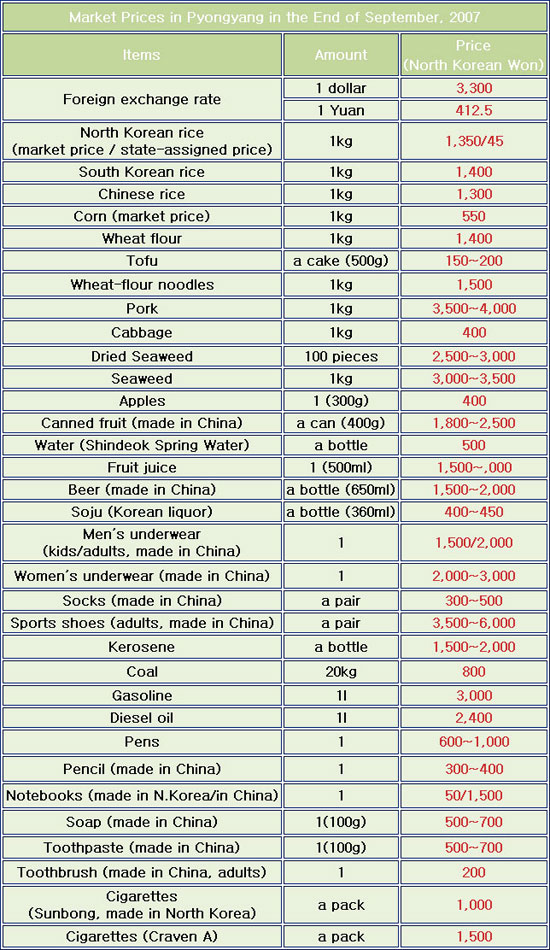
dprkmarketprices.jpgAccording to DailyNK’s research on prices in North Korea conducted in late September, the prices in Pyongyang are similar to the prices in other parts of the country. The finding shows that Jangmadang (markets) economy has been going through integration and similar distribution process across North Korea.

In the past, domestic commodities were sold cheap, and foreign products were sold expensive in Pyongyang.

DailyNK has been conducting quarterly research on prices in the central such as Pyongan Province and Hamkyung Province and northern areas.

This time the research result shows that the price of rice in a Jangmadang in Pyongyang is 1,350 won/kg, which is similar to the price of rice in Sinuiju, 1,400won/kg. In North Korea, the rice price serves as a gauge for price trends.

In Pyongyang, the exchange rate is about 330 thousands won to 100 dollars, which is the same as the exchange rate in other places. The most famous imported cigarettes, Cat (Craven A) is sold at the same cost of 1,500 won in Pyongyang and other areas.

Subsidiary food is more expensive in Pyongyang. The price of cabbage is 400 won/kg, 50 won/kg higher than cabbage price in Sinuiju. The price of pork ranges from 3,500 to 4,000/kg, 500~1,000 won/kg higher than the pork price in other areas.

The prices of seafood such as brown and green seaweed, and dried Pollack are cheaper in Pyongyang. Seafood caught in Kangwon Province and neighboring areas is transported to markets in Pyongyang in refrigerator car. Since the demand is high, seafood is sold in great quantities, and the price remains low in general.

Movie ticket prices range from 200 to 400 won. Telephone service is charged five won per minute. Overall, the price range for each commodity is high, and many different kinds of goods are available in Jangmadang.

Imported items from China such as socks, sports shoes, or underwear are expensive being sold at a cost of 1,000 won in Pyongyang. That is because there are extra shipping rates and labor costs imposed on Chinese goods transported to Pyongyang. On the contrary, in Sinuiju, imported goods from China are circulated on the market right away.

Often, retail prices are higher in Pyongyang because of high levels of consumption among Pyongyang citizens. However, cigarettes or liquor produced in Pyongyang, or clothes from South Korea circulated to other areas via Pyongyang are sold cheap in Pyongyang.

However, in these days the differences in regional price levels have almost disappeared.

A defector from Pyongyang, Ahn Chul Min (a pseudonym) who came to South Korea in 2006 said, “Prior to 2002, there were individuals who hung around from place to place and made money on price differences. But nowadays, the retail prices are almost uniform across the country because people just use a telephone and find out where to get items they want at what prices.

“Since there is no big difference in retail prices, retailers are not doing well in business,” Ahn added, “Instead, individuals driving a truck and selling goods wholesale are making good money.”

Ahn said, “Not everyone who lives in Pyongyang is well-to-do. Despite of their locations whether in Pyongyang or Chongjin, all markets have goods from South Korea and China. The poor people even if they live in Pyongyang should buy cheap and low quality of products from China. In contrast, those who live in Chongjin and have money can buy goods from South Korea anytime.”


Market Prices Consistent Throughout DPRK
Institute for Far Eastern Studies (IFES)
NK Brief No. 07-10-25-1

10/25/2007

The results of a survey conducted by Daily NK on the price of goods in Pyongyang at the end of September show that prices in the capital were similar to those in rural areas. This is an indication that markets throughout the country are integrated, and evidence that goods can be circulated from region to region.

In the past, the price of domestic goods in Pyongyang was relatively cheep, while imported goods were sold at high prices. During that time, Daily NK carried out local price surveys in central regions such as Pyongan and Hamkyung provinces, as well as in northern areas. According to this latest survey in Pyongyang, the cost of one Kg of rice, the standard measure of the cost of goods in North Korea, was 1,350 won, similar to the 1,400 won price in Sinuiju, and the 1,250 won cost in Hyeryung. An exchange rate of 3,300 won per USD is also in line with rural exchange rates, as is the 1,500 won price tag on a pack of Craven A cigarettes, the most favored imported cigarette in North Korea.

Non-essential food goods are more expensive in Pyongyang than in outlying areas, with one Kg of lettuce selling for 400 won, 50 won more than in Sinuiju. Also, pork in the capital runs between 3,500 and 4,000 won per Kg, which is 500 to 1,000 won more than it would cost elsewhere in the country.

On the other hand, seaweed, dried Pollack, and other marine products are cheaper in Pyongyang than elsewhere. Ocean harvests from Kangwon and neighboring provinces are brought to Pyongyang markets by way of refrigerated trucks. Because of high demand, a variety of goods get delivered, yet overall, prices are held fairly low.

Overall, the price range on a particular ware was very wide, indicating that there was a variety of products available in the markets. The survey found that goods such as undergarments, socks, sneakers imported from China were selling for the high cost of 1,000 won each. In Sinuiju and other northern areas, goods from China are brought directly to markets, but by the time these same goods reach Pyongyang, additional labor and transportation costs force prices up. Pyongyang residents typically have more money to spend than those in rural areas, also leading vendors to raise prices on some goods, however cigarettes and alcohol produced in Pyongyang and distributed to rural areas, as well as South Korean goods which reach DPRK markets by way of Pyongyang, are slightly less expensive in the capital.

Recently, regional price differences have nearly disappeared. Prior to 2002, some traders earned their living traveling from region to region exploiting price differences. However, now with one simple phone call, North Koreans can find out where and for what price goods are being sold, leading the majority of retail prices to be similar throughout the country.

Share