Archive for the ‘Communications’ Category

Orascom update: 6,000 in 2 weeks.

Thursday, February 5th, 2009

Martyn Williams writes in The Standard:

Koryolink, the North Korean 3G cellular network established in mid-December by Egypt’s Orascom Telecom, has attracted several thousand subscribers in the first two weeks since it began accepting applications in January.

“We didn’t start sales until about two weeks ago,” said Naguib Sawiris, chairman of Orascom Telecom in a telephone interview. “So far we have about 6,000 applications. The important point is that they are normal citizens, not the privileged or miliary generals or party higher-ups. For the first time they have been able to go to a shop and get a mobile phone.”

Orascom has a single shop in Pyongyang and is in the process of expanding its sales network, he said.

But while Koryolink’s first customers might not have high-profile official jobs, they are among the more wealthy in society and price, particularly of the handsets, stands as an obstacle to greater penetration.

“The price is quite high,” said Sawiris. “The government has put a big tax on handsets and it’s making it difficult for everyone to participate but we are having negotiations with the government to reduce that.”

The handsets Koryolink is offering, localized Korean versions of phones from China’s Huawei, cost between US$400 and $600 after the government levy has been added and there’s also calling charges.

The cheapest subscription costs 850 North Korean won per month. That’s about US$6 at the official exchange rate but only 24 cents at the current black market rate used by many citizens and traders. Calls on this tariff are charged at 10.2 won per minute. The highest package costs 2,550 won per month and call rates are 6.8 won per minute.

But all calls can be monitored:

With the launch of the Koryolink network the state continues to have the ability to monitor what its citizens are saying and can eavesdrop on calls if it wants, said Sawiris.

“That’s the right of the government,” he said.

How long to get the project moving?

It took about a year from that initial contact to reach an agreement and another nine months to get the network installed.

“We were quite worried about 2 things: the time it would take and the fact that they would really let normal citizens purchase lines.”

The full article is worth reading here:
North Korean 3G service attracts 6,000 in 2 weeks
The Standard
Martyn Williams
2/5/2009

Share

US might not have a DPRK envoy, but…

Sunday, February 1st, 2009

US slaps sanctions on DPRK companies
According to the Associated Press (Via CBS):

The United States is imposing sanctions on several Chinese, Iranian and North Korean companies for violating arms export regulations governing missile technology and other proliferation activities.

The sanctions are largely symbolic as they bar the companies from trade with the U.S. that they were not likely involved in. Although they were in the works for some time, the Obama team signed off on the sanctions on Jan. 21, a day after it took office, signaling a continuing tough stance from Washington on weapons technology transfers.

U.S. Slaps Sanctions On Overseas Companies
Associated Press (via CBS)
2/2/2009

Here is a link to the text from the US Federal Register
Below is a summary:

SUPPLEMENTARY INFORMATION: Pursuant to Section 73(a)(1) of the Arms Export Control Act (22 U.S.C. 2797b(a)(1)); Section 11B(b)(1) of the Export Administration Act of 1979 (50 U.S.C. app. 2410b(b)(1)), as carried out under Executive Order 13222 of August 17, 2001 (hereinafter cited as the “Export Administration Act of 1979”); and Executive Order 12851 of June 11, 1993; the U.S. Government determined on January 15, 2009 that the following foreign entities had engaged in missile technology proliferation activities that require the imposition of missile sanctions described in Section 73 of the AECA (22 U.S.C. 2797b)  and Section 11B of the EAA (50 U.S.C. Appx 24710b) on these entities:

Korea Mining and Development Corporation (KOMID) (North Korea) and  its sub-units and successors
–Mokong Trading Corporation (North Korea) and its sub-units and successors
–Sino-Ki (North Korea) and its sub-units and successors

And from the Donga Ilbo:

This is the eighth time for the mining company, which has been closely watched by Washington as an exporter of Pyongyang’s ballistic missiles and conventional weapons, to get U.S. sanctions.

The company was slapped with sanctions in 1992, 1998, 2000, 2003, January and August in 2007, and August last year.

Ex-IRA figure faces US counterfeiting charge
According to the Associated Press:

Irish police arrested former Workers Party leader Sean Garland, 74, outside the entrance of the fringe party’s Dublin headquarters — more than three years after he jumped bail in the neighboring British territory of Northern Ireland while facing a similar U.S. extradition warrant there.

Garland had been living openly in the Republic of Ireland — which typically refuses to extradite citizens to face criminal charges outside the European Union — since he left Belfast and abandoned a bail of 30,000 British pounds (about $53,000 at the time) following his October 2005 arrest.

U.S. authorities that year indicted Garland with receiving, smuggling and laundering millions in “superdollars” — so called because of their expert design — that the government of North Korea allegedly began distributing in the late 1980s to weaken the American currency. If extradited and convicted, Garland could face up to five years in prison and a $250,000 fine.

Only one of the past two-dozen extradition requests from the U.S. Justice Department has been approved by Irish judges, who generally oppose extradition, citing America’s harsher sentences and penal system.

Under [Garland’s] leadership, the Workers Party appealed in 1986 to the Communist Party of the Soviet Union for funds. According to the 2005 U.S. indictment, Russian officials encouraged Garland and other Official IRA activists to take counterfeit U.S. $100 bills produced by North Korea.

Read the full story here:
Ex-IRA figure faces US counterfeiting charge
Associated Press
Shawn Pogatchnik
1/30/2009

NK Defectors’ Groups to Get US Gov’t Aid
According to the Korea Times:

The U.S. Department of State will directly provide groups organized by North Korean defectors here with financial support for the first time, according to reports Sunday.

Thus far, Washington has funded local groups working for improvement of North Korean human rights via the National Endowment for Democracy (NED), a private organization supporting freedom around the world.

The move was construed as part of increased U.S. efforts to shed light on humanitarian issues in the Stalinist state.

The State Department posted a notice on the Human Rights Democracy Fund (HRDF) last September and about 50 organizations reportedly applied for the program.

Among the beneficiaries, Free North Korea Radio and the Coalition for North Korean Women’s Rights were granted $500,000 and $300,000, respectively.

The groups will receive a certain amount of money every month for two to three years in accordance with their performance.

Kang Su-jin, founder and representative of the coalition, said she thinks that the U.S. department aims at nurturing North Korean defectors as future leaders through the direct funding.

An official of the department was quoted as saying on condition of anonymity by Radio Free Asia (RFA) that a total of $3 million has been set aside for the program.

But the official refused to elaborate on grantees, saying the issue was “very sensitive.”

Read the full story here:
NK Defectors’ Groups to Get US Gov’t Aid
Korea Times
Kim Sue-young
2/1/2009

Share

Some “good” news from North Korea

Friday, January 9th, 2009

On market regulations:  North Korean authorities issued three decrees restricting market activity: 1. Markets may only open once every 10 days  2. Only vegetables, fruits, and meat from private citizens can be sold in the markets.  Imported goods and products of state-owned companies are prohibited  3. To reduce the influence and growth of professional merchants, market booths will be allocated on a first-come, first-served basis (no fixed locations).

The “good” news is that the authorities are having trouble implementing these rules:

A Pyongyang source said in a phone conversation with Daily NK on the 7th, “Until now, markets in Pyongyang have been opening at 2 PM every day and operating normally. They are only closed once a week, on Mondays as usual.”

However, the sale of imported industrial goods from China such as clothing, shoes, cosmetics, kitchen utensils and bathing products has become more restricted in the market. Subsequently, street markets or sales of such goods through personal networks have become increasingly popular.

The source noted, “Inspection units regulate the markets with one eye closed and the other eye open, so it is not as if selling is impossible. With a bribe of a few packs of cigarettes, it is easy to be passed over by the units. However, the sale of industrial goods has rapidly decreased and, if unlucky, one can have his or her goods taken, so the number of empty street-stands has been increasing.”

So many North Koreans now buy Chinese kitchen utensils in the same way Americans purchase cocaine!

But even in Pyongyang they are having troubles enforcing the new rules:

“Since December, rations in Pyongyang have consisted of 90 percent rice and 10 percent corn and in the Sadong-district and in surrounding areas, rice and corn have been mixed fifty-fifty percent.”

“It has even been difficult in Pyongyang, where rations are provided, to convert to 10-day markets due to opposition from citizens, so restricting sales in the provinces, where there is virtually no state provision, is impossible in reality. It is highly likely that the recent measure will end as an ineffective decree, like the ones to prohibit the jangmadang or the sale of grain”[.]

On North Korea’s information blockade:  Radio Free Asia published an informative article on the ability and propensity of North Koreans to monitor foreign broadcasts.  The “good” news is that access to unauthorized information continues to grow.  

The whole article is worth reading (here), but here is an excerpt:

North Koreans manage to gain limited access to foreign media broadcasts in spite of increasing government crackdowns in the isolated Stalinist state.

“We clamped down on the people watching South Korean television sets, but it wasn’t easy,” a North Korean defector and former policeman who monitored North Koreans’ viewing habits said. He said channels fixed by the North Korean authorities could easily be altered to catch South Korean programming.

“You could watch South Korean television such as KBS and MBC in Haeju, Nampo, Sariwon, even in Wonsan,” he said, referring to regions of Hwanghae province, just north of the border with South Korea.

“They reach also to the port cities near the sea. But you can’t watch them in Pyongyang because it’s blocked by mountains.”

He said the police themselves used to watch South Korean television “all the time” along with their superior officers.

“We would enjoy what we watched, but outside in public, we would praise the superiority of our socialist system. We knew it was rubbish.”

“According to North Korean defectors interviewed who came to South Korea right after living in the North, educated, intelligent people in North Korea do listen to foreign stations despite the inherent danger,” Huh Sun Haeng, director of the Center for Human Rights Information on North Korea, said in a recent interview.

He said he made good money fixing people’s radios, so they could get better reception of foreign broadcasts.

“I made good money readjusting channels on radios, or upgrading them with higher frequency parts for local people who want to listen to broadcasts other than the North’s state-run radios. There were at least a few hundred people that I know of who listened to foreign broadcasts,” he said.

He said no television reception reached the northern part of the country near the Chinese border, so people there watched recorded programs on videotape and video CD (VCD) instead.

Read the full articles here:
Pulling Back from Converting to 10-day Markets
Daily NK
By Jung Kwon Ho
1/9/2009   

Growing Audiences for Foreign Programs
Radio Free Asia
Original reporting in Korean by Won Lee
1/8/2009

Share

Orascom 3G wrap up

Friday, December 19th, 2008

UPDATE: Here is an older paper by Stacey Banks which I have not read: North Korean Telecommunication: On Hold.

ORIGINAL POST: On Monday the Orascom 3G mobile network launched in North Korea.  Just about everyone covered this story…so here are the highlights:

Telecommunications in North Korea: Has Orascom Made the Connection?
Working Paper: Marcus Noland

The topicality of the second paper, on the Egyptian firm Orascom’s role in North Korea’s telecommunications modernization, received a boost this week with the announcement in Pyongyang that Orascom was finally rolling out its cell phone service and creating a joint venture bank with a North Korean partner.  The planned Orascom investments are large: if actualized, they would be the largest non-Chinese or non-South Korean investments in North Korea, and would exceed total private investment in the Kaesong Industrial Complex to date

Financial Times

Orascom is confident North Korea is opening up its economy and says it has been assured by the ­government that everyone will be allowed to buy a mobile. However, experts think that such a volte-face is highly unlikely and reckon only senior military and government officials will be allowed access, and then only to a closed network.

When asked how many people would ultimately use the service, Orascom’s chairman Naguib Sawiris said: “We have a modest target of 5 to 10 per cent of the population.” The population is about 23m. Mr Sawiris expects 50,000 subscriptions in the first three-to-six months.

Jim Hoare, Britain’s former chargé d’affaires to Pyongyang, says the new network is bound to have severe restrictions.

“It’s unlikely that a country that doesn’t allow you to have a radio unless it’s set to the state frequency will suddenly allow everyone to have mobile phones. It’s more credible that there will be a limited network for officials in Pyongyang and Nampo.”

Dong Yong-sung, chief of the economic security team at the Samsung Economic Research Institute in Seoul, believes another obstacle to ordinary North Koreans owning phones will be the cost. “As far as I know, mobile phone registration costs about $1,000,” he said, a sum equivalent to the average annual income.

(NKeconWatch: Others put the price at $700…and there are many problems with asserting that the DPRK’s per capita income is $1,000 per year.)

Bloomberg

The inauguration of Koryolink took place today in North Korea, Orascom Telecom said in an e-mailed statement. Orascom Telecom Chief Executive Officer and Chairman Sawiris attended the event, a company official said, requesting anonymity. The Cairo- based company got a 25-year license and exclusive access for four years in January. It plans to spend as much as $400 million on a high-speed network and the license for the first three years.

The North Korean venture is “in line with our strategy to penetrate countries with high population and low penetration by providing the first mobile telephony services,” Sawiris said in a statement earlier this year.

CHEO Technology JV Company, the North Korean unit that will operate under the Koryolink name, is 75 percent owned by Orascom Telecom and 25 percent by the state-owned Korea Post and Telecommunications Corporation.

The unit will see average revenue per user of $12 to $15 this year as Orascom Telecom targets three of the country’s biggest cities, according to company forecasts.

Koryolink has rolled out its so-called third-generation grid to initially cover Pyongyang, with a population of 2 million.

Orascom is counting on four potential markets in the Stalinist nation, according to a study by Marcus Noland of the Peterson Institute for International Economics.

The military and government officials are the top targets, followed by foreigners working for UN organizations and diplomats. The others are customers from South Korea, which has several economic projects with its neighbor, and local demand from rich North Koreans.

To protect its investment, Orascom “hedged its bet, committing only half of its investment at the outset and making additional investment conditional on its assessment of conditions going forward,” Noland said.

If the deal is threatened, Orascom may withdraw specialized equipment or technicians, reducing the value of the network to Pyongyang, Noland said in his study.

“Orascom may have spread the wealth informally, creating beneficiaries within the decision-making apparatus who would stand to lose if the agreement failed,” according to the study.

Bloomberg

Orascom Telecom, the Middle East’s biggest wireless company, opened Ora Bank in Pyongyang in the presence of Chairman and Chief Executive Officer Naguib Sawiris, a company official said on condition of anonymity. Ezzeldine Heikal, who is also head of Koryolink, Orascom’s North Korean mobile-phone network, was appointed president of the bank, the official said without providing further details.

“This is a big deal, especially as far as North Korea is concerned, because the current banking system is virtually non- existent,” Marcus Noland of the Peterson Institute for International Economics said in a telephone interview from Washington, D.C. “It’s a ground that others have feared to tread and is perhaps an endorsement for North Korea that says ‘we’re open for business.’”

Ora Bank is a joint venture between Orascom Telecom and North Korea’s state-owned Foreign Trade Bank, North Korea’s official news agency reported today. The director of North Korea’s central bank Kim Chon Gyun and Egypt’s ambassador to Pyongyang Ismail Abdelrahman Ghoneim Hussein, were also present at the opening ceremony, the news agency said.

Radio Free Asia

Chinese traders who regularly travel back and forth to North Korea said local residents showed little enthusiasm for the new service, which cost more than U.S. $900 to set up before the Ryongchun explosion.

North Korean defector Kim Kwang-jin, a senior researcher at the Institute for National Security Strategy in Seoul, said the fact that the government had once pulled the plug on North Korean cell phones meant that it could easily do so again.

“In the beginning, people will be hesitant, because a few years ago many of them made a big investment in cell phones. But service was suspended abruptly, so they are still very concerned that might happen again,” Kim said.

“People are also worried that the ability to pay such a high amount of money for a cell phone may raise a red flag and bring them under scrutiny by the North Korean authorities.”

Most foreigners are banned from using cell phones while in North Korea, although a network for government officials is believed to exist in the capital, Pyongyang.

(NKeconWatch: I personally saw elite North Koreans use mobile phones and even some western journalists in 2005.)

The Guardan

North Korea first experimented with mobile phones in 2002, but recalled the handsets 18 months later after a mysterious train explosion that killed an estimated 160 people. Some experts argue that officials feared the incident was an attempt to assassinate the regime’s “dear leader”, Kim Jong-il, and that mobile phones were involved.

BBC

Some reports suggest that handsets for the new network will cost around $700 each, putting them far beyond the reach of the vast majority of people in the impoverished country.

Choson Ilbo

Although the technology would enable users to send and receive text messages and video content, North Korean customers will only be allowed to speak over their phones.

BMI Political Risk Analysis, Dec 16, 2008 (h/t Oliver)

BMI View: North Korea has officially begun third-generation (3G) mobile phone services, thanks to Egypt’s Orascom Telecom (OT). However, the growth of the network could be limited by the regime’s fear that mobile phones will increase the scope for anti-regime activities.

North Korea has officially commenced third-generation (3G) mobile phone services, thanks to an investment by Egypt’s Orascom Telecom (OT). The firm’s initial target is 100,000 subscribers in three major cities, including Pyongyang, and it eventually hopes to develop a nation-wide network connecting North Korea’s 23mn citizens. OT has promised to invest US$400mn in network infrastructure over the next four years. It has signed a 25-year contract with the North Korean government, and owns 75% of their joint-venture (known as Korealink). OT’s exclusivity rights will last for four years. Orascom’s foray is something of a coup, given that North Korea’s communications network is so rudimentary (for further background see December 8 2008, Industry Trend Analysis – North Korea Prepares For Mobile Network Launch).

Why Pyongyang Fears Mobile Phones
North Korea launched a mobile phone service operated by a Thai subsidiary firm in 2002, but reversed course in 2004, apparently because of a devastating bomb blast on a train in Ryongchon in April of that year. Given that North Korean leader Kim Jong Il’s personal train had passed through the area only a few hours earlier, there was speculation that the explosion had been an assassination attempt, possibly triggered by mobile phone. Since then, only those living in areas close to the border with China have had access to mobile phones, thanks to the proximity of the Chinese network.

Aside from the notion of mobile phones as bomb triggers, they can also make it easier for citizens to communicate with one another. This would increase citizens’ ability to organise anti-government activities – such as protests or sabotage. For example, the popular uprising that led to the overthrow of Philippine president Joseph Estrada in 2001 was dubbed the ‘text message revolution’, because that is how the marches were announced and coordinated. Admittedly, the Philippines is a far more open society than North Korea, but the subversive aspect has not been lost on the regime.

Mobile phones would also make it easier for North Koreans to communicate with the outside world, and thus allow the real-time transmission of information or intelligence to foreign media or spy agencies, and vice versa. They would also allow the North Korean elite to communicate more efficiently, allowing dissident elements to plot against the regime.

Thus, even something as basic as mobile phones are seen as potentially regime threatening.

Mobile Service Difficult To Spread
Consequently, Orascom will surely find it difficult to spread its mobile service across the country. For a start, registration will be tightly watched. Secondly, the cost of the handsets, at several hundred dollars, will mean that only the political and moneyed elites will be able to afford mobiles. Of course, elements of the elite can ‘misuse’ their phones to arrange subversive actions if they deem it worthy, but it seems that the regime are counting on loyalty. Indeed, depending on the sophistication of their equipment, the regime will probably be able to snoop in on the elite’s conversations and movements, giving them an additional layer of security.

Read the full articles below:
Orascom eyes North Korean network
Financial Times
Christian Oliver
12/14/2008

Orascom Telecom’s Sawiris Signs North Korean Deal
Bloomberg
Tarek Al-Issawi
12/15/2008

Orascom Telecom of Egypt Opens Bank in North Korea
Bloomberg
Tarek Al-Issawi
12/16/2008

North Korea Brings Back Cell Phones
Radio Free Asia
Jung Young
12/16/2008

Secretive North Korea launches restricted mobile phone service
The Guardian
Tania Branigan
12/16/2008

N Korea launches 3G phone network
BBC
Steve Jackson
12/15/2008

N.Korea Restarts Cell Phone Service
Choson Ilbo
12/17/2008

Share

Christian group smuggling radios into DPRK

Wednesday, November 12th, 2008

Individuals and organizations who smuggle radios into the DPRK, whether for personal gain or for altruistic reasons, do not to attract attention to themselves.  This makes it difficult to determine just how many foreign-made radios can be operated, and by whom, in the DPRK.

This week, however, Christian broadcaster Trans World Radio announced that it will distribute 3,400 radios in the DPRK this year alone:

International Christian broadcaster Trans World Radio (TWR) confirmed Friday, November 7, that it has secretly distributed thousands of radio receivers in North Korea, one of the world’s most isolated Communist nations. 

“TWR already delivered 3,100 radio’s in recent months and the plan is to increase that number to 3,400 by the end of this year,”  said TWR-Netherlands from its headquarters in the Dutch town of Barneveld. “Radio is the only way for North Koreans to hear the Gospel.  However receivers sold in the country are only tuned to the state-run network,” TWR added.

TWR said it has set up a transmitter in the region to reach the people of North Korea with Christian programming and encourage underground churches. “Most Christians in North Korea are not able to share their faith with other believers openly, and are forced to worship in secret.”?

Who knows how many of these radios will end up in actual use, but this is just one organization in one year.  Is it plausible to believe that over 10,000 radios are smuggled into the DPRK in a year? Are there reasons to doubt or qualify these numbers?  Why would they announce this if it was true?

Source:
Christian Broadcaster Smuggles Radio’s To North Korea   
Bos News Life
Eric Leijenaar
11/7/2008

Share

North Korea on Google Earth

Thursday, October 2nd, 2008

North Korea Uncovered: Version 12
Download it here

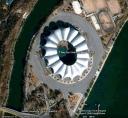
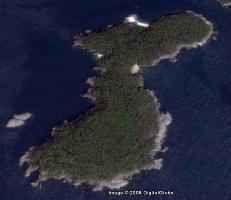
mayday.JPGAbout this Project: This map covers North Korea’s agriculture, aviation, cultural locations, markets, manufacturing facilities, energy infrastructure, political facilities, sports venues, military establishments, religious facilities, leisure destinations, national parks, shipping, mining, and railway infrastructure. It is continually expanding and undergoing revisions. This is the 12th version.

Additions include: Tongch’ang-dong launch facility overlay (thanks to Mr. Bermudez), Yongbyon overlay with destroyed cooling tower (thanks to Jung Min Noh), “The Barn” (where the Pueblo crew were kept), Kim Chaek Taehung Fishing Enterprise, Hamhung University of education, Haeju Zoo, Pyongyang: Kim il Sung Institute of Politics, Polish Embassy, Munsu Diplomatic Store, Munsu Gas Station, Munsu Friendship Restaurant, Mongolian Embassy, Nigerian Embassy, UN World Food Program Building, CONCERN House, Czech Republic Embassy, Rungnang Cinema, Pyongyang University of Science and Technology, Pyongyang Number 3 Hospital, Electric Machines Facotry, Bonghuajinlyoso, Second National Academy of Sciences, Central Committee Building, Party Administration Building, Central Statistics Bureau, Willow Capital Food House, Thongounjong Pleasure Ground, Onpho spa, Phipa Resort Hotel, Sunoni Chemical Complex (east coast refinery), Ponghwa Chemical complex (west coast refinery), Songbon Port Revolutionary Monument, Hoeryong People’s Library, Pyongyang Monument to the anti Japanese martyrs, tideland reclamation project on Taegye Island. Additionally the electricity grid was expanded and the thermal power plants have been better organized. Additional thanks to Ryan for his pointers.

I hope this map will increase interest in North Korea. There is still plenty more to learn, and I look forward to receiving your contributions to this project.

Version 12 available: Download it here

Share

Korean Computer Center software

Monday, September 1st, 2008

The enterprising team at NOKO Jeans, who are trying to manufacture and export blue jeans from the DPRK, posted some information from the Korean Computer Center‘s Samilpo Information Center.

The KCC’s PDF flyer (available here: samilpo_sample.pdf), promotes the company’s software and media products. 

Share

Download glitch fixed: North Korea Google Earth (version 11)

Thursday, August 14th, 2008

The most authoritative map of North Korea on Google Earth
Download it here

This map covers North Korea’s agriculture, aviation, cultural locations, markets, manufacturing facilities, railroad, energy infrastructure, politics, sports venues, military establishments, religious facilities, leisure destinations, and national parks. It is continually expanding and undergoing revisions. This is the eleventh version.

Additions include: Mt. Paegun’s Ryonghung Temple and resort homes, Pyongyang’s Chongryu Restaurant, Swiss Development Agency (former UNDP office), Iranian Embassy, White Tiger Art Studio, KITC Store, Kumgangsan Store, Pyongyang Fried Chicken Restaurant, Kilju’s Pulp Factory (Paper), Kim Chaek Steel Mill, Chongjin Munitions Factory, Poogin Coal Mine, Ryongwun-ri cooperative farm, Thonggun Pavilion (Uiju), Chinju Temple (Yongbyon), Kim il Sung Revolutionary Museum (Pyongsong), Hamhung Zoo, Rajin electrified perimeter fence, Pyongsong market (North Korea’s largest), Sakju Recreation Center, Hoeryong Maternity Hospital, Sariwon Suwon reservoir (alleged site of US massacre), Sinpyong Resting Place, 700 Ridges Pavilion, Academy of Science, Hamhung Museum of the Revolutionary Activities of Comrade Kim Il Sung, South Hamgyong House of Culture, Hamhung Royal Villa, Pork Chop Hill, and Pyongyang’s Olympic torch route. Additional thanks go to Martyn Williams for expanding the electricity grid, particularly in Samjiyon, and various others who have contributed time improving this project since its launch.

Disclaimer: I cannot vouch for the authenticity of many locations since I have not seen or been to them, but great efforts have been made to check for authenticity. These efforts include pouring over books, maps, conducting interviews, and keeping up with other peoples’ discoveries. In many cases, I have posted sources, though not for all. This is a thorough compilation of lots of material, but I will leave it up to the reader to make up their own minds as to what they see. I cannot catch everything and I welcome contributions.  Additionally, this file is getting large and may take some time to load.

Share

N.Korea Likely to Provide Internet Service from 2009

Thursday, August 7th, 2008

Choson Ilbo
8/7/2008

It seems likely that North Korea will finally join the worldwide web and provide Internet service from next year. Kim Sang-myung, the chief of the North Korea Intellectuals Solidarity, a group of former North Korean professionals, at a symposium in the National Assembly on Wednesday said, “According to the Internet Access Roadmap it launched in 2002, North Korea will begin providing Internet service for special agencies and authorized individuals as early as next year.”

Kim defected from North Korea in 2004, when he was a professor of computer engineering at Communist University. An expert on North Korea’s information technology, he is currently an adjunct professor at Kyonggi University and a fellow at the Institute of North Korea Studies.

Implementation of the roadmap, which major agencies such as the Workers’ Party, the Ministry of Post and Telecommunications, the Ministry of Electronic Industry, and the North Korea Academy of Sciences have pushed for under the instructions of North Korean leader Kim Jong-il since 2002, is now at its final stage, he said.

First of all, North Korea will establish infrastructure for a super-speed Internet service network by laying optical cables between Pyongyang and Hamhung and extending them to Chongjin and Shinuiju this year. North Korea has recently succeeded in consolidating security solutions for the prevention of online leaks of data to foreign countries and of online intrusions, and in enhancing service stability.

It has also recently finished necessary consultations with the Internet Corporation for Assigned Names and Numbers (ICANN) for the Internet service in North Korea. In this situation, North Korea can begin providing Internet service any time provided equipment for server and Internet-based relay systems is supplied, Kim said.

“North Korea is strongly determined to be part of the global community through the Internet,” he said. “After watching China and Vietnam control the Internet effectively although these countries have opened up Internet wireless networks since the early days of their opening, the North has concluded that it can now introduce the Internet service.”

Currently, North Korea provides only a limited service via a kind of Intranet called Kwangmyong, through which it is possible to access databases on scientific and technological information at North Korean central government agencies.

Share

Inside Air Koryo’s new Tupolev

Wednesday, July 23rd, 2008

UPDATE: from Simon:

There’s no way that the suggestions [below] are the way that the passport popped up on screen, that isn’t how the application process works. Is it not more likely that they have a little scanner at the check-in desk and that’s how it popped up? Also when you run the magnetic strip of a passport though the passport control machines doesn’t this contain a picture of the passport that comes up on the screen? Anyway whichever way it is, it isn’t from a scanned copy of the passport being sent in advance, this isn’t how it works.

The new plane is indeed much better than the old ones, they show a movie (same one in both directions) currently it is Order-027 which has plenty of fights and is a reasonable film, nervous flyers like myself will probably not love the part where a helicopter explodes while the plane descends!

I read some report that said that the plane was bought reasonably cheaply due to poor sales of the model, also Air Koryo is a company run for profit after all (even if it doesn’t make any, subsidising airlines would hardly be unique to NK, who pays for any new planes for major airlines then?), so those funds would have been what paid for it most likely.

BTW the food on the Beijing – Pyongyang leg of the flight is still the same but they have reverted back to the ‘Koryo Burger’ that was much loved/hated previously, this time though the bun is vastly enlarged meaning that you have to bite through about 2 inches of bread on either side of the burger to get to it, as before, about 50% of passengers didn’t bother with it (burger at 9AM is a bit early for some)

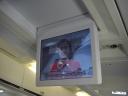
ORIGINAL POST: A recent visitor to North Korea (Stephan) posted a set of photos on flickr.com.  Normally I am not impressed with North Korea tourist photos, but in this case, I was pleased because they are the first I have seen of the inside of Air Koryo’s new Tupolev.

airkoryotupolev.jpg
Click on image to see larger version at flickr.

Veterans of Air Koryo’s older planes are familiar with the on-board speaker announcement welcoming visitors to the Juche paradise led by the Great Leader, Kim Jong Il.  Now travelers can expect a professional video!

The food looks the same.

In true communist fashion, there is still a business class section.

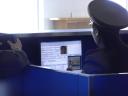
And for the intelligence coup…below is a photo of North Korea’s (new?) passport control system.  It appears to be Windows-based.  It also appears that there is a database and ethernet (?) connection between the North Korean embassy in Beijing, the Foreign Ministry in Pyongyang, and Sunan Airport.  I draw this conclusion because it seems like the passport control officer in the photo is looking at a digital scan of the passport ID page.  This means the image was probably captured when the visa was issued in Beijing and it was sent to a central database to be pulled up when it the passport is scanned.  Anyone have a better idea?

UPDATE: according to the photographer, he delivered a scan of his passport to KITC (Korea International Travel Company) in Beijing.  KITC probably sent the image via email to the DPRK embassy.  So what kind of wire network connects the DPRK embassy in Beijing with the Foreign Ministry/Sunan Airport back home?  I would like to think there is a dedicated/encrypted line, or satellite feed (rented from China), but I would not be surprised if the DPRK embassy just emails the images to someone back in Pyongyang who puts them on an internal network.

dprkpassportcontrol.jpg
Click on image for larger version

(hat tip to benms)

Share