Joong Ang Daily
8/8/2007
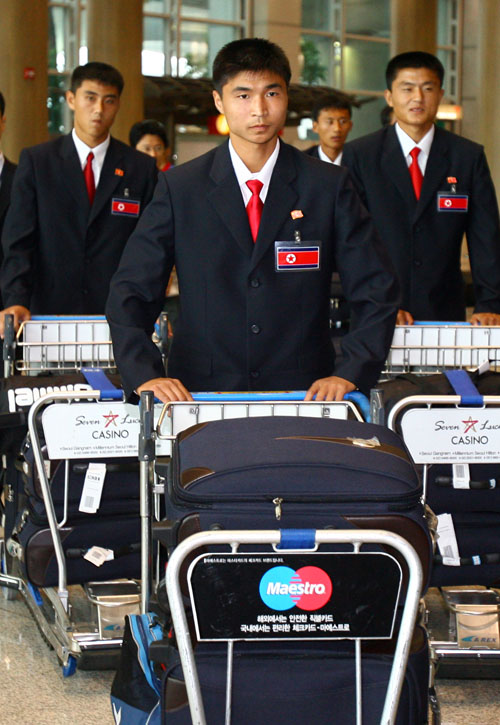
North Korean youth soccer players arrive yesterday at Incheon International Airport. The North Korean team will participate in the U-17 World Cup organized by FIFA in South Korea from Aug. 18 through Sept. 9.

Joong Ang Daily
8/8/2007
North Korean youth soccer players arrive yesterday at Incheon International Airport. The North Korean team will participate in the U-17 World Cup organized by FIFA in South Korea from Aug. 18 through Sept. 9.
Asia Times
Sunny Lee
8/8/2007
Hurry if you’re in the mood to travel to one of the least traveled countries on the planet. North Korea says it will admit foreign tourists this year only until October 10.
That’s the latest schedule Walter Keats received from Pyongyang. Keats heads Illinois-based Asia-Pacific Travel, the only travel company in the United States authorized by Pyongyang. The reclusive country opens itself to foreign tourists only for a limited period of the year. Restrictions on Americans are even stricter. In fact, Americans are allowed into North Korea only during the Arirang Festival, a birthday party for the late leader Kim Il-sung.
As a US citizen who is not part of a diplomatic or humanitarian aid mission on North Korea, Keats has had the rare experience of visiting the secretive country 10 times in the past 12 years, starting in 1995. During the period, Keats saw the country “definitely” changing.
“I don’t know if that’s the question of being closed or open. Things are still very restricted. But the people we deal with, at least, are more flexible, more friendly, and more open now,” Keats said in an interview in Beijing before he was to fly with Pyongyang-bound American tourists last weekend.
North Koreans’ flexible attitude is reflected, for example, in the tour scheduling. In the past, the North Koreans decided every itinerary. But Keats told them some places are not really interesting for Americans, while some are more interesting. Now they are more willing to listen.
Besides, the North Korean guides are more willing to accommodate impromptu requests from foreign tourists now such as visiting a local elementary school, even if that was not part of the original travel itinerary.
The changes are also noticeable in the North Korean tour guides themselves as well. They used to be rather solemn and less spontaneous, but these days they even crack jokes in English. Keats sees it as a “nice” change.
“One of the purposes of this tour is to break down the barriers to show that we are human beings and they are also human beings. We’re not both devils fighting each other. So it’s nice to see the humanity in both sides. Humor is a good medium,” Keats said.
North Korea and the US are still technically at war with each other as a legacy from the Korean War. However, today American tourists in North Korea are not subject to any of the anti-American sentiment and rhetoric that Keats experienced during some of his previous visits.
However, all foreign tourists to the Stalinist nation must go on guided tours and must have their tour guides with them at all times. Photography is strictly controlled, as is interaction with the local people. Besides, tourists holding US passports are not usually granted visas. But exceptions were made in 1995, 2002, 2005 and this year.
Some observers are inclined to view the timing of these exceptions as coinciding with a softening in US relations with North Korea. But that actually may not be the case, because North Korea gave the green light for US tourists in 2002 – just after President George W Bush lumped it in with a group known as the “axis of evil”.
On his part, Keats has to remind his fellow American tourists that visiting North Korea is “very different” from visiting any other country in the world and tells them to be mindful of following a few rules. These include refraining from attempting to strike an unauthorized conversation with local people.
In general, the North Korean people would not appreciate foreign tourists coming up to them because “frankly, it endangers them”, Keats said. Somebody could later ask them why they talked to the foreigners, what they said to the foreigners, what the tourists gave to them.
“So I advise our people to refrain from such approach. Of course, you’d like to talk to somebody there. But most of them don’t speak English anyway. So, if you do so, you’d be putting them at risk for no reason.”
Unfortunately, Keats observed, it’s not just the country that has changed over the years, but the tourists themselves have shown some changes as well. In the early days, tourists came with some research, reading about the society before they visited North Korea. The early tourists were more knowledgeable and inquisitive. But “today’s tourists are more interested in making sure that they’ve been to this place”, Keats said.
Keats believes the idea of going to North Korea as merely going on an “exotic tour” should be discouraged. “We get phone inquiries from people who say they don’t want to be in a group, want to go out and meet local people in North Korea. If you’re so ignorant about how the society there works, you’d think you can just go and talk to somebody on the street. That’s very dangerous.
“I don’t think you have a right to create a situation where somebody there might get into trouble because of your need to go back home and brag that you talked with North Korean people. I think it’s immoral for somebody, particularly from our [US] culture, to do so.”
Keats said no American on his tour so far has been rejected an entry visa to North Korea, but added that people with certain professions would have difficulty getting in. He took an example of journalists. He said he was specifically told by the North Koreans that he would be fined a minimum of US$1,000 per journalist, if found.
For him, however, that’s not the only business risk he has to bear in dealing with the North Koreans. Last year, he suffered a financial setback after the scheduled trip was abruptly canceled after more than 200 Americans had signed up for it.
Understandably, he was not very happy about it. “The problem is that they make changes all the time,” he said. In fact, the travel-permit dates for this year were already a third revision.
Keats said the North Koreans would simply change the dates for foreign visitors and say the foreigners needed to change their arrival dates. “They don’t seem to understand that in some peak travel seasons, changing dates on the air tickets could cost additional money. I don’t think people at the top [in North Korea] really understand how the market works.”
These days, a tour to North Korea usually comes as a four-day-three-night package. That may sound reasonable for a country that is roughly half the size of Minnesota. But the devil is in the details. The first day counts from the day the tourists’ airplane departs from Beijing to Pyongyang. (Foreign travelers usually arrive in Pyongyang via Beijing.) And on the last day, the foreigners have to leave the country at 8am. But that is still technically counted as “one day”.
So, to save time, once arrived, going to the hotel usually becomes the last itinerary of the first day. After stopping by a few places on the way from the airport, tourists go directly to see the Arirang performance, which starts at 7pm.
The Arirang Festival, the high point of any visit to North Korea, is a performance by 100,000 synchronized gymnasts inside the world’s largest stadium, occasioned for a celebration of the birth of the late “Great Leader” Kim Il-sung. It depicts two separated lovers, symbolizing the two Koreas, culminating with their reunion.
In North Korea, among the lists of “must-sees” is Mansu Hill, where a Korean War memorial and statue of Kim Il-sung is located. Others include the Arch of Triumph, Geumsu-san Memorial Palace and Kim Il-sung Mausoleum, a film studio in Pyongyang, and the Korean Central History Museum. Keats has found that these are the places American tourists find particularly interesting.
He said it’s also worth watching how the local people pay their respect to Kim Il-sung at his mausoleum, who is regarded as a deity there. “From a foreigner’s eye, that would be quite a cultural experience.”
Last year, the reclusive country accepted about 20,000 visitors from abroad. The majority were Chinese and South Koreans. Fewer than 2,000 Westerners visited North Korea last year.
So, at the end of having the rare opportunity to see the secretive country, “people are pretty amazed”, Keats said.
“North Korea is a unique system. I think most of the visitors leave with a positive view of the tour, which doesn’t necessarily mean that they get to have a positive view of the country. But they learn more about the country by being there. Seeing it first-hand gives them a much better sense of what is going on there.”
Daily NK
Han Young Jin
8/7/2007
Defector Choi Young Lim [pseudonym] who entered South Korea this past January was a “broker” in North Korea who would receive money from defectors and deliver it to family members in North Korea. He was exposed while mediating money and arrested but was released after giving bribes.
Choi said, “Previously, even with just evidence that there was a connection to a South Korean, you were dragged to a political prison camp and your family members were exiled. However nowadays, even if it is exposed that a defector who entered South Korea sent money, the family members aren’t severely punished.”
“These days, even if there is evidence that you received wired money, unless there is hard evidence of ties to the National Intelligence Service in South Korea the national security agents just impose a fine and release you,” he said.
According to Choi the fine is around the range of USD $2000.
Most of the foreign currency that enters North Korea these days is done through wired transfers from defectors in South Korea to family members. The money that Korean defectors send to family in the North undergoes a 20-30% processing fee and is finally delivered to the individual. The process is from the defector in South Korea through Chinese exchange broker to North Korean broker.
If USD $100 is sent from South Korea, the brokers share $30 and the remaining $70 is delivered to the family.
Until the mid-1990s, regardless of reason, North Korean authorities would take any monetary matter related to South Korea and punish them as “spies”. However, as the number of defectors concentrated in the North and South of Hamkyung increased after the food crisis, a uniform punishment became difficult to impose.
Choi said, “Even the National Security Agency doesn’t consider receiving money from family in South Korea as a spy activity. If they punish everyone, there is a side effect that even their own personal connections will be made adversaries. Thus, they can’t touch this issue.”
The emergence of taxis targeting large city wealthy classes
Trader Hwang Sang Do [pseudonym] who had traveled Chongjin, Hamheung and Shinuiju to collect trade items to export to China entered the South Korea this March.
Hwang introduced a variety of daily activity that he experienced in North Korea. “Even in Hamheung and Chongjin, taxis are operated. The base fare is around 3,000 won. Some cars have the mark that says, ‘taxi’ but some operate as passenger cars without such marks,” he said.
In the North Korean black market 1kg of gasoline (North Korea ordinarily uses kg) costs around 2,000 won. Hwang says, “There are drivers who solicit customers in front of the Chongjin Station or Hamheung Square Station. There aren’t many customers so when veering outside of central city, they receive the round trip fare.” The customers are mainly trade workers, overseas Chinese emigrants or the wealthy class.
It is known that taxi drivers refurbish used taxis or passengers cars that come in from China, then register it as an institution or business entity and start business activity. As there was an order earlier this year to remove all Japanese cars within 3 years, most of the cars that are on the street are manufactured in China.
Massage Parlors, Skincare Salons – Prostitution Secretly Going On
In large cities of North Korea, motels, massage parlors and skincare salons have been established and prostitution has been going on secretly.
Trade worker Hwang says, “There has been an increase of places in Hamheung motels that also function as saunas or skincare salons. A Chinese style massage at a massage parlor is 10,000 won (around US$3.4) per 60 minutes and there is instantaneous prostitution with female masseuse.” It is told that prostitution goes on for about 20,000 – 30,000 won.
With North Korean bathhouses, a service culture to put women at the forefront has taken place. The owners here use jargons such as “selling a bed” or “selling flowers” to feel out a customer’s intention for prostitution. There are cases where women find private homes to prostitute themselves. Hwang says that because it is easy to make money through prostitution, there has been an increase of female prostitutes.
Previously, if prostitution was exposed, you would be sentenced to forced labor. Even now, the authorities ban prostitution. However, the reality is that related entities have secretly been increasing.
On the other hand, there have been several luxury restaurants that opened in Wonsan and Hamheung. These places have implemented the Chinese service system, so the interior facilities are luxurious and female employees greet customers with a “Welcome” at the door.
Previously, only overseas Chinese emigrants or Chinese businessmen invested in such restaurants but recently, there are many cases where North Korean residents open large restaurants as well. Hwang says that as the Chinese restaurant culture that competes with taste and service infiltrated North Korea, North Korea has been undergoing a huge transformation to gain customers through service.
A service concept to “treat the customer as a king” has been emerging different from 1990s.
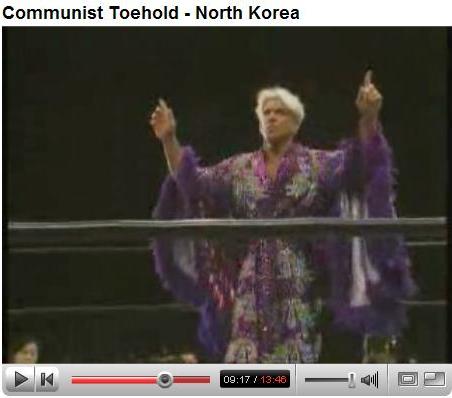
According to Wikipedia (so it must be true):
In 1995 the Japanese and Korean governments came together to hold a two-day wrestling festival for peace in Pyongyang, North Korea. The event drew 150,000 and 190,000 fans respectively to May Day Stadium. The show featured The Steiner Brothers, Road Warrior Hawk, Hiroshi Hase, Chris Benoit, and others. The main event saw the first and only match between Inoki and Ric Flair with Inoki coming out on top. Days before this event, Antonio Inoki and the Korean press went to the grave and birthplace of Rikidozan and paid tribute to him.
UPDATE: Here is the full match.
UPDATE: Ric Flair discusses the match!
Daily NK
Han Young Jin
8/6/2007
Frequently in the last couple years, it’s been said within North Korea and among defectors that “North Korea has changed a lot.”
North Korean citizens say, “North Korea is not in the same situation as it was in 10 years ago. The biggest difference is that nowadays, people will do whatever it takes to make money. Also, they confidently raise their opinions to the authorities.”
It is hard to find merchants being called out as “opportunist factions.” It’s also different than the mid-90s when people would sell whatever they could. The market is specializing in items and broadening as well. The market is taking its form.
North Korean authorities have also expanded micro-level autonomous management systems to factory enterprises as they are unable to give out rations.
Of course there are people who make ends meet but most people are merchants. It is hard to find people who work as “servants” or housemaids or people who starve to death. They unanimously say, “It is enough to suffer once. Even cows don’t fall into pits that they’ve fell into once.” This is to say that there will no longer be horrific incidents such as the Great Famine of the mid-90s.
We listened to five defectors who recently entered South Korea on changes in the situation of North Korean residents.
I’m the one who farmed
“I’m the one who farmed. Why should I hand it over to the government?” Defector Kim Kyung Sik [pseudonym] from Onsung, South Hamkyung Province, who came to South Korea in March, 2007 says, “There was an incident with a riot as laborers collectively protested the increase of land tax in 2006.”
After the measures taken on July 1st, 2002, North Korea had laborers other than farmers farm on designated areas according to household and expanded the policy of submitting a portion of the harvest to the government.
Concerned that this measure would be seen as a revolutionary liberal step, North Korea assigned the land according to company title and gave a square around 992 meters to each laborer in the company.
Kim said, “As people farmed on their own land, laborers would work wholeheartedly and there would not even be a patch of grass on the farming land. Because people would find some way to get fertilizer to spread, the size of the fruits was also different.”
He said, “As it became fall, the Management Committee (collective farm’s Leading Group) and the collective farm who had designated the land gave orders to hold off on the fall [harvest] until the standards of grain exchange came from above. Along with this an incident occurred and tens of laborers protested.”
Choi, a woman from the same region said, “As the laborers of Onsung Mine were told to submit 10% of the yield to the government, laborers strongly opposed saying ‘Who had farmed this?’ ‘Why should we hand it over to the government?’ It happened in 2003.”
Accordingly she said, “After dividing the land to the laborers, there has been a sharp decrease in the number of people starving. It will be hard to reverse such tide of change.”
Increase of “Audio-Video Places”
Recently in large cities of North Korea, places to screen multimedia CDs or videos called “Audio-Video Places” – comparable to video rooms in South Korea – have increased. As it is set in a square 50 meters that is decorated like a small theater and plays movies, citizens of the region have been reacting positively.
Defector Suh Kang Chul [pseudonym] from North Hamkyung Province Chongjin who had defected July 2006 said, “There are three screening rooms around the Chongjin Train Station. It is 50 won to see a film. You must watch 2-3 films at once to be satisfied. This is not a small amount of money.”
Screening rooms of North Korea renovate the interior of a building and with the goal to screen “North Korean or Russian films,” they receive the government’s approval. However, most play Chinese or Hong Kong movies. As long as they don’t play South Korean, American, Japanese or pornographic films, there are no severe punishments. The reason people go to screening rooms is because movies are screened for 24 hours without a power outage.
Suh said, “If there is a power outage, the store owner hurries to change to a car battery to play the film. The films people like are Bruce Lee’s “The Big Boss” (1971) and “Fists of Fury” (1972) or Jet Li’s action films.”
Foreign multimedia have been a strong catalyst to change the thoughts of North Koreans. Even Korean dramas that have been copied on to CDs have secretly spread the “Korean Wave” in North Korea. Bae Yong Joon of “Winter Sonata” is recognized as a famous actor.
Many years ago, the “109 Inspection Team” (Bureau to oversee VCDs and videos) was established to regulate illegal screenings and even on the 3rd, in the name of the People’s security, there was an order that “Public officials, institutions, entities and groups must rid all karaoke rooms, movie rooms, computer rooms that were established without the government’s approval for the purpose of making money.”
However, Kim says, “as the ratings of Korean dramas rise, it becomes a situation that cannot be controlled.” Thus, most of the viewers are tied to the Security Agency or an acquaintance of the People’s Safety Agency that it will not be easy to eradicate this problem.
North Korean authorities have made declarations on the “Exposure of Liberalist Corrupt Culture” but in reality the regulating institutions have stopped at indirect responses.
In a phone conversation with a reporter on the 2nd, an internal North Korean news source also said, “It is planned that the Great North Korean Defamatory Broadcasting that was based around the Kaesung area will now move to the Tumen River area. People have been saying that there have been many cases where people are tricked into believing the broadcasting and betraying the country or watching Korean films to get fantasies and crossing the border, but such acts will be severely punished.
Daily NK
Kim Min Se
8/3/2007
“There is no better way to make a living than being a driver in North Korea. By delivering food, vegetables and even lumber for winter use to companies, one can take a portion as a driver too. Even when transporting radishes or cabbages for Kimchi (Korean cabbage pickles) one can always put aside the ones of best quality in a plentiful amount.”
Defector Kim Choong Il [pseudonym] who had come to South Korea due an unavoidable situation had worked in North Korea as a driver for a company. Reminiscing his days as a driver in North Korea he smiled and even said that he missed the life.
“People who need cars come ask and even bring gas so there are no expenses on my part. I just need to drive. I rarely even ate at home. Most of the time I was treated out. Because there are no means of transportation, everyone wants to use cars. I even make some business when I drive long distances for company-related work. Sometimes when I drive a couple merchants on the road because they beg me to give them a ride, I get drinks and cigarettes for free.”
In South Korea, any healthy adult – male or female – is eligible for driver’s license. However in North Korea, there are several classes of driver’s licenses and they limit the training of drivers. Driver’s licenses are that much recognized in North Korea.
In South Korea, being a driver is not the ideal profession but in North Korea, a “car driver” is very popular. Once you obtain your driver’s license and get assigned to a truck, you never have to worry about making a living again. The income is fairly good.
Kim said, “There is just one time that I faced a difficult situation working as a driver.”
A Conscientious Accountant is the First to Starve
He said, “While transporting radishes and cabbages for the company employees’ use, I put aside 2 tons for an accountant and myself. If a driver takes it alone then he’ll be caught by the accountant so the two collaborate to embezzle goods. But the new accountant was a conservative and nice woman. She refused the 1 ton of cabbages that had been allotted to her and demanded that I bring back my portion too. I begged her “to turn the other way” but it didn’t go through. I ended up restoring the cabbages and radishes.
Moreover, he said, “this nice accountant was the first to starve when the food rations ended in 1995. She had been conservative and waited for rations from the Party but ended up dying. I survived. Even in the Great Starvation period, none of the drivers starved to death.”
To obtain a driver’s license in North Korea, one must learn about the basic structure of the car and simple maintenance operations along with a year of driving practice at an automobile driving school. After a year of education and passing the test, a diploma is given.
Only with this diploma the Automobile Management Bureau of the provincial Safety Agency (County Police Agency) gives out an official driver’s license. At this time a Grade 4 is given. With this “Grade 4”, one can’t automatically start driving.
There are heavy equipment driver’s license to operate excavators and tractors and automobile driver’s license. Heavy equipment driver’s license has 7 grades and automobile driver’s license has 4 grades.
Most “Grade 4” drivers work as assistant drivers to drivers with much experience for at least 3 to 5 years and gain experience and skills on driving and car repair. Even afterwards, one must give bribes to the affiliated company (factory) to receive one’s own car and drive.
Grade 1 License is Nearly Impossible
Once a driver who has been distributed a car drives without any accidents, their grade is raised once every 3 to 5 years. If they get into an accident, the promotion rate slows down.
According to the testimony of another defector Choi Young Chul [pseudonym] who had worked as a car driver, most drivers obtain a “Grade 4” status after 10-15 years of experience. However, from “Grade 3” it’s not just driving that one must excel at. From “Grade 3” regardless of years of experience and lack of accidents, one must pass the National Public Official Exam to obtain [higher levels].
“Grade 3 drivers are given the same license as a college graduate. In Kimchaek City where I lived there were only two people who had a Grade 2 driver’s license,” he said.
Choi said, “To obtain a “Grade 1”, you must be able to build a car. Realistically even if most drivers drive long-distance for more than 30 years, they remain at “Grade 4”. Even if you graduate from Dukcheon Automobile College (3 years), you’re only given a “Grade 4″. If you graduate with flying colors, you’re given a Grade 3.”
The reason it’s hard to obtain a “Grade 3″ driver’s license in North Korea is because drivers must have overall knowledge about maintenance as well as thorough knowledge and skills on repair.”
With a highway system that is deteriorated and the absence of a car repair system, the frequency of break downs or troubles are very high. Also, most civilian cars excluding military cars have a severe deterioration.
Choi also exposed, “There is an item that North Korean drivers never forget when they leave for a long distance trip. Lighters, rice, drinking water and a pot are integral. It’s like our life. When there’s a severe problem and it’s impossible to fix on the spot, they survive off of the rice and call the factory and wait. Most drivers who have driven for 10 years struggle from gastroenteric trouble.
It’s Choi’s explanation that if a car breaks down in an uninhabited area in the winter or a mountainous road, it can eventually lead to a human casualty. Thus it is the driver’s burden to take care of the damages and repair as well as the casualties from it.
On the other hand, the North Korean military trains army drivers for the military through a separate driving school in each troop. Recruits who had just graduated from middle-high school receive education for a year at the driving school to work as army drivers. In “Ohro Driving School” in Youngkwang, South Hamkyung Province and “Lanam Driving School” in Lanam-district, Chongjin, North Hamkyung are representative army driving schools in the Hamkyung Province areas.
Once they finish their rookie training and dispatched to a base, they fulfill their army duty by working as a car driver. After being discharged, these military drivers must go to the corresponding Defense Department Automobile Management Bureau and exchange their licenses with societal driving licenses.
The amusing fact is that at this time most army drivers receive societal driving licenses that is a grade lower than one that was given in the military. It is also evidence that the North Korean society does not trust the discharged soldiers who tend to cause accidents frequently.
Daily NK
Kim Song A
8/2/2007
Kim Jong Il Enthralled by the Desire to Produce International Films
A memoir of late film director Shin Sang Ok titled, “I was a film” (Randomhouse) was published. Shin Sang Ok had lived quite the life having been kidnapped to North Korea with his wife Choi Eun Hee – the most famous South Korean actress of the 1970s – and later escaping.
As this book was written by Director Shin himself as an autobiography, he had finished writing in 2001 but the publication was delayed as he passed away due to the worsening of his illness. Only after a year had passed did his wife Choi Eun Hee organize the late director’s manuscript and laid it out for the world.
In the book remains the untouched film life of Director Shin that starts from his entrance into the film industry and glory days to his kidnapping and escape from North Korea and finally his advancement into Hollywood.
Shin captured the reader’s attention as he recounted various episodes of his times in North Korea after his kidnapping in 1978. He was captured this very year after inquiring about the whereabouts of his wife Choi Eun Hee who had been kidnapped to North Korea first.
One incident when he was shooting his second film, “Tale of an Escape” in North Korea. Director Shin needed a scene with a train explosion so he submitted a proposal to Kim Jong Il. He writes, “Thinking I had nothing to lose, I said I wanted to explode a real train to enhance the movie’s special effects. In response, the approval came immediately.” He recalls, “This is only possible in North Korea. It’s the first time I experienced a film shoot so spectacular.”
Such consideration was only possible because Kim Jong Il was a crazed movie fanatic. Shin claims he was quite surprised to see that there was about 15,000 films from around the world stored in a movie storage area that is pretty much Kim Jong Il’s personal property.
Shin said, “Kim Jong Il uses films for a political agenda but is also enthralled by the desire to veer off from conventional mannerisms to create a further international film of higher quality. One way to overcome such agony and dilemma was to kidnap us two.”
To Kim Jong Il, Shin even made quite dangerous remarks such as advising him to “Free oneself from worshiping individuals.” Shin claimed that the obstacle to advancing North Korean films was “Kim Il Sung instruction” and said “if [Kim Jong Il] rid the practice of worshiping individuals, the film industry will revive and the country itself will also advance.”
He also said that for the first time in a North Korean film, he inserted a caption to introduce the cast and staff and in place of the Kim Il Sung instruction, he inserted a passage from the introduction to “Les Miserables”. He claims he did not bind himself to the instruction of Kim Jong Il.
In 1983, Kim Jong Il established a film production company named “Shin Film” with Director Shin’s name. Shin says, “What if Kim Jong Il required me to make a political propaganda film for idolatry? What would I have done? In that sense, I have a unique sentiment towards Kim Jong Il.”
The book also mentions an episode about when Shin was in North Korea remembering a scene from a movie he directed while he was in South Korea. He thought that this scene was a sight for sore eyes as he secretly wrote to his brother in South Korea and asked him to burn the original copy.
In the preface he self evaluates himself saying, “With the tragic reality that not many veteran actors remain, I felt that someone needed to start archiving. Just like the title, the highs and lows of life started to cross and I lived a path that was even more dramatic than the movies I directed.”
UPDATE 1 (2007-8-2): I have just completed reading Andrei Lankov’s North of the DMZ. One chapter discussed the history of preserving communist leaders in mausoleums so their remains can be venerated for years to come. Quoting Lankov:
Kim Il Sung’s body has been embalmed and left on public display in a special glass-covered coffin. Actually, in this regard, Korea follows an established — if bizarre — Communist tradition. Like many other Communist traditions, this one originated from the USSR.
In 1924, the body of Vladimir Lenin, the founding father of the Soviet Union, was laid in a specially constructed mausoleum where it was kept in a glass-covered coffin. This mausoleum became a place of mass pilgrimage. Initially most visitors may have been driven by sincere devotion, but in later decades the major impulse bringing visitors was, more likely than not, just bizarre curiosity. Nonetheless, passions sometimes ran high. In the Soviet times, there were two known attempts to damage Lenin’s mummy in an act of symbolic resistance against the regime. On the other hand, the post—Communist Russian government has not dared to close the mausoleum, being aware that such an act is certain to spark large-scale protests and riots of the Russian Left.
In the Soviet times, a special and highly secretive research institute with a generous budget was responsible for the maintenance of Lenin’s body. Over the decades, its research staff gained unique expertise. In due time this expertise was in demand for new generations of the venerable dead.
In 1949, the Bulgarian Communist leader Dmitrov became the first person to be embalmed by the personnel of Lenin’s mausoleum. After Stalin’s death in 1953 the body of the Soviet dictator was also treated with this proven technique and put alongside Lenin’s mummy. However, in 1961 Stalin’s corpse was hastily removed from the mausoleum, to be buried below the Kremlin wall.
Meanwhile, Soviet experts were sent to take care of a number of politically important corpses across the world. They embalmed the bodies of a number of other Communist rulers: Choibalsan of Mongolia, Gottwald of Czechoslovakia, Ho Chi Minh of Vietnam, Netto of Angola (Mao’s body was treated by the Chinese themselves).
Thus, when in 1994 Kim Il Sung died, few people doubted that his body would be put on display as well. The Russians confirmed that they had taken part in treating Kim Il Sung’s body. According to unconfirmed reports a group of Russian biologists and chemists worked in Pyongyang for almost a year.
In the l950s and 1960s Moscow did not charge its clients and allies for treating the bodies of their deceased rulers. But this is not the case any more. After the collapse of the Communist system in Russia, the research center has had to survive on a very tight budget, and it is not willing to provide its unique know-how for free. Incidentally, these laboratories’ major income source is now the bodies of Mafia bosses or new Russian capitalists (it was not really easy to distinguish between the former and the latter in the Russia of the 1990s).
The fees for treating the earthly remains of the Great Leader, the Sun of the Nation, were never disclosed, but the Russians reportedly charged North Korea one million dollars. Frankly, this was a steal: Kim Il Sung died at the time when the former USSR was in the middle of its severest crisis, and ex—Soviet scientists were ready to accept meager rewards for their work.
Nonetheless, this deal was made at the time when North Korea was on the eve of the worst famine in Korea’s history. The final result of the scientists’ efforts was the mummy of Kim Il Sung which, incidentally, cannot be referred to as a “mummy” but only “the eternal image of the Great Leader.”
However, the million-dollar fee is only a fraction of the ongoing cost of keeping Kim Il Sung’s body well preserved. A few years ago a high-level North Korean bureaucrat mentioned to visiting Indonesians that North Korea paid about 800,000 dollars annually for these expenses. On might surmise that at least a part of this money goes to the budget of the same Soviet research centre which once did the embalming.
In one respect the North Koreans did not emulate other Communist countries. The bodies of Lenin, Mao, and Ho Chi Minh were laid in mausoleums specially constructed for that purpose. The North Koreans did not erect a new structure but renovated a pre-existing building, the Kumsusan Palace. This large structure was erected on the outskirts of Pyongyang in the mid—1970s. In subsequent decades it served as the residence and office of Kim Il Sung. Now this building’s huge central hall became the Great Leader’s resting place.
Unlike the USSR, where visits to Lenin’s tomb are essentially voluntary acts, the North Koreans are picked by their party secretaries to visit the Kumsusan Palace. Most of them, admittedly, do not mind going—partially out of curiosity and partially out of sincere reverence to the deceased strong- man.
For the past few years, crowds of North Koreans have passed by the body of the Great Leader who, for better or worse, ran their country for almost half a century. The visitors are required to stop for a while and bow to the glass- covered coffin containing the embalmed body. The dim lights and quiet music emphasize the quasi-religious nature of the entire scene. The visitors pay their tribute to a person who once started the worst war in Korean history, killed at least a quarter of a million people in prisons and ran what even in the Communist world was seen as an exceptionally repressive state.
Indeed, many (I would say, most) North Koreans more or less believed in what the official propaganda told them about the Great Man. All Koreans younger than 70 have spent their entire life listening to stories about Kim Il Sung’s greatness. He is supposed to be the person who defeated the Japanese in 1945, then repelled U.S. aggression in 1950 and, by keeping the cunning imperialists at bay for decades, saved North Koreans from the sorry fate of their enslaved Southern brethren. Of course, outside the North it is common knowledge that Kim Il Sung did not fire a single shot during the liberation of Korea, that the Korean war was started by him and nearly lost due to his miscalculations, that South Korea had one of the fastest growing economies of the 20th century while the North became an international basket case. But these things remain largely or completely unknown inside the North, where many people still believe in the deceased Great Fatherly Leader.
And just where did the communists get the idea of preserving their leaders in perpetuity? One hypothesis can be found in Paul Froese’s, The plot to kill God: findings from the Soviet experiment in secularization. He claimed that many Soviet cultural practices were based on religious ones.
ORIGINAL POST (2007-6-10): My traveling comrade at Knife Tricks points to an interesting claim by an L.A. Times Journalist that the body of Kim il Sung on display in Kamsusan Memorial Palace is actually made of wax.
There are currently four communist leaders on display in this manner (Vladimir Ilyich Ulyanov (Lenin), Ho Chi Minh, Chairman Mao Zedong, and President Kim il Sung), and claims that they are not the actual bodies have been part of travel folklore for some time. Joseph Stalin’s body was on display next to Lenin, but was later removed. Chairman Mao’s body is reportedly swapped out with a wax duplicate occasionally, and people in the former Soviet Union have all sorts of stories about individuals winning “Lenin look-a-like” competitions and then promptly disappearing.
I suspect that all four bodies are at least real bodies. I have seen three of the four myself, and the only reason that I am not four-for-four is because Ho Chi Minh was in Russia getting touched up when I visited Hanoi in 1996. Several years later I had a conversation with an ABC reporter based in Asia who told me that there was in fact a secretive Russian firm that exclusively serviced these corpses. (If anyone knows anything about this firm, please let me know). This seems like a lot of trouble to go through if all they were doing was re-sculpting wax. If this was the case, then I doubt that they would go through all the risk and expense of shipping the bodies so frequently unless–as game theory teaches us–going through all the trouble makes their organic composition seem more likely. Occam’s Razor applies unless someone can give me a reason to believe a more complex scenario.
I have read (although forgotten the cite–so disregard if necessary) that Kim il Sung was supposed to be buried in Kim il Sung Square in the pavilion that is now used for viewing parades and dancing. After his death, plans were developed to construct what is now Kamsusan Mausoleum. One other thing to note, which the LA Times and most other travel accounts fail to mention, is that the softball-sized tumor which grew on the left-hand side (facing him) of Kim il Sung’s neck (which is why official portraits are taken from a slight angle on the right side) was removed (or hidden by the pillow) so that it is not visible at all to the millions who have visited the presidential mausoleum.
Institute for Far Eastern Studies (IFES)
8/1/2007
INTER-KOREAN RELATIONS
Following two days of talks between economic representatives of the two Koreas at the Kaesong Industrial Complex, South Korea announced on July 7 that it would begin shipping raw materials to the North in exchange for DPRK natural resources. South Korea shipped 800,000 USD of polyester fabric on July 25, and is set to send the rest of the materials by the end of November. North Korea accepted South Korean prices for the goods, and will pay transportation, cargo working, and demurrage costs, as well. South Korea will pay for shipping, insurance, and the use of port facilities. On 28 July, a South Korean delegation left for the North in order to conduct on-site surveys of three zinc and magnesite mines. The team will spend two weeks in North Korea.
It was reported on 17 July that North Korea proposed a joint fishing zone north of the ‘Northern Limit Line’ dividing North and South territorial waters to the west of the peninsula. Seoul turned down the offer.
Inter-Korean military talks broke down early on 26 July after only three days of negotiations as North Korea insisted on the redrawing of the Northern Limit Line.
North Korea demanded on 27 July that workers in the Kaesong Industrial Complex be given a 15 percent pay raise. The North Korean workers will not work overtime, weekends or holidays beginning in August unless the raise is granted.
It was reported by the Korea International Trade Association on 26 July that inter-Korean trade was up 28.6 percent in the first six months of 2007, totaling 720 million USD.
RUSSIA-DPRK INVESTMENT
It was reported on 19 July that Russia and North Korea have agreed to connect Khasan and Najin by rail, enlisting investment from Russian oil companies interested in an inactive refinery at Najin Port capable of processing up to 120,000 barrels per day. The project is estimated to cost over two billion USD.
MONGOLIA-DPRK RELATIONS
During a four-day visit to Mongolia by Kim Yong-nam beginning on 20 July, the two countries signed protocols on cooperation on health and science, trade and sea transport, and labor exchange issues. This follows on the heals of an agreement to allow South Korean trains to travel through North Korean territory on to Mongolia in route to Russia and Europe.
JAPAN-DPRK PROPAGANDA
Japan took one step further to recover abductees in North Korea this month when the government began broadcasting propaganda into the DPRK intended for Japanese citizens. The broadcasts are made in Korean and Japanese (30 minutes each) daily, and updated once per week.
U.S.-DPRK PEACE PROSPECTS
U.S. Ambassador to the ROK Alexander Vershbow stated that Washington was prepared to negotiate a permanent peace regime on the Korean Peninsula by the end of the year if North Korea were to completely abandon its nuclear ambitions.
EGYPT-DPRK INVESTMENT
The Egyptian company Orascom Construction Industries announced a 115 million USD deal with North Korea’s state-owned Pyongyang Myongdang Trading Corporation to purchase a 50 percent state in Sangwon Cement. To put this in perspective, the deal in worth more than four times the amount of frozen DPRK funds that had caused six-party talks to break down and delayed the implementation of the February 13 agreement.
NORTH KOREAN SOCIETY
The Economist reported on 7 July that, according to foreigners living in the North’s capital, concern for petty law appears to be weakening. Citizens are reportedly smoking in smoke-free zones, sitting on escalator rails, and even blocking traffic by selling wares on the streets.
It was reported on July 11 that a letter sent earlier in the year by the North Korean Red Cross indicated severe shortages of medical supplies. The letter stated that North Korea would accept any medicine, even if it was past expiration, and accept all consequences for any problems that arose from using outdated supplies. The (South) Korea Pharmaceutical Manufacturers Association had no choice but to reject the request.
Events were held on July 11 in North Korea in order to promote women’s health and well-being issues. Marking World Population Day, a North Korean official stated that the DPRK has cooperated with the UN Population Fund since 1986, and is now in the fourth phase of cooperation.
Seeing entertainment venues as a “threat to society”, North Korean security forces have been implementing a shutdown of karaoke bars and Internet cafes. These venues mainly cater to traders in the northern regions of the country.
It was reported on July 13 that construction of North Korea’s first all-English language university was nearing completion. The Pyongyang University of Science and Technology, funded largely by ROK and U.S. Christian evangelical groups, will hold 2600 students and offer undergraduate and post-graduate degrees in business administration, information technology, and agriculture.
Local elections were held on 29 July for DPRK provincial, city, and country People’s Assemblies. 100 percent of 27,390 candidates were approved with a 99.82 percent turnout reported.
Now available on Google Earth!
(click above to download to your own Google Earth)
North Korea Uncovered v.3
Google Earth added a high-resolution overlay of the area between Pyongyang and Nampo. In it, most of the Koguryo tombs listed with UNESCO are now distinguishable. In addition, viewers can see the latest Kim Jong Il palace (including a yacht), the DPRK’s premier golf course, and the Chinese-built Taean Glass factory. I have also made some progress in mapping out the DPRK electricity grid.
This is the most authoritative map of North Korea that exists publicly today. Agriculture, aviation, cultural institutions, manufacturing, railroad, energy, politics, sports, military, religion, leisure, national parks…they are all here, and will captivate anyone interested in North Korea for hours.
Naturally, I cannot vouch for the authenticity of many locations since I have not seen or been to them, but great efforts have been made to check for authenticity. In many cases, I have posted sources, though not for all. This is a thorough compilation of lots of material, but I will leave it up to the reader to make up their own minds on the more “controversial” locations. In time, I hope to expand this further by adding canal and road networks.
I hope this post will launch a new interest in North Korea. There is still plenty more to learn, and I look forward to hearing about improvements that can be made.
