Archive for the ‘Civil society’ Category

Film Screening: “The Schoolgirl’s Diary” (2006)

Monday, April 7th, 2008

(NKeconWatch: “I hope to see you there”) 

April 09 2008, 4:00 p.m. – 6:30 p.m.
6th Floor Auditorium
Woodrow Wilson Center
One Woodrow Wilson Plaza
1300 Pennsylvania Ave., NW
Washington, DC 20004

Learn more and REGISTER here

The Schoolgirl’s Diary (Han Nyeohaksaengeui Ilgi-2006, in Korean–no subtitles) is the story of a self-absorbed North Korean teenager, Soo-Ryeon, who yearns to move to an apartment from her home in the countryside and questions the values of her father and mother; a scientist and a librarian at the academy of sciences who put the good of the nation before that of their family. Soo-Ryeon realizes how selfish she is only after her mother falls ill and her father makes a major breakthrough in his research. The film’s screenwriters reportedly received guidance in drafting the script from North Korean leader Kim Jong Il.

Following the screening: Suk-Young Kim will discuss the film and offer comments.  Suk-Young Kim is assistant professor of theater and dance at the University of California at Santa Barbara and an expert on North Korean propaganda. She is currently completing a book project titled Illusive Utopia: Theater, Film, and Everyday Performance in North Korea, which explores how state produced propaganda performances intersect with everyday life practice in North Korea. Another book project, Long Road Home: A Testimony of a North Korean Camp Survivor (coauthored with Kim Yong) is forthcoming from Columbia University Press.

Sponsored by: North Korean International Documentation Project

Share

UN pulls out of North Korea Olympic torch ceremony

Saturday, April 5th, 2008

More politicization of the Beijing Olympics…

The United Nations has withdrawn its staff from the Olympic torch run in North Korea amid concerns that the relay will be used as a propaganda stunt.

The decision followed a heated internal debate among foreign donors, who face a constant battle with Kim Jong-il’s government in their efforts to get food and aid to impoverished people.

It is believed to be the first acknowledgment by the world body that the Olympic torch relay is a political event that can be exploited by unscrupulous governments, diplomats said.

and…

“Unicef originally decided to participate in the Pyongyang leg of the Olympic torch run in response to a request from, and as a demonstration of support for, the International Olympic Movement,” said Christopher de Bono, a spokesman for the organisation.

“However, we are no longer convinced that Unicef’s participation in the run will support the aim of raising awareness of the situation of children in the DPRK [Democratic People’s Republic of, or North, Korea] and elsewhere,” he said.

“Unicef has decided, in concert with other UN family entities, to withdraw from the Pyongyang relay.”

Read the full article here:
UN pulls out of North Korea Olympic torch ceremony amid fears of propaganda coup
Times of London
Michael Sheridan
4/6/2008

Share

North Koreans are people too.

Friday, April 4th, 2008

The Daily NK reports that demand for South Korean pornography among Northerners is on the increase:

The demand for X-rated movies among North Korea’s high cadres is so great that a single VCD sells for 50 US dollars.

The latest publication of Good Friends, a North Korea-related aid organization, tells the story of Mr. Park, a resident of Hyesan, Yangkang Province. Mr. Park was arrested for making copies of South Korean adult movies–called “colored movies” in North Korea–and selling them in Pyongyang. Despite the high price per VCD, the publication notes that supplies are getting tight.

“Mr. Park bought the CDs near the North Korean- Chinese border from China. Then he would make his friend in Pyonsung, South Pyongan Province copy them and to sell them to traders in Pyongyang,” reported the publication.

The fact that there is a demand for pornography in the DPRK is not surprising (I have met several North Koreans who have seen it more than once) but the price reported in the story seems unusually high. 

Read the full story here:
Pyongyang Cadres Want South Korean Adult Movies
Daily NK
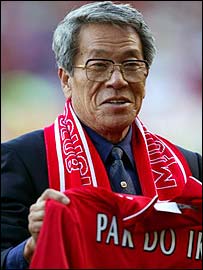
Park In Ho
4/4/2008

Share

World Cup Qualifier: Under dogs vs. Running dogs

Tuesday, April 1st, 2008

Update 2 – 6/9/2008: YouTube video of the game

Both national anthems played

North Korean tem thanks the fans 

Update 1 –  4/3/2008: Interesting coment on DPRK sports social norms below… 

By pure serendipity I happened to be in Shanghai last week when the DPRK and South Korea faced off in their first world cup qualifier.  As readers are aware, this match was supposed to be held in Pyongyang, but after the DPRK refused to raise the South Korean flag (preferring instead a single “unification” flag), FIFA moved the game to Shanghai.

dprkflags.jpg

gameshot.jpg

Both flags were raised and national anthems were played–then the players took to the field.  The game was pretty exciting.  Although the final score was 0-0 both teams played like they wanted to win.  The South Koreans were the clear favorites, so it was a surprise when the game ended in a tie.  Fortunately, I could not contact my bookie from China.

dprkfans.jpg dprkfans2.jpg

Above: the North Korean fans sitting directly below me.

Although it was a “home” game for the North Koreans they were drastically out-numbered by Southerners and contained together in their own section.

dprkfun2.jpg dprkfun.jpg dprkfun3.jpg

Scarves available from Koryo Tours!

The Northerners were quite accessible, however, in the hallways at half-time and after the game. The few I spoke with were language students, business students, engineering students, and businessmen, mostly all from Beijing and Shanghai.  They were organized into groups like Japanese tourists, but it was nice they made the effort bringing out some supporters for the home team. 

Thanks to Simon for the tickets, scarves, and the title.

UPDATE
nkmonitor:
The DPRK fans seem pretty friendly. By the way, where they mostly Chaoxian Zu or actual DPRK citizens? Where they aware of the controversy surrounding the match?

Simon: 
All the ones in white clothes (as seen in the pics taken from above) were full-on DPRK citizens, as mentioned in the piece above they were mostly working in Beijing and Shanghai; there were airline staff, businessmen, students, waitresses, etc all there. The Chinese chaoxian zu seemed to be sitting on the upper stand across the stadium, at least there were a load of people dressed drably, not really making any noise and they had a couple of NK flags out so I assume this was them. The NKs in the lower stand made a bit of noise and had big singalong at the end. When people attend matches in Pyongyang they tend to just sit in silence regardless of how it is going so this did make a refreshing change from that scenario.

Share

Pyongyang International Trade Fair and IT delegation

Monday, March 31st, 2008

GPI Consulting is once again hosting an IT business delegation in conjunction with the Pyongyang International Trade Fair this spring. 

Marketing language:
Business trip to the “11th Pyongyang International Trade Fair” (May 2008)
North-Korea is slowly opening up to the outside world. The trade with neighboring China and South-Korea is already growing fast, and also several European companies are conducting business. An excellent way to collect information and to make new contacts is by visiting the annual “International Trade Fair”, wich takes place from 12-15 May in Pyongyang. Companies interested in exploring business opportunties in North-Korea are invited to join our 10-17 May IT-business mission. The participants will be offered a tailormade program, with a focus on the International Trade Fair. For European companies, it is possible to make use of a collective European stand: for only 600 Euro, they can present their products or services to the public (or have them presented by local staff).   
 
IT- and multimedia study tour to North-Korea (May 10-17, 2008 )
The main focus of our business mission is to explore IT opportunities in North Korea. The goal of this studytour is to give the participants detailed information about offshoring. The IT-participants will visit firms in Pyongyang in the field of IT, animation, 2D and 3d design, cartoons, computer games, mobile games,and BPO. The business mission will have an informal character, with some attention to cultural or touristic elements. The trip will start in Beijing, and after returning from North Korea, an extension of the stay in China is possible in order to visit additional firms. The program of the tour has been added, and can also be found at: www.gpic.nl/NK-IT-tour.pdf   
 
Contact Information: 
Paul Tjia (sr. consultant)
GPI Consultancy, P.O.  Box 26151, 3002 ED Rotterdam, The Netherlands
tel: +31-10-4254172  fax: +31-10-4254317 E-mail: paul@gpic.nl  Website: www.gpic.nl

Share

DPRK promotes multifaceted trade to boost exports

Thursday, March 27th, 2008

Institute for Far Eastern Studies (IFES)
NK Brief No. 08-3-27-1
3/27/2008

The latest issue of the North Korean publication “Economic Research” (2008, issue no. 1) highlights the need to restructure North Korea’s trade system in order to meet the demands of the capitalist market. The journal quotes Kim Jong Il as saying, “[We] need fresh improvement, in our own manner, of the basic Socialist economy’s trade system of yesterday, meeting the current demands being faced due to the capitalist market.”

Therefore, the journal stresses, “As the socialist market crumbles, and given the demands of the capitalist market as [our] focus shifts to overseas economic relations, what is currently needed for the development of overseas trade is improvement of our own style to the trade system that can ensure large profits.

The journal goes on to recommend that, in order to meet these new demands of the international capitalist market, “the most important thing is improving the import-export system based on the foundation of an self-reliant national economy.” It states that raw materials should not be sold as-is, but rather should be turned into processed goods and then sold, that goods popular on the international market should be manufactured for export, and that niches should be chosen in which North Korean goods can dominate the international market.

However, the journal also says, “If individual offices trade with capitalists outside the scope of government controls, ‘reform’ and ‘opening’ sought by the imperialists would occur, and the nation’s economy could liberalize and capitalize…International trade must take place orderly under the uniform control and guidance of the nation.”

The journal asserts that even though a variety of offices are engaged in trade, they must first receive government permission, follow government guidelines, and operate in a government-created environment. The central government must standardize prices and designs of selected export goods from each trading company.

Share

DPRK citizens turn to batteries, bicycles to solve energy shortages

Monday, March 24th, 2008

Institute for Far Eastern Studies (IFES)
NK Brief No. 08-3-24-1
3/24/2008

North Koreans, long suffering from a chronic engergy shortage, are now putting forth efforts to solve even this electrical issue on their own.

The Daily NK, a South Korean-based human rights organization, has learned from interviews with North Korean residents that these days, even in farming villages, families with regular incomes are relying on batteries to light their houses and power their televisions.

Many batteries are being imported from China, and there are also many households using bicycle-mounted generators to produce electricity to overcome energy shortages. Despite the fact that these North Koreans are living in a Socialist country that fails to provide them electricity, they are coming up with their own methods for solving problems.

According to these North Koreans, there is a difference in the way they are solving the electrical shortages in the cities and in the farming communities. In the cities, many are using rechargable car batteries. There, power is provied from around 8:00am to 1:00pm, and then again in the evenings from around 8:00pm until 11:00pm. During these times, batteries are recharged and then used later for lighting and watching television.

In order to use these batteries to watch television or videos, direct current needs to be transformed into 220-volt alternating current, requiring a small power converter. The prohibitive cost of such a converter means that in farming commuities, the use of batteries to power households is difficult.

This has led many in rural areas to find a slightly different method of solving their energy needs. In farming villages, small generators attached to the rear wheel of bicycles so that ‘human power’ is used to produce electricity.

The cost of a used car battery in North Korea is around 70,000 won, while a new battery could run as much as 120,000~160,000 won*. Batteries produced in China are of high quality, but if there is ever a problem, it is difficult to have them repaired. Therefore, ‘Daedong River’ car batteries produced in North Korea are preferred.

* The current black-market currency exchange rate is approximately 2,500 DPRK Won/ USD.

Share

Women and police clash in DPRK Markets

Saturday, March 22nd, 2008

Institute for Far Eastern Studies (IFES)
NK Brief No. 08-3-22-1
3/22/2008

Recently, North Korea passed a measure prohibiting women younger then 49 from selling goods in markets, leading to clashes between police enforcing the rule and younger women wanting to work in markets.

The March 19th newsletter from ‘Good Friends’, an organization providing aid for North Korea, reported that on February 5th in Haeju, South Hwanghae Province, women who were not allowed to enter the local market and so were selling goods on a nearby corner physically clashed and police. This reportedly led to the arrest and detention of 9 people.

The newsletter reported, “The women held at the police station were subjected to harsh interrogation as to ‘who was the ringleader’, and after being subjected to four days of torture, one who could no longer hold out confessed to being the ringleader and was sent to a detention center, while the remaining women were all released.”

North Korean authorities announced the measure restricting women under 49 from selling goods in markets after December 1st last year, and that measure is being enforced not only in Pyongyang, but in rural areas as well.

According to Good Friends, “Just like other cities, Haeju City has received absolutely no food rations since March,” and “Women from households barely managing regular meals through market trading are being reduced to the weakest level by North Korean authorities’ prohibition on trading.”

It follows that in Haeju City, either authorities recognize that if these women can not sell in the markets their families will starve to death and so turn a blind eye to their activities, or these women, prevented from selling in markets, will continue to clash with authorities.

The newsletter also reported, “On March 3, in Chungjin City, North Hamkyung Province, organized protests by women prevented from market activities by the new regulations broke out, and Chungjin City authorities are now allowing all women, with no exception, to sell goods in markets.”

Immediately following organized protests by these women, Chungjin City officials reported the disturbances, but no policies to deal with the issue were forthcoming, and so it appears that all women, with no exception, are now allowed to conduct market activities.

Share

World oil and grain prices up, DPRK feels the pinch

Thursday, March 13th, 2008

Institute for Far Eastern Studies (IFES)
NK Bfrief No. 08-3-13-1
3/13/2008

International fuel and food prices are skyrocketing, while the cost of Chinese goods continues to rise, so that this so-called ‘triple-threat’ is sending shockwaves through the North Korean economy. In this year’s New Year’s Joint Editorial, North Korea championed the banner of a ‘strong and prosperous nation’, and declared that this year would focus on the economy, however this ‘triple-threat’ will likely make it extremely difficult for the North to meet its policy goals.

With oil prices peaking at over 110 USD per barrel, if these high oil prices continue, North Korea, which imports crude and refined oil from China, Russia and other countries, will face a growing import burden. In accordance with the February 13th agreement reached through six-party talks, South Korea, the United States and others will provide some heavy fuel oil, and the agreement stipulated the amount of oil to be delivered, rather than the value, so this will not be affected by rising prices. However, this oil does not cover all of the North’s needs, and as for the remaining portion, either the amount imported will have to be reduced, or the North will have no choice but to invest considerably more in fuel. In addition, as a large portion of North Korea’s oil is imported from China, Pyongyang’s trade deficit with its neighbor will also grow.

According to the Korea Trade Investment Promotion Agency (KOTRA), North Korea imported 523,000 tons of crude oil from China in 2005, 524,000 tons in 2006, and 523,000 tons last year, each year accounting for approximately 25 percent of total oil imports. North Korea’s trade deficit with China has shown a steadily growing trend, reaching 212,330,000 USD in 2004, 588,210,000 USD in 2005, and 764,170,000 USD in 2006. With grain prices also skyrocketing, and North Korea depending largely on China and Thailand for rice and other grain imports, the burden on the North’s economy is growing, and this is one factor in the instability of domestic prices in the DPRK.

According to the Chinese Customs Bureau, North Korea imported 81,041 tons of rice and 53,888 tons of corn last year, increases of 109.9 percent and 37.4 percent, respectively. North Korea’s corn, rice and oil imports from China are subject to market price controls, so that rising international prices directly affect the North’s cost burden. Last year, the price of Chinese goods rose 4.8 percent, recording the largest jump in ten years, and this trend extends to a wide variety of goods. 80 percent of disposable goods in North Korea are produced in China, and rising Chinese prices are directly reflected in North Korean import costs, which is passed on to DPRK citizens.

As North Korea emphasizes the building of its economy, it appears unlikely that residents will feel any direct effects of Pyongyang’s promise to prioritize the stability of its citizens’ livelihoods.

Share

Taedonggang Brewery…

Monday, March 10th, 2008

Reuters has a write up of my favorite North Korean beverage, Taedonggang Beer:

North Korea’s quest to produce decent beer began in earnest in 2000 when it started talks with Britain’s Ushers brewery about acquiring its Trowbridge, Wiltshire plant that had ceased operations.

The North Koreans took apart the brewery that had been producing country ales for about 180 years, shipped it piece by piece to Pyongyang and reassembled it under the banner of its Taedonggang Beer Factory.

By April 2002, it was up and running. In June 2002, the North’s leader Kim Jong-il, known for his fondness of expensive brandy and wines, went on a brewery tour.

“Watching good quality beer coming out in an uninterrupted flow for a long while, he noted with great pleasure that it has now become possible to supply more fresh beer to people in all seasons,” North Korea’s official KCNA news agency said.

Taedonggang beer, named for a river that runs through Pyongyang, is a full-bodied lager a little on the sweet side, with a slightly bitter aftertaste.

Still not the choice of locals:

Taedonggang is one of several brews in North Korea and it has quickly become the top brand, according to foreigners living in the reclusive country.

Park Myung-jin, of distributor Vintage Korea which used to sell the beer in the South, said the North’s leader Kim wanted a showpiece brewery.

“They used the best quality material without thinking of the production cost,” Park said. He stopped selling the beer in the South in 2007 due largely to a sudden price hike.

The North taps into overseas markets for ingredients, Park said. It has abundant supplies of fresh water because its hobbled factories do not produce enough to cause pollution problems.

Beer is not the drink of choice for most North Koreans, who prefer cheaper rice-based liquor that packs a big punch.

Dont expect to see it in your local pub:

But do not expect to see Taedonggang or any North Korean beer invading overseas markets any time soon.

North Korea may have solved the riddle of making a robust beer but it has not completely solved the problem of bottling it.

The brewery has occasional trouble sealing bottles properly and the glass it uses is fragile.

The transport system in North Korea is also a mess, making it unlikely that the beer can become one of the few legitimate exports from a country shunned by the developed world for its defiant pursuit of nuclear weapons and a human rights record cited by the United States as one of the world’s worst.

The full article can be found here:
North Korean beer: great taste, low proliferation risk
Reuters
Jon Herskovitz
3/9/2008

Share

An affiliate of 38 North