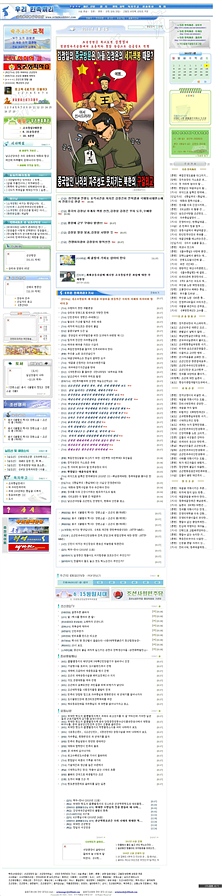
Naenara has posted a summary of the DPRK’s annual joint editorial. You can read it in English here. You can read it in Korean here.
For those of you unable or unwilling to access the Naenara web page, I created a PDF document which you may access here (English) and here (Korean)
Below I will maintain an updated list of media stories that cover the joint editorial.
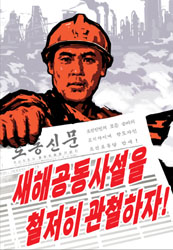
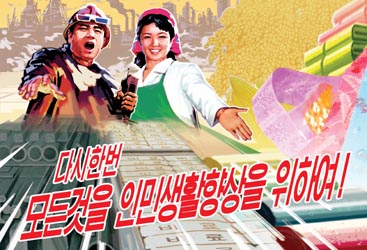
Pictured above: Propaganda posters that “encourage the popular masses to carry out the militant tasks set forth in the joint New Year editorial” (KCNA)
Report 7 from IFES:
DPRK New Year’s Joint Editorial emphasizes light industry for improving the lives of the people
NK Brief No. 11-01-05-2
(1/5/2010)
In North Korea’s 2011 New Year’s Joint Editorial, the main theme was again the development of light industry in order to improve the lives of the people, just as last year, and emphasis was placed on Party leadership, self-reliance, and the principles of socialist economic management. Under the slogan, “Let’s bring about a decisive turn in the improvement of the people’s standard of living and the building of a great, prosperous and powerful country by accelerating the development of light industry once again this year,” light industry and quality of life improvements were again highlighted as part of the advance toward the 2012 goal of opening the doors to a Strong and Prosperous Country, but this issue was only lightly touched upon.
On the other hand, considerable space was allotted to the section on inter-Korean relations. Inter-Korean dialog and cooperation were emphasized, and the editorial positively evaluated its efforts toward unification, stating that “Last year our nation’s movement for the country’s reunification made dynamic progress even in the face of the vicious challenges of the separatist forces inside and outside.” In 2010, the Joint Editorial was more pessimistic, calling South-North relations “aggravated” by vicious maneuvers of “splittist forces.” This year, the editorial called for “all Koreans in the north, south and abroad join efforts and bring a new phase of independent reunification!” Under this slogan, Pyongyang appeared to take a very positive stance, citing the need to east tensions between the two Koreas, to remove the danger of war and safeguard peace, and to proactively promote dialogue and cooperation.
Under the banner of ‘national prosperity’, the article emphasized creating an atmosphere of dialog and cooperation between the two Koreas, and highlighted the need to diffuse the situation that the Lee Myung-bak government drove “to the brink of war.” Despite the Cheonan and Yeonpyeong Island incidents, the North maintained a consistent effort to reopen Keumgang Mountain tourist resort and other steps to repair inter-Korean relations. For North Korea, a tense military atmosphere between the two Koreas is not helpful in its bid to successfully reach its goal of a Strong and Prosperous Country by 2012 by building an economically strong state. Pyongyang also needs to manage relations with Seoul in order to improve relations with the United States and others.
The editorial calls for bringing about “a decisive turn in the improvement of the people’s standard of living and the building of a great, prosperous and powerful country,” and launching “an all-out, vigorous offensive for a breakthrough to realize the wish of the President to build a prosperous country, and thus greet the centenary of his birth as the greatest holiday of Kim Il Sung’s nation and a great event of humankind,” setting 2012 as the goal for opening the doors to a Strong and Prosperous Country. The editorial emphasized that “this year’s general offensive is a continuation of the grand onward march for improving the people’s standard of living, and its new, higher stage,” and is Party policy that “the improvement of the people’s standard of living should be regarded as the most important issue, the highest goal of its struggle, and carried through to the end.”
In the 2010 New Year’s Joint Editorial, Party policy was described as it’s “steadfast determination and resolve to have our people, who have weathered difficult hardships following the party, enjoy being blessed with socialism to their hearts’ content by having the achievements of the great upswing actually be allotted to the people, and to blossom into reality, without fail, the sublime intent and desires of the fatherly leader, who dedicated his entire life to the people.” This year, “light industry is the major front in the general offensive,” while “light industry and agriculture [were] the main fronts of the struggle” in 2010.
Regarding light industry, the editorial emphasized, “The sector of light industry should pay first and foremost attention to making the factories and enterprise . . . keep their production running at a high level,” and that they “should focus on the production of primary consumer goods and other necessities widely used in life, and expand and augment the overall production of other consumer goods.”
The economic section mentioned coal, electricity, iron and steel, as well as transportation as four vanguard industries, emphasized improvements in light and chemical industry, and said that “the agricultural front is the lifeline for solving the problem of people’s living.” The editorial also states, “Breaking through the cutting edge that all sectors should surpass in the shortest time the scientific and technical standards the world has reached,” on the basis of self-reliance and the principles of socialist economic management. The section would lead one to believe that North Korea needs Chinese-style reforms in order to develop its economy, yet it bases these campaigns on self-reliance and the socialist principles of “strict discipline . . . in planning, finance and labour administration.”
This year, North Korea’s New Year’s Joint Editorial continues to push for light industrial development in order to improve the lives of the people and open the doors to a Strong and Prosperous Country in 2012. However, now, after hammering out public financing during last year’s Party conference, the Party is reaffirming that development will be on the basis of “our-style” of reform.
Report 6 from KCNA: The Pyongyang rally has been posted to YouTube.
Report 5 in Yonhap:
About 100,000 North Koreans gathered Monday in Pyongyang to show support for their country’s economic push outlined in a New Year’s message, holding high the portraits of their leader Kim Jong-il and his late father, the communist state’s official media said.
The scene marks the latest in a series of mass rallies the North has organized nationwide since a joint press editorial on Jan 1. called for the revival of light industries ahead of a landmark year.
North Korea has designated 2012 as a moment in its history to rise as a “powerful, great and prosperous country.” The year marks the centennial birthday of Kim Jong-il’s father, Kim Il-sung, and analysts say the regime appears to be trying to improve people’s living standards in a bid to create a mood favorable for its second hereditary power succession underway in Pyongyang.
“Slogan boards were set up at the site of the rally, saying hurray to the revolutionary ideas of Great President Kim Il-sung and Dear Leader Kim Jong-il,” the Korean Central TV said.
Since his death in 1994, Kim Il-sung, who founded the country, has assumed the post of “Eternal President.” The impoverished North runs a massive cult of personality around the Kim family. Kim Jong-il is now grooming his third son, Kim Jong-un, as his successor.
The rally, which brought together a wide collection of propaganda flags, began with a hymn to Kim Jong-il, the television said, while the participants pledged to fervently carry out the New Year goals.
North Koreans are said to be forced to memorize joint press editorials released every New Year’s Day. The editorials are scrutinized by outside officials and analysts for hints into the isolated country’s political and economic plans.
North Korea this year also called for dialogue with South Korea despite tensions that arose when it shelled a South Korean border island and killed four people on Nov. 23. South Korean President Lee Myung-bak said in his New Year speech on Monday that his country would retaliate harshly if North Korea provoked it again, even though he left room for dialogue open.
Analysts believe the North, one of the poorest countries in the world, will have difficulties reviving its economy unless it opens up for outside resources. The North, which fears outside influence may undermine its grip on the 24-million population, made little mention of a need to open up economically in its New Year editorial.
Report 4 in the Daily NK:
North Korea has asserted as its goals for 2011, “improvement of the people’s lives and constant pursuit of construction of the strong and prosperous state” through its annual “Common Editorial” carried by the three major publications of state; Rodong Shinmun, Chosun People’s Army and Youths’ Advance Guard.
The publications, which carry the propaganda of the Party, military and Kim Il Sung Socialist Youth League respectively, released the editorial this morning under the heading, “This year let us realize a decisive change in improving the people’s lives and constructing the strong and prosperous state by once more accelerating light industry.”
Without mentioning nuclear issues or improving relations with the U.S., and only scant mention of the succession, the editorial mostly reiterated the contents of last year’s editorial; “improving the people’s lives through development of light industry and agriculture.”
This year’s piece started with an evaluation of the last ten years, calling it a “victorious decade” and asserting, “Juche 99 (2010) was the year when phenomenal issues which showed the strong and prosperous future happened in consecutive order.”
Specifically, it pointed to the Delegates’ Conference of the Chosun Workers’ Party as the biggest achievement of the last year.
Regarding the Delegates’ Conference, it went on, “It was a significant chance to raise the authority of the Party in all possible ways and reinforce and develop our Party into an eternal Comrade Kim Il Sung Party,” adding that the Conference was “the fundamental background for the succession and completion of the achievements of the Party and Juche revolution.”
In terms of Kim Jong Il’s activities, it defined the last year as “a historical year when the excellent leadership of comrade Kim Jong Il was displayed at the highest level,” and emphasized, “The General’s leadership work, which led the whole military and people into a brave, aggressive war, was truly extraordinary and intelligent.”
The editorial praised Kim Jong Il’s diplomatic activities, stating, “Two visits to China by the respectful General were historic trips to raise the conventional friendly relations between China and Chosun onto a new level which have prepared the advantageous surroundings for our revolution.”
This appears to suggest that the biggest of Kim Jong Il’s achievements was obtaining Chinese support for the Kim Jong Eun succession.
After the evaluation of the previous year, strategies, goals and major slogans for the New Year followed as normal, and as normal all is led by a quotation from Kim Jong Il; this year, “We have to bring forth the bright future of the strong and prosperous state through constant innovation and advancement, while harboring a deep faith in our victory.”
Regarding the economy, it stated, “This year’s all-out battle is the constant, enormous march for an enhancement to people’s live,” and “light industry is the primary frontier of the all-out battle.”
Among the most interesting points may turn out to be, “The movement of August 3rd people’s consumer good production has to be carried out actively,” which may suggest that the authorities are set to partially allow autonomy of production, an idea which stands apart from recent strong-armed attempts to return to the socialist economy of yesteryear.
August 3rd people’s consumer goods refer to all the necessities made independently with by-products or recycled materials from each factory, enterprise or collective farm to help them generate revenue.
The editorial also demanded indirectly loyalty to Kim Jong Eun, who became the Vice Chairman of the Central Military Commission under the Central Committee of the Party through the Party Delegates’ Conference in September, asserting, “Holding aloft the slogan, ‘Let’s defend the Central Committee of the Party surrounded by great comrade Kim Jong Il with our lives,’ we have to inherit solidly the precious tradition of believing absolutely and following the Party and Suryeong.”
It additionally implied that the North may take a hard-line towards South Korea this year, stating that, “The spirit of the People’s Army, which resembles its great supreme commander, is the fighting spirit of the Mt. Baekdu, and its way of reacting is through urgent and merciless annihilation.”
It also explained that the major reason for the latest confrontation between North and South is the South’s policy towards the North.
It asserted, “South Chosun authorities must come to the path of withdrawing their policy of anti-reunification, confrontation with the same nation and respect and implement the June 15 Joint Declaration and the October 4 Inter-Korean Summit Agreement.”
Saying, “If the flame of war bursts to life on this soil, there will be nothing but a nuclear disaster,” the editorial threatened, “The whole nation should never forgive the criminal maneuvers of pro-American and belligerent elements, which have dragged the situation into a war in collision with foreign forces.”
In conclusion, the editorial finished, “While unifying strongly around the Central Committee of the Party led by great comrade Kim Jong Il, let’s create decisive change in the construction of the strong and prosperous state with deep faith.”
Report 3 in the Wall Street Journal:
The annual New Year’s message from North Korea’s authoritarian regime urged the country’s 24 million citizens as usual to work together for a stronger country, but it was more militant toward South Korea than last year’s statement was.
The message issued Saturday contained no signs of a new direction in overall economic and diplomatic strategy. It warned the South’s government to stop what it called “north-targeted war moves” and a “smear campaign” against it.
The New Year’s message is one of the few regular statements from Pyongyang that offer an opportunity to gauge the tone and direction of the regime, and is always a curiosity to outsiders because of its totalitarian language.
Running nearly 6,000 words in English, the message followed the usual pattern by first recalling the past year’s accomplishments. It then turned to focus on 2011 with a one-sentence declaration of purpose for the nation, which was immediately underlined by a quotation from dictator Kim Jong Il.
This year, Mr. Kim was quoted as saying, “We should bring earlier the bright future of a thriving nation by making continuous innovations and advance, full of confidence in victory.”
Most of the message focused on a long-promoted drive by the North’s government to build a “prosperous nation” by 2012, the 100-year anniversary of the birth of Kim Il Sung, who is Kim Jong Il’s father. The elder Mr. Kim founded North Korea and was its absolute ruler from 1948 until his death in 1994. Kim Jong Il in September 2010 tapped his youngest son, Kim Jong Eun, as heir apparent, in a sign the family will attempt a third generation of control over the nation of 24 million.
As in previous New Year’s statements, the last 1,500 words or so of the 2011 message were devoted to the tension between North and South Korea, which has spanned decades.
The message indirectly referred to North Korea’s Nov. 23 attack of a South Korea-controlled island, the first attack by the North on South Korean land since the war of the 1950s. The North in Saturday’s message again blamed South Korea’s government and “outside forces,” a reference to the South’s allies, the U.S. and Japan, for inciting the attack with “north-targeted war moves.”
“The danger of war should be removed and peace safeguarded in the Korean peninsula,” the message said. That was stronger language than it used in the 2010 New Year’s message, when it said, “The way for improving north-south relations should be opened.”
By contrast, the 2010 statement didn’t use the word “war” in describing the tension with the South. Instead, it called the South’s government “vicious” and urged Seoul to “refrain from committing acts that may aggravate the confrontation and tension.”
Both the 2010 and 2011 statements outlined a number of steps the South’s government should take to avoid trouble with Pyongyang. It urged Seoul to halt weapons purchases and end its military alliance with the U.S.
“Collaboration with outside forces leads to war and national ruin,” the 2011 message said. “The entire nation should never tolerate the criminal moves of pro-U.S. war hawks who stake their fate on foreign forces and drive the situation to the brink of war in collusion with them.”
The message also reiterated the North Korean regime’s oft-stated themes of independent development, which it puts into practice by limiting freedoms of its citizens, including their ability to travel and obtain information about the outside world while telling them there is no life better that the North Korean one.
“There are no party and people in the world as great as ours, which have an ever-victorious history and a highly promising future,” it said.
The New Year’s statement is printed in every major North Korean newspaper and read on state-run broadcasts. Its state news agency also distributed the entire message Saturday, along with seven separate news stories about it on that day and several more on Sunday.
Report 2 in the Wall Street Journal:
North Korea’s authoritarian regime, in its annual New Year’s message, on Saturday underlined its desire to take over South Korea and warned the South’s government to stop what it called “north-targeted war moves” and a “smear campaign” against it.
Much of the nearly 6,000-word message repeated statements it made last year and in previous years. Most of it focused on a long-promoted drive by the North’s government to build a “prosperous nation” by 2012, the 100-year anniversary of the birth of Kim Il Sung, who founded North Korea and was its absolute ruler from 1948 until his death in 1994.
Mr. Kim’s son, Kim Jong Il, has led North Korea since then and, in late September 2010, tapped his youngest son Kim Jong Eun as his heir apparent, in a sign the family will attempt a third generation of control over the nation of 24 million.
As in the 2010 statement, the last 1,500 words or so of the 2011 message was devoted to the decades-long tension between North and South Korea. The Korean peninsula was divided by other countries in the aftermath of World War II. Since then, North Korea’s regime has spoken of “reunification” under its totalitarian leadership.
South Korea’s government, meanwhile, envisions a united Korea with its democratic government in control. The North’s government calls that vision “antireunification” and “treachery.”
“Today there is no more vital task than national reunification for the Korean people,” the North’s message on Saturday said. “The stand of attaching importance to the nation, the stand toward independent reunification, is the touchstone by which to distinguish patriotism from treachery.”
The message indirectly referred to North Korea’s Nov. 23 attack of a South Korea-controlled island, the first attack by the North on South Korean land since the war of the 1950s. The North in Saturday’s message again blamed South Korea’s government and “outside forces,” a reference to the South’s allies the U.S. and Japan, for inciting the attack with “north-targeted war moves.”
“The danger of war should be removed and peace safeguarded in the Korean peninsula,” the message said. That was stronger language than it used in the 2010 New Year’s message, when it said, “The way for improving north-south relations should be opened.”
The 2011 statement went on to outline a number of steps the South’s government should take to avoid confrontation, including a halt to weapons purchases and its military alliance with the U.S. “Collaboration with outside forces leads to war and national ruin,” the message said. “The entire nation should never tolerate the criminal moves of pro-U.S. war hawks who stake their fate on foreign forces and drive the situation to the brink of war in collusion with them.”
It called for “active efforts” to “create an atmosphere of dialogue and cooperation” between the two Koreas and said “free travel of and exchanges between people from all walks of life should be ensured.”
The message also reiterated the North Korean regime’s oft-stated themes of independent development, which it puts into practice by limiting freedoms of its citizens, including their ability to travel and obtain information about the outside world while telling them there is no life better that the one they are leading.
“There are no party and people in the world as great as ours, which have an ever-victorious history and a highly promising future,” it said.
The New Year’s statement is one of the main messages of the year by the North’s leadership to its people. It is printed in every major North Korean newspaper and read on state-run broadcasts. Its state news agency distributed the entire message, along with seven separate news stories about it early Saturday.
Report 1 in Yonhap:
North Korea called Saturday for defusing tension with South Korea, warning of a “nuclear holocaust” should another war break out on the peninsula, as the impoverished communist state made its last annual pitch for economic revival ahead of a landmark year.
A joint New Year’s editorial by the North Korean press did not make clear allusions to the country’s ongoing hereditary succession nor did it repeat the 2010 call for ending the state of enmity with the United States even though it did renew a pledge for denuclearization.
The editorial, considered a blueprint for Pyongyang’s policy goals, came amid the highest level of animosity between the Koreas in decades after the North bombarded a South Korean island on Nov. 23, killing four people in one of the worst attacks since the 1950-53 Korean War.
South Korean President Lee Myung-bak has vowed retaliation while Seoul and Washington have teamed up to conduct joint military drills in a show of force to the North and a warning against provocation.
“Confrontation between north and south should be defused as early as possible,” the North said in the editorial jointly released by Rodong Sinmun, Joson Inmingun and Chongnyon Jonwi.
“If a war breaks out on this land, it will bring nothing but a nuclear holocaust,” it said, arguing that war was averted last year because of “our persevering efforts” and calling for the creation of “an atmosphere of dialogue and cooperation” this year.
North Korea typically makes calls for dialogue with the South in an effort to extract politically motivated aid, which Seoul has suspended since President Lee took office in early 2008.
The North also demanded that the South end its series of military exercises, accusing Seoul of aligning with “U.S. war hawks” and driving the situation to the brink of war.
The New Year’s message came after Lee expressed his hope earlier this week for the resumption of multilateral denuclearization-for-aid talks on the North. New Mexico Governor Bill Richardson of the U.S. visited North Korea last month and won a pledge from the North to allow the return of international nuclear monitors on its soil.
The series of developments signaled a growing mood for the resumption of the stalled talks that include the two Koreas, the U.S., Russia, Japan and China. The so-called six-party negotiations have not been held since late 2008.
“The DPRK is consistent in its stand and will to achieve peace in Northeast Asia and denuclearization of the whole of the Korean peninsula,” the North’s joint editorial said, using the country’s official title, the Democratic People’s Republic of Korea.
North Korea alarmed the world in November when it revealed through U.S. scholars that it was operating thousands of centrifuges to enrich uranium, a second track to building nuclear bombs.
The country, which has conducted two nuclear tests since 2006, claims the uranium enrichment, coupled with the construction of a light-water reactor, is for peaceful energy use. The U.S. sees the argument as a thin cover for advanced nuclear arms development.
Stressing that light industries are the “major front,” the North said standards of living for its people should be improved ahead of 2012, the year the leadership has designated as a moment in its history to rise as “a great, prosperous and powerful country.”
“Next year we will be greeting the centenary of the birth of President Kim Il-sung,” the country’s founder who passed his power to his son Kim Jong-il upon his death in 1994, the editorial said.
“We should launch an all-out, vigorous offensive for a breakthrough to realize the wish of the President to build a prosperous country,” it said, calling for a “full-scale offensive” to revive the moribund economy.
The North suffered extreme inflation and social unrest in some regions after a botched currency reform in late 2009 sent the prices of staples soaring high. The failure to reassert control on the market economy reportedly led authorities to make a public apology.
“Improving the economic management becomes more urgent at the moment, when the national economy is put on the trajectory of revitalization,” the editorial said, calling for a boost in the production of “primary consumer goods and other necessities widely used in life.”
“The sector of light industry should turn out commodities that would be favored by people,” it said.
Analysts have said the North will step up its efforts to address the economic plight of its people as it moves to justify its second hereditary power succession.
“Despite the attack on Yeonpyeong Island, North Korea is seen demonstrating an open-minded stance on inter-Korean dialogue and cooperation to tackle the current status of isolation,” said Chung Seong-chang, a senior analyst at the Sejong Institute in Seoul.
“However, I think military tensions would remain for the time being as the North also emphasized combat preparedness of its military,” Chung said.
The North unveiled the third son of its aging leader Kim Jong-il as a four-star general last year, anointing him as throne successor even though Kim Jong-un was no older than 28.
The editorial said the ruling party conference in September — in which Kim Jong-un rose to high political posts — marked a “a spirit of single-hearted unity to invariably defend the centre of unity and leadership despite the passage of time.” But it did not make comments that could be seen as directly related to succession.
Kim Jong-un has been touted by North Korean media as someone most capable of further developing the songun, or military-first, policy chartered by his father, who reportedly suffered a stroke in 2008.
The editorial said the 1.2 million-strong military should “conduct intense combat training in an atmosphere of actual battle as required by the tense situation,” warning the North will not pardon an act of invasion “even an inch.”
“We should further strengthen the militant might of the People’s Army,” it said, suggesting Pyongyang will continue to invest large resources in arms development despite economic difficulties.
The North claims it has developed nuclear arms to deter an invasion by the U.S., which signed a truce with the North at the end of the Korean War. The peninsula remains technically at war because no peace treaty has been signed.
Read the full stories here:
North Korea Issues New Year Warning
Wall Street Journal
Evan Ramstad
1/2/2010
North Korea Warns South in Annual Message
Wall Street Journal
Evan Ramstad
1/1/2011
N. Korea calls for ending tension with S. Korea, reviving economy
Yonhap
Sam Kim
1/1/2011