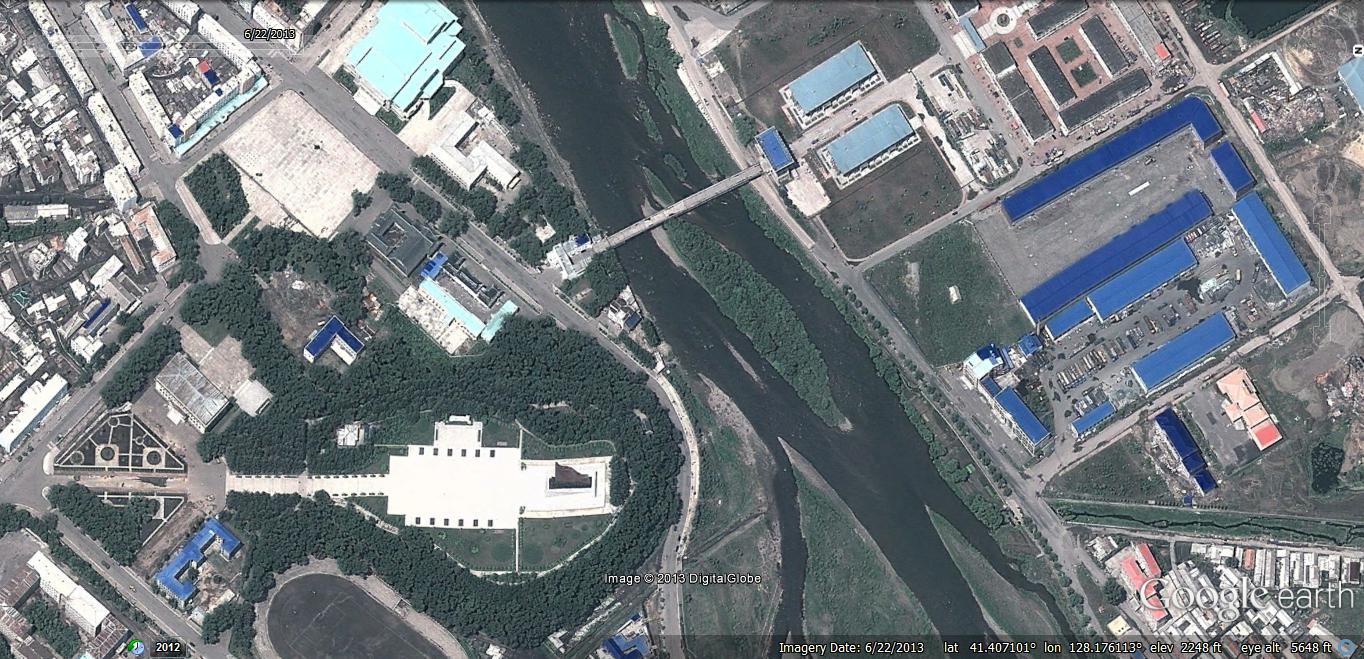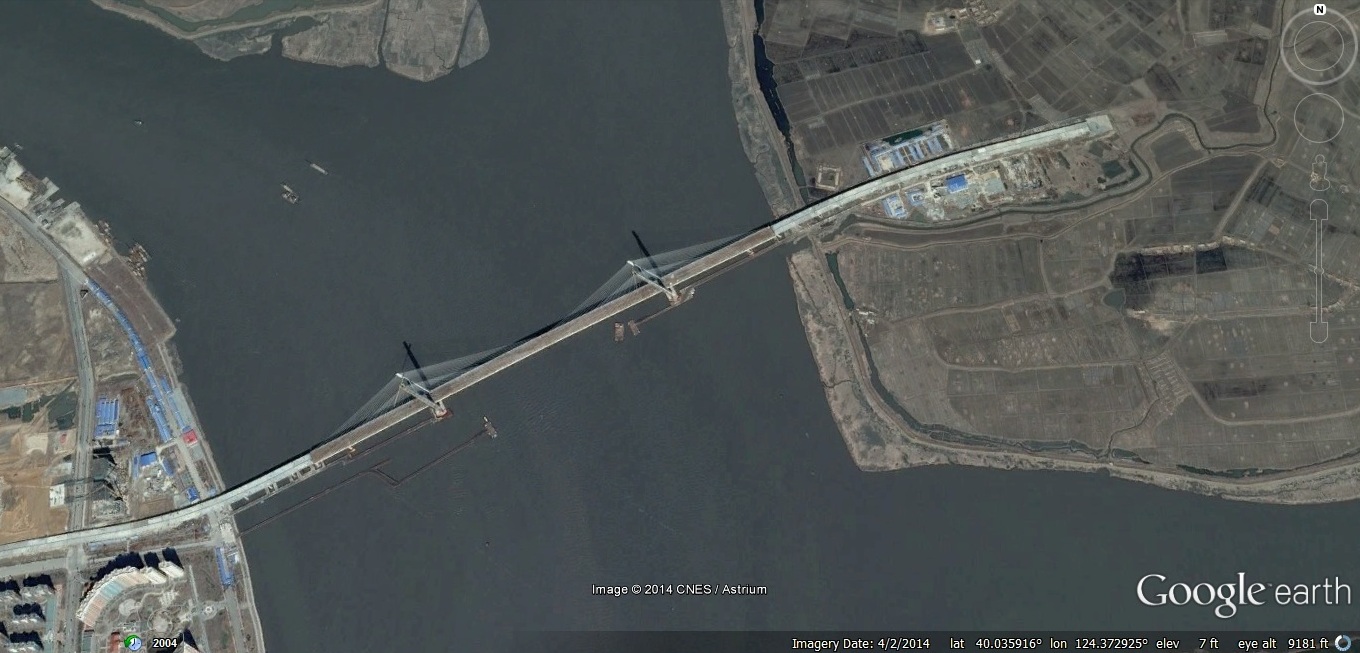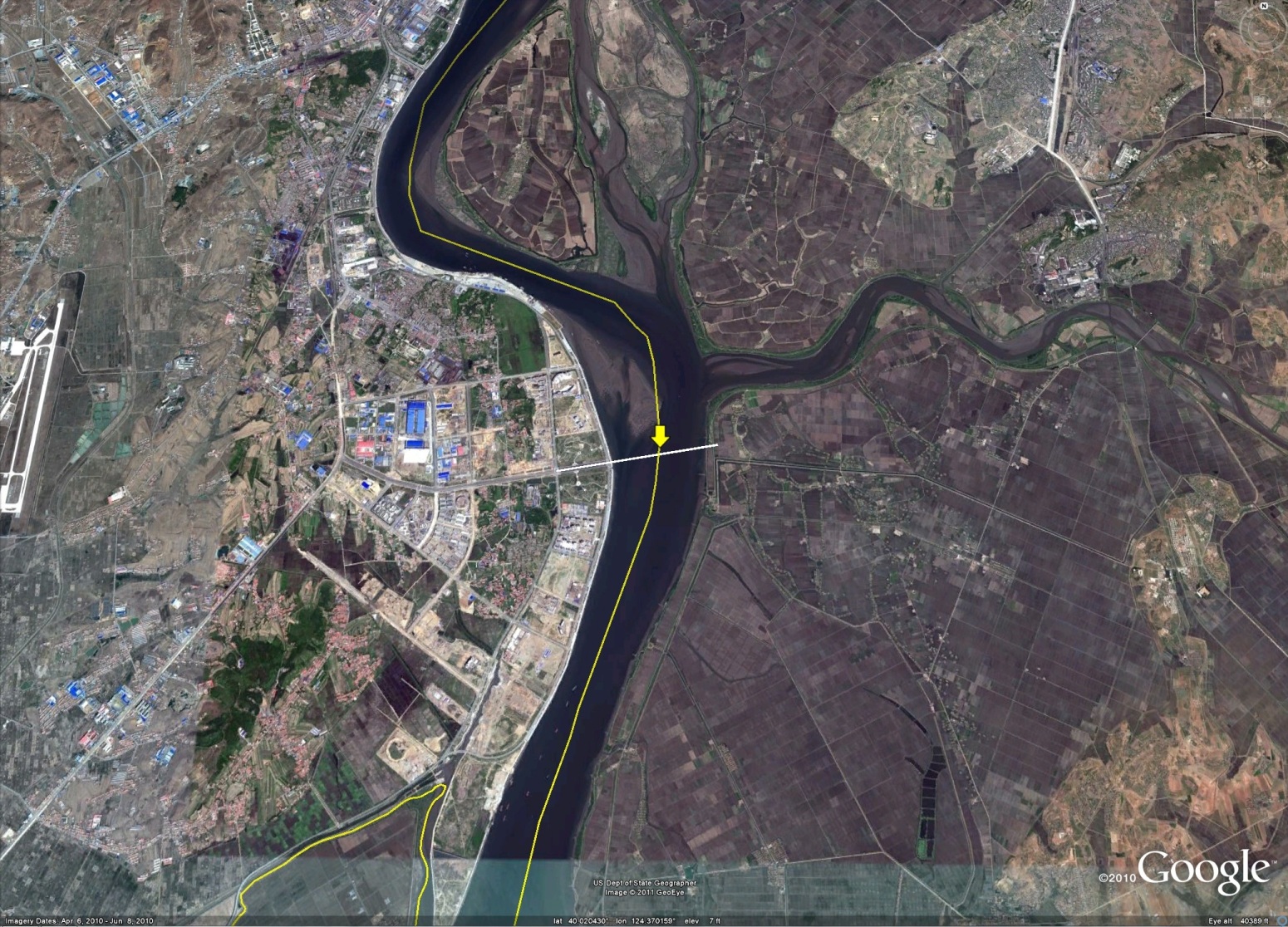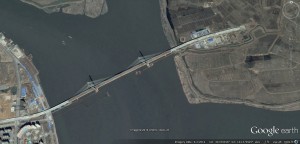
Pictured above (Google Earth): The new Yalu/Amnok River bridge under construction
UPDATE 13 (2014-10-31): Opening of new NK-China bridge delayed indefinitely. According to the Daily NK:
The planned opening of the bridge connecting Dandong in Liaoning Province, China with Sinuiju, North Pyongan Province in North Korea has been delayed indefinitely, according a report by China’s state-run Global Times on October 31st.
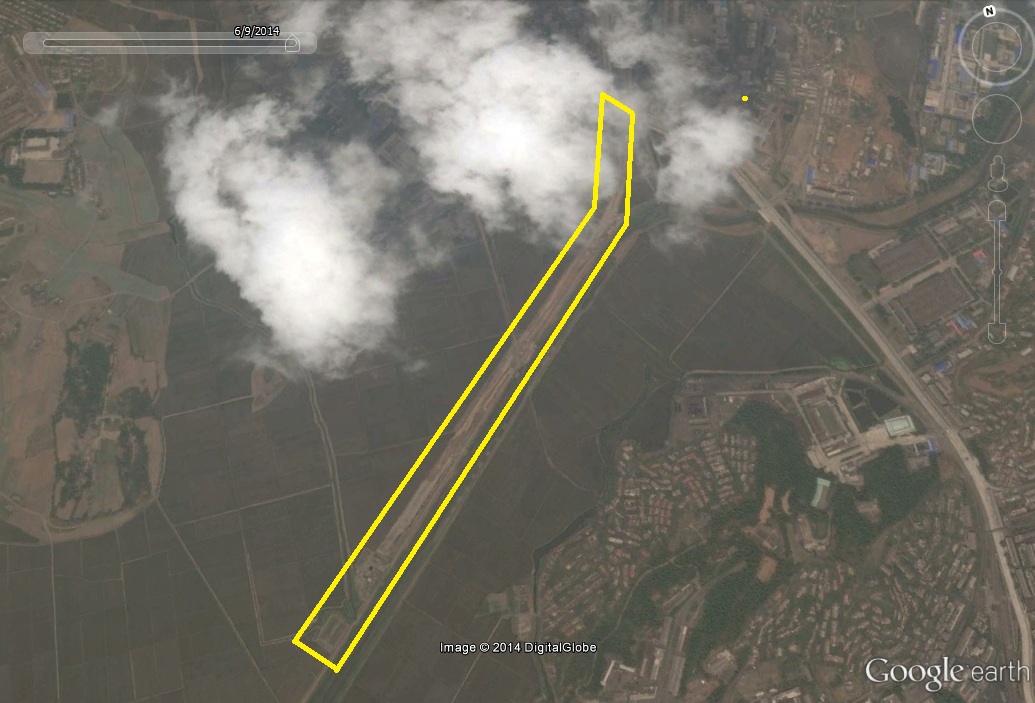
According to the report, North Korea has not followed the business plan stipulating that it construct access roads to the bridge, and as such, its opening remains on hold. North Korea was charged with construction on access roads for the bridge, but work at the site has yet to begin, in fact, the area continues to be nothing but swathes of farmland.
On the ground in Dandong, the report conveyed the disappointment by many in the area, “This new bridge that was going to be so magnificently built is finished on one side, and a vegetable plot on the North Korean end.” Many traders and people purchasing homes and opening stores in the area were anticipating to benefit from increased commerce between the two cities, which account for 70% of bilateral trade, after the bridge’s completion.
The construction of the new bridge over the Amrok [Yalu] River, to replace the aging “Sino-Korean Friendship Bridge,” was officially proposed by China’s former Vice Minister of Foreign Affairs, Wu Dawei, when he visited North Korea in 2007. However, it was not until October 2009 that former Premier Wen Jiabao visited North Korea to make the deal official, for which China agreed to take on the construction costs. The two countries then finalized plans for the project in February 2010, with China continually pushing for construction to begin in October, only to see them finally begin in December that year after a series of delays.
Over the past four years of construction, China accelerated efforts to build a four-lane highway and other advanced features amounting to 2.22 billion RMB [approximately 360 million USD].
As to why the project has not moved forward despite China’s completion of its end of the deal, “North Korea demanded more investment from China for the connecting roads and has done no construction,” the report stated.
Daily NK previously reported in July about the advanced construction efforts on the Chinese side and predicted delays in the bridge’s opening due to failure by North Korea to uphold its end of the contract.
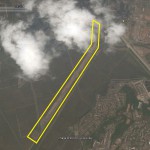
The story is not completely accurate, however, because the North Koreans have at least begun the process of building a road to connect the bridge to Sinuiju. According to Google Earth satellite imagery dated 2014-6-9 we can see the beginning of road construction:
Here is more in the Hankyoreh.
UPDATE 12 (2014-7-18): The Institute for Far Eastern Studies (IFES) offers an explanation for the lack of progress on the DPRK side of the bridge:
New Amnok (Yalu) River Bridge – Present Conditions and Future Outlook
According to recent reports, the New Amnok (Yalu) River Bridge may not be finished by its projected date of September 2014 due to delays in the construction of roads and customs facilities.
The bridge, which will connect the North Korean city of Sinuiju with the Chinese city of Dandong in Liaoning Province, has advanced into the final stages of construction following the recent completion of the control tower and the bridge deck.
When the bridge is completed, the existing Amnok River Bridge (located approximately 10km away from the new bridge) will be restricted to railroad traffic only, and general road traffic to-and-from North Korea and China will be rerouted to the new bridge.
The existing Amnok River Bridge has been cited as a bottleneck for the blooming trade industry between North Korea and China for several reasons. The bridge, built in 1911, accommodates both a railway and roadway, but has only one lane. Furthermore, its old age has sparked safety concerns; trucks weighing over 20 tons have been prohibited from using the bridge.
Reportedly, China has begun construction on a new commerce zone costing 2 billion RMB (330 billion KRW) that will connect with the New Amnok River Bridge from the Chinese side.
The new commerce zone is set to be built on a 380 thousand square-meter plot of land and will include various services such as border checkpoints, customs, quarantine facilities, and immigration. Business facilities such as hotels, shopping centers and other residential and commercial buildings are also expected to be built in this area.
Once construction finishes and operations begin, China is expecting that the new area will accommodate for the passage of up to twenty thousand cars and fifty thousand people per day. It is also predicted that the new trade zone will be responsible for up to 60 percent of the total trade volume passing between the two countries.
However, on the North Korean side, it appears that construction has yet to begin on any of the necessary immigration facilities such as checkpoints and customs.
It has been reported that since construction of the New Amnok (Yalu) River Bridge began in 2010, abrupt changes in the state of affairs and weakening international ties between the two countries has left North Korea without a financier. North Korea had originally projected total construction and operation costs of 20 million USD (approx. 20 billion KRW), but has yet to secure the money from foreign investors.
In the past, the Chinese government persuaded North Korea into constructing the New Amnok (Yalu) River Bridge, but appears to have lost its previous fervor.
Back in 2007, China’s former Vice Minister of Foreign Affairs, Wu Dawei, proposed the construction of the new bridge under the condition that China will be responsible for the entirety of construction costs. In October 2009, former Premier Wen Jiabao visited North Korea and finalized the agreement.
From the outset, plans for the creation of the New Amnok River Bridge were not drawn up by North Korea, but rather strongly demanded by the regional governments in China’s Liaoning province and Dandong city. North Korea set its focus on the repair of the original existing Amnok River Bridge in order to set a fixed limit on the exchange of personnel and materials, citing regime stability as a reason. However, China persisted, promising to provide financial support for the construction of not only a new bridge, but also for customs facilities, immigration, and a highway connecting the bridge to Pyongyang.
At first, China was actively engaged in supplying North Korea with the financial resources necessary for construction. However, with the increase in nuclear tests, missile launches and increasingly negative internal public opinion, as well as the execution of Chinese ally Jang Song Thaek, China seems to have slowed the pace and now carefully monitors its involvement with North Korea.
In order to protect its domestic and foreign image, it is expected that China will complete construction of the infrastructure on their side of the New Amnok River Bridge within the year. China is also expected to offer less support to North Korea, showing an increasingly passive response.
According to recent reports, North Korea is currently in the process of preparing the customs and immigration facilities in Sinuiju—connected to the existing Amnok River Bridge—to handle procedures after construction of the new bridge is finished. The existing facilities are expected to be used due to North Korea’s inability to finish construction of the new immigration facilities and other connecting roads on time.
North Korea’s Central News Agency (KCNA) introduced the New Amnok River Bridge on a television program in August 2013, boasting that over 3,000 lorries and cargo ships will pass over and under the bridge per day. In the program, it is said that the bridge will be completed by September 2014
UPDATE 11 (2014-7-2): The bridge opening is likely to be delayed (again). According to the Daily NK:
The planned opening of a large new bridge across the Yalu River connecting Dandong in Liaoning Province with Sinuiju is likely to be delayed, Daily NK has learned. The cause of the delay is thought to be North Korea’s failure to make good on its contractual obligations.
“The Chosun side took on the job of constructing the roads, but they are making painfully slow work of it. Because the roads are still not finished, people are wondering whether their initial aim of increasing trade volumes is on its way down the drain,” a source close to the project told Daily NK on the 1st.
“China provided a lot of materials and machinery to the North, but there is a story that this machinery was sent for use on other projects rather than for the bridge construction. The Chinese traders who did harbor high hopes for [economic] opening brought on by the bridge are showing their disappointment more and more,” the source explained.
The partially complete New Amrok [Yalu] River Bridge is designed to connect Langtou new city with south Sinuiju at a total cost of 2.22 billion RMB (approximately 357 million USD). It lies 8 km downstream from the ageing “Sino-Korean Friendship Bridge” (formerly the Amrok [Yalu] River Bridge).
The old bridge is currently the only one that connects the two cities, but, built in 1943, it is wholly unfit for purpose. Trucks that weigh more than 20 tons are not allowed on it due to safety concerns, and it also has just one lane, which restricts trade volumes. Traders had hoped that the new bridge would speed up commerce between the two cities, which account for 70% of bilateral trade despite these structural limitations.
The construction of the new bridge was officially proposed by China’s former Vice Minister of Foreign Affairs, Wu Dawei, when he visited North Korea in 2007. However, it was not until October 2009 that former Premier Wen Jiabao visited Pyongyang and sealed the deal, under which China agreed to foot the bill for construction. The two countries then finalized plans for the project in February 2010, and the groundbreaking ceremony was held in December that year.
The Chinese side has demonstrated its intent to see the completion of the four-lane bridge, with its accompanying management, security and inspection infrastructure.
“In accordance with the plan, China has already got a customs office in place to administer the flow of goods over the bridge,” the source revealed. “But the North has slowed right down, and the talk of trade expansion from before has gone away.”
This declining enthusiasm is tangible in the property market in Langtou, the region of Dandong that ought to benefit the most from bilateral economic activity across the new bridge. “Apartment prices remain where they were three years ago, at roughly 4000 Yuan per pyeong,” explained the source. Pyeong is a Korean unit of measuring area, and amounts to 3.305785m².
“The number of people wanting to learn Korean in Dandong is still the same,” he admitted, “but that’s only because they want to watch Korean dramas. They have already given up on the idea of booming trade with North Korea since they saw those who had been successful going to the wall after the execution of Jang Song Taek.”
In addition to problems with the bridge, Daily NK established in May that almost no progress has been made on the development of two Special Economic Zones in the Sinuiju area (see linked article).
UPDATE 10 (2014-1-14): Xinhua reports the bridge will open in 2014:
A new bridge over the river border between China and the Democratic People’s Republic of Korea (DPRK) is expected to open this year, local authorities said on Tuesday.
About 80 percent of work on the Yalu River Bridge is complete, according to the Transport Department of northeast China’s Liaoning Province.
Construction began on the 3 km bridge at the end of 2010, and will cost 2.22 billion yuan (356 million U.S. dollars).
A joint project between the two countries, the bridge will have four two-way lanes upon completion, according to an agreement signed in February 2010. The new route is expected to boost communication and economic cooperation.
The only bridge connecting the nations was built in 1937. Trucks weighing more than 20 tonnes are not allowed on the one-way bridge, considerably restricting trade volume.
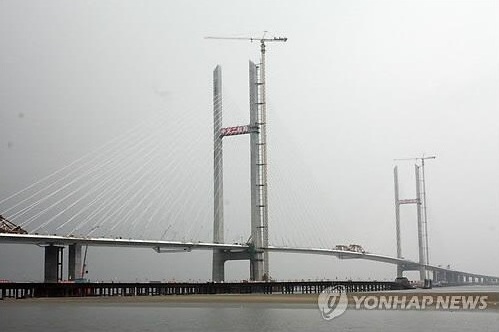
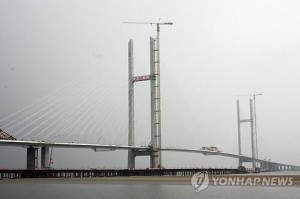
UPDATE 9 (2013-11-8): Yonhap releases a photo of the bridge nearing completion:
UPDATE 8 (2013-10-14): According to the Global Times:
A new bridge will link China and the Democratic Republic of Korea (DPRK) by 2014 and greatly boost exchange and trade between the two countries, officials said Monday.
A new border trade complex, complete with customs services, border control and quarantine services, as well as office buildings, hotels and markets will also be operational by 2014, according to Shi Guang, mayor of Dandong city, where the bridge is located.
The whole complex will cover 38 hectares and cost two billion yuan (325.8 million USdollars) to build, Shi said.
The new bridge is 10 kilometers down the Yalu river from the old bridge, which was built in 1937 and has been sole major passage on the China-DPRK border.
The two governments agreed to build the new bridge in early 2010. It will have four lanes and a span of about three kilometers.
The new facilities will be able to handle as many as 20,000 vehicles and 50,000 people a day and Dandong authorities expect that businesses done at the trade complex will account for 60 percent of China-DPRK trade.
UPDATE 7 (2013-10-10): The Institute for Far Eastern Studies (IFES) offers some new information:
The construction of the New Yalu River Bridge, the new suspension bridge over the Yalu River, connecting China’s Dandong city (Liaoning Province) and North Korea’s Sinuiju city (North Pyongan Province) is in its final stages.
Currently, the volume of trade between Sinuiju and Dandong is heavy, and the Yalu River Railway Bridge is saddled with transporting goods. It is hoped that the new bridge will help ease that burden. Several hundred workers are involved in its construction.
According to one Dandong resident, “Despite North Korea’s nuclear test and China’s decision to impose sanctions against the North, construction of the New Yalu River Bridge has been relentless.” The new bridge is considered as an important symbol of Sino-DPRK economic cooperation. Its construction is believed to be well on track.
The total project cost of the construction is estimated to be 2.22 billion CYN (about 390 billion KRW or 3.6 million USD). China is covering the bridge’s construction costs and has reportedly introduced a variety of new technologies to improve the precision and safety of the structure. Once completed, the bridge will be 3 km in length, with the height of its two pylons at 197 meters and the distance between pylons to be about 636 meters.
Travel from Pyongyang to Dandong currently takes 4 hours; that time is expected to be cut in half as the new suspension bridge is located 8 km downstream from the existing railway bridge.
If the construction progresses smoothly, the bridge should open for operation by July 2014. The Korean Central News Agency (KCNA) reported on August 23 that the new bridge should accommodate over 3,000 55-tonne freight cars per day, and 3,000-tonne ships will be able to pass under the bridge.
Along with the new bridge, China and North Korea are also engaged in joint development of a new district in Dandong and the Hwanggumpyong Special Economic Zone (SEZ). Despite the lingering concerns over the development of these areas after the death of former North Korean leader Kim Jong Il, the development has reportedly continued uninterrupted.
Despite the continued international and other sanctions against North Korea, the development of Hwanggumpyeong SEZ is speculated to pick up speed after the completion of the bridge. The Hwanggumpyeong SEZ is a project that North Korea put forth in response to the “May 24 Sanctions” imposed by the South Korean government after the sinking of ROKS Cheonan. These sanctions essentially had brought an end to all inter-Korean economic cooperation and exchanges (with the exception of the operations at the Kaesong Industrial Complex).
Last September, a groundbreaking ceremony for the administrative building in the Hwanggumpyeong SEZ was held. Since then a customs building, security facilities, management office, street lights, and transport inspection office are reported to have been built or are currently under construction.
UPDATE 6 (2013-8-23): New KCTV footage of the bridge can be seen here:
UPDATE 5 (2013-6-4): I wrote an update on the construction of the bridge at NK News.
UPDATE 4 (2012-11-7): The China Daily’s English-language Dandong page reports on the status of the bridge:
Construction on the new bridge, with an investment of 2.22 billion yuan, began at the end of 2011. According to the Dandong government, the main structure of the bridge has been completed. It is expected to become operational in July 2014.
UPDATE 3 (2011-6-25): Adam Cathcart took some pictures of the new bridge construction–so it is progressing!
UPDATE 2 (2011-2-2): For some time I have been trying to track down the location of the proposed new Yalu River bridge which will connect the DPRK and China. Thanks to a story in the Daily NK, I was able to map it out on Google Earth:
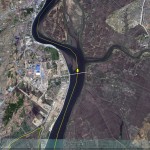
Pictured above: Location of the proposed Yalu Bridge (Google Earth) [UPDATE-The bridge was ultimately moved from this location]
According to the Daily NK:
According to someone inside the construction company responsible for the bridge’s development, “The development of Xinchengqu has been on the drawing board for two years. This time, the construction of the New River Yalu Bridge was confirmed between China and North Korea. This is a very good chance for us, from now on Xinchengqu will become the center of China-North Korea trade.
According to Dandong’s urban development plan, the bridge will connect Busan-Seoul-Pyongyang-Dandong and Beijing in the future, implying that future trade and cooperation between a reunited Korea and China is being taken into account.
China is providing the construction costs for the New Yalu River Bridge; an estimated one billion Yuan (approximately $145 million).
This particular location is interesting because it completely bypasses the city and county of Sinuiju–where earlier reports (below) described its location. The bridge actually crosses from China into Sopuk-ri, Ryongchon County (서북리, 룡천군)—in the middle of nowhere. There is absolutely no infrastructure at this location for administering trade between the DPRK, China, and prospectively South Korea, so it will all need to be built from scratch or moved from Sinuiju. Either way, this is bad news for Sinuiju which today benefits financially as both the capital of North Pyongan Province and as the gateway for the majority of trade between the DPRK and China. It looks like Ryongchon may be taking some of their business!
In addition, the North Koreans have been widening the Sinuiju highway and “beautifying” all of the surrounding residential areas in anticipation of greater loads of traffic coming from China. See more about this here. This could all be for naught if the Chinese end up building a trade artery south of all this construction!
UPDATE 1 (2010-12-31): (KCNA h/t Aidan Foster-Carter) The ceremony did take place to mark the launch of the bridge’s construction:
Pyongyang, December 31 (KCNA) — A ground-breaking ceremony for a DPRK-China bridge across the River Amnok took place in Dandong City, China, on Friday.
Present there from the DPRK side were its government delegation headed by Kim Chang Ryong, minister of Land and Environmental Conservation, and from the Chinese side Li Shenglin, minister of Transport, Hu Zhengyue, assistant to Foreign Minister, and Chen Zhenggao, governor of the Liaoning Provincial People’s Government, and other officials concerned of the central and local governments of China.
Speeches were made by Kim Chang Ryong, Kim Song Gi, vice-minister of Foreign Affairs, and Choe Jong Gon, chairman of the North Phyongan Provincial People’s Committee, from the DPRK side and Li Shenglin, Hu Zhengyue, and Chen Zhenggao from the Chinese side.
They said that two rounds of General Secretary Kim Jong Il’s visit to China this year marked historic events of epoch-making significance in developing the DPRK-China friendship on a fresh high stage.
They expressed belief that the bridge would make a contribution to demonstrating once again the great vitality and invincible might of the DPRK-China friendship steadily growing stronger.
The bridge will be successfully built as a symbol of the DPRK-China friendship and a structure of the two peoples, they added.
Then followed a ceremony of the ground-breaking for the project.
The Ministry of Transport, the Liaoning Provincial Committee of the Communist Party and the Liaoning Provincial People’s Government of China arranged a reception in connection with the ceremony.
ORIGINAL POST (2010-12-28): According to Daily NK:
It was reported that there will be a ceremony to celebrate the start of construction of the New Yalu River Bridge linking Shinuiju and Dandong, China, before the end of the year.
Yonhap News yesterday quoted Shenyang and Dandong sources saying that both the North Korean and Chinese authorities decided to hold the ceremony this year and have started preparing for the event.
The source in Dandong said, “Instructions that the start of the bridge construction must not slip to next year were handed down from the Chinese government last week, so the governments of Dandong City and Liaoning Province urgently are trying to set a date. It will likely happen the 30th or 31st.”
The source also explained the reason why the Chinese government is hurrying to start the construction, which was supposed to start early next year. “Both China and North Korea intend to show observers domestically and internationally they have the will to construct the bridge.”
In Langtou, Dandong, where one end of the bridge will be built, a construction board has been set up and says the New Yalu River Bridge will connect to Jangseo in the southern part of Shinuiju.
China and North Korea agreed to construct the bridge in October 2009, and in February, the Vice Minister of Foreign Affairs of North Korea, Pak Gil Yon, and Chinese Assistant Foreign Minister Wu Hailong signed the agreement in Dandong, China.
Dandong City had announced plans to start construction of the bridge in October, but it has been delayed for uncertain reasons. It was rumored there was conflict over the construction of the bridge because North Korea had requested additional aid from the Chinese government.
Researcher Jeon Byung Gon of the Korea Institute for National Unification said in a telephone interview with The Daily NK that, “The ceremonial ground-breaking will be a chance to promote the friendship between China and North Korea again.”
Researcher Jeon explained that, “So far, there have been several impediments to trade such as quotas, outdated facilities for transportation, both countries’ border management, etc. However, when the New Yalu River Bridge is constructed, such limitations can be resolved and trade between China and North Korea can be revitalized.”
He predicted, “Since they are trying to carry out the construction in a hurry, economic cooperation and friendship relations between two countries will be taken to the next level.”
Also, from the Choso Ilbo:
A source in Dandong said Wednesday that North Korea and China will start construction of the bridge as early as Friday. The two sides agreed to build the bridge during Chinese Premier Wen Jiabao’s visit to North Korea in October last year, with work expected to start this October.
China insists on having the bridge connect the newly renovated area of southern Dandong and southern Sinuiju, but North Korea wanted it to cross over Wihwa Island in Apnok River and connect Dandong with the old part of Sinuiju. The North claimed the route preferred by China would necessitate building a long embankment but in fact seems to have been nervous that a direct link to Pyongyang would cause security concerns like making it easier for North Koreans to flee.
But the North seems to have caved in. A source said construction will begin in March but a groundbreaking ceremony will be held before the end of this year.
Meanwhile, transport of goods and products has picked up via the Hunchun- Rajin-Sonbong route as part of an economic cooperation project. Around 500 truckloads of coal from China’s Jilin Province were shipped out of Rajin-Sonbong Port on Dec. 7 and are being transported to Shanghai across the East and South seas.
Read the full stories here:
New Yalu Bridge Groundbreaking This Year
Daily NK
Mok Yong Jae
12/28/2010
N.Korea’s Cross-Border Business with China Picking Up
Choson Ilbo
12/30/2010