Archive for the ‘Automobiles’ Category

Road to Rason (38 North)

Tuesday, August 30th, 2011

38 North
Andray Abrahamian
2011-8-29

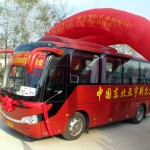
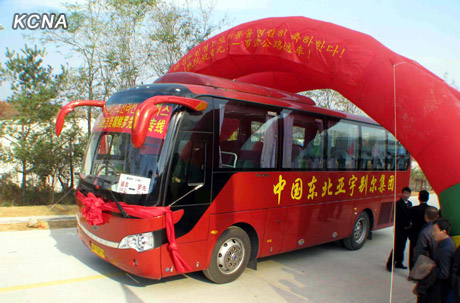
A bus bumps and bruises its way along the unpaved road, carrying would-be investors to Rason’s First Rason International Trade Exhibition which ran from August 21-25, 2011, in Sonbong. The windows are open, until a crimson humvee barrels past, its powerful suspension dancing on the road, leaving behind a plume of beige dust. The bus windows snap shut, the still air quickly gets hot and more than one of the passengers wishes we were Chinese high-rollers, being whisked to the Emperor Casino and Hotel, which sits beautifully on Korea’s East Sea, overlooking Bipa Island and flanked by lush green mountains and crystal waters.

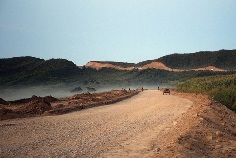
The passengers of the humvee-part of the casino’s fleet-will long be checked in and gambling their fortunes away by the time we complete our two and a half hour journey. However, it won’t always be this way. Rason’s 50km road to the border is finally being upgraded. Indeed, the 2.5 hour journey took 3.5 hours in June. Since then, the road has been widened, the first stage of the construction plan, allowing for traffic to flow both directions more easily and smaller passenger vehicles to overtake the more cumbersome truckers who ply the road.

Its construction is an important sign in the development of the Rason Special Economic Zone. Rason, an amalgamation of the names of the area’s two biggest cities, Rajin and Sonbong, could theoretically be a vibrant hub for both logistics and manufacturing. It is located in the far Northeast of the Democratic People’s Republic of Korea, bordering Russia and China. It has abundant, cheap labor and the region’s northernmost ice-free port. It has been a legal entity since the early 1991, but has struggled to reach its potential in the face of ambivalence from Pyongyang and difficult geopolitical circumstances.

Local administrators have bold plans for this experiment in economic opening-up and to develop as the Rason Municipal People’s Committee has imagined, an efficient road link with China’s Northeastern provinces is vital. For about a decade, improvements to the road have been “under discussion” and “coming soon,” but it is now undeniably underway. Work began in May of this year…READ MORE HERE

Share

PRC military exports to DPRK

Tuesday, August 23rd, 2011

The Choson Ilbo posts a video of dozens of military vehicles being shipped to the DPRK:

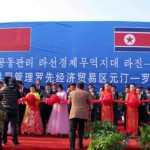
Left: Click image above to see video. Right: Dandong Customs House

According to the article:

Some 3,000 to 4,000 Chinese-made military trucks and jeeps entered North Korea last month, it was confirmed Monday. According to video clips obtained by the Chosun Ilbo, over 100 military trucks and jeeps made in China went to North Korea everyday last month after going through customs in Dandong.

There were eight video clips of varying lengths ranging from two minutes to 16 minutes. The footage shows Chinese-produced military vehicles standing in the 10,000 sq.m parking lot of the Dandong customs office waiting to be cleared along with other civilian cars, and two-story trailers loaded with military vehicles waiting on the side road to enter the customs office. A local source in Dandong said, “Normally, all Chinese-made vehicles going into North Korea were civilian, but in July, a massive number of military cars went to North Korea.”

A senior source in North Korea said that these cars were gifts to military officers by North Korea’s heir apparent Kim Jong-un in celebration of “Victory Day,” or the day the armistice in the Korean War was signed on July 27. “North Korean military vehicles produced in the 1970s and the 80s are too old to carry out drills, and many soldiers were dissatisfied. In order to buy the loyalty of the military and show what he can do, Kim Jong-un replaced the old vehicles thanks to the assistance of China,” the source added.

Jeeps were given to officers to be used to conduct operations, and the trucks were given to soldiers.

Analysis of the footage suggests the trucks were 6-ton trucks made by FAW Car Limited Company. North Korean leader Kim Jong-il visited the headquarters of this firm in Changchun, Jilin, during his visit to China in May. The military jeeps were manufactured by Beijing Automobile Works with engine capacity of 2,200 cc and 100 horsepower. BAW, which specializes in SUVs, trucks and military vehicles, is a subsidiary of Beijing Automotive Group, a partner of Hyundai Motor.

Dump trucks, large buses, sedans, oil trucks, agricultural machines and heavy machinery were also spotted in the video going into North Korea. In the windscreen, the name of the recipients is written. One is Korea Taesong Trading Company, a trading company under the Workers Party that manages Kim Jong-il’s slush funds. It was blacklisted by the U.S. as part of its economic sanctions against the North.

In one video clip, tourist buses pack one side of the parking lot. Another clip shows a queue of several dozens of LNG trucks. A South Korean government official commented, “North Korea depends on China for almost entire amount of fossil fuel it needs.”

Share

DPRK-China launch minerals – for – fertilizer program

Friday, August 19th, 2011

Pictured above (Google Earth): The Musan Mine, the DPRK’s largest.  See in Google Maps here.

According to the JoongAng Daily:

During his surprise May visit to China, North Korean leader Kim Jong-il secured free fertilizer and discounted food to help alleviate the impoverished country’s chronic food shortages.

A source in Beijing who monitors North Korea-China relations told the JoongAng Ilbo on Monday that Chinese officials agreed to provide 200,000 tons of fertilizer free of charge as well as 500,000 tons of corn at a discount in exchange for rights to North Korea’s abundant natural resources.

“When 200,000 tons of fertilizer is planted on North Korean soil, it can bring about a three-fold increase in the harvest,” the source said. “This can be the equivalent of giving 600,000 tons of food.”

The source added that China agreed to sell the 500,000 tons of corn for half of the international rate, which would be $30 per ton.

The corn, the source said, had already crossed the border into North Korea from northeastern China.

In exchange, Kim will allow China access to his country’s natural resources.

“The two parties agreed to participate in the extraction of buried rare earth minerals in Musan in Hamgyong Province,” the source said. “It’s quite a profit for China as it is thirsty for materials.”

North Korea is estimated to have around 20 million tons of rare earth minerals, which are vital in the production of high-tech goods.

The Beijing-based source said the agreement gives China the responsibility for the cost of building roads to transport the natural resources as well as lending equipment.

In exchange, North Korea will hand over 50 percent of the extracted rare earth minerals free of charge to China, with the rest to be sold to China at international market rates.

Meanwhile, other sources said that Kim also received a health checkup during his stay in China.

“When Kim Jong-il was visiting Yangzhou, he received a special examination from an oriental medicine doctor that the highest Chinese elite have gone to over the years,” a source familiar with North Korean issues said

The source added: “Kim Jong-il has never trusted China’s Western medicine. I heard from a Chinese official that Kim received an oriental medicine diagnosis by taking his pulse and that it did not involve drawing blood.”

Additional Information:

1. Here is a post linking to all the major DPRK food stories this year.

2. The media has reported on other DPRK food barter deals with Cambodia and Myanmar.

3. The role of the Musan Mine in DPRK-PRC relations has been quite interesting.  Here are previous posts on the mine.

Read the full story here:
North got fertilizer on Kim’s trip to China
JoongAng Daily
Chang Se-jeong
2011-8-19

Share

On the de-facto privatization of industry in the DPRK…

Wednesday, August 17th, 2011

Pictured above (Google Earth): A bus depot in Rakrang-guyok, Pyongyang.  See in Google Maps here.

According to the Daily NK:

Growth and improvement is evident in some areas of the private sector in North Korea, Ishimaru Jiro of ASIAPRESS revealed on the 16th, pointing to the growth of bigger, better private transit concerns and relatively productive coal mining operations as evidence of this trend.

In the past, trains were almost the only viable means of long-distance transportation in North Korea. Then, as private business began to grow and the railways fell into a deep malaise, vehicles such as trucks and cars belonging to military bases, state security and state enterprises were pushed into service to earn money for moving people; this, the so-called ‘servi-cha’ industry.

The servi-cha industry has long been fragmented and small scale; but now transportation companies run by rich individuals (‘donju’) which purchase several buses and hire drivers, guides and mechanics, are acting just as a transit company in a capitalist state would do.

With profit-sharing and bribery as the backbone, a large number of North Korean organs and enterprises have decided to lend their name to these individuals, fuelling the growth and development of a network of sorts.

“From the early 2000s, a high-speed bus network mostly between major cities began to emerge,” Ishimaru, revealing the latest research by ASIAPRESS internal North Korean sources, commented. “The companies are packaged as an enterprise affiliated to some state authority outwardly, but they are actually operated by individuals who pay kickbacks to that authority.”

The People’s Safety Ministry affiliated 116 Task Force Team is one such transportation company, Ishimaru says. It operates buses connecting Shinuiju, South Pyongan Province and Pyongyang. Ordinarily, the bus parks at a station or major public location, and then departs when it is full of passengers going to the next destination.

Here are previous posts on the servi-cha industry.

Read the full sotry here:
Green Shoots of Private Enterprise Growth
Daily NK
2011-8-17

Share

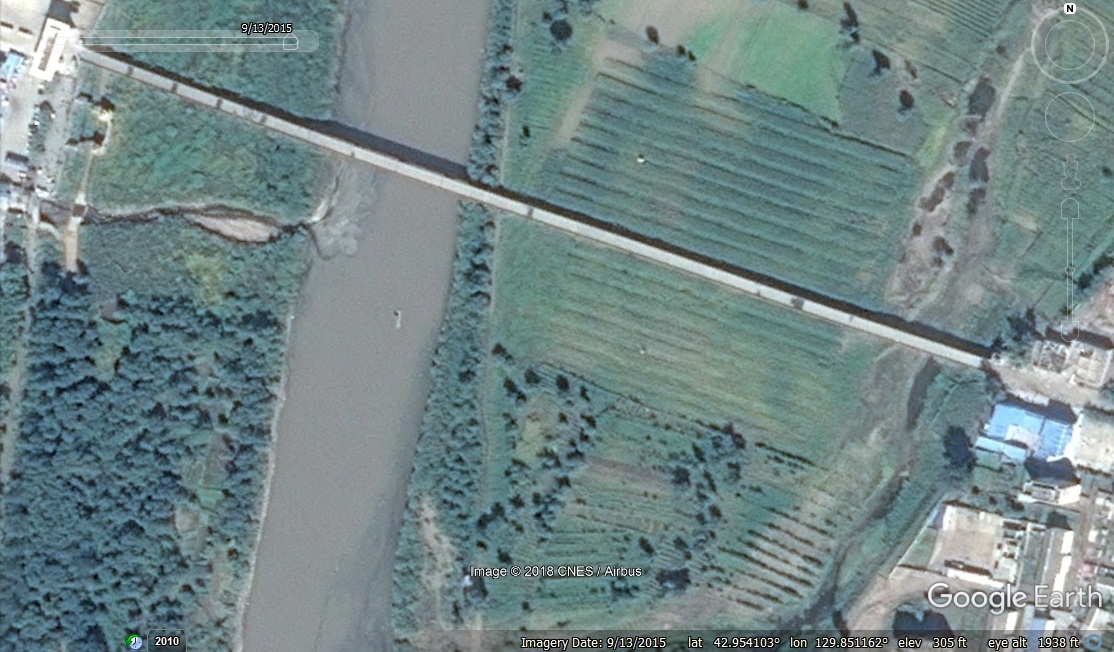
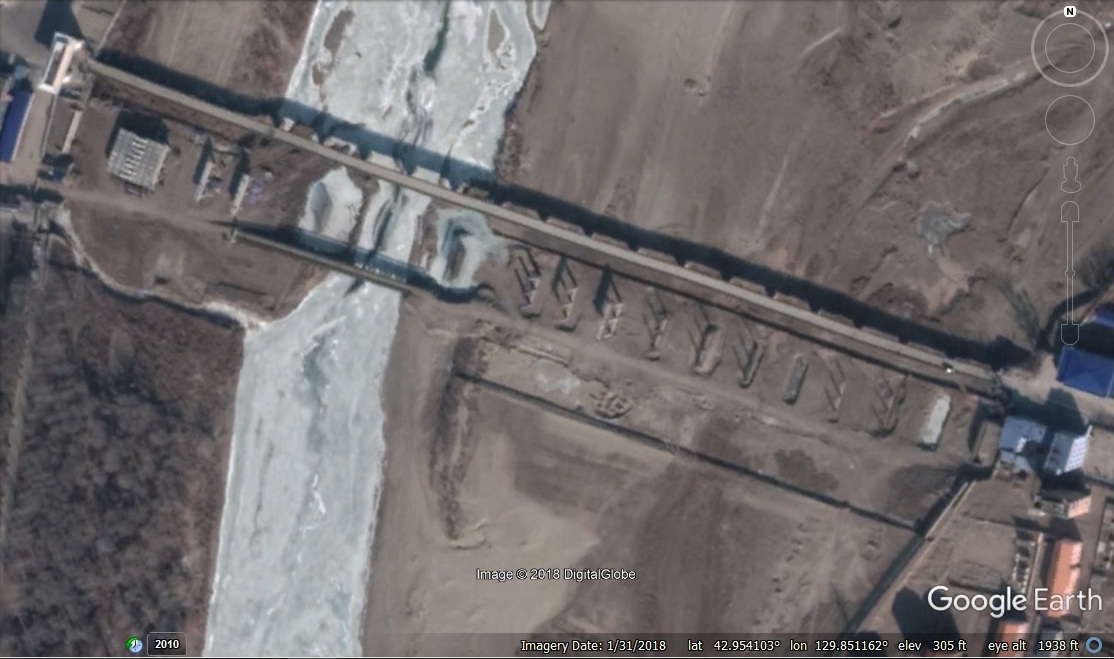
New Yalu River bridge in south-west Dandong

Wednesday, June 29th, 2011

UPDATE 3 (2011-6-25): Adam Cathcart took some pictures of the new bridge construction–so it is progressing!

UPDATE 2 (2011-2-2): For some time I have been trying to track down the location of the proposed new Yalu River bridge which will connect the DPRK and China.  Thanks to a story in the Daily NK, I was able to map it out on Google Earth:

Pictured above: Location of the proposed Yalu Bridge (Google Earth)

According to the Daily NK:

According to someone inside the construction company responsible for the bridge’s development, “The development of Xinchengqu has been on the drawing board for two years. This time, the construction of the New River Yalu Bridge was confirmed between China and North Korea. This is a very good chance for us, from now on Xinchengqu will become the center of China-North Korea trade.

According to Dandong’s urban development plan, the bridge will connect Busan-Seoul-Pyongyang-Dandong and Beijing in the future, implying that future trade and cooperation between a reunited Korea and China is being taken into account.

China is providing the construction costs for the New Yalu River Bridge; an estimated one billion Yuan (approximately $145 million).

This particular location is interesting because it completely bypasses the city and county of Sinuiju–where earlier reports (below) described its location.  The bridge actually crosses from China into Sopuk-ri, Ryongchon County (서북리, 룡천군)—in the middle of nowhere.  There is absolutely no infrastructure at this location for administering trade between the DPRK, China, and prospectively South Korea, so it will all need to be built from scratch or moved from Sinuiju. Either way, this is bad news for Sinuiju which today benefits financially as both the capital of North Pyongan Province and as the gateway for the majority of trade between the DPRK and China.  It looks like Ryongchon may be taking some of their business!

In addition, the North Koreans have been widening  the Sinuiju highway and “beautifying” all of the surrounding residential areas in anticipation of greater loads of traffic coming from China.  See more about this here.  This could all be for naught if the Chinese end up building a trade artery south of all this construction!

UPDATE 1 (2010-12-31): (KCNA h/t Aidan Foster-Carter) The ceremony did take place to mark the launch of the bridge’s construction:

Pyongyang, December 31 (KCNA) — A ground-breaking ceremony for a DPRK-China bridge across the River Amnok took place in Dandong City, China, on Friday.

Present there from the DPRK side were its government delegation headed by Kim Chang Ryong, minister of Land and Environmental Conservation, and from the Chinese side Li Shenglin, minister of Transport, Hu Zhengyue, assistant to Foreign Minister, and Chen Zhenggao, governor of the Liaoning Provincial People’s Government, and other officials concerned of the central and local governments of China.

Speeches were made by Kim Chang Ryong, Kim Song Gi, vice-minister of Foreign Affairs, and Choe Jong Gon, chairman of the North Phyongan Provincial People’s Committee, from the DPRK side and Li Shenglin, Hu Zhengyue, and Chen Zhenggao from the Chinese side.

They said that two rounds of General Secretary Kim Jong Il’s visit to China this year marked historic events of epoch-making significance in developing the DPRK-China friendship on a fresh high stage.

They expressed belief that the bridge would make a contribution to demonstrating once again the great vitality and invincible might of the DPRK-China friendship steadily growing stronger.

The bridge will be successfully built as a symbol of the DPRK-China friendship and a structure of the two peoples, they added.

Then followed a ceremony of the ground-breaking for the project.

The Ministry of Transport, the Liaoning Provincial Committee of the Communist Party and the Liaoning Provincial People’s Government of China arranged a reception in connection with the ceremony.

Read older posts on the bridge below:
(more…)

Share

DPRK opens paved Kowon-Hamhung highway

Friday, June 17th, 2011

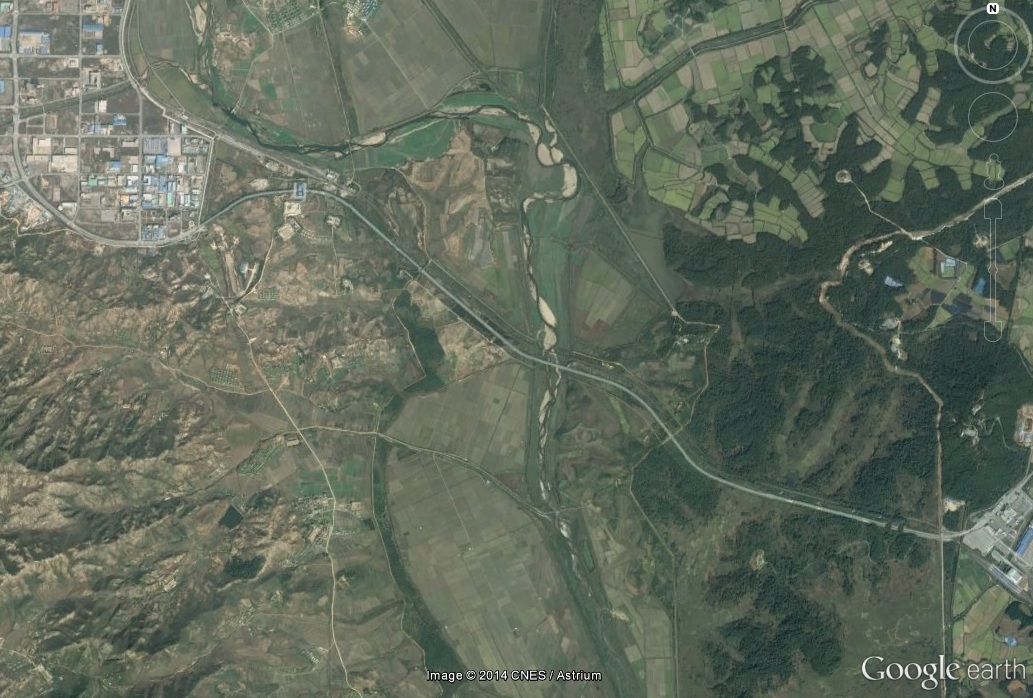
Pictured above (Google Earth): The approximate route of the new Kowon-Hamhung highway

Here are the KCNA stories on the new highway in chronological order:

Pavement Project of Kowon-Hamhung Highway Finished

Pyongyang, May 26 (KCNA) — The pavement project of the Kowon-Hamhung highway in South Hamgyong Province was finished recently. The highway began to be reconstructed on an expansion basis in mid-March.

Some 600,000 cubic meters of earth were cut or filled on the ground, over 250,000 cubic meters of sand and gravel tamped and nearly 700,000 square meters of road paved with concrete.

Trees have been planted and flowerbeds made on both sides of the highway. Slopes are being swarded and accident-preventing stones and waymarks installed.

Revetment, conduit and culvert projects will be completed soon.

The reconstructed highway will help facilitate transportation in the area and promote the country’s economic growth.

Highway between Kowon and Hamhung Reconstructed

Pyongyang, May 31 (KCNA) — The highway between Kowon and Hamhung was successfully rebuilt.

The completion of this project helps to satisfactorily ensure the cargo transport for various domains of national economy, provide people with good conditions for travel and radically improve the environment in this area.

Builders finished the projects for paving the highway and building many structures, etc. in a matter of 60 odd days.

More than 40,000 trees of good species were planted and an area covering hundreds of thousands of square meters was put in turf, turning the landscape of the highway beautiful.

New Motorway Opened to Traffic in DPRK

Pyongyang, June 17 (KCNA) — A project for rebuilding Kowon-Hamhung motorway on an expansion basis has been completed in the DPRK.

During the project, the army and the people carried out concrete pavement and building of scores of bridges and retaining walls in single-minded unity.

The completion of project made it possible to contribute to the economic development of the country and renewed the looks of the land to meet the requirement of the Songun era.

A ceremony of opening the road to traffic took place on Friday. Present there were Premier Choe Yong Rim, Minister of the

People’s Armed Forces Kim Yong Chun, Chief Secretary of the South Hamgyong Provincial Committee of the Workers’ Party of Korea Kwak Pom Gi, officials of relevant organs, servicepersons, officials and builders of South Hamgyong Province, working people and helpers.

Conveyed at the ceremony was a message of thanks of the WPK Central Military Commission addressed to soldier-builders and inhabitants and helpers of South Hamgyong Province who performed labor feats in the project.

There were a report and speeches there.

The highway from Hamhung to Kowon, however, is only half of the distance needed to connect Hamhung to the Pyongyang-Wonsan paved highway.  I am unsure if the remainder of this route has already been completed or if it remains to be done as a separate project.

The distance of road that was paved is approximately 60km.

Share

Rason’s Chinese investor tour

Friday, June 10th, 2011

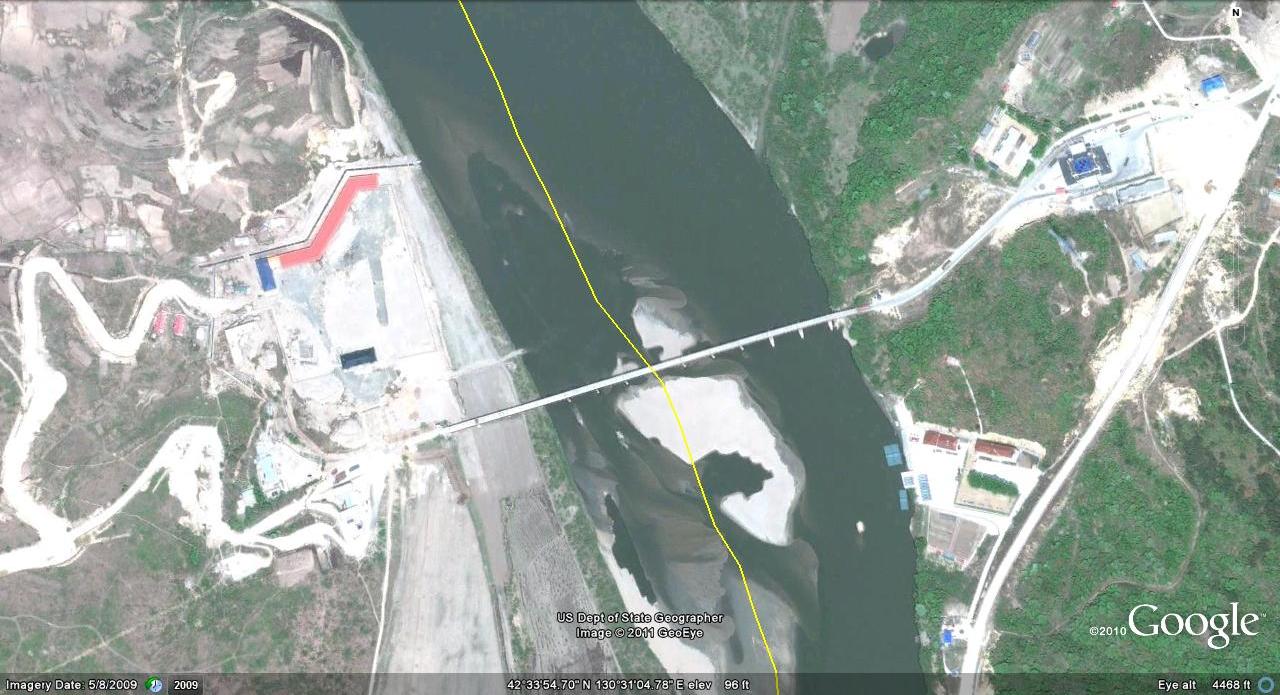
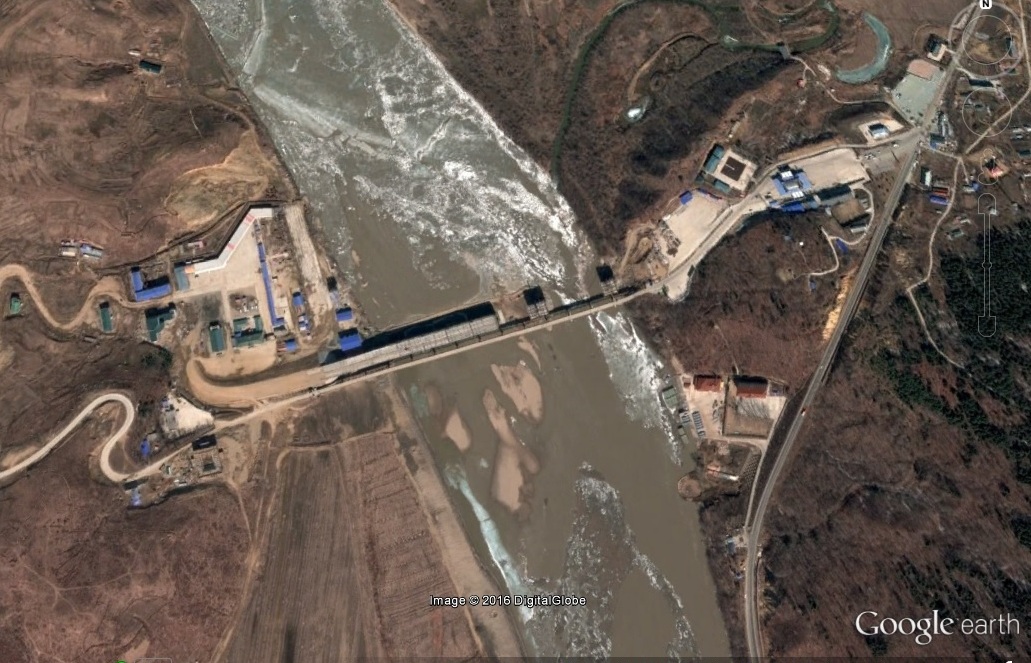
Pictured above (Google Maps): The Wonjong Bridge and route traveled by Chinese drivers from the border to Rason

UPDATE 6 (2011-6-15): Here is a great news video of the Chinese driving tour:

Click image to watch video at YouTube

UPDATE 5 (2011-6-10): Barbara Demick writes in the L.A. Times:

No doubt the most attractive part of the package for China is the access to the port in Rajin, part of a larger special economic zone known as Rason. In 1860, China’s weak Qing dynasty signed a treaty that ceded a long strip of coastline to Russia, leaving Chinese Manchuria landlocked. The use of the port in Rajin makes it easier to transport raw materials from the resource-rich region of northeastern China to the industrial hubs in southern China. In December, the Dalian-based Chuangli group, which had spent $3.6 million renovating the port, shipped 20,000 tons of Manchurian coal through the North Korean port to Shanghai.

“It is faster and cheaper to ship through North Korea’s port than to use the railroads,” said a businessman who was in Rajin this week as preparations were underway for the groundbreaking. “Everybody in Rajin is very excited about what the Chinese are doing. They think it will bring jobs.”

UPDATE 4 (2011-6-9): KCNA coverage of the Hwanggumphyong ground breaking ceremony also mentioned developments in Rason:

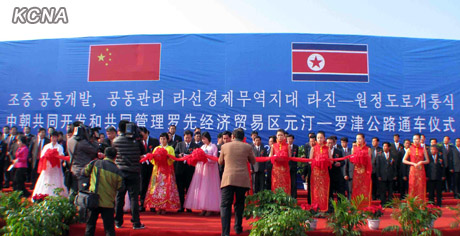
The [Hwanggumphyong] ceremony was followed by announcing the start of the reconstruction of the Rajin Port-Wonjong road, ground-breaking ceremonies of Athae Rason Cement Factory and the Rason, DPRK-Jilin Province, China High Efficiency Agricultural Model District and departing ceremonies of Chinese domestic freight transit transportation via Rajin Port and private car tourism as the first phase projects for the start of the joint development of the zone.

UPDATE 3 (2011-6-10): China’s Global Times reports on the Chinese business tour:

The first self-drive tour from China to North Korea started on Thursday, with around 100 tourists setting off from Changchun, Jilin Province, to Rason, North Korea, China News Service (CNS) reported.

A total of 24 vehicles carrying around 100 travelers including well-known entrepreneurs, officials with the Changchun Tourism Bureau and provincial government took part in the tour, according to a staff member surnamed Wang with the publicity department of the China Youth Travel Service (CYTS) Tours Corporation Jilin Branch, which organized the tour.

“We’ve spent more than a month preparing for the activity. We sent invitations to tourists and negotiated with the Rason government,” Wang told the Global Times on Thursday.

The tour will last from June 9 to 11, and the cost for each tourist was more than 1,000 yuan ($149), an anonymous staff member with the executive office of the CYTS Tours Corporation Jilin Branch told the Global Times on Thursday.

After assembling at the Changchun Exhibition and Conference Center on Thursday morning and identifying each car with a number, the tourists began their journey at 7 am and planned to reach Hunchun, the border city in Jilin Province that leads to North Korea, in the afternoon, according to the CNS report.

“The 24 vehicles were all provided by the tourists themselves, but we have dispatched a car to lead them and they were all given interphone sets in case some of them fall behind,” she told the Global Times on Thursday.

After passing through Hunchun, the tourists will reach Rason district and tour guides dispatched by the Rason government will lead them to visit Rajin Port and Rajin Bay.

There, they will be able to enjoy children’s performances and also visit local scenic spots, according to the staff member with the executive office of the CYTS Tours Corporation Jilin Branch.

“There were so many people who called to ask about this activity, so I believe we will organize a second tour in the near future,” she told the Global Times.

The North Korean government plans to develop Rason, located in the border area between China and North Korea, into an international economic zone. At the end of May, the North Korean government allowed Chinese tourists to make the self-drive trip to Rason to enjoy its scenery, according to CNS.

“Allowing self-drive tours from China to North Korea means a lot to both countries, because it will increase the interaction and enhance mutual understanding between the two peoples, and consequently, enhance friendly relations between the two countries,” Yang Zhenzhi, a professor at the School of History and Culture (Tourism) with Sichuan University, told the Global Times, adding that the decision will also help to boost economic ties between the two countries.

UPDATE 2 (2011-6-4): According to an earlier report in the Donga Ilbo a “groundbreaking ceremony” for the Rason area will also take place Thursday (June 9).  No doubt this will take place just before the convoy of Chinese investors crosses into the DPRK.  According  to the article:

Sources in China`s Yanbian Autonomous District in Jilin Province and Dandong in Liaoning Province said Friday that the groundbreaking ceremony for the special district in Rason Special City will be held Thursday and that for the development of Hwangkumpyong in the Yalu River near Shinuiju will come Tuesday.

UPDATE 1 (2011-6-6): The news out today indicates that, as earlier reported (see original post below), a convoy of Chinese investors will travel the new road from Wonjong to Rason to explore investment opportunities.  There are a few interesting differences between the time the story was originally published (in April) and today:

Firstly, and the least interesting point, the “investment convoy” is about nine days behind the original schedule. Originally the convoy was to depart for the DPRK on June 1.  The convoy now appears to be departing on June 9.

Secondly, the convoy appears to be operated by a different Chinese tour company.  Back in April the convoy was being coordinated through the Sanjiang International Travel Agency in Hunchun.  The convoy departing this week, however, is run by CYTS Tours.  I do not know enough about either of these businesses to speculate on treasons for the last minute switch in partners.

Thirdly, the cost of the trip has increased significantly.  In April the Sanjiang Travel Agency said the trip would cost 680 Yuan.  Now CYTS Tours says the cost will be 1450 Yuan per person, and the convoy size will be limited to 30 vehicles.

Here is the most recent report in the Donga Ilbo:

Chinese nationals can start traveling Thursday to Rason, a free trade zone in North Korea`s northeastern region, with their own cars for three days.

This is in line with the development plan linking the Chinese cities of Changchun, Jilin and Tumen that the Chinese government is promoting, China’s Xinhua News Agency said Friday.

For starters, the service launched by CYTS Tours will begin with fewer than 30 cars. Travel costs will be 1,450 yuan (224 U.S. dollars) per person, including lodging and eating. Whether anyone has applied remains unknown, however.

People who will start from Changchun Thursday will drive 500 kilometers to Hunchun in Yanbian Korean Autonomous Prefecture and then enter North Korea through the maritime customs at Quanhe. After crossing the Tumen River, they will go through immigration procedures at the customs office in the North Korean village of Wonjeong-ri and then go to Rason through a Hunchun-Rason road under construction.

The travelers will tour the port of Rajin and then tour Rajin Bay by boat. They will watch a children’s show and visit Sea Village and Wang Hai Guo, where the late founder of North Korea Kim Il Sung visited.

A source at CYTS Tours said, “The product was designed as a part of the (Chinese) government’s travel development plan for Changchun, Jilin and Tumen.”

ORIGINAL POST (2011-4-4): According to the Choson Ilbo:

North Korea is reportedly allowing Chinese motorists to drive to the special economic zone of Rajin-Sonbong so they can look around for investment opportunities there.

A spokesman for Sanjiang International Travel Agency in Hunchun, China on Friday said a group of Chinese motorists will tour Rajin-Sonbong and Duman near the North Korean-Chinese-Russian border under an initiative by the Tourism Bureau of Jilin Province on May 31-June 1. Sanjiang specializes in travels to the lower reaches of the Duman (Tumen) River in North Korea and Russia.

The two-day trip will cost 680 yuan (approximately W115,000) per person.

The Sanjiang staffer said small groups of Chinese motorists have gone to Rajin-Sonbong before, but this is the first large-scale trip organized by the Jilin provincial government and the first time tourists are visiting Duman.

The aim is apparently to lure Chinese investors to Rajin-Sonbong. Early this year, the North agreed with Hunchun city to build a large recreation center and park in its special economic zone.

Back in March 2008, the North allowed South Korean motorists to travel to the scenic Mt. Kumgang resort, but only four months later the tours were suspended after a South Korean tourist was shot dead by a North Korean soldier.

Related historical information:

1. Bridge on China-North Korea border being renovated (2010-4-13)

2. DPRK-China border bridge opens (2010-6-23)

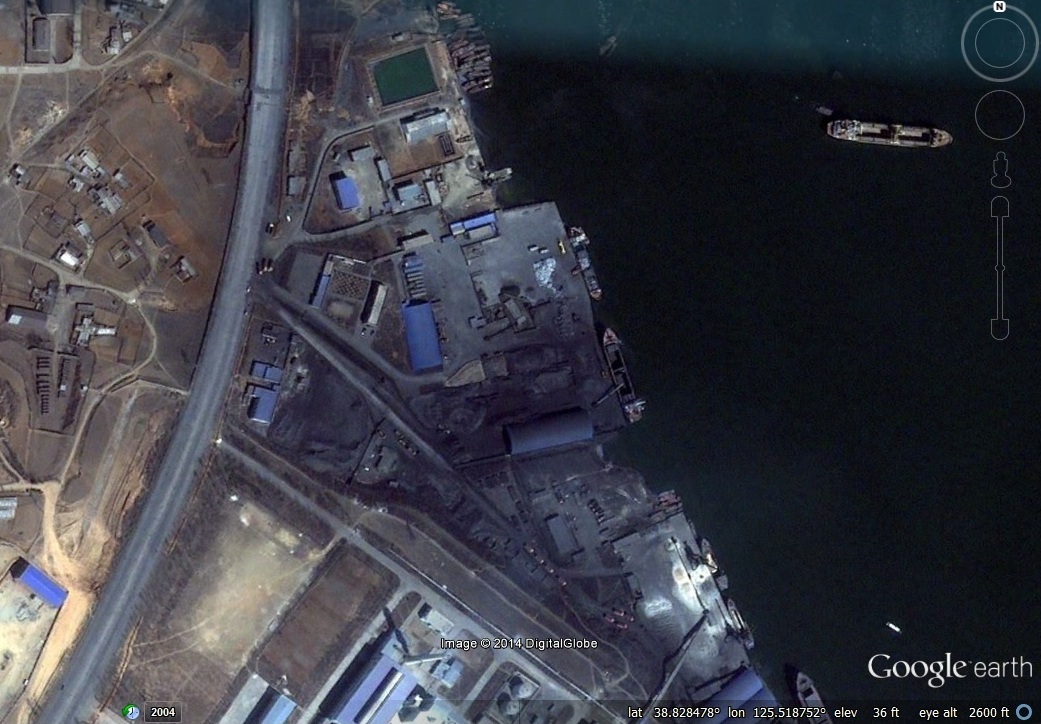
3. Who uses Rajin’s Ports? (2010-5-23)

4. Rason port facilitates intra-China coal distribution (2011-1-4)

Read the original stories here:
China to allow nat`ls to travel to Rason, N.Korea, by car
Donga Ilbo
2011-6-6

Chinese Motorists to Tour N.Korean Investment Zones
Choson Ilbo
2011-4-5

Share

New DPRK status symbols

Thursday, May 26th, 2011

According to the Daily NK, motorcycles, computers, and “big dogs” have replaced the rice cooker and wristwatch as the cutting edge status symbols among North Koreans.

According to the article:

In today’s North Korea, where wealth inequality is growing more and more extreme, what is a symbol of upper class income status? Just a few years ago, the answer was a branded South Korean rice cooker, the ‘Cuckoo’. So much so, indeed, that the brand name has totally usurped the dictionary description, ‘pressurized electric rice cooker’, altogether.

However, according to a new interview with a cadre from an enterprise in Chongjin published in the new, June edition of NK Vision, the most potent recent symbols of a wealthy family are motorcycles, notebook computers and military dogs!

“Nowadays in Chongjin, transport agents are being stationed here and there because of motorcycle accidents. There are usually around three motorcycle accidents per day, and people are losing their lives,” the cadre explained.

The majority of the motorcycles ridden in North Korea are Chinese brands such as Jangbaeksan costing around 2,000-3,000 Yuan (with 1 Yuan worth 400 North Korean won). Meanwhile, even second-hand versions of Japanese brands including Yamaha and Honda cost considerably more than 5,000 Yuan.

The cadre continued, “The bicycle is still the basic means of transport, as it has been until now. But the bicycle is now just a really ordinary means of transport; it is no longer a symbol of wealth.”

A notebook computer is another symbol of economic good health. Among other reasons, this is because in random inspections by the North Korean authorities they check computers, and since notebook computers can be hidden easily, they are enjoying great popularity.

The source explained, “On average, computer checks crop up once every two or three months, and since this happens without warning, we cannot get rid of things like foreign movies or Korean songs. Seeing these checks getting more serious, nowadays notebook computers are the most popular thing.”

Big dogs are, similarly, growing in popularity, even though one dog can cost as much as 100,000 North Korean won, or more than 50kg of rice. According to the cadre, there is sound logic to this, too.

“Affluent households need dogs to deter thieves, and a military dog can be raised for around seven years then it leaves meat to the house,” he explained.

Yesterday, Martyn Williams informed us about the DPRK’s juche laptop!

Read thee full story here:
Motorcycles and Notebook Computers
Daily NK
Kim So-yeol
2011-5-26

Share

Recent articles on Rason’s future

Wednesday, May 4th, 2011

According to the Hankyoreh:

China is stepping out into the Pacific through the gates of North Korea’s Rason Special District. North Korea, which has been declaring its aim of creating a “strong and prosperous nation by 2012,” is actively welcoming the move from China.

A number of sources, including officials with the Jilin Province government in China, reported that a groundbreaking ceremony is to be held on May 30 for a highway linking the North Korea cities of Wonjong and Rason, bordering directly on Quanhe in Hunchun, Jilin Province. A number of leaders from both countries are scheduled to attend the ceremony, which is to take place in Rason (Rajin-Sonbong), North Korea.

A Chinese official working on preparations for the project said in a recent interview with the Hankyoreh that the event would be “an occasion for declaring North Korea-China economic cooperation and North Korean openness to the world.” The official added that dozens of officials from the Chinese central government would be attending, including a number of leaders.

The construction effort is a signal announcing the opening of Rason and large-scale economic cooperation between North Korea and China. In addition to the groundbreaking ceremony for the highway, which is to be a major channel tying North Korea and China together economically, efforts to develop China’s Rajin Harbor and transport large amounts of coal through it are beginning in earnest.

The Rason development effort is taking place according to China’s “blueprints” in everything from the planning to investment and management. Local sources said that China and North Korea have already formed a special joint steering committee for the district, and that it has been decided that the chairman will be from China.

The Rason urban development plan jointly drafted by China and North Korea includes the development of international freight brokerage, export processing, and financial regions. According to a North Korean video, models for the plan include Dalian and Tianjin, which Kim Jong-il inspected in 2010 during a visit to China.

An official with the Yanji city government said, “North Korea is also aware that keeping its doors closed will only lead to death, but it is concerned that the regime will be destabilized if it opens up all at once, so it plans to first open up Rajin and develop it as a ‘test region.’”

“They are adopting the Chinese model, learning from China about legislation, taxes, and benefits to lure businesses,” the official added.

The effort is being pursued promptly, in contrast with previous North Korea-China economic efforts, which tended to amount to little more than words. The reason for this is that the central governments in Beijing and Pyonyang are directly taking care of economic cooperation through the medium of Rason’s development.

A Chinese government official reported that Chinese Minister of Commerce Chen Deming traveled to North Korea to sign a memorandum of understanding, and that China and North agreed on a plan for joint investment in and administration of Rason’s highway, port, and industrial park construction. The official added the Chinese Prime Minister Wen Jiabao personally signed policy documents upgrading Hunchun to a special economic district in line with the Rason development plans.

Meanwhile, North Korea formed an office in its central government to directly administer Rason Special City, replaced old officials who failed to make progress with Rason’s development over the years, and sent in young officials from the central government, including Rason Special City secretary Im Kyong-man, sources reported.

China needs the Rason development to ensure the success of its current national development plan for Changchun, Jilin, and the Tumen River basin, while North Korea decided to cooperate with China to address its economic problems and stabilize its succession framework. Analysts say North Korea hopes to tout successful development of Rason as an achievement of Kim Jong-un.

The development project is proceeding in a very specific and far-reaching way. “This is Korean land, but the industrial complex is being operated as Chinese and will hire North Korea workers to earn foreign currency” for North Korea, said an official with a Chinese company in charge of a large-scale construction effort in Rason.

The electricity shortage issue, which had previously been a major stumbling block to investment, has been resolved by China. A source in Hunchun said, “Plans are being examined to either send surplus power from Hunchun’s thermoelectric power plants to Rason, or for a company in Jilin Province to retrofit an old Soviet crude oil plant in the Sonbong region into a coal-burning power plant.”

Even Chinese officials have been astonished at the active measures from Pyongyang. A Rajin representatives’ office opened in downtown Yanji, the seat of the Yanbian Korean Autonomous Prefecture, is hard at work drawing in investment.

“If Chinese investors want to take a look at Rason, they can drive their cars in for themselves with an invitation from the Rajin representatives,” explained a source in Yanbian.

In the border city of Hunchun, money and people have begun shifting toward the North Korean side. Construction of 500 apartments for Chinese people working in Rason began in late March, according to officials at a construction company commissioned to carry out the project. Capital and labor investment for the Hunchun-Rason highway construction is coming entirely from China, and a number of the roughly 500 Chinese workers needed to begin have already arrived in Rason with six-month passes issued by North Korea. Large Chinese corporations such as Changli, Shangdi Guanquan Investment, and FAW are known to be undertaking investment in Rason.

According to the Korea Herald:

Despite its reputation as one of the most closed nations in the world, North Korea is, at least partly, opening up to market economy conventions, evident in its effort to cultivate its specially designated economic zone.

North Korea designated Raseon the country’s first free trade zone, as a “special city” in January 2010. The city, which borders both China and Russia, was dubbed a free trade zone along with nearby Sonbong in 1991, even though foreign investment never materialized.

In recent years, the North has tried to reinvigorate the trade zone, signing an accord with Russia to restore railways that could help rejuvenate the port there. Russia invested 140 million euro ($202 million) in the Rason project in late 2008.

In recent months, North Korea appears to have initiated a media campaign for Rason, beckoning foreign investors as Pyongyang struggles to resuscitate its moribund economy, according to informed sources and media reports.

According to a source familiar with North Korean affairs, the city has seen both new factories built and upgrades of previous ones.

A couple of large Chinese companies have also reportedly signed deals on either providing construction parts or investments in the region’s resources development.

Chinese commerce officials from the central government and the nearby Jilin Province have also reportedly held talks with their Pyongyang, Rason counterparts regarding such business transactions.

The city is also becoming more urbanized, according to sources. Apartments and road construction repairs are sprouting, while the number of daily logistics traffic across the nearby North Korea-Chinese border has nearly doubled to some 200 trucks in late April, compared to some 100 trucks just three months ago.

The North Korean leader Kim Jong-il recently traveled to the city, a move that analysts see as underlining the regime’s desire to promote the trade city to lure foreign investment.

The KCNA reported on April 22 that Kim visited the city’s Rajin Shipyard where he was briefed on different processes of shipbuilding. There he highlighted the importance of the shipbuilding industry and urged for the introduction of new production technology.

It was the first time that the North’s tightly controlled media reported the name of the shipyard and Kim’s visit there. Known as one of three major shipyards in North Korea, the Rajin Shipyard is believed to have built warships and submarines, according to sources in Seoul.

Increasing media reports from North Korea on Rason also seems to back claims that the country is putting its weight behind the city.

On April 19, the KCNA filed a profile report on Rason’s tourism industry, touting its historic relics, cultural facilities and fantastic seascape “and introducing tourist hot spots in and near the city.

In an earlier, March 30 report, the KCNA said that the city has adopted “a preferential tariff system” for foreign investors and traders.

“Choe Kwang-nam, an official in charge of economic cooperation of the Rason City People’s Committee, told the KCNA that the zone provides favorable business conditions to foreign investors through the preferential tariff system,” it said.

“Foreign investors and businesses are allowed to conduct diverse economic and trade activities and have a free choice of investment forms and business,” it quoted Choe as saying.

Read the full stories here:

N.Korea’s Rason Special District could open country to China
Hankyoreh
Park Min-hee
2011-5-4

Investment, projects seemingly brim in N. Korea border city
Korea Herald
2011-5-4

Share

Military drivers involved in car theft

Thursday, March 10th, 2011

According to the Daily NK:

A spate of car thefts over the last few months in Chongjin, North Hamkyung Province is said to have been done by military drivers trying to cling onto their posts, according to a source.

The source said some of the thieves were apprehended in an intensive crackdown on car theft carried out from late January to early February by the People’s Safety Ministry (PSM), and subsequently revealed the details.

According to the source, the drivers, in collusion with civilians, stole “servi-cha”, or service cars, and sold the parts, apparently in order to purchase gas and other things they needed to keep their own vehicles running.

Service cars are vans, trucks or buses used to transport people and cargo in lieu of an adequate public transport system.

Even though the PSM in the province apparently launched an investigation into the case, it was apparently unsuccessful because base Party cadres protected the drivers, so now the issue has developed into a tug of war between the military and the provincial PSM.

Speaking on the 7th, the source explained, “The drivers, who are part of a platoon which manages private cars for cadres under the 45th Division of the 9th Corps, which is stationed in Chongjin, hid the stolen cars in a parking lot on-base and sold the parts.”

He explained, “Agents from the Criminal Investigations Section of the PSM tried to access the corps, but 9th Corps cadres including the political commissar and the base National Security Agency head instructed soldiers not to allow them to get onto the base under any circumstances.”

One of the arrested men apparently admitted, “We utilized the fact that the security forces cannot search military bases.”

According to the source, their dire situation drove the drivers to car theft. He said, “An official’s cars projects his pride, so if a driver cannot run his car properly even on condition of having no gas or parts, it is difficult to hold on to that position.”

“The authorities used to turn a blind eye to the military earning money for fuel by supporting foreign currency earning companies or individuals by helping them carry their cargo. However, the military police’s crackdown even on military vehicles has recently been reinforced, so drivers found themselves in that difficult situation,” he concluded.

Following the Arduous March, drivers have played a role of growing importance in the North Korean economy.  Here are some previous posts on the DPRKS transporters and transportation market: Story 1, Story 2, Story 3, Story 4, Story 5.

Read more here:
Military Drivers Involved in Car Theft
Daily NK
Im Jeong Jin
3-8-2011

Share