Archive for the ‘Gold’ Category

Increase in DPRK’s mineral resources exports to China expected again for this year

Monday, February 28th, 2011

Institute for Far Eastern Studies (IFES)
2/24/2011

The trade volume between North Korea and China has steadily increased, reaching its record high of USD 3.4 billion in 2010. Total exports amounted to 1.19 billion USD while imports doubled that figure to USD 2.22 billion. Imports have continued to grow, increasing by 2.4 times over the previous year.

Since the Cheonan incident and the implementation of May 24 sanctions, inter-Korean economic cooperation has come to a halt, naturally resulting in rise in exports to China. In particular, a significant growth in anthracites exports was observed. The monthly anthracites exports that averaged around USD 10 million surpassed USD 70 million mark last August and maintained USD 50 million monthly average between September to November. In addition, cost-per-ton of anthracite in March which was USD 52.2, jumped to USD 82.8 in November, a climb of 60 percent. This boost is attributed to its increased export.

The current supply of electric power consists mostly of hydroelectric power — reaching over 60 percent– but during the winter season most of the hydropower plants are unoperational due to frozen facilities from harsh winter weather. Anthracites were the alternative resource to fill this gap. Sacrificing power production and exporting great amount of anthracites despite severe winter is a strong indication of the poor foreign currency situation in North Korea.

In its New Year’s joint editorial, North Korea placed heavy emphasis on its anthracite export that took up 60 percent of its total exports. In the statement, four vanguard sectors of coal, electricity, metals, and railroads were highlighted as important industries as “rich underground resources that will help with securing funds and resolving raw material problems.” This is the first time in 13 years – that is, since the Arduous March — for coal to be mentioned first in the New Year’s message.

North Korea also began to lift export restraints of mineral resources like coal and silver from the latter half of last year and ordered to increase imports of rice and corns in place of minerals.

The reason food procurement is placed first at the expense of its mineral resources is believed to be associated with the implementation of the succession involving Kim Jong Un, and to keep North Korean people’s dissatisfaction under control and manage the domestic situation.

North had placed restraints on coal, gold, silver, lead, and zinc exports from 2007 through adopting export control of mineral resources.

In addition, North Korea and China will meet in Beijing to sign an agreement on joint development of underground resources. This agreement will include Musan Mine and rare-earth mines that POSCO (The Pohang Iron and Steel Company of South Korea) has shown interest in in the past for development. China’s moves in this sector are suspected as China’s attempt to monopolize the DPRK’s underground resources.

The DPRK’s Joint Venture and Investment Guidance Bureau and China’s Ministry of Commerce were expected to meet on February 15 to discuss agreements related to underground resources development. On the agenda was Musan Mine, abundant in gold and anthracite, and other mines rich in rare-earth elements. Other mines are also known to be specified in the agreement.

China is expected to bring private companies into the underground resources development project after reaching an agreement with the DPRK. According to our source, “both parties will establish a joint venture investment corporation in Hong Kong after signing the agreement.”

Construction of a highway connecting Heilong City of Yanbian Korean Autonomous Prefecture to Nampyong and Chongjin of North Korea and railway system linking the cities of Heilong, Nampyong, and Musan are currently underway, expected to be in operation by end of this year. Jilin Province and Ministry of Railways of China began construction of this railway system from October 2010 investing CNY 1.19 billion, which runs a distance of 41.68 km. However, it is expected to extend further onto Chongjin and is considered to become the major transportation hub, integrating economic cooperation between the two countries.

Musan Iron Mine is known as the largest outdoor iron mine in Asia and Tonghua Iron and Steel Group along with three other Chinese corporations acquired 50-year development rights of Musan Iron Mine. They are bringing in about 120 tons of iron ore each year and more is expected to be brought in once the Heilong-Musan rail link is completed.

Share

DPRK-Chinese mining deal

Monday, February 7th, 2011

According to Yonhap:

North Korea and China are expected to sign an agreement on joint development of the North’s underground resources in the middle of this month in Beijing, a source here said Sunday.

“It has been learned that Pyongyang and Beijing are expected to conclude a deal to jointly develop North Korea’s underground resources on Feb. 15, one day before the birthday of North Korean leader Kim Jong-il,” said the source, noting the accord will be signed in Beijing between China’s Commerce Ministry and the North’s Joint Venture Investment Committee.

“Specifically, the two sides may agree to jointly develop natural resources such as gold, anthracites and rare earths under the bilateral deal. Following the agreement, the two countries are likely to establish a joint venture company in Hong Kong,” said the source, asking to remain anonymous.

Trade between North Korea and China reached US$3.06 billion in the first 11 months of last year, which marked a rise of 9.6 percent from the 2008 annual volume of $2.7 billion. Mineral resources like coals and iron ores account for over 30 percent of the North’s exports to China.

Chinese mining investors have had mixed results in the DPRK despite geographical proximity and monopsony purchasing power (the Chinese can offer lower prices because in many cases they are the only purchaser/investor).

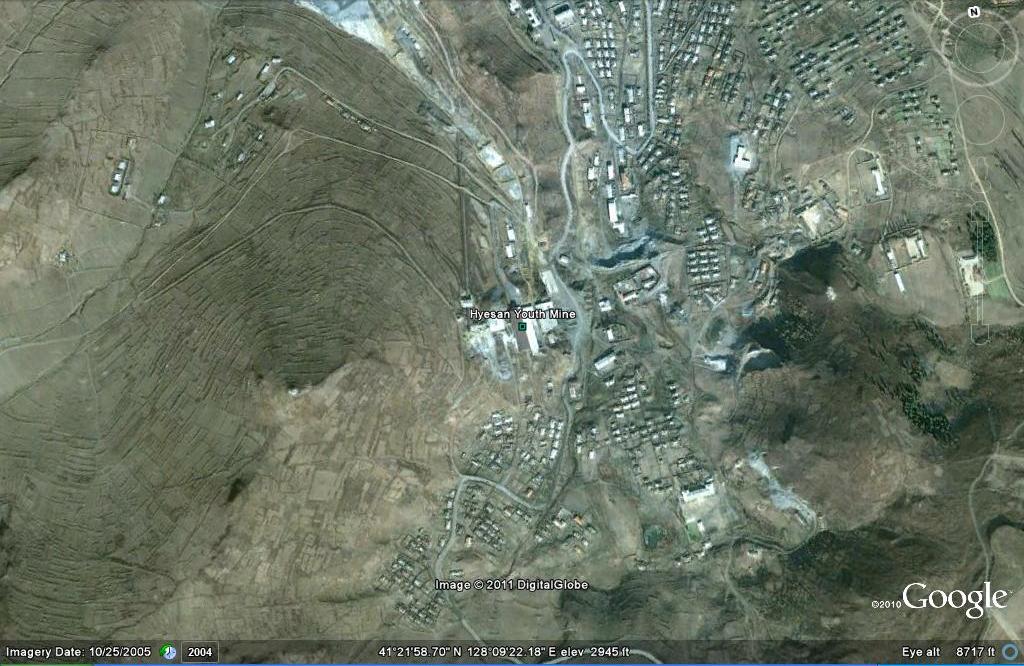
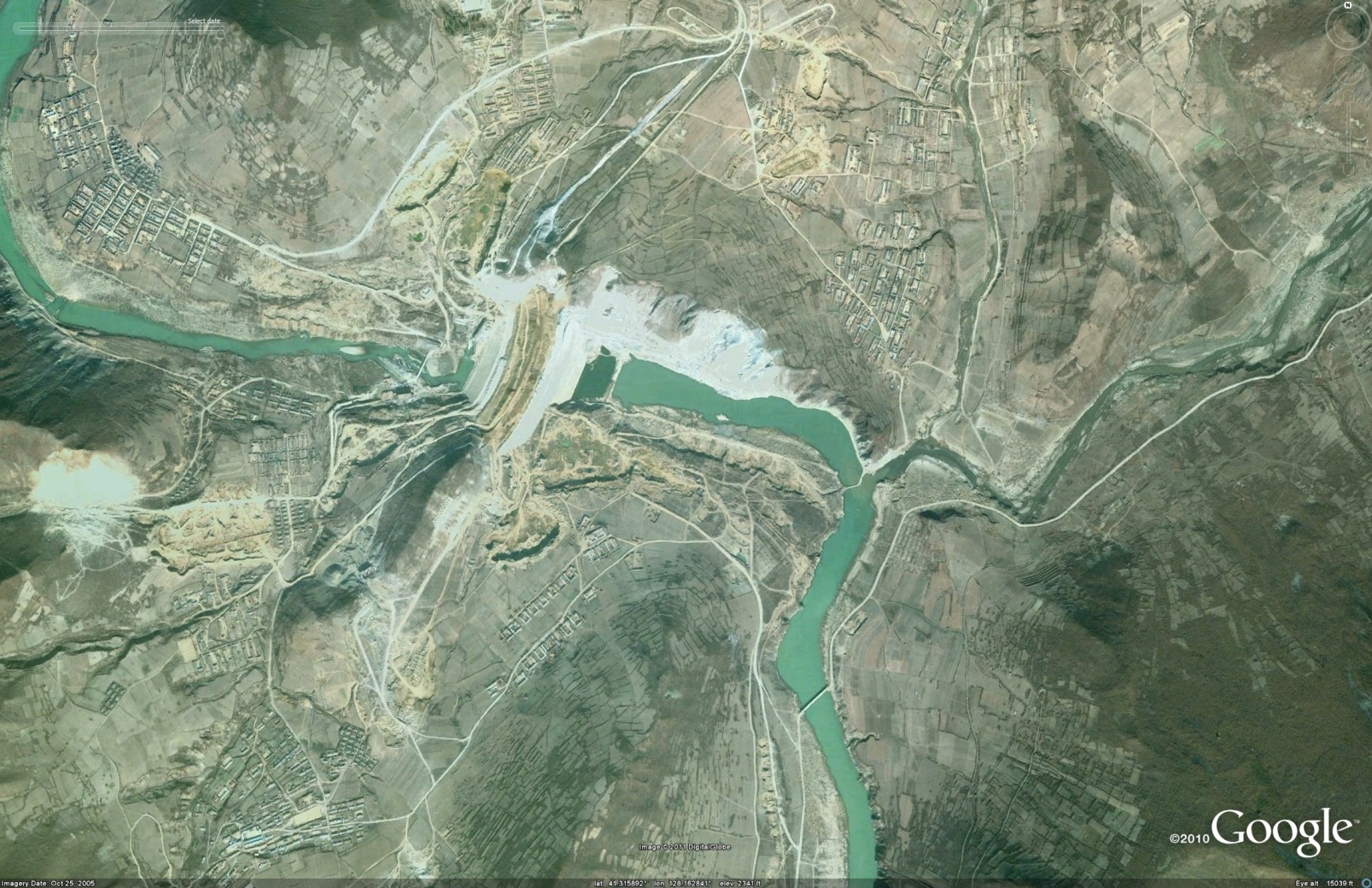
At one point, a Chinese firm had a controlling share of the DPRK’s Hyesan Youth Copper mine (Satellite image here).  As best I can tell, the mine is no longer operable because of flooding from nearby dam construction.

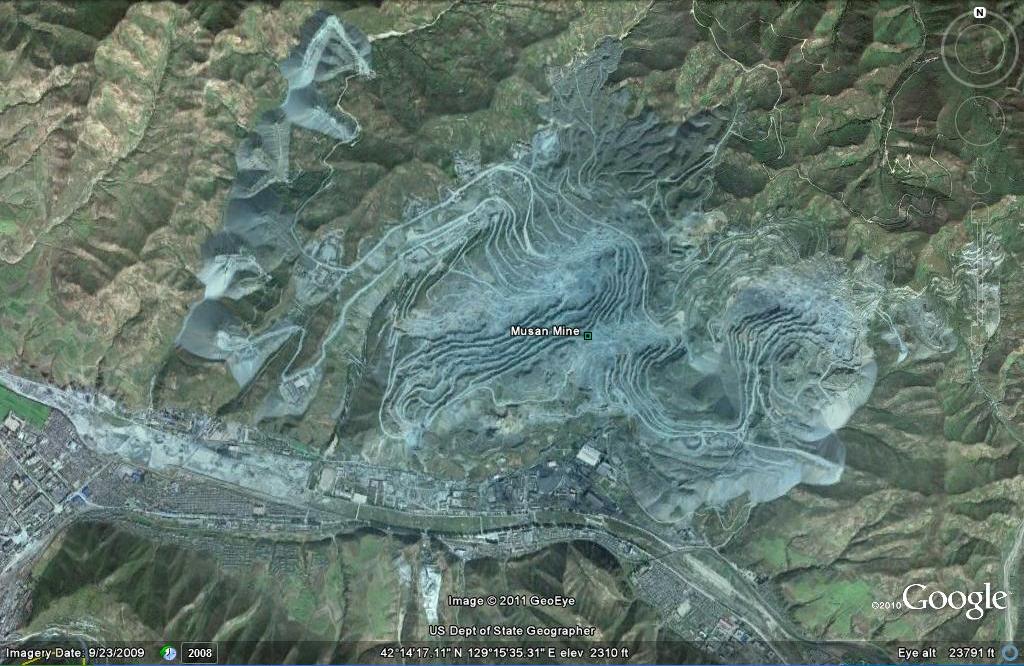
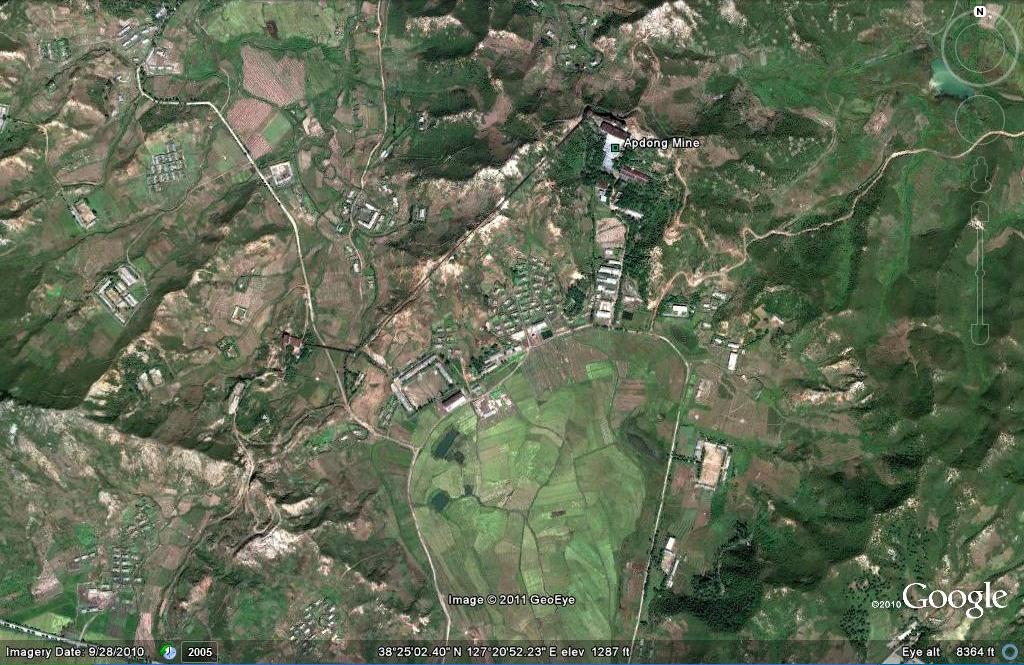
A Chinese firm had also invested in the Musan Mine, the DPRK’s largest, conveniently located on the Chinese border (Satellite image here). This deal also fell trough (see here).

I have heard informally that Chinese mining investors do not particularly like doing business in the DPRK because their North Korean business partners routinely violate contract terms and local officials need to be bribed repeatedly.  Today Chinese mining firms operate across the world in both developing and developed countries, so why bother with the DPRK?

The particular deal mentioned in this Yonhap article is interesting because it hints that the Chinese and North Korean central governments are setting the terms for mining investment in the DPRK for the first time.  This will give local officials less room for post-contractual rent-seeking behavior and could smooth the way for regular/predictable business operations in the DPRK.

Again, centralized corruption is preferable to decentralized corruption for investors.

Read the full Yonhap story here:
N. Korea, China likely to ink deal on joint resource development
Yonhap
2/6/2011

Share

Room (Bureau) 38 allegedly restored

Wednesday, June 23rd, 2010

According ot the Choson Ilbo:

North Korea in March restored a special department in the Workers Party codenamed Room 38 which manages leader Kim Jong-il’s coffers and personal slush funds, it emerged Monday. The North last fall merged Room 38 with Room 39, which manages party slush funds.

“Rooms 38 and 39 were merged to simplify Kim Jong-il’s slush funds,” said a North Korean source. “But when it became difficult to secure hard currency due to international sanctions, Room 38 seems to have been restored because there was a feeling that Room 39 alone can’t meet the need.”

Room 38 is reportedly led by Kim Tong-il, who heads three regional departments in charge of earning hard currency.

Room 39 tries to maximize earnings from gold and zinc mining and farming and fisheries. It also manages stores and hotels exclusively for foreigners in Pyongyang. Room 39 seems to have suffered badly due to the recent suspension of inter-Korean trade. “Taesong Bank and Zokwang Trading, which received remittances from Mt. Kumgang tourism, are both controlled by Room 39, and is also in charge of the exports of agricultural and fisheries products,” said a government source.

Kim Jong-il needs dollars to maintain the party elite’s loyalty to him and his heir presumptive. He is said to have told party bigwigs in February, “From now on I will judge your loyalty based on the amount you contribute to the fund.” His son Jong-un is also said to be amassing separate slush funds for his own use.

But international sanctions on exports of weapons, counterfeit dollars, fake cigarettes and drugs remain in place, and the United States is pushing ahead with additional financial sanctions over the North’s sinking of the South Korean Navy corvette Cheonan in March. Pyongyang was dealt a heavy blow in 2005 when the U.S. froze US$25 million in the Banco Delta Asia in Macao which was apparently for Kim’s personal use.

Kim earlier this year appointed his high school friend Jon Il-chun head of Room 39. Jon was also named chairman of the National Development Bank, established early this year with a view to conducting normal international financial transactions to induce foreign investment. “North Korea seems to be planning to divert part of foreign investment to Kim’s slush fund,” said a government official.

NK Leadership Watch has more

Read the full story here:
Kim Jong-il Restores Special Department to Swell Coffers
Choson Ilbo
6/24/2010

Share

Brazil, North Korea: Brothers in trade

Wednesday, June 2nd, 2010

Bertil Lintner wrties in the Asia Times:

For more than a decade, the world around North Korea has been shrinking. In the wake of its missile and nuclear tests and recent accusations that it torpedoed a South Korean naval vessel, the list of internationally imposed sanctions and trade restrictions aimed at isolating the reclusive state has grown ever longer.

But the North Koreans, who have been in a state of war for more than half a century, have often found ingenious ways around those restrictions and added pressures from the United States, Japan and other countries, most visibly seen in the string of front companies and bank accounts it maintains across Asia.

Recent indications are that Pyongyang has sought willing trade partners outside of Asia and its new closest commercial ally appears to be Brazil. Relations between the two countries have warmed considerably since leftist Luiz Inacio Lula da Silva became president in January 2003.

The official Chinese news agency Xinhua reported in October 2004 that North Korea planned to open an embassy in Brasilia, its fourth in the Latin and South American region after Havana, Cuba, Lima, Peru and Mexico City. On May 23, 2006, the official Korean Central News Agency (KCNA) and the Brazilian media reported that the two countries had signed a trade agreement.

More recently, the KCNA reported last December that a “protocol on the amendment to the trade agreement” had been signed in the capital Pyongyang. “Present at the signing ceremony from the DPRK [Democratic People's Republic of Korea, or North Korea] side were Ri Ryong Nam, minister of foreign trade, and officials concerned and from the Brazilian side Arnaldo Carrilho, Brazilian ambassador to the DPRK, and embassy officials,” according to the news report.

China’s role in facilitating trade between Brazil and North Korea remains a matter of conjecture, but it is significant that the state mouthpiece Xinhua has eagerly reported on the warming of relations between the two countries. China remains Pyongyang’s most important base for all kinds of foreign trade – legitimate as well as more convoluted business transactions through front companies in Beijing and elsewhere.

But North Korea also needs more discreet trading partners, as China is often criticized in international forums for its close relations with the North Korean regime and is undoubtedly closely watched by Western intelligence agencies. And it is hardly surprising that Brazil, which is known to harbor its own nuclear ambitions, albeit for stated peaceful purposes, has emerged as such a friendly nation to Pyongyang.

Significantly, Brazil has established what appears to be an understanding with another aspiring nuclear power: Iran. “Also like Iran, Brazil has cloaked key aspects of its nuclear technology in secrecy while insisting the program is for peaceful purposes, claims nuclear weapons experts have debunked,” according to an April 20, 2006 Associated Press report.

While Brazil is more cooperative than Iran on international inspections, some worry its new enrichment capability – which eventually will create more fuel than is needed for its two nuclear plants [1] – suggests that South America’s biggest nation may be rethinking its commitment to nuclear non-proliferation.

”Brazil is following a path very similar to Iran, but Iran is getting all the attention,” said Marshall Eakin, a Brazil expert at Vanderbilt University in the United States. ”In effect, Brazil is benefiting from Iran’s problems.”

In September 2009, Lula declared before the United Nations General Assembly: “Iran is entitled to the same rights as any other country in its use of nuclear energy for peaceful purposes.” He added to reporters outside the UN General Assembly, “I defend for Iran the same rights with respect to nuclear energy that I do for Brazil.” He added: “If anyone is ashamed of having relations with Iran, it’s not Brazil.”

But it is Lula’s budding cooperation with North Korea that is especially worrying to some Western observers. According to one longtime observer of the North Korean scene, “Both nations have long-standing ambitions to develop a nuclear capability as well as missiles and space-launched vehicles. Both have been the subject of intense US political pressure at times, Brazil on-and-off, North Korea all the time. And Brazil has access to technology that North Korea can only dream about.”

Because Brazil is not on any international sanctions list, it is easier for it to obtain dual-use materials. It remains to be proven, however, that Brazil has served as a conduit for such goods ultimately destined for North Korea.

According to official trade statistics, available at www.stat-trade.com, North Korea’s largest trading partner in 2009 was China, with two-way commerce totaling US$2.67 billion. That was followed by South-North Korean trade worth $1.68 billion. A surprising third on the list was Brazil with US$221 million in two-way trade, well ahead of Singapore, Hong Kong and North Korea’s other traditional Asian trading partners.

The nominal figure may not be impressive in an international context, but it is substantial for North Korea, a country with an estimated total gross domestic product of about $22 billion. North Korea’s trade with Brazil has recently increased almost at the pace it has decreased with Thailand, from where it previously sourced dual-use chemicals, raw materials and machinery. Thailand no longer figures prominently in recent trade statistics, which is noteworthy given that their two-way trade reached a record US$331 million in 2004.

Those deals were done under the government of Thaksin Shinawatra, who at one point even proposed signing a full-blown free-trade agreement with North Korea. In August 2005, the former Thai premier was formally invited by North Korean leader Kim Jong-il to visit Pyongyang. The visit never materialized, however, and when Thaksin was ousted in a September 2006 military coup, Thai-North Korean relations began to deteriorate. By 2008, bilateral trade between Thailand and North Korea fell to $76 million and in 2009 dipped further to $47.1 million.

Among North Korea’s more remarkable export items before the September 2006 coup in Thailand were 1.3 tons of gold and 10 tons of silver. Another pre-arranged shipment of 12 tons of silver arrived in Bangkok in October of that year. However, business is now reportedly sluggish at the two main trading companies that North Korea is known to maintain in Bangkok, Star Bravo and Kosun Export Import.

Successive Thai governments that have ruled the country since Thaksin’s overthrow are believed to have complied more strictly with international pressure to restrict dealings with North Korea. In Brazil, however, North Korea has a long history of involvement with various leftist groups, the distant offshoots of which are now in power in Brasilia.

North Korea expert Joseph S Bermudez wrote in his 1990 study “Terrorism: The North Korean Connection”:

From 1968 to 1971 the DPRK provided financial and military assistance to several leftist organizations in Brazil, most notably to Carlos Marighella’s National Liberating Action (Acao Libertadora Nacional – ALN) and the Revolutionary Popular Vanguard (Vanguarda Popular Revolucionaria – VPR). By November 1970, the DPRK established a training base in the Porto Alegre area, where a small number of guerrillas were given guerrilla warfare, small arms, and ideological training. A small number of ALN and VPR personnel is believed to have also received training within the DPRK.

Marighella – a Marxist, writer and founder of the ALN – was the leader of a militant movement that fought against Brazil’s US-supported, authoritarian right-wing governments in the 1960s. In September 1969, the guerrillas even managed to kidnap US ambassador Charles Burke Elbrick for 78 hours. After his release in exchange for 15 imprisoned leftists, Elbrick remarked, “Being an ambassador is not always a bed or roses.” Two months later, Marighella was killed in an encounter with Brazil’s police. But on November 4, 2009, the 40th anniversary of the death of Marighella, Lula declared him a “national hero”.

Although ideology may be less important than profits in today’s capitalist world, there are old emotional bonds between North Korea and Brazil under Lula that should not be entirely discounted. Brazil may be among the countries which have condemned North Korea’s nuclear program, as was shown when, in May 2009, the Brazilian government called on North Korea “to sign the Comprehensive Nuclear Test Ban Treaty and to strictly observe the moratorium on nuclear tests”.

But bilateral trade between the two sides is nevertheless – in relative terms – now booming. In May last year, North Korea’s Foreign Affairs Minister Pak Ui-chun arrived in Brazil to meet with his Brazilian counterpart, Celso Amorim. Pak expressed Pyongyang’s interest in receiving assistance in its deep-water oil prospecting efforts from PETROBRAS (Brazilian Petroleum Corporation), while Amorim said his country was reportedly interested in exporting what he referred to as “farm” machinery.

So far no military hardware, or material that could have military applications, is known to have changed hands between North Korea and Brazil. But Pyongyang has found at least one new trading partner which could potentially replace some of its former business allies in Asia. It’s a budding relationship that will be closely monitored by North Korea watchers in Japan and the West.
Read the full story here:
Brazil, North Korea: Brothers in trade
Asia Times
Bertil Lintner
Asia Times
6/3/2010

Share

DPRK looking for Chinese investors in Taebong gold mine

Tuesday, May 4th, 2010

According to the Daily NK:

The chairman of North Korea’s State Development Bank, Jeon Il Chun visited China on April 8, reportedly to try and bring Chinese investment to Daebong Mine, located near Hyesan, Yangkang Province.

Daebong Mine is one of North Korea’s major gold mines, managed under the auspices of the No. 39 Department of the Central Committee, a special department charged with raising funds for Kim Jong Il’s personal use. Jeon Il Chun is the person in charge of the No. 39 Department.

Attempts to sell shares in a gold mine directly controlled by the 39 Department, Kim Jong Il’s own private safe, to China seem to indirectly imply that Kim is suffering from a debilitating foreign currency supply crisis.

One Daily NK source in China who is well-acquainted with North Korean affairs reported that while Jeon was in China, he met with the management of three or four Chinese enterprises which already have investments in North Korea, and suggested investment conditions under which the North could transfer some of its mineral rights to them and receive capital investments in return.

The source said, “For now, as far as I know, executive managers of the No. 39 Department have been in contact with Chinese enterprises. Since the Workers’ Party is trying to sell shares in a gold mine, it seems the funding of the Party might be serious.”

“It is not clear whether or not this attempt was done on Kim Jong Il’s instructions, but attracting foreign investment in a gold mine is not a commonplace affair,” the source pointed out, adding that an investor has not yet been put in place.

What is the Daebong Mine for?

The Daebong Mine is a relatively large gold mine on the border of Woonheung and Gapsan in Yangkang Province. Until 2001, a Yangkang provincial foreign currency earning enterprise and the foreign currency earning department of the People’s Safety Agency jointly managed it. However, in May, 2002, it became a No. 39 Department affiliated enterprise.

The No. 39 Department has been raising private funds for the leader and Party operations under the Finance and Accounting Department of the Central Committee since the mid-1970s. According to defectors, it has the highest authority and the largest funds of all North Korea’s foreign currency earning enterprises. Especially, it has the ability to mobilize tremendous financial resources since it manages and controls supplies of gold and silver and rare non-ferrous metals.

A source from Yangkang Province explained, “According to Chongjin University of Mining and Metals and Kim Chaek University of Technology, the purity of the gold from the Daebong Mine is more than 76 percent, while production from Hoichang and Eunsan in South Pyongang Province is 63 percent and 61 percent respectively. More than 150kg of solid gold is produced annually, so this mine is known as the ‘loyalty mine’.”

“People say that the government earns four or five million dollars a year through this mine. Neither Yangkang Provincial Committee nor Hyesan Municipal Committee is involved with the business of the mine.”

The source added, “Since the No. 39 Department deals with the mine, only those discharged soldiers with good family backgrounds are dispatched there by the Central Committee. In October of last year, around 200 discharged soldiers with good family backgrounds came to the mine.”

Almost all the gold produced in the Daebong Mine is stored in Swiss and Austrian banks in gold bars.

A Chinese company had a contract with the DPRK’s Musan Mine which has been canceled for an unknown reason.

Click here to see what I believe is the mine’s location.

Read the full article here:
No. 39 Department Hawking Shares in Key Gold Mine
Daily NK
5/3/010
Lee Sung Jin

Share

2007 US Geological Survey published on North Korea

Wednesday, October 22nd, 2008

An advanced copy of the 2007 US Geological Survey of North Korea has been published. 

Here is the outlook from the author, John C. Wu:

For the next 3 to 4 years, the North Korean mining sector is likely to continue to be dominated by the production of coal, iron ore, limestone, magnesite, and zinc. Because of the continuing strong demand for minerals by China, its investments in North Korea’s mining sector are expected to continue to increase beyond its current investments in coal, copper, gold, iron ore, and molybdenum into other mineral commodities, such as nickel, crude petroleum, steel, and zinc. North Korea’s economy is expected to recover slowly but its real GDP is expected to grow at less than 1% during the next 2 years.

The whole report is fairly brief and worth reading in full.  You can download it here: usgs-dprk.pdf or read it on line here.

Share

North Korea on Google Earth

Thursday, October 2nd, 2008

North Korea Uncovered: Version 12
Download it here

mayday.JPGAbout this Project: This map covers North Korea’s agriculture, aviation, cultural locations, markets, manufacturing facilities, energy infrastructure, political facilities, sports venues, military establishments, religious facilities, leisure destinations, national parks, shipping, mining, and railway infrastructure. It is continually expanding and undergoing revisions. This is the 12th version.

Additions include: Tongch’ang-dong launch facility overlay (thanks to Mr. Bermudez), Yongbyon overlay with destroyed cooling tower (thanks to Jung Min Noh), “The Barn” (where the Pueblo crew were kept), Kim Chaek Taehung Fishing Enterprise, Hamhung University of education, Haeju Zoo, Pyongyang: Kim il Sung Institute of Politics, Polish Embassy, Munsu Diplomatic Store, Munsu Gas Station, Munsu Friendship Restaurant, Mongolian Embassy, Nigerian Embassy, UN World Food Program Building, CONCERN House, Czech Republic Embassy, Rungnang Cinema, Pyongyang University of Science and Technology, Pyongyang Number 3 Hospital, Electric Machines Facotry, Bonghuajinlyoso, Second National Academy of Sciences, Central Committee Building, Party Administration Building, Central Statistics Bureau, Willow Capital Food House, Thongounjong Pleasure Ground, Onpho spa, Phipa Resort Hotel, Sunoni Chemical Complex (east coast refinery), Ponghwa Chemical complex (west coast refinery), Songbon Port Revolutionary Monument, Hoeryong People’s Library, Pyongyang Monument to the anti Japanese martyrs, tideland reclamation project on Taegye Island. Additionally the electricity grid was expanded and the thermal power plants have been better organized. Additional thanks to Ryan for his pointers.

I hope this map will increase interest in North Korea. There is still plenty more to learn, and I look forward to receiving your contributions to this project.

Version 12 available: Download it here

Share

Interview with Ken Frost, CFO, Phoenix Commerical Ventures

Monday, July 28th, 2008

Interview Blog, Germany
(click here for all their North Korea-related interviews)

Phoenix Commercial Ventures Ltd is a venture capital company that offers investors business and investment opportunities in the DPRK” – Interview with Ken Frost (CFO of Phoenix)

Klaus-Martin Meyer: Mr. Frost, you are member of the Board of Phoenix Commercial Ventures Ltd, a company that offers investors business and investment opportunities in the Democratic People’s Republic of Korea (DPRK) otherwise known as North Korea. Would you mind introducing yourself and your company as well to our readers?

Ken Frost: Phoenix Commercial Ventures Ltd is a venture capital company that offers investors business and investment opportunities in the DPRK, enabling them to take advantage of the economic reforms that are taking place there.

Phoenix is owned and run by four experienced professionals, who are based in London, Paris and the DPRK. The Board has between them many years of international business experience, and an invaluable network of well placed contacts. Phoenix offers a unique service, by being able to offer direct access to the DPRK.

Phoenix Commercial Ventures Ltd specialises in project finance in the DPRK. As is well known, the business environment is difficult, and the company targets very specific investment projects; these are small enough to manage and have the capacity to generate foreign currency, either through export or import substitution.

Phoenix Commercial Ventures Ltd maintains an office in Pyongyang, almost the only European company to do so, and operates with the following specific aims:

• Identify commercially viable investment projects in the DPRK, on a case by case basis
• Identify reliable local partners for all forms of business in the DPRK, either trade or investment
• Seek overseas investment sources for such projects
• Minimise the risk in such projects, by taking responsibility for supervision of the local set-up procedures and management of the projects

The Board of Phoenix Commercial Ventures Ltd consists of nationals of the UK, France and the DPRK. The European flavour is enhanced by the fact that most of the counterparties and suppliers in the various projects are also European, and the DPRK government views Phoenix Commercial Ventures as a prime conduit for European business and investment in the DPRK.

One of the directors of Phoenix Commercial Ventures is also General Manager and CEO of the Daedong Credit Bank, the only western-invested foreign bank in the DPRK. Based in Pyongyang, this is a 70-30 joint venture between a UK financial management company based in Hong Kong and the Korea Daesong Bank, one of the main DPRK banks.

Phoenix Commercial Ventures is unique in having this connection with a reliable, locally based financial institution. The synergy benefits include a wider exposure to local business contacts in differing fields; as well as an additional degree of control, made possible by the fact that the various joint venture projects have to maintain their accounts with the bank.

We have a number of projects within DPRK, including two 50/50 joint ventures:

- Hana Electronics JVC, a consumer electronics company now ranked as one of the top three best performing joint ventures in DPRK, as assessed by the Ministry of Finance.

- Sinji JVC, whose main areas of operations are retail, software and bonded processing.

Full details about our company can be found on our website www.pcvltd.com

I am the CFO of Phoenix and am a chartered accountant with over twenty years international experience of FMCG industries, consumer electronics, rough diamond distribution and the Internet. I have worked in KPMG, Philips Electronics, De Beers and run my own Internet company. I am also a Scholar on Gerson Lehrman Group Councils.

In November 2007 I reached the finals of Accountant of the Year held by the Association of International Accountants at the President’s Awards Dinner 2007. This award is designed to recognise organisations’ accountancy stars.

In January 2007 I was awarded, based on recommendations from fellow members of the ICAEW, a New Year’s Honour by AccountingWeb. The award was for my services to the accountancy profession in opposing the merger of the ICAEW with other accountancy bodies.

In November 2006 I was awarded an honorary fellowship of the Institute of Professional Financial Managers (IPFM), for my services to the accountancy profession.

In January 2006 Accountancy Age placed me on their Financial Power List for 2006. I was 11th on their list of the top 50 of “The Ones To Watch”. The list identified the “most influential names to look out for” in the world of finance for 2006.

Klaus-Martin Meyer: We read on your website “offers investors business and investment opportunities in the Democratic People’s Republic of Korea (DPRK), enabling them to take advantage of the economic reforms that are taking place there.” Can you tell us what kind of opportunities this could be?

Ken Frost:There are three main areas of investment opportunities open to investors, which we can facilitate within the DPRK:

1 Small scale investments ($500K or less) yielding good levels of return (20% or more).

These investment opportunities are in local production (consumer goods, bonded processing, software etc) for domestic market consumption and export. These utilise the advantages that DPRK has over all the other countries in the region namely:

- 99% literacy
- skilled/disciplined/hard working workforce
- well educated workforce, many speak a good level of English
- lowest wage rates in the region

Phoenix has a number of opportunities that it can offer investors in this area; eg bonded processing, consumer manufacturing, clothing manufacturing and software development.

2 Natural resources

DPRK has proven abundant natural resources worth several trillion dollars; eg coal, gold, copper, titanium, lead, zinc, nephelite, nickel, magnesia, graphite etc.

The investment required would be of a higher order than the small scale investments above, $1M plus. The money would be used to bring existing mines back to production, by pumping out flood water and renewing worn out capital equipment.

Phoenix has, via its working relationship with CPEEC, a number or opportunities in the natural resource sector that it can offer genuine investors.

3 Infrastructure development

Clearly investment in infrastructure is the costliest form of investment. However, given the dilapidated state of the roads, railways, ports, electricity grid etc it is necessary if the economy is to be revived.

DPRK also has a keen interest in infrastructure development focussed on green/renewable energy areas.

Phoenix has on it books a profitable renewable energy project that would suit a serious, well financed and experienced green energy investor.

The DPRK is the final economic frontier and is a “green field” site. Its primary advantages are:

- Location (physical position between Russia, South Korea, China and in AP)
- Location (historical, all the major players now want to move forward)
- Location (resources, it has abundant rich resources both mineral and human capital – high literacy, well educated etc)

Klaus-Martin Meyer: What are the main differences between your company and a conventional venture capital company that is investing for example in internet our biotech companies?

Ken Frost: Companies such as those you mention are industry-specific, whereas ours is location-specific. Our company is relevant to people who might want to invest in the DPRK.  We work in the DPRK and have a physical presence in the DPRK, other “conventional” venture capital companies do not.

Klaus-Martin Meyer: Are there any differences to other investment companies?

Ken Frost: We apply the same principles to potential investments as any other professional investment company, we look at:

- the risk
- the returns
- the quality of the local management
- the quality of the business plan
- the size of investment
- the share offered for that investment etc

We also pay very close attention to corporate governance issues such as; financial reporting, management structure and ethics etc. We have a code of conduct which can be seen on our website.

Phoenix Commercial Ventures Ltd is committed to being a responsible corporate citizen and to the pursuit of a sustainable future, both economic and social.

Phoenix Commercial Ventures Ltd adheres to three fundamental ethical principles:

- Integrity
- Competence
- Courtesy

To this end Phoenix Commercial Ventures Ltd has developed a Code of Conduct, which sets out to ensure that these principles are followed in its operations. The Code of Conduct governs Phoenix’s business decisions and actions. The Code applies equally to corporate actions, and to the behaviour of individual employees when conducting business on behalf of Phoenix.

We work very hard with our local management teams and business partners to ensure that international standards re reporting, corporate governance and ethics are understood and followed.

Klaus-Martin Meyer: What are your plans for the company’s future? How do you see Phoenix Commercial Ventures in five years time?

We see the coming period for Phoenix as that of being continued growth.

In our view there will be a major upswing in economic relations between the DPRK and other countries over the coming months/years. Phoenix Commercial Ventures is uniquely placed to take advantage of, and to respond to, that upswing.

We are one of the very few organisations to have made successful joint ventures in the DPRK. We are also one of the very few organisations to have people with many years’ experience, and cultural sensitivity, actually on the ground in Pyongyang. You cannot run a business by email!

Share

DPRK Energy Experts Working Group Meeting

Saturday, May 10th, 2008

From the Nautilus Institute (presentations at bottom):

Background
Energy insecurity is a critical dimension of the North Korean (DPRK) nuclear challenge, both in its making, and in its reversal. One of the Six-Party Talks working groups, the Economy and Energy Working Group, is largely devoted to this topic, and energy assistance will play an important role in the process of denuclearization of the DPRK. Nautilus Institute maintains a unique database and set of quantitative and qualitative analytic tools to evaluate and track the DPRK’s energy economy, and has maintained working relations with North Korean scientists and technical personnel from the energy sector for more than a decade. With this capacity, Nautilus has provided a stream of policy analyses and briefings at their request to US, ROK and other officials on the DPRK’s energy needs, its likely negotiating postures and demands, and possible negotiable options. The need for such expertise in support of the Six-Party Talks is increasing.

This project ensures that the underlying data and technical analysis available at Nautilus is as up-to-date as possible, and that analysis and policy advice are available when needed by US and other officials.
The Second DPRK Energy Experts’ Working Group (2008) served to provide information and views from key experts in the field to inform the Nautilus DPRK energy sector analysis update. Experts in attendance at the meeting provided both pertinent, recent data and special insights that are being used to help to make the database as reflective as possible of actual conditions in the DPRK. This in turn provides crucial input to the analysis needed to help to inform the parties to the 6-Party talks regarding possible approaches to DPRK energy sector redevelopment.

In addition, the DPRK Energy Experts Study Group Meeting served, as did the first Meeting, as an opportunity for experts on the DPRK to exchange views on the appropriate “next steps” in DPRK energy sector redevelopment. Key outcomes of this discussion are being reflected in the updated DPRK Energy Sector Analysis. In the process of discussions, the experts in attendance helped to further develop and elaborate-as well as providing input on the prospects for-the activities and means by which the various parties concerned with Korean peninsula affairs might engage and work with the DPRK to help resolve both the DPRK’s energy problems, and, in so doing, begin to address and ameliorate the regional and global insecurities of which the DPRK’s energy problems are a key part. In particular, through the focus of the second day of the meeting on Building Energy Efficiency, progress was made on consideration of possible benefits from and approaches to improving the effectiveness of energy use in the crucial DPRK buildings sector.

The Second DPRK Energy Experts Study Group Meeting convened by Nautilus and its partners will was attended by experts in a variety of areas related to energy supply and demand in the DPRK-including electricity, coal and other minerals, the DPRK economy as a whole, trade into and from the DPRK, and the DPRK’s rural household and agricultural sectors, and energy use in buildings in general in the DPRK and elsewhere (the primary topic of the second day of the Meeting)-to review and discuss the results of existing and newly-commissioned research, and to provide insights from their own experience and their own research. A total of approximately 15 experts on the DPRK and on matters related to DPRK issues attended the Meeting, not including an additional 15 experts, representatives from the organizations partnering to fund and organize the meeting (Nautilus, Tsinghua University, USDOE), including observers from bilateral aid agencies associated with a number of countries, from international organizations, from the business sector, and others, who also lent their expertise to the workshop. On the second day of the workshop, supported by funding from a private foundation, a five-member delegation from the DPRK also attended the meeting, providing presentations and insights of their own on energy use in DPRK buildings, and on related energy sector problems and plans in the DPRK.

Presentations:
Presentation: North Korea’s Mineral Resources and Inter-Korean Cooperation
By Woo-jin Chung

Presentation: Nautilus Institute’s Analysis of the DPRK Energy Sector and DPRK Energy Paths: Update
By David von Hippel

Presentation: Analysis on DPRK Power Sector Data & Interconnection Option
By Yoon Jae-young

Presentation: DPRK Energy and Energy-Related Trade with China: Trends Since 2005
By Nate Aden

Share

The Number of Day Laborers Hired by Private Parties Increasing in North Korea

Tuesday, December 11th, 2007

Daily NK
Lee Sung Jin
12/11/2007

The number of day labor jobs offered by private parties is gradually increasing in the North. Unlike those with full time jobs at State-run factories, individuals with day labor jobs work by the day.

According to inside sources and many defectors who came to the South earlier this year, individuals looking for day labor jobs normally work as gold miners, construction workers in cities, as luggage carriers for train passengers and maids.

In North Korea, these day laborers are called “Bulbulee (which means a person sweats for labor),” “Sakbari (which means a person waiting for wages)” or “Ilkkun (workers).” It is reported that there are day labor hiring centers in big cities and around the closed mining areas.

Daily laborers’ wages vary based on the type of work. Laborers working at gold mines are provided with housing and food and get paid 1,500 North Korean won per day. In the city construction sites, skilled laborers such as plasterers earn 2,000 won daily whereas unskilled laborers make less than 1,000 won. Daily laborers are making good money compared to factory workers whose average monthly wages fall between 3,000 and 5,000 won.

Kim Yong Chul (pseudonym), a defector who used to work as a day laborer at a mine in Hoichang of South Pyongan Province said, “Since 2004, day labor hiring centers started to appear in the jangmadang (market) of Hoichang. Employers hired young men and women in good health on the spot and took them to workplaces.” He used to work at a mine well-known across the country since the Japanese colonial period. Mr. Kim said, “Day laborers not only dug for gold but were also mobilized to build or fix houses for their employers.”

In Hoichang, there are some gold mines closed by the authorities that were thought to be tapped out. In the mid 1990s, some locals dug the mines again and made a great fortune. Years later, around 2003, these locals began looking out for workers and started hiring individuals from other provinces. Now the county has a great number of day laborers from various provinces working at mines.

Good Friends, the Seoul-based relief organization dedicated to North Korea, said in a recent report, “On October 23rd at around 10 A.M., a gold mine in Hoichang of South Pyongan Province collapsed, leaving three miners dead and two wounded.” In the North, private parties are banned from trading gold and pine mushrooms by law, and only the State can make these types of transactions. However, it is well known that many officials in charge of enforcing the ban frequently take bribes and allow those who pay them to dig for gold in closed mines.

Gold miners usually stay underground between 15 to 30 days each time they begin a mining operation. The miners dig up the ore, crush it using a machine called a Maguanggi (ore-polishing machine) and apply mercury to extract gold. The whole process is done in underground tunnels, and the processed gold is sold to gold dealers in Pyongsung and Sinuiju.

Individuals who run the crushing machine are laborers from other provinces, and most of them are females. With food and housing provided by their employer, they make 1,000 won daily. If they work year-round this way, they can earn decent money.

45-year-old Park Jong Moo (pseudonym) who came to the South this year said, “I earned 2,000 won per day when I worked as a plasterer, building a house for a man who made his money from trade in Chongjin City.”

Mr. Park’s son worked as a cargo porter at the Chongjin railway station. Since there were so many “Sakbari (referring to cargo porters working for daily wages)” at the station, competition among “Sakbari” was fierce. Normally, these porters made less than 1,000 won per day.

It is becoming popular among party cadres and the new wealth to have a maid who does housework and takes care of children. These people introduce the maid to their neighbors as a ‘distant relative’ because having a maid is unthinkable in the Socialist North. While performing maid services and getting paid for the work that she does, the maid pretends to be a family member and acts as if she is merely helping out with the housework.

A source inside the North said, “There was once a party official in Chongjin who employed a girl as a maid after having paid her parents. When the official was accused of having a maid, the official said she was a ‘relative.’”

Regarding the rise in day laborers, an expert on North Korea says, “Those North Koreans who made a fortune from mining or trade privately employ laborers to further expand their businesses…However, since the regime will never allow the rich to become too powerful, it will begin to regulate the employment activities of private parties at the proper time.”

Share