Archive for the ‘Manufacturing’ Category

Unification Church to sell Pyeonghwa (Pyonghwa) Motors?

Monday, December 3rd, 2012

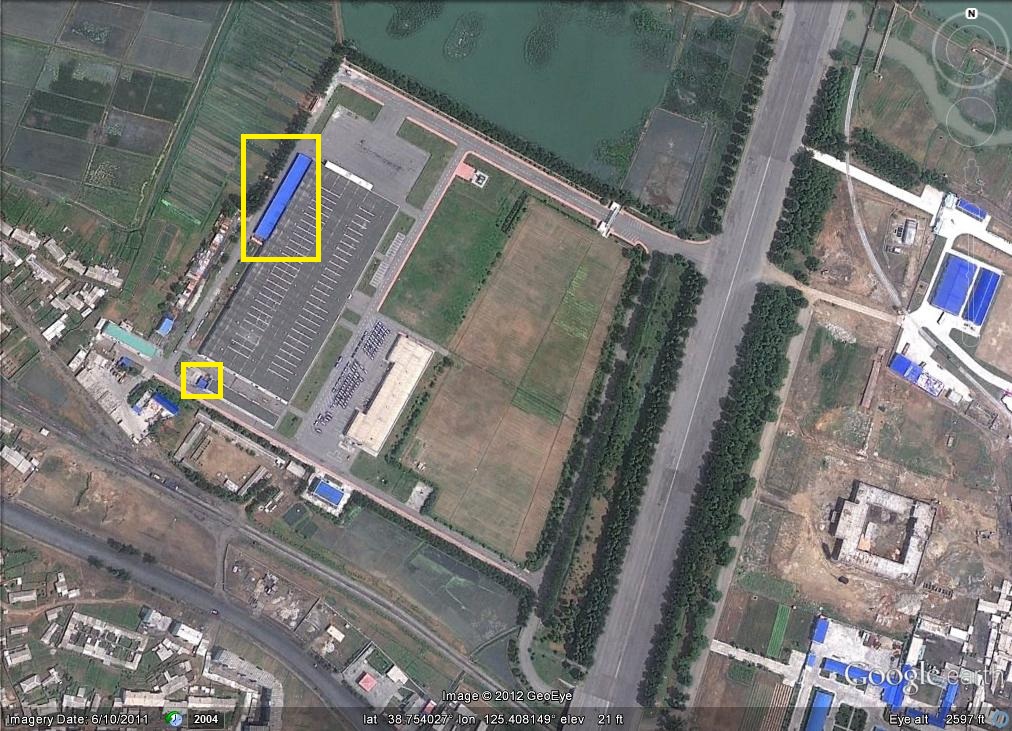
Pictured Above (Google Earth): Pyeonghwa Motors Factory in Nampho. Recent additions highlighted in Yellow.

UPDATE 1 (2013-1-22): In a later interview, the head of Pyeonghwa Motors revealed more information on his compan’y relinquishment of Pyeonghwa Motors, and described their future ambitions.

ORIGINAL POST (2012-12-3): According to Yonhap (via Korea Times):

The source said, “As far as I know, Pyeonghwa Motors is seeking to sell its factory in Nampo for about US$20 million in order to end its auto business.”

“The (South Korean) president of the auto firm appears to be eyeing the distribution sector” in North Korea, an official at the foundation said, adding the president may move to a new industry after liquidating the auto business. “But nothing has been determined so far,” the official said.

Pyeonghwa Motors president Park Sang-Kwon is widely expected to hold discussions with the North over the business shift during a North Korean visit scheduled for mid-December, to mark the first anniversary of the death of late North Korean leader Kim Jong-il, who died on Dec. 17.

According to the Wall Street Journal:

The North Korean government is a 30% partner in the car manufacturer.

A unit from the church’s business arm spent about $55 million to build the Pyeonghwa factory in Nampo, a port city on North Korea’s west coast about an hour or so outside of the capital Pyongyang. After the factory was completed in 2002, workers there completed partially built cars, in a form called knockdown kits, that were imported from manufacturers in Italy and China.

But the company appears to have rarely been profitable. In 2009, the firm earned about $700,000 from the sale of 650 cars. About $500,000 of that was remitted to its parent operation in South Korea. The South Korean government noted then that it was the first time a South Korea-based company repatriated profits from North Korea.

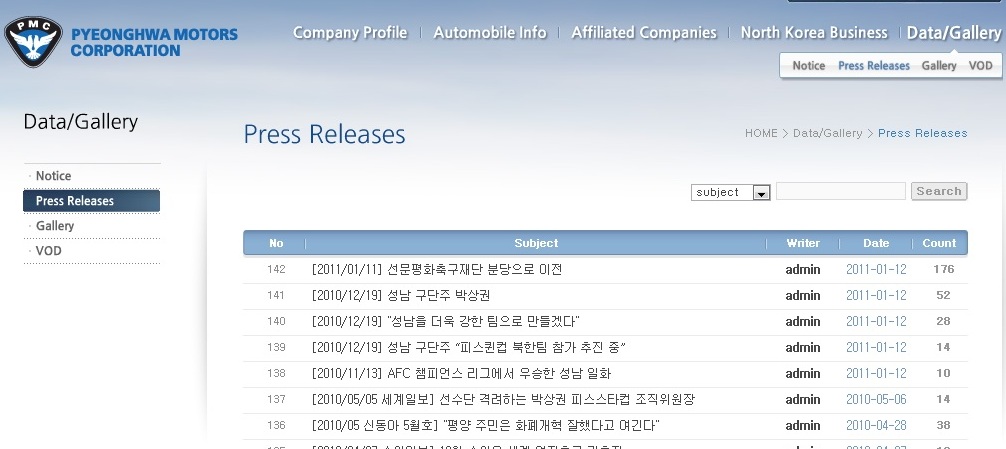
The Pyeonghwa Motors web page does not contain any information on this development.  You can view the web page here (english). The last published press release was on 2011-1-11:

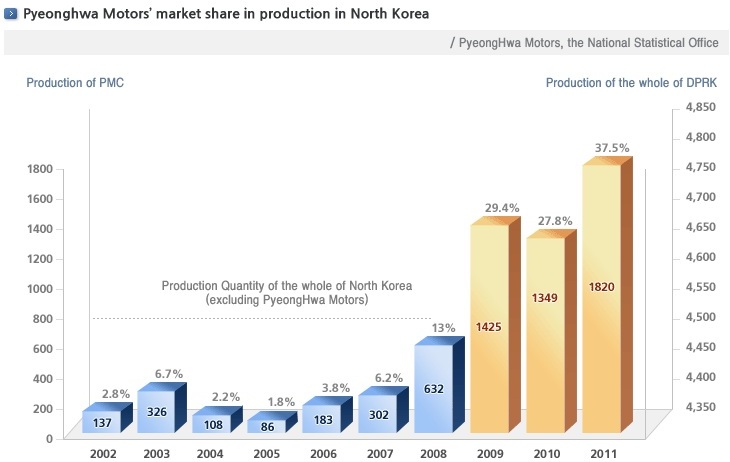
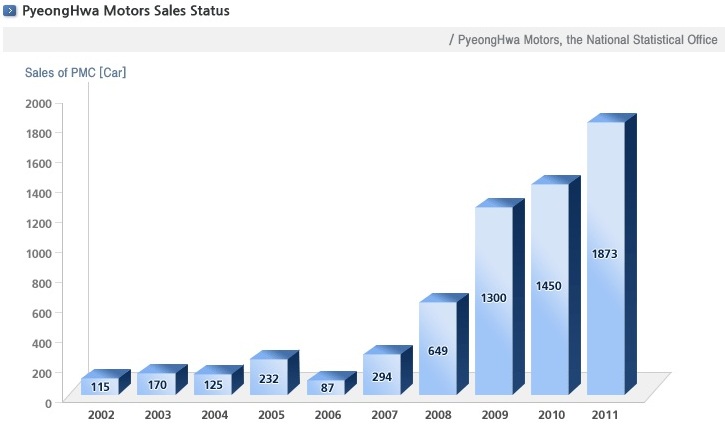
The web page does have production and sales data (if you choose to believe it):

No revenue or profit numbers are given on the web page, but it does mention that the factory’s capacity is 10,000 units per year. If these numbers are correct, in 2011 (the most productive year in terms of output) the factory was only running at approximately 19% capacity.

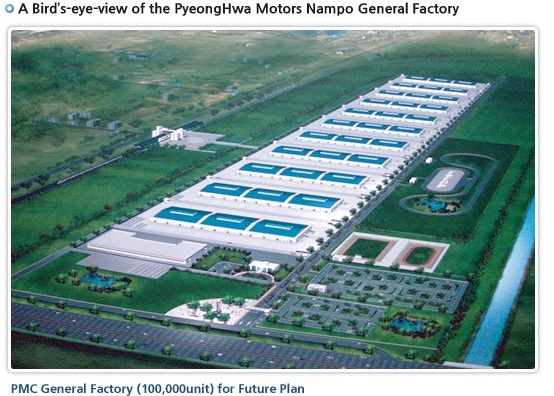
The Pyeonghwa Motors web page also offers a grand vision of the factory’s future (100,000 unit capacity):

However, as Google Earth satellite imagery shows, this plan has yet to come to fruition.

Previous posts on Pyeonghwa Motors here.

Read the full stories here:
Unification Church to wind up auto venture in NK
Yonhap (via Korea Times)
2012-11-28

End of the Road for North Korean Auto Maker?
Wall Street Journal Korea Real Time
Evan Ramstad
2012-11-27

Share

Kaesong Data

Tuesday, November 27th, 2012

Stephan Haggard posts some economic data from the Kaesong Industrial Zone. I repost most of it here for archival purposes:

According to the MOU, the average monthly wage at KIC has reached $128.3 as of the first half of 2012. This marks a steady increase from $68.1 in 2006, $71.0 in 2007, $74.1 in 2008, $80.3 in 2009, $93.7 in 2010, $109.3 in 2011. One source of the increase is a built-in escalator clause on the minimum wage payment, which started at $50 and has increased 5% a year over the last six years. But that only gets you to about $67 for this year.

The remainder of the observed increase is apparently the result of additional payments for overtime, which has been rising dramatically. Average weekly working hours were already 55.2 hours in 2006 but now stand at 61.6 in 2012 (up to July). If we knew that these additional hours were the result of the free choices of hard-working, upwardly mobile workers we would still probably find it a little excessive. But of course, the advantages of working in Kaesong are such that North Korean authorities have absolute power to hire and fire at will. There is no way of knowing whether workers would choose this regimen if they were organized or not.

But the story is much worse, of course, because we don’t ultimately know what share of these wage payments actually end up in the hands of the workers in the complex. Wages are paid in U.S. dollars to the North Korean authorities by the South Korean companies operating in the complex. 45% of the wage bill–15% for “social security” and 30% for “socio-cultural policy entitlements”–flows into the regime’s coffer, while the remaining 55% is supposedly given to the workers in either DPRK won or coupons.

But not so fast. A crucial question is the exchange rate at which workers are paid and the value of the “coupons” they receive. We hardly need to state the obvious: North Korean workers are not getting paid the won equivalent of their dollar salaries at anything resembling the shadow-market exchange rate that reflects actual scarcities. At least in the Yonhap report, the MOU makes no mention of what the real dollar equivalent of won payments are using a realistic exchange rate. But given the country’s high inflation and rapid depreciation of the exchange rate—see my colleague Marc Noland on this—the dollar value of what North Korean workers actually receive could be only a small fraction—even a very small fraction—of the stated dollar wage .

Why has Kaesong stayed open? The answer lies in a pretty straightforward political economy calculus on both sides. For the South, Kaesong is industrial policy for labor-intensive firms. For North Korea, it is a cash cow that even hardliners have been loath to push the way of the Mt. Kumgang project. Since 2004, total wage payments for North Korean workers in the KIC has totaled $245.7 million, rising from $380,000 in 2004 (the first year of operation) to $61.76 million in 2011 and $45.93 million in the first half of 2012. For Pyongyang, even hardliners can see that this is a no-brainer.

Share

DPRK ships missile parts to Syria

Wednesday, November 14th, 2012

According to the Korea Herald:

A shipment of graphite cylinders usable in a missile program and suspected to have come from North Korea was found in May aboard a Chinese ship en route to Syria in what appears to have been a violation of U.N. sanctions, diplomats said Tuesday.

South Korean officials seized the shipment of 445 graphite cylinders, which had been declared as lead piping, from a Chinese vessel called the Xin Yan Tai, U.N. Security Council diplomats told Reuters on condition of anonymity.

South Korean authorities stopped the ship at the South Korean port of Busan, the envoys said, adding that the cylinders were intended for a Syrian company called Electric Parts.

South Korean officials informed the Security Council’s North Korea sanctions committee about the seizure on Oct. 24, the envoys said, adding that China had offered to help investigate the circumstances surrounding the incident.

“It appears the cylinders were intended for Syria’s missile program,” a diplomat said.

“China assured us they will investigate what looks like a violation of U.N. sanctions.” Diplomats said the graphite cylinders appeared to be consistent with material usable in a ballistic missile program and that South Korea would investigate the case with China.

The shipment to Syria was arranged by a North Korean trading company, diplomats said. One diplomat said the Syrian company that was to have received the cylinders may be a subsidiary of the North Korean trading firm.

North Korea is barred from importing or exporting nuclear and missile technology under U.N. Security Council sanctions imposed on Pyongyang because of its nuclear tests in 2006 and 2009.

Read previous posts about the DPRK and Syria here.

Read the full story here:
Suspected N.K. missile parts seized en route to Syria
Korea Herald
2012-11-14

Share

Promoting New Technologies and Inventions at the National Exhibition

Thursday, September 27th, 2012

Institute for Far Eastern Studies (IFES)
2012-9-27

North Korea is promoting new inventions and technologies with potential to influence the economy and improve the daily lives of the people.

As an extension of that effort, North Korea hosted the 12th National Exhibition of Invention and New Technologies. The KCNA reported on September 19, this exhibition was a meaningful event for promoting intellectual products.

Kim Young-gun, the Commissioner of the National Science and Technology Council said, “One important purpose of the exhibition was to encourage and provide a place for agreements, contracts, and sales between consumers and exhibitors of intellectual products on display.”

He explained, “As a preparatory step, two weeks prior to the exhibition day, we gathered and distributed product and technology proposal information nationwide. We also try to meet the domestic demands and promote distribution of products throughout the country.”

He boasted that the exhibition was a success with over 1,000 orders taken for intellectual products. He also commented that wide varieties of new inventions, with new technologies, were on display and contracts were signed for technology and product development and new inventions.

North Korea established intellectual product regulations with the intention to create an environment favorable for intellectual product distribution and to follow the current trend in science and technology of the international community. North Korea also has a patent and technical literature archives in operation.

North Korea emphasized that this exhibition well displayed the strength and wisdom of the North Korean people in the country’s attempt to rise as a science and technology powerhouse.

North Korea has filed two cases of international patents through the World Intellectual Property Organization (WIPO) this year. WIPO has confirmed that one of the patents filed this April was a cast iron welding rod structure used for industrial material while the other patent was still in the filing process and thus could not be disclosed to the public.

North Korea submitted three patent filings in 2007, seven in 2008, and four in 2011.

North Korea became a member of WIPO in 1974 and joined the WIPO Patent Cooperation Treaty (PCT) in 1980.

Share

Friday Fun: The DPRK’s anti-trauma toothpaste

Friday, September 7th, 2012

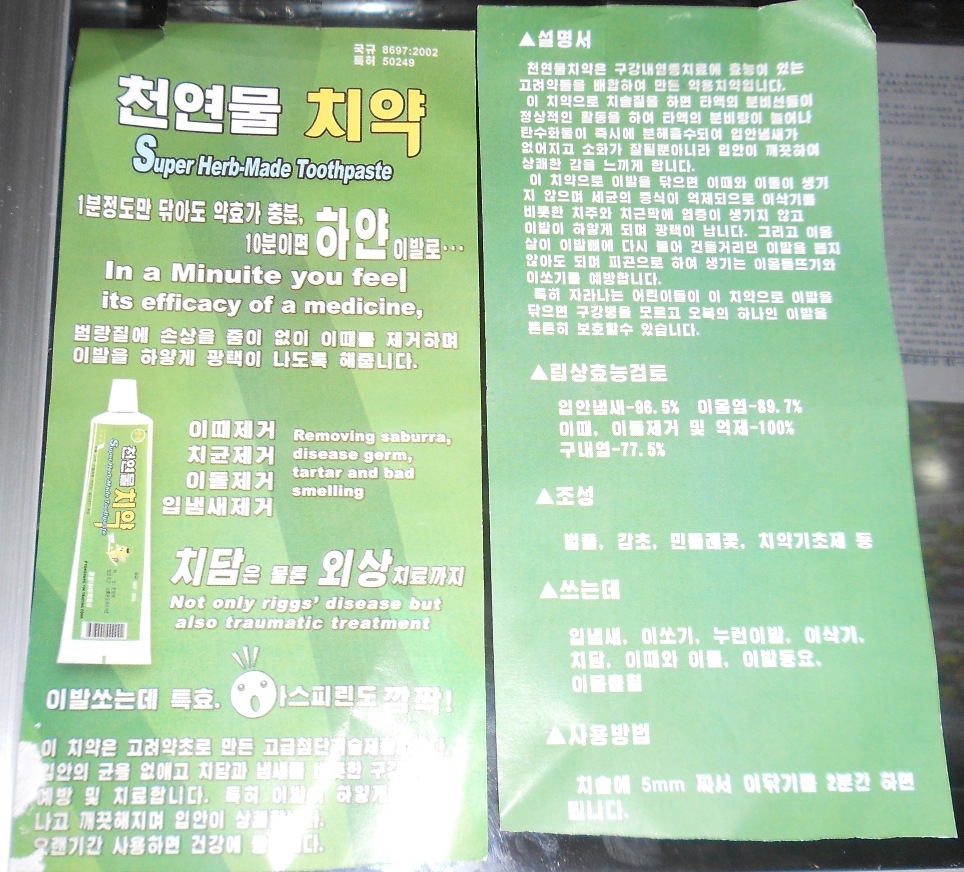
A reader sends in the marketing material for a new toothpaste on offer in the DPRK:

According to the label this toothpaste is quite innovative:

“Super herb-made toothpaste”

“In a minuite you feel its efficacy as at medicine.”

“It removes saburra, disease germ, tartar (?) and bad smell”

“96.5% effective at removing bad breath”

“Not only riggs´ disease but also traumatic treatment”

Feeling traumatized? Reach for this toothpaste!

If anyone can determine the active ingredient or name of the manufacturing company/factory on the label, please let me know.

Share

Kaesong production increases in first half of 2012

Wednesday, August 22nd, 2012

Yonhap reports that the Kaesong Industrial Zone has experienced growth in both the nominal dollar value of its output (I do not know what exchange rate is used to determine the dollar value for accounting and reporting purposes) and the number of employed North Korean workers.

According to Yonhap:

Output in North Korea’s Kaesong industrial park jumped 23 percent in the first half of this year from a year earlier as more North Korean laborers worked at the South-North joint industrial project, Seoul said Tuesday.

The value of products manufactured at the industrial zone in the North Korean border city amounted to US$236.08 million during the January-June period of this year, compared with $192.01 million for the same period last year, according to the Unification Ministry, which handles inter-Korean issues.

The Kaesong Industrial Complex’s monthly production value surpassed the $40-million level for the first time in March before nearing $43 million in both May and June, according to the ministry.

The total number of North Korean workers in the Kaesong park stood at 51,310 as of the end of June after touching the 50,000-level in January. The number for January last year was 46,194, the ministry said.

Mentioned before on this web page, but nowhere else in English as far as I have seen, is the notion of foreign exchange risk built into the procedures that govern the Kaesong Industrial Complex.  The exchange rate risk stems from the fact that costs (payments made to the North Koreans) are denominated in US dollars whereas revenues (the output produced in Kaesong sold in South Korea) are denominated in South Korean won.  This means that if the dollar was to unexpectedly appreciate against the South Korean won, firms in the Kaesong Zone would find themselves in a bind with prices paid for inputs rising relative to the revenues received from sales. I am not sure what contingencies the architects of the Kaesong Zone have built in preparation for this scenario so if you seen anything about it, please let me know.

Previous posts on the Kaesong Industrial Zone here.

Read the full story here:
Kaesong industrial park’s output up 23 pct in H1
Yonhap
2012-8-21

Share

Kaesong Industrial Complex: Accumulative production output exceeds US$ 1.7 b

Friday, August 3rd, 2012

Institute for Far Eastern Studies (IFES)
2012-8-2

Kaesong Industrial Complex (KIC) has recorded 1.7 billion USD in accumulative production output as of May this year. The first phase construction of KIC consisting of some 3.3 square meters was completed in July 2006.

According to a report submitted to the National Assembly on July 25, the Ministry of Unification (MOU) specified that, out of the 123 companies in KIC, there were 51,452 North Korean employees (as of May 2012) and the accumulative export reached 1.21 billion USD out of the accumulative production output.

Despite the severed inter-Korean ties from the May 24 sanctions of 2010, the KIC continued to operate while most economic cooperation, social and cultural exchanges and humanitarian aid were halted.

The report also included MOU’s pledge to continue to support for stable development of KIC consisting of building fire stations and emergency medical facility and road repairs, among other measures.

Currently, there are water purification and supply plant (30,000 ton/day), waste water treatment plant (15,000 ton/day), waste landfill (60,000 ㎥), and waste incineration plants (12,000 ton/day) in operation and health and safety facilities such as police and fire stations, Green Doctors Hospitals are in the vicinity. Power is provided by South Korea with 100,000 kilowatts capacity power supply system.

In addition, MOU announced that it will continue to coordinate with North Korea to improve transportation, communication and customs system at the next meeting, and engage in negotiation to solve other issues including improvement of personal safety and labor shortages.

MOU also claimed it is making efforts to obtain the “Made in (South) Korea” labels for the products made in KIC for FTAs (Free Trade Agreement) with the EU, United States, and China. MOU officials are also a part of the South Korean FTA negotiation team.

Currently, the top agenda for the KIC is housing for North Korean employees. Unification Minister Ryu Woo-ik stated, “While I understand the positions of both North and the South, in which South Korean companies are in need of more labor and North Korea wants for more employment opportunities, dormitory construction for employees is a large-scale project similar to building a new town. Therefore, it must be coordinated carefully with North Korea to find the best solution.”

Share

Bank of Korea publishes 2011 DPRK economic estimates

Monday, July 23rd, 2012

A couple of weeks ago, the South Korean Central Bank, the Bank of Korea, published its estimate of the size and composition of the North Korean economy in 2011. You can read the finings (PDF) here. I have posted this and many other estimates of the North Korean economy on my “DPRK economic statistics page“.

Here is coverage of the report in Bloomberg/Business Week:

Gross domestic product in the communist nation increased 0.8 percent in 2011 after a 0.5 percent decline in 2010, according to an estimate published by the Bank of Korea in Seoul. The nation’s economy has contracted during four of the last six years, the bank’s data show.

“The manufacturing sector declined, but the agricultural industry enjoyed better weather and more use of fertilizer,” the Bank of Korea said in an e-mailed statement.

North Korea is projected to keep growing under the new leader as its economic ties with China and Russia develop.

“Mineral exports to China and dollars brought in by North Korean workers sent to China and Russia would have driven the country’s GDP growth,” said Koh Yu Hwan, a professor of North Korean studies at Dongguk University in Seoul. “North Korea is expected to be economically stronger under Kim Jong Un as it continues to increase transactions with its allies.”

Kim Jong Un has waged a nationwide campaign to “bring about a turn in agriculture” and increase crop yields, according to a June 7 report carried by the official Korean Central News Agency. North Korea’s agriculture and fisheries sector expanded 5.3 percent in 2011 while manufacturing fell 3 percent, according to the BOK report.

North Korea’s nominal GDP totaled 32 trillion won ($28 billion) in 2011, compared with South Korea’s 1,237 trillion won, the BOK said. North Korea’s per capita income was 1.33 million won while South Korea’s was 25 million won, according to its estimates.

After adjusting for inflation, North Korea’s economy remained smaller at the end of 2011 than it had been in 2008, according to the Bank of Korea.

Here is more from Strategy Page:

The North Korean economy is undergoing changes. In fact, last year there was actually some growth, with GDP increasing .8 percent, versus a .5 percent decline in 2010. The North Korea GDP (about $28 billion, compared to $1,100 billion for South Korea). Thus even with a larger population, the average South Korean has 20 times more income as their northern counterparts. Moreover, income distribution is quite different in the north, where about two-thirds of the population is very poor and very hungry. The other third contains the well-fed ruling elite (whose lavish country estates can be seen via commercial satellite photos) and their supporters (secret police, military officers, bureaucrats) plus the semi-legal merchant class that has been allowed to develop over the last six years to avoid total economic collapse.
The economic decline in 2010, was the result of agricultural (floods) and industrial (massive power shortages) failure. But China came to the rescue by offering to set up mining operations in North Korea and buy billions of dollars-worth of minerals each year. China rebuilt railroads to handle the increased traffic from the remote North Korean mines. In addition, China offered legal jobs for North Koreans in China. The only catch was that the North Korean government took most of the pay. Similar deals have long been used with Russia but China offered far more jobs under more comfortable conditions. Competition for these jobs is fierce in North Korea and the government selects those deemed least likely to run away.

Last year North Korea bought more fertilizer for farmers and the weather was pretty good. That, plus the growing income from Chinese run mines and North Korean workers in China made up for the continuing declines in manufacturing. A good year on the farm is a big deal in North Korea, where farming and fishing are 23 percent of the economy (compared to under three percent in the south). But this year all of Korea is suffering from a record-breaking drought. This is hurting the north a lot more than the south. Although the monsoon (jangma) rains recenly arrived, a month late, the damage was already done in the north. Three months of very hot and very dry weather has seriously damaged crops. The rains will save some of them but at least a fifth of this year’s crops will be lost.

Share

KCNA announces new printing joint venture company

Tuesday, June 26th, 2012


Pictured above: A KCNA image of the factory and the view from Google Earth (39.043378°, 125.728149°)

According to KCNA (2012-6-25):

Pyongyang, June 25 (KCNA) — The Printing Factory of Tongbaek Printing Joint Venture Company [동백인쇄합영공장] under the Foreign Languages Publishing House was commissioned with due ceremony on Monday.

The factory was jointly established by the Foreign Languages Publishing House of the DPRK and the Oriental Yongli Hong Kong Int’l Investment Co., Ltd. and Jiangsu Zhongcai Printing Co., Ltd. of China. The factory will produce and sell varieties of printed materials and trade marks.

Attending the ceremony were Ri Kwang Gun, chairman of the Commission for Joint Venture and Investment, officials concerned and employees of the factory, Huang Junjie, vice mayor of Danyang City, Jiangsu Province of China, personages of the two Chinese companies, Wu Shiguang, councilor in charge of culture, and officials of the Chinese embassy here.

Choe Kyong Guk, director and editor-in-chief of the Foreign Languages Publishing House, addressing the ceremony, said that technicians and builders of the two countries built the factory in a short span of time.

He expressed belief that the factory would make a positive contribution to meeting the interests of the peoples of the two countries.

Jiao Xiaoping, manager of the Tongbaek Printing Joint Venture Company, in a congratulatory speech referred to the process of the construction of the factory, stressing the need to operate the company well.

At the end of the ceremony, the participants planted trees and looked round the production processes.

A reception was given on the same day.

Share

Ari Sports Factory

Monday, June 11th, 2012

The Hankyoreh has published an interesting about a inter-Korean economic project in Dandong, China.

According to the article:

Taking its name from the traditional song “Arirang,” Ari Sports was established in Nov. 2011 with a 500 million won investment from the city of Incheon and 23 workers from North Korea. It is managed not by a North or South Korean organization, but by China’s Yunnan Xiguang Trade.

The football sneaker and sports clothing production plant was originally planned for Pyongyang’s Sadong District. Efforts began in 2008, and the building was nearly complete when the May 24 measures were passed in 2010 and it had to be abandoned. The factory in Dandong is a temporary structure erected in its stead.

Inter-Korean Athletic Exchange Association standing committee chair Kim Gyeong-seong said, “It’s frustrating not to be able to use the good land and facilities we had in Pyongyang.”

“I hope we are soon able to produce and sell soccer shoes and clothes in Pyongyang,” Kim added.

Song said, “Things are difficult right now between North and South Korea, but if we all work together we can overcome it.”

He added that the company was a “small but meaningful project taking place at a time when economic cooperation has been shut off.”

The company has received orders for three thousand pairs of soccer shoes as of May. It currently plans to produce and sell two to three thousand pairs a month. To achieve this, it is organizing a football contest for working people nationwide at the first Incheon Peace Cup event to commemorate the June 15 Summit on June 16 and 17.

I have never heard of this project and I have been unable locate any other articles on the factory. Despite its relative obscurity, however, the North Korean workers know how to deal with the foreign press (they stay on message):

On June 9, the company was visited by around fifty participants in the Incheon-Dandong-Hankyoreh West Sea Cooperation Forum, including Incheon Mayor Song Young-gil and Hankyoreh Foundation for Reunification and Culture chairperson and former Unification Minister Im Dong-won. Located in a farming village on the outskirts of Dandong in China’s Liaoning Province, Ari Sports has 1,600 square meters of floor space on a plot of land also measuring 1,600 square meters.

North Korean workers expressed their frustration with the inability of economic cooperation projects to move forward due to the state of inter-Korean relations. Workers Kwon Ok-kyong, Kim Kum-ju, and Kim Myong-hwa said they wished production and sales could proceed smoothly.

When asked about working at the company, Cho Sang-yon said, “Well, it’s not as good as working in my home country.”

Pak Hyok-nam said, “I’d like to see bigger economic cooperation projects between North and South.”

I have been unable to learn anything else at all about this project.  If you are able to find company logos, web page, photos, or even factory locations on Google Earth, please let me know.

Read the full story here:
Factory in China continues producing soccer shoes in spite of frosty relations
Hankyoreh
Kim Kyu-won
2012-6-11

Share

An affiliate of 38 North