Chinese tourists take day-long bus tour of Hoeryong

May 27th, 2014

According to China Daily:

A one-day bus tour from the northeast China border city of Longjing to Hoeryong in the Democratic People’s Republic of Korea (DPRK) was launched on Tuesday.

The opening of the route will enable Chinese tourists to arrive in Hoeryong directly, without transferring to a DPRK vehicle at the port, according to Wang Jing, a government worker from Longjing in Jilin Province.

“This will save tourists a lot of time and facilitate the whole journey,” Wang said.

A total of 134 tourists joined the tour on the first day of the route opening.

The trip costs 580 yuan (94 US dollars) per tourist. Tourists can visit historical sites on the DPRK side, taste Korean delicacies and enjoy performances by DPRK artists.

China and the DPRK have in recent years witnessed booming border tourism on the back of multiple travel schemes aimed at boosting the regional economy.

The DPRK has opened several cities for group tours from China, including Rason, Namyang, Chongjin and Mount Kumgang. About 10,000 tourists from Yanbian, also in Jilin, visit the DPRK annually.

The process for for preparing Hoeryong for Chinese tourists has been underway for several years. Hoeryong’s “Food Avenue” was completed in 2010. Chinese tourists started showing up in 2012. Western tourists started showing up in 2013.

Just a few days ago, the Chinese and DPRK launched day-long bicycle tours of Namyang. Previously, Chinese tourists could only take day tours of Sinuiju (an experience that is now available to western tourists) and Rason.

UPDATE: Here is coverage in KCNA (2014-6-4):

One-day Bus Tour of Hoeryong by Chinese People

Pyongyang, June 3 (KCNA) — Chinese people made the first one-day bus tour of Hoeryong City, North Hamgyong Province, the DPRK.

After the tour, the Chinese tourists told that they were deeply impressed by their visit to the DPRK.
Jin Bo (male: 55), deputy director of the Foreign Affairs Office in Yanbian Korean Nationality Autonomous

Prefecture, told as follows:

The one-day tour from Longjin to Hoeryong, China by Chinese bus helped the tourists deepen their friendly feelings towards the DPRK.

The tourism course was very excellent. Many tourists said that they felt as if they were in Pyongyang.

I think one-day tour of Hoeryong will be one of major attractions for Chinese in the near future.

Sha Chunxia (female: 44), a staff of Yanbian News, said:

I was deeply moved to see an art performance given by kindergarteners.

It was hardly believable that the five-or six-year old children could give such an excellent performance.

I have never thought of giving art education to my daughter.

The educational system in the DPRK is very admirable.

I want my daughter to be educated under such excellent system.

Later, I will come together with my daughter to see the performance.

Read the full story here:
China, DPRK border cities open one-day bus tour
China Daily
2014-5-27

Share

DPRK imports digital televisions

May 25th, 2014

According to the Korea Times:

North Korea’s imports of digital television sets from China have more than quadrupled this year, a South Korean trade group said Sunday, amid reports that the country is moving to introduce digital TV broadcasting.

In the first four months of the year, China shipped digital TVs amounting to some US$17.66 million to North Korea, up 338 percent from $4.02 million during the same period last year, according to the Korea International Trade Association.

The figure is the fifth-largest amount for any single item shipped from China to North Korea in the January-April period. Gasoline topped the list.

The North earlier said on a state-run website that it was moving to introduce digital TV broadcasting. The country also asked the U.N. International Telecommunication Union in 2011 for assistance in switching from an analog to a digital broadcasting system.

“The move by the North Korean government to switch to a digital broadcasting system appears to be an effort to win greater public support by showing that the people’s lives are improving,” said Cho Bong-hyun, an analyst at the IBK Economic Research Institute.

Read the full story here:
Trade report says N. Korea importing large number of digital TVs
Korea Times
2014-5-25

Share

China to build new bridge linking Tumen and Namyang

May 23rd, 2014

According to the China Daily:

Construction on a new bridge over a river separating China and the Democratic People’s Republic of Korea (DPRK) has started, authorities of northeast China’s Jilin Province said on Tuesday.

With a total investment of 137 million yuan (21.93 million US dollars), the 804.7-meter new Tumen River bridge is expected to open in 2015 or 2016 as a new route for bilateral trade, authorities said.

The old Tumen River bridge has not been repaired for many years and is facing safety risks. However, the old bridge will not be dismantled and will be kept as a scenic spot.

Tumen City is linked to the DPRK by both highway and railway.

According to Yonhap:

China will begin constructing a new major bridge to North Korea over the Tumen river, China’s state media reported Friday, in the latest sign that economic relations between the two nations remain stable despite the North’s nuclear ambition.

The 804-meter-long, 23-meter-wide bridge will link the Chinese border town of Tumen to North Korea’s northeastern coastal city of Chongjin, the Yanbian Daily newspaper reported, citing the city government of Tumen.

China’s central government recently gave a final approval to build the bridge, which is entirely funded by China at a cost of 137 million yuan (US$21.9 million), the report said.

The newspaper did not specify when the construction would start but that it would “soon be implemented.”

China has been building another major bridge connecting its border city of Dandong to the North Korean city of Sinuiju across the Amnok river, called as the Yalu River in China.

North Korea’s series of provocations, including last year’s third nuclear test, have strained political ties with its last-remaining ally, China. Still, many analysts believe that Beijing will not put strong pressure on Pyongyang due to the risk of aggravating the current situation.

According to AFP:

The bridge will replace an older structure, built in 1938, which will be turned into a tourist attraction, Xinhua said. There are several other rail and road bridges linking the two countries.

Chinese tourists recently started crossing into Namyang for day trips on bicycles.

Read the full stories here:
China to build new cross-border bridge to N. Korea: report
Yonhap
2014-5-23

New bridge to link China, DPRK
China Daily
2014-5-27

Share

“Miraewon” Electronic Libraries to be constructed across North Korea

May 22nd, 2014

Institute for Far Eastern Studies (IFES)
2014-5-22

North Korea has been working to construct “Miraewon” – electronic libraries packed with cutting edge equipment and the latest information technology – in all counties and provinces across the country.

The Rodong Sinmun introduced the recently completed Jonchon County Miraewon in a May 12, 2014 article saying, “Many workers, students, and young people are already visiting the Miraewon, which has been magnificently renovated into an electronic library to meet the demands of the information-economy age.” The article praised the Miraewon, noting that “In just a short period of two months, the entire interior and exterior has completely changed; the library has been updated with dozens of the newest computers, audio-visual equipment, networks, lighting and various other amenities.”

Prior to this, the Korean Central News Agency (KCNA) reported on May 9th, “There have been many new businesses sprouting up all over the nation’s various counties and provinces with the goal of constructing these modern Miraewon.” It has also been revealed that each center is equipped with “e-libraries, computer study rooms, rooms for scientific and technical knowledge, tele-education rooms, etc.” According to the KCNA, the Miraewon will act as a “base” for scientific technology and information, contributing directly to the nation’s economic development and the “cultural and emotional life of the people.”

Specifically, the KCNA emphasized the establishment of a “data service system” at the Miraewon, which “allows readers to access modern scientific and technological data and [the] latest achievements in various fields [at] any time.” It appears that the name “Miraewon” was created by the First Chairman of the National Defense Commission, Kim Jong Un.

This was first seen in a Korean Central Broadcasting Committee (KCBC) report from February 2014: “Marshal Kim Jong Un has extended his love and graciousness by bestowing the name ‘Changsong County Miraewon’ unto a newly renovated library (in North Phyongan Province).”

First Chairman Kim Jong Un stressed the importance of scientific technology in his New Year’s Address, saying that it is the “impetus that drives the construction of a great nation.” He also emphasized the need for all executives and workers alike to strive to master modern scientific technology, calling on the nation to have a “science and technology-focused spirit” and setting the goal for all citizens to become technologically capable.

Meanwhile, North Korea is also concentrating efforts on developing energy-saving technology which will ultimately lead to the end of the nation’s chronic energy shortage. North Korean state media emphasized the need to address the energy problem, saying, “The most important thing in creating a great Socialist nation is the urgent demand of electricity and energy. In a Socialist economy, saving ten percent more energy would have a much larger effect than increasing production by ten percent, and would also drastically cut costs.”

In other articles, the Rodong Sinmun introduced several examples of newly developed energy-saving technology in detail. Such technology includes the “High Performance Far-Infrared Radiator (FIR),” which reduces energy consumption in heating, and the “High Frequency Impulse Electroseparator,” which increases the efficiency of the electricity used in extracting minerals. Furthermore, the Rodong Sinmun introduced “Distributed Power Systems,” which focuses on the construction of several smaller power plants compared to having just a few large-scale plants. According to the Rodong Sinmun, this method is not only more efficient, but more eco-friendly as well.

First Chairman of the National Defense Commission Kim Jong Un spoke in his 2014 New Year’s Address, “All members of society must strive to save each watt of electricity, each gram of coal, and each drop of water,” emphasizing North Korea’s devotion to reducing consumption of energy and natural resources. This movement to develop energy saving technology and increase energy efficiency is related to the national pursuit of economic “self-rehabilitation” in the midst of sanctions imposed by the international community.

Share

DPRK – China Trade 2012-2013 comparison

May 22nd, 2014

UPDATE: Here is the original KOTRA report.

ORIGINAL POST: According to Yonhap:

Despite years of international sanctions, North Korea’s overall trade volume reached a new annual high in 2013 due largely to growing shipments to and from its closest ally, China, a South Korean trade agency said Thursday.

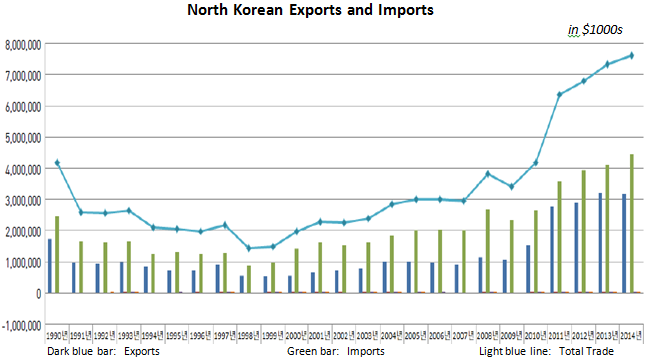
The North’s overall trade volume came to US$7.34 billion in 2013, up 7.8 percent from the previous year, according to the state-run Korea Trade-Investment Promotion Agency (KOTRA).

“It is the highest amount since KOTRA began compiling data on North Korea’s annual trade volumes in 1990,” it said in a press release.

The country’s exports jumped 11.7 percent on-year to $3.22 billion, with imports growing 5 percent to $4.12 billion.

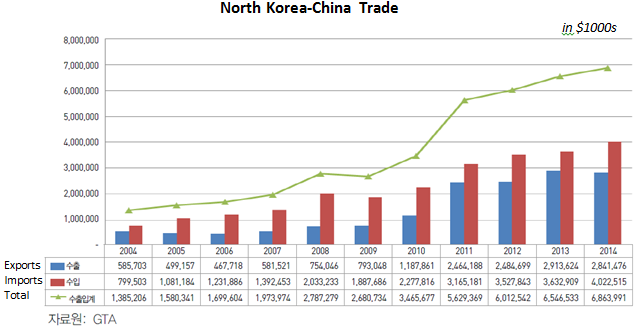
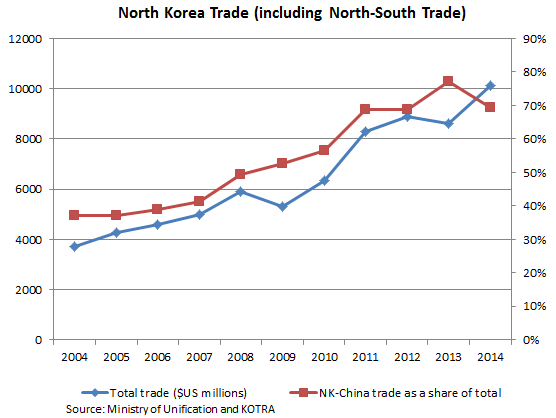
Bilateral trade volume between North Korea and China came to $6.54 billion, accounting for 89.1 percent of the North’s overall trade in 2013.

“North Korea’s dependence on China for trade has been increasing steadily since 2005 when its trade volume with China exceeded 50 percent of its overall trade,” KOTRA said.

“In addition, it shows China’s pledge to tighten its customs check on shipments to and from North Korea, in protest of North Korea’s missile launch in December 2012 and a nuclear test in February 2013, did not have any significant effect on North Korea-China trade,” it added.

The large increase in North Korea’s overall exports was attributed to growing shipments of fuel, such as coal, which surged 14.9 percent on-year to $1.43 billion, accounting for 44.4 percent of the country’s total exports.

Out of all energy exports, 97.2 percent were shipped to China.

Russia, another North Korean ally, was the country’s second-largest trading partner in 2013, with bilateral trade volume spiking 37.3 percent to $104 million.

Note, this does not contain South Korea data, which for purely political reasons is counted as inter-Korean (domestic) trade. According to a KIEP presentation by Yoon Deok-ryong, DPRK-ROK trade in 2013 amounted to $1.14b.

Here is what the Institute for Far Eastern Studies had to say:

North Korean Foreign Trade Volume Posts Record High of USD 7.3 Billion in 2013

According to a recent report by the Korea Trade Investment Promotion Agency (KOTRA), foreign trade in North Korea (excluding inter-Korean trade) reached a record high of USD 7.3 billion in 2013, up 7.8 percent from the previous year. The report, released on May 22, 2014, marks the fourth year since South Korea enacted the “May 24 Measures,” suspending all inter-Korean trade and economic cooperation outside of the Kaesong Industrial Complex. KOTRA, a South Korean state-run agency which analyzes North Korea’s foreign trade volume, noted that last year’s figures were the highest ever since they began recording data in 1990.

The report shows that North Korean exports and imports in 2013 both increased compared to the previous year, up 11.7 percent (totaling USD 3.2 billion) and 5 percent (totaling USD 4.1 billion), respectively. KOTRA’s data analysis says that North Korean exports consist mostly of “mineral resources such as coal, iron ore, copper and aluminum,” and noted that “the recent boom of contract manufacturing (toll processing) businesses has led to an increase in textile and clothing exports.” Imports, such as electricity, transport vehicles and grains also saw increases, but North Korea was still able to cut their trade deficit by about USD 20 million, from 1 billion (2012) to 980 million (2013).

North Korea’s largest trading partner is China. The trade volume between the two allies reached a total of USD 6.5 billion in 2013, up 8.9 percent from the previous year. This accounts for 89.1 percent of all of North Korea’s foreign trade, showing increasing dependence on China. Despite Beijing’s partaking in international sanctions against North Korea, it appears to have had a little effect on the bilateral trade between the two nations.

North Korea’s other top trading partners behind China include Russia, India, Thailand and Singapore (in that order). In particular, foreign trade with Russia increased by 37.3 percent last year and totaled over USD 100 million (7 million in exports, 97 million in imports). KOTRA explained the sharp increase in Russian imports in the second half of 2013 was due to import of transport vehicles and machineries for the railway construction between the areas of Rajin and Hassan.

KOTRA’s research shows that while the trade with Japan has been nonexistent since 2009, the two nations recently have begun to engage in talks at the bureau-chief level. As expected, due to the economic sanctions imposed on North Korea, foreign trade with the United States remains limited to food, basic necessities, and humanitarian aid.

Coal, lignite and other mineral fuels are North Korea’s largest export products, accounting for 44.4 percent of total foreign exports. This figure increased by nearly 15 percent in 2013, reaching USD 1.4 billion. A staggering 97.2 percent of these mineral exports are sent to China. Other exports such as clothing and textiles saw a 33.5 percent increase from the previous year, totaling USD 520 million. Meanwhile, imports of crude and refined oil – North Korea’s largest import commodities – were recorded at USD 780 million in 2013, a 3.8 percent decrease compared to 2012. North Korea’s oil is imported almost exclusively from China at 94.5 percent.

Despite recent economic sanctions imposed by the international community, North Korea’s foreign trade volume has continued to rise over the last four years thanks to increases in coal, iron and other mineral exports to China. Furthermore, in order to diversify its foreign trade and reduce its trade dependence on China, North Korea likely will continue to further promote bilateral ties with Russia.

Here is coverage in Business Korea.

Aidan Foster-Carter offers this update in the Wall Street Journal’s Korea Real Time.

Nicholas Eberstadt offers analysis here.

Read the full story here:
N. Korea’s overall trade volume grows to record high in 2013
Yonhap
2014-5-22

Share

North East Asia Bank

May 16th, 2014

The North East Asia Bank has received a new headquarters building in downtown Pyongyang, next to the Changgwang Hotel:

NorthEastAsiaBank-2013-12-1

 Pictured Above (Google Earth, 2013-12-1): Pyongyang’s North East Asia Bank

The Ministry of Unification offers some details on the bank. I translated and altered their information to provide this information:

The ING-East Asia Bank was founded as a joint venture in December 1995 by Korean International Insurance Company(조선국제보험회사) [A subsidiary of the Korea National Insurance Corporation (조선민족보험총회사)] and ING of the Netherlands. The bank was established to to facilitate various financial transactions for foreign investors in the Rason SEZ. Disappointed in the North’s underdeveloped financial system, ING stepped out in 1999.  Korean International Insurance Company acquired  ING’s share and changed the Bank’s name to the North East Asia Bank (동북아시아은행).

According to Kim Kwang-jin, “Change in Foreign Currency System in North Korea and it’s Increasing Dependency on Hard Currency” (2008, p. 27):

 In June 11, 2000, Kim Jong il has personally gave his command to give the [North East Asia] Bank the power to manage funds of the Organization and Guidance Department’s administrative organs. 

The bank has not been featured in the North Korean media.

Share

Weekend fun: Pyongyang tilt shift

May 16th, 2014

It has been a long time since I did a “fun” post. Since there are so many North Korea bloggers and writers these days, it is hard to find as much unique material to highlight, or by the time you get around to it, 15 other North Korea bloggers and news organizations have already posted it… This post has been in my draft folder for ages, however, so I should probably just get it out there…

Miniature Pyongyang

Several photographers have been able to use a tilt-shift photograpy to create “miniature” pictures of the DPRK. I find them fascinating. Here are some of the pictures I have found online:

PY-tilt-shift-2014

Full size photos and others like it can be found here.

Here is a tilt-shift photo of the DMZ.

Here and here are two more great examples captured from the Juche Tower.

Here is a photo of the Juche Tower.

Here is one of the Kim Il-sung statue in Chongjin.

Share

Market prices stable despite lean period

May 16th, 2014

According to the Daily NK:

Rice prices in North Korea remain stable despite the arrival of the April-May “spring hardship period,” inside sources have conveyed to Daily NK.

Spring months are usually tough because food supplies run low as North Korea, with its relatively low level of external trade in foodstuffs, waits for the early domestic potato harvest at the end of June. This in turn impacts market rice prices; in May 2012, the price of a kilo of rice skyrocketed by 20% in a single month.

However, this year has been a good one. Sources convey that a kilo of rice is trading in Pyongyang, Sinuiju and Hyesan for 3700, 3850 and 3900 won respectively. This is consistent with preceding months, and below the 4000 won mark initially recorded last December.

The price of corn, often used as a cheap substitute by low-income households when rice gets expensive, is also showing a stable or downward trend. At 800-1000 won per kilo, it is 500 won less than it was in April.

Several factors are contributing to this relative stability, a Hyesan source contended. Firstly, work units on cooperative farms are bringing their stores of rice to market in bulk payment for resources for the planting season. Secondly, May has seen a small decrease in the exchange rate, and this has helped to keep the rice price down in terms of imports.

“It’s the spring planting season and work units have to purchase resources like diesel and fertilizer. People say that ‘rice is money,’ and now they’re selling rice they had stored from last year to purchasing farming products. This means there is enough rice in the markets and the price is stable,” the source said.

A Pyongyang-based source also reported stable market prices, as well as consistent state ration delivery in April.

“The authorities have been continually distributing rations and there is sufficient rice in the markets. More people are buying meat including pork because some laborers had a wage increase. The rice price could drop even further,” he assessed.

Nevertheless, experts in Seoul assert that rice prices could be negatively affected by current dry conditions in the country’s western breadbasket zones

Cho Bong Hyun of the IBK Economic Research Institute clarified to Daily NK, “The recent price stability in North Korea’s markets is because of continuous distribution since the release of military rice reserves last year. Expectations around this year’s output could also impact prices further down the line. Some will plan to store rice if they anticipate this year being a lean one, which will in turn drive up the rice price.”

Read the full story here:
Market Prices Stable Despite Lean Period
Daily NK
Lee Sang Yong
2014-05-16

Share

DPRK expected to produce 1.9 mln tons of rice in 2014

May 13th, 2014

According to Yonhap:

North Korea is expected to produce 1.9 million tons of rice in 2014, the same amount that the country is estimated to have produced last year, the U.N. food agency said on May 13.

The figure represents an increase from 2010, 2011 and 2012 when North Korea’s average rice production reached 1.7 million tons, the Food and Agriculture Organization said in a biannual global food report posted on its website.

The report said per capita rice consumption in North Korea is forecast to reach 67.8 kilograms this year, compared with 65.4 kg from a year earlier.

It also said North Korea is forecast to produce 2.3 million tons of maize this year, compared with 2.2 million tons in 2013.

Rice is a key staple food for both South and North Koreans, though North Koreans also rely on maize due to chronic food shortages.

The North has relied on international handouts since the late 1990s when it suffered a widespread famine that was estimated to have killed 2 million people.

I spent a good 15 minutes looking for the report (which was never cited by name–sloppy reporting). If the report is to be found on the UNFAO web page, they sure don’t make it easy for a curious person to find.

Read the full story here:
N. Korea expected to produce 1.9 mln tons of rice in 2014: U.N. food agency
Yonhap
2014-5-13

Share

Medical Science Conference & Women’s Health Initiative

May 12th, 2014

The Pyongyang Project is hosting an interesting conference in the DPRK. According to the organizers:

Overview

This mission seeks to develop educational contacts between foreign institutions and select DPRK universities, medical schools and hospitals. A visiting delegation of experts and academicians will provide interactive lectures for women’s health providers located at various sites in the DPRK. Delegate applications will also be considered from medical students and graduate students in the health professions. Themes for women’s health covered during this conference include:

• Reducing maternal mortality and neonatal death
• Improving GYN cancer screening and treatment (including breast cancer)
• Sharing new advances in treatment of miscarriage (and infertility)
• Updating community practice for routine wellness/health maintenance

Other themes, such as infectious disease, will also be covered if there is interest among delegates. While in the DPRK, delegates will interact with DPRK colleagues in a variety of contexts to discuss clinical questions concerning patient care. Evidence‐based research will be reviewed to discuss current best practice, as informed by international standards.

Program objectives are achieved across a range of settings inside the DPRK—either didactic lectures or less formal small group presentations. In addition, delegates will have opportunities to learn about women’s health issues in the DPRK, so the program facilitates a two‐way dialogue among all participants. This will be particularly beneficial to visiting doctors having questions regarding traditional Korean medicines, about which little is published outside the DPRK.

This program strongly encourages sustained academic partnerships between DPRK investigators and foreign colleagues on areas of shared research interest, and anticipates collaborative publications to follow in peerreview medical or scientific journals.

August 1st through August 10th, 2014.

There is a registration fee.

Learn more here (PDF)

Share

An affiliate of 38 North