Archive for the ‘Civil society’ Category

Logistics of filming in North Korea

Tuesday, April 8th, 2008

My friend Paul at Knife Tricks recently interviewed the producers of Crossing the Line about the logistics of filming in the DPRK.  Here are some excerpts:

Gordon and his crew brought their own equipment to North Korea because local film technology was not compatible with the needs of a modern documentary shoot. “As far as equipment goes, they film on 35mm, and we were filming on DigiBeta for the first two films and hi-def video for Crossing the Line,” says Gordon.

“I used standard Canon lenses,” notes Bennett. “When I needed to light, I used Kino Flos, but much of the film was shot with available light.” Gordon adds, “In North Korea, the electricity isn’t necessarily on, and when it’s on, it isn’t necessarily constant, so we tried to use available light wherever we could.” He carried batteries at all times and hooked into mains when possible.

In addition to Gordon, Bennett, soundman Stevie Haywood and co-producer Nicholas Bonner, the crew included one or two North Koreans assigned to the shoot by the Ministry of Culture. Gordon notes, “Your immediate suspicion is that they’re government plants — security people pretending to be film people. But the longer you work with people, you tend to find out what they are and what they’re not, and the people we worked with day by day were absolutely film people.”

“They basically took it upon themselves that they were going to work for us and get us the access that we wanted, whatever that took and whatever personal risks that took on their part,” he continues. “Had it all gone wrong, there would have been quite nasty consequences for everyone involved.”

The filmmaking process involved many nights of discussions with the North Koreans about access or other issues concerning the next day’s shooting. The topics to be discussed with Dresnok were provided to the North Koreans in advance, with the understanding that new topics would arise over the course of the interview. The minders occasionally reviewed the dailies. “There was never an occasion when they said, ‘No, you can’t shoot that,’” Bennett recalls. “There were lots of occasions where they’d hem and haw as to whether they wanted us to film something, and we shot it, and they had a look at it afterwards and said, ‘Yeah, it’s fine.’ You’re not always aware of what they’re looking for.”

“No footage was ever taken away from us,” adds Bennett. “We came away with everything we shot.”

The North Koreans had no hand in the edit, either. Gordon says the final cut was not shown to North Korean officials until after it was screened at the Busan Film Festival in South Korea.

Read the full article here:
Documentary filmmakers are granted rare access to shoot a project that provides glimpses of life in the closed-off society.
American Cinematographer
Paul Karl Lukacs
March 2008

Share

An In-depth Look at North Korea’s Postal Service

Tuesday, April 8th, 2008

Daily NK
Moon Sung Hwee
4/8/2008

April 8th is Postal Service Day in North Korea. Each province has a branch office of the Ministry of Posts and Telecommunications and Communication Maintenance Bureau. The postal system manages the distribution of letters, telegrams, telephone calls, TV broadcasts, newspapers and magazines. Additionally, they mint stamps and also operate an insurance agency in name only.

In the late 1990s, the national postal system was completely ruined

In North Korea, postal service offices are set up in each “ri”—a small village unit–, of each county to deliver letters, parcel posts and telegrams. Following the March of Tribulation in the late 1990s, the delivery system was completely destroyed and its formal structure was left in tatters. Even in the 1980s when the North Korean economy and people’s lives were relatively stable, it took around 15 days to two months on average to deliver a letter from Pyongyang to a rural village.

In the case of a telegram, it took generally 3 or 4 days to reach a postal office in a rural area. In the late 1980s, to guarantee efficiency within the telegram delivery system, the authorities supplied the offices with second-hand bicycles from Japan.

After the March of Tribulation, letters disappeared due to train delays and frequent blackouts, and the telegram service was virtually incapacitated due to the lack of electricity.

Telephones were restricted to control the outflow of national secrets

North Korea uses a separate electricity supply for its telephone system. Even if there is a power blackout in a village, villagers can still use the telephone network. In 1993, fiber-optic cables were installed and the use of mail and telegram services began to decline. North Korean people call fiber optic cable a “light telephone.”

North Korea built an automatic telecommunicates system by developing multi-communication technology with imports of machinery and by inviting engineers from China in 1998.

In 2003, authorities allowed cadres to use telephones in their houses and in 2005, they also allowed people to use the telephone at home as long as they paid 2,000 North Korean won (approx. USD0.6) a month (a monthly salary is 1,500 won per laborer).

In August, 2007, the government tightened regulations regarding the telephone system. People could make calls only within their province. Authorities said the reason was to prevent the outflow of national secrets.

The Ministry of Posts and Telecommunications controls TV and other broadcasting. There is no cable TV in North Korea. Authorities set up an ultra-short wave relay station in each county to relay television broadcasts.

North Korea signed a contract with Thailand for satellite broadcasting and installed U.S.-made transmission and relay facilities in 2000.

People can now listen to “Chosun Central Broadcasting,” but in rural areas, it is difficult to recieve signals because the broadcasting facilities and cables have already begun to deteriorate.

People sarcastically say a “newspaper is not about news but about “olds.” The authorities pay special attention to the successful delivery of the Workers Party Rodong Shinmun bulletin. To deliver Rodong Shinmun from Pyongyang to each province or even to each city and county by train, it normally takes 4-5 days. Sometimes, it takes more than a week.

People also say they use an “oral-paper” to get information because rumors are faster than the Rodong Shinmun.

Postal service workers were dragged to prison camps

In 1992, the Minister and all related officials of Posts and Telecommunications were fired, and the Minister, the Vice Minister and their families were sent to political prison camps for having wasted national finances for the import of factory machinery to produce fiber-optic cables from the U.K.

They submitted a proposal to Kim Jong Il to buy factory machines in order to earn foreign currency through the production and export of fiber optic cables. However, in the end they eventually bought worn-out machines from the U.K. and failed to earn profits. In addition, they embezzled some of the funds.

In 2001, in Lee Myung Soo Workers-District of Samjiyeon, Yangkang Province, two office workers and a manager of a relay station broadcasted Chinese TV programs that they were watching to residents by mistake, so they were sent to a political prison camp and their families were expelled to a collective farm.

Agents of the National Security Agency are stationed at the Ministry of Posts and Telecommunications in order to scrutinize mail, parcels, to tap telephone wires and to supervise residents.

The Ministry regularly dispatches professional engineers to the 27th Bureau, to the airwaves-monitoring station, and to the 12th Bureau, which was newly established to censor mobile phones.

On Postal Service Day, Chosun Central Agency often delivers praise for the development of North Korea’s postal system and facilities under the General’s direction.

However, most ordinary citizens will not be able to watch or read about it in time, for the lack of paper, electricity, infrastructure, and delivery systems.

Share

Film Screening: “The Schoolgirl’s Diary” (2006)

Monday, April 7th, 2008

(NKeconWatch: “I hope to see you there”) 

April 09 2008, 4:00 p.m. – 6:30 p.m.
6th Floor Auditorium
Woodrow Wilson Center
One Woodrow Wilson Plaza
1300 Pennsylvania Ave., NW
Washington, DC 20004

Learn more and REGISTER here

The Schoolgirl’s Diary (Han Nyeohaksaengeui Ilgi-2006, in Korean–no subtitles) is the story of a self-absorbed North Korean teenager, Soo-Ryeon, who yearns to move to an apartment from her home in the countryside and questions the values of her father and mother; a scientist and a librarian at the academy of sciences who put the good of the nation before that of their family. Soo-Ryeon realizes how selfish she is only after her mother falls ill and her father makes a major breakthrough in his research. The film’s screenwriters reportedly received guidance in drafting the script from North Korean leader Kim Jong Il.

Following the screening: Suk-Young Kim will discuss the film and offer comments.  Suk-Young Kim is assistant professor of theater and dance at the University of California at Santa Barbara and an expert on North Korean propaganda. She is currently completing a book project titled Illusive Utopia: Theater, Film, and Everyday Performance in North Korea, which explores how state produced propaganda performances intersect with everyday life practice in North Korea. Another book project, Long Road Home: A Testimony of a North Korean Camp Survivor (coauthored with Kim Yong) is forthcoming from Columbia University Press.

Sponsored by: North Korean International Documentation Project

Share

UN pulls out of North Korea Olympic torch ceremony

Saturday, April 5th, 2008

More politicization of the Beijing Olympics…

The United Nations has withdrawn its staff from the Olympic torch run in North Korea amid concerns that the relay will be used as a propaganda stunt.

The decision followed a heated internal debate among foreign donors, who face a constant battle with Kim Jong-il’s government in their efforts to get food and aid to impoverished people.

It is believed to be the first acknowledgment by the world body that the Olympic torch relay is a political event that can be exploited by unscrupulous governments, diplomats said.

and…

“Unicef originally decided to participate in the Pyongyang leg of the Olympic torch run in response to a request from, and as a demonstration of support for, the International Olympic Movement,” said Christopher de Bono, a spokesman for the organisation.

“However, we are no longer convinced that Unicef’s participation in the run will support the aim of raising awareness of the situation of children in the DPRK [Democratic People’s Republic of, or North, Korea] and elsewhere,” he said.

“Unicef has decided, in concert with other UN family entities, to withdraw from the Pyongyang relay.”

Read the full article here:
UN pulls out of North Korea Olympic torch ceremony amid fears of propaganda coup
Times of London
Michael Sheridan
4/6/2008

Share

North Koreans are people too.

Friday, April 4th, 2008

The Daily NK reports that demand for South Korean pornography among Northerners is on the increase:

The demand for X-rated movies among North Korea’s high cadres is so great that a single VCD sells for 50 US dollars.

The latest publication of Good Friends, a North Korea-related aid organization, tells the story of Mr. Park, a resident of Hyesan, Yangkang Province. Mr. Park was arrested for making copies of South Korean adult movies–called “colored movies” in North Korea–and selling them in Pyongyang. Despite the high price per VCD, the publication notes that supplies are getting tight.

“Mr. Park bought the CDs near the North Korean- Chinese border from China. Then he would make his friend in Pyonsung, South Pyongan Province copy them and to sell them to traders in Pyongyang,” reported the publication.

The fact that there is a demand for pornography in the DPRK is not surprising (I have met several North Koreans who have seen it more than once) but the price reported in the story seems unusually high. 

Read the full story here:
Pyongyang Cadres Want South Korean Adult Movies
Daily NK
Park In Ho
4/4/2008

Share

World Cup Qualifier: Under dogs vs. Running dogs

Tuesday, April 1st, 2008

Update 2 – 6/9/2008: YouTube video of the game

Both national anthems played

North Korean tem thanks the fans 

Update 1 –  4/3/2008: Interesting coment on DPRK sports social norms below… 

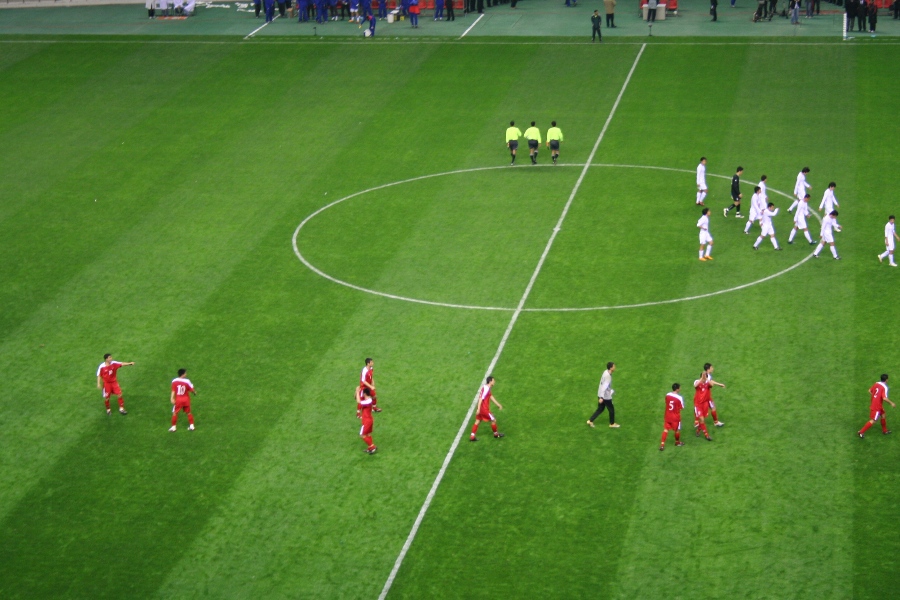
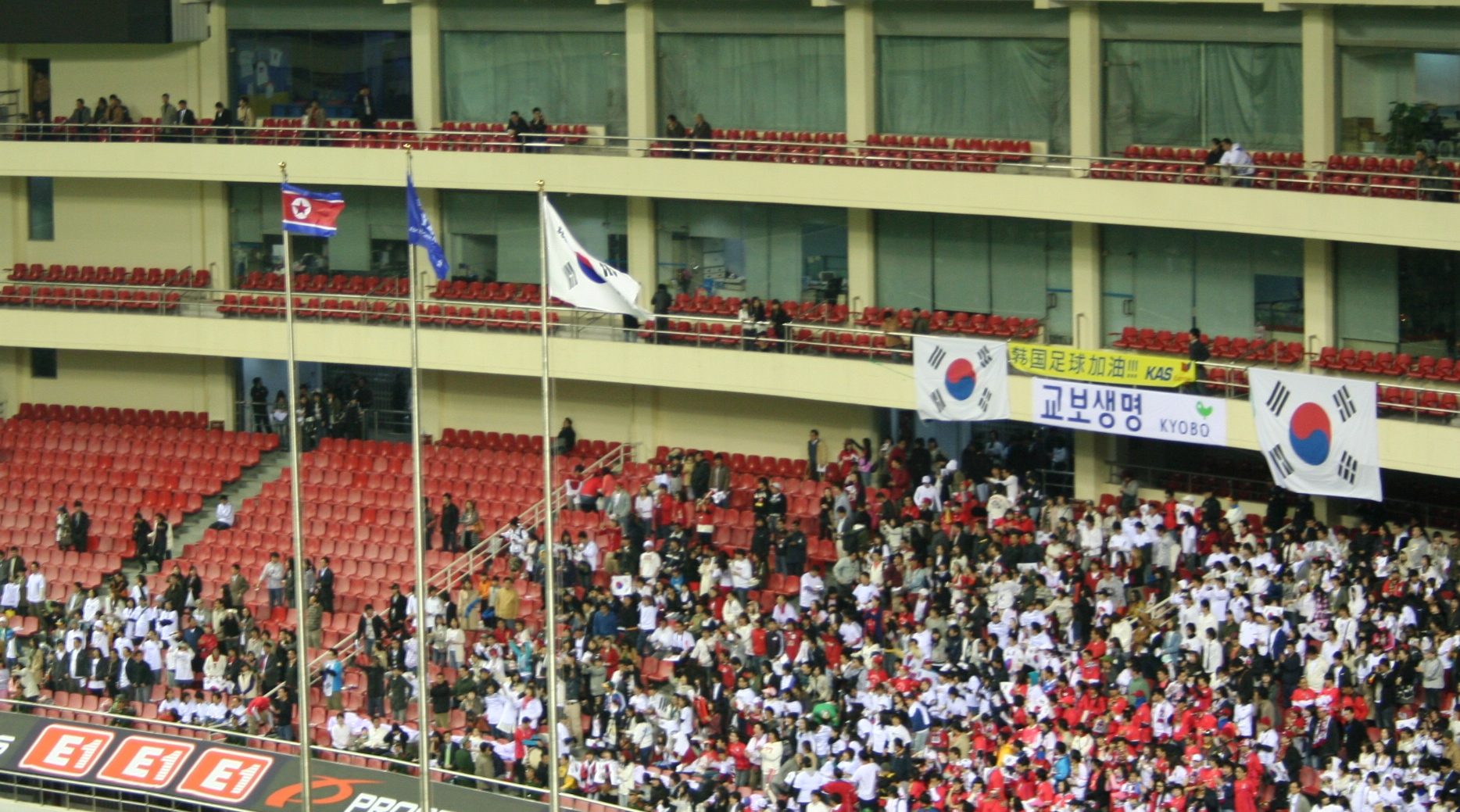
By pure serendipity I happened to be in Shanghai last week when the DPRK and South Korea faced off in their first world cup qualifier.  As readers are aware, this match was supposed to be held in Pyongyang, but after the DPRK refused to raise the South Korean flag (preferring instead a single “unification” flag), FIFA moved the game to Shanghai.

dprkflags.jpg

gameshot.jpg

Both flags were raised and national anthems were played–then the players took to the field.  The game was pretty exciting.  Although the final score was 0-0 both teams played like they wanted to win.  The South Koreans were the clear favorites, so it was a surprise when the game ended in a tie.  Fortunately, I could not contact my bookie from China.

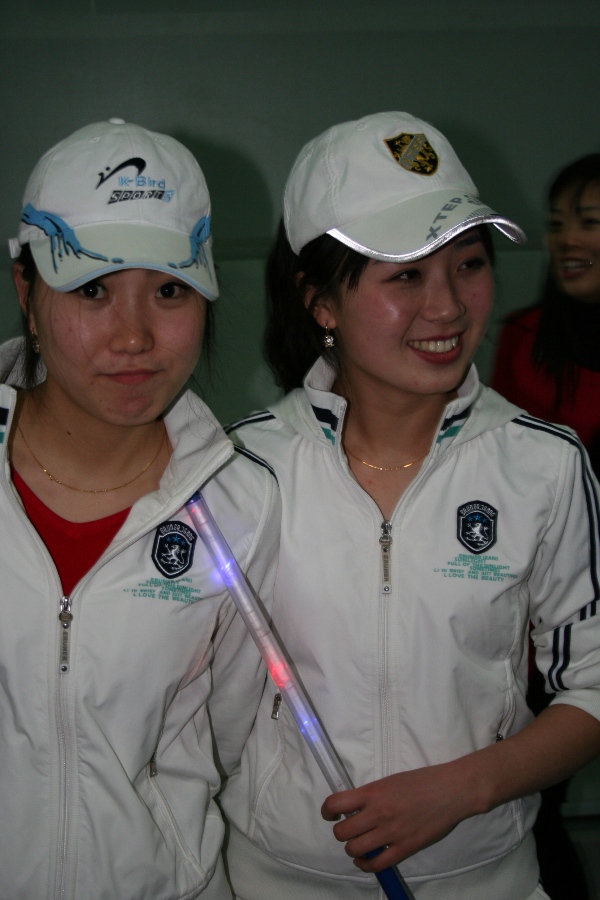
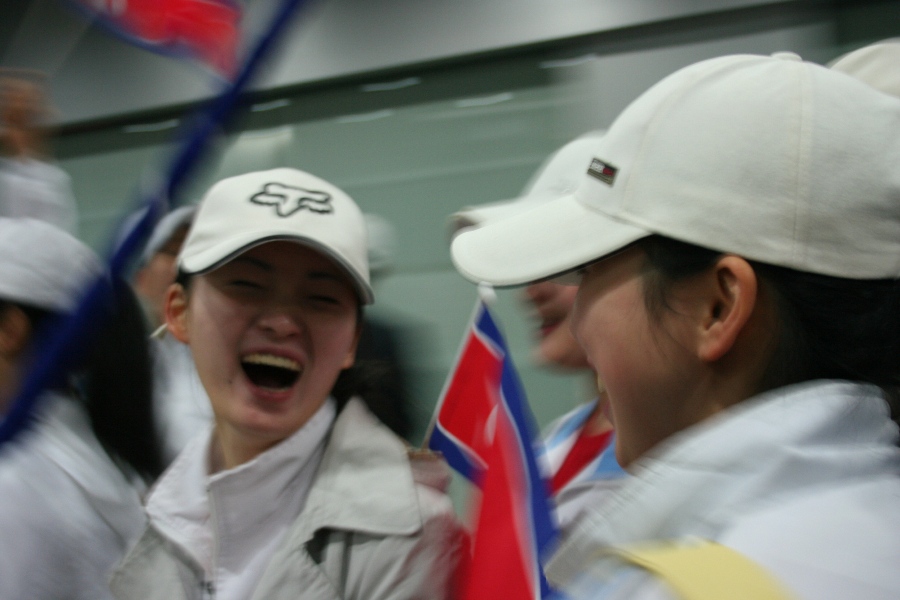
dprkfans.jpg dprkfans2.jpg

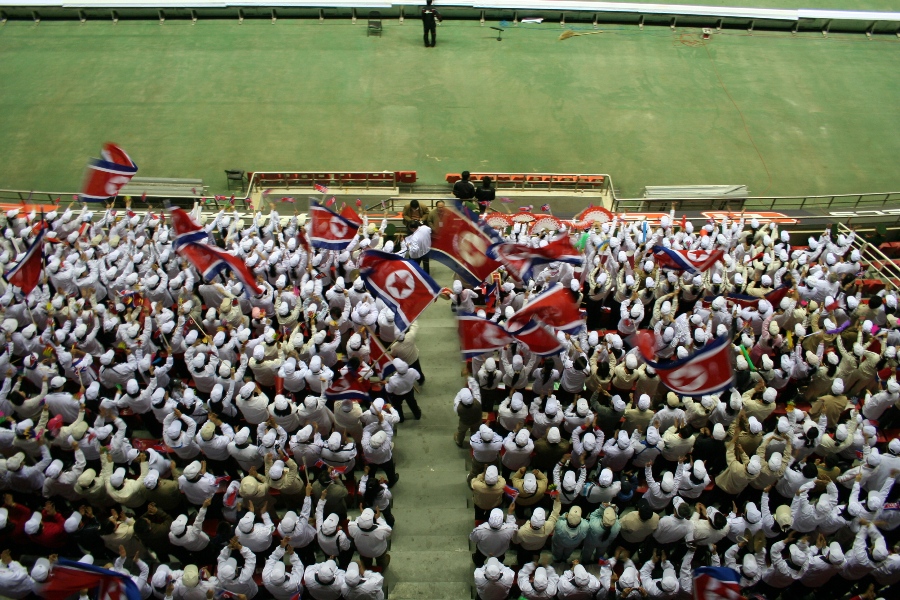
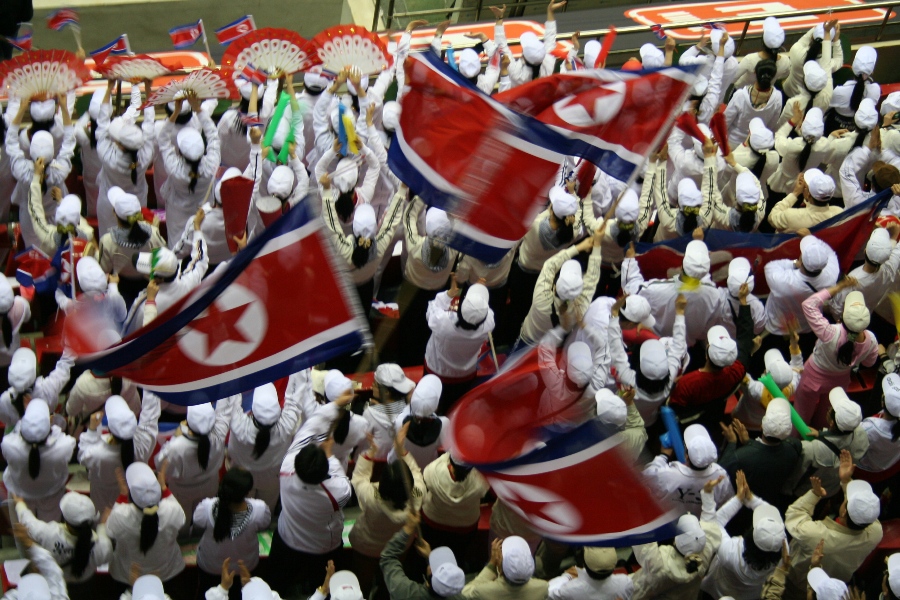
Above: the North Korean fans sitting directly below me.

Although it was a “home” game for the North Koreans they were drastically out-numbered by Southerners and contained together in their own section.

dprkfun2.jpg dprkfun.jpg dprkfun3.jpg

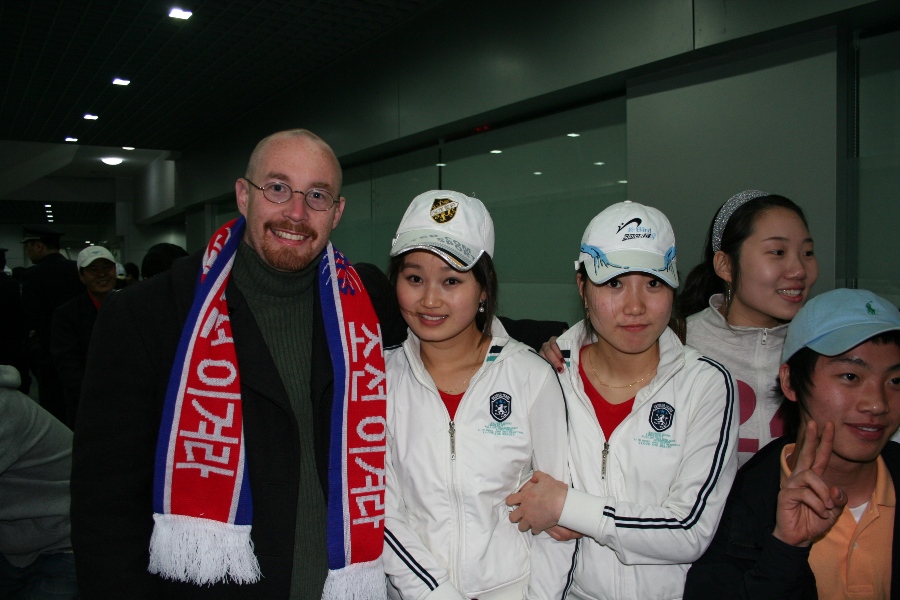
Scarves available from Koryo Tours!

The Northerners were quite accessible, however, in the hallways at half-time and after the game. The few I spoke with were language students, business students, engineering students, and businessmen, mostly all from Beijing and Shanghai.  They were organized into groups like Japanese tourists, but it was nice they made the effort bringing out some supporters for the home team. 

Thanks to Simon for the tickets, scarves, and the title.

UPDATE
nkmonitor:
The DPRK fans seem pretty friendly. By the way, where they mostly Chaoxian Zu or actual DPRK citizens? Where they aware of the controversy surrounding the match?

Simon: 
All the ones in white clothes (as seen in the pics taken from above) were full-on DPRK citizens, as mentioned in the piece above they were mostly working in Beijing and Shanghai; there were airline staff, businessmen, students, waitresses, etc all there. The Chinese chaoxian zu seemed to be sitting on the upper stand across the stadium, at least there were a load of people dressed drably, not really making any noise and they had a couple of NK flags out so I assume this was them. The NKs in the lower stand made a bit of noise and had big singalong at the end. When people attend matches in Pyongyang they tend to just sit in silence regardless of how it is going so this did make a refreshing change from that scenario.

Share

Pyongyang International Trade Fair and IT delegation

Monday, March 31st, 2008

GPI Consulting is once again hosting an IT business delegation in conjunction with the Pyongyang International Trade Fair this spring. 

Marketing language:
Business trip to the “11th Pyongyang International Trade Fair” (May 2008)
North-Korea is slowly opening up to the outside world. The trade with neighboring China and South-Korea is already growing fast, and also several European companies are conducting business. An excellent way to collect information and to make new contacts is by visiting the annual “International Trade Fair”, wich takes place from 12-15 May in Pyongyang. Companies interested in exploring business opportunties in North-Korea are invited to join our 10-17 May IT-business mission. The participants will be offered a tailormade program, with a focus on the International Trade Fair. For European companies, it is possible to make use of a collective European stand: for only 600 Euro, they can present their products or services to the public (or have them presented by local staff).   
 
IT- and multimedia study tour to North-Korea (May 10-17, 2008 )
The main focus of our business mission is to explore IT opportunities in North Korea. The goal of this studytour is to give the participants detailed information about offshoring. The IT-participants will visit firms in Pyongyang in the field of IT, animation, 2D and 3d design, cartoons, computer games, mobile games,and BPO. The business mission will have an informal character, with some attention to cultural or touristic elements. The trip will start in Beijing, and after returning from North Korea, an extension of the stay in China is possible in order to visit additional firms. The program of the tour has been added, and can also be found at: www.gpic.nl/NK-IT-tour.pdf   
 
Contact Information: 
Paul Tjia (sr. consultant)
GPI Consultancy, P.O.  Box 26151, 3002 ED Rotterdam, The Netherlands
tel: +31-10-4254172  fax: +31-10-4254317 E-mail: [email protected]  Website: www.gpic.nl

Share

DPRK promotes multifaceted trade to boost exports

Thursday, March 27th, 2008

Institute for Far Eastern Studies (IFES)
NK Brief No. 08-3-27-1
3/27/2008

The latest issue of the North Korean publication “Economic Research” (2008, issue no. 1) highlights the need to restructure North Korea’s trade system in order to meet the demands of the capitalist market. The journal quotes Kim Jong Il as saying, “[We] need fresh improvement, in our own manner, of the basic Socialist economy’s trade system of yesterday, meeting the current demands being faced due to the capitalist market.”

Therefore, the journal stresses, “As the socialist market crumbles, and given the demands of the capitalist market as [our] focus shifts to overseas economic relations, what is currently needed for the development of overseas trade is improvement of our own style to the trade system that can ensure large profits.

The journal goes on to recommend that, in order to meet these new demands of the international capitalist market, “the most important thing is improving the import-export system based on the foundation of an self-reliant national economy.” It states that raw materials should not be sold as-is, but rather should be turned into processed goods and then sold, that goods popular on the international market should be manufactured for export, and that niches should be chosen in which North Korean goods can dominate the international market.

However, the journal also says, “If individual offices trade with capitalists outside the scope of government controls, ‘reform’ and ‘opening’ sought by the imperialists would occur, and the nation’s economy could liberalize and capitalize…International trade must take place orderly under the uniform control and guidance of the nation.”

The journal asserts that even though a variety of offices are engaged in trade, they must first receive government permission, follow government guidelines, and operate in a government-created environment. The central government must standardize prices and designs of selected export goods from each trading company.

Share

DPRK citizens turn to batteries, bicycles to solve energy shortages

Monday, March 24th, 2008

Institute for Far Eastern Studies (IFES)
NK Brief No. 08-3-24-1
3/24/2008

North Koreans, long suffering from a chronic engergy shortage, are now putting forth efforts to solve even this electrical issue on their own.

The Daily NK, a South Korean-based human rights organization, has learned from interviews with North Korean residents that these days, even in farming villages, families with regular incomes are relying on batteries to light their houses and power their televisions.

Many batteries are being imported from China, and there are also many households using bicycle-mounted generators to produce electricity to overcome energy shortages. Despite the fact that these North Koreans are living in a Socialist country that fails to provide them electricity, they are coming up with their own methods for solving problems.

According to these North Koreans, there is a difference in the way they are solving the electrical shortages in the cities and in the farming communities. In the cities, many are using rechargable car batteries. There, power is provied from around 8:00am to 1:00pm, and then again in the evenings from around 8:00pm until 11:00pm. During these times, batteries are recharged and then used later for lighting and watching television.

In order to use these batteries to watch television or videos, direct current needs to be transformed into 220-volt alternating current, requiring a small power converter. The prohibitive cost of such a converter means that in farming commuities, the use of batteries to power households is difficult.

This has led many in rural areas to find a slightly different method of solving their energy needs. In farming villages, small generators attached to the rear wheel of bicycles so that ‘human power’ is used to produce electricity.

The cost of a used car battery in North Korea is around 70,000 won, while a new battery could run as much as 120,000~160,000 won*. Batteries produced in China are of high quality, but if there is ever a problem, it is difficult to have them repaired. Therefore, ‘Daedong River’ car batteries produced in North Korea are preferred.

* The current black-market currency exchange rate is approximately 2,500 DPRK Won/ USD.

Share

Women and police clash in DPRK Markets

Saturday, March 22nd, 2008

Institute for Far Eastern Studies (IFES)
NK Brief No. 08-3-22-1
3/22/2008

Recently, North Korea passed a measure prohibiting women younger then 49 from selling goods in markets, leading to clashes between police enforcing the rule and younger women wanting to work in markets.

The March 19th newsletter from ‘Good Friends’, an organization providing aid for North Korea, reported that on February 5th in Haeju, South Hwanghae Province, women who were not allowed to enter the local market and so were selling goods on a nearby corner physically clashed and police. This reportedly led to the arrest and detention of 9 people.

The newsletter reported, “The women held at the police station were subjected to harsh interrogation as to ‘who was the ringleader’, and after being subjected to four days of torture, one who could no longer hold out confessed to being the ringleader and was sent to a detention center, while the remaining women were all released.”

North Korean authorities announced the measure restricting women under 49 from selling goods in markets after December 1st last year, and that measure is being enforced not only in Pyongyang, but in rural areas as well.

According to Good Friends, “Just like other cities, Haeju City has received absolutely no food rations since March,” and “Women from households barely managing regular meals through market trading are being reduced to the weakest level by North Korean authorities’ prohibition on trading.”

It follows that in Haeju City, either authorities recognize that if these women can not sell in the markets their families will starve to death and so turn a blind eye to their activities, or these women, prevented from selling in markets, will continue to clash with authorities.

The newsletter also reported, “On March 3, in Chungjin City, North Hamkyung Province, organized protests by women prevented from market activities by the new regulations broke out, and Chungjin City authorities are now allowing all women, with no exception, to sell goods in markets.”

Immediately following organized protests by these women, Chungjin City officials reported the disturbances, but no policies to deal with the issue were forthcoming, and so it appears that all women, with no exception, are now allowed to conduct market activities.

Share