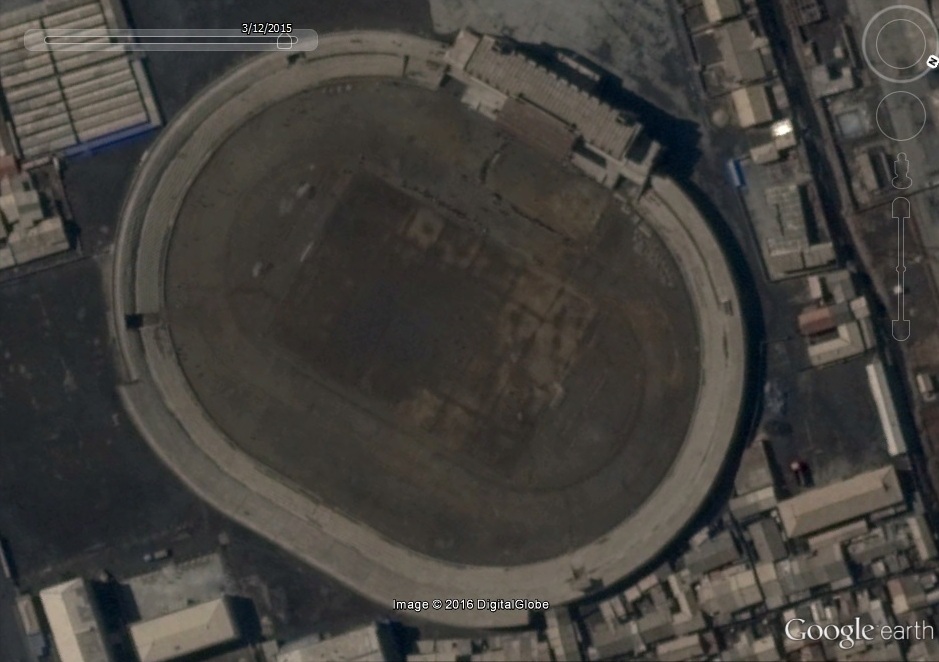
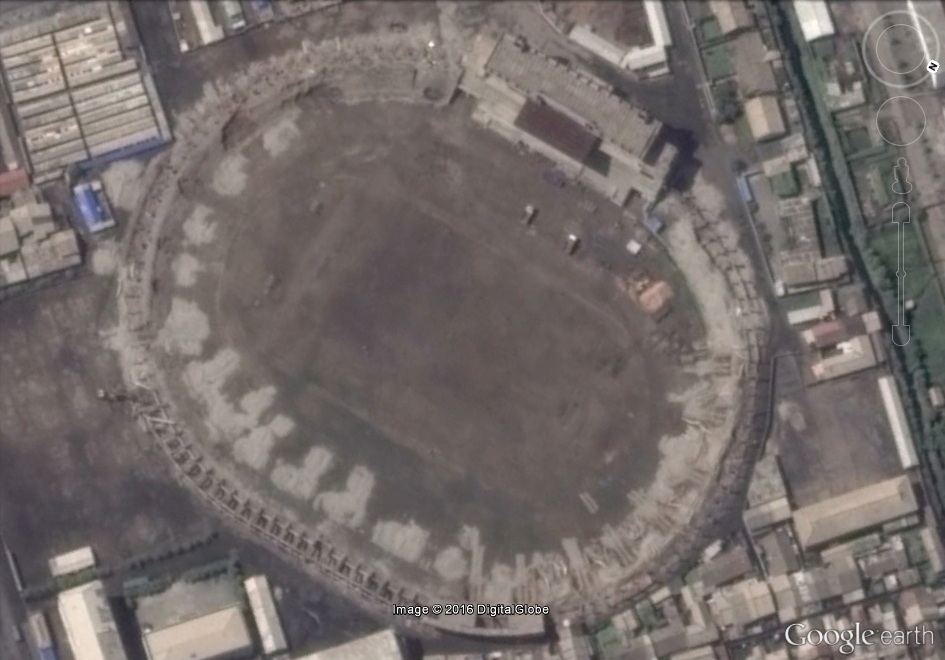
Pictured above (Google Earth): (L) Sinuiju Stadium on 2015-3-12, (R) Sinuiju Stadium on 2015-9-2.
The stadium is either being renovated or this will be the location of the North Phongan Sports Village. New imagery will reveal the answer!

Pictured above (Google Earth): (L) Sinuiju Stadium on 2015-3-12, (R) Sinuiju Stadium on 2015-9-2.
The stadium is either being renovated or this will be the location of the North Phongan Sports Village. New imagery will reveal the answer!
By Benjamin Katzeff Silberstein
To what extent is China enforcing the latest round of UNSC sanctions on North Korea? This question is as important and interesting as it is nebulously complicated and difficult to answer. For the fact is, like Curtis points out here, that lower coal imports by China from North Korea does not necessarily give evidence to sanctions enforcement. Some of the figures reported in the news concern the value of the imports, which fluctuates with world market prices.
Moreover, as the old saying goes, correlation does not imply causality. In other words, the mere fact that trade in coal and other goods is decreasing does not necessarily mean that it is going down because of sanctions alone. It is worth to remember that Chinese imports of North Korean coal has decreased in the past too, before the latest sanctions round, due to decreased domestic demand and other factors. A whole host of variables other than sanctions may well be at play too.
Looking back at some previous trade data gives some context to the latest reports of decreasing trade. Even though volumes may be down, to fully understand how this impacts the North Korean economy, dollar value terms may be more relevant.
To recap:
To put this in perspective, consider the following changes in the past:
The point of citing these numbers is not to show that sanctions are not being implemented by China. Rather, such flows tend to fluctuate quite heavily for other reasons as well, and it is too early to conclude that sanctions are the only reason behind the contraction. As a New York Times story from late March this year showed, Chinese border agents tend to be fairly lax in controlling goods crossing the border – NYT cited a figure of about five percent of all goods being inspected. In sum, it is too early to draw any major conclusions about Chinese sanctions enforcement, and only future data will be able to give a more conclusive picture.
Here is the statement from the Treasury Department:
Treasury Takes Actions To Further Restrict North Korea’s Access to The U.S. Financial System
6/1/2016
Action Responds to the Threat that North Korea Poses to the Global Financial System; the United States Calls on International Partners to Similarly Takes Steps toward Severing Banking Relationships with the Dangerous Regime
WASHINGTON – Today, the U.S. Department of the Treasury announced a Notice of Finding that the Democratic People’s Republic of Korea (North Korea) is a jurisdiction of “primary money laundering concern” under Section 311 of the USA PATRIOT Act. Treasury, through its Financial Crimes Enforcement Network (FinCEN), also released a notice of proposed rulemaking (NPRM) recommending a special measure to further isolate North Korea from the international financial system by prohibiting covered U.S. financial institutions from opening or maintaining correspondent accounts with North Korean financial institutions, and prohibiting the use of U.S. correspondent accounts to process transactions for North Korean financial institutions.
Section 311 gives the Secretary of the Treasury the authority to identify a foreign jurisdiction to be a primary money laundering concern. Once identified, the Secretary can require U.S. financial institutions to take appropriate countermeasures. The special measure proposed in today’s NPRM would impose the most significant measure available to the Secretary under Section 311.
“The United States, the UN Security Council, and our partners worldwide remain clear-eyed about the significant threat that North Korea poses to the global financial system. The regime is notoriously deceitful in its financial transactions in order to continue its illicit weapons programs and other destabilizing activities,” said Adam J. Szubin, Acting Under Secretary for Terrorism and Financial Intelligence. “Today’s action is a further step toward severing banking relationships with North Korea and we expect all governments and financial authorities to do likewise pursuant to the new UN Security Council Resolution. It is essential that we all take action to prevent the regime from abusing financial institutions around the world – through their own accounts or other means.”
Reasons for This 311 Determination
Treasury is taking this action consistent with the North Korea Sanctions and Policy Enhancement Act, enacted on February 18, 2016, which requires Treasury to determine within 180 days whether reasonable grounds exist for concluding that North Korea is a jurisdiction of primary money laundering concern, and if so, to propose one or more special measures. In addition, the United Nations Security Council adopted Resolution 2270 on March 2, 2016, which in part requires UN Member States to sever correspondent banking relationships with North Korean financial institutions within 90 days of the adoption of the resolution.
North Korea is proposed for action under Section 311 because (1) North Korea uses state-controlled financial institutions and front companies to conduct international financial transactions that support the proliferation and development of WMD and ballistic missiles; (2) North Korea is subject to little or no bank supervision anti-money laundering or combating the financing of terrorism (“AML/CFT”) controls; (3) North Korea has no diplomatic relationship, and thus no mutual legal assistance treaty, with the United States and does not cooperate with U.S. law enforcement and regulatory officials in obtaining information about transactions originating in or routed through or to North Korea; and (4) North Korea relies on the illicit and corrupt activity of high-level officials to support its government.
Impact of the 311 Notice of Finding and the NPRM Special Measure
While current U.S. law already generally prohibits U.S. financial institutions from engaging in both direct and indirect transactions with North Korean financial institutions, this NPRM, if finalized, would require U.S. financial institutions to implement additional due diligence measures in order to prevent North Korean banking institutions from gaining improper indirect access to U.S. correspondent accounts. While North Korea’s financial institutions do not maintain correspondent accounts with U.S. financial institutions, North Korean financial institutions frequently conduct transactions on behalf of the North Korean government and state-controlled corporations. The NPRM, if finalized, would prohibit the use of third-country banks’ U.S. correspondent accounts to process transactions for North Korean financial institutions.
Italics added for emphasis.
The “Notice of Finding” is here, and is also worth reading.
According to the Wall Street Journal:
Treasury Department officials said they are moving to ban non-U.S. banks and entities from processing dollar transactions on behalf of North Korea, an arrangement known as a U-turn, in a move to block its international trade.
…
China is by far Pyongyang’s largest trading partner, and Chinese firms could be caught in the crosshairs, according to current and former U.S. officials.
…
Zhu Haiquan, the spokesman for China’s embassy in Washington, repeated Beijing’s warnings against what it considers “unilateral sanctions taken by any country.”
He added that “we should avoid any move that may further aggravate tensions” on the Korean peninsula, and said “the unilateral sanctions must not affect and harm the legitimate rights and interests of China.”
…
U.S. officials were pleased that China agreed in March to support the new U.N. sanctions, which could significantly impair North Korea’s ability to generate hard currency and ship its exports.
Still, U.S. officials have voiced skepticism that Beijing would significantly punish Pyongyang, a longtime ally. China has rebuked North Korea in the past for its nuclear and missile tests, only to increase investment and trade with the country.
The issue is likely to be among the topics discussed when Messrs. Kerry and Lew meet top Chinese officials in Beijing for the Strategic and Economic Dialogue, a series of annual bilateral meetings.
According to the New York Times:
As a practical matter, that would largely affect Chinese banks, which facilitate North Korea’s financial transactions with Beijing, its largest trading partner. It could also affect some institutions in the nominally autonomous Chinese regions of Macau and Hong Kong, as well as in Singapore, where Pyongyang has often gone to hide the true nature of its banking activities, and to pay for missiles, nuclear fuel and the huge infrastructure it has built around those programs.
…
It is hard to assess how much the action will hurt North Korea. Such sanctions against financial institutions doing business with Iran proved effective because Tehran had billions of dollars in monthly oil and other energy exports that could be choked off; North Korea has none. Oftentimes Pyongyang deals in cash. Until a few years ago it was one of the largest counterfeiters of $100 bills. But that once-lucrative fraud was largely cut off by the redesign of the $100 bill.
…
Banks in the United States are already prohibited from doing business with financial institutions in North Korea. But the recommended rules would require them to perform additional due diligence to ensure they are not inadvertently transacting with North Korean financial institutions or the Pyongyang government through shell companies or other fictitious entities.
Notice of the new rules has been published by the Federal Register. Feel free to comment if you like.
Josh also writes a walk-through of how this works.
Here is information from Choson Exchange.
Troy Stangarone writes about the sanctions for KEI.
The UK also strengthened financial sanctions against the DPRK.
UPDATE 5 (2016-6-1): The photographer Aram Pan (DPRK360) shot an incredible video of the trade fair. You can really learn a lot about the DPRK from watching it. There were lots of little surprises for me.
Also check out his Facebook photos of the Trade Fair here.
UPDATE 4 (2016-5-26): KCTV covered the trade fair.
UPDATE 3 (2016-5-23): KCTV Covered the trade fair.
UPDATE 2 (2016-3-17): According to the Institute for Far Eastern Studies (IFES):
North Korea to Host International Trade Fairs despite UN Sanctions
Despite the newly imposed sanctions by the UN Security Council (UNSC), North Korea does not appear to be deterred from hosting large-scale international events, as Pyongyang plans to host its annual Pyongyang International Trade Fair (PITF) twice this year, in May and September.
North Korea’s official web portal ‘Naenara’ reported that the spring PITF will be held at the Three-Revolution Exhibition House in the Sosong District in Pyongyang from May 16th to the 19th and the autumn PTIF will be held at the same venue from September 5th to the 8th.
‘Naenara’ claimed that the country “has been hosting hundreds of trade shows both in the country and abroad for over 50 years since April 17, 1958 and such events will enable the DPRK to accelerate its friendship and cooperation with other states and boost its international trade.”
According to the website, these trade fairs will exhibit items such as machine tools, mining equipment and their manufacturing technology for minerals—items in a sector now heavily targeted by the new sanctions imposed by the UNSC.
According to the report, the trade fairs will also include displays of construction machinery and building materials, energy and environment protection materials, communication and information technology, agricultural equipment and technology, foodstuffs and production technology, print and packing machinery, medical equipment and pharmaceuticals, light-industry products, consumer goods, and even vehicles.
Advertising is of course permitted at the trade fairs, with installation and removal displays and promotional materials requiring pre-approval by the host Korean International Exhibition Corporation. Transportation of the items for exhibition is to be dealt with by the Pyongyang Agent Department of the Italian company OTIM (Organizzazione Transporti Internazionali Marittimi). OTIM, a freight forwarding company established in the late 1940s, has been authorized and in charge of transporting goods between North Korea and Europe.
‘Naenara’ announced that the fairs will accept emailed or faxed applications until 40 days prior to the opening and has requested companies to send along their list of participants.
Apart from domestic enterprises, companies from around 16 countries or more — including Australia, China, Cuba, Cambodia, Germany, Italy, Indonesia, Mongolia, New Zealand, Poland, Russia, Singapore, Switzerland, and Vietnam — have reportedly participated in these trade fairs in the past.
Given North Korea’s isolation from the international system and closed-nature of its economy, the international trade fairs have been important events for its economy. However, while North Korea seems determined to host its annual spring and autumn events despite the international sanctions and pressure, just how many companies from other countries will participate is an open question.
UPDATE 1 (2016-3-1): The 2016-Q1 issue of Foreign Trade is out, and it contains some additional information on the 2016 Pyongyang Spring International Trade Fair.
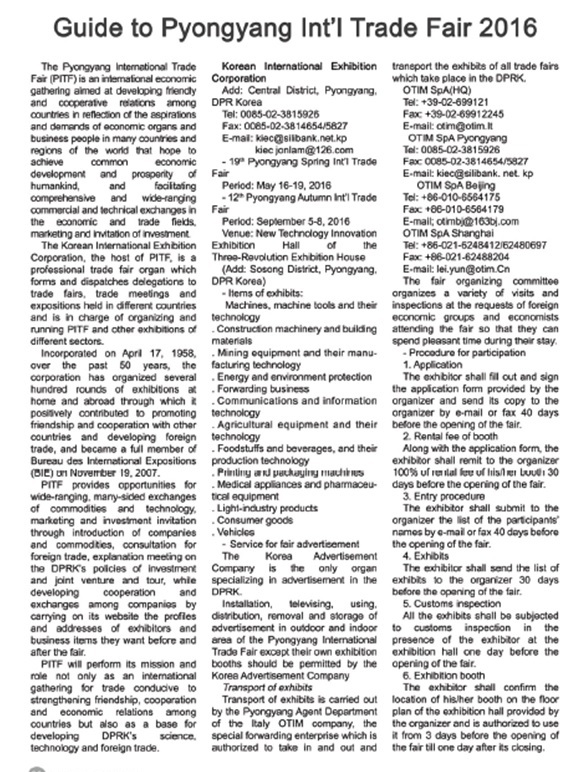
ORIGINAL POST (2016-2-11): Everyone may be talking about nukes, rockets, sanctions, and the closure of the Kaesong Industrial Complex, but the North Koreans have begun planning the 2016 Pyongyang Spring Trade Fair. Below you can see images of the first flyers to emerge:
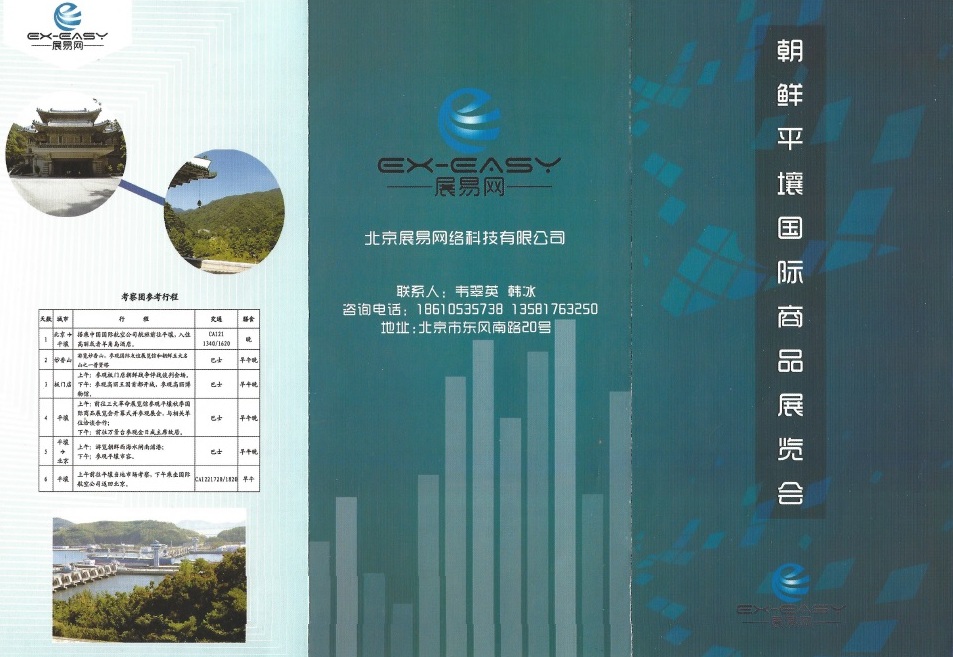
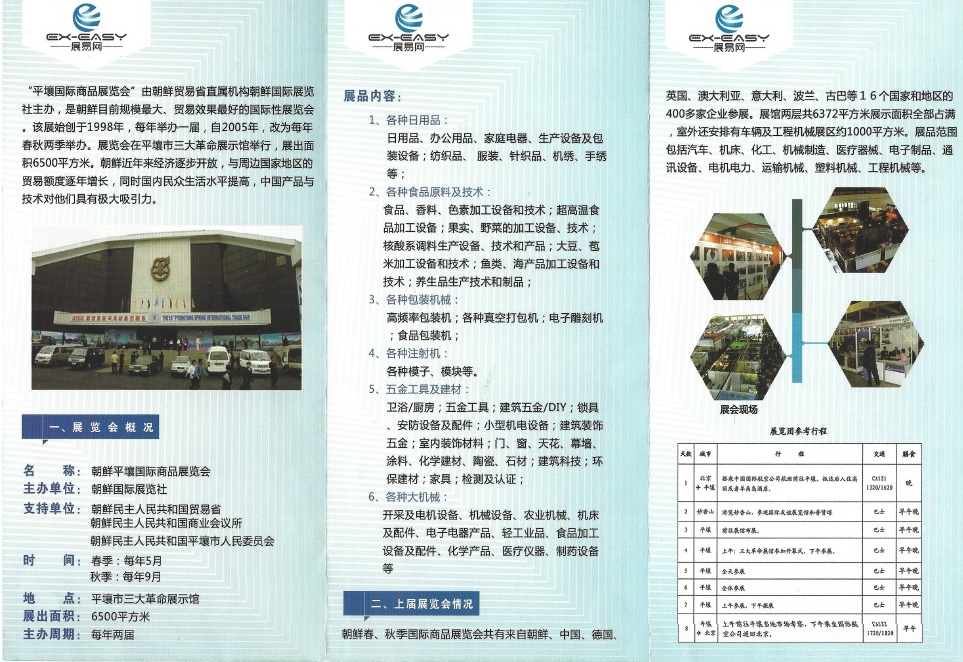
Promotion of the trade fair appears to be in the hands of a Chinese internet firm named Ex-Easy.
Thanks to a reader (Andy) for translating some of the flyer:
“Pyongyang International Business Products Exhibition” is organised by an affiliated company under DPRK’s Ministry of Trade. This international exhibition is DPRK’s largest and most trade-conducive of its kind. It is organised yearly since 1998, and is held twice yearly – in spring and autumn – from 2005. The exhibition will be held in Pyongyang’s Three Revolution Exhibition hall, with a capacity of 6500 square meters. The DPRK has been gradually liberalising its economy in recent years and increasing its trade with neighbouring countries. At the same time, it has raised its domestic living standards, and they are attracted to Chinese products and (manufacturing) techniques.
Products exhibited:
1. Daily necessities, office supplies, household appliances, manufacturing / packing equipment, sewing equipment, clothes, stitched (embroidered?) products, …
2. Food, flavourings, food additive facilities/techniques, high temperature processed products and equipment, fruits, vegetable processing equipment, techniques, nucleic acid manufacturing facilities/techniques/products, bean processing and techniques, fish/seafood processing/techniques, health product processing/techniques
3. Sealing machinery, vacuum packaging, engraving machinery, food packaging machinery
4. Injection moulding machinery, moulds.
5. Misc hardware and DIY materials: bathroom/kitchen, construction/DIY, locks, safety equipment/accessories, small scale electronics, construction decorations, interior decoration – doors/windows/ceiling/walls/paint/chemicals/ceramics/masonry materials, building tech, environmentally frendly materials, furniture, inspection and certification
6. All sorts of large machinery – mining and related equipment, farming equipment, electronics, light industries, food processing and related equipment, chemical products, medical equipment, medicine manufacturing facilities.Last exhibitions featured exhibitors from DPRK, China, Germany, UK, Australia, Italy, Poland, Cuba…. 400 over companies from 16 countries/regions. A total of 6372 square meter of exhibition space over two floors, taking up all usable space. Cars and engineering machinery took up about 1000 square meters of space outdoors. Exhibited products included cars, tooling machine, chemical, machines, communication equipment, electrical equipment, transportation machinery, plastics machinery, engineering equipment.
By Benjamin Katzeff Silberstein
Kim Jong-un has showed quite a bit of interest in the machinery industry as of late. Moreover, Rodong Sinmun has been touting the increased use of (domestically manufactured, I believe) machinery in agriculture in its reporting on the harvest campaign. And as IFES reports in its latest NK brief, the pattern continues (assuming it is a pattern and not just a series of coincidences…). Notice also the emphasis on domestic production. North Korea’s domestic market and manufacturing sector has made pretty significant strides in the past few years, so Kim’s words (highlighted below) may not just be the same old Juche talk of past generations:
Kim visited Machine Factory run by Ho Chol Yong on May 19th and ordered to complete the modernization of the plant by the ruling Party’s founding anniversary in October.
Since his first visit 10 years ago, he has provided field guidance to this factory in 2013 and 2014.
Kim toured an exhibition of machinery and equipment on May 13, emphasizing the need to eradicate the ‘disease of imports.’
On display at the exhibition was unit machinery equipment manufactured during the most recent “70 days speed battle.”
He sat inside the new 80 horsepower tractor developed by Kumsong Tractor plant and expressed his satisfaction over the fact that “[we have] a machine manufactured by our own efforts and with our own technology.”
In addition, he examined the agricultural equipment including seed drills and ordered to “enhance modernization of the agricultural plants and production process in order to produce more efficient farming equipment and parts by increasing the level of mechanization in agricultural industry by 60 to 70 percent.”
“For the mechanical products at the exhibit, self-reliance must come first, self-reliance is our way of life,” Kim stressed. He also emphasized the need to “eradicate the disease of imports.”
Kim Jong Un also said “we should continue to reinforce our Juche-based capacity based on our own ability, technology and resources and continue the pursuit of revolutionary self-determination-first policy,” and added, “the only thing we can believe in is our own self strength.”
During the Seventh Party Congress, Kim Jong Un said that the machinery industry is the touchstone of economic and technological development. He also directed to introduce a state-of-the-art equipment system and modernize a production line by updating existing equipment for maximum capacity in the machinery sector.
Kim Jong Un has visited 10 different machinery factories this year alone, placing considerable attention on making improvements to advance and modernize this industry.
Source:
Kim Jong Un Showing Special Attention to Improving Machinery Industry
Institute for Far Eastern Studies (IFES)
2016-05-31
By Benjamin Katzeff Silberstein
Just as one mass campaign ended (the “70-day battle”), another one begins. This time, it’s a 200-day campaign to boost the economy and fulfill the 5-year plan. Perhaps a grim premonition of what is to come as the 5-year plan is implemented further. Yonhap:
North Korea kicked off a new loyalty campaign to get people to work more as part of its five-year economic program announced at its seventh ruling party congress, state controlled media said Sunday.
According to the Korean Central News Agency (KCNA), a meeting of ruling Workers’ Party of Korea (WPK), government, economic and military officials was held Thursday through Saturday, where participants agreed to launch the “200-day campaign of loyalty” that can bolster growth.
The announcement comes on the back of Pyongyang concluding its “70-day campaign of loyalty” program just before the start of the rare congress that took place early this month. That campaign ran from mid-February to May 2.
The new effort is being pursued as the United Nations sanctions take bite, and the country finds itself more and more isolated from the outside world. The global body slapped its toughest sanctions to date on the reclusive country for its fourth nuclear test in January and the firing off of a long-range missile the following month.
The KCNA said that leading members at last week’s gathering in Pyongyang concurred on the need to join forces to bring about the successful conclusion of the new campaign in accordance with the guidance put forth by North Korean leader Kim Jong-un.
Kim outlined his new five-year economic growth plan running from this year to 2020 and called on North Koreans to meet the growth goals.
Article source:
N. Korea kicks off new loyalty campaign to prop up economy
Yonhap News
2016-05-29
Here is a statement from the Pyongyang Times (2016-5-30):
Joint conference takes measures for five-year economic development strategy, declares 200-day campaign
A joint conference of Party, government and military officials was held between May 26 and 28 in Pyongyang to discuss the ways to implement the tasks set forth at the Seventh Congress of the Workers’ Party of Korea.
It was attended by senior officials Pak Pong Ju, Choe Thae Bok, Pak Yong Sik, O Su Yong, Kwak Pom Gi, Ri Man Gon and Jo Yon Jun and other officials from Party and military organs, the Cabinet, working people’s organizations, ministries, national agencies, local Party and government organs and major industrial establishments.
The joint conference, the first of its kind in the history of the WPK, discussed scientific and realistic ways to carry through the national five-year strategy for economic development put forward at the Seventh WPK Congress and important measures to achieve the grand objective for building a socialist power by inspiring all the service personnel and people to the campaign to create the Mallima speed.
Premier Pak Pong Ju, member of the Presidium of the Political Bureau of the WPK Central Committee, delivered a report.
He said the Party, army and people are faced with the important and honourable task of accomplishing the cause of a socialist power as early as possible when the independent ideal and desire of the people are being translated into reality in an all-round way under the banner of Kimilsungism-Kimjongilism.
In the five-year period, he noted, we should resolve the energy problem, put the vanguard sectors and key economic industries on a normal track and increase agricultural and light industrial production by adhering to the Party’s new line of simultaneously promoting the two fronts, thereby radically improving the people’s standards of living.
Specifying the targets for implementing the five-year strategy by major indices, he pointed to the issues to be settled in all sectors of an economic giant building, including the concentration on easing power shortage, the master key in economic development and improved livelihood of the people.
To thoroughly implement the important tasks set forth at the Seventh Party Congress, he pointed out, it is imperative to enhance the state’s function as the organizer of the economy and establish a Korean-style economic management method embodying the Juche idea in an all-round way.
“Officials of the Cabinet, ministries and national agencies should work out phased plans for implementing the economic development strategy in a realistic manner on the basis of the Party’s line and policy, arrange economic work scrupulously and make persistent efforts to carry them through,” he stressed.
“Economic work should be planned and directed in such a way as to concentrate efforts on the main link and activate the economy as a whole. All sectors and all units have to establish strict discipline and order whereby they place all economic work under the control of the Cabinet and work according to its unified planning and direction in line with the requirements of the Cabinet-responsibility system and Cabinet-centred system.
“Relevant sectors and units should establish Korean-style economic management methods as required by developing reality, while factories, enterprises and cooperative organizations have to map out business strategies and conduct business activities on their own initiatives and in a creative manner in keeping with the requirements of the socialist system of enterprises managing themselves on their own responsibility, thereby putting production on track and expanding and developing it.”
As part of the joint conference, meetings were held by each economic sector.
The meetings discussed the tasks to be tackled by each sector and unit, presenting lots of innovative and creative ideas.
As he wound up the joint conference, the Premier said that it fully discussed scientific and realistic measures and ways to implement the tasks of the Congress, stressing that all the participants came to have firm confidence and optimism through the conference that they could well attain the targets of the five-year strategy.
He called on all officials to plan and command economic work of their sectors and units in a three-dimensional way and at lightning speed and carry out the tasks of the Congress at the risk of their lives as the standard-bearers of their ranks and buglers of advance, thereby fulfilling their honourable mission as commanding officials in the glorious era of Kim Jong Un.
At the conference, a 200-day campaign of loyalty was declared for making a breakthrough in the implementation of the five-year strategy.
On the other hand, a meeting of members of Party guidance teams for the 200-day campaign was held on May 28, where the significance of the campaign was mentioned and steps related to the campaign were emphasized.
Read out at the meeting were the names of members of the central and provincial headquarters of the Party guidance teams and those who would be dispatched.
Speakers expressed their resolve to keep up the heightened spirit of having brought about great victory in the 70-day campaign so as to win triumphs uninterruptedly from the outset of the new campaign, thereby making a tangible contribution to demonstrating once again the mettle and stamina of Juche Korea rushing forward towards a socialist power.
Institute for Far Eastern Studies (IFES)
In the Central Committee’s report at the Seventh Congress of the Worker’s Party of Korea, Kim Jong Un stated the country’s achievements—field by field—since the last (sixth) congress was held back in October 1980. The leader also revealed his upcoming plans. In the economic field, he specifically introduced goals of building a state that is economically independent and possesses highly developed scientific technology, a ‘five-year plan’ for economic development, and expansion of the country’s foreign relations, inter alia. Below are some of the highlights.
Building Economic Independence – According to the report, it was said that “both the party and the people have struggled to build the socialist economy along with economic independence. With the industrialization of the new century, factories and companies have experienced modernization in production line, resulting in an advancement of technology for the economy. We [DPRK] have already become a strong nation both politically and militarily, but still are lacking economically. The country we are trying to build with strength in economy is one that is independent and prospers through scientific technology. Thus we must reinforce our independence and identity. We must also seek self-sufficiency in food production.”
Five-Year Plan in Economic Development – According to the report, it was stated that “We must act in accordance with the Five-Year plan from 2016 to 2020. The goal of the five-year plan is to vitalize and balance the economy in order to continuously develop the economy. In the next five years, we must raise the quality of life for the people by initiating the Byungjin Policy and solve the energy related issues to put industries that have fallen behind back on track. The most urgent issue we face now is the energy shortage that we must build power plants as soon as possible and build an energy complex in Danchon to go hand in hand with the construction of nuclear power plants.”
Expanding Foreign Relations – The report also mentioned that “We must build and maintain our credibility in foreign trade while improving it by increasing the variety of our exports and the technology-based trade. We must also guarantee the environment and conditions for foreign investment on our special economic zones and put emphasis on the tourism.”
Previous posts on the new five year plan can be found here.
UPDATE 1 (2016-5-26): DPRK Linked to attacks on Swift. According to the New York Times:
Security researchers have tied the recent spate of digital breaches on Asian banks to North Korea, in what they say appears to be the first known case of a nation using digital attacks for financial gain.
In three recent attacks on banks, researchers working for the digital security firm Symantec said, the thieves deployed a rare piece of code that had been seen in only two previous cases: the hacking attack at Sony Pictures in December 2014 and attacks on banks and media companies in South Korea in 2013. Government officials in the United States and South Korea have blamed those attacks on North Korea, though they have not provided independent verification.
On Thursday, the Symantec researchers said they had uncovered evidence linking an attack at a bank in the Philippines last October with attacks on Tien Phong Bank in Vietnam in December and one in February on the central bank of Bangladesh that resulted in the theft of more than $81 million.
“If you believe North Korea was behind those attacks, then the bank attacks were also the work of North Korea,” said Eric Chien, a security researcher at Symantec, who found that identical code was used across all three attacks.
“We’ve never seen an attack where a nation-state has gone in and stolen money,” Mr. Chien added. “This is a first.”
The attacks have raised alarms in the global banking industry because the thieves gained access to Swift, a Brussels-based banking consortium that runs what is considered the world’s most secure payment messaging system. Swift’s system is used by 11,000 banks and companies to move money from one country to another — one reason that it is a tempting target for criminals.
Swift has warned publicly that the attacks are part of a broad coordinated assault on banks, though it has not assigned blame. It has also emphasized that it was the banks’ connection points to its network — and not the core Swift messaging network itself — that the attackers were able to breach. Also, American bankers have noted that the security lapses all occurred at banks in third-world countries, which may give some comfort to banking customers in the United States.
Security researchers and American government officials have tied thousands of attacks to nations in the past. They have linked the United States and Israel to an attack that destroyed Iranian centrifuges, and the Chinese military and contractors to attacks that stole military and trade secrets from thousands of foreign entities.
Continue reading the main story
RELATED COVERAGEHackers’ $81 Million Sneak Attack on World Banking APRIL 30, 2016
Details Emerge on Global Bank Heists by Hackers MAY 13, 2016
Once Again, Thieves Enter Swift Financial Network and Steal MAY 12, 2016
But the latest spate of attacks on banks in Bangladesh and Southeast Asia would be the first time, security researchers say, that a nation has used malicious code to steal purely for financial profit.The idea that Pyongyang had turned to digital theft would not be surprising. North Korea’s economy has been ravaged by sanctions, food shortages and other deprivations. Pyongyang does not publish economic data, but estimates have put North Korea’s gross domestic product between $12 billion and $40 billion, tiny when compared with South Korea’s economic output of more than $1.4 trillion.
In the attack at Bangladesh’s central bank in February, the thieves tried to transfer $1 billion in funds from an account at the Federal Reserve Bank of New York. Fed officials became suspicious of the some of requested transfers and released only $81 million to accounts in the Philippines.
“If you presume it’s North Korea, $1 billion is almost 10 percent of their G.D.P.,” Mr. Chien said. “This is not small change for them.”
Symantec researchers said it was possible that the bank in the Philippines containing the North Korean code was also involved in the Bangladesh bank scheme and the attempted breach on the Vietnamese bank. The researchers would not identify the Philippines bank and did not say whether the thieves had been successful in transferring funds. Researchers were able to confirm only that the attackers had managed to breach the bank and install identical code strings on the bank’s computer systems — the same code that they discovered in Bangladesh, Vietnam and the two previous attacks at Sony in 2014 and South Korea in 2013.
Mr. Chien noted that the attackers not only used identical numbers but wrote the code in the same, unusual sequence across all three attacks.
Mr. Chien said the evidence pointed to all three attacks being the work of the “Lazarus Group,” a name his team gave to the attackers behind the Sony and South Korean attacks.
Officials have pointed to North Korea’s threat of “merciless countermeasures” against Sony if the studio released “The Interview,” a movie by Seth Rogen and Evan Goldberg that made fun of North Korea and includes a fictional assassination of its leader. F.B.I. analysts also note critical mistakes North Korean hackers made, such as logging into their attack servers from known North Korean Internet addresses and even logging into both their Facebook account and Sony’s servers from the same computers.
In the months since evidence of the attacks involving the Swift network started to emerge, investigators have been looking for commonalities at numerous other potential breaches. It remains unclear whether these breaches are connected to the ones in Bangladesh and Vietnam, but they too have occurred in or around Southeast Asia.
There is no evidence to date that the thieves have gone after large American or European banks, though new possible attacks are being reported weekly. Last week, evidence emerged that Banco del Austro, an Ecuadorean bank, was infiltrated by hackers who were also able to sneak onto the Swift network. The thieves transferred several million dollars to accounts around the world, according to a lawsuit the bank filed in federal court in the United States against Wells Fargo, which facilitated one of the transfers.
Researchers have yet to unearth any of the code used in the Ecuador attack, but banking analysts say it is probably no coincidence that these attacks are happening in the developing world, where security measures tend not to be as tight as they are in financial hubs like New York and London.
Swift has issued numerous warnings in recent weeks urging banks to step up their security protocols. Analysts worry that the breaches could have a chilling effect on global finance; larger banks may become reluctant or even refuse to transact with smaller banks in the developing world unless they can have assurances that their networks have not been compromised by thieves and malware.
At a conference on Tuesday in Brussels, Swift’s chief executive, Gottfried Leibbrandt, said the recent attacks could do far more damage than breaches on retailers and telephone companies, which he said suffer largely reputational and legal hits.
“Banks that are compromised like this can be put out of business,” Mr. Leibbrandt said.
North Korea has long been known for creative attempts to generate badly needed hard currency. In the last decade, United States government officials accused North Korea of counterfeiting $100 bills, which were known as “superdollars” or “supernotes” because the fakes were nearly flawless. The Federal Reserve began thwarting that effort by circulating a new $100 bill over the last three years that makes counterfeiting nearly impossible: The redesigned $100 is easier to authenticate and harder to replicate.
“North Korea is hurting for money,” said Herb Lin, the senior research scholar for cyberpolicy and security at Stanford University’s Center for International Security and Cooperation and a fellow at Stanford’s Hoover Institution. “They’ve been cut out of the financial system because of sanctions. They had been among the best counterfeiters in the world, and only recently have they been stymied in the counterfeiting of superdollars. If it’s true that we’ve cut them off from that, then it’s not at all surprising that they would turn to something else.”
Read the full story here:
North Korea Linked to Digital Attacks on Global Banks
New York Times
2016-5-26
ORIGINAL POST (2016-5-27): Swift hack linked to Sony hack. According to The Guardian:
Security researchers Symantec have found clues in the malware used to hack into international financial messaging network Swift, which suggest a link to the Sony Pictures hack in 2014.
At least three banks have reported financial attacks based on the Swift hack. In February, Bangladesh’s central bank lost $81m (£55m) after fraudulent messages were sent through the network instructing a transfer to an account in the Philippines. In May, a Vietnamese bank came forward to say that it had been targeted by the hackers as well, and had managed to stop a $1m transfer. And later that month, Reuters revealed that a third bank, Ecuador’s Banco del Austro, had also fallen prey.
At heart, all the hacks relied on social engineering as much as technical talent. Once the attackers gained fraudulent access to the Swift network, they simply messaged the banks’ banks, and asked for funds to be transferred – which, generally, they were. The Bangladesh case only came to light because a typo in one of the instructions alerted a worker.
But in order to gain access to the network, the attackers used a specific type of malware, dubbed Trojan.Banswift by Symantec.
The security research firm analysed the malware used in the Bangladesh attack, and found what it describes as “a distinct file wiping code”. The way the software deleted files was like little else the company had seen, but it had been seen in one other piece of malware, a specimen named Backdoor.Contopee, which had been used to hack into financial organisations in south-east Asia.
Programmers often have quirks that make it into their code, and they also reuse code between projects. Symantec says it believes “distinctive code shared between families and the fact that Backdoor.Contopee was being used in limited targeted attacks against financial institutions in the region, means these tools can be attributed to the same group.”
That means the hackers, who gained public notoriety with the Bangladesh hack, may have been attacking financial institutions for much longer than previously thought.
But it also links them to a wider group of hackers. The Backdoor.Contopee malware has previously been used by a group known as Lazarus, which has been attacking businesses and commercial operations across the US and South Korea for the last six years. And Lazarus, in turn, is “linked” to another piece of software, Backdoor.Destover, which was used in the 2014 hacking attack against Sony, which the FBI ended up attributing to the North Korean state.
The link is not conclusive, however. Hacking groups often share and sell code, and the Sony Pictures hack is several degrees removed from the Swift attacks.
What’s more, Lazarus was severely disrupted earlier this year, Symantec says. “The group was the target of a cross-industry initiative known as Operation Blockbuster earlier this year, which involved major security vendors sharing intelligence and resources in order to assist commercial and government organizations in protecting themselves against Lazarus.”
Swift itself has promised to improve its security following the hacks. According to Information Security magazine, the group’s chief executive offered up a new plan for change. Gottfried Leibbrandt said: “Banks can learn from one another about the modus operandi and put better preventative measures in place; entities like Swift can serve as the information sharing channel, and we can develop indicators of compromise to help those banks improve their detective capabilities.
“We are doing so,” he added, “But information sharing needs to get better, much better.”
Read the full story here:
Swift network bank thefts ‘linked’ to Sony Pictures hack
The Guardian
2016-5-27
By Benjamin Katzeff Silberstein
Despite the rise of the markets in post-1990s North Korea, the public distribution system (PDS) retains an important function in supplying grain inside the country.
However, in the early 1960s, Kim Il-sung considered doing away with the official system for food distribution (식량공급제도). It is not clear how firmly such ideas were considered, but in a speech in Pyongyang in 1962 – or so his collected works from 2000 claim – Kim said he thought of abolishing it in favor of letting people purchase food freely.
Interestingly, in this speech, Kim cites relatively pragmatic reasons for sticking with central distribution of food. The issue, Kim says, would be that big families would fare comparatively worse if they had to depend on cash income for their food purchases. If food was bought and sold freely, a difference in living standards would arise (생활수준에서 차이가 생기게 됩니다).
Source: Kim Il-sung, Ch’ŏnjib (전집), vol. 29. Pyongyang, Korean Workers’ Party Publishing House, 2000.
According to the Choson Ilbo:
Russia has halted financial transactions with North Korea, and the EU has added 18 individuals and one organization to its North Korea sanctions list.
The international sanctions aim to strangle the flow of hard currency into the North’s nuclear and missile programs.
The Russian central bank last Thursday told all Russian banks to halt financial dealings with North Korean agencies, organizations and individuals on the UN Security Council sanctions list, Radio Free Asia reported.
The order said the banks must immediately freeze bonds held by sanctions targets and close accounts related to the North’s development of nuclear weapons and missiles.
A Russian presidential decree will also take effect soon to close North Korean bank branches and joint venture firms.
But Russia will continue to allow financial transactions between Russian and North Korean banks authorized by the UN.
The measures deal a blow to North Korea because the two countries have only recently increased cooperation.
Russia has been criticized for giving the North Korean regime a lot of leeway by allowing its banks to open accounts for North Korean banks and settling business with North Korea in roubles.
“What’s important is whether the international community including Russia and Switzerland will put their decisions into action,” a diplomatic source said. “If they do, the North will suffer a lot.”
A recent gasoline price hike in the North seems due to Russia’s downsizing of supplies to the North.
The EU has announced its third round of sanctions since the North’s latest nuclear test. This has brought the number of sanctions targets to 66 individuals and 42 organizations. They will be banned from entering EU countries and their assets will be frozen.
Here is coverage in the Joong Ang Ilbo:
Russia’s central bank called for a suspension of all transactions with North Korea, media outlets reported Friday, which follows Switzerland’s toughened sanctions on the regime earlier this week.
The move is in line with the strongest-ever United Nations Security Council resolution adopted in early March to penalize North Korea for its fourth nuclear test and long-range missile launch and curb its weapons of mass destruction program.
The Russian central bank was reported to have issued an order to local banks and financial institutions to suspend transactions with Pyongyang on Thursday, according to Radio Free Asia.
The order stated that transactions with Pyongyang were possible only with the permission of the United Nations.
The central bank further declared an immediate freeze on bonds held by North Korean individuals, agencies and organizations blacklisted by the UN Security Council.
Likewise, Russian financial institutions will have to close any accounts that have possible links to the North’s nuclear and missile programs.
On Wednesday, Switzerland imposed tighter sanctions on North Korea, ordering the freezing of assets held by North Koreans in the country and closure of their bank accounts as well as blocking funds owned by the North Korean government.
The Swiss government made the move to block all funds and economic resources connected with North Korea’s nuclear and missile programs in line with UN Security Council Resolution 2270, which was adopted in March in response to Pyongyang’s nuclear test in January and a ballistic missile test in February.
This included mandatory inspections of all cargo going in and out of North Korea, a ban on exports of coal, iron and other mineral resources from the North, as well as prohibiting aviation and rocket fuel exports into the country.
Russia and China, two of the five permanent members of the 15-member Security Council, have generally defended Pyongyang’s stance in the council. They also negotiated some room for leeway in the March resolution on North Korea. How they implement the sanctions will be crucial to cutting the cash flow into Pyongyang’s WMD program.
The Swiss government extended an existing ban on exports of luxury items to include more goods and prohibited North Koreans from studying in Switzerland in higher physics or nuclear engineering.
On Thursday, the European Union expanded its sanctions against Pyongyang, adding 18 individuals and an entity it deemed related to its weapons program to its blacklist.
This brings the EU blacklist to 66 individuals and 42 entities considered to be involved with North Korea’s nuclear and missile development.
When asked about the government’s position on Russia’s sanctions, South Korean Ministry of Unification spokesman Jeong Joon-hee said in a briefing Friday, “We strongly welcome that countries around the world, including China and Russia, are actively taking part in these strong sanctions.”
Read the full story here:
Russian Central Bank Halts Dealings with N.Korea
Choson Ilbo
2016-5-23
