Japan Focus
Outi Luova
1/1/2006
China’s coastal regions have received impressive financial and organizational resources through overseas Chinese networks and international capital generally. China’s land borders are also linked to transnational communities, thanks to the networks of ethnic minorities who live there. This article introduces the mobilization of the Korean minority’s transnational ethnicities in the service of local economic development. China’s well-established structure for the utilization of overseas Chinese resources serves as a frame of reference. The analysis focuses on foreign investment, donations, and remittances—resources that are widely regarded as the most important development input provided by the overseas Chinese. The regional focus is on Yanbian, a Korean autonomous prefecture in Jilin Province in Northeast China, which has enjoyed a measure of success in attracting Korean investment in step with burgeoning China-South Korea economic and political ties. But it has also faced significant challenges.
The Yanbian Koreans and the Transnational Korean Community in Northeast Asia
The current Korean population in China is of rather recent origin. A wave of migration from the Korean Peninsula began in the 17th century. However, most of the migrants arrived during the tumultuous decades between the middle of the 19th century and the end of the Second World War. Northeast China was first a refuge for poor peasants and later a base for Korean nationalists, who fought against the Japanese colonial rulers in the period 1910–45. After Japan annexed Northeast China in 1931, hundreds of thousands of Koreans migrated to the new Japanese-dominated state of Manzhouguo, including many forcibly sent to work in factories and mines. However, the vast majority of migrants from Korea came allured by the promise of land.
When Japan was defeated in 1945, there were 1.7 million Koreans in Northeast China. When the People’s Republic of China was established in 1949, some 600,000 Koreans returned to the Korean Peninsula, while 1.1 million remained in China. China’s ethnic Korean minority presently totals roughly two million people. Most live in Northeast China, with a dense Korean population in Yanbian on the North Korean border. The number of ethnic Koreans in Yanbian is about 200,000, 38 percent of the prefecture’s population. An estimated 80 percent of the Yanbian Koreans have their roots in contemporary North Korea, and 20 percent have their roots in South Korea.
While the current Korean-Chinese population mainly originated in these recent waves of migration, both Chinese and Korean kingdoms earlier ruled and fought over the area that is now Yanbian. The historical dispute over the area continues even today among historians and politicians: Both South Korea and China claim historical antecedence with respect to the Kingdoms of Gaoguli (Chinese)/Goguryeo (Korean) and Bohai (Chinese)/Balhae (Korean), which ruled over the area from 37 BCE to 926 CE. Another historical dispute concerns the region of Jiandao (Chinese)/Gando (Korean), which is roughly congruent with contemporary Yanbian. Some Korean nationalists continue to demand that Jiandao, which they regard as a part of Korea, be restored to Korea. [1]
Yanbian has two pools of Korean resources abroad: Koreans, and Korean-Chinese who possess Chinese citizenship. The Koreans include, from a Chinese point of view, Koreans living on the Korean Peninsula and the some 3.7 million people of Korean origins residing throughout the world, mainly in Japan, the United States, and the former Soviet Union. There are three overlapping categories of overseas Koreans who maintain relations with Yanbian: The first group comprises Koreans (including people of Korean origins) with relatives and acquaintances presently living in Yanbian. A second group is comprised of Koreans whose life history is linked to Yanbian; these Koreans, or their parents, were born or lived part of their lives in Northeast China. Many who left China in 1945 have ties to the region where they, or their parents, lived; however, compared with the overseas Chinese, their linkages are more tenuous, since their ancestral homeland is on the Korean Peninsula, and Yanbian can be seen to have constituted only a temporary home. Finally, the third and broadest category of overseas Koreans who maintain ties to Yanbian consists of all overseas Koreans whose sympathy and interest in Yanbian is rooted in blood ties, ethnicity, and culture. Overall, Overseas Koreans remain critical to Yanbian attempts to mobilize transnational Korean resources.
As for overseas Korean-Chinese, there are currently over 150,000 living in various parts of the world. Besides Yanbian, Korean-Chinese from other parts of Northeastern China have migrated to South Korea. Han Chinese migrant workers in South Korea in 2001 included more professionals than did Korean-Chinese (638 versus 268) but fewer trainees (8,629 vs 13,243) and undocumented migrants (38,000 vs 57,000). [2] An estimated 50,000 Yanbian Koreans live in South Korea, including professionals, workers, trainees, students, and wives of South Korean men.
The Opening Up of Yanbian
Direct trade between China’s coastal provinces and South Korea flourished starting in the late 1980s, despite the lack of official relations between the two countries. Indirect trade began around the time of the Asian Games, which took place in Seoul in 1986; China’s participation in the games signalled a changed attitude towards South Korea. South Korean investments were soon directed toward southern China, the region then most open to foreign investment. Following the Seoul Olympics in 1988, direct trade between the two countries began, and South Korea investments moved northward, mainly to Shandong and Liaoning provinces, which are closest to South Korea.
Jilin’s border and barter trade with North Korea were restored in 1982, having been frozen since 1970 in the aftermath of the radical period of the Cultural Revolution. The first direct South Korean investment in Northeast China was made in Heilongjiang as recently as 1989 and in Jilin in 1990, and direct trade with South Korea was restricted to these provinces until 1990. Hence, despite the presence of an ethnic Korean population, Yanbian did not receive much South Korean investment in the 1980s. A partial explanation lies in particular features of the economy and history of China’s northeast. Conservative party officials had sought to limit foreign economic penetration there, in part to protect inefficient state-run industries. Economic cooperation was also restricted for political reasons. In particular, Japanese and South Korean investments evoked concern; Japanese investments revived memories of colonial domination of an earlier area, and South Korean investments were a sore point for China’s ally North Korea. Thus, while allowing trade to expand elsewhere in China, the central government prevented the northeastern provinces from drawing closer to South Korea. For Yanbian, with its close political and ethnic relationship with North Korea, it became particularly important to keep its distance from South Korea. Beijing used Yanbian as a political card to assure North Korea of China’s support.
In the latter part of the 1980s, the Yanbian elite was divided into two camps, one opposing contacts with South Korea and the other favouring opening up to South Korea and other capitalist countries. The pro-South Korea camp lobbied the central government to grant Northeast China preferential trade rights. Both groups included Han Chinese as well as Korean-Chinese. Thus, not only national-level policies but also divisions among local factions hampered the opening up of Yanbian.
Although small-scale trade associated with tourism was lively by the late 1980s, official trade contacts between Yanbian and South Korea were few before 1991. Yanbian Koreans first developed transnational bonds with North Koreans and Korean-Soviets. Yanbian Koreans frequently visited relatives in North Korea and the USSR and created close ties with kin and friends there. The local authorities supported these visits partly because of the profitable small-scale trade conducted during the visits. In particular, the shuttle trade with North Korea was profitable: In the early 1990s, the annual value of this unofficial trade was estimated to exceed RMB 100 million.
In 1991, Yanbian emerged as a center of international cooperation as the UNDP-backed Tumen River development program was inaugurated. The bold initial plan of this program was to turn the Sino-Russian-North Korean border area around the mouth of the Tumen River into a new international commercial hub with intercourse extending to South Korea, Mongolia and Japan. After the establishment of China-South Korean official relations in 1992, Yanbian was fully integrated into a regional, transnational Korean ethnic community, and state-supported transnational activities expanded especially to South Korea.
Organizing Activities for the Promotion of Ties
Since the mid-1980s, Yanbian’s contacts with South Korea and other countries have gradually expanded through unofficial channels drawing on ethnic and family ties. The first business contacts were created by associations, individual scholars, artists, and athletes. The first to “break the isolation” was a Yanbian University professor who visited West Germany and Sweden in 1982. Unofficial cultural exchange with South Korea began in 1989, when a famous Yanbian Korean poet visited several South Korean universities and a song and dance troupe from Yanbian performed in South Korea. In the mid-1980s, the Party-affiliated Yanbian Overseas Union hosted members of the Sino-Canadian Association for Economic and Cultural Exchange of the Korean People and the Friendship Association of Korean People in China and the United States. In 1988, the Yanbian Overseas Union paid a return visit to Canada and the United States, paving the way for economic cooperation. Members of this same association had also visited South Korea even before the establishment of Sino-South Korean diplomatic relations. In 1990, the Yanbian Department of Foreign Trade and Economic Cooperation set up a Chamber of International Commerce to build unofficial ties with South Korea.
Once official Sino-South Korean relations were established in 1992, the local government launched a full-fledged mobilization of Korean linkages. It openly encouraged Yanbian Koreans to visit South Korea and contact Koreans living abroad. In addition to associations, businessmen, and officials, ordinary people were also encouraged to link up with South Koreans and visit the country. Yet, the foreign trade administration of Yanbian was ill-prepared for large-scale international economic cooperation. In this situation, unofficial channels inevitably took the lead.
Different types of associations helped widen business contacts and act as middlemen. The Yanbian Overseas Union played a decisive role in attracting five foreign investments, and the Association of International Public Relations drew two factories to the area. Ethnic Korean members of these two associations also supported foreign trade officials when business negotiations encountered difficulties. For example, when negotiations between officials and investors deadlocked, the associations sometimes persuaded investors to start businesses in Yanbian. In the 1990s, the role of ethnic Korean middlemen became crucial for the additional reason that the state-owned companies were staffed mainly by Han Chinese, who lacked appropriate cultural and social capital.
The role of the above associations and other ethnic Korean middlemen in business promotion subsequently diminished. Following the early 1990s, when the foreign trade administration struggled in the face of insufficient resources, contacts, and experience, the administration expanded and gained strength. The administration and local companies established wide and stable international contacts, as well as additional resources to facilitate international cooperation. Now, the associations were mobilized in campaigns that focused on student exchange, labour export, and charity work, to mention a few.
In order to reinforce the emerging cooperation, leaders of the prefecture as well as lower-level units invited South Korean businessmen to discuss cooperation and celebrate the Spring Festival, the New Year, and China’s National Day in Yanbian. South Korean foreign students, politicians and artists were also invited to participate. At these events, important South Korean partners were granted honorary citizenships and other honours. Local governments were also active in establishing ties with cities, prefectures and counties elsewhere. By 1999, the Yanbian capital Yanji had created friendly relations with 11 cities and districts in five countries. Of these locations, five were in South Korea. In addition, Yanji had friendship cities in Australia and Russia.
One form of official business promotion activity was the arrangement of international Korean cultural events. Some of these events had a purely commercial character, while others sought to bring the Korean-Chinese community to the knowledge of Koreans abroad and portray them as potentially valuable partners. Important occasions included international trade fairs and the anniversaries of the autonomous prefecture, which were celebrated grandiosely every fifth year. These celebrations were organized by the prefectural government. The First Korean Cultural Festival, which Yanbian Prefecture organized in August 1992 to celebrate the prefecture’s 40th anniversary, provides a good example of these cultural-trade events. The organizers of the First Korean Cultural Festival invited ethnic Korean guests from 10 countries, among them over 500 businessmen with a Korean background. During the festival, representatives of Yanbian companies negotiated with the business guests and agreed on participation in over 40 projects.
In addition to holding festivals with an ethnic Korean character, Yanbian also tried to attract overseas Koreans’ attention by building up a permanent exhibition on Korean-Chinese folk customs, and by reconstructing several traditional villages. Cultural activities of this kind echoed the practices of China’s minority policy. China has emphasized the cultivation of minorities’ folk customs, such as traditional festivals, the performing arts and clothing, often adapted to Chinese sensibilities. Koreans in China have managed to maintain their folklore rather well, and they enjoy a high level of education, mainly in the fields of literature, history and the performing arts. This background has provided a solid basis for the arrangement of ethnic cultural events and exhibitions.
The above attempts to elevate the Koreanness of Yanbian can be interpreted as a way to strengthen “diffuse solidarity” in the transnational community. This type of solidarity creates affinity within larger entities such as territorial and symbolic communities, in which participants largely lack face-to-face contact. [3] Yanbian tried to deepen the interest and affection of foreign Koreans toward Yanbian by highlighting its cultural Koreanness. At the same time, it aimed to control politically sensitive claims on commonality. For example, the officials suppressed all statements of Yanbian being a part of Korea historically or in terms of nationhood.
Building Ties
The first joint venture in Yanbian was established in 1986 between an American subsidiary of a South Korean company and the prefecture of Yanbian. Before the establishment of Sino-South Korean official relations, most foreign investments came from Korean-Americans or American affiliates of South Korean companies. By the end of 1992, a total of 131 of the 212 wholly or partly foreign-owned companies in Yanbian, sanzi qiye, were run by ethnic Korean capital. The greatest part, consisting of 72 companies, had absorbed South Korean capital, and 10 had taken up North Korean capital. In all, 49 companies were partly or wholly financed by ethnic Koreans from other countries such as the United States, Japan and Canada. At least in these 49 cases, it could be reasonable to argue that ethnic and family ties had played an important role in the investment decision. In 1996, an official in the foreign trade administration informed me, foreign investors from countries other than South and North Korea were mainly ethnic Koreans.
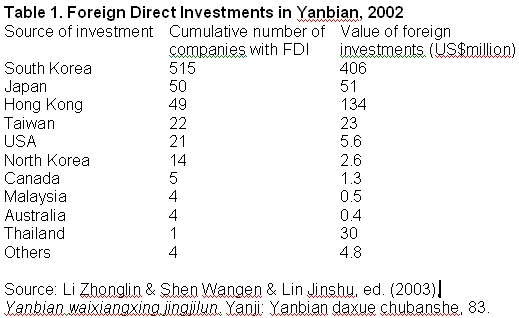
The year 1996 can be seen as a turning point in Yanbian’s foreign economic cooperation. The number of enterprises receiving South Korean investments rose to 393, including large-scale investments. Between 1996 and 1997 the total volume of implemented foreign investment more than doubled. The financial crisis which hit the South Korean economy in the latter years did, however, precipitate a nosedive in South Korean foreign direct investments. South Korea recovered quickly from the crisis, but the number and value of the absorbed FDI would not quickly return to 1996 and 1997 levels. Still, by 2002, total South Korean direct investment projects had risen to 515, which was 74 per cent of all FDI in Yanbian. Their average value (US$790,000) was rather small compared with the average value of FDI from Hong Kong (US$2.7 million), Taiwan (US$1.02 million) and Japan (US$1.01 million). A report compiled by a leading cadre of the Tumen Programme Office, however, revealed disappointment with the type of investments Yanbian had received. Although the number of investments was relatively high compared with other parts of Jilin Province, and South Korean investment accounted for more than two thirds of international investment in Yanbian by 2002,the level of technology, scale, efficiency and compatibility was said to be low. Moreover, the companies experienced huge losses and failed to invigorate the local economy. [4]
Compared with South Korean investment in other parts of China, interest in Yanbian was limited. Shanghai, Tianjin and the coastal provinces Shandong, Liaoning, Jiangsu, and Zhejiang ranked highest in South Korean investment. Investment decisions were guided principally by profitability, not by emotions. By comparison to leading coastal provinces, Yanbian’s infrastructure was meagre, hence South Korean interest in investment low. In addition, South Korean companies could readily recruit Korean-speaking workers from Northeast China to their factories situated in the coastal regions.
The amount of FDI in Yanbian rose gradually in the early 1990s, but foreign trade did not. Yanbian’s foreign trade declined between 1993 and 1996. In the early 1990s Yanbian’s main trade partner was North Korea, which faced mounting economic difficulties leading to a sharp drop in trade in 1993. The other reason for the crash was the establishment of Sino-South Korean official relations. North Korea responded by cutting back on trade. The low quality and narrow selection of Yanbian’s main export products in the early 1990s—cereals, coal, tobacco, sugar—also hindered development of trade with the emerging new trade partners, Japan and South Korea. Yanbian’s foreign trade plummeted from a peak value of US$467 million in 1993 to US$155 million in 1995.
Yanbian responded by launching, in cooperation with South Korean investors, new export products: textiles, yarn, timber, and wooden products. One third of the South Korean-invested companies were engaged in textile manufacturing. Yanbian also imported timber from Russia and North Korea in order to manufacture wooden products for South Korean markets.
In 2003, the value of Yanbian’s trade with North Korea was nearly equal to its trade with South Korea: US$117 million versus US$116 million. Yet two years later, trade with North Korea had expanded to double the value of trade with South Korea. The economic reforms initiated in North Korea in 2002 were presumably one of the main reasons for this increase. In addition, the visit by China’s leader Jiang Zemin to North Korea the same year probably boosted trade relations. However, compared with other regions in China, Yanbian’s trade with neighbouring countries remains small. By comparison, the border city of Dandong in Liaoning Province handles over two-thirds of China’s trade with North Korea.
In reality, Yanbian’s trade with North and South Korea and Russia, like its trade across other land borders, has been much more extensive than official numbers show. Many of the companies involved in foreign trade with North Korea were not registered. Thus, their trade remains outside of the statistics. Similarly, the vibrant shuttle trade with the bordering countries, South Korea included, is not visible in the statistics.
Trade and investment flows between China and the two Koreas have been most intensive in China’s Bohai region, which stretches from Liaoning to Shandong; Yanbian, due to its remote location and less developed infrastructure, has remained a backwater by comparison. Nevertheless, although the Korean investments in Yanbian are relatively few, and registered trade with the two Koreas low, the role of overseas Korean ties in the development of the Yanbian economy has been crucial. China’s central government has provided Yanbian with several preferential polices [5], but it has provided only limited funds to create a solid economic foundation. Supported by preferential policies, Yanbian’s development has largely been financed by South Korea. Today, as Yanbian’s economic structure has become consolidated, domestic companies are showing increasing interest in Yanbian, further supported by the state-sponsored campaign to rejuvenate the economy of Northeast China. This new development could reinforce Yanbian’s position in the Northeast Asian circle of ethnic Korean capital flows.
The patterns of ethnic Korean investments in Yanbian show similarities with overseas Chinese investments in China’s coastal regions. The investments have been small and have not involved high technology. Rather, they have concentrated in the service sector. Cooperation with South Korean companies has provided an important learning process for inexperienced Yanbian Korean companies, helping them to adapt to international cooperation. In southern China, overseas Chinese investments have paved the way for other foreign investors; in Yanbian, overseas Korean investments have created conditions which facilitate the flow of both foreign and domestic Chinese investments into the area. In this way, the foreign investments have in fact supported Yanbian’s integration into China’s domestic economy.
Compared with overseas Chinese community investments in China, the Korean transnational community has been less inclined to invest in South Korea. To a great extent this is the product of South Korea’s restrictive policy on foreign direct investments. South Korea made the first attempts to mobilize its Korean diaspora for economic purposes only in 1997, when the Overseas Koreans Foundation was established. Since 2002, the Foundation has convened annual “World Korean Business Conventions,” which aim at building a global Korean business network in support of the South Korean economy. As South Korea has liberalized foreign investment rules, ethnic Korean investment has started to increase. Yanbian has been ahead of South Korea itself in its organized attempts to mobilize the transnational ethnic Korean community.
Attracting donations and remittances has been a central part of building ties between China and overseas Chinese. By comparison with overseas Chinese donations in Guangdong, overseas Korean donations in Yanbian and elsewhere have been few.
There have, however, been donations directed to schools, institutes and universities, as is the case with Chinese contributions to their hometowns in Guangdong. Some foreign Koreans who lived in Yanbian in their childhood have donated to their alma maters. Donations have included technical equipment, books, periodicals and grants. During fieldwork in Yanbian in 2004, I met with a South Korean businessman who had recently made a donation to a technical institute in Yanbian. Although he was investing in other parts of China, he had chosen Yanbian for his donation because his father and mother were born there.
During the 1990s, Yanbian received institutional donations worth US$10 million. High taxes imposed on donations, as well as corruption, were mentioned as reasons for limiting donations. Remittances to relatives tended to flow out from Yanbian rather than in, as local Koreans helped their relatives in North Korea; indeed, my local contacts emphasized that the main flow of economic support was from Yanbian to North Korea, not from South Korea to Yanbian. Rather than sending money, many South Korean relatives preferred to give generous gifts when they met with their Yanbian relatives. By contrast, significant flows of Korean capital were directed from Yanbian to North Korea. Yanbian Koreans supported relatives and friends in North Korea both financially and by providing clothes and food. Yanbian also served as a channel for South Korean remittances to North Korea. Both South Koreans and North Koreans who lived outside their home country used Yanbian Korean brokers to deliver money to their relatives in North Korea.
Finally, the remittances sent by Yanbian Korean labour migrants from abroad to Yanbian were significant. In 2003, migrant remittances are said to have reached US$650 million. This sum was double the local budget, and fifteen times higher than the value of realized foreign investments in 2003.
Korean Ethnic and Family Ties in the Service of Economic Development
Without a doubt, Korean ethnic ties have given impetus to Korean investors to start businesses in Yanbian. Firstly, ethnic affinity led some investors to invest in Yanbian. Some South Korean researchers of China-South Korean trade have mentioned the Korean population of Yanbian as being advantageous for South Korean investors; for example, the South Korean economist Si Joong Kim assumes that cultural proximity has attracted South Korean small- and medium-sized firms to China’s Korean areas. [6] Yanbian has also attracted Korean interest in its capacity as a link with North Korea. As Yanbian Koreans can easily enter North Korea, information from and about North Korea is readily available there. Local companies can also act as middlemen with North Korean companies. Thus, some investors see Yanbian as a springboard for future investments in North Korea.
The Complexity of Transnational Ethnic Ties as an Economic Resource
Overseas Korean networks have not, however, provided comparable resources to Yanbian as the overseas Chinese networks have provided to Southern China. China’s coastal region possesses a long tradition of entrepreneurship, and the overseas Chinese community is highly business-oriented, factors which have contributed to the rapid economic growth on China’s southern coast. Yanbian, by contrast, was predominantly agrarian, and due to its remote position adjacent to North Korea, its economy has been less developed. The high level of education of the Korean-Chinese has not led directly to economic cooperation with foreign countries, as the highly educated Korean-Chinese have mainly pursued studies in history, literature and the arts. Moreover, they have tended to be oriented toward careers in government, in the performing arts and literature, or in the media. Hence, compared with the overseas Chinese, the Korean transnational community has been less well positioned to invest in Yanbian.
A closer look at certain elements of Koreanness that Yanbian wished to rely on reflects the complexity of ethnic ties as a resource for promoting economic cooperation. Ethnic background or family ties do not automatically generate business. When the Yanbian Koreans won the opportunity to visit South Korea, they were surprised at not receiving a warmer welcome there. Indeed, South Koreans tended to look down on them. For political and cultural reasons, North Koreans were held in even lower esteem in South Korea. As Korean-Chinese were often mistaken for North Koreans when visiting South Korea, due to similar dialect and appearance, they often met rather harsh treatment.
As contacts between Korean-Chinese and South Koreans intensified, the differences in their habits and values also became quite clear. Korean-Chinese and South Koreans had drifted apart during forty years of separation. The resulting differences led to conflicts over values and other misunderstandings between the two groups. According to sociologist Hyun Ok Park, the Korean-Chinese had turned from “long-lost relatives of blood-kin” to a cheap labour force which faced discrimination, arrests, crackdowns and deportations. [7]
Family networks did not provide wide access to business, because the majority of the Yanbian Koreans had their relatives in North Korea. Close ties between the Yanbian Koreans and North Korea constituted a hindrance to trade with South Korea in the mid-1990s. According to one Yanbian Korean contact, those who wished to maintain trade relations with North Korean companies were often unable to seek business partners in South Korea, for fear that the North Korean side would break off the relationship. Although trade with North Korea had become less and less profitable by the mid-1990s, many Yanbian Korean businessmen avoided business contacts with South Korea in order to maintain their partnerships with North Korean companies. Some Yanbian Koreans also feared that cooperation with South Korea would put their relatives in North Korea in a difficult situation.
Loyalty to China
Some Chinese government officials also wanted to avoid the problems which contacts with South Koreans might create. This, especially, seems to have hindered cadres of Korean origin. Due to the strong South Korean connection with Yanbian, and the pan-nationalistic activities aimed at creating a united Great Korea, including Yanbian, Yanbian was classified as one of the four sensitive regions in China where the Central Government fears separatism. [8] The fear is that pan-nationalistic South Koreans might infiltrate Yanbian in the guise of economic cooperation. Some officials, who wished to render their career secure by avoiding all trouble, chose to block cooperation with South Koreans and other foreigners.
The activities of the associations that were pursuing people’s diplomacy with overseas Koreans were closely monitored. One article in the journal of the local Party School stated that strengthening party guidance was essential for people’s diplomacy, and urged close cooperation between associations and the Party. The article even called for Party cells in associations in order to assure that they follow the Party line. [9] In this environment, the prerequisite for an internationally oriented association to be active seemed to be a chairperson who was a trusted Party member.
Similar views were presented in articles prepared by the national-level Ethnic Affairs Commission, Minwei. [10] Korean-Chinese were generally regarded as a patriotic group, having participated in the Civil War on the side of the Communists, and later in the Korean War in the ranks of the Chinese People’s Liberation Army. The starting point in these articles was that the Korean masses should be trusted; leaders should have faith in the Koreans and trust that their political consciousness is strong enough to resist the influence of foreign infiltrators. The second point was that international economic cooperation is essential for Yanbian, so ties with foreigners should be developed. Still, social stability, national unity and border security remained priorities.
There was also concern for the eventual reactions to strong condemnation of Yanbian Koreans as unpatriotic or unreliable. The labelling of Yanbian as a sensitive area (mingan diqu) would convey a lack of trust to local Koreans. It was feared that this would create opposition and disappointment, which could push the Korean-Chinese to the side of infiltrators. There was a clear need to find an appropriate balance between flexibility and control, in order not to obstruct positive economic transfers from the Korean transnational community to Yanbian.
At the same time as concern for the loyalty of Yanbian Koreans arose, exclusivist tendencies in South Korean society produced a counter-force in favour of China. Many Yanbian Koreans became disillusioned because of the discrimination they encountered in South Korea. This strengthened their bonds with China. In addition, in China, they could anticipate rising living standards and could feel pride in belonging to the Korean-Chinese community. Thus, the question of the loyalty of Yanbian Koreans involved multiple contradictory factors.
The Role of Religion
In addition to political ideas, religious activities spread through transnational ties. Christianity was not only perceived by the Chinese leadership as a threat to the “Chineseness” of the Yanbian Korean culture, but Christian congregations were considered to be a disguise for political infiltrators who aimed to disintegrate the country through peaceful means. South Korean missionaries worked not only among Korean-Chinese but also among North Korean migrants and refugees. While in South Korea, many Korean-Chinese encountered Christianity. Until the 1980s, the role of religion had been limited among Korean-Chinese, while in South Korea, one-third of the population were Christians. One contact assumed that the Korean-Chinese migrants were initially attracted to Christianity when they got support from South Korean believers while working under adverse social and economic conditions: Christian organisations provided practical help, like free medical treatment, as well as social and political support. Christian organisations also won support by backing Korean-Chinese demands that South Korean authorities guarantee humane treatment.
Korean churches worked among Korean-Chinese actively not only in South Korea but also in China. They sent both money and personnel to local churches and ran welfare projects. Some churches had established congregations in Yanbian and other areas of China. Many returning migrants joined a local Christian congregation. By the year 1996, the Christian community in Yanbian had grown to include nearly 10 percent of the ethnic Korean population. In addition to return migrants, these congregations also appealed to locals who looked for support in the midst of deteriorating socio-economic conditions.
In order to counteract foreign political and religious infiltrators, three measures were taken in Yanbian in the late 1990s. Firstly, education emphasizing patriotism, socialism and religious policy was intensified. Secondly, leadership was strengthened. Thirdly, control of foreign religious activities was intensified.
Government-Imposed Limitations to Transnational Activities
Yet, various issues remained salient. A report on the new tasks of nationality work from 2001 stated that unequal and slow economic development worked against the cohesion and “centripetality” of minority nationalities. Furthermore, certain international factors and religious activities posed a latent threat to the ethnic unity and social stability in some areas. Yet, this particular document did not provide any policy proposals beyond the routine phrases of training ethnic minority cadres in the spirit of the “three representatives” (sange daibiao). [11] This dilemma will persist as long as the Sino-Korean border exists.
Overall, at the grassroots level, unorganized transnational activities have been allowed to operate freely, but organized activities have only been approved if under the guidance of the Party. At a higher level of institutionalization, whether controlled by individuals, government units, or companies, transnational activities have been required to proceed only according to a strict code of operation. Hence, central tenets of Yanbian’s approved transnational policies can be summarized into two key concepts, viz: trustworthy relations with the centre, and ethno-politically disciplined organizations.
Conclusion
In the course of the 1980s and early 1990s, Yanbian Koreans were gradually linked to the Korean transnational community. Their relationship to this community has since evolved from a fervent Korea-fever to disillusionment. Bernard Vincent Olivier has drawn interesting parallels between the interaction of Yanbian Koreans and North Koreans in the 1960s and the interaction of Yanbian Koreans and South Koreans in the 1990s. In both cases, close interaction initially generated euphoria but later resulted in strengthening the Chineseness of Yanbian Koreans. [12] This tendency was also evident in the early 21st century. Contrary to the fears of China’s leaders, transnational ethnic relations do not necessarily undermine the loyalty of cross-border ethnic groups. Indeed, deeper contacts with ethnic kin abroad may even strengthen minority groups’ ties to the home country.
Although trade and investment flows between China and the two Koreas have been most intensive in China’s Bohai region, the role of overseas Korean ties in the development of the Yanbian economy has been crucial to the locality. As Yanbian’s economic structure consolidates, its position in the Northeast Asian circle of ethnic Korean capital flows might become more significant.
Drawing on traditions of overseas Chinese work, the Yanbian administration was able to mobilize ethnic Korean resources for prefectural development. The mobilization of the Korean transnational community by Yanbian officials was similar to that in overseas Chinese-connected areas such as coastal Guangdong and Fujian, but on a smaller scale. The administration of transnational relations of the ethnic minorities is, however, politically more sensitive in Yanbian than in coastal China since transnational ethnic relations raise questions about border security and separatism. Nevertheless, transnational ethnic relations have been allowed to expand and deepen in relatively unrestricted ways, compared, for example, with those involving the Uyghurs of Xinjiang. This suggests the possibilities of ethnicity-based cross-border economic activities in China.
The mobilization of transnational linkages has provided China with substantial resources that have contributed to China’s rise. While this has been widely recognized with respect to the Chinese diaspora, far less attention has been paid to linkages with Koreans abroad. Yet China has clearly embarked on major efforts, both at the center and in localities, to draw in overseas resources to support China’s rise.
Editors’ note: This article refers to Chinese persons of Korean descent as Korean-Chinese (Korean-Chinese in Yanbian are frequently termed Yanbian Koreans). Other English-language literature, including the author’s PhD thesis, refers to Korean-Chinese as Chinese-Koreans. Chinese usage is closer to “the Korean nationality” or “the Korean minority nationality.”
Outi Luova is a senior researcher at the Centre for East Asian Studies, University of Turku, Finland. Her PhD thesis dealt with the attempts of the Yanbian government to utilize transnational Korean ethnic capital for the economic development of Yanbian. She can be contacted at [email protected]. This article is a revised version of an article that appeared in China Information 2006:1. Many thanks to Mark Selden for comments on earlier drafts of this article.
On Gaoguli/Goguryeo (or Koguryo), see “Competing Nationalisms: The Mobilisation of History and Archaeology in the Korea-China Wars over Koguryo/Gaogouli,” “The Legacy of Long-Gone States: China, Korea and the Koguryo Wars,” and other Japan Focus articles searchable using the keyword “Koguryo.” On border politics and cultural politics, see “Dance or Else: The Politics of Ethnic Culture on China’s Southwest Borders.”
Notes
[1] Ahn, Yonson (2006). “Competing Nationalisms: The Mobilisation of History and Archaeology in the Korea-China Wars over Koguryo/Gaogouli.” Japan Focus, February 9.
[2] Dong-Hoon Seol and John D. Skrentny (2005). “South Korea: Importing Undocumented Workers.” In Cornelius W. et al., eds., Controlling Immigration: A Global Perspective. Stanford, California: Stanford University Press, 489.
[3] Faist, Thomas (2000). The Volume and Dynamics of International Migration and Transnational Social Spaces. Oxford: Clarendon Press, 106, 109.
[4] Sun Xingbiao ( 2001). Guanyu Yanbian duiwai kaifang wenti de sikao. A report by the deputy director of the Tumen Programme Office (no date available). In Zhu Hongqi, ed., Zhongguo dangdai juece wenku. Yanbian Chaoxianzu zizhizhou lingdao ganbu diaocha lunwen ji. Shang juan. Beijing: Xueyuan chubanshe, 274.
[5] These policies include preferential policies for ethnic minority regions: the Tumen River Development, the Development of the West, and the Development of the Old Industrial Basis of the Northeast.
[6] Si Joong Kim (1994). “Korean Direct Investment in China: Perspectives of Korean Investors.” In Sumner J. La Croix, Michael Plummer, and Keun Lee, eds., Emerging Patterns of East Asian Investment in China: From Korea, Taiwan, and Hong Kong. Armonk, New York: M. E. Sharpe, 205.
[7] Park, Hyun Ok (1996). “Segyehwa: Globalization and Nationalism in Korea.” In The Journal of the International Institute 4:1. www.umich.edu/~iinet/journal/vol4no1/segyeh.html.
[8] The other sensitive regions are Inner Mongolia, Xinjiang, and Tibet.
[9] Jin Yongwan (1999). Shilun shehui zhuyi xiandaihua jianshe he minjian waijiao. Yanbian dangxiao xuebao 1. CNKI Database.
[10] Yanbianzhou Minwei (1997). Duiwai kaifang duinei gaohua zhashi gongzuo cujin bianjiang de wending he fanrong. Speech given by a cadre in a responsible position in the Yanbian Minwei at a national meeting on Minwei’s work in border areas. Minzu gongzuo 5; Wang Tiezhi & Li Hongjie 1997. Duiwai kaifang yu zhongguo de chaoxianzu. Minzu Yanjiu 6
[11] Han Changzhen (2001). Dangqian wozhou minzu gongzuo minlin de yixiang xin renwu. Report by deputy head of the Standing Committee of the People’s Government in the Yanbian Prefecture (no date available). In Zhu Hongqi, ed., Zhongguo dangdai juece wenku. Yanbian Chaoxianzu zizhizhou lingdao ganbu diaocha lunwen ji. Shang juan. Beijing: Xueyuan chubanshe, 286.
[12] Olivier, Bernard (2001). “Ethnicity as political instrument among the Koreans of Northeast China, pre-1945 to the present.” Korean and Korean-American Studies Bulletin 12:1.