DPRK fertilizer imports 2013

May 27th, 2013

UPDATE 1 (2013-5-27): The DPRK has significantly its imports of Chinese fertilizers. According to Yonhap:

North Korea’s fertilizer imports from China jumped nearly five-fold last month from a year earlier, a report showed Monday, pointing to Pyongyang’s efforts to increase agricultural produce.

The North brought in 91,318 tons of Chinese fertilizer in April, compared with 15,218 tons a year earlier, according to the report released by Kwon Tae-jin, an analyst at the Korea Rural Economic Institute.

For the January-April period, the total fertilizer imports from China, the North’s closest provider of resources, came to 121,109 tons, 4.6 times more than those shipped in for the same four months last year, according to the report based on data from the Korea International Trade Association.

The sharp increase in fertilizer imports seems unexpected, given that China is imposing high-rate export customs in order to limit outbound shipments of Chinese fertilizer, Kwon said.

“The increase this year shows that the North is putting top priority on boosting productivity in the agricultural sector as well as that the conditions for fertilizer production in the North Korea are in a bad shape,” the analyst said.

The report also showed that the North imported 25,850 tons of grains like rice and corn from China last month, only half of what it brought in from China a year earlier.

Read the full story here:
N. Korea’s fertilizer imports from China jump 5-fold in April
Yonhap
2013-5-27

Original Post (2013-4-30): According to Yonhap, the DPRK has increased its imports of Chinese fertilizers.

According to the report by the Korea Rural Economic Institute (KREI), Pyongyang bought 29,791 tons of chemical fertilizers from its neighbor, up 3.6 fold from the 6,530 tons it imported for the same three month period in 2012.

It said for March alone, the country brought in 28,725 tons of fertilizer.

“Normally the North imports fertilizers in April,” said Kwon Tae-jin, a research fellow at KREI. He said the fact that it bought so much ahead of when it usually imports the product means Pyongyang may be interested in improving farm output.

North Korean leader Kim Jong-un had said earlier in the year that the North needs to concentrate on farming and light industries in 2013 because they directly impact the everyday lives of people.

The expert, in addition, speculated that a surge in imports could be the result of problems in local fertilizer production.

The latest findings based on data provided by Korea International Trade Association, meanwhile, showed the North importing 54,178 tons of grain from China in the first quarter, an increase of 31.6 percent from the year before.

Total imports as measured in dollars also jumped 39.2 percent on-year to US$24.71 million from $17.75 million in the first three months of last year.

Read the full story here:
N. Korea’s imports of Chinese fertilizers jump in Q1: report
Yonhap
2013-4-30

Share

DPRK in default on ROK food loans

May 24th, 2013

UPDATE 2 (2013-5-24): South Korea has again requested that the DPRK repay past food loans. According to Yonhap:

South Korea again called on North Korea Friday to repay millions of dollars in loans provided in the form of food since 2000, the Unification Ministry said.

The impoverished North missed the June 7, 2012 deadline to repay South Korea US$5.83 million in the first installment of the $724 million food loan extended to the North in rice and corn. The latest call is the South’s fifth demand made on the North to repay its debt.

Seoul’s state-run Export-Import Bank (Eximbank) sent a message on Thursday to Pyongyang’s Foreign Trade Bank, calling for the repayment, Unification Ministry spokesman Kim Hyung-suk said in a briefing.

The South Korean bank also sent another message the same day, notifying the North of its forthcoming June 7th deadline to repay the second installment of $5.78 million, the spokesman said.

“North Korea should faithfully abide by what they previously agreed to with the South,” Kim said, calling for the repayment of food loans.

Amid a conciliatory mode under the liberal-minded late President Kim Dae-jung, Seoul started to provide food loans to the famine-ridden country, providing a total of 2.4 million tons of rice and 200,000 tons of corn from 2000-2007.

Under the deal, the North is required to pay back a total of $875.32 million by 2037.

Read the full story here:
S. Korea again asks North to repay food loans
Yonhap
2013-5-24

UPDATE 1 (2012-7-15):  South Korea claims the DPRK missed a deadline for explaining how it intended to repay South Korean “loans”. According to Yonhap:

North Korea missed the deadline Sunday for notifying South Korea of how it will repay millions of dollars in loans provided in the form of food in 2000, resulting in Seoul having the right to declare Pyongyang has defaulted on its debt, an official said.

South Korea sent the North a message on June 15 that the communist nation was supposed to have paid back US$5.83 million in the first installment of a 2000 food loan worth $88.36 million by June 7. The North was required to respond to the message in 30 days.

That deadline passed on Sunday with the North remaining silent, giving South Korea the right to declare the North has defaulted on the debt, according to a government official in Seoul.

But South Korea is unlikely to go ahead with the declaration any time soon as it would have little effect on the North. The communist nation remains largely outside of the international financial system and the prospect of national default is unlikely to force it to repay its debt.

Officials said they are considering sending Pyongyang a message again calling for debt repayment.

Widespread views are that it won’t be easy for the North, which is still struggling with food shortages, to pay back its debt, but officials said the country could repay the debt in kind as it did before. In 2007 and 2008, the North repaid some debt with $2.4 million worth of zinc ores.

After the two Koreas held their first-ever summit in 2000, South Korea provided the North with a total of US$720 million in loans of rice and corn until 2007. Including interest accrued on the loans, the North is required to repay some US$875 million by 2037.

Such aid has been cut off after the South’s President Lee Myung-bak took office with a pledge to link any assistance to the North to progress in international efforts to end Pyongyang’s nuclear weapons programs.

The Daily NK also covered the story.

ORIGINAL POST (2012-6-8): According to Yonhap:

North Korea has not shown any signs of repaying the loans South Korea extended in food grains since 2000 although the initial day of the scheduled repayment passed as of Thursday. The South Korean government provided North Korea grain loans worth US$725 million for seven years until 2007, including 2.4 million tons of rice and 200,000 tons of corn. The total principal and interest North Korea should repay for the next 20 years is estimated at $875.32 million.

North Korea was scheduled to pay South Korea $5.83 million by Thursday for the loans extended to it in 2000. Korea Eximbank, which is in charge of trade finance with the North, notified its counterpart the Chosun Trade Bank of North Korea of the repayment obligation Monday but North Korea had not responded of Friday.

The former South Korean governments led by President Kim Dae-jung and Roh Moo-hyun provided an estimated 1 trillion won (US$850 million) to North Korea from 2000 to 2007 under the sunshine policy. South Korea provided an additional 1.37 trillion won to North Korea to finance the construction of a light water reactor in order to suspend North Korea’s nuclear development. All the loans to the North were taxpayer’s money.

North Korea should show sincerity in the repayment of these loans for the sake of its future. If it fails to do so, the North will encounter substantial difficulties in accessing further loans from the international community. North Korea also has failed to repay loans it borrowed from the old Soviet Union. Russia reportedly had to reduce 90 percent of the Norths loans, worth $11 billion.

If North Korea has difficulties repaying its debts to South Korea in cash, it should sincerely discuss alternative measures to repay the loans with the South Korean government.

The South Korean government should positively consider measures to get the money back in kind, such as in mineral resources. North Korea should understand that if it fails to show the minimum sincerity on the repayment of its debts, it will experience much more difficulty in attracting economic assistance from the outside world.

The Choson Ilbo reports this additional information:

In 2007 and 2008, South Korea also gave the North $80 million worth of raw materials to produce textiles, shoes and soap. At the time, North Korea repaid 3 percent of the loan with $2.4 million worth of zinc ingots. Repayments of the remaining $77.6 million become due after a five-year grace period, so North Korea must start repaying $8.6 million a year every year for 10 years starting in 2014.

Seoul also loaned Pyongyang W585.2 billion (US$1=W1,172) from the Inter-Korean Cooperation Fund so it could re-connect railways and roads with the South that were severed in the 1950-53 Korean War. And it provided W149.4 billion worth of equipment to the North. The North must repay that loan in 20 years with a 10-year grace period at an annual interest of 1 percent.

It also seems unlikely that South Korea will be able to recoup W1.37 trillion plus around W900 billion in interest it provided North Korea through an abortive project by the Korean Energy Development Organization to build a light-water reactor.

The loans amount to a total of around W3.5 trillion, which the South will probably have to write off.

The Daily NK also reported on this story.

Read the full story here:
North Korea should show sincerity in repaying South Korea loans
Yonhap
2012-6-8

N.Korea Misses 1st Loan Repayment Deadline
Choson Ilbo
2012-6-8

Share

North Korea passes city beautification law

May 23rd, 2013

Institute for Far Eastern Studies (IFES)
2013-5-23

It has been confirmed that North Korea has passed a ‘City Beautification Law’ and that it is moving ahead in earnest with environmental beautification projects.

On May 9, 2013 the mouthpiece of North Korea’s cabinet, the Minju Chosun, introduced the city beautification legislation in its ‘Regulations Explained’ section. This is the first time city beautification has been mentioned in one of North Korea’s major publications. The Ministry of Unification claimed that “it has not yet been confirmed” whether this law has been enacted. The City Beatification Law was not included in the Complete Collection of North Korean Statutes which was published in October 2012. As such, one can infer that the City Beautification Law was enacted in the last few months.

According to Minju Chosun, the City Beautification Law is a five page document consisting of 42 clauses. The law’s purpose is “to contribute to providing a culturally sanitary living environment to the North Korean people by setting up strict institutions and establishing order in the following areas: the city cleaning industry, the beautification of buildings and facilities, and city planning.” The City Beautification Law sets regulations that provide for the participation of the North Korean people in the business of city beautification. It also establishes city beautification sectors for management by civic organizations, government agencies, and enterprises.

The legislation includes content which calls on North Koreans to strengthen cooperation and international exchanges in terms of city beautification. It also encourages scientific industry research for the sake of city beautification and the expansion of investment in the city beautification industry. Minju Chosun emphasized that city beautification is not something which can be taken on by only a few individual civic groups. Emphasizing that city beautification is a project which must be conducted on a national scale, the paper reported that, “it is a huge task which must be undertaken by all people across the country.”

Recent reports from major news centers in North Korea seem to confirm that North Korea is concentrating efforts in the city beautification business. In an April 3 article entitled “The Urban Planning Industry is a Noble Patriotic Industry,” Rodong Sinmun, the official paper of the Korean Workers’ Party, reported that “Continually, a great effort must be put into the innovation of the appearance of North Korea’s cities.” The paper suggested beautification techniques such as remodeling the facades of buildings, conserving fences, city planning, paving sidewalks with precast pavers, gardening and afforestation of areas around streams, and riverbank beautification.

On April 9, Pyongyang Broadcasting reported that Independence Road Park is being constructed in the Mangyongdae region as a relaxation area for workers and students. The park is projected to have facilities for volleyball, basketball, roller-skating, and mini-golf. At the end of last month, the Sweetbrier Center, a state of the art civic center, was opened on the bank of the Daedong River.

One is able to get a sense of North Korea’s plans for environmental beautification from Kim Jong Un’s recent statements and activities. While visiting the National Science Center Biological Building’s Turf Research Center, Kim emphasized the importance of cultivating grass: “Grass gives the ground a beautiful appearance by covering its exterior like silk. It plays an important role in protecting national land and in cultivating our living environment both culturally and in terms of sanitation.”

According to Kim’s statement, it can be assumed that the City Beautification Law’s enactment was driven by Kim Jong Un’s emphasis on building a “civilized socialist country.” The expansion of the task of city beatification from Pyongyang to other regions coincides with the slogan coined by the Kim regime: civilized socialist country. That the city beautification business is backed by legislation suggests it will not be a short term policy.

Share

UNFPA provides medical aid to DPRK

May 22nd, 2013

According to Yonhap:

A United Nations organization supporting child birth has provided US$500,000 worth of medical aid to North Korean mothers and children, a report said Wednesday.

The United Nations Population Fund (UNFPA) shipped drugs and medical equipment for mothers with newborn babies in the North last month, the report by the Washington-based Radio Free Asia said.

The goods were sent to about 300 health facilities in the country and the UNFPA tapped into the U.N.’s Central Emergency Response Fund in order to provide the assistance, it said.

With a budget of $10 million, the UNFPA has been leading a five-year project to help pregnant North Korean women and conduct a census in the communist country since 2011.

Maternal death in the North reached 77 in 2008, up 40 percent from 54 recorded in the 1990s, according to the UNFPA. The rate refers to the number of women dying from child birth-related complications per 100,000 live births.

Read the full story here:
UNFPA provides US$500,000 in medical aid to N. Korean mothers
Yonhap
2013-5-22

Share

DPRK frees Chinese fishing boat

May 21st, 2013

UPDATE 1 (2013-5-27): According to the Global Times (PR China):

Chinese agencies operating in Dandong, Northeast China’s Liaoning Province have been implicated in the seizures of Chinese fishing boats for ransom by armed North Koreans.

The Beijing Times quoted Zhang Dechang, whose boat was seized by North Koreans in May last year, as saying that he was given a cellphone number registered in Dandong and was demanded to pay a ransom to the cellphone owner. However, Zhang failed to reach the cellphone owner, and the number later was canceled.

The report said Zhang asked the boss of a Chinese agency in Dandong, which represents North Korea in handing out licenses for Chinese fishermen to fish in North Korean waters, for mediation but was turned down. He claimed a Chinese boat took part in the looting of his boat when the North Koreans seized it.

A North Korean patrol ship, which has hijacked several Chinese fishing boats, is said to be a retired Chinese ship and given to the North by a Chinese agency, the report said.

Yu Xuejun, whose boat was hijacked by North Koreans for two weeks this month, earlier told the Global Times that the kidnappers asked him to pay ransom to a bank account of a company in Dandong, but he failed to catch the name of the company.

The Guangzhou-based Nandu Daily quoted an unidentified fishing boat owner as saying that the Chinese agencies in Dandong are related to the company which is collecting the ransom.

There are three major agencies in Dandong representing North Korea. The fishing boats, which obtained licenses from the agencies, fly both Chinese and North Korean flags and can enter certain areas inside North Korean waters.

The Chinese boat owners, whose boats had been hijacked, insisted that their boats were operating in Chinese waters when they were captured.

Sun Caihui, whose boat was seized by North Koreans in May last year and released after the intervention of the Chinese government, told the Global Times Monday that local fishermen have been operating on the western side of 124 degrees east longitude for generations, which has long been regarded as the demarcation line of the sea border between China and North Korea.

“We aren’t going to take the risk of being seized by the North Koreans again,” he said, calling on the government to clarify the sea border with the North so as to address the concerns of fishermen.

However, there is no available official documentation on the sea demarcation between the two countries.

Meanwhile, Sun Chen, a professor from Shanghai Ocean University, said Monday that the Chinese fishery authority should strengthen law enforcement activities to protect the fishermen.

“Currently, we face shortages in personnel, equipment and spending of the fishery management department. The government should attach importance to the building of the law enforcement force,” she said.

ORIGINAL POST (2013-5-21): According to Bloomberg:

North Korea freed a Chinese fishing vessel and its crew after the boat’s owner posted updates on his microblog account saying that he’d been told to pay a 600,000-yuan ($97,800) ransom to win their release.

The ship and its crew, from the northern city of Dalian, were freed today, the official Xinhua News Agency reported, citing a Chinese consular officer in North Korea. The ship’s owner, Yu Xuejun, said on his Tencent Holdings Ltd. (700) microblog account today that he couldn’t come up with the cash and was “thankful to the Foreign Ministry for its diplomacy.”

China, which filed a formal complaint over the detention, is asking North Korea to investigate and “make a full explanation to us,” Foreign Ministry spokesman Hong Lei said today. No ransom was paid to secure the crew’s freedom, China National Radio reported today, without citing anyone.

“There is no territorial confrontation between China and North Korea,” the editorial said. “It’s more likely the North Korean military police are using the ambiguity of maritime borders to make a quick buck.”

Last year a North Korean ship seized three Chinese fishing and demanded 300,000 yuan to free each vessel.

Read the full story here:
North Korea Frees Chinese Fishing Boat After Ransom Report
Bloomberg
2013-5-21

Share

Inter-Korean trade tumbles

May 21st, 2013

According to Yonhap:

Trade between South and North Korea tumbled last month after the North shut down the jointly run industrial park in its border town of Kaesong, government data showed Tuesday.

The monthly inter-Korean trade volume came to US$23.43 million in April, down 88 percent from $194.27 million recorded the previous month, according to the data from the Ministry of Unification in charge of inter-Korean affairs.

The April figure is almost similar to the average monthly trade volume of $23.94 million registered in 1995.

In early April, the North banned the entry of South Korean workers and materials into the Kaesong Industrial Complex and withdrew all North Korean workers employed by South Korean firms there in protest against Seoul’s joint military exercises with the U.S. in March.

Trade between the two countries, which remain technically at war since the 1950-53 Korean War ended in an armistice, had steadily increased since late in the 1980’s to register an annual record of $1 billion in 2005.

Read the full story here:
Tnter-Korean Trade Tumble
Yonhap
2013-5-21

Share

Kim Jong-un’s directions on improving economic management

May 20th, 2013

Institute for Far Eastern Studies (IFES)
2013-5-20

High ranking North Korean officials have relayed that, since last year, North Korea’s Kim Jong Un has on several occasions provided direction on improvements for economic management methods and that some new measures are being implemented on an experimental basis.

In a May 10, 2013 interview with the Choson Sinbo, North Korean Cabinet secretariat Kim Ki Chol and National Planning Committee director Ri Yong Min relayed that “Kim Jung Un spoke on several occasions, both this year and last, about the time to fix economic management practices and delegated related responsibilities to students and laborers.” The officials added, “We are holding rounds of consultation and discussion together with research institutes and representatives of several economic sectors.”

The officials further stated that “Out of these consultations have emerged a number of promising economic proposals which we are putting into practice on an experimental basis. In the case that they show positive results, we plan to introduce them across the country. Most remain in the research stage.” These remarks indicate that North Korea is embarking on some kind of economic reform measures.

These statements seem to confirm that North Korea’s economic measures are being driven by the direct orders of Kim Jung Un, such as the ‘June 28 Measure’ (i.e., policy on agriculture). They also suggest that once measures clear the testing stage, they will be implemented on a national scale.

They also explained that while additional new economic control measures are being adopted, these measures at the same time deal with issues related to production planning, price adjustment, and currency circulation. They added that new laws would have to be created, and explained that measures were being expanded that allow for the expansion of authority in the interest of reinvigorating production at factories and industrial sites.

Mention of price adjustment and currency circulation suggests that North Korea’s new economic reforms may not be limited to farms, factories, and industrial sites; rather, it hints at the possibility that North Korea will embark on much larger scale reform extending to the financial sector.

They explained that some farms which carried out the national plan last year implemented land distribution, and contributed to the right of factories and industrial sites to sell and trade freely. They added that such steps reflected the demands of workers.

The officials were reserved in their comments in regard to the timing of any future announcements related to North Korean economic measures: “If successes are consistent we can advance the reforms on a wide scale; but, for now, we need to keep an eye on progress.”

The officials added that they were being retrained in management at the University of the People’s Economy and taking classes about farm management and management at Kim Bo Hyun College.

North Korea emphasized the construction of an economic powerhouse at the beginning of May, and it is currently heating up in the fields of industry and farming by encouraging an increase in production. In relation to this, the Korean Workers’ Party is mobilizing media sources including the Rodong Sinmun, the Korean Central News Agency, and Korean Central Broadcasting.

Particularly, these media sources are emphasizing that obtaining a nuclear deterrent is the greatest asset on the road to economic construction. They are also claiming that increase in production is one means for the achievement of the new economic line of pursuing simultaneously economic construction and building of a nuclear force.

Now that the annual US-ROK joint unit tactical military field training drills, i.e., ‘Foal Eagle’, have concluded (as of April 30) and tensions on the Korean peninsula have subsided somewhat, North Korea’s new economic line is being assessed as one which is aimed at enhancing the economic livelihoods of North Koreans.

Share

Bird flu in the heart of Pyognyang

May 20th, 2013

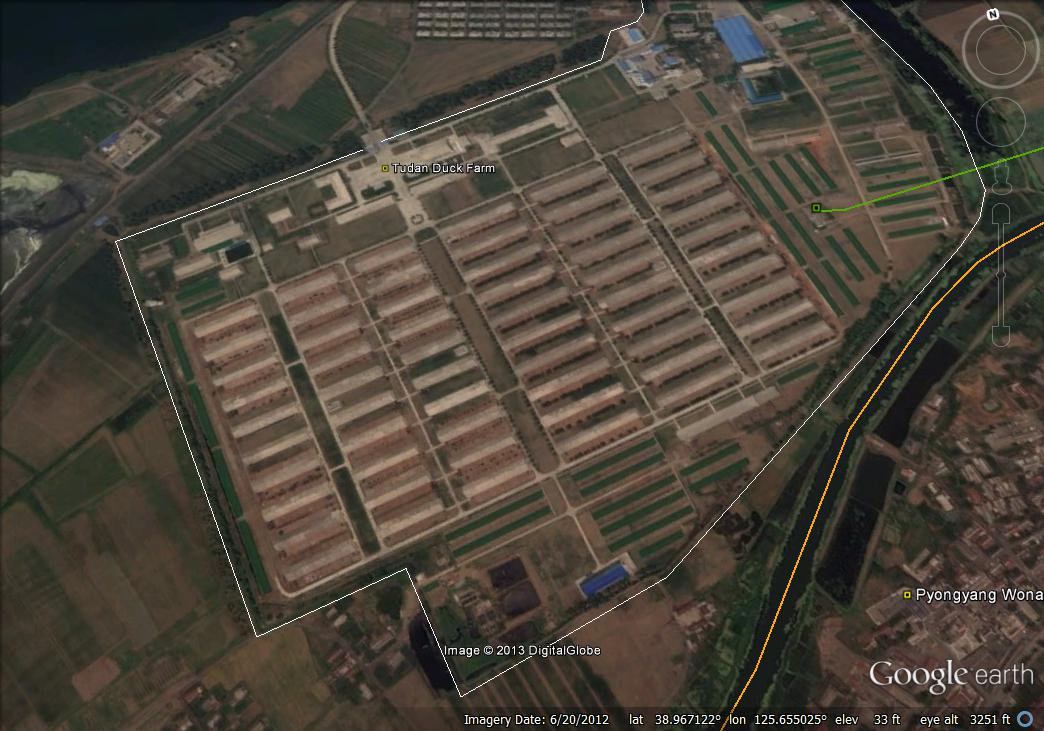
tudan-duck-farm

Pictured above (Google Earth): Tudan Duck Farm

UPDATE 1 (2013-6-11): According to Yonhap (via Global Post):

North Korea has reported to the international agency on animal health that the country has seen no new bird flu cases since early last month, agency officials said Tuesday.

Ri Kyong-gun, the North’s agricultural department chief, said, in a report sent to the World Organization for Animal Health (OIE), “There are no new outbreaks” as of May 22, some 10 days after a duck farm near Pyongyang reported animals showing symptoms of avian influenza, known as the H5N1 virus.

While the source of the outbreak and its origin are not yet known, the communist country “humanely culled all ducks in the infected cages and has vaccinated 500,000 heads nationwide,” the official said in the report.

According to the comments there, weekly follow-up reports will be submitted, “as the event is continuing.” The May 22 report is the latest one available on the OIE website.

The international agency earlier said the highly contagious virus was presumed to be spread by migrating birds from China, where its Tibet Autonomous Region saw 35 chickens die at a farm after showing symptoms of avian flu.

In a move to conduct an on-spot inspection into the recent cases and to help North Korea with quarantine activities, three experts from the OIE and the Food and Agriculture Organization made a one-week trip to the communist country from June 3, the Washington-based Voice of America said.

An outbreak of the avian flu led to a mass cull of 210,000 chickens in North Korea back in 2005.

ORIGINAL POST: According to KCNA (2013-5-20):

DPRK Strives to Prevent Spread of Bird Flu Virus

Pyongyang, May 20 (KCNA) — The Democratic People’s Republic of Korea has been making big efforts to prevent the spread of the bird flu virus.

According to an examination made by the Central Epizootic Prevention Center and the Veterinary Institute under the Academy of Agricultural Science on May 7, it was found that ducks in the Tudan Duck Farm in Pyongyang were infected with the H5N1 virus by migratory birds. They briefed UN bodies concerned on this situation while taking steps to kill as many as 160 000 ducks in the farm and quarantine and disinfect it.

More than 1 360 veterinary epidemic control teams are now working throughout the country to keep a close eye on poultry and movement of wild birds. Efforts are made to raise the diagnosis capability of provincial epizootic prevention organs and increase preventive medicines.

Meanwhile, preventive measures are being taken against H7N9 virus under the direction of the State Emergency Anti-epidemic Committee. They include checkup of persons from the bird flu virus-hit areas, test and quarantine of poultry and restriction on movement of living fowls. A strict step was taken to hedge fowl, duck, pigeon and other domestic poultry off from the outer world.

Intensive hygienic information service is going on among inhabitants.

Additional information as the WSJ Korea Real Time.

Share

Concentration on economic construction based on nuclear deterrance

May 9th, 2013

Institute for Far Eastern Studies (IFES)
2013-5-9

The official mouthpiece of the (North) Korean Worker’s Party, Rodong Sinmun, claimed on May 3, 2013 that the key to rapid economic growth was to concentrate on economic construction based on the country’s foundation as a powerful nuclear state and obtaining a powerful nuclear deterrent.

On the same day, it ran an editorial entitled “Our Party Line of Economic Construction and Nuclear Weapons Development Is Permanent”, which claimed that “as demonstrated throughout history, the greatest path to economic construction is developing a reliable nuclear deterrent.”

While this is a restatement of the nuclear weapons development and economic construction plan adopted on March 31 at a plenary session of the Party’s Central Committee, it also indicates that in the future North Korea may focus on capital investment in the economic sector.

The editorial mentioned the importance of developing the nuclear energy industry, uranium resources, and the knowledge and skills of North Korea’s nuclear technicians. It also mentioned that “Kim Il Sung and Kim Jong Il provided us with a robust nuclear energy industry and we possess both inexhaustible supplies of uranium and world-renowned nuclear technicians.” The article also claimed that “the Party’s policy is based on our sovereign right to nuclear power and while developing nuclear weapons, the Party aims to address the issue of insufficient electric power.” This can be seen as an indication that North Korea intends to make use of its nuclear technology in solving its electricity woes.

In respect to the current political situation on the Korean peninsula, the editorial commented, “the current state of affairs in the future is dependent on the attitudes of the enemy that could take a turn toward a nuclear war or appeasement.” It denounced the United States, saying that “whether it adopts a hard line or appeasement policy, its nefarious attitude toward our republic, contriving the collapse of the regime remains unchanged.”

It claimed the only solution to alleviate the tension on the Korean peninsula and to improve relations with the South was through reinforcement of nuclear power and economy which can “ultimately terminate the schemes of the external powers and accelerate our nation’s long-cherished wish of national reunification.”

The principle of self-reliance was named as the imperative strategy to engender major revolution and growth and encouraged “all sectors, ranging from the Workers’ Party to business administration, education, literature and arts, must establish innovative and effective ways that meet the realistic demands of development and overcome schemas and rigidity.”

Share

DPRK debt

May 8th, 2013

The Impossible State: North Korea, Past and Future, Victor Cha, 2012, p116-118.

The third bad decision took place in the 1970s. It related to foreign debt. The DPRK continued the same trends of previous decade as economic resources were diverted to the military. Despite having half the population, North Korean military spending exceeded that of the South every year from 1968 to 1979. The buildup of this decade included increasing the size of the armed forces from 485,000 to 680,000, which was twice that of the ROK. By 1980, troop number stood at 720,000 and continued to swell, with the majority deployed along the thirty-eighth parallel with their sights set on the South. Special forces grew from 15,000(1970) to 41,000(1978)The military began Scud missile development, boosted its submarine and surface flee, and the air force grew to over 200 attack plane. The army added 2,500 armed personnel carriers, about 1,000 heavy tanks, and 6,000 or so artillery tubes and rocket launchers. Military doctrine was revamped to increase the speed, power, and lethality of attacks in combat, focusing on rapid advance advance and infiltration tactics. In spite of its relatively limited technological base, by 1992 the North had twice the number of tanks and artillery that U.S-ROK defenses had in the South.

Academic Lee Hy-Sang, who has written one of the best scholarly treatment of the North Korean economy, has noted that this obsession with aggrandizing the military was driven by ideology as much as it was by external security threats. Self-reliance required the strongest military one could muster. The net effect, however, was an increasingly reckless and irresponsible approach to the economy. In order to offset the strain of the military budget on the economy, the DPRK should have directed efforts at excavating coal and other mineral resources to trade for hard currency, which mighty then have been used to finance heavy industry development, and to address energy shortages. Instead, the government decided to engage in massive borrowing from foreign markets. At the times, it seemed like the right decision. Sino-American rapprochement and U.S.-Soviet detente transformed relations between the East and West, and in this wider political context Western European countries were willing to extend credit to countries like North Korea. More important, the North began looking over its its shoulder as the 1970s saw the gradual acceleration of South Korean growth and development of major heavy industries like the Pohang Steel Complex.

So, in 1972, Pyongyang borrowed $80 million from France to build a fertilizer plant. The following year they borrowed another $160 million, from the United Kingdom to build a cement factory. In 1974, they borrowed $400 million from countries including Japan for large-scale plant equipment. In fact, between 1970 and 1975, the North borrowed approximately $1.2 billion before foreign governments realized that Pyongyang could not service the debt, These numbers do not account for whatever else might have been provided to the North from Eastern bloc countries and China.Thus, in 1976, the debt market dried up for the North as precipitously as it had opened to them six years earlier. Trapped by it own self-reliance ideology, the North could not do things normal nations would, such as issue bonds to finance its debt. Today, North Korea’s external debt is estimated $12.5 billion and no one expects them to pay it off. An attempt was made to pay back some of this in 1990 and 1991, but the DPRK has long since defaulted on its long-term debt. Pyongyang has occasionally asked Russia and former Soviet satellites like Czech Republic to forgive the majority of the debt. In response, these countries have asked for North Korea to repay part of the debt through barter. Pyongyang asked Russia in 2007 to make a “high-level political decision” to forgive $8.8 billion in unpaid debt. In August 2010, Prague asked for zinc ore as repayment for an outstanding $10 million in unpaid loans from the Cold War when it provided Kim Il-sung with machinery and equipment. Pyongyang responded that it would provide four hundred tons of “heavenly ginseng root” worth some $500,000. Since annual consumption of the root in the country was barely two tons, this would have kept Czechs well-stocked with ginseng—which, among its many reported benefits, boasts of enhancing sexual vitality—for two hundred years. As unusual secondary market has emerged for North Korean debt that a few courageous investors have dared to enter. It sells DPRK debt paper at about 6 cents on the dollar, based on the bet not that Pyongyang would ever repay but that under a future unification scenario, South Korea would want to reestablish North Korean creditworthiness as it worked to gradually reintegrate the two systems. If Seoul were to take on this debt, it could repay it all, speculators hope, with only one week’s addition to its foreign exchange reserves. Even if Seoul were to pay off only a portion of the debt, speculators could make six to seven times what they have paid for North Korean paper.

Share