Archive for the ‘Transportation’ Category

In Kim’s North Korea, cars are scarce symbols of power, wealth

Tuesday, July 10th, 2007

Bloomberg
Bradley Martin
7/10/2007

A black Volkswagen Passat with smoked windows glides down a suburban Pyongyang road. Its license plate begins with 216 — a number signifying Kim Jong-il’s Feb. 16 birthday, and a sign the car is a gift from the Dear Leader.

Even without a 216 license plate, a passenger sedan bestows VIP status in a country where traffic is sparse and imports are limited by external sanctions and domestic restrictions alike.

Just across the border, South Korea is the world’s fifth-largest automotive manufacturer. To an ordinary North Korean, though, a private car is “pretty much what a private jet is to the ordinary American,” says Andrei Lankov, author of a new book “North of the DMZ: Essays on Daily Life in North Korea.”

He estimates there are only 20,000 to 25,000 passenger cars in the entire country, less than one per thousand people.

Discouraging private car ownership is not just a matter of ideology in a communist country, Lankov said in a phone interview from Seoul, where he teaches at Kookmin University. The passenger car, usually black and chauffeur-driven, “is the ultimate symbol of the prosperity of high officials,” he says. They keep the vehicles scarce “so everybody knows they are the boss.”

Measuring, copying

North Korea moved early — shortly after the Korean War, and ahead of the South — to mass produce trucks and 4-wheel-drive Jeep-type military vehicles. Craftsmen took apart imported Soviet tractors, trucks and utility vehicles, measuring the parts to make copies.

The indigenous civilian passenger-car industry, too, mostly made knockoffs of models produced elsewhere. After importing a fleet of Mercedes-Benz 190s, the country produced replicas under local model names into the 1990s. Unfortunately, the domestically-made copies were dogged by reports about “terrible overall quality,” says Erik van Ingen Schenau, author of a new pictorial book, “Automobiles Made in North Korea.”

Lee Keum-ryung, a former used-car trader who defected from North to South Korea in 2004, agrees. The knockoffs came with “no air conditioning, no heater, and they’re not tightly built or sealed,” he says. “If you drive out of the city and return, your car will be full of dust. It’s like an oil-fueled cart.” Lee, 40, uses a pseudonym because he fears repercussions from North Korea.

Slow recovery

Material and energy shortages that accompanied a famine in the 1990s brought state-run factories to a halt. Recovery has been slow, and Schenau said he believes even domestic production of Jeep-style vehicles has been replaced by imports from Russia and China.

Imports have similarly come to dominate what passes for the passenger-car market. Used cars — mostly Japanese-made — are the mode of transit for many members of the new trading and entrepreneurial class that has emerged in the last couple of decades. Under a loophole in the country’s long-standing private-car ban, these vehicles typically enter the country disguised as gifts to North Koreans from their relatives in Japan’s Korean community, Lankov says.

Lee says “a relative abroad” helped him buy his first car when he was 23. “But as an ordinary person, I couldn’t keep it under my name, and I didn’t have a number plate of my own,” he says. “A friend was a high police official with many cars under him. I borrowed a plate.”

‘A very affluent life’

Lee had “a very affluent life” before he defected, importing 10-year-old cars from Japan and selling them both in North Korea and, for a time, across the border in China. “I had money, status,” he says. “I enjoyed everything people my age could have.”

A small passenger vehicle for which his agent paid $1,500 at the docks in Japan would sell for $2,500 to $3,000, Lee says. A bigger car — say, a Toyota Crown — might cost him $4,000 to $5,000; he would sell it for $8,000.

While Japanese trade figures show annual exports of some 1,500 passenger cars, mostly used, to North Korea in 2005 and 2006, the total for this year is zero. After Kim’s government tested a nuclear device last October, Japan placed passenger cars on a list of banned luxury exports.

Perhaps as a sign of displeasure with Japan’s sanctions, Kim ordered most Japanese cars confiscated, according to a February 2007 dispatch by South Korea’s Yonhap news agency. The order, if it indeed was issued, hadn’t been carried out by the time of a May visit to Pyongyang, when a number of Japanese cars could be seen.

German inroads

When a European-made import passes by, it’s often owned by the state, used by high officials and foreign dignitaries. Sweden’s Volvo had a hefty market share in the 1970s; Germany’s Audi and Volkswagen have made inroads lately. Mercedes is particularly well-represented in Kim’s personal fleet of hundreds of vehicles, according to Lee Young Kook, a defector who served in Kim’s bodyguard force.

In a 2003 Yonhap story, Lee said the security-conscious leader traveled in motorcades of identical cars to confuse would-be assassins and generally maintained 10 units each of any model so five would always be road-ready.

With the nation’s access to imports constricted, a relatively new player in the market, Pyonghwa Auto Works, has attempted to fill the gap. The company was created when Seoul-based Pyonghwa Motors, which began as a car importer affiliated with Rev. Sun Myung Moon’s Unification Church, teamed up as majority partner in the 70-30 venture with the North Korean state-owned trading firm Ryonbong Corp.

Kits of parts

The first assembly line was set up in 2002 at the west coast port city of Nampo to produce, from kits of parts, a version of the small Fiat Siena, called the Hwiparam (Whistle) in Korean.

So far, the factory has built about 2,000 cars and pickup trucks, according to Noh Jae Wan, a spokesman in Seoul for Pyonghwa Motors, who said it is the only manufacturer now turning out passenger cars in North Korea. According to a February announcement by Brilliance China Automotive Holdings, Pyongyhwa has agreed to let Brilliance use part of the Nampo plant to assemble Haise minibuses.

While some news accounts have mentioned the possibility that the North Korean cars may eventually be sold in the South, “this will take time,” Noh said in an interview. “It can only happen when the two Koreas reach some significant agreement on trade or other international circumstances change.”

Share

A Scientific City Pyongsung Became a Distributors Haven for Goods

Monday, July 9th, 2007

Daily NK
Kim Min Se
7/9/2007

Pyongsung, a city located in the province of South Pyongan has recently been targeted as a scientific city transformed into distribution hub.

In the late 1960’s, North Korean authorities established Pyongsung as an area for scientific research with a population of 300,000.

In Pyongsung, there are 25 scientific research centers beginning with a nature centre. Further, there is Pyongsung Scientific University and a training centre for scientists and engineers. Pyongsung lies on the outer-skirts of Pyongyang near the districts of Soonan, Samsuk and Yongsung.

Park Chan Joo (pseudonym) a North Korean tradesman on business in Dandong, China introduced the changes occurring in Pyongsung in a telephone conversation with reporters.

Park currently works as an employee for the Myungjin Trade Company and imports goods needed for everyday living into North Korea.

Park said, “All goods made from China pass through Shinuiju and are generally dispatched from Pyongsung to each region for sale. This includes eastern regions such as Hamheung and Wonsan. Of course traders from Sariwon, Haeju and Nampo in southern provinces also come to Pyongsung to receive their goods.”

Regarding Pyongsung which developed into a distributor of imports, Park said, “The delivery cost is double if goods made from China pass through Shinuiju and are delivered directly to eastern and southern regions. However, stopping over at Pyongsung can make a profit on time and cost effective.”

Further, he said, “It’s close to eastern regions and in the vicinity of southern regions. This area has increasingly become an intermediary wholesalers district with the rise of warehouses.”

Park said, “We are located right next to Pyongyang where the population is greatest. Also, many Pyongyang citizens with high standards of living compared to other regions come and buy the goods.”

“It only takes about one hour to travel from Pyongyang to Pyongsung via car or train. Tradesmen and citizens must obtain a travel permit to enter Pyongyang, but any North Korean citizen can easily come to Pyongsung with an ordinary identification card. Nowadays, you can travel to any special district (excluding Pyongyang and border regions) as long as you have an identification card” he added.

Also, Park said “There are more and more people wanting to living in Pyongsung because of trade” and informed, “All this happened as Pyongsung changed into a centre for wholesalers. Even up until a few years ago, it wasn’t so hard to live in Pyongsung, but now you have to pay thousands of dollars to move in the area to Pyongsung’s People’s Safety Agency (police).”

As Pyongsung emerged into a distributors haven, more and more long distance bus services have been operated connecting rural districts to Pyongsung city.

Kim Jong Hoon (pseudonym) a Shinuiju resident who came to Dandong to visit his relatives said, “People with money hire second hand buses made from China and register the vehicle at the traffic registry and operate the services while offering some profits” and “It takes 3 days to get from Shinuiju to Dancheon in South Hamkyung. It took me 3 days to go to Pyongsung, then from Pyongsung to Wonsan and then Wonsan to Dancheon.”

Presently, the only direct bus services in operation from Pyongsung are to Shinuiju, Wonsan, Sariwon, Nampo and Haeju.

Institute for Far Eastern Studies (IFES)
NK Brief No. 07-7-9-1
9/7/2007

The North Korean city of Pyongsung, situated in the South Pyongan province, is undergoing a transformation. Previously known as the center of North Korean scientific research, it is now becoming a distribution hub for goods imported from neighboring China. Pyongsung, with a population of approximately 30,000, was established by DPRK authorities in the mid 1960s in order to serve as a center for scientific studies. It is a satellite city on the outskirts of Pyongyang, bordering the Soonan, Samsuk, and Yongsung areas of the capital. The Institute of Natural Sciences and 24 other scientific research centers are located there, along with the Pyongsung College of Science and numerous scientific and technical training facilities.

These days, most Chinese imports being brought into the country through Shinuiju are coming though Pyongsung before being sold to various regions throughout the country. Traders from the east-coast cities such as Hamheung and Wonsan, as well as Sariwon, Haeju, Nampo and other areas regularly travel to Pyongsung in order to stock up on goods.

Located close to eastern cities and bordering southern provinces, Pyongsung is becoming the new distribution center of Chinese goods due to the considerably lower cost of delivering wares through Shinuiju and directly to these regions. This new route is much more lucrative in terms of both cost and time. Therefore, the number of wholesalers erecting warehouses and filling orders in the city has been growing quickly.

Pyongyang, the capital city with a population greater than any other city in the North and a higher standard of living than the rest of the country, is only one hour away by train or car, and so many Pyongyang residents have been purchasing high-end goods from there.

Traders and ordinary North Koreans need a travel permit with an approval number in order to enter Pyongyang, but anyone can easily travel to Pyongsung with only a general registration permit. In recent times, North Koreans can travel throughout the country with only a resident permit, with the exception of some particularly sensitive areas such as the border region or the capital city. Recently the number of people wishing to live in Pyongsung in order to trade has been on the rise. Only a few years ago, it was relatively easy to move to Pyongsung, but today someone wishing to relocate in this new market must hand over several thousand dollars. 

Share

Purchase Popular Jangmadang Goods at State-Operated Stores

Tuesday, July 3rd, 2007

Daily NK
Yang Jung A
7/3/2007

A North Korean insider source relayed on the 2nd that citizens’ complaints have been rising because the North Korean government recently gave guidelines to sell a portion of products which have been selling with popularity at the jangmadang (markets) only at state-operated stores.

This source, who resides in North Pyongan, revealed in a phone conversation with DailyNK, “Recently, plastic floors have been popular, so “plastic sales” is earning a lot of money. However, government authorities have mandated that the commerce office directly oversee plastic floors and that they be sold at state-operated stores.”

The insider relayed, “Families above middle-class have been showing a lot of interest in acquiring furniture. Besides floors, drawers on which TV can be placed and cabinets displaying wines and others are very popular.”

Previously, floors made of paper covered the floors of houses, but since North Korean civilians’ standard of living started rising recently, Chinese-made plastic floors decorated in flowers is drawing popularity.

He said, “Rumor has been leaking that pork (1,700 North Korean won per kg), the price for which has declined recently, is also directly managed by the commerce office, along with plastic floors.” “Besides this, the complaints of merchants have been rising since rumor starting circulating that the list of items to be overseen by the office will increase.”

He added, “Would they want to do any business given that individual sales are discouraged and turned over to national control when sales go even remotely well? There are grievances due to the fact that earning a livelihood through jangmadang sales is not even allowed, on top of the lack of provisions.”

Further, he said, “Regulations regarding people engaging in “Chapan-Jangsa (sales by trucks)” using privately-owned buses or trucks exceeding eight tons have begun. If one is caught, the vehicles become registered as national property and the vehicle owner receives a salary from the country instead.”

“Chapan Jangsa” refers to carrying out wholesale while ferrying the load on trucks. The “plastic floor” and “Chapan Jangsa,” along with what is popularly known as “ice (drug) sales” are counted are the top three business that brings in the most amount of money.

“The complaints of people are high, but the scope of regulation is wide-ranging, so there are people who think that the inspections will stop after several times.”

Even guideline to prevent wearing of wedding dresses

He also said, “Since October 2006, there were even guidelines to prevent wearing of wedding dresses at weddings. Not only wedding dresses, but wearing white gloves were also prohibited.”

In North Korea, wearing wedding dresses at weddings became a trend seven to eight years ago. Nowadays, many civilians are known to wear them. Even if they do not wear wedding dresses, North Korea’s general wedding culture is donning flowers on the chest part of dresses and on the head and putting on white gloves.

Additionally, the insider relayed, “The size of the flower of the groomsmen and the bridesmaids should not be bigger than the groom’s and the bride’s. The flower of the groom and the bride is fixed at 7cm and the flower of the groomsmen and bridesmaids fixed at 5cm. In the case with those who go against the orders and get their pictures taken after marriage, the photo volunteer in charge’s volunteer card (employment permit) can be revoked.”

Share

Pyongyang Makes an Appearance

Sunday, June 17th, 2007

Korea Times
Andrei Lankov
6/17/2007

Keeping up appearances: this is how the official North Korean policy in regard to the city of Pyongyang, the cradle of revolution, can be best summed up. Being a Pyongyang dweller is a great privilege in itself. Until things began to fall apart in the mid-1990s, this meant that your food rations would consist largely of rice (not barley and corn, as in the countryside) and that your children would be entitled to a small glass of milk in school. But you also had to follow the rules, and participate in the grandiose symbolic performance that Pyongyang actually was _ and to an extent still is.

Many laws which dealt with the daily life of Pyongyang’s residents essentially served the purposes of presentation. Take, for example, the case of Pyongyang bikes. East Asia has a well-deserved reputation as a cyclists’ paradise. Nonetheless, North Korea used to be different. Until the early 1990s bicycles were outlawed in Pyongyang. Obviously, the North Korean authorities saw bicycles as decisively low-tech _ and hence inappropriate for the “capital of revolution.’’

Foreigners were not exempt from this charade. When in the mid-1970s a visiting Norwegian diplomat brought his bike to Pyongyang, he stirred up a diplomatic controversy. After painful negotiations he was granted permission to ride his bike… on weekends only.

Another example is a strict dress code imposed on the female dwellers of Pyongyang and some other cities. Women are not supposed to wear trousers outside their work. Actually, police turn a blind eye to such inappropriately dressed women in winter. Older halmoni also can walk in trousers with impunity _ at least if they do not stray outside their neighborhood. But for other women in summer time, skirts are obligatory, and until the late 1990s an attempt to walk the street in trousers would result in a fine and a probable report to police.

There are other restrictions as well: a certain tradition or institution may not be outlawed but should not be mentioned in the press. A phenomenon could exist in the real world, but it is not permitted to enter the world carefully constructed by Pyongyang propaganda.

My favorite example is the pram. North Korean women carry their children like women in East Asia have done for centuries: on their backs. This is probably a very good way: at least, Russian Koreans, arguably the most de-Koreanized of all overseas Korean communities, still sometimes follow this custom after some 150 years of their life in Russia. Perhaps, it makes sense: a baby feels so comfortable on a mother’s back!

But the North Korean authorities decided that this age-old habit of carrying children on the back should not be too widely advertised. Hence, you cannot find pictures of women carrying kids on their back. Instead, on the glossy pages of the North Korean propaganda monthlies, readers frequently encounter pictures of impossibly happy mothers who are moving their children about in prams. In real life one has to spend several weeks in Pyongyang before chancing on a pram-pushing lady. The politically incorrect tradition of carrying children on the back should not be mentioned in official publications or depicted in visual arts (unless they employed as a reference to the bad old days before the coming of the Kim dynasty).

Nowadays, the rules have been somewhat relaxed, but back in the 1970s or 1980s a foreigner took some risk by taking a picture of a mother with a baby on her back. There were chances that, if spotted, the film would be removed from the camera and exposed to the light.

The same fate could easily befall somebody who dared take pictures of Korean women moving heavy loads on their heads. Such scenes are increasingly rare in Seoul these days, but in Pyongyang this is still a commonplace sight. Nonetheless, in the ideal world of the official propaganda, Korean women do not carry large weight in such an archaic way, and no media is allowed to break the censorship of such subversive information.

Actually, I think that there are good reasons why the North Korean officials are afraid of such scenes. They likely know little about Edward Said’s writings on “Orientalism’’: after all, Leninist regimes were always very suspicious about non-Leninist brands of leftist ideology, so people like Gramsci, Althusser, or Said were never much loved in Moscow, Beijing, or Pyongyang. But they obviously grasped some of Said’s “Orientalist’’ ideas instinctively. For most Western readers, pictures of women with children on their backs or of old ladies moving heavy loads on the top of their heads do hint at “exoticism’’ and also, by implication, “underdevelopment’’. And the North Korean state does not want to present itself as underdeveloped.

But all these efforts to impress the world appear quite strange when we remember how small the target audience actually was. North Koreans knew the truth anyway, and foreigners in Pyongyang were very few in number. In most cases their positions and experiences made them very skeptical of all these propaganda exercises. But the North Korean officials tried hard nonetheless.

Share

Russia, North sign deal for a joint railway

Monday, May 28th, 2007

Joong Ang Daily
5/28/2007

Russia has its own dreams of a cross-border railway, linking its tracks to North Korea.

The former communist country has signed a non-binding deal with the communist country to rebuild a section of railway from the Russian border station of Khasan to the North Korean port of Najin, a Russian radio station reported yesterday.

Representatives of the Russian Railways and the North’s Ministry of Railways signed the memorandum last April at the end of the four-day talks held in Pyongyang, the Voice of Russia said.

A container terminal in Najin is the end goal of the new joint venture. After the repairs and reconstruction are completed, the two sides plan to ship freight from Northeast Asia to Russia and Europe, it said.

To solve technical and financial issues connected with this project, working groups will be set up. The first meeting is scheduled in Pyongyang next month.

After resolving practical issues, the two sides plan to organize a meeting of the leaders of the two countries’ railways to sign an agreement.

The restoration of the railway from Khasan to Najin will make it possible in the future to link the Trans Korean Railway to the Trans Siberian Railway, according to Russian media reports.

On May 17, two trains crossed the Military Demarcation Line dividing the two Koreas for the first time since the end of the 1950-53 Korean War. South Korea hopes the historic test runs will lead to the connection by railway of the Korean Peninsula, China and Europe.

Share

Inter-Korean railroad faces huge obstacles

Monday, May 21st, 2007

According to the Joong Ang Daily (2007-5-21):

It must have been the most expensive train ride in history. A ticket to cross the border between the two Koreas, a 90-minute journey over 30 kilometers, cost more than 2.7 billion won ($2.9 million) per person last week.

On Thursday, 200 South Koreans boarded two trains on the reconnected Gyeongui and Donghae lines on the west and east sides of the peninsula to chug across the Demilitarized Zone in a show of potential unity. The cost to South Korea, so far, has been 545.4 billion won to reconnect the sections of the cross-border railway severed by the Korean War.

While there are no concrete plans for further runs, the South Korean government has dreams of an inter-Korean rail network that would help the peninsula, cut freight shipment costs dramatically and link Korea by rail to the vast markets of China and the natural resources of Russia.

But to get there from here, the money spent so far on the test run is a pittance. Assuming that the enormous political obstacles to dealing with the North could be overcome, experts say it could cost as much as $10 billion to overhaul the slow, obsolete and backward rail infrastructure of North Korea.

That has not stopped some officials from insisting it can happen. On May 14, Unification Minister Lee Jae-joung announced a three-step plan for an inter-Korean railroad.

The first step would be to use a section of the Gyeongui Line, connecting Seoul and Shinuiju in the North, to serve the Kaesong Industrial Complex project. Transporting goods in and out of Kaesong and allowing North Korean workers to commute to the inter-Korean industrial complex by train is part of the plan.

The next step would be expanding use of the Gyeongui Line up to Kaesong for South Koreans, so that commuters to the complex and South Korean tourists visiting Kaesong could ride the train.

And finally, the South wants to operate trains on a regular basis between Seoul and Pyongyang.

“As of now, providing transportation for goods and commuters to Kaesong and allowing Mount Kumgang tourists to travel by train are current demands,” Lee said at the briefing. The Donghae Line, running between Yangyang and Anbyon in the North, will be used for the Mount Kumgang trip.

“More than 10 billion won worth of goods is produced in Kaesong,” Lee said. “More than 13,000 North Koreans are working there and commuting has become a serious issue.”

Lee has even more ambitious dreams ― the building of a rail line to connect Korea with Europe. “The reconnected inter-Korean railroad will be connected to Russia, one of the largest reserves of natural resources in the world, and China, to provide new economic opportunities,” Lee said. “We need a serious discussion on this with the North.”

Lee, however, admitted that there are enormous obstacles. Gaining the cooperation of the North’s hard-line military, which has been reluctant to open the border to train crossings, and modernization of the outdated North Korean rail infrastructure are among them.

Continuing his drumbeat for the project, after the test run, Lee said South Korea will gladly pay for updating the North’s railroad network ― and cost is no object. “No matter how much it will cost, it is an investment for our economy,” Lee said Friday. “The research is ongoing to estimate the cost, so it is hard to make the number public.”

Estimates vary widely about the cost of modernizing the North’s railroads. Lim Jae-gyeong, a researcher at the Korea Transport Institute, estimated that upgrading the North’s sagging rail networks, for both the Gyeongui and Donghae lines, would cost from 6.5 trillion won to 8 trillion won.

Kim Gyeong-jung, the team leader for inter-Korean railroad networks at the Ministry of Construction and Transportation, cited a Russian report that estimated it would cost up to $3.5 billion “to modernize the railroads in the North and connect them with the Trans-Siberian Railroad.”

Ahn Byung-min of the Korea Transport Institute put the figure at $10 billion for the project, also citing previous Russian reports.

Russia is enthusiastic about the prospects, though, and it conducted three surveys of the North’s railroad infrastructure between 2001 and 2003. The project may accelerate when the two Koreas and Russia begin railroad talks next month.

“We are pushing to hold talks with Kim Yong-sam, the North’s railroad minister, and Vladimir Yakunin, president of the state-run Russian Railways company, at the end of next month in Pyongyang,” said Lee Chul, head of the Korea Railroad Corporation. “The South and Russia have already agreed and the North responded positively.”

The meeting will focus on linking a trans-Korean railway with the trans-Siberia railway. By linking to the Russian lines, Vladivostok could be reached directly by rail from Busan. Researchers say the connection would enable freight to be shipped from Busan to Moscow by rail in just eight days. The transportation cost would be half of the current rate for sea shipments, which is about $600 for a 20-foot container.

The immediate challenge is the infrastructure. Rail is the backbone of North Korea’s transportation system, Ahn said. About 60 percent of passenger traffic and 90 percent of freight is carried by train. With two main rail lines running on the east and west sides of the country, Ahn said, the North Koreans have tried unsuccessfully to connect the systems since the 1970s.

“As of late 2005, the North had about 5,248 kilometers of rail, but 98 percent of them are single-track lines,” Ahn said, meaning that the traffic that can be carried is limited to one train at a time. “Most of the other infrastructure, such as bridges, tunnels, stations and communication systems, is also extremely outdated.”

The trains also run at very slow speeds, between 30 and 60 kilometers an hour. “The speed has not changed much since 1956,” Ahn said. “From Pyongyang to Shinuiju, the distance is 223.6 kilometers. By express, it would take about five hours and five minutes, so the average speed is about 40 kilometers per hour,” Ahn said. “But the regular trains take more than 11 hours.” He noted that there are also no set timetables and service is erratic and sometimes dangerous.

Ahn, who has visited North Korea several times to examine the fraying rail network, provided some extreme examples of how the North tries to cope. “Russia and China often provide food aid to the North via trains,” Ahn said. “When train cars from the two countries arrive, the North, under bilateral treaties, must send back the trains within six months. Rarely are the actual train cars returned, instead China and Russia often receive older train cars ready to retire from service.”

About 2,000 train cars sent from China and Russia have thus been marked as “made in North Korea” and put to use, Ahn said.

“North Korea’s founder Kim Il Sung once said the operation of a railroad is like the circulation of blood in the human body,” Ahn said, “Based on that expression, you could say that North Korea’s rail network is a patient suffering from a serious circulatory disease.”

Read the full story here:
Inter-Korean railroad faces huge obstacles
Joong Ang Daily
Ser Myo-ja
5/21/2007

Share

N.Korean ship sails in South waters

Sunday, May 20th, 2007

China Daily
5/20/2007

A North Korean cargo ship arrived in South Korean waters for the first time in more than 50 years on Sunday, as commercial shipping services began to open up between the divided countries, officials said.

The 1,850-ton Kang Song Ho with a crew of 27 anchored near the southeastern port of Busan early Sunday for inspections by South Korean maritime authorities, said Kim Na-young, a coast guard official.

Kim said the ship – the first North Korean cargo vessel to arrive in South Korea for commercial business since the 1950-53 Korean War – would dock at Busan port on Monday.

The North Korean ship will “carry cargoes between Busan and the North’s northeastern port of Rajin three times a month,” said Lee Won-jae, an official for Kukbo Express Co., a South Korean agent for the North’s cargo ship.

The ship was expected to depart Busan as early as Monday after loading 60 empty containers, said Lee.

Officials handling the issue at South Korea’s Unification Ministry were not immediately available for comment.

Share

Koreas, Russia to Discuss Rail Link

Thursday, May 17th, 2007

Korea Times
Kim Yon-se
5/17/2007

Senior officials of South Korea, North Korea and Russia will likely meet soon to discuss linking the Trans-Korean Railway (TKR) and the Trans-Siberian Railway (TSR), the chief executive of the Korea Railroad Corp. (KORAIL) said Thursday.

The three countries plan to hold a second round of talks for railway cooperation in Pyongyang in late June, said KORAIL President Lee Churl.

In a meeting with reporters in Munsan, north of Seoul, Lee said, “We’ve already reached an agreement with Russia and received a positive reply from the North.”

If the North accepts the proposal, Lee will meet his North Korean and Russian counterparts to discuss the matter on the basis of the first tripartite meeting in Russia in March 2006.

The connection of TKR and TSR, dubbed the “Iron Silk Road,” is expected to bring enormous economic benefits to the two Koreas and Russia.

Experts say it is expected to cut logistic costs as well as freight delivery times substantially.

First of all, inter-Korean projects including tours to Mt. Geumgang or Gaeseong, an ancient capital city in North Korea, will likely be activated .

Freight transportation fares between Incheon and Nampo in the North are expected to fall by 25 percent on average by utilizing the railway instead of ships.

It takes about 30 days and costs $2,213 for conveying 1 TEU (20-foot equivalent units) of freight between Busan and Moscow by ship. In comparison, it would take about 15 days and $1,822 if the railways were linked.

The Busan New Port has recently been designed to make Korea a logistics hub in Northeast Asia.

The port is likely to provide another advantage when the railroad among the two Koreas and Russia is connected.

It will become both the starting and ending point of the “Iron Silk Road,” crossing the Eurasian continent via the Trans-Siberian, Trans-Manchurian and Trans-China railways.

The port authority plans to build a logistics complex on a 1.2 million-square-meter lot in the northern container pier of the new port by 2008.

Share

Inter-Korean railway test

Thursday, May 17th, 2007

There has been a plethroa of articles on the ROK/DPRK train crossing.  Here is a grab-bag of facts and sources:
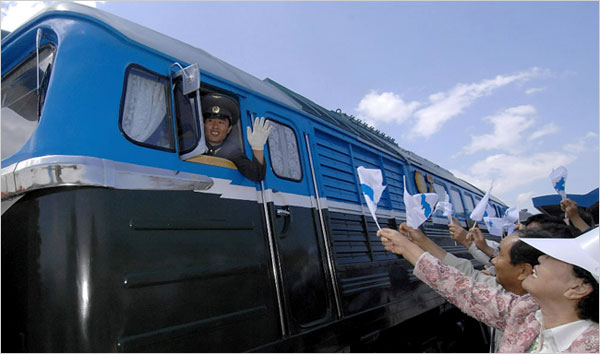
17korea337.jpg

Joong Ang Daily
5/15/2007
Unification Minister Lee Jae-joung expressed hope that regular inter-Korean rail services would transport workers to an industrial complex in the North’s city of Kaesong as well as serve as a mode of transportation for South Korean tourists at the Mount Kumgang resort.  However, North Korea has only agreed to one test run.

The sticking point was the number of passengers aboard the trains. South Korea stressed the need for an equal number of North Koreans, but North Korea declined the offer, citing unspecified reasons, ministry officials said. The two sides will exchange passenger lists via an inter-Korean economic office in Kaesong tomorrow.

The two Koreas are set to conduct test runs on a 27.3-kilometer (17-mile) line between Munsan Station and Kaesong Station in the western section, and on a 25.5-kilometer line between Jejin Station and Kumgang Station in the eastern section.

Rare experience aboard N. Korean train across the border
Yonhap
Sohn Suk-joo
5/17/2007

At the urging of North Korean conductors, 100 South Koreans and 50 North Koreans boarded a five-car train at 11:25 a.m. With no speaker system at Kumgangsan Station at the North’s scenic mountain along the east coast, conductors repeated “Please board the train” through a loudspeaker mounted upon a South Korean-made Hyundai Starex utility vehicle.

Painted green on the main body and the roof a faint gray, the facade of the train was far from modern. “The train looks like South Korea’s obsolete third-class train, but its ability is better than that,” said Lim Jong-il, a South Korean official at the Ministry of Construction and Transportation.

South Korean Construction Minister Lee Yong-sup, Kim Yong-sam, the North’s railway minister, and some 20 South and North Korean journalists crowded into the second car of the train. The smell of new paint assailed the nostrils upon ascending the steps, while a pair of portraits of Kim Il-sung and his son Kim Jong-il hung on the wall above the door.

The seating arrangement was face-to-face, and refreshments for passengers were set on a small table in front of the window — one lemon-lime soda, one strawberry juice, one bottled water, two apples and a pear. North Korean female attendants served a cup of ginseng tea for passengers later.

The upright, ivory-colored vinyl seats were a little bit uncomfortable and did not recline, but the cushions were softer than they appeared to be.

Outside the window, a uniformed North Korean conductor waved a red flag and goose-stepped past the train, which signaled the impending departure. A few North Korean security officers came inside to check the number of passengers and asked journalists jostling for position to sit down.   

At 11:27 a.m. a long whistle sounded, reminiscent of an old-time steam locomotive. The train spluttered back and forth several times and then slowly started forward. “North Korean trains usually whistle a lot,” a South Korean transportation official said. 

North Korean middle school students, who attended a ceremony, started to wave their hands, and South Korean passengers responded in kind. The train moved out of Kumgangsan Station at the speed of 10 kilometers per hour, and North Koreans working nearby just looked at the train without reacting in a friendly manner.

Some 50 meters away from the railway on the right side, a paved road appeared as the scenic Mount Geumgang faded from sight. Rice paddies were waiting for rice seedlings to be planted, but no peasant was seen working outside.

Unexpectedly, well wishers were South Korean tourists traveling to the Mount Geumgang resort in a convoy of eight buses. “At this time of the day tourist buses go to the resort,” a South Korean official said.

At 11:30 a.m. the stretch of hills and mountains continued, and the clouds moved quickly against the blue sky, cleansed from the previous day’s rain.

A few Toyota jeeps driven by soldiers, military jeeps and trucks drove parallel with the train and then fell behind. North Korean soldiers were stationed at the checkpoints of major intersections.

Then the track turned sharply, a rare occurrence on South Korean track. The sharp turns came again and again, and a woman peeked outside the window at a nearby village.

The overall atmosphere was friendly, a throwback to a picnic in the 1970s-80s on a slow, squeaking train. Hills and mountains passed by, and splendid pine trees of all kinds of shapes. After awhile the Nam River appeared on the right side of the train. At one village, some 10 residents came out and looked over the communal wall to watch the passing train.

At 11:50 a.m. the train passed Samilpo Station. The painted name on the station was very small, like Kumgangsan Station, and an oversized portrait of Kim Il-sung hung on the front of the station, along with pro-communist and cult propaganda slogans.

The train crossed the river on a bridge restored with steel plates provided by South Korea. Outside the window, North Korean tourist attractions such as Haegumgang and Samilpo were seen a little farther away.

At 11:50 a.m. some passengers pushed up the windows, and the unpolluted air coming through the open windows refreshed them. A group of 10 North Korean soldiers stood guarding a storage house of diesel engine trains built for the railway test run. There was no other train in sight.

The train slowed down at Kamho Station, where North Korean customs officials were stationed. It was 11:55 a.m.

Around 12:00 p.m. four customs officials and two conductors boarded each car of the train. One of them shouted, “We fervently welcome you who have become the first passengers of the train! Now we will start customs clearance procedures.”

Conductors checked the identities of the passengers and digital cameras. They asked a passenger to delete a photo of portraits of Kim Il-sung and Kim Jong-il that had been blurred from the shaking of the camera.

At 12:15 p.m. the conductors suddenly moved to the exit and disembarked. They must have gotten orders to let it pass, as the inspection took longer than expected. The train started to move again right away.

“Now you will see an outpost about 200 meters. It is the Military Demarcation Line,” said Kim Kyong-jung, chief of the inter-Korean railway team at the Ministry of Construction and Transportation.

A sharp whistle blew, and the train picked up speed, double its previous pace. The shaking was palpable, but not enough to affect the bottles on the small table. With the speed increasing, the frequency of the whistle’s call also increased.

In five minutes, the train passed the Northern Limit Line and went into the Demilitarized Zone. At 12:21 p.m., it passed the Military Demarcation Line to roars of applause. The train slowed a bit and the passengers became quiet, awaiting arrival.

At 12:25 p.m., a South Korean tourist observatory appeared, and some 200 tourists on the porch waved their hands eagerly, welcoming the North Korean train. Wide paved roads came into view and the train arrived at Jejin Station five minutes later. Amid the loud sound of a welcoming brass band and the cheering crowd, the train stopped at a South Korean station for the first time in more than half a century.

Trains cross inter-Korean border for first time in over 50 years
Yonhap
5/17/2007

A North Korean train traveling on reconnected track along the east coast of the Korean Peninsula on Thursday crossed the heavily armed border to return to its point of departure after a brief stay here.

At the same time, a South Korean train returned to the South in the west of the Korean Peninsula.

Earlier in the day, the two trains, one carrying 100 South Koreans and the other 50 North Koreans, crossed the Military Demarcation Line (MDL) dividing the two countries for the first time in more than half a century.

“It took more than half a century to cross this short, approximately 20-kilometer distance. We have to prevent anyone from blocking the railways. They were so hard to reconnect,” Kim Yong-sam, North Korea’s railway minister, said in a luncheon speech after arriving here.

In response, South Korean Construction Minister Lee Yong-sup hailed the test run of the cross-border railways, suggesting South and North Korea cooperate in promoting the mutual interest and prosperity of the Korean people.

At 11:30 a.m., Lee, who led the 100-member delegation to North Korea Thursday morning, boarded the North Korean train in Kumgangsan Station near the scenic Mount Geumgang resort for a test run on a 25.6-kilometer track in the eastern section of the peninsula.

At the same time, Kwon Ho-ung, chief councilor of the North Korean Cabinet, who had led the 50-member delegation to the South, boarded the South Korean train at Munsan Station in the western side of the peninsula on a restored 27.3-kilometer track, along with his South Korean counterpart, Lee Jae-joung.

Before the trains departed, South and North Korea held ceremonies to mark the historic event at Kumgangsan and Munsan stations, respectively.

“I hope it will contribute to forming a joint economic community and making balanced development on the Korean Peninsula. A new curtain of peace has been raised on the peninsula,” Lee said in a commemorative speech.

In his speech, Kwon said that North Korea will make every effort to make sure that the “train of unification” runs along a “track” of inter-Korean collaboration, with its emphasis on peace and understanding.

“Right at this moment, however, the challenge from divisive forces inside and outside is continuing. We should not waiver or be derailed from the track of national sovereignty and inter-Korean collaboration,” Kwon said.

The one-time test run came only after North Korea reluctantly agreed to provide military security arrangements last week. The tracks have been set to undergo tests since they were restored in 2003, while a set of parallel roads has been in use since 2005 for South Koreans traveling to the North.

In May 2006, North Korea abruptly called off the scheduled test runs, apparently under pressure from its hard-line military. The cancellation led to the mothballing of an economic accord in which North Korea would receive US$80 million worth of light industry raw materials from the South in return for its natural resources. North Korea’s subsequent missile and nuclear weapons tests further clouded hopes of implementing the agreement.

The reconnection of roads and train lines severed during the 1950-53 Korean War was one of the tangible inter-Korean rapprochement projects agreed upon following the historic summit between then South Korean President Kim Dae-jung and North Korean leader Kim Jong-il in 2000.

South Korea hopes to use the restored railways to help North Korean workers commute to a joint industrial complex in the North Korean border city of Kaesong as well as to transport South Korean tourists to the North’s scenic Mount Geumgang.

The Gyeongui (Seoul-Sinuiju) line cutting across the western section of the border was severed on June 12 in 1951, while the Donghae (East Coast) line crossing the eastern side was cut shortly after the outbreak of the Korean War.

South and North Korea used radio communication between Dorasan Station in the South and Panmun Station in the North for the western rail line, and between the South’s Jejin Station and the North’s Kamho Station for the eastern one. The stations are closest ones to the border on both sides.

In March, the two Koreas agreed to put humanitarian and economic inter-Korean projects back on track just days after North Korea promised to take the first steps toward its nuclear dismantlement in return for energy aid and other concessions from the other five members of the six-party talks.

South and North Korea are still technically at war, as the Korean War ended in an armistice, not a peace treaty.

Korean Train Crossing Seen as Sign of Progress
New York Times

Choe Sang-Hun
5/17/2007

[excerpts]

South Korea has long dreamed of building a trans-Korea railroad that would connect its train network to China and to the Trans-Siberian Railway in the former Soviet Union, creating a so-called Iron Silk Road.

North Korea blocks overland access to Asia, which makes South Koreans “feel as if we live in an island,” the South Korean transportation minister, Lee Yong Sup, said yesterday.

A trans-Korea railroad would offer a faster and cheaper way for South Korea to bring exports that are now shipped by sea to China and Europe. It would also provide a shortcut for Russian oil and other natural resources transported to South Korea. Such a rail system would save South Korea $34 to $50 a ton in shipping costs, said Lim Jae Kyung, a researcher at the Korea Transport Institute.

But before the dream of a trans-Korea rail system comes true, transportation analysts and government officials say, years of confidence-building talks and billions of dollars in investment in North Korea’s decrepit rail system will be needed.

Officials acknowledge that such a dream will not be made real until after North Korea gives up its nuclear weapons and improves its human rights record. Those moves would help build public support in South Korea for large investments across the border and would open the way for international development aid.

South Korean officials say a trans-Korea railroad would invigorate inter-Korean trade, which tripled from $430 million in 2000 to $1.35 billion last year.

It would also bring cash to North Korea, which could collect an estimated $150 million a year in transit fees from trains that pass through its territory, according to some estimates.

But it is unclear whether or when North Korea might agree to regular train service across the border.

Procuring international aid to renovate the rail network and letting trains from one of Asia’s most vibrant economies, carrying exports and tourists, rumble through its isolated territory could threaten the North Korean regime, analysts and others say.

The agreement came after South Korea promised to send North Korea 400,000 tons of rice, as well as $80 million worth of raw materials for shoes, soap and textiles.

South Korea has spent 544.5 billion won, or $589 million, on reconnecting the rail system, including 180 billion won in equipment, tracks and other material loaned to North Korea.

South Korean policy makers have called for patience in working toward reconciliation with the North. They have often been accused by conservative politicians and civic groups of giving in to North Korea’s strategy of extracting economic aid for every step toward reconciliation.

“This is a precious first step for a 1,000-mile journey,” Mr. Lee, the unification minister, said today.

South Korea has seen some tangible results in its overtures to the North in recent years.

The North Korean military cleared mines and moved some of its weapons to make room for the rail system and the Gaesong industrial complex. In addition, South Korean factory managers commute from Seoul to Gaesong using a road that was reconnected in 2004, and South Korean buses regularly take tourists to the Diamond Mountain resort in the North.


Share

Russia and China seek use of port in North

Wednesday, May 16th, 2007

Joong Ang Daily
Lee Yang-soo and Brian Lee
5/16/2007

With an eye on future transportation infrastructure, both Russia and China are courting North Korea to get in on the development of Najin port, in the far north of the country near the Russian border.

A Foreign Ministry official said yesterday that Russian Railways President Vladimir Yakunin is scheduled to visit North Korea to discuss launching a project aimed at improving and repairing a railroad from Najin to Khasan, just across the border into Russia.

Yakunin told former Prime Minister Han Myeong-sook, who visited Russia last month, that President Vladimir Putin had great interest in the project and Russia was hoping for the active participation of South Korean companies, the official said. The railway official visited Seoul in July last year to discuss the project with South Korean companies. The issue was also discussed in March at a bilateral meeting with Russia on economic cooperation.

A government official said that Russia wants to use Najin port as a logistics hub, but is also intending to develop the port into a base for future development of oil and natural gas in Siberia. The ultimate goal would be to connect the trans-Siberian railway with an inter-Korean railway system.

Beijing also has its eye on the North Korean port, which it envisions as part of its grand design to build a transport network that stretches from the Indian Ocean to the North Pacific.

“Najin Port is near the Jilin area and China’s own ports in the area have already reached their full capacity,” a government official said yesterday.

Beijing has recently notified Pyongyang that it is willing to spend $1 billion to develop port facilities, build railroads connecting the port to China and improve existing infrastructure such as highways, the official said.

In a report published earlier this year, Cho Myung-chul, a researcher at the Korea Institute for International Economic Policy, predicted that China would use investments in the North’s ports and railroads to extend its own infrastructure for export and import purposes. China has made similar investments in Burma and Bangladesh, among others.

Share