Archive for the ‘Trade Statistics’ Category

DPRK exports to Japan halved amid economic sanctions

Wednesday, August 30th, 2006

From Yonhap:
8/30/2006

North Korean exports to Japan dropped by nearly 50 percent last month from June amid Tokyo’s economic sanctions against the communist state for its test-firing of missiles early last month, a report by Japan’s Finance Ministry released on Wednesday showed.

The total amount of North Korea’s exports to Japan last month dropped to some 440 million yen (US$3.75 million), a 44.2 percent decrease from that of June, the report said. The amount is also down 42.2 percent from that of the same period in 2005.

The report failed to provide specific reasons for the drop, but observers believed it was mainly due to the country’s economic sanctions against the impoverished North, which followed Pyongyang’s test-firing of seven ballistic missiles on July 5.

The observers also said trade between the two is likely to further shrink amid Tokyo’s strong reaction to North Korea’s missile tests and the communist state’s alleged preparations to test a nuclear bomb.

The United Nations Security Council unanimously adopted a resolution on July 15, condemning the North Korean missile tests and prohibiting any missile-related dealings with the North. But Tokyo has been taking additional steps to cut off any cash inflow to North Korea from its country.

The country has banned a major North Korean ferry, Mankyongbong-ho, from its ports at least for the next six months, cutting off the largest and almost the only direct means of transportation between the two for North Koreans and some 200,000 pro-Pyongyang Korean residents in Japan.

Share

Growth of N. Korea-China trade tumbles to five-year low

Monday, August 28th, 2006

From Yonhap:
Byun Duk-kun

The increase in the first-half trade between North Korea and China fell to the smallest volume in five years, South Korea’s Unification Ministry said Monday.

Ministry officials said the slowdown did not appear to be linked to North Korea’s recent provocations, such as the test-firing of seven ballistic missiles in early July.

The amount of North Korea-China trade only increased 4.7 percent on-year to US$780 million in the January-June period, Kim Nam-sik, head of the ministry’s information and analysis bureau, told reporters.

This marked the smallest, as well as the first slowdown of, increase in trade between the close allies since 2002 when trade volume increased by 6.2 percent for the same period from a year before.

The year-on-year growth in the first-half Sino-North Korea trade reached 16.2 percent in 2003, 37 percent in 2004 and 43 percent last year, according to Kim.

The report comes amid reported signs that Beijing may have begun taking measures to reduce or limit its economic cooperation with Pyongyang as a way of expressing its dismay or anger at the North for its test-firing of seven ballistic missiles on July 5.

The ministry official, however, cautioned against interpreting the slowdown as signs of a possible disruption in relations between the communist allies, saying the reason for the slowdown appears to be economic rather than political.

“Many experts believe it (the slowdown) is more due to economic than political reasons,” Kim said.

The amount of North Korea’s exports to China for the first six months of the year decreased by more than 14 percent to some $200 million, also marking the first decline since 2000, according to a report by the information bureau.

Kim said this, too, was mainly because of economic reasons, such as the reduced price of North Korean exports to China “while the amount of exports remains the same” from that of last year.

Analysts here believe China may completely halt its economic and political relations with the North if Pyongyang decides to conduct a nuclear test.

The ministry official said there were no immediate signs of China taking such measures to punish North Korea.

Share

Inter-Korean trade tops US$600 mln until July

Sunday, August 27th, 2006

Yonhap
8/27/2006

Trade between South and North Korea in the first seven months of this year topped US$600 millio this year due to increasing trade of agricultural products and corporate products, a local trade promotion agency said Sunday.

The inter-Korean trade reached $668 million in the January-July period, up 14.7 percent from a year earlier, according to the Korea International Trade Association (KITA).

Corporate-related trade, including the trading related to inter-Korean industrial complex in Kaesong, increased 31.9 percent to $489 million worth, while non-corporate trade such as government and private aids fell 15.3 percent to $178.5 million.

South Korea sent $446.6 million worth of goods to the North, down 2.2 percent, from the same period last year while the value of products coming to South Korea reached $263.2 million, up 56.8 percent, the association said.

Share

Nautilus Institute: DPRK Reform and PRC relations

Wednesday, August 23rd, 2006

Policy Forum Online 06-70A: August 23rd, 2006
DPRK’s Reform and Sino-DPRK Economic Cooperation

Analysis by Li Dunqiu
CONTENTS

I. Introduction
II. Analysis by Yi Li Dunqiu
——————————————————————————–
I. Introduction
Li Dunqiu, Director of Division of Korean Peninsular Studies at the Institute of World Development Center of Development Studies, writes, “Sino-DPRK economic cooperation is growing in depth and width but both sides adopt a low-profile and practical attitude… In fact Chinese enterprises, both private and state-owned, are looking for greater room for their future development as a result of the constantly improving market economy in China. Amid such backdrop, the DPRK naturally becomes their target…It is not difficult to see that laws of the market economy are the most fundamental reason behind Chinese enterprises’ investment in DPRK.”

The views expressed in this article are those of the author and do not necessarily reflect the official policy or position of the Nautilus Institute. Readers should note that Nautilus seeks a diversity of views and opinions on contentious topics in order to identify common ground.

II. Analysis by Li Dunqiu
– DPRK’s Reform and Sino-DPRK Economic Cooperation
by Li Dunqiu
DPRK’s change is by no means accidental. It has its profound international and domestic backgrounds. DPRK has made tremendous efforts in shackling off the shadow of the Cold War and integrating into the constantly changing international community, but with little result. Leaders of DPRK have no choice but to explore a new way that suits its country. Amid this backdrop, DPRK is slowly but steadily promoting its reform, which is low-profile but pragmatic.

From the end of 1990s, DPRK has begun to make adjustments to its economic theories and policies, putting forward such new views and propositions as pragmatism, building a strong socialist country, focusing science and technology, new concepts and improving economic management modes. A series of “Measures to Improve Economic Management Order” was issued on 1 July 2002. The adjustment this time, comparing with previous ones, was strong in enforcement and wide in the areas involved, thus injecting new impetus in its economic recovery and development. Though DPRK’s economic reform is only introducing rational elements of the market economy to make up pitfalls of its planned economy with the prerequisite of adhering to the latter, it should be commended as a major innovation in DPRK’s theories and practice in building socialism. Early this year, we saw new phenomenon from the DPRK side. It started with Kim Jong Il ‘s visit to China accompanied by premiers of the State Council in mid-January to learn the successful experience of China’s reform and opening up, followed by Chang Song-taek’s eleven-day China inspection tour accompanied by over thirty high-ranking economic officials, and then Cabinet Premier Pak Pong Ju’s elaboration of this year main tasks in economic work on the Fourth Plenary Session of the Eleventh Supreme People’s Congress. These new changes were not only widely reported but also aroused great interest among the international community in the country’s economic changes.

I. DPRK’s Guiding Principle Undergoing Quiet Changes.

Basic Theories of DPRK’s Economic Reform

At present DPRK has not yet established systemic theories to guide its economic reform. But Chairman Kim Jong Il has proposed new ideas which have become the basis for its economic reform.

Pragmatism

It was first proposed by Kim Jong Il after he became General Secretary of the DPRK Labor Party. There is no works which systematically elaborates Pragmatism. But according to economists from DPRK, pragmatism has two meanings, i.e. to bring actual benefits for the people, and to be profit-oriented instead of suffering losses. The former is the principle while the latter is the detailed content.

To follow the rule of pragmatism in economy is to seek economic benefits and for companies to make profits. To this end, the Fiscal Law amended by DPRK in April 2004 changed the ultimate goal of companies from “reducing cost” to “increasing net income”, so as to help them be profit-oriented. At present, pragmatism is the principle that must be followed in all DPRK’s economic work. Its economists have vividly compared it with China’s “seeking truth from facts”. It is fair to say that pragmatism will become theoretic basis for people in DPRK to liberate their minds and promote economic reform.

Theory with Economic Development at the Core

The strategy that DPRK has established with economic development at the core is mainly embodied in its goal of “building a strong socialist country”. Entering into the new century, DPRK has proposed three targets including building its country into a strong military, political and economic power. It maintains that it has already achieved the first two with the third one yet to achieve. As a result, the goal of “building a strong socialist country” means that economic development is its core task at the moment.

Theory of “New Thinking”

Labor News, DPRK People’s Army and Young Pioneers DPRK, in their joint editorials on the New Year Day of 2001, put forward the “new thinking”, stressing that “priorities at the moment were fundamental changes in ideas, ways of thinking, styles of struggle and work to meet requirements of the modern times”. Chairman Kim Jong Il also pointed out that, having entered the modern times, it is necessary to update thinking according to the new times instead of living the old way on the basis of the past, and that they should boldly abandon those that should be abandoned instead of being restricted to the old ideas and sticking to the past and the outdated. “In the 21st century efforts should be made to approach and solve all questions with new ideas and from new height.” In addition, DPRK’s Labor News pointed it out in its editorials that “they should be bold in reform”, “further improve DPRK’s economic management system to meet the requirement of the new environment and new atmosphere”, and that priorities for the Labor Party in the 21st century is to ensure that the ideas, ways of thinking and working styles conform with the requirement of the new century.

Approach the Word “Reform” with Prudence

Though DPRK introduced elements of the market economy through constitutional amendments in 1998 and consequently adopted some reform measures, it strongly dislikes such words as “reform” and “opening up” and they are forbidden in the adjustment of its economic policies.

Despite this, the essence is “reform”, though different in word, evidenced in their newly issued policies for economic adjustment which were targeted at the outdated demands and practices that were divorced from reality. DPRK’s Labor News pointed it out in an article entitled “On the Rules of Socialist Economic Development” on 21 November 2001 that “those who manage the economy, i.e. people of DPRK, do not have enough experience, there are still room for improvement and perfection due to short history of socialism, and that the economy cannot be developed if those that are outdated, backward and separated from reality are not abandoned.” It is clear that this kind of “abandoning” has the implication of “reform”. Therefore it is reform unsuitable for DPRK instead “reform” itself that it is opposed to. In fact it is nonetheless progressing with economic reform both in theory and in practice in spite of it all. It was not until June 2003 that DPRK’s Central News Agency finally used the word “reform” though it quickly dropped the word again. The reason behind its prudence with the word “reform” is because it once openly expressed its opposition to and criticism against reform in China and former Soviet Union in its major official media.

Learn Reform Experience from Foreign Countries

DPRK’s supreme leader Kim Jong Il has visited China for four times since 2000, most of which were aimed at inspecting China’s economy. His unofficial visit to China from 10 to 18 January 2006 and inspection of China’s economic work in Beijing, Hubei and Guangdong Provinces attracted great attention from the international community.

The nine-day visit in China was rich in content, clear in objective and profound in significance. Kim brought his team to Beijing, Wuhan, Yichang, Guangzhou, Zhuhai, Shenzhen and they listened carefully to introductions made by government officials and companies managers in those provinces and cities, with the aim of learning and drawing upon China’s experience. He was deeply touched and impressed and even had “sleepless night” when he arrived in Beijing following the tour in China’s south. He said that he was unwilling to see the current situation in DPRK and hoped to see further progress in its economic and social development by absorbing the vigor and vitality from the market economy while continuing its planned economy; that he hoped to learn from China and do a good job in DPRK’s future economic development by combining its national conditions with actual situation. It was the first time for him to voice such opinions, indicating that leaders of DPRK were transforming their mode of thinking, acknowledging and accepting China’s development concepts; and that they were exploring laws of economic development in order to prepare for profound and comprehensive reform with DPRK style.

It is more important to note that the visit gave him a chance to see the fact that China’s reform had neither weakened the leading role of the Chinese Communist Party nor aroused social upheaval. It had instead enhanced the reputation of the Communist Party and its international influence, which removed his worry that reform and opening up might undermine the stability of the authorities. Shock waves continued among the high-level officials after he came back from the visit. Unprecedented views were voiced and new explanations made on major theoretic questions like what was socialism, how to evaluate capitalism. High-level officials were asked to theoretically keep abreast with the times and unify their thinking.

Only two months later, Chang Song-taek, First Deputy Minister of the Department of People’s Group and Capital Construction of the Central Committee of the DPRK Labor Party, headed an “expert team” of over thirty high-ranking economic officials to the places that Kim had just visited. His 11-day visit was yet another demonstration of DPRK’s aspiration to learn from China. In addition, DPRK also sent various economic delegations to China to study its experience in reform. It started to send trainees to China, Viet Nam and countries in Europe since its economic reform in 2002, equipping them with knowledge of market economy, finance, trade and hi-tech in particular. It thus started its nationwide campaign from the top down to study economics.

II. DPRK’s Economy and Current Policy Options

From 2000 DPRK has gained positive economic growth from the previous negative one. Of course the rate was very low, around 0.5%–1% for six years in running. Some estimated that growth rate in 2005 reached 2%, an opinion shared by some DPRK officials though genuine figures were hard to obtain in the country. DPRK’s economy has recovered and is poised to continue its steady growth in 2006.

There are two sets of mechanisms in DPRK, i.e. the military and the civilian. The most important economic sectors are controlled by the military, a noticeable feature of its economy. Strength and efficiency of the factories run by the military are higher than their civilian counterparts. Take the Taean Glass Factory for example. It was built with the assistance of the Chinese Government. At first a civilian factory was designated but its workers were low in efficiency and poor in quality, with which the Chinese side became dissatisfied. Consequently a military factory took up the role and all went well afterwards. With good cooperation, the project was successfully completed. This example showed that talents of economic development are mostly with DPRK’s military. It is therefore, like China in its first phase of reform and opening up, formulating policy to transform some military factories into civilian ones to support local economic growth.

All signs show that economic work has become the priority of DPRK. Leaders of the country and the Labor Party are concentrating their time and efforts on economic work. Main measures for this year are as follows:

Agriculture is the main task of this year’s economic development.

The Fourth Plenary Session of the Eleventh Supreme People’s Congress was convened on 11 April, on which Premier Pak Pong Ju delivered a report entitled Review of Work in 2005 and Plan for 2006. He stressed that the central task of the economic development for this year was “to develop agriculture in a decisive manner to successfully solve the food problem for the people in DPRK”.

In recent years DPRK has always taken agriculture as the “primary task” of its economic development. In order to solve food shortage it launched “Potato Revolution” and “Seed Revolution” in 2001, advocating the growth of agricultural crops with short mature periods and great harvests. Agricultural technicians cultivated new breeds of potatoes with no virus and high yields, in order to “supplement rice with potatoes”. Thanks to increased government input in agricultural production and development in agricultural science and technology, grain production has risen in recent years, reaching 4.6 million tons in 2005, the highest in ten years. With experience accumulated and benefit gained, DPRK has realized the importance of agriculture. It will continue to take it as the priority and central task of this year’s economic work. It is especially notable that when Kim Jong Il visited China last January, he went to the Crop Institute of the Chinese Academy of Agricultural Science, a sign which fully vindicated the importance attached to agricultural science and technology.

Work Hard to Develop Foreign Trade and Attract Foreign Investment.

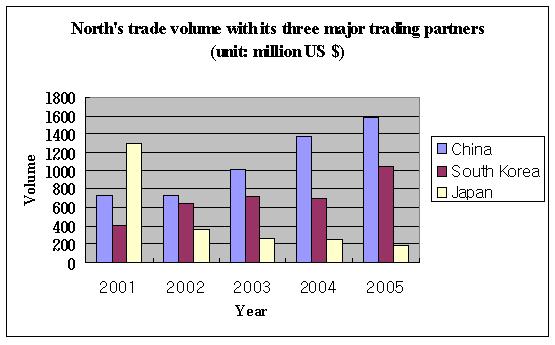
Premier Pak Pong Ju stressed in his above-mentioned report that it was necessary to work hard to develop foreign trade and actively explore foreign markets to achieve diversification and multi-lateralization of trade in accordance with the changing environment and practical demands. DPRK has enhanced foreign trade up to an unprecedented height, which was a new change itself. Though US had begun its financial sanction against DPRK since the end of last year, its foreign trade increased by a large margin in 2005, reaching 3 billion USD in total, the highest since 1991. Trade between DPRK and ROK reached 1.05 billion USD in 2005 and this figure was not included in the total volume. It is estimated that this year DPRK will actively explore new markets in the EU and ASEAN countries while continuing to grow its trade with China and ROK.

China is DPRK’s largest trading partner. Sino-DPRK trade reached a historic high at 1.58 billion USD in 2005, up 14%. China’s export accounted for two thirds of its total. DPRK mainly imported food and energy from China, up by 35.2% annually and reaching 1.08 billion USD in 2005. Growth in Sino-DPRK trade was partly attributed to decrease in bilateral trade between DPRK and Japan, which stood at 0.194 billion USD in 2005, down by 23%.

Meanwhile DPRK is working actively to introduce foreign investment, including capital and technology. It organized two international commodities fairs, one in the 1980s and the other in the 1990s, to be followed by annual fairs every spring since 2000. The fairs were then held twice every year since 2005, one in spring and one in autumn.

The 9th Pyongyang Spring International Fair was grandly held from 15 to 18 May 2006. The total area of the exhibition hall was 16.5 thousand sq meters and it hosted 217 companies from 13 countries and regions in the world including China, the Netherlands, France and Germany. Products on display ranged from chemicals, electronics, pesticides, agricultural machines to cosmetics, pharmaceuticals and foods. Of the 196 foreign participating companies, 179 were Chinese, with 80% from China’s Liaoning Province. Contractual value topped 100 million Euros.

Ms Choe Lian-shi, Division Chief of DPRK’s Bureau of International Exhibition, said in her interview with the Xinhua New Agency that the main purpose for such fair was to help DPRK companies to know the world and for the world to know DPRK’s market. It was also to help DPRK companies establish links with their foreign counterparts in order to promote export, explore international markets and introduce advanced foreign technology to promote its economic development.

She pointed out that during the fair held last year, contracts, both for import and export and joint ventures, valued 70 million Euro, among which, export contracts amounting 30 million Euro, import contracts 32 million Euro and joint venture 8 million Euro.

She also stressed that Chinese companies took up the bulk of the participants. They came this time with the China Committee for the Promotion of International Trade, which made them more orderly and organized. All this showed that economic relations between China and DPRK were constantly developing and trade has become more active.

Apart from this DPRK also cooperates with the relevant sides in China to hold commodity fair and trade and investment talks in Beijing, Dandong and other cities in China several times a year.

Recently DPRK has organized some companies suitable for foreign markets to go outside the country to conduct foreign trade and economic cooperation. Construction companies in DPRK like Foreign Construction Co. sent thousands of experts and technicians to scores of countries and regions including Russia, Bangladesh, Kuwait and Libya to engage in project and labor contracting. Mansudae Overseas Development Group undertook to build bronze statues, monuments and other works of arts, and fit out buildings and parks in over 70 countries and regions to earn foreign currencies for the country. President statues in the seven African countries like Equatorial Guinea, Togo and Gabon, monument of the people’s heroes in Ethiopia, and the grain museum in Malaysia were all works of the company. DPRK Industrial Tech Co. opened branches in China and other countries to conduct trade in new technology, inventions and patents by replying on the institute and production bases attached to DPRK’s Academy of Sciences.

Improve Modes of Economic Management

Premier Pak Pong Ju also stressed in the report that efforts should be made to improve modes of economic management, to ensure practical benefits while reflecting socialist principles. DPRK has carried out factory and company reform through market price instead of planned price. It will also partially give up the state plan in production and sale. These measures are not only suitable for small- and medium-sized factories and enterprises but also for large-sized ones. Governments may purchase products from them according to market prices. They are also allowed to introduce foreign capital, establish joint-ventures or earn profits through trade within their capacity.

Speed up Development of Science and Technology

Another agenda of the Fourth Plenary Session of the Eleventh Supreme People’s Congress was extremely noticeable. It was the report entitled Speed up Development of Science and Technology to Build a Strong and Prosperous Country, delivered by Choe Thae Bok, Secretary General of the Central Committee of DPRK’s Labor Party. Development of Science and Technology as one of the priorities of DPRK’s future development, the report was regarded as indication of the importance attached to science and technology development and its aspiration to embrace the information society. A strategic goal of its science and technology development is to become a major software country by 2022.

It is not common for DPRK’s Supreme People’s Congress, its highest body of power, to add on the agenda the development of science and technology. Media in DPRK have stressed on many occasions that the 21st century is a century of science and technology and a century of information, and that without the development of science and development it is impossible to achieve the goal of “building a strong and prosperous country”. The Supreme People’s Congress deliberated carefully and adopted the report, fully testifying its importance on science and technology and the fact that science and technology development had become a nationwide consensus.

Special Economic Zones remains an important option for DPRK.

Kae-song Industrial Park is a successful cooperation between DPRK and ROK and the two sides have decided to expand its scale on the current basis. Covering an area of 10,000 sq meters, it is planned to expand to 1 million sq meters. Many small- and medium-sized enterprises in ROK intend to invest and start business in the park as labor price in China’s coastal region in the south east is rising. Products manufactured there can be regarded as ROK-made and exported to a third country.

The DPRK Government might copy China’s special economic zones to establish new such zones along the border areas between China and DPRK. It is reported that DPRK planned to establish a new economic zone on the Bidan Island on the lower reaches of the Yalu River and build it into a future financial center. The establishment of such zones remains an important option for DPRK but it is also very prudent due to previous failure.

III. DPRK’s Energy and Mineral Recourses

DPRK has severe shortage of energy, especially oil. 90% of its oil supply comes from China. It also has oil trade with Russia but the amount is trivial as it does not have enough foreign currency. Russian oil companies sell oil to DPRK at price lower than international market price. DPRK has almost no oil reserve to speak of. It is currently working actively with China to exploit oil in its West Sea.

Electricity is also in short supply in DPRK though its supply is slightly better compared to oil. DPRK is rich in water recourses so the Government tries to develop small hydro power stations. And in accordance with the principle of those who develop will benefit, local governments are encouraged to build such projects according to their own conditions, and with good results. It is claimed by DPRK officials that the country is in fact equipped with conditions to build large hydro power stations. That’s why Kim Jong Il and other high-level officials in DPRK visited China’s Three Gorges Hydro Power Project in Yichang early this year. But because of its tension with US and its fear of conflicts or wars, the Government only encourages small- and medium-sized hydro power stations before its relations with US has improved. In addition, it also stresses thermal power since it is rich in coal and able to provide sufficient fuel. Consumption of coal ranks the first among all energy, to be followed by hydro power.

DPRK is now studying new energy and hopes to convert it into actual use in production and life, i.e. solar power and biogas.

There are four important recourses in DPRK: rich forest resources; important mineral resources like abundant coal, iron ore, graphite, gold, silver, lead, zinc, magnesite, all of which now allow the participation of foreign companies; 8600-kilometer coasts with no pollution, which are rare in the world and hold great potentials for fishing, aqua-culture, processing of sea food once foreign capital and technology are channeled in; rich tourist resources, that may become one of its future pillar industries.

DPRK has abundant mineral recourses, with over 360 kinds confirmed and 200 kinds economically viable. It is noticeable that the reserve of its magnisite ranks the first in the world, accounting for 56% of the world’s total. Its top ten minerals include tungsten, molybdenum, graphite, heavy spar and fluorite. The reserve of copper and ilmenite is calculated in tens of millions of tons and that of white jade, jadeite, black jade and sand jade is also abundant. Since it has such a large reserve of metal and energy mines, 70% of its industrial raw materials and fuels are self-sufficient. But there is no oil and pitch coal (raw material for charcoal), both of which are necessary for iron and steel industry though anthracite and brown coal are abundant. Coal, iron ore, lead and zinc core, limestone and magnisite take up the bulk of DPRK’s mineral industry but only 30% of the capacity is utilized due to restrictions of outdated equipment and poor technology. Iron ore is exploited in over 20 mines represented by Musan Mine. With a reserve of 1 billion tons, it is a famous open mine in the world and the largest in a country with an iron output of 8 million tons. Production of iron ore grew by 2-3% since 1970s, as a result of expansion and development of iron mines. But the growth has slowed down recently due to poor results of prospecting and outdated equipment. Foreign capital is now being introduced.

DPRK’s coal is divided into anthracite and bituminous coal. The former is mainly located in Pyongan-namdo and Pyongan-bukto while the latter in Hamgyong-bukto and Hamgyong-namdo. According to administrative division, there are four major coal mines in DPRK, namely Pyongan-namdo Mine, Pyongan-bukto Mine, Hamgyong-bukto Mine and Hamgyong-namdo. Currently there are over 100 national coal mines, 70 anthracite mines and 30 bituminous coal mines, and over 500 small- and medium-sized local mines.

In the 80-kilometer belt in the south of Pyongan-namdo stretching from east to west with Pyongyang at the center, the reserve of anthracite is abundant. Notable mines include Samsin (Samsindon, Daefon-gu) , Sadon (Sadon-gu), Ryongzen (Ryongzen-gu), Haelyong (Ladonza-gu, Haelyong, Gangdon-gun), Gangdon (Gangdon-gun), Gangso (Gangso-gun), Zencun (Zencun-gun), Wonstun (Wonstun-gun). There is anthracite in 668 sq kilometers in the north of Pyongan-namdo. Main coal mines there include those in Donstun, Syongbun, Jaenam, Joyang of Ganstun, Ganstun, Bonstun, Yamzum, Wyonlae, Xinlyon, Sonam of Bugstun-gun, Xiandon, Xinstun of Ensam-gun, Stunzen, Yongdae, Sunstun, Mujindae, Gigdon, and Ryongden, Ryongmun and Ryongcel of Kujang-gun, P’y?ngan-bukto.

Bituminous coal is mostly concentrated in the North Mine (north of Aoji) and South Mine (south of Chongjin) in Hamgyong-bukto and Anju Mine in Pyongan-namdo. Largest coal mines in the north include Aoji Mine in Undok-kun, Obun Mine in Musam, Hue Ryon Mine. There are seven ore strata that are 2-5 meters in depth in Anju Mine, producing brown coal of 5300kcal. With an annual output of 7 million tons, it is thus the largest mine in DPRK.

DPRK’s proven coal deposits are 14.74 billion tons, 11.74 being anthracite and 3 billion tons brown coal. Recoverable reserve, allowed by the current technology, is about 7.9 billion tons. Its coal production has dropped since the end of 1980s due to restrictions of technology and equipment. (See the table below for annual production since the 1980s)

*Unit: 10,000 tons

Year 1980 1985 1990 1993 1995 1999 2000 2002
Production 3,027 3,750 3,315 2,710 2,370 2,100 2,250 2,190

IV. Rapid Growth of Sino-DPRK Trade and Economic Cooperation

Sino-DPRK trade and economic cooperation grows at an eye-catching pace. With trade accounting for 40% of its total and investment 70%, China has thus become DPRK’s largest trading partner and source of investment. DPRK has been more dependent on China in food and energy supply. Main ports between the two countries have become or are becoming major vehicles of bilateral trade and economic cooperation. The friendly visit by Chinese President Hu Jintao to DPRK in October 2005 and Kim Jong Il’s China visit in January this year have further promoted political and economic cooperation between the two countries and injected new impetus in bilateral trade.

Trade between China and DPRK has increased by 14%, reaching 1.6 billion USD. DPRK import commodities like oil and corn from China, worth 1 billion USD, and export commodities like coal and iron ore to China, worth 0.5 billion USD. According to the statistics from Dandong Customs, 1.86 million tons of import and export went through the Dandong Port in 2005 at a value of 0.84 billion USD, up both in quantity and value by 10%, with 0.45 billion USD in China’s favor. It is estimated that DPRK will continue to expand trade with China this year. The two countries have planned to build a new road bridge across the Yalu River to meet the demands of the constantly growing trade.

Sino-DPRK Trade Volume from 1997 to 2005

*Unit: 100 million USD

Year DPRK’s Total Foreign Trade DPRK’s Trade with China China’s Export China’s Import

Year DPRK’s Total Foreign Trade DPRK’s Trade with China China’s Export China’s Import
1997 21.7 6.5 5.3 1.2
1998 14.4 4.1 3.5 0.6
1999 14.8 3.7 3.2 0.5
2000 19.7 4.8 4.5 0.3
2001 22.7 7.37 5.7 1.6
2002 22.6 7.33 4.6 2.7
2003 29 10.23 6.3 3.9
2004 31 13.85    
2005 40.5 15.8 10.8 5

In recent years Chinese businessmen have accelerated their investment in DPRK. Those who took the lead in investing DPRK mainly came from Zhejiang, Jilin, Liaoning, Jiangsu and Guangdong Provinces with Zhejiang businessmen taking up the bulk. In 2003, 40 businessmen from Wenzhou, Yiwu, Dongyang, Cixi and Hangzhou headed by Lu Yunlei, agreed on cooperation intent with the operators of Pyongyang No. 1 Store. Guhui Trading Co. lead by Lu, obtained, unexpectedly, operating right of 15,000 sq meters of the store and corresponding 9,000 sq meters of warehouse. The deal was signed on 6 August 2003. Lu commented that what he valued was the market potentials in a country that was opening up. Lu also disclosed that he would invest several million of RMB to renovate the store and that operating space in the store would cover 10,000 sq meters, divided into over 300 booths to be further rented to Chinese businessmen to wholesale and retail small Chinese commodities, daily necessities in particular. The Zhejiang businessman commented opportunities in DPRK like this: “It is better to have our presence in the country but don’t expect too much from the first phase”.

It was the private companies that gave rise to the first wave of investing in DPRK. The second wave in 2005 was mostly generated by large state-owned enterprises, in areas like heavy industry, energy, mineral recourses and transportation, different from the first one.

At present DPRK has agreed to the joint-venture between China National Metals and Minerals Import and Export Corporation and its ??Coal Mine. This is not only the first established by China outside DPRK’s special economic zone but also represents an important measure by DPRK to open its recourses. Rydongden Coal Mine is the largest anthracite mine in DPRK. Covering an area of 18.8 sq kilometers, it has a reserve of 0.15 billion ton, 0.125 billion of which is recoverable. Its annual output is 1 million tons, equal to a medium-sized coal mine in China.

According to report issued by the Development and Reform Committee of Jilin, the province has reached a “barter” agreement with DPRK, transmitting electricity to the country in exchange of the mining rights of its Youth Copper Mine. With a total investment of 0.22 billion RMB, it is a typical experiment by DPRK to exchange electricity with mineral recourses. Jinlin Tonghua Iron and Steel Group will obtain 50-year mining rights in Musan Iron, the largest in DPRK, at a price of 7 billion RMB. Musan Iron, located in Hamgyong-bukto is the largest open mine in Asia, with proven reserve of iron powder about 7 billion tons. With iron content as high as 66%, it is able to be smelted directly.

Gold reserves in DPRK are also very rich. Guoda Gold Shareholding Co. Ltd., in Zhaoyuan, Shandong Province signed an agreement in 2004 with DPRK on gold exploration and smelting project. According to the agreement, a joint-venture would be set up for gold mining in ??? and bring back the ore to the company for smelting. ??? Gold Mine, which was set up quite early, has a considerable reserve and at least 150 tons can be recoverabled. But due to the lack of capital and outdated technology, operation of the mine has been at a standstill.

In September 2005 DPRK sold the 50-year exclusive operating rights of Najin wharf to Huichun, Jilin, in order to get the latter’s support for building a road from Tongsungu, Wonstunli, Kasung-si, to Najin Port. Sources from the Administrative Committee of the Border Economic Cooperation Zone in Huichun, Jilin, disclosed that the sale this time of the wharf in Najin Port was more of a corporate instead of government act. It was said that Fan Yingsheng, a real estate developer from Hunan, was the mastermind behind the deal and he alone would channel half of the 60 million Euro in payment.

Capital from Hong Kong is also coming. Early investments were mainly channeled to hotels, restaurants and the entertainment industry. But according to a recent report from Hong Kong media, a local businessman Qian Haoming reached a 3-billion USD agreement with the DPRK Government and China’s Ministry of Railway to build a railway from Tumen, border city in China, to Chongjin, port in DPRK. The agreement signifies that the deadlock between railway authorities of the two countries is being broken. There used to be three pending questions with the DPRK railway, i.e. overstock, arrears and withholding of Chinese cargo carriages. This forced the Chinese railway authority to take measures to restrict transportation between the two countries, like intermittent loading and goods limits. Statistics show that over 2000 carriages were held up in DPRK in 2004, 260 of which were for coal. It is reported that Hong Kong International Industry Development Co. Ltd., headed by Qian Haoming, promised to provide 500 to 1000 carriages to DPRK as required by the agreement.

Preliminary agreements have been reached at the moment between China and DPRK concerning minerals, railway and port lease. Sino-DPRK economic cooperation is growing in depth and width but both sides adopt a low-profile and practical attitude. It is necessary to point out that such development has aroused concern from relevant countries in North East Asia, which mistake China for having political motives. In fact Chinese enterprises, both private and state-owned, are looking for greater room for their future development as a result of the constantly improving market economy in China. Amid such backdrop, neighboring country DPRK naturally becomes their target. There are plenty of Chinese enterprises with strength ready to come into DPRK, more active than the government policy allows. During the National People’s Congress last march, delegates from local enterprises proposed a motion to the Central Government, calling for policy and legal guarantees for expanded and deepened economic cooperation with DPRK, including the establishment of special economic zones and free trade areas. It is not difficult to see that laws of the market economy are the most fundamental reason behind Chinese enterprises’ investment in DPRK.

Share

North Korean trade statistics

Monday, May 15th, 2006

RoK Ministry of Unification

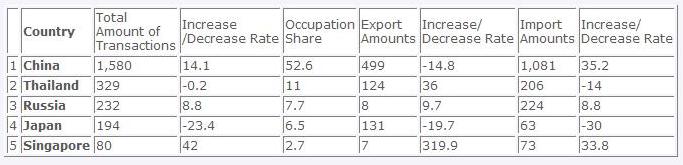
North Korea’s foreign trade amounted to a total of 3,001 million USD, a 5.1 % increase on a year-on-year basis from the previous 2,857 million USD in 2004. Its export recorded 998 million USD, a 2.1 % decrease from 1,020 million USD in 2004. The imports totaled 2,003 million USD, a 9.1 % increase from 1,837 million USD in 2004. As a result, the balance of trade recorded a deficit of 1,005 million USD, a slight increase compared to that of 2004, which recorded 817 million USD.

The status of the North’s trade with its five largest trading partners is as follows.
table.JPG

80% of the North’s trade was conducted with countries in the Asia and Pacific regions. The transactions with the EU countries totaled 292 million USD, showing a 12 % increase on a year-on-year basis, compared to 261 million USD in 2004.

The rise in the North’s foreign trade can be attributed to an increase in exports of raw materials to China and Thailand and crude oil price hikes. North Korea is expected to seek expansion of trade with the major trading countries and diverse trading partners.

Share

North Korean Economics Presentations at KEI

Tuesday, April 18th, 2006

Economic Reform and SEZ as Survival Strategy of DPRK
PDF: Deok Ryong Yoon.pdf
Deok Ryong Yoon

Introduction to & implications of Gaesong Industrial Complex Project
PDF: kaesong.faqs.pdf
Ministry of Unification

Gaeseong Industrial complex: Past, Present and Future
PDF: Dong-geun Kim.pdf
Speech by Dong-geun Kim, Chairman of Gaeseong Industrial District Management Committee

Gaeseong Industrial Complex : Frequently Asked Questions (FAQs)
PDF: kaesong.faqs1.pdf
Ministry of Unification, ROK

Share

Trade Volume between North Korea and Japan in 2005

Thursday, March 2nd, 2006

Republic of Korea, Ministry of Unification 
3/2/2006

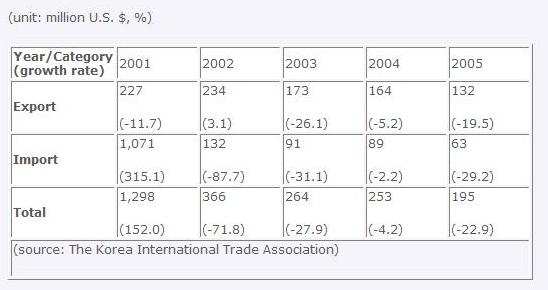
The trade volume between North Korea and Japan amounted to around 200 million U.S. $, recording a negative year-on-year rate of 22.9 percent. The North’s export to Japan decreased 19 percent, totaling 132 million U.S. $ while the North’s import from Japan shrank by 29.2 percent, recording 63 million U.S. $, down from 900 million U.S. $ in 2004.

table.JPG

The top five export items including marine products, mineral fuels, electrical equipment, vegetables and clothing, took up 74 percent of the total export volume, about 100 million U.S. $. Among them, marine products recorded a minus 49.4 percent due to Japan’s tightening crackdown on country of origin but still accounted for the largest share of the total export volume, 27.7 percent. While electrical equipment and clothing decreased by 18.9 percent to 20 million U.S. $ and by 46.3 percent to 10 million U.S. $ respectively, export of vegetables snowballed by 60.2 percent to 200 million U.S. $.

With the major import items on the downward slope, import of vehicles took up the largest share of the total import volume, recording 300 million U.S. $. The top five import items including vehicles, electrical equipment, machineries, artificial filament, and cigarettes, amounted to 400 million U.S. $, accounting for 65.3 percent of the total import volume.

table2.JPG

(This part is excerpted from the KITA’s report on the status on bilateral trade between North Korea and China in 2005 written in Korean)

Since 2002 when the issue of the Japanese abductees bulged out, bilateral trade volume has been on the decrease for four consecutive years. The issue worsened the North’s images and raised anti-sentiment among the Japanese consumers, which deepened their reluctance to buy North Korean goods.

The increase in bilateral trade will be expected to be restrained by two factors: Japan’s ban on the entry into its ports by ships weighing over 100 metric tons which are not insured, and Japan’s regulations on export of strategic goods to North Korea.

Share

North Korea’s Kim Allows Tentative Stirrings of Profit Motive

Wednesday, December 28th, 2005

Bloomberg
Bradley K. Martin
12/28/2005

A sign of North Korea’s fledgling moves toward a market economy can be found at the Pyongyang monument commemorating the 1945 founding of the Workers’ Party. Beneath a 50-meter-tall rendition of the party’s logo — a hammer, sickle and writing brush — sits a street photographer.

A handmade sign displays her price list and sample photos, mostly of groups of North Korean visitors, with the monument as background.

The photographer is one of countless sidewalk entrepreneurs – – most of them selling food and drink — who have set up shop in North Korea since 2002. Before that, they would have been hauled off to re-education camps for profiteering. In the late 1990s, North Korea’s Civil Law Dictionary described merchants as a class to be eradicated because they “buy goods from producers at a low price and sell them to consumers at a high price by way of fraud, deceit and spoils.”

Since then, the party newspaper, Rodong Shinmun, has quoted Kim Jong Il, who’s held supreme power since the 1994 death of his father, Kim Il Sung, as favoring profits under socialist economic management.

North Korea, one of the world’s last Stalinist regimes, has gradually begun permitting commerce. On a four-day visit to Pyongyang, the capital, in October — arranged and scripted by the government — a group of 17 Western journalists got a glimpse of the changes. Clean, new restaurants were packed with paying customers while the streets — almost empty in 1979 and only lightly traveled in ’89 and ’92 — bustled with bicycles, motorbikes and Japanese sedans.

Casino Pyongyang

In the state-owned Yanggakdo Hotel on an island in the Taedong River, a mostly Chinese clientele played slot machines, cards or roulette at the Casino Pyongyang. Since 1998, Macau billionaire Stanley Ho, through his Sociedade de Turismo e Diversoes de Macau SARL, has invested $30 million in the casino, whose staff is also Chinese.

Now some investors from farther afield are joining pioneering Chinese and South Koreans in plunging into a country once so isolated it was known as the Hermit Kingdom. In September, Anglo- Sino Capital Partners, a London-based fund manager, said it had formed the Chosun Development & Investment Fund, which plans to raise $50 million for investments in North Korea.

“It’s the last virgin economy,” says Colin McAskill, 65, a director of Anglo-Sino and chairman of Koryo Asia Ltd., which is investment adviser to the new fund.

Natural Resources

Besides recent changes in the economic system, a 99 percent literacy rate and a minimum wage for workers in foreign-invested ventures of only $35 a month, McAskill says, he was drawn by North Korea’s rich natural resources — including iron ore, copper, lead, zinc, molybdenum, gold, nickel, manganese, tungsten, anthracite and lignite.

The fund will concentrate on North Korean companies that have been active internationally in the past, with track records as foreign currency earners, says McAskill.

He negotiated on behalf of North Korea with foreign bank creditors in 1987, when the country was unable to repay some $900 million in balance-of-payment loans that had enabled the regime in the 1970s to purchase Western industrial technology — Swiss watch-making machinery, for example — as well as such non-capital goods as 1,000 Volvo sedans from Sweden.

Oil Potential

The country’s petroleum potential lured Dublin-based Aminex Plc and its Korea-focused subsidiary, Korex Ltd., which in August announced the signing of a nine-year production-sharing agreement to explore and develop 66,000 square kilometers (25,000 square miles) of North Korean territory. The agreement covers areas in the Yellow Sea’s West Korea Bay and in the Sea of Japan as well as onshore.

While North Korea lacks proven petroleum reserves, according to the U.S. Energy Information Agency, the West Korea Bay in particular may contain hydrocarbon reserves, as it’s considered to be a geological extension of China’s oil-rich Bohai Bay.

More foreign investment may come, says Tony Michell, a Seoul- based consultant on North Korea. Michell, a 58-year-old Briton, says he has recently shepherded 20 senior managers of international companies, representing seven nationalities, to Pyongyang.

“They’re big players,” says Michell, declining to identify his clients by name or company. “They’re looking at everything, from services to manufacturing. They want to get the measure of the North Koreans and be ready if the six-party talks succeed.”

Six-Party Talks

The so-called six-party talks — between North Korea and China, Japan, Russia, South Korea and the U.S. — are aimed at ending the country’s pursuit of nuclear weapons. In September, the six countries agreed on a statement of principles to govern further talks. It called for a nuclear-free Korean peninsula, a peace treaty and economic cooperation in energy, trade and investment.

Seoul-based Hyundai Research Institute, an affiliate of the Hyundai Group, projected in September that a successful outcome to the talks would be worth as much as $55 billion to the economy in the North — and more than twice that in the South.

Optimism about the economy has boosted the prices of defaulted North Korean debt originally owed to hundreds of creditors, mostly European banks, which in the 1970s began meeting as a London-based ad hoc group to discuss restructuring options. In the 1990s, that so-called London Club turned a portion of the debt into Euroclearable certificates, securities that were denominated in Swiss francs and German marks.

The certificates are trading at about 20-21 percent of face value, up from 12 percent in 2003, according to London-based Exotix Ltd., a unit of Icap Plc, one of a few financial firms that make an over-the-counter market in them.

Excessive Optimism

The debt’s price has risen in the past on excessive optimism about the country’s future. In early 1998, the debt was trading at nearly 60 percent of face value amid rumors that North Korea would collapse imminently and be absorbed by wealthy South Korea, which would then make good on the entire outstanding debt.

That had not happened by the time of the crash later that year in global emerging-market securities, when the North Korean debt price sank to about 25 percent of face value.

Exotix estimates that North Korea owes the equivalent of some $1.6 billion in principal and interest to banks out of a total $14 billion in principal and interest owed globally to mainly communist and formerly communist countries.

Although a cease-fire was declared in 1953 in the war between North Korea and China on one side and the United Nations — under whose flag the Americans, South Koreans and others had fought — on the other side, no peace treaty has ever been signed.

The U.S. maintains sanctions under the Trading with the Enemy Act that restrict trade and financial transactions with North Korea — and apply to Americans and permanent residents of the U.S. and to branches, subsidiaries and controlled affiliates of U.S. organizations throughout the world.

China, Russia

North Korea’s flirtations with capitalism are belated compared with those of China and the former Soviet Union, which began opening their economies in the 1970s.

North Korea did pass a law legalizing foreign investment in 1984. The law, which permitted equity joint ventures between state enterprises and foreigners, attracted only $150 million in investment during the following decade, largely because investors were put off by the country’s poor roads, railroads, power systems and phone networks and by official interference in joint ventures’ recruitment, dismissal and compensation of workers, according to a 2000 thesis by Pilho Park, a postgraduate student at the University of Wisconsin Law School in Madison.

Vietnam Example

In contrast, Vietnam lured $7.5 billion in investment in the first five years after it opened its economy to foreign capital in 1988, Park wrote.

Following the collapse of European communism in the early 1990s, North Korea opened the Rajin-Sonbong Free Economic and Trade Zone on the northeastern border with China and Russia. A brief flurry of investor interest ensued and then fizzled out when a crisis over the country’s nuclear weapons program took North Korea to the brink of war with the U.S. and South Korea in 1994.

In the mid ’90s, catastrophic floods, combined with the collapse of the global communist system of aid and preferential trade, caused a severe energy shortage that crippled the economy. As much as 70 percent of manufacturing capacity went idle, according to the South Korean central bank.

Also in the mid ’90s, famine killed as many as 2.5 million North Koreans, by the estimate of the U.S. Agency for International Development.

Food Insecurity

Since then, food aid from abroad, an absence of large-scale natural catastrophes and a 2005 harvest that was the biggest in 10 years have kept North Korea from the massive starvation that’s taken place elsewhere, including Niger, says Richard Ragan, North Korea director for the United Nations World Food Program.

Still, “the country faces chronic food insecurity,” Ragan says. “One of the things that happened with the food shortages is that marginal lands became less controlled. You see people trying to farm on some of the most inhospitable plots of land you could imagine.”

In October, steep, unterraced hillsides were plowed outside Pyongyang. The crops can then wash down, rocks and all, during rainstorms, harming water supplies and damaging farmland – fertility.

A second nuclear weapons crisis boiled up in 2002 when the U.S. accused the North of conducting a secret uranium enrichment program — to replace a plutonium program that it had frozen as part of a settlement of the earlier crisis.

Economic Rules

That same year, the regime proceeded with what then Prime Minister Hong Song Nam described as dramatic new economic measures, which helped bring arbitrarily set prices and foreign exchange rates closer to those prevailing on the black market.

The North Korean won consequently dropped to 150 won to the dollar in December 2002 from 2.15 to the dollar a year earlier. The official rate is currently about 170 won, while on the black market, one dollar can bring about 2,000 won.

The government also introduced pay incentives aimed at boosting worker productivity. The system is in operation at enterprises such as the Pyongyang Embroidery Institute, where some 400 women stitch elaborate pictures for framing and sale.

Employees who don’t perform up to expectations aren’t fired; they’re denied raises, says spokeswoman Woo Kum Suk. Unable to live on their minuscule basic salary, equivalent at black market rates to something over a dollar a month, non-performers eventually quit and go elsewhere, Woo says. Good workers can see their salaries raised as much as fivefold.

Consumers

“In my opinion, it’s good to have this system,” she says. “Although the government supplies things to us, sometimes there’s something more we want to buy.”

North Korea has some way to go before many investors rush in. According to a UN report, net investment inflow for 2003 — the most recent year for which statistics are available — was a negative figure: minus $5 million.

Currently the country is constructing a new special economic zone at Kaesong, just north of the South Korean border, where several small companies from the South already employ North Koreans to make clothing, footwear and household goods. Authorities declined to let Western reporters visit it, permitting only a glimpse from a highway bridge a mile away.

Those who are investing are taking a long-term view. Singaporean entrepreneur Richard Savage was looking at least five years into the future in 2001, when he formed a joint venture tree plantation with the Ministry of Foreign Trade. The company, Evergreen Kormax Paulownia Ltd., is 30 percent-owned by the government, which has assigned Savage 20,000 hectares (49,000 acres) on a 50-year lease with an option to extend for 20 more.

Timber Business

Savage, 58, says he, family members, friends and a few other investors have put $3 million into the project so far. Savage says he hopes that by the time the paulownia trees mature — they grow as fast as 7 centimeters (2.85 inches) a day on his farm, and some may be ready for harvesting five years after planting — he’ll be able to sell the wood in a unified Korean market.

When the Northern economy takes off, the first beneficiary will be the building industry, he says. “That’s why I’m in timber,” he says, adding that his fallback plan is to sell the wood to China, Japan and South Korea.

It’s not the first venture in North Korea for Savage, who wears a cowboy hat and whose e-mail moniker is WildRichSavage. In 1994, he introduced North Korean officials to Loxley Pcl, a Thai telecommunications company. In 1995, an affiliate formed for the purpose, Loxley Pacific Co., signed a joint venture agreement with North Korea’s post and telecommunications ministry to create modern telecommunications in the Rajin-Sonbong special economic zone. The venture earns about $1 million a year, Loxley Pacific Chief Financial Officer C.C. Kuei, 56, says.

Mining for Gold

North Korea’s 1992 Foreign Investment Law guaranteed that foreign investors’ shares of profits could be repatriated, a promise that’s now being tested by Kumsan Joint Venture Co., a gold mining concern that’s half owned by a Singapore-led group of Asian investors and half owned by Hungsong Economic Group, a large trading, mining and manufacturing group in Pyongyang that’s controlled by North Korea’s military.

Roger Barrett, a Beijing-based British consultant, has helped arrange financing and technology for Kumsan. Barrett, 50, introduced Kumsan to the foreign investors, whom he declined to identify.

The company used its investment to buy secondhand mining equipment from Australia in 2004 for the venture’s mine 2,000 meters (6,562 feet) above sea level near the city of Hamhung. In the first year the new equipment was used, Barrett says, the mine produced about 100 kilograms (220 pounds) of gold, half of which the foreign investors took out of the country. He says doing business with North Koreans has proved to be absolutely normal. “It’s working very well,” he says.

Foreign-Run Bank

The business environment in North Korea is surprisingly welcoming, says Nigel Cowie, 43, a former HSBC Holdings Plc banker who was hired a decade ago by Peregrine Investment Holdings Ltd. to start North Korea’s only foreign-run bank.

When Peregrine collapsed in 1998, Cowie and the North Korean joint venture partner kept the local unit operating. He and three other investors bought Peregrine’s 70 percent stake in it from the firm’s liquidators in 2000. Cowie, who’s general manager of what’s now called Daedong Credit Bank, says the bank has about $10 million in assets and has only foreigners as customers, mostly Chinese, Japanese and Western individuals and institutions. Only North Korean-owned banks can do business with state enterprises and North Korean individuals.

Better Living Conditions

Living conditions for expatriates have improved significantly in the past three or four years, Cowie says over a meal of Korean barbecue in the capital’s Koryo Hotel. “For me, personally, it’s things like creature comforts, more shops, Internet, e-mail,” he says. While the Internet is available to foreigners, it is forbidden to most North Koreans.

Cowie says his biggest challenge at the bank comes from outside North Korea. In September, the U.S. Treasury Department barred U.S. financial institutions from dealing with a Macau bank, Banco Delta Asia, that it said had been “a willing pawn” in corrupt North Korean activities and represented a risk for money laundering and other financial crimes.

The bank and North Korea both denied the charges, but the Macau government took over the bank and announced it would provide no services to North Korea in the future. Cowie says the action tied up a big chunk of Daedong Credit Bank’s customers’ assets because Banco Delta Asia had been a main correspondent bank for North Korean banks.

The Treasury Department in October broadened its dragnet by ordering a freeze of the assets, wherever in the world the U.S. could assert its jurisdiction, of eight North Korean companies it suspected of involvement in proliferating weapons of mass destruction.

`WMD Trafficking’

The department explained its action in an Oct. 21 statement on its Web site: “The designations announced today are part of the ongoing interagency effort by the United States Government to combat WMD trafficking by blocking the property of entities and individuals that engage in proliferation activities and their support networks.”

North Korea sought to connect the Treasury actions to Washington’s position in the six-party talks. The country’s Korean Central News Agency, using the acronym for the Democratic People’s Republic of Korea, said on Dec. 2 that “lifting the financial sanctions against the DPRK is essential for creating an atmosphere for implementing the joint statement and a prerequisite to the progress of the six-party talks.”

Assistant Secretary of State Christopher Hill, the chief U.S. envoy to the talks, had said in a Nov. 11 press conference that the asset freeze wasn’t directly related to the talks.

Money Laundering Banned

Cowie says he doubts the U.S. action was intended to harm Daedong, which had already issued a manual prohibiting money laundering. He says he fears such U.S. actions could damp investor enthusiasm for North Korea. “It can cause the people doing legitimate business to just give up,” he says.

Cowie isn’t packing up to leave, though. Neither is Felix Abt, a Swiss native who heads a new European Business Association in Pyongyang. “I am very busy with visiting foreign business delegations,” Abt, 50, says. “Take it as a sign that the economy is developing and that more foreign business activities are under way.”

Outsiders’ investment on capitalism’s farthest frontier is gradually bringing benefits to North Koreans, too, says Savage, the tree farmer. “I can’t convert the whole country, but for the people who work for me, I’m giving them a better standard of living,” he says. “Slowly, people will prefer not to work for the government.”

If Savage and his fellow pioneers have their way, it’s only a matter of time before capitalism takes root in North Korea.

Share

Banking steps towards the real world

Monday, December 12th, 2005

FDI Magazine
Stephen Timewell
12/12/2005

On my journey to Pyongyang a Beijing receptionist remarked that the Democratic People’s Republic of Korea (DPRK) is very much like China was 25 years ago. And as the motorcade of China’s president Hu Jintao passed thousands of flower-waving North Koreans on his visit to the world’s most secretive and politically isolated country at the end of October, he may well have agreed.

Visiting Pyongyang is like going back decades in a time machine, to a land with no advertising, no Nokia, Microsoft or McDonald’s billboards and almost no cars. Impressive grand avenues and massive public monuments dominate the landscape but there is no new construction or shops.

The streets are scrubbed clean by hand and are full of hundreds of orderly people wearing their ‘Great Leader’ badges and walking everywhere. Curiously, bicycles are discouraged because of bad accidents and the government encourages power walking for good health, or so I am told. In a country said to spend 30% of its GDP on defence, there is no visual military presence (or overt police presence) in the capital at all.

The ‘traffic ladies’ standing at major intersections are a welcome replacement for traffic lights but there are precious few cars to direct.

Questions greatly outnumber answers in this capital where visitors are duly dazzled by the spectacular grand mass gymnastics and artistic performance (called Arirang) by almost 70,000 children in the massive 150,000-seat May Day Stadium. But visitors are also aware of serious food shortages and cannot ignore the capital’s tallest building, a magnificent 105-floor pyramid tower with a crane on top, left unfinished many years ago, I was informed, due to financial problems.

Winds of change

Whether the DPRK is seen as the last Stalinist communist state or as a Confucian nationalist monarchy or even, as it describes itself, as a “powerful socialist nation”, visitors can feel the winds of change, particularly on the economic front. For more than 50 years the iconic stature of the late ‘Great Leader’ Kim Il Sung and that of his successor son Kim Jong Il have dominated the political landscape; the question going forward is how the country’s dire economic circumstances can be improved and whether the regime has the capability to create the new structures needed.

Pyongyang was playing host not only to Mr Hu but also to an increasing number of foreign delegations and journalists, all keen to understand the trends taking place in probably the last country to have massive pictures of Marx and Lenin hanging outside its Ministry of Trade. For many, however, the current focus is progress in the Six-Party Talks on the nuclear weapons programmes of the DPRK.

In the fourth round of talks in September between the two Koreas, China, Japan, Russia and the US a landmark agreement appeared to have been reached. “All six parties emphasised that to realise the inspectable non-nuclearisation of the Korean Peninsula is the target of the Six-Party Talks,” a joint statement said. “The DPRK promised to drop all nuclear weapons and current nuclear programmes and to get back to the non-proliferation treaty as soon as possible and to accept inspections from the International Atomic Energy Agency.”

At the time of going to press in November a fifth round of talks was expected to move a final agreement closer but detailed negotiations over implementation of the above agreement were not expected to be easy or to be concluded quickly. The DPRK, unsurprisingly, wants some payback, be it light-water reactors from the US or other economic incentives.

The core issue is that the DPRK’s publicly acknowledged plutonium programme, believed to provide enough radioactive material for about six bombs, is probably also the country’s key card in trying to rebuild the economy. Kim Jong Il needs to gain maximum advantage from giving up his nuclear threat, but even then, what does his economy have to offer?

Information hollow

For a financial journalist the DPRK represents a serious challenge. Understanding the economy and the banking sector of a country is never easy, but when no data is published by the government or the central bank it becomes significantly more difficult. I knew information was scarce but believed that the two very agreeable government minders, assigned to monitor my every move in my four-day visit, would be able to help me extract a simple list of banks operating in the country. No such luck. Although my visit was welcomed, the central bank (which acts as both the issuing bank and as a fully operational commercial bank in the traditional socialist model) failed to provide the list (or anything else), despite numerous requests.

Although the consensus after several interviews was that around 20 banks of various types exist, I can only vouch for the handful listed here. Clearly the Foreign Trade Bank (FTB) represents a pivotal bank in the financial system and Ko Chol Man, director of the FTB, was keen to explain the peculiarities of the DPRK banking system. “The domestic and foreign exchange settlement systems are completely separate. The central bank deals with the domestic market and money issuance and it also has a commercial banking role; the FTB has complete control over foreign exchange matters and trade and also holds the country’s foreign exchange reserves.”

Unlike other banking systems, the FTB in the DPRK acts as a clearing house for the foreign exchange activities of the banks in the country. It does not report to the central bank but, like all banks, reports to the State Fiscal and Financial Committee (SFFC), the overall banking regulator.

Mr Ko was pleased to note that the FTB had around 500 correspondent banks worldwide and, along with its 600 staff (including 11 branches) in North Korea, had six representative offices outside the country (including offices in Austria, Russia and China) and planned to establish a UK representative office in London. However, when asked for details of FTB’s banking activities he replied bluntly that no banking institution had published its figures in terms of activities or balance sheet. “We cannot give figures about the size of our assets because it is a regulation of the state. If the situation becomes better we can make them public but up to now it is impossible.”

Economic estimates

Despite the absence of official economic and banking data, various estimates help make the picture a little less murky. A recent Standard Chartered Bank report places North Korea’s nominal GDP at the end of 2004 at $22bn or $957 in GDP per capita terms for the country’s 23 million population; by comparison, South Korea’s nominal GDP is put at $680bn or $14,167 per capita for its 48 million population. While the unification of the two Koreas is seen as an important political objective, especially in Pyongyang, the startling economic gap between the two states could mean that the North becomes a huge burden on the South, and Seoul well recognises the economic problems that emerged from the reunification of Germany in the 1990s.

Meanwhile, Jong Msong Pil, of the Institute of Economy at the Academy of Social Science, explained how the economy had declined dramatically from a GDP per capita of $2500 in the mid-1980s to $480 per capita in 2000.

“The big drop was caused by the disappearance of the socialist market worldwide in the early 1990s; the collapse of our socialist barter trade system led to the failure of many enterprises and a decline in living standards,” he said.

Dr Jong noted that, following the hard times of the mid-1990s, the first target of the national economy has been self-reliance. He added that no economic data had been published since 2000. He believed, however, that 10% economic growth occurred in 2004 and, responding to reports from the World Food Programme (WFP) that a third of the population were malnourished, he said the food situation was improving. “In our country, all people have a job so for this reason no one has died of starvation or hunger. Our country is a socialist planned economy so the government takes care of people’s living.”

Acknowledging shortages in the past, Dr Jong said that in October the government had normalised the public food distribution system, which indicated the government was now supplying sufficient food.

Is the DPRK’s food crisis over? Driving around Pyongyang’s spacious avenues (with two minders) there was no visual evidence of malnutrition – but the capital is likely to be much better served than elsewhere. A supermarket was shown but the goods were only available for foreign currency, hardly food for the masses. Cha Yong Sik, deputy director general at the Ministry of Foreign Trade, said the government had not imported food on a commercial basis in 2005, unlike previous years, but neighbouring countries are still providing significant food aid. Richard Ragan, country director of the WFP, said food production in 2005 was up 10%, with cereals up 6.6%. But while the food situation may have improved, the DPRK is said to be still dependent on food aid.

Trade predictions

So what are the DPRK’s prospects? Much depends on the outcome of the nuclear negotiations but estimates from the Seoul-based Korea Trade-Investment Promotion Agency (KOTRA) say the DPRK’s trade volume in 2005 is expected to pass $3bn for the first time since the fall of the Soviet Union with the figure likely to reach $4bn if inter-Korean trade is included. Trade with China, the DPRK’s largest trading partner, grew by more than 40% in the first half of 2005, indicating Pyongyang’s growing dependency on Beijing.

Upbeat on trade prospects, Mr Cha explained that the recently opened Tae-an Friendship Glass Factory, built with a $32m donation from the Chinese government, would export 40% of its 300-ton capacity, mainly to Siberia. Also Pyongyang’s first autumn international trade exhibition in October included companies from six European countries, the focus being on the country’s mineral potential rather than its manufacturing abilities, which are a long way off.

As for banks, the group of up to 15 joint venture banks are helping to finance the country’s 150 or so international companies. But do not expect miracles. The latest, Koryo Global Credit Bank, set up in June, is a joint venture between the UK-based Global Group, headed by Hong Kong businessman Johnny Hon, with 70%, and the state-owned Koryo Bank with 30%. Established with a paid-up capital of e10m, KGC Bank is ambitious in its plans to engage the DPRK in trade and commercial relations with the rest of the world, especially Asia, the Middle East and Europe.

KGCB’s first correspondent banking relationship in Europe is with Germany’s Helababank. The bank, the first product of cooperation in the finance field between the DPRK and the UK, has a staff of five and is also interested in investing in property. It was also able to produce, at the instigation of US authorities, a comprehensive anti-money laundering file.

Another local venture is North East Asia Bank (NEAB), which was set up by ING Group in 1995 but is now wholly owned by the Korean BOHOM Group. Amazingly, Kim Hyon Il, NEAB’s president, produced a balance sheet showing total assets of e79m at the end of 2004 and a paid-up capital of e25m. He also showed me the bank’s newest product, a chip-based cash/debit card, the first in the DPRK. The card demonstrates perhaps that the country is slowly joining the real world – but with only 100 issued and only 13 outlets available, the service has a long way to go.

Political effects
 
At Daedong Credit Bank, chief executive Nigel Cowie explained how international politics can have a dramatic impact on banking even in the isolated DPRK. In September, just before the conclusion of the fourth round of the Six-Party Talks, the US Treasury accused Banco Delta Asia (BDA), a Macao-based bank, of aiding the DPRK in a series of ‘money laundering’ cases. The Wall Street Journal had said the Macao crackdown was Washington’s method of cutting off Pyongyang’s financial sources for its nuclear weapons programme.

Mr Cowie, a former HSBC banker, explained that all DPRK banks had accounts with BDA for the purposes of remitting funds and, as a result, the accounts were suspended pending an inquiry in mid-November. While Stanley Au, chairman of BDA’s parent, denied the US allegations and BDA’s involvement in any illegal business relations with DPRK banks, the damage is done. “It affects our customers because it affects people’s ability to remit money to and from the country. I imagine that this will cause people doing legitimate business to give up,” says Mr Cowie.

The nuclear negotiations remain critical to the country’s future and the Chinese, in particular, want them to succeed. But that is just a start. There is evidence that the DPRK is opening up and changing with reports that there are 300 open markets operating across the country, 30 in Pyongyang. But whether the DPRK follows the China model of 25 years ago and can restructure its ‘powerful socialist nation’ doctrine remains doubtful under the current leadership.

Share

The North Korean Criminal State, its Ties to Organized Crime, and the Possibility of WMD Proliferation

Tuesday, November 15th, 2005

Nautilus Institute
David L. Asher
11/15/2005

I am very pleased to be invited back to the Wilson Center to speak today. I enjoyed my time here this summer and want to thank my colleagues for the chance to be affiliated with the Center, which I consider the finest organization of its kind in Washington. I also wish to thank my former boss, Assistant Secretary Jim Kelly and the many members of our inter-agency team for kindly attending today. In particular, I want you to know of the extraordinary work that our friends and colleagues here from the United States Secret Service have done recently to safeguard our nation and our currency from a determined adversary.

I left the State Department in July and I want to be very clear that my remarks today are personal in nature. They in no way should be interpreted as representing the view of the US government, the Department of State or the Department of Defense. They also are drawn strictly from unclassified sources (the vast amount of information now in the public domain is indicative of the scale of the problem of DPRK criminality).

Let me make clear, I am a believer in the Six Party Talks. I applaud the efforts of my former colleagues, Chris Hill, Joe Detrani, and Jim Foster to effect positive diplomatic movement via direct dialog and clearly demonstrate to all the parties seated at the big table within the Diaoyutai State Guesthouse that the US is sincerely willing to join the international community in engaging North Korea to facilitate its denuclearization, its economic development, and its opening to the outside world. At the same time, given this objective, there should be no further room for tolerating the unacceptable and in many ways outrageous criminal and proliferation activities that the North Koreans continue to engage in.

Allow me to begin my remarks by laying out the major aspects of North Korean trans-national criminal activity. I will then look at the specific question of how the DPRK’s growing ties to Organized Crime groups and illicit shipping networks could be used to facilitate WMD shipments. I’ll propose a possible way to reduce this risk. I will conclude by frankly commenting on the nature of state directed criminality in the DPRK and its implications for international law and the DPRK’s status in the international community and the United Nations.

My research topic this summer at the Wilson Center was on the rise and fall of “criminal states” – government’s whose leaders had become intimately involved with trans-national criminal activity. I compared North Korea under Kim Jong Il with Serbia under Milosevic, Romania under Ceausescu, and Panama under Noriega. I won’t get into the details of this comparative research now but, suffice to say, the scale and scope of the other cases pale in comparison with present-day North Korea.

The rise of the criminal state in North Korea is no secret. It has occurred in full view of foreign governments and with increasing visibility to the world media. Over the last three decades agents, officers, and business affiliates of the DPRK have been implicated in hundreds of public incidents of crime around the globe. Incidences of illicit activity have occurred in every continent and almost every DPRK Embassy in the world has been involved at one time or another. This should be no surprise. North Korea is perhaps the only country in the world whose embassies and overseas personnel are expected to contribute income to the “Party Center,” not rely on central government funds for their operations. Such repeated illicit actions from diplomatic premises amount to a serial violation of both articles 31 and 41 of the Vienna conventions on Diplomatic Relations, which respectively convey that A. commercial, and most certainly, criminal activities for profit shall not be conducted by accredited diplomats or via accredited facilities and B. mandate that officials posted abroad must obey the laws of the nation to which they are posted. The DPRK routinely pays no attention to either critical provision of the Vienna conventions.

I am frequently asked “how much is this stuff going on?” Although it is hard to pin down the exact scale of the illicit activity we can make a rough guess. In 2003 the DPRK ran a trade deficit of at least $835 million and that if more broadly measured to exclude concessionary trade with the ROK was more like $1.2 billion. Even making a very bold estimate for informal remittances and under the table payments for that year, the DPRK probably ran a current account deficit of at least $500 million. Moreover, North Korea’s accumulated trade deficit with the ROK and China alone since 1990 is over $10 billion. North Korea has not been able to borrow on international markets since the late 1970s and has at least $12 billion in unrepaid debt principal outstanding. Yet, until recently – at least – it has managed to avoid self-induced hyper-inflation (which should have occurred given the need to reconcile internal and external monetary accounts, even in a communist country). Instead, the street stalls in Pyongyang and other North Korean cities seem to be awash in foreign made cloths, food, and TVs and the quality of life of the elite seems to have improved. What’s apparently filling the gap and accounting for the apparent improvements to the standard of living for the elite? The short answer as I see it: Crime. And if I am right, then the criminal sector may account for as much as 35-40% of DPRK exports and a much larger percentage of its total cash earnings (conventional trade profit margins are low but the margin on illegal businesses is extremely high, frequently over 500%).

Whatever the precise size of the criminal surplus, all analysts and law enforcement authorities agree that overseas illicit and weapons trading activities have become increasingly important sources of foreign exchange for the DPRK. These earnings have provided support to North Korea’s “military-first” economy and contributed to Pyongyang’s ability to resist demands from the international community for an end to its nuclear weapons program. They also apparently have persuaded the Kim Jong II regime it can affordably maintain its political isolation and resist the imperative for sweeping economic and social reforms that all other communist states have had to engage in. Given that periodic exposure of illegal dealings by North Korean officials overseas in the past has not resulted in serious or lasting consequences, Pyongyang may believe that an open door for global criminality exists.

Let’s review the scale and scope of the North Korean “soprano state.” As is well known the North Korean government is involved in a wide range of illicit businesses in partnership with organized crime groups or unilaterally. These include:

1. Production and overseas distribution of narcotics, in particular heroin and methamphetamines:

DPRK Narco trafficking continues as a major income generator, although less prominently perhaps than before. China continues to be the major market for North Korean drugs and the situation became so bad that in March of last year the Vice Minister of the MPS called a highly unusual “press conference” to announce his determination to cut into DPRK drug rings in Jilin province, on the border with North Korea (which some Chinese law enforcement officials have stated is “out of control”). Japan probably still comes in second. From 1998-2002 Japanese police interdicted nearly 1500 kg of meth that in six separate prosecuted cases was shown to have originated in the DPRK. This amounts to thirty-five percent of all methamphetamine seizures in Japan in that period and had a wholesale value of over $75 million and a street value of as much as $300 million. Given the chemical profile for DPRK produced meth (essentially of extremely high purity) several Japanese authorities I spoke with the week before last believe that a fairly large percentage of the meth coming in from Northern China today is consistent with DPRK origin. As elsewhere, in Japan to mask their fingerprints the North Koreans are going through triads, snakeheads, and other indirect channels. This has been less true with Heroin where North Koreans continue to be observed selling the drugs. The Australian seizure of 125 kg of Heroin worth $150 million off the Pong Su – a Worker’s Party linked vessel and with a KWP secretary on board – in my mind was hardly a random or isolated incident (it is not surprising given that the North Koreans had established an Embassy in Canberra the year before that one would assume needed to produce income for the center – it was Pyongyang’s way of saying “thanks very much”).

2. Production and international distribution of counterfeit currency, in particular the US dollar, as well as counterfeiting or illegally reproducing and selling numerous other items, in particular counterfeit cigarettes and pharmaceuticals.

Under International Law, counterfeiting another nation’s currency is an act of causus belli, an act of economic war. No other government has engaged in this act against another government since the Nazis under Hitler. North Korea has been counterfeiting the dollar and other currencies of importance the entire time it has been on the international engagement bandwagon. What does this say about the regime’s intentions?

As the recent DOJ indictment of Sean Garland and other members of the Official IRA for their partnership in the criminal distribution of counterfeit US currency reads: “Beginning in or about 1989, and continuing throughout the period of this Indictment, a type of high-quality counterfeit $100 FRNs began to be detected in circulation around the world. Their high quality made it particularly difficult for them to be detected as counterfeit by untrained persons. The United States Secret Service initially designated these counterfeit notes as “C-14342” and they came to be known as “Supernote” or “Superdollar.” Quantities of the Supernote were manufactured in, and under auspices of the government of, the Democratic People’s Republic of Korea (“North Korea”). Individuals, including North Korean nationals acting as ostensible government officials, engaged in the worldwide transportation, delivery, and sale of quantities of Supernotes.”

The Royal Charm and Smoking Dragon investigations that were concluded this summer revealed a willingness to sell millions of dollars in DPRK supernotes into the US by Asian OCs linked to the North Korea government. Whether this was a deliberate act of policy decided in Pyongyang or just business among crooks is hard to tell but it seems unusual that according to the public indictment the cost of the notes was less than 40 cents per dollar, far below the market value associated previously with the counterfeit supernotes, given their ability to be circulated without ready detection by the naked eye. One wonders how such a price could be obtained unless the notes were coming from a very high source inside the country in question.

The relatively sophisticated shipping methods for transporting supernotes uncovered in the FBI-USSS Royal Charm/Smoking Dragon investigations also needs to be given scrutiny, especially given our topic today. The following slides, reproduced from a Taiwanese newspaper article gives you a sense of how they move the notes around, falsely manifesting the cargo as a non-dutiable item (in this case as “toys”), falsifying port of origin information (to indicate a port in Northern China instead of in the DPRK), and cleverly concealing the contraband.

The production of counterfeit cigarettes also appears to be a very large and profitable business for North Korea and one with global reach. Indeed, Counterfeit cigarettes may well be North Korea’s largest containerized export sector with cargoes frequently coming from the ports of Najin and Nampo for shipment via major ports in China and the ROK throughout the world. Phillip Morris International, Lorillard, Japan Tobacco and others have identified numerous factories producing counterfeit cigarettes in North Korea. Affected industry participants have worked assiduously with relevant government authorities around the world to stop this trade. The numbers explain why. A forty foot container of counterfeit cigarettes might cost as little as $70,000 to produce and have a street value of 3-4 million dollars, so it’s not surprising that the North has focused on this business line-with its profits increased if tax stamps are forged (something that has been observed repeatedly of late, costing affected states such as California tens of millions in stamp revenue per year). A 1995 Associated Press article reported the seizure by Taiwan authorities of 20 shipping containers of counterfeit cigarette wrappers destined for North Korea. According to officials of the cigarette company whose label and trademark were being violated, the seized materials may have been used to package cigarettes with a retail value of $1 billion. Increasingly DPRK counterfeit cigarettes, counterfeit pharmaceuticals (especially counterfeit Viagra), and counterfeit currency are being moved in parallel. Royal Charm revealed that weapons, too, potentially even manpads might be run through the same channels. What could be next?

3. Smuggling sanctioned items, including conflict diamonds, rhino horn and ivory, and endangered species, utilizing official diplomatic means

I find this to be one of the most outrageous and unacceptable of the DPRK’s criminal acts, absolutely contravening international law, including the Convention on International Trade in Endangered Species of Wild Fauna and Flora. There are numerous notorious examples to cite. In the early 1980’s, five North Korean diplomats were forced to leave Africa for their attempts to smuggle rhino horns. The horns were transported from Luzaka to Addis Ababa to South Yemen. From there, they traveled to the consulate in Guangzhou, which ran operations in Macau, Zhuhai, and Hong Kong. This kind of activity has apparently not changed. As Stanford researcher, Sheena Chestnut, noted in a recent thesis, in the years since 1996, “at least six North Korean diplomats have been forced to leave Africa after attempts to smuggle elephant tusks and rhinoceros horns.” Ivory seizures directly linked to North Korean officials amounted to 689 kg in Kenya in 1999; 537 kg in Moscow in 1999; and 576 kg in France in 1998. I don’t have more recent data I can share publicly but I don’t think they have given up on the illicit ivory trade.

4. Money laundering for its own account and in partnership with recognized organized crime groups abroad:

The extent to which the DPRK uses banking partners around the world to launder funds has recently gotten a lot of attention in the wake of the Macau based Banco Delta Asia designation under Section 311 of the USA Patriot Act. The Treasury Department’s website paints a pretty clear picture: “One well-known North Korean front company that has been a client of BDA for over a decade has conducted numerous illegal activities, including distributing counterfeit currency and smuggling counterfeit tobacco products. In addition, the front company has also long been suspected of being involved in international drug trafficking. Moreover, Banco Delta Asia facilitated several multi-million dollar wire transfers connected with alleged criminal activity on behalf of another North Korean front company.”

5. Weapons smuggling and trading in WMD

Even while its customer base diminishes, North Korea defiantly remains in the business of selling MTCR class missiles and base technologies. It also continues to field more advanced systems domestically that could be exported. Logically speaking, as its stockpile of WMD grows so could its willingness to export technologies, systems, and even materials. Business and ideology conveniently mix in the minds of North Koreans, it seems, as they calculate where, when, and how to sell weapons and weapons systems.

Moreover, in the face of increased surveillance of DPRK flagged vessels, the threat of using conventional shipping means to move cargoes increases as does the incentive to use organized crime channels.

There are several thousand containers each year coming out of North Korea from its two main container cargo ports: Najin on the east coast and Nampo on the west coast. To get into the international maritime transport system, they have to go through friendly ports, typically in China, the ROK, and Japan. Virtually none of these containers in China is subject to inspection and few in the ROK. Japanese customs has made a bigger effort but it remains insufficient in regard to cargoes destined for non Japanese ports.

As we learned from the investigations concluded this summer, containers of counterfeit cigarettes, counterfeit currency, weapons, and other illicit items apparently produced in the DPRK or linked to a distribution chain it has ready access to have managed to make their way into the US. So could North Korean WMD if we don’t create a system to better scrutinize cargoes and enhance Maritime Domain Awareness to protect our SLOCs.

Unfortunately, neither the PSI no the CSI are attuned to addressing these threats. The Container Security Initiative is a worthy effort to move US customs outward, inspecting select cargoes destined for US waters overseas before they embark in our direction. I am impressed by the work being done by US Customs and ICE officers overseas to look into suspect cargoes and the dedication of personnel at the National Tracking center to identify ships and cargoes that may have not been covered by the CSI or fallen through the loop. Nonetheless, the CSI has no application to containers destined for non-US ports and, moreover, it is only operating in a small number of foreign venues. What happens to the majority of containers coming here or going elsewhere? Nothing.

Moreover, the hallowed Proliferation Security Initiative unfortunately remains much more talk that action. I support the initiative but it is not sufficient and does not substitute for a dedicated DPRK counter-proliferation policy. It is nice to see countries getting together to agree to intercept shipments but it is another to engage in such interdictions. There has not been one single PSI interdiction of a DPRK flagged vessel that I am aware of. Does this mean they have stopped sailing? A quick look at the “Lloyd’s List” database reveals this to not be true with many notorious North Korean vessels like the Sosang, which was interdicted shipping missiles to Yemen in December 2002 (before the PSI existed), still plying the high seas. What are these ships carrying? Moreover, I find the implicit premise that interdiction alone is adequate for stopping proliferation unsettling. Stopping a weapons shipment on the high seas is like stopping a drug shipment under dark of night-easier said than done. The odds are not good, especially when you face an adversary with access to near state of the art communications, excellent denial and deception, diplomatic immunities, and friendly criminal partners to facilitate its activities.

More decisive action is required, well beyond the PSI’s current scope. The AQ Khan network was brought down by a network disruption strategy that utilized all aspects of national power. Such a strategy may need to be mounted soon to stop a determined North Korea engaged in the weapons trading business.

Fortunately, there are some things in the area of peaceful international cooperation we can do to minimize the chance North Korean contraband, missiles, or WMD will get into the international distribution system. I propose that a special Container Security Initiative be created and applied to the DPRK, beginning in China and the ROK. Specifically, all containerized cargo out of North Korea should be mandated for inspection at the first international port of conveyance. Legitimate trade would be allowed to pass but illicit cargoes would be stopped. The US could not accept containers from ports that do not wish to join this special inspection regime. Such a regime would dramatically reduce the risk of weapons proliferation and cut into crime. Were all ships coming from the DPRK, whether bearing containers or not, subject to first order inspection the system would be even more effective. Given that DPRK trade represents a drop in the bucket for even major Chinese and Koreans ports, instituting such a regime should not be particularly onerous.

Down the road a more elegant solution is possible, whereby only smart containers can gain access to the international shipping system. The President recently announced a new policy on Maritime Domain Awareness (MDA). As Vice Admiral John Morgan has recently written, “MDA is the collection, fusion and dissemination of enormous quantities of data – intelligence and information to form a common operating picture (COP) – a web of integrated information which will be fully distributed among users with access to data that is appropriately classified.” Through the COP, specialists should eventually be able to monitor vessels, people, cargo and designated missions, areas of interest within the global maritime environment, access all relevant databases, and collect, analyze and disseminate relevant information.

This goal of Maritime Domain Awareness may sound overambitious, if not down right impossible. However, within the next five years, we likely will see the global deployment of such “smart-containers.” These sophisticated containers will be equipped with RFID tags that can not only broadcast the precise geo-location of the container but also be linked to relational databases that reveal detailed information on the container’s cargo: where it was loaded and by whom, when and where it was produced, and a host of other important information. IBM and Maersk have in fact just announced a pilot project to validate this smart container concept and allow the data to be trackable via an open information architecture.

In effect, driven by industry requirements even more than government regulations, by the end of the decade we can look forward to the development of a “world wide web of things” – the physical data tracking equivalent of the internet. Such a web promises to dramatically enhance supply chain management for multinationals, expedite and safeguard trade, and reduce counterfeiting. This is not science fiction: companies like Walmart have already demanded that their suppliers insert RFID tags into products with the goal of eventually being able to track in near real-time the status of virtually every asset in the company’s supply chain domestically and – relatively soon – globally.

Countries, ports, or companies not subscribing to smart container standards would be subject to automatic inspection or simply not be allowed to engage in international trade with countries participating in the initiative.

Conclusions:

North Korea is the only government in the world today that can be identified as being actively involved in directing crime as a central part of its national economic strategy and foreign policy. As a result, Pyongyang is radically – and perhaps even hopelessly – out of synch with international law and international norms. In essence, North Korea has become a “soprano state” – a government guided by a Worker’s Party leadership whose actions, attitudes, and affiliations increasingly resemble those of an organized crime family more than a normal nation.

North Korea’s serial violation of international laws and agreements begs the question whether it should be allowed normal protections granted to states under the United Nations treaties.

Its reliance on illicit activity for maintaining what my former colleague Bill Newcomb has termed the “palace economy of Kim Jong Il” perhaps makes it very hard for North Korea to abandon such activities and also provides Pyongyang a means to avoid serious engagement with the outside world. Thus, unless and until the North finds itself censured for its involvement in such activities and its illicit finances come under great pressure it may have few incentives to be cooperative and come clean and act normal.

The North must cease its dealings with trans-national organized criminals, its illicit export of weapons, its nuclear reprocessing, its threats to engage in nuclear proliferation, etc. Instead it should accept the extremely reasonable terms the US, with the others parties in the talks, have offered for promoting a positive and peaceful transformation of relations in the context of full denuclearization. If it does then next month’s talks should represent a turning point in the history of our relations with the DPRK. If it does not, as I have shown the evidentiary ground exists for the DPRK’s comprehensive diplomatic isolation and a systematic denial in diplomatic privilege, if not as a pariah state with nuclear weapons but as a criminal state engaged in causus belli acts against the United Nations, its laws, and its principles. I hope Mr. Kim Jong Il makes the right decision.

Share