Archive for the ‘Trade Statistics’ Category

A Mass-Scale Trade Deficit Results after the July 1 Economic Measure

Thursday, July 26th, 2007

Daily NK
Park Hyun Min
7/26/2007
 
In North Korea, despite the additional reform measures on the table after the implementation of the 2002 July 1 Economic Management Reform Measure (July 1 Economic Measure), it appears that a mass-scale trade deficit has resulted.

Choi Soo Young, a Senior Researcher of Korea Institute for National Unification, said through a recently published report called “Five years after the July 1 economic measure, North Korea’s Economy and Process of Transformation” in the July issue of the Reunification Affairs Analysis, “The size of the deficit in North Korea’s revenues and expenditures (with the exception of North and South Korea trade) has increased from 790 million dollars in 2002 to 11 hundred million dollars in 2006.”

Researcher Choi said, “After the July 1 economic measure, North Korea, through regionalization of trade activities, which used to revolve around the Central Planning Administration, by allowing provincial-level offices such as the city and district offices, attempted trade revitalization.” However, to control inflation resulting from structural unemployment and shortage of supply, the North Korean government ignored revenues outside of national planning, which was the cause of the deficit.

After he also pointed out that, “When the North Korean economy’s dependence on China became chronic, the situation has become exacerbated,” he said, “North Korea’s export to China in 2006, compared to 2002, rose 72.7%, but on the other hand, import from China increased 163.8%.”

Between 2002-2004, North Korea’s size of trade deficit with China was only around 2 hundred million dollars, but in 2005 and 2006 each, it expanded to 5.8 hundred million dollars and 7.6 hundred million dollars. Further, North Korea’s reliance on trade with China, augmented from 48.5% in 2004, to 52.6% in 2005, and 56.7% in 2006.

Accordingly, North Korea has to depend on China in order to get equipment, energy, and raw materials for industrial production.

Simultaneously, Choi, from the perspective of macroeconomics on the basis of North Korea’s economic growth rate, North Korea’s economy has recovered from the worst situation and is maintaining a low-growth condition.

He analyzed, “From 1990 to 1998, a continuous 9-year negative economic growth has been recorded, but from 1999 to 2004, a positive growth has been achieved. After the July 1 economic measure, the North Korean economy’s low-growth originated from its verbal effort of increasing productions of agricultural and a portion of its light industry goods and the support of the outside world.”

However, he pointed out that it is not off-target to evaluate that the North has a foundation of undergrowth due to its sustained level of low-growth, that its shortage of food, energy, and raw material goods is continuing, and on the industrial front, productions increase has not shown any movement.

On one hand, researcher Choi said that going beyond the financial deficit, in order to realize a form of annual income and annual expenditures, an establishment of the power of taxation for an increase in tax revenues and restraining of unnecessary financial expenses are needed. Also, he ordered the acquirement of an objective tax system for the assurance of an effective financial plan and a fair tax.

Share

Inter-Korean Trade Jumps 28.6%

Thursday, July 26th, 2007

Korea Times
Jane Han
7/26/2007

Inter-Korean trade rose 28.6 percent in the first half of 2007 from a year earlier, the country’s leading trade agency said Thursday, attributing the boost to the Gaeseong joint industrial complex and the eased tension between Seoul and Pyongyang.

Trade amounted to $720 million during the January-June period, the Korea International Trade Association (KITA) said.

While South’s exports to the North dropped 9.4 percent to $330 million, imports from the North jumped an impressive 63.3 percent to $390 million.

The trade group credited the big import leap to the expanded number of items produced in the industrial complex located at North Korea’s western border city.

But unlike the positive performance of the two-way trade, the Mt. Geumgang tour business has dropped 7.2 percent.

South Korean companies are currently employing about 15,000 North Korean workers in the Gaeseong complex and the number is expected to rise as the facility undergoes expansion.

Symbolic of the cooperation between the Cold War rivals, the industrial park began construction in June 2003 and its operation started the following year.

Share

Foreign Sales of Drugs Decline, North Korean Citizens Surface as Consumers

Tuesday, July 17th, 2007

Daily NK
Kim Min Se
7/17/2007

Only six, seven years ago, drugs inside North Korea secretly circulated among a portion of the upper-level officials and the specially affluent class, such as Chinese emigrants. Opium or heroine, produced in North Korea, were sold abroad to make foreign currency.

North Korea produces and exports drugs at the national level. Events where North Korean vessels and diplomats, through drug transport or charges of sales, are prosecuted by third-party countries is common. South Korean government, in the midst of North Korea’s breakdown in foreign currency supply in 1998, has deduced at one point that foreign-currency earners through illicit drug sales and illegal activities had amassed 100 million dollars.

From year 1970, North Korea’s drug sales, which secretly began on a small-scale, by the decree of Chairperson Kim Jong Il, rose in reality as a national enterprise and began official productions. In the August of same year, Chairperson Kim named the opium seed cultivation work as “White Bellflower Business.”

Further, he bestowed the appellation, “White Bellflower Hero,” to the person who sold over 1 million dollars of drugs, and ordered, “For the acquisition of foreign currency, export opium on a large scale (information reported by the National Intelligence Service, Lee Jong Chan former Chair at the inspection of National Intelligence Service on November 6, 1998).” As for North Korea’s drug production factories, the Nanam Pharmaceutical Factory in Chongjin and Hamheung’s Heungnam Pharmaceutical Factory are well-known.

Drugs, which are costly to average civilians preoccupied with making a living, were considered as a portion of the special class’ acts of aberration. The North Korean government, besides the foreign-currency earners, strictly inspected acts of drug circulations, so one could not even dream about this as a means of making money.

After the collapse of national provisions, drug sales also increase.

However, the food shortage brought a huge change to North Korea’s drug production and circulation. When the planned-economy system, where the nation was in charge of the provisions, broke down, the citizens started doing sales for survival. In North Korea where means of making money are not abundant, the place where one can smell money is at the market.

The revitalization of the jangmadang (black market) and general markets gave citizens in the cities a certain of opportunity to make a living. Further, they learned the mentality that money is best for survival. The custom began to spread where the citizens went through thick and thin if it meant working at a money-making job. Drugs infiltrated this opening.

Drugs that are most highly circulated in North Korea are philopon and heroine. The center of philipon productions is in Hamheung, South Hamkyung.

Hamheung is considered as a chemical industry synthesis base within North Korea where companies related to the chemistry branch can be abundantly found.

The representative place is the 2.8 Vinyl Chemical Complexes. Besides this, there are Hamheung Chemical Industry College (in its 5th year), the Heungnam Fertilizer Factory, and the Heungnam Pharmaceutical Factory, which are the providers of North Korea’s top chemical researchers.

The reason why Hamheung became the main place of philopon production

The raw materials for the vinyl complex are limestones of the Ounpo Mine in Hongwon-gun and the raw materials of the Heungnam Fertilizer Factory are ramrods of Huhcheon-gun and emulsified steel of the Manduk Mine.

For this reason, many chemistry-related researchers and workers are residing in Hamheung. The problem is that after the food provisions were cut off, they turned their eyes to Philopon production when making a living became difficult.

They can produce high-quality philopon, if they just have a good laboratory and raw materials. In particular, outside demand for Philopon was explosive in early 2000, when there were no huge restraints in the North Korea-Japanese trade and when the North Korea-Chinese trade became active.

Hamheung citizen Choi Myung Gil (pseudonym) said, “In the initial stage, if the businessmen provided raw materials and funds to researchers, they made high-quality Philipon and kept half of the profit. Do poor researchers have any money? They made them because businessmen received orders from China and Japan and sold them. Also, there was nothing to fear because bribes kept the mouths of the National Security Agency and the Social Safety Agency shut. There is nothing one cannot do with money, so what kind of a researcher would crush such a money-making scheme?”

Mr. Choi said, “The cost of production of philopon is no more than 3,000 dollars per kilogram in North Korea. If one sells this, he or she can receive 6,000 dollars on the spot. Manufactured Philopon can be handed over to middlemen or if it directly enters Shinuiju and is given to dealers, it can bring in from 9,000 to 10,000 dollars.”

He said, “My friend, who worked as a researcher in the Hamheung Branch Laboratory, also lived poorly, but became wealthy overnight by making philopon. I also am benefitting from him. There are many people who have become wealthy in Hamheung by making philopon.”

Ultimately, when the North Korea-Chinese traders bring the raw materials from China, the Hamheung chemical researchers make the philopon and the merchants take these to China for sale. In this process, the Chinese crime syndicate have also intervened.

Share

The North Korean Rice Price Narrowly Increased after the Spring Shortage

Thursday, July 12th, 2007

Daily NK
Kim Young Jin
7/12/2007

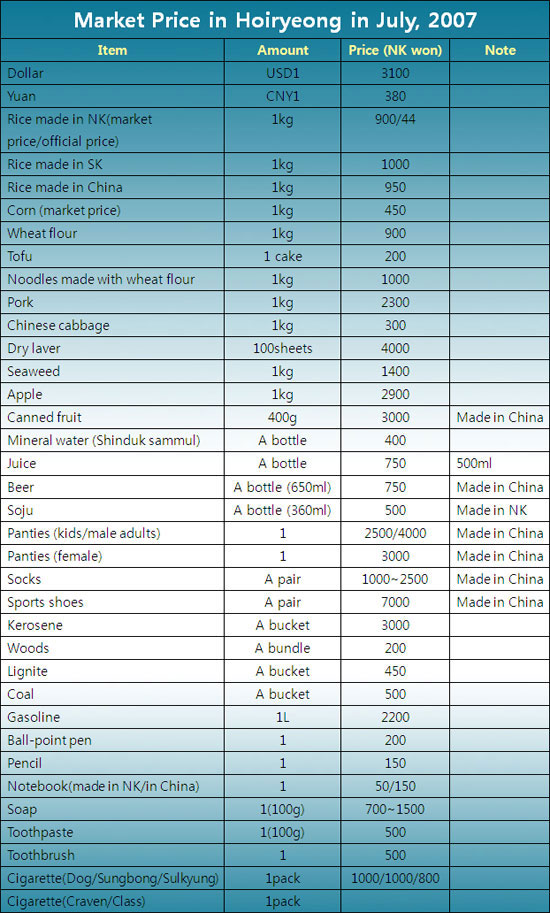
prices.jpgThe North Korean jangmadang’s (market) rice price has narrowly increased after the spring shortage season.

As a result of DailyNK’s investigation of price levels in Northern cities of North Korea at the end of June and beginning of July, the price of North Korean rice is 900 won per kilogram which has increased 80 won compared to its price at the end of March.

At the jangmadang in Shinuiju, North Pyongan, the price of rice, compared to three months ago, has been sold at a 120 won higher price at 980 won. North Korea’s spring shortage season is around March to May before the barley harvest, after the passage of spring.

The reason why the price of rice has shown a narrow upward tendency of 100 won domestically is that along with the effects of the spring shortage season, the nationwide “farm supporting combat” was implemented last May. During the farm supporting period, the jangmadang was closed out, so it became difficult to obtain rice.

Further, with the delay in South Korea’s support of 40,000 tons of rice to North Korea, the increase in the price of rice seems to have been fueled. The price of South Korean rice, compared to the end of March, increased over 150 won. South Korean rice was sold at the increased price of 1,100 in the Shinuiju region.

Along with the increase in the price of rice, the exchange rate seems to show a slight increase as well. In Hoiryeong, it increased by 50 won, compared to the end of March, according to the basis of 3,100 won per dollar. The Chinese Yuan was sold at a 390 won line, having increased 20 won.

Besides this, the staple of North Korea’s lower-class, corn, compared to the end of March, increased by approximately 80 won to 450 won per kilogram. With the rise in the price of rice, the demand for corn as a substitute ration seems to have increased as a result. Frozen pollack, which cost 4,000 won per one, went down to 3,500 won.

Chinese-made shoes, compared to March, is being sold for 7,000 won per pair, having decreased around 5,000 won. In addition, the price of Chinese industrial products as a whole is showing a decline.

Due to North Korean merchants who received goods through Korean-Chinese peddlers in the past going over to China themselves and obtaining goods through dumping, the drop in prices has been continuing.

Pork (2,300 won per kg) or cabbage (300 won per kg) and the price of other vegetables, compared to the end of March, declined by 200 won. In the case of fruits, the price of apples skyrocketed by 1,400 won from three months ago to 2,900 won per kilogram.

Also, among North Korean cigarettes, a product with the brand “Dog” recently surfaced. The price is the same as “Sunbong” at 1,000 won. The representative foreign brand “Craven (called ‘Cat’ in North Korea)” narrowly declined to 1,300 won.

Cost of DPRK grains up as lean season continues
Institute for Far Eastern Studies (IFES)
NK Brief No. 07-7-16-1
7/16/007

The results of a general survey of market prices in the northern region of North Korea carried out by the “Daily NK” show that grain prices continue to rise. The survey, taken from the end of June to the beginning of July, showed that the price per kilogram of domestic rice was 900 Won, 80 Won higher than at the end of March. Sinuiju market prices have risen 120 Won over the last three months, with rice now selling for 980 Won per kilogram.

The ‘lean season’ in North Korea runs from the spring and lasts 3 to 5 months into the summer until barley crops are ready for harvesting. The rise in rice costs by around 100 Won appears to be due to a combination of factors, one being the influence of the lean season, and another being the mobilization of city residents to farming communities to help with harvesting. During harvesting season, markets are closed as workers are sent to the fields, making it difficult to purchase rice. In addition, the decision by Seoul to delay delivery of 400 thousand tons of aid has further aggravated the situation. The price of South Korean rice in the North has also risen, up 150 Won since March in some areas, and up as much as 250 Won in Sinuiju, where a kilogram of ROK rice sells for 1,100.

The rising cost of rice is fueling demand for substitute grains, causing their prices to rise as well. Corn, a staple food for low-income DPRK families, has risen 80 Won since March, to now sell for 450 Won per kilogram. In addition to rising grain prices, currency exchange rates also appear to be on the rise. In the city of Hyeryung, one USD is worth 3,100 Won, 50 Won more than in March. The Chinese Yuan has risen 20 Won, and now trades for 390 Won.

On the other hand, the prices of some goods in the markets are falling. In particular, Chinese goods are becoming more available, thus lowering costs. Chinese shoes have fallen to 7,000 Won, 5,000 Won less than the price in March. Previously, goods were brought into the country only through Chinese-Korean cross-border traders, but now North Korean vendors have direct access to Chinese goods being ‘dumped’ in the North, causing their prices to continue to decline.

Share

North Korea Sells Fishery Licenses in Chulsan’s Coastal Sea to China

Wednesday, July 11th, 2007

Daily NK
Yang Jung A
7/9/2007

A North Korean insider source said on the 5th that the North Korean government sold the fishery licenses of coastal waters at Chulsan, North Pyongan during the crab catching season between May and July for a moderate price.

Chinese marine traders who bought the fishery licenses from North Korea are large marine companies based on Donggang in Lianoning.

The ship-owners and fishermen of North Korea, due to a huge decline in fishes with the Chinese ships’ competitive entry into Chulsan’s offshore waters after receiving the North Korean government’s fishery licenses, are supposed to be going through a hard time.

The source said, “Recently, with the exclusion of the neighboring sea off the coast of Chulsan near the People’s Army’s marine head where the fish farms are located, the fishery licenses to the offshore of the Chulsan-Donggang (China) have been sold to Chinese businessmen. Tens of Chinese fishermen have bought the rights.”

The source said, “The organization in charge who has issued the fishery licenses is not the marine products association, but the No. 64 naval squadron in charge of the this region’s seashore boundary.

Donggang in Liaoning in China located in the mouth of Yalu River, is a small-size city across from Bidan Island.

He said, regarding the price of the fishery licenses, “A small boat is 1,000 Yuan (US$133) per day and a large boat which can accumulate over 100 ton is around 7,000 Yuan (US$ 922) in Chinese currency.”

He added, “The rumors say besides the costs of the licenses, a lot of money has been handed over to North Korea in the negotiations process.”

“Due to monopolizing of the Chinese fishing boats, North Korea’s ships anchored at decks of Donggang are barely seen. North Korean businessmen who have smuggled marine products using small-size boats are having a difficult time because they cannot go out to sea where the current is rough and a lot of gas is required.”

North Korea’s fishermen are saying they have no choice but to go out to the far sea, because they cannot go near the oceanic region operated by Chinese ships.

The source also said, “Chinese ships surreptitiously attacking North Korean ships in their permitted region and beating people have been occurring frequently.”

The Korea Martime Institute, in a report which was announced early this year, said, “The C
hinese government is promoting advancement of North Korea’s operations when the complaints of the country’s fishermen climaxed due to the reduction of ships in the Yungeun Sea and the decline in their income.”

On one hand, besides the oceanic operation rights, the situation is that China’s direct investment in North Korea’s resource development, such as the mining rights being handed over to China, is increasing.

China, instead of investing 70 hundred million Yuan at Musan Mine in 2005, is exercising its 50-year mining licenses to take 10bn tons of iron ore annually.

Share

Japanese Cars Banned, a Fallacy?

Wednesday, July 11th, 2007

Daily NK
Yang Jung A
7/11/2007

Earlier this year, North Korean authorities banned the importation of cars made from Japan. However, it seems that Japanese cars are still being imported into North Korea.

Moreover, due to Japan’s sanctions on North Korea which prohibits the entry of North Korean cargo ships into Japanese ports, it seems that 3rd countries’ ships are being used to import the cars.

On the 8th, the Sankei Shimbun reported, “The Japanese government placed a measure prohibiting the entry of the “Mankyungbong 92” and other North Korean ships into Japanese ports. However, North Korea is using foreign cargo ships to import second hand goods made from Japan.”

In relation to this, the Sankei Shimbun reported, “From January until June this year, a total of 13 foreign cargo ships have entered North Korea loaded with Japanese goods” and informed, “These ships come from 5 countries including Russia, China, Georgia, Cambodia and Belize, with the majority of staff Russian or Chinese.”

Further, the newspaper stated, “1,000 second hand refrigerators and hundreds of small second hand trucks have been imported into North Korea through 3rd countries’ ships.”

In particular, “Last January, a Cambodian cargo ship carrying 9,000 second hand Japanese bicycles entered North Korea and in April, a Berlize cargo ship containing 11,000 second hand Japanese bicycles entered North Korea” the newspaper reported.

The fact that North Korea has continued to import Japanese cars is a clear sign that the measure to ban all Japanese vehicles was more or less a bluff.

A number of North Korean sources revealed this month, “Authorities made an order to confiscate all Japanese made vehicles including trucks and cars until 2009, and to change all the vehicles to cars made from South Korea or China.”

A source informed “This order was notified by the secretarial department of the central authorities around February 16th, as a directive from the transportation division in the form of lectures” and said, “In Pyongyang, the city traffic security agencies are in charge of the inspections whereas in the country, the provincial traffic security agencies are in charge.”

However, the drivers and conductors of Japanese cars and trucks in North Korea question whether all the Japanese cargo vehicles will be confiscated considering they make up 95% of North Korea’s vehicles. Rather, the atmosphere tends to be leaning towards the measure diminishing away sometime in the near future.

North Korea experts speculate that the order to confiscate Japanese vehicles is an attempt to aggravate antagonisms against Japan in response to Japan’s abductees issue and progression of six party talks. Nonetheless, Japanese goods beginning with cars are used and spread widely across North Korea. In reality, it may be difficult to see any results in attempt to confiscate the vehicles.

Share

Inter-Korean trade up by 300%

Tuesday, June 19th, 2007

Joong Ang Daily
Hwang Young-jin
6/19/2007

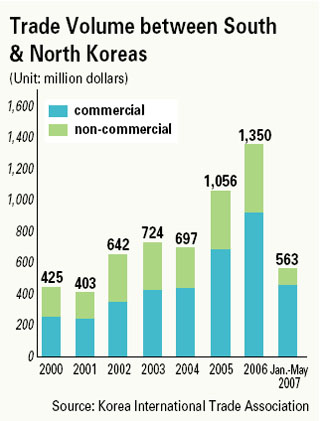
graph.jpgTrade volume between North and South Koreas has increased more than threefold since the historical June 15 Declaration in 2000.

With an average increase of 24.3 percent, annually, the total amount will reach $1.7 billion by the end of the year, according to the report on inter-Korean Trade from the Korea International Trade Association, also known as KITA.

Annual trade volume in 2000 was $425 million, which increased to $1.3 billion last year. Trade volume so far this year until May has already reached $563 million, which is a 31.3 percent increase year-on-year.

Besides the overall growth, what is healthy about the trade quality is that commercial trade accounts for almost 70 percent of the total trade. That figure was below 60 in 2000, according to the report. Non-commercial trade refers to aid including items such as rice, clothing and fuel. In other words, they are products that were sent to North Korea free of charge.

“The success of the Kaesong Industrial Complex is the biggest reason [for the rise],” said Roh Sung-ho, head of the Inter-Korean trade support team at KITA. “We are accepting bids for additional space at the Kaesong complex, and three times more companies bid than there are lots available.”

With more and more companies establishing factories in Kaesong, more material is exported from the South, and more manufactured goods return, said Roh.

The value of goods leaving South Korea was higher than the value of goods returning. However, about 30 percent of those goods were aid and were given free of charge. When that is taken into account, the North made more money from its exports to the South than the South made in exports to the North.

This allows the North to record a profit in trade account books.

“The nuclear incident last year, didn’t affect inter-Korean trade. There might be minor falls, but I expect trade volume between the two Koreas to increase for the time being,” Roh said.

Share

Overview of the Inter-Korean Exchanges & Cooperation for April 2007

Saturday, June 9th, 2007

South Korean Ministry of Unification

Exchange of People
Visits to North Korea

During the month of April, the total number of accomplishments for visits to North Korea was 3,281, an increase of 99% from 1,648 in the previous month. It included 3,136 for economic exchanges, 60 for social and cultural exchanges, 81 for humanitarian aid and 4 for family reunion.

The number increased by 222% from 1,019 in April 2006.

The total number of actual visits made during this period was 13,250 an increase of 40% from 9,894 in the previous month. It included 9,886 for economic exchanges, 1,411 for social and cultural exchanges, 1,807 for humanitarian aid and 146 for family reunion.

The number increased by 39.5% from 9,495 during the same period last year.

The total number of Mt. Geumgang tourists during April was 17,805 in 30 trips altogether, an increase of 1.1% from 17,610 in previous month and a 35% decrease from 27,404 during the same period last year.

Contacts with North Koreans

During the month of April, the total number of the accomplishments for inter-Korean contacts was 72, a decrease of 17.2% from 87 in the previous month. It included 46 for economic exchanges, 23 for social and cultural exchanges, 1 for humanitarian aid and 2 for family reunion.

The number increased by 111.8% from 34 during the same period last year.

The total number of actual contacts made during this period was 229, an increase of 1.3% from 226 in the previous month, It included 69 for economic exchanges, 151 for social and cultural exchanges, 2 for humanitarian aid and 7 for family reunion.

The number increased by 218% from 72 during the same period last year.

In April, a total of 178 North Koreans visited to South Korea, including 72 for participating in ITF(International Taekwondo Federation) founding ceremony of Seoul chapter, 72 for Inter- Korean Worker’s Unification Convention on May Day, 32 flight attendants of Koryeo Air.

Inter-Korean Trade

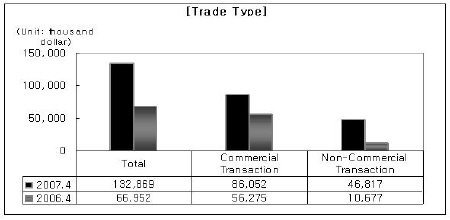
The total volume of inter-Korean trade during April 2007 was $132,869 thousand, showing an 98.5% increase from $66,952 thousand during the same month last year(a 28.8% increase from $103,151 thousand during the previous month).

Trade Type

The total amount of Commercial Transaction were $86,052 thousand (64.8%), showing an 52.9% increase from $56,275 thousand(84.1%) during the same month last year.

The total amount of Non-Commercial Transaction were $46,817 thousand(35.2%), showing an 338.5% increase from $10,677 thousand(15.9%) during the same month last year.

table 1.bmp

Import & Export Status

Import from North Korea totalled $46,028 thousand, an 51.5% increase from $30,388 thousand during the same month last year(a 21.5% decrease from $58,637 thousand during the previous month).

  • Composition by Items (Unit : %)

Agricultural and aquatic products    21
Minerals                                       19.6
Textile products                            28.5
Steel and metal products               18.1
Livlihood supp                              4.5

Export to North Korea totalled $86,841 thousand, an 137.5% increase from $36,564 thousand during the same month last year(a 95.1% increase from $44,514 thousand during the previous month).Composition by Items (Unit : %)

Agricultural and aquatic products 48.7
Textile products 8.8
Steel and metal products 7.9
Machineries 16
Electric and products 7.5

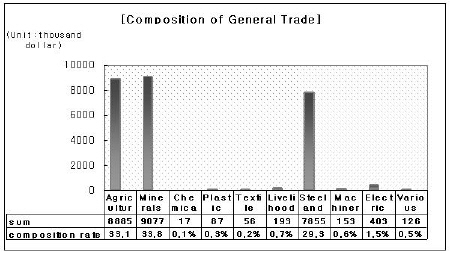
The total volume of General Trade during April 2007 was $26,850 thousand ,a 61.9% increase from $16,589 thousand during the same month last year(a 23.9% decrease from $35,265 thousand in the previous month).The volume of import in General Trade was $25,450 thousand, export was $1,400 thousand and had 94.8%, 5.2% each other.

The composition rate by items had a great part of Minerals(33.8%), Agricultural and Aquatic Products(33.1%), Steel and Metal products(29.3%), Electric and Electronic Products(1.5%)

table 2.bmp

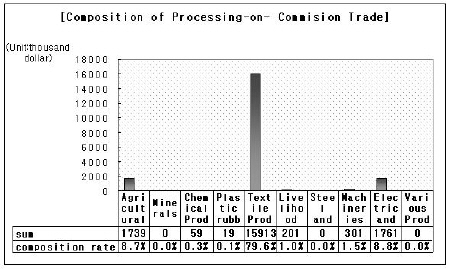
The total volume of Processing-on-Commission Trade during April 2007 was $19,992 thousand, a 38.8% increase from $14,402 thousand during the same month last year.(a 15.4% decrease from $23,629 thousand in the previous month)

The volume of import in Processing-on-Commission Trade was $14,063 thousand, export was $5,929 thousand and had 70.3%, 29.7% each other.

The composition rate by items had a great part of Textiles(79.6%), Electric and Electronic Products(8.8%), Agricultural and Aquatic Products(8.7%)

table 3.bmp

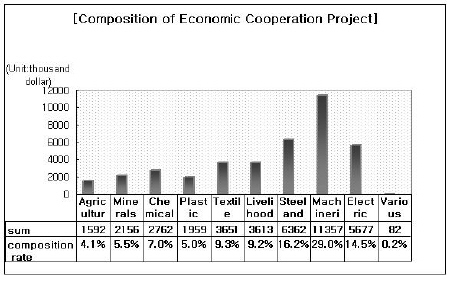
The total volume of Economic Cooperation Project during April 2007 was $39,210 thousand, a 55.1% increase from $25,284 thousand during the same month last year(a 12.4% increase from $34,881 thousand in the previous month).

The volume of import in Economic Cooperation Project was $6,513 thousand, export was $32,697 thousand and had 16.6%, 83.4% each other.

The composition rate by items had a great part of Machineries(29.0%), Steel and Metal Products(16.2%), Electric and Electronic Products(14.5%), Livelihood supplies(9.2%)

table 4.bmp

The total volume of Aid to N.K. during April 2007 was $46,815 thousand, a 338.5% increase from $10,677 thousand during the same month last year(a 399.5% increase from $9,373 thousand in the previous month).

The volume of export was $46,815 thousand.

The composition rate by items had a great part of Chemical Products(84.7%), Machineries(8.3%), Plastic rubber and Leather(2.3%), Agricultural and Aquatic Products(1.2%).

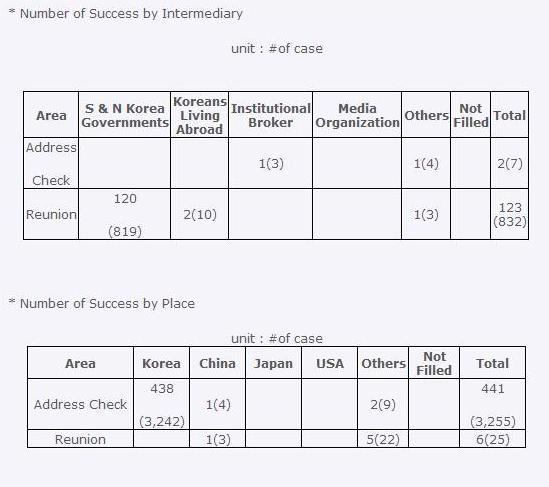
Humanitarian Projects

A. Separated Families

Exchange: # of casses(#of people)

Application for contact 9(14)
Address check 2(7)
Reunion 6(25)
Exchange of letters 36

table 7.JPG

Share

Despite Nuclear Tests North Korea-China Trade Continues to Rise

Tuesday, June 5th, 2007

Daily NK
Kim Yong Hun
6/5/2007

table 5.jpg

Despite the nuclear test last October, trade between North Korea and China has increased steadily. Rather, signs of North Korea’s economic dependence on China is becoming more obvious.

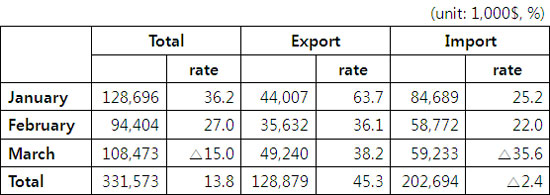
According to statistics recently released by the Ministry of Unification, “2007 1st Quarter, North Korea’s trade status with China,” trade between the two countries recorded $330mn, a 13.8% increase compared to 2006. While North Korea exported $130mn worth of commodities, an increase of 45% compared to the previous year, imports equaled a total of $200mn, a small decrease of 2.4%.

Last year, trade between both North Korea and China totaled $1,699.6mn recording the highest amount of trade ever in history and even this figure had risen 7.5% compared to the year before.

Analysts argue that North Korea’s economic dependence on China is increasing as a result of sanctions implemented by the international community and delay of the February 13 Agreement.

Even until last year, the trade deficit had increased to $764.17mn, an increase of 29.9% compared to 2005. However, in the first quarter of 2007, the trade deficit seems to have taken a major plummet of 61.3% down to $74mn.

North Korea’s main trade commodities are fuel based including coal and minerals, accounting for $45mn (49% increase to 2006) of exports to China, and 34.7% of total exports. In detail, $33mn of minerals, $12mn of medicine, $7.7mn of steel and $6.2mn of fisheries are exported also.

On the other hand, goods imported into North Korea are again fuel based including petroleum and crude oil and account for $31mn (42.5% decrease to 2006) of imports. Further, machinery equates to $17mn of imports, electric appliances $16mn and filaments $11mn.

In the report, the Ministry of Unification indicated North Korea’s major export to China as coal and minerals and analyzed, “This is the result of China’s increased demands for economic growth.”

The Ministry reported, “The majority of imported goods are energy, electric appliances and machinery” and added, “Demand for these light industry goods have increased from an expansion in North Korea’s consumer market. Imports have risen as a result of materials necessary for industrialization.”

According to a report recently released by the U.S. Congressional Research Service (CRS) “North Korea’s Economy,” the amount of trade that occurred between the U.S. and North Korea barely reached $3,000 in 2006, the lowest figure ever recorded since 1990. The only items exported to North Korea were books and newspapers and no imports were received by the U.S, revealed the CRS.

Furthermore, 2006 recorded an all time low of $130mn trade between Japan and North Korea, undoubtedly a reflection of Japan’s strong implementation of economic sanctions on North Korea. Since 1995, Japan has been supporting North Korea with a total of 1.2mn tons of food aid but suspended the aid relief in late 2004 following the issue of Japanese abductees.

Russia’s exports of minerals and coal to North Korea surged dramatically in 2003 and in 2006, total trade with North Korea recorded $220mn. Hence, Russia became now one of the big three trading partners of North Korea with China, South Korea, the CRS reported.

Share

China’s grain exports to N. Korea remain flat in Jan.-April

Friday, June 1st, 2007

Kyodo (Hat Tip DPRK Studies)
6/1/2007

China, North Korea’s major food supplier, exported roughly the same amount of grain to the country in the first four months of the year as it did a year earlier, according to recently released Chinese customs figures.

China’s January-April exports of maize, rice and wheat flour to the country totaled 55,446 tons, up 0.6 percent from the same period in 2006, according to the figures.

When compared to 2005, exports were down 66.7 percent.

The World Food Program warned earlier this year that the food shortage in North Korea is worsening.

While North Korea has faced a chronic food shortage, the shortfall had been made up in the past by multilateral aid channeled through the WFP as well as bilateral shipments from countries such as China and South Korea.

But external food aid has gone down recently, leaving the North with a huge food deficit.

China does not explicitly reveal its food assistance to North Korea, and analysts rely on export figures to assess the amount of aid Beijing gives Pyongyang.

Share