Archive for the ‘Trade Statistics’ Category

DPRK economic statistics from KEI (BoK data)

Saturday, February 2nd, 2008

In October, the Korea Economic Institute published a presentation of North Korean economic data assembled by the Bank of Korea.  Basic stats below:

  • GDP: -1.1% in 2006 (+3.8% in 2005)-Due to decrease in agriculture output. 
  • Services are the largest component of the economy (34%)
  • Trade volume (exports + imports) approximately US$3 billion
  • 2005 trading partners in order: China, South Korea, Thailand, Russia, Japan, Singapore

See the full report here: northkorea.ppt

Share

A Black Hole

Wednesday, January 30th, 2008

Today The Economist published a report on the political momentum of the North Korean human rights movement.  Although this web site does not keep up with the politics of the movement, the article points out how globalization is seemingly improving human rights in the DPRK…

A Black Hole
The Economist
1/30/2008

When you learn that Chinese firms are teaching notions of corporate social responsibility to factories in North Korea, there are two possible reactions besides incredulity. One is despair. Scandals from China involving tainted products, abused workers or environmental degradation are legion: what could its companies possibly have to teach their backward, isolated and viciously repressive neighbour?The other is to celebrate the glorious rising tide of globalisation, which washes up little bits of good news on even its most remote and neglected shores.

Human rights, then, no longer seem so central to the West [politically]. So it is moderately encouraging to hear that Chinese garment-makers, subcontracting to North Korea to escape mounting costs at home, insist that their partners stop imposing seven-day working weeks. Just as China’s Western partners 15 years ago trapped them in misdemeanours by finding that sewing needles had broken on supposed rest days, so the Chinese are catching the North Koreans with the same tactics.

This might seem like a radical thought, but imagine how much better companies from OECD countries would be doing this. According to US Census data, the US has only imported $1.7 m from the DPRK since 1992 (including the famine).  Since isolation from western markets has been the DPRK’s policy essentially since its founding,  why try to maintain it?  Lets start investing and trading.  Agree or disagree in the comments.  I’d like to know your thoughts.

Share

2007 Biggest year for inter-Korean exchange, at USD$1.79 billion

Monday, January 7th, 2008

Institute for Far Eastern Studies (IFES)
NK Brief No. 08-1-10-1
1/10/2008

The net worth of inter-Korean exchanges totaled 1,797,890,000 USD in 2007, up 33% from the 1.35 billion USD in the previous year. Exchanges between the two Koreas began in 1989, and topped one billion dollars for the first time in 2005. The almost 1.8 billion dollars in trade recorded in 2007 is the highest to date, and is equal to 65 percent of North Korea’s non-Korean trade volume of 2.996 billion USD in 2006.

Inter-Korean commercial trade was worth 1,431,170,000 USD, 54 percent higher than the 928 million USD in 2006, while non-commercial trade fell 13 percent, from 421,660,000 dollars in 2006 to only 366,720,000 dollars last year. Overall, commercial trade made up over 80 percent of cross-border exchanges, proving that inter-Korean exchanges continue to grow based on commercial transactions. Commercial trade growth was centered around the mining and fishery sectors (52 percent) and increased production in the Kaesong Industrial Complex (48 percent). Textiles and other goods processed on commission also grew by 30 percent.

Additional manufacturing by companies entering the KIC, as well as the installment of equipment used to increase output by those manufacturers already established in the first phase of the complex, saw a great jump last year. Additionally, South Korea loaned the North 80 million USD for equipment, cloth, soap, polyester fibers, synthetic leather, and other materials to be used in light industry, while the North repayed 2.4 million USD (3 percent) of the loan by delivering 1,000 tons of zinc. This was the first example of the North repaying funds to the South, and shows opportunities for the two Koreas to fulfill each other’s needs and carry out friendly economic cooperation in the future.

With increases in domestic use and export of Bukhan Mountain’s minerals and timber, improvements in communications, customs, and transport issues at the KIC and a growing number of companies moving into the complex leading to an increase in production and manufacturing activity, inter-Korean exchanges are expected to continue to grow in the future.

Share

N. Korea repays Seoul aid with minerals

Friday, January 4th, 2008

In the 1980s Pepsi went on sale in the Soviet Union [as did eventually Coke].  Since the hard currency needed to buy the syrup was scarce, the Soviets traded it for Vodka (which they presumably had plenty of)–At least this is what I was able to piece together when I visited the USSR as a teenager.

Yonhap (January 4, 2008) reports that North Korea has adopted the same basic strategy to repay its external debts.  This is a positive move on the part of the North because it is the first time the North has made an effort at repaying its external bills.

(excerpt from Yonhap)  The South-North Korea Exchanges and Cooperation Support Association said 500 tons of North Korean-produced zinc, worth about US$1.2 million, arrived in the port of Incheon on Thursday and was unloaded on Friday. It was the second repayment by the communist country for economic assistance provided by Seoul.

Although the amount agreed upon by both countries for 2007 has been paid in full, the installment represents only 3 percent of the North’s total debt to South Korea [appx. USD$80 million]. Pyongyang had agreed to pay Seoul with $2.4 million worth of mineral ore to reimburse it for aid.

[…]reportedly mark[ing] the first time the North has redeemed any of its debt.

Share

Kaesong output increases 150 pct: Unification Ministry

Friday, December 28th, 2007

Yonhap
12/28/2007

The total output of a South Korea-built industrial complex in North Korea’s border town of Kaesong totaled over US$180 million this year, shooting up 150 percent from a year ago, Seoul’s Unification Ministry said on Friday.

“The total production by businesses at the Kaesong industrial complex recorded an estimated $185 million this year, up about 150 percent from $74 million last year,” the ministry said in a press release.

Share

South to Send Steel Plates to North

Sunday, December 9th, 2007

Korea Times
Yoon Won-sup
12/9/2007

South Korea will provide 5,100 tons of steel plates to North Korea on Dec. 17 in a six-party deal that involves the provision of energy or alternatives to North Korea in exchange for the North’s disablement of its nuclear facilities by year’s-end, government officials said Sunday.

U.S. President George W. Bush sent a personal letter to North Korean leader Kim Jong-il last week urging him to keep his word on the disablement and declaration by Dec. 31.

The shipment is the first alternative to oil sent to the North under the agreement, although participants in the six-way talks have been taking turns to provide 50,000 tons of heavy fuel oil to the North every month recently.

Share

Trade between divided Koreas rises 23 percent in first 10 months

Wednesday, November 7th, 2007

Yonhap
11/7/2007

Bilateral trade between the two Koreas increased by 23 percent in the first 10 months of the year due mainly to an increase in shipments of goods produced at the South Korea-built industrial complex in the communist North, the Unification Ministry said Wednesday.

The two-way trade volume jumped to nearly US$1.44 billion in the January-October period, up from $1.16 billion from a year earlier, according to the ministry.

“The rise mainly comes from a 48 percent increase in the amount of goods shipped from Kaesong,” a ministry official said, adding trade in some other areas, such as minerals and fisheries, increased by nearly 50 percent year-on-year.

Exchanges in non-commercial areas, however, dropped by 18 percent, according to the ministry official.

Seoul hopes cross-border trade will continue to increase over the coming years as the sides are about to launch a second development plan to expand the Kaesong industrial complex, where about two dozen South Korean companies are currently employing some 10,000 North Korean workers.

The joint industrial complex is expected to house over 2,000 South Koreans businesses and employ as many as 500,000 North Koreans when it is fully developed by a target year of 2012.

President Roh Moo-hyun and North Korean leader Kim Jong-il have also agreed to develop the North’s western Haeju area as a special economic district in the second-ever inter-Korean summit held in the North Korean capital of Pyongyang early last month.

Share

North Korean Economy Does Not Have a Basis for Development

Wednesday, November 7th, 2007

Daily NK
Yang Jung A
11/7/2007

Although the North Korean economy has been growing since late 1990s, it is hard to say that the economy has growth on its own.

A senior researcher at the Korea Institute for National Unification, Choi Su Young, released a paper titled “the Latest Tendency of the North Korean Economy” in the October “Finance,” which is issued by Korea Federation of Banks. He pointed out in the paper that “North Korea’s economic reliance on China is getting serious and cited the state’s 1.7 billion dollars in trade with China.”

He explained “On one hand, North Korea exports to China in 2006 increased to 72.7% compared with exports in 2002; on the other hand, imports from China increased to 163.8%. This resulted in a recorded deficit of 760 million dollars. The rate of North Korean trade reliance on China was 48.5% in 2004, and it reached 60% last year.”

He relayed that “In the production industry, North Korea has to rely systematically on China’s raw materials, energy, facilities and parts. North Korea is importing its entire amount of petroleum for transportation and production. Chinese influence on the North Korean economy is so absolute that 70-80% of consumer products are made in China.

Mr. Choi insists that “Although foreign aid and South-North economic cooperation were expanding and its reliance on the influx of foreign currency was great, North Korea was staying in low-growth status, which means North Korea does not have the economic foundation for development.

According to the report, the scale of exchange between the South and the North was rapidly increasing through the annual provision of South Korean rice and free fertilizer supporting and South Korean enterprises’ activities at the Kaesung Industrial Complex.

With the exception of South Korea and China, there are no countries willing to invest in North Korea. Most developed countries turn away from North Korea because the standard and environment related to North Korean investment are significantly inferior to the norm.

He explained that “The North Korean investment environment is inconvenient for foreign investors due to obsolete infra-structures, high distribution costs and limited markets. It is unnecessary to mention the international policies related to North Korea.”

Mr. Choi added that “The scale of North Korean foreign trade was 2 billion dollars in 2000 and reached 3 billion dollars in 2006. Exports amounted to 950 million dollars and imports came to a total of 2.05 billion dollars.”

Share

Inter-Korean trade climbs 12.7 pct to US$1.23 bln in January-September period

Wednesday, October 31st, 2007

Yonhap
10/31/2007

South Korean trade with North Korea rose 12.7 percent from a year earlier to US$1.23 billion for the first nine months of this year, a report said Wednesday, amid progress in talks on the North’s nuclear programs.

During the January-September period, South Korea exported $700 million worth of goods to North Korea and imported $530 million, the Korea International Trade Association said in the report.

Share

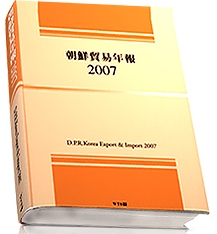
D.P.R. Korea Export and Import 2007

Monday, October 22nd, 2007

book.jpgD.P.R. Korea Export and Import 2007
Price JPY39,900.-(tax included)
Date of issue October  2007
Size B5/Page 514
Publisher WTS
ISBN Code ISBN978-4-9903339-2-8-C3033

This book summarizes foreign trade statistics in fiscal year 2006 of the Democratic People’s Republic of Korea (DPRK).  Since DPRK does not publish the trade statistics, it is not even certain whether or not statistical data on trade are systematically collected.  Therefore, WTS drew up this book by investigating foreign trade with DPRK, based on customhouse statistics of 190 or so countries (and regions) which are trade partners of DPRK.

The statistical format applied in this book was created, based on the HS code (the commodity classification list based on “International Convention on the Harmonized Commodity Description and Coding System”) which is the international standard.
Amounts in various currency units were all converted into the U.S. dollar on the basis of the annual total.

We would be delighted if this book could serve as reference for concerned parties.

Contents of “D.P.R.Korea Export and Import 2007”
1. Overview
2. Statistics by country
3. Statistics by product group
4. Statistics by country and product group (20 high rank countries = China, South Korea, India, Thailand, Yemen, Russia, Brazil, Qatar, Japan, South Africa, Singapore, Mexico, Greece, Germany, Hong Kong, Netherland, Chile, Taiwan, Peru, Paraguay)
5. Topics:
1) Oil import
2) Export of gold and silver
3) Export of rare metals
4) Export of other subterranean resources
5) Import of luxury items
6) Export of apparels
7) Export of fishery products
8) Data on imports to DPRK after the nuclear test
9) Partial confusion of the statistics of DPRK with those of South Korea
6. Statistics by product group and country (HS6ST)- EXPORT 3,161 all articles
7. Statistics by product group and country (HS6ST)- IMPORT 4,294 all articles

Information provided by:
Miyagawa Jun
Korea Specialty Bookstore, Rainbow Trading Co.
TomodaSanwaBldg. 2F, 1-37,
KandaJinbocho1-37, Chiyoda-ku,
Tokyo101-0051 Japan
tel/ fax +81-3-5283-6100,
[email protected]

Share
