Archive for the ‘Statistics’ Category

DPRK refugees head for home

Thursday, August 12th, 2010

Andrei Lankov writes in the Asia Times:

Sisa Journal, an influential and well-informed South Korean weekly, recently published interesting statistics. It is well known that some 20,000 North Korean refugees currently reside in South Korea. However, the magazine reports that an estimated 200 of them are not here any more. Surprisingly, they have moved back to the North.

Who are those returnees? Broadly speaking, from this correspondent’s personal knowledge of North Korean refugees, they belong to three separate categories.

To start with, some returnees – a few dozen, perhaps, are North Korea spies who completed their missions and went back to Pyongyang to receive their medals and promotions. Indeed, as a recent attempt to assassinate Hwang Chang-yop, the highest-ranking defector from the North, demonstrated once again, it is not too difficult to plant a few intelligence agents into the steadily growing stream of refugees.

To complicate things further, most refugees have their families in the North, so it is easy for the North Korean intelligence agencies to recruit even a bona fide refugee by blackmail.

However, one should not make too much from the presence of espionage agents in South Korea. They usually have no access to sensitive information, since refugees are seldom employed in jobs that give them such access (and if they are, they are watched carefully). So, the only area where they can gather meaningful intelligence is the activities of refugee groups from North Korea. Indeed, many of the refugees who have gone missing in recent years once demonstrated suspicious interest in defectors’ groups and organizations.

Another group of returnees are those refugees who were disappointed with life in South Korea. Most of the North Koreans went South with great and often inflated expectations, but soon they discovered the life they had to lead was far less glamorous than the life they saw in smuggled copies of South Korean TV dramas.

North Korean refugees are not faring well in the South. Their average income is about one million won (US$625) a month, roughly half of the national average. They do not have many useful skills, so they have to do only badly paid unskilled work. Last but not least, they are often discriminated against by “locals” – to the extent that many of them try to pass for ethnic Koreans from China (those are discriminated against, too – but to a somewhat lesser degree).

The situation is aggravated by a sense of loneliness and alienation. So, some North Koreans begin to perceive their past life in the North as an attractive alternative, and move back.

Technically, it is easy: since the refugees have South Korean passports, they can always depart from China after using a North Korean embassy or consulate there.

It helps that the North Korean regime follows a lenient policy towards returning refugees. They are allowed to settle down in their native towns and villages, and if they make a sufficient donation (reportedly, a few tens of thousand dollars) they can even be granted good positions and privileges. They are often used for propaganda, telling horror stories about life in the capitalist hell down south. Professional propaganda mongers help them to prepare such stories in which the personal experiences of the returnees (bitter, to be sure) are liberally mixed with necessary inventions.

And finally, some refugees cannot stand the thought of the families they left behind. Many of them move back to reunite with their families. In recent years, family defections can be arranged via a professional defection broker, but there are people who due to different reasons prefer a do-it-yourself defection. They go back and sometimes perish somewhere in China or North Korea.

So, even the tremendous material advantage of the South does not always make it more attractive. Yes, merely a few hundred refugees have chosen to move back (less so, if we take into account spies and those who went to get their families). Still, this is a discomforting reminder about their position in the prosperous and sophisticated South. It also does not bode well for unification.

South Korean society is not doing well when it comes to absorbing 20,000 North Koreans, most of whom are active and even adventurous people. However, sooner or later it will have to accommodate 20 million. How will it handle this task? The experience of the refugees makes one suspect that the first few decades of a unified Korea will be a tough.

UPDATE: Chris Green at the Daily NK takes issue with the source of Lankov’s numbers:

However, the department within the Ministry of Unification, which controls defectors settlement in South Korean society, asserts that there is more to it than that. “As far as the Ministry has confirmed, only two defectors have so far returned to the North, one of them came back again,” an official with the Ministry explained to The Daily NK this evening. “That number (200) seems to be exaggerated. There are many cases where police officers who are supposed to take care of defectors and their lives lose a defector’s contact details or where defectors leave their places without notifying our officers.”

Among those who disappear from where they live, many simply move to China to live with Chinese families. Therefore, the official noted, there are “insufficient grounds” for the assertion that the 200 who disappeared have actually returned to North Korea.

Read the full story here:
North Korean refugees head for home
Asia Times
Andrei Lankov
8/13/2010

Share

Inter-Korean trade hits record high

Thursday, August 12th, 2010

According to Yonhap:

Inter-Korean trade soared to a record high in the first half of this year despite escalating tensions caused by the sinking of a South Korean naval ship in late March, a government report said Thursday.

Two-way trade jumped 52.4 percent on-year to US$983.2 million in the January-June period, according to report by the Korea Customs Service (KCS). It also represents a six-fold increase from the $161.6 million tallied in the same period in 1999.

Outbound shipments spiked 66 percent on-year to $430.5 million, with imports from the North surging 44 percent to $552.7 million for a deficit of slightly more than $122.2 million.

The report, however, said that with most cross-border exchanges being cut off by Seoul in retaliation for the sinking of the South Korean warship Cheonan, inter-Korean trade is expected to drop about 30 percent on-year in the second half.

A Seoul-led multinational investigation team found the North responsible for the sinking of the 1,200-ton warship that resulted in the deaths of 46 sailors. The North countered that it was in no way in involved.

Only the Kaesong Complex, located just north of the DMZ that separates the two countries, has not been affected by the fallout from the ship sinking. The complex accounts for roughly 70 percent of all inter-Korean trade and is home to 120 South Korean companies that make products with the help of North Korean laborers.

The customs office, meanwhile, said trade between the two Koreas rose from $328.6 million in 1999 to $1.08 billion in 2005 and peaked at $1.82 billion in 2008. Last year, the trade volume fell to $1.66 billion after Pyongyang detonated its second nuclear device.

According to the Choson Ilbo:

In spite of strained inter-Korean relations following the March sinking of the South Korean Navy corvette Cheonan, trade volume between the two Koreas hit a record high in the first half of this year.

According to data from the Korea Customs Service, the total value of exchanged goods reached over US$983 million in the January to June period, up more than 52 percent from $645 million a year ago.

The latest figure tops the previous record of $885 million in 2008, and is six times higher than the $162 million recorded in 1999.

The South’s cross-border exports jumped 66 percent to $435 million, and inbound shipments 44 percent to $553 million.

Amid the ever-changing atmosphere on the Korean Peninsula, inter-governmental efforts to spur North-South trade and the expansion of the joint Kaesong Industrial Complex have fueled a gradual yet continuous growth in trade activity.

The annual trade volume, which amounted to nearly $329 million in 1999, peaked at over $1.8 billion in 2008 before dropping slightly to $1.67 billion in the wake of North Korea’s second nuclear test in 2009.

Experts, however, forecast the trade volume to drop by as much as 30 percent on-year in the second half of this year, reflecting Seoul’s suspension of all trade with Pyongyang, except for operations at the Kaesong Industrial Complex, in response to the sinking of the Cheonan.

Much attention is focused on the future of business at the industrial park, which produces 70 percent of the goods traded between the two sides.

Read the full stories here:
Inter-Korean trade hits record high in H1: report
Yonhap
8/12/2010

Inter-Korean Trade Reaches Record High
Choson Ilbo
8/13/2010

Share

Regular food rations not provided as Prices Soar and food shortages grow in DPRK

Friday, August 6th, 2010

Institute for Far Eastern Studies (IFES)
NK Brief No. 10-08-06-1
8/6/2010

Over the last five months, regular food rations have not been provided even to those in the capital city of Pyongyang, indicating the severity of food shortages in North Korea. According to the ROK Ministry of Unification, rice and corn were added to the list of goods with controlled prices in at least one market in Pyongyang. A list of controlled goods with state-set upper price limits has been distributed to each market throughout North Korea since 2003. While prices may vary slightly, comparing them with earlier price caps gives a good indication of the availability of goods.

The July appearance of rice and corn on the list of restricted goods, neither of which has been on the list even as far back as February, when strict market controls were enacted in the aftermath of failed currency reform measures, indicates that the ration system is not operating normally, even in Pyongyang. It also means that not only are officials not receiving normal rations, but that average residents are relying more on markets for their food. One Unification Ministry official stated, “Rice was on the list of controlled goods in markets outside of Pyongyang in February, but couldn’t be found in markets in the capital city…in July, rice and corn emerged [as items with price caps] in Pyongyang markets.” The official also explained that as the food ration system collapsed even in Pyongyang, the issuance of price caps on rice and corn was an indication that more people were turning to the markets to buy these staples.

Looking at other goods on the list, it appears that agricultural goods cost 3~7 times more in July than in February, and manufactured goods were as much as 7 times more expensive. Necessary goods, both agricultural and manufactured, have grown considerably more expensive in North Korea over just five months. More specifically, beans were up 3.6-fold; chicken, 3.3-fold; lettuce, 3-fold; apples, 6.3-fold; rice and corn, 2-fold. Ball-point pens and other daily-use items were up 5~6-fold. In July, rice sold for 550 won per kilogram, while corn was priced at 280 won per kilo.

The price caps are upper limits set by North Korean authorities, but the reality is that goods are often sold at higher prices. The shortage of agricultural goods, and the fact that the Chinese Yuan has appreciated 3-fold since February, has led to these record price-hikes. On May 26, Workers’ Party of Korea (WPK) authorities issued a decree, “Regarding Korea’s Current Food Situation,” calling for residents to fend for themselves. As prices skyrocketed on agricultural goods, one measure adopted by North Korean authorities has been to more than double exports of iron ore from Musan, North Hamgyong Province to China, while drastically increasing the import of corn. This increased import of corn has brought down the price of rice from 1,200 to 900 won per kilogram in Musan, while corn itself has fallen from 600 to 500 won. On the other hand, the drop in the foreign currency exchange rate in mid-July caused a shortage of dollars, driving the price of rice up to as high as 1,200 won per kilogram in some regions.

Share

Inter-Korean trade falls more than 30%

Friday, August 6th, 2010

According to Yonhap:

Inter-Korean trade has fallen more than 30 percent since the South cut almost all business relations with the North after Pyongyang was blamed for torpedoing one of its naval ships in late March, the customs office here said Friday.

According to data provided by the Korea Customs Service, the trade between the two Koreas came to US$123.06 million in June, down 32 percent from April, when they still kept their ordinary business relations despite a probe into the naval disaster.

South Korea’s exports to the North amounted to $56.88 million in June, down 27 percent from April, while imports decreased 36.5 percent to $66.18 million over the same period, the data showed.

Inter-Korean trade also dropped 21 percent from May, with its exports to and imports from the North falling 4 percent and 32 percent, respectively.

Despite such a sharp shrinkage, the customs office said the decline was not as steep as expected thanks to the Kaesong complex, which takes up most inter-Korean trade.

“The reason why the decline was not as sharp as expected is because we still keep a trade channel open in the Kaesong complex, which accounts for around 70 percent of total trade with the North,” a customs official said.

South Korea is the North’s second-largest trade partner after China. A suspension of inter-Korean business would cause a significant impact on the efforts of the reclusive communist nation to secure cash, according to experts.

Earlier, a state-run think tank here said inter-Korean trade suspension could cost North Korea about $280 million annually, adding to pressure on the North’s cash-strapped regime in governing its country.

Read the full story here:
Inter-Korean trade falls more than 30 pct amid heightened tensions
Yonhap
8/6/2010

Share

DPRK seeks to repay debt in ginseng

Wednesday, July 28th, 2010

UPDATE: This story was picked up by the Financial Times (8/11/2010):

North Korea has offered the Czech Republic 20 tonnes of ginseng in lieu of payment for some of its debts.

However, Prague has turned down the deal, instead suggesting that Pyongyang pays in the valuable mineral zinc, which can be resold on international markets.

North Korea owes the Czech Republic $10m from the days when the Czech Republic was under communist rule and the two countries traded with each other regularly. Communist Czechoslovakia was a leading supplier of trucks, trams and machinery to North Korea, creating a large pile of debt.

Pyongyang reportedly offered $500,000 worth of ginseng, a root which is reputed to boost memory, stamina and libido, as a down payment.

However, consumption of ginseng in the European country is low, with just 1.4 tonnes used each year.

North Korea’s economy is struggling as international sanctions tighten and it hopes to be able to barter its way out of handing over valuable cash.

Non-cash transactions between socialist countries is common, with Cuba sending Venezuela doctors in exchange for discounted oil.

A Czech government spokesman has said that the countries were in negotiation over how the debt would be paid.

“We have been trying to convince them to send, for instance, a shipment of zinc,” the deputy finance minister told the MF Dnes newspaper.

ORIGINAL POST: According to the Korea Times:

North Korea has offered to pay its debt to the Czech government with ginseng, according to a local Czech daily newspaper.

MF DNES, a daily newspaper based in Prague, reported last Saturday that North Korea has recently suggested to the Czech Finance Ministry that it would pay 5 percent of its debt — approximately $500,000 — with ginseng.

“We are trying to persuade them (North Korea) to give us, for example a bulk of Zinc instead, so that we could sell it to someone else,” Tomas Zidek, deputy finance minister, told the newspaper in Czech.

North Korea is believed to have a significant amount of zinc in deposits.

The paper went on to say the consumption of ginseng in the Czech Republic is very small, and it only imported 1.4 tons last year. The amount of ginseng worth $500,000 will be roughly 400 tons, securing the supply for more than 200 years.

But, to Czech’s disappointment, North Korea seemed to have made up its mind, as it sent a delegation with samples of ginseng.

North Korea is known to be Czech’s 10th biggest debtor, which goes back to the communist governments. The North bought many trams and vehicles from former Czechoslovakia.

Read the full story here:
North Korea wants to pay back debt in ginseng
Korea Times
Kim Se-jeong
7/26/2010

Share

India-DPRK trade expanding

Sunday, July 25th, 2010

According to Forbes:

Last year India exported roughly $1 billion to North Korea, up from an average of barely $100 million in the middle of the past decade, reports the Confederation of Indian Industry, a trade organization–most of that in refined petroleum products. The trade group says that North Korea’s exports to India were a minuscule $57 million, including silver and auto parts. (South Korean trade figures suggest India’s exports are much lower.)

The commercial tie has no deep historical roots and is curious, to say the least, given Pyongyang’s closeness with China, India’s commercial rival, and its connection to the A.Q. Khan nuclear network in Pakistan, India’s enemy.

North Korea needs oil to maintain power plants and to keep its outsize military on the move. It apparently has enough hard- currency reserve from its murky export trade to buy on the spot market. India, for its part, has ramped up refining but gotten ahead of domestic demand. Further, by keeping an artificial lid on pump prices until recently, Indian policy encouraged these oil sector producers to look for clients overseas. “India is the largest exporter of refined products east of the Suez [meaning the Middle East and Asia],” says Fereidun Fesharaki, chairman of Facts Global Energy in Singapore. A lot of enhanced supply came online in 2009, mostly from Reliance Industries, which has the world’s largest refinery, and the Essar Group, the Mumbai steel and energy giant. At current usage and demand “India needs 15 years of demand to absorb this current supply,” he adds.

Until June the New Delhi government kept a cap on domestic gasoline prices, running up a $10 billion subsidy bill, or roughly 7% of its budget. While state-owned companies were compensated for their losses, those in the private sector were on their own, causing them to look for other markets, especially since the price for crude has doubled, to $78 per barrel since 2004. “Their incentive is [to find] who in the world is desperate enough to take the products, and it’s usually Iran or North Korea,” says Fesharaki.

Some North Korea watchers are caught off guard. “I was flabbergasted by the increase in trade,” says Stephan Haggard, director of the Korea-Pacific Program at UC, San Diego. “North Korea is basically engaged in close to barter trade.” No one seems more surprised than Pratap Singh, India’s ambassador to Pyongyang, who says he has no idea of trade volume because the North Koreans won’t supply credible data, much less working phone lines. “How did you manage to get through?” he asks a reporter.

Like other oil refiners, neither Reliance nor Essar exports fuel to North Korea directly. That’s too much of a risk politically (even though this trade isn’t barred under current UN sanctions) and economically, as Pyongyang has been known to slip on its payments. Instead, the fuel is sold through a network of traders and banks in Dubai and elsewhere. Trade data nevertheless record the origin of the refined petro goods.

Curiously, both New Delhi and the U.S. State Department, which have bumped along in relations complicated by India’s own nuclear development, show no alarm. A spokesman for India’s Ministry of Foreign Affairs says all international strictures are observed and nothing sinister is at hand. Washington won’t comment without verifying the data.

Perhaps a little more attention is in order since India is selling more than mere oil to North Korea. Last year, according to Indian trade data, India also exported $2 million in goods in a category called “nuclear reactors, boilers, machinery and mechanical appliances”–most likely water pumps, computer data storage units, ball bearings and machine tools. Could they be used to maintain a nuke plant in some way? Maybe.

“North Korea, over the years, has attained skills to disguise their trade activities and also to utilize materials they have for other purposes,” says Jennifer Lee, a research analyst at the Peterson Institute for International Economics in Washington. “Countries need to be especially careful in what they export to North Korea.”

Read the full story here:
Look Who’s Helping North Korea
Forbes
Megha Bahree
7/22/2010
(Magazine date: 8/9/2010)

Share

Kaesong exports to ROK remain constant

Tuesday, July 20th, 2010

According to Yonhap:

The volume of goods brought into South Korea from a joint factory park in North Korea has remained unchanged despite Seoul’s trade ban slapped on Pyongyang in May in retaliation for its deadly attack on a South Korean warship, the government here said Tuesday.

The volume of products transported from the Kaesong industrial park stood at 6,953 tons in June, compared to 7,004 tons a month earlier when South Korea banned trade with North Korea and cut the number of South Korean workers staying in the North Korean border town, the Unification Ministry said in a release.

“There has been little difference in the amount of manufactured products brought in since the May 24 measures,” which the South imposed after a multinational investigation found the North responsible for the March sinking of the Cheonan, it said.

Ministry spokesman Chun Hae-sung said currency conversions for the data were not immediately available.

North Korea has denied any responsibility for the attack in the Yellow Sea that left 46 sailors dead. About 121 South Korean firms operate in Kaesong, employing 44,000 North Korean workers — the last remaining major symbol of detente between the divided countries.

According to the ministry that handles cross-border affairs, the amount of goods brought into South Korea for the first half of this year nearly doubled compared to the same period last year. The figures signaled the Kaesong factory park continued to grow even though the relations between the Koreas have soured since 2008.

But many of the Kaesong companies have complained of falling orders and are seeking rescue funds, arguing the deteriorating political relations are increasingly becoming a liability for their businesses.

Read the full story here:
Influx of goods from inter-Korean factory park stays consistent: gov’t
Yonhap
Sam Kim
7/20/2010

Share

DPRK-PRC trade up 18.1% from January to May 2010

Tuesday, July 13th, 2010

Institute for Far Eastern Studies (IFES)
NK Brief No.10-07-08-2
7-8-2010

As inter-Korean commerce has all but dried up in the wake of the Cheonan incident, trade between North Korea and China appears to have continued to grow. According to Chinese customs statistics released on July 6, trade with North Korea from January to May amounted to 983.63 million USD; 18.1 percent more than the 833.07 million USD reported for the same period last year.

North Korea imported 727.192 million USD-worth of Chinese goods (29 percent increase over the same period last year), but exports dropped by 4.9 percent, amounting to only 256.438 million USD. This indicates a 60 percent increase in North Korea’s trade deficit with China, which was 470.757 million USD in the first part of 2009. With South Korean sanctions against the North halting all inter-Korean trade outside of the Kaesong Industrial Complex following the sinking of the Cheonan, it is expected that Pyongyang will become even more economically dependent on Beijing.

During this period, crude oil accounted for most of North Korea’s imports from China, as Pyongyang bought 254,000 tons (slightly more than the 247,000 tons in early 2009). However, due to rising international fuel prices, this oil cost the North 157.097 million USD, a 76 percent increase over what Pyongyang spent during this period last year.

In addition, rice (24,400 tons), corn (31,400 tons), beans (20,500 tons), flour (34,000 tons) and other necessary food imports totaling 11,300 tons reflected a 41 percent increase over the same period in 2009. The cost of fertilizer imports also jumped sharply, amounting to 81,943 tons, or 115.6 percent more than the 38,004 tons imported from January to May 2009. Increasing imports of food and fertilizer are a result of the growing agricultural difficulties being faced in the North. Based on current prices, aviation fuel imports also grew by 46.8 percent, freight trucks by 98.7 percent, automobile fuel by 47.4 percent, and bituminous coal by 137 percent.

The top ten official imports of Chinese goods by North Korea were as follows: crude oil (21.6 percent); aviation fuel (3.1 percent); freight trucks (2.9 percent); automobile fuel (2 percent); bituminous coal (1.9 percent); fertilizer (1.8 percent); beans (1.6 percent); flour (1.6 percent); rice (1.5 percent); and corn (1.1 percent).

North Korea’s exports to China were mainly underground natural resources. The top ten exported goods were: iron ore (17.1 percent); anthracite (16 percent); pig iron (9.6 percent); zinc (5 percent); Magnesite (3.6 percent); lead (2.4 percent); silicon (2.3 percent); men’s clothing (2.2 percent); frozen squid (2.1 percent); and aluminum (1.9 percent).

Share

Miscellaneous foreign assistance documents

Monday, July 12th, 2010

Several reports on various foreign assistance programs in the DPRK have been piling up on my desktop so I thought I would go ahead and post them for you.  They are not particularly timely, but they are full of interesting information.

U.S. Bilateral Food Assistance to North Korea Had Mixed Results (PDF)
US GAO
June 2000

DPRK: Water and sanitation in three counties of Kangwonin three counties of Kangwon Province (Thongchon, Chonnae, Popdong)
Reliefweb Mission Report
March 2002

Rehabilitation of Thongchon, Popdong and Chonnae Water Supply systems (Kangwon Province, DPR of Korea)
Reliefweb Mission Report
June 2002

Democratic People’s Republic of Korea: Operations Report
International Federation of Red Cross and Red Crescent Societies
Appeal no. MDRKP001
November 15, 2007

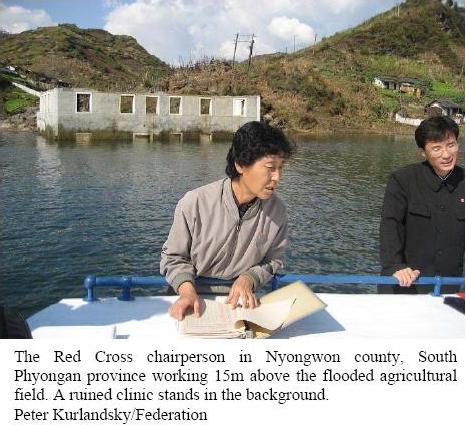
The IFRC contains the below photo of a flooded clinic:

nyongwon-clinic-flooded-ground.JPG

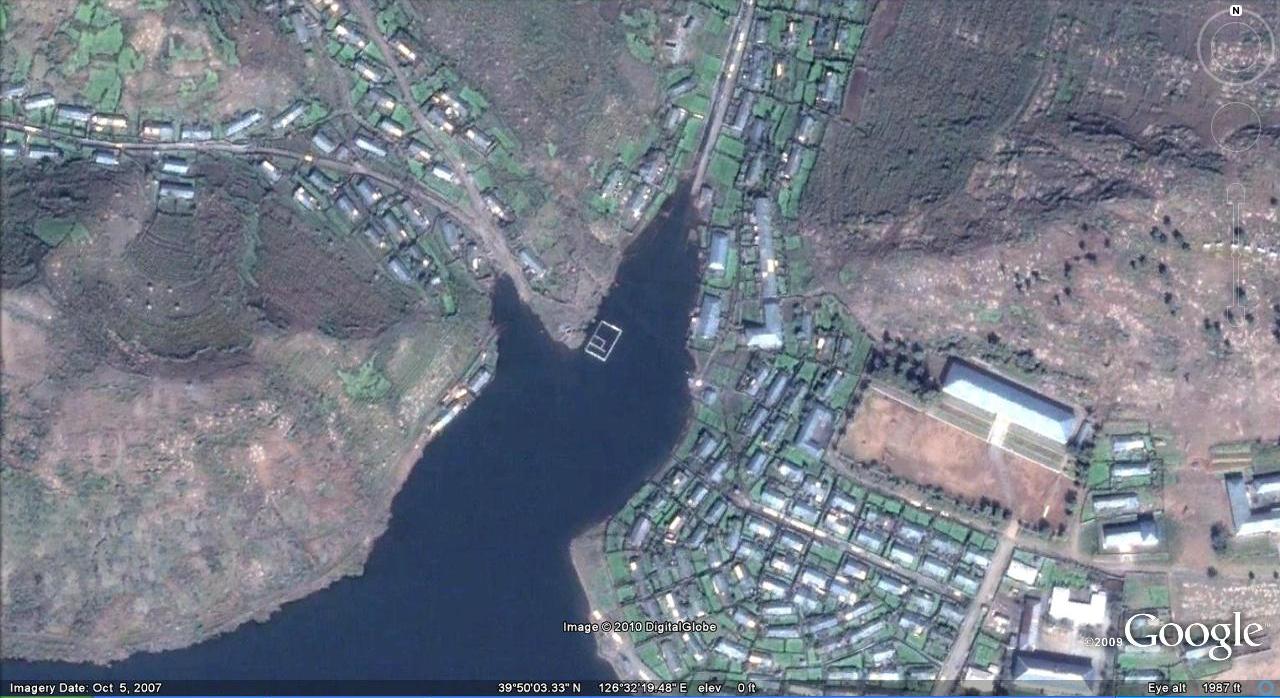
This clinic is in Nyongwon at 39°50’3.51″N, 126°32’18.64″E.  Here is a satellite image:

nyongwon-clinic-flooded-satellite.JPG

The sad part is that the damage caused by flooding is in large part an unintended consequence of agriculture, deforestation, and hydro-power policies.  This clinic lies behind the Taedonggang Dam in Tokchon (satellite image here).

Share

DPRK aid update

Sunday, July 11th, 2010

According to KBS:

Red Cross to Help NK Prepare for Monsoon Season

The International Federation of Red Cross and Red Crescent Societies reportedly plans to allocate around nine million dollars this year for projects to support North Korea ahead of the monsoon season.

Radio Free Asia said Wednesday that the Red Cross plans to select 31 towns that are considered to be the most vulnerable to natural disasters and will provide them with up to nine-and-a-half million dollars for preparedness training and to build dams and reservoirs.

The report said the international organization’s plans aim to help some eight-point-two million North Koreans this year.

The Red Cross also plans to form a committee on preventing natural disasters in the North from this month until mid-September, when the region is affected by monsoon rains.

And according to another KBS story:

WFP to Spend $2.8 Mln on NK Food Aid

The U.N. World Food Program (WFP) has decided to spend nearly two-point-eight million U.S. dollars on food aid for North Korea.

The funding for the aid was provided by the Swedish government.

Radio Free Asia quoted WFP global media coordinator Greg Barrow as saying that his agency will use the Swedish donation to help North Korea, which is in desperate need of emergency food aid.

Barrow said that the North will require even more donations from countries around the world, given that the current amount of food aid for the impoverished nation is expected to run out by September.

Read the full stories here:
WFP to Spend $2.8 Mln on NK Food Aid
KBS
7/7/2010

Red Cross to Help NK Prepare for Monsoon Season
KBS
7/7/2010

Share