Archive for the ‘Statistics’ Category

North Korea increasing coal production – seeking to ease power shortages and boost exports

Wednesday, February 2nd, 2011

Pictured Above: Pongchon Coal Mine (Google Earth)

Institute for Far Eastern Studies (IFES)
NK Brief No. 11-01-18
1/28/2011

The DPRK Workers’ Party’s newspaper, the Rodong Sinmun, recently featured a front-page editorial urging the North Korean people to increase coal production. On January 26, the KCNA reiterated the call, reporting that the newspaper editorial highlighted fertilizer, cotton, electricity, and steel as products suffering from a lack of coal, and that “coal production must be quickly increased in the Jik-dong Youth Mine, the Chongsong Youth Mine, the Ryongdeung Mine, the Jaenam Mine, Bongchon Mine [Pongchon Mine] and other mines with good conditions and large deposits.”

The editorial also emphasized that “priority must be placed on the equipment and materials necessary for coal production,” and, “the Cabinet, national planning committee, government ministries and central organizations need to draft plans for guaranteeing equipment and materials and must unconditionally and strongly push to provide,” ensuring that the mines have everything they need. It also called on all people of North Korea to assist in mining endeavors and to support the miners, adding that those responsible for providing safety equipment for the mines and miners step up efforts to ensure that all necessary safety gear is available.

In the recent New Year’s Joint Editorial, coal, power, steel and railways were named as the four ‘vanguard industries’ of the people’s economy. Of the four, coal took the top spot, and all of North Korea’s other media outlets followed up the editorial with articles focusing on the coal industry. On January 15, Voice of America radio quoted some recent Chinese customs statistics, revealing that “North Korea exported almost 41 million tons of coal to China between January and November of last year, surpassing the 36 million tons exported [to China] in 2009.” It was notable that only 15.1 tons were exported between January and August, but that 25.5 tons were sent across the border between August and November.

North Korea’s coal exports to China earned it 340 million USD last year, making the coal industry a favorite of Pyongyang’s economic and political elites. Increasing coal production is boosting output from some of the North’s electrical power plants, while exports to China provide much-needed foreign capital. However, even in Pyongyang, where the electrical supply is relatively good, many houses lack heating and experience long black-outs. Open North Korea Radio, a shortwave radio station based in the South, reported on January 24, “As electrical conditions in Pyongyang worsen, now no heating is available.” Farming villages can find nearby timber to use as firewood, but because prices are so high in Pyongyang, even heating has become difficult. Some in the city even wish for rural lifestyles, just for the access to food and heat.

Share

US and DPRK begin another round of food diplomacy

Monday, January 31st, 2011

UPDATE 3: The JoongAng Daily (2/12/2011) reports on comments made by Robert King:

King explained that in the past, the U.S. had agreed to give North Korea 500,000 tons in food aid, but was only able to give 170,000 tons as North Korea refused the rest and ordered foreigners who had entered North Korea to deliver the aid to leave.

The envoy also said that it has not yet been decided whether the U.S. will grant food aid to the North and that three prerequisites must be fulfilled if it does.

The three conditions, he explained, are whether a real demand for food truly exists in North Korea, whether the North’s need for food is on the same level as other countries in need of aid, and whether monitoring of the aid will be securely guaranteed. Only when these three prerequisites are met can the U.S. grant aid, King said.

UPDATE 2: According to the JoongAng Daily (2/9/2011) the North Koreans have made an official request for food aid to the US government:

North Korean deputy ambassador to the UN, Han Sang-ryol, requested U.S. food aid last month through Robert King, the U.S. special envoy for North Korean human rights, a diplomatic source told the JoongAng Ilbo yesterday.

Local analysts suspect that King, who is currently in Seoul, informed the South Korean government of the request and is discussing a joint response to it.

“Ambassador Han met King in New York on Jan. 14 and requested large-scale U.S. food aid for the North,” said the diplomatic source in Washington.

It is the first time in years that a behind-the-scenes diplomatic discussion between Pyongyang and Washington on aid has come to the surface. U.S. food aid to the North has been suspended since March 2009 after the Kim Jong-il regime rejected a U.S. proposal to increase the number of Korean-speaking food-distribution monitors to make sure aid was getting to the public.

Han told King that the North was willing to enhance international monitoring of food aid “as much as the U.S. wants,” the source said.

King, who came to Seoul on Sunday, started meetings with Seoul officials yesterday, including Wi Sung-lac, the top envoy on North Korean nuclear issues. At a brief media conference after the meeting with Wi, King did not elaborate on the purpose of his visit or his discussion with the South Korean envoy, saying only it was “very good, very serious and a very thoughtful discussion.”

When asked whether food assistance to the North was on the agenda, King said they “talked about a lot of issues.”

“[It is] extremely important for the U.S., as we pursue our policies toward North Korea, to coordinate with the government of South Korea,” King said. “We have a close working relationship, we are able to work together well on issues, we share our analysis, we share our ideas in terms of making progress.”

The official United States stance, as U.S. Assistant Secretary of State Kurt Campbell said earlier this month, is that it does not have a plan to resume food aid to the North for now.

“The U.S. does not think the North has met conditions to get U.S. food aid,” the source said.

And even if Washington decides to resume aid, it will take time because of congressional procedures, the source said. But some analysts see the possibility of change, citing some opinions in the U.S. State Department in favor of engaging the North with aid to sway its attitude on other issues, including denuclearization.

UPDATE 1: According to the Donga Ilbo (2/6/2011):

The U.S.-based Radio Free Asia says the U.S. government and nongovernmental organizations are discussing the resumption of food aid to North Korea.

Quoting diplomatic sources in the U.S., the broadcaster said Washington has not decided to resume food aid to Pyongyang but is having many talks and discussions on the issue.

Voice of America said Friday that the World Food Program and the U.N. Food and Agriculture Organization, both of which are under U.S. influence, also plan an additional survey of the North`s food situation for about a month from Feb. 10.

In an interview, Dr. Kisan Gunjal of the food organization said he will survey the North’s food security and crop situations from Feb. 10 to March 12 at Pyongyang’s official invitation.

In a phone interview with The Dong-A Ilbo, an official at a South Korean aid group said, “The U.S. has asked South Korean non-governmental organizations about North Korea’s crop and food supply situations in 2011 since the North’s artillery provocation on Yeonpyeong Island in November.”

Washington, however, remains officially cautious. U.S. State Department spokesman Philip Crowley told a news briefing Monday that the U.S. government has no immediate plans to provide humanitarian aid to the North.

ORIGINAL POST: According to the Donga Ilbo (1/31/2011) the US and DPRK are talking food aid once more:

The U.S. and North Korea have begun their third round of food diplomacy, with Washington considering resuming food aid to Pyongyang.

The U.S. has halted food aid to the North twice since its first provision in 1996 after blaming Pyongyang for diverting the aid.

The North has always asked for food aid first since North Korean leader Kim Jong Il confronted a series of crises in the early 1990s, when the former Soviet Union and China stopped economic assistance to the Stalinist country.

His father and the North`s founder Kim Il Sung died in 1994. When the North was devastated by floods and other natural disasters nationwide, Kim Jong Il ordered state cadres to beg the U.S. for help.

The North Korean Foreign Ministry then formed a committee for flood damage and went hat in hand to Washington. The Clinton administration provided 19,500 tons of food through the World Food Program in 1996, expecting the North to implement the 1994 Agreed Framework and be docile in talks for the repatriation of remains of American soldiers killed in action in the Korean War.

Washington increased its food aid from 177,000 tons in 1997 to 695,000 tons in 1999. In 2000, a joint communiqué between the North and the U.S. was signed.

North Korea, however, diverted the food aid in ignoring U.S. and international principles for humanitarian aid.

As public opinion in the U.S. worsened over the assistance, the George W. Bush administration slashed the aid volume from 350,000 tons in 2001 to 40,000 tons in 2003. The U.S. Congress demanded greater transparency in the distribution of the food aid in 2004, when it passed the North Korean Human Rights Act.

Rejecting the demand, Pyongyang expelled World Food Program staff in 2005. Washington opted not to provide food aid to Pyongyang in 2006.

Flexing its muscles in November 2006 by conducting its first nuclear test, North Korea again requested U.S. aid in 2008. The Bush administration, which was nearing the end of its term, chose to sit at the negotiating table with the North and offered 500,000 tons of food aid through the World Food Program.

The North received 169,000 tons of food by expanding the areas where food distribution is monitored and agreeing to allow more Korean-speaking monitoring personnel.

In early 2009, Pyongyang decided to test the newly inaugurated Obama administration by launching a long-range rocket and preparing for a second nuclear test. In March that year, the North expelled humanitarian aid groups, saying it would not be able to keep its promise of distribution transparency.

In fall last year, North Korea unveiled its uranium enrichment program and showed its centrifuges to the U.S. in a virtual threat to conduct its third nuclear test with uranium bombs if Washington failed to provide food.

What the U.S. will eventually do is attracting interest since South Korea is opposed to aid to the North.

Read the full stories below:
Pyongyang asks U.S. to restore food aid: source
JoongAng Daily
Kim Jung-wook, Moon Gwang-lip
2/9/2011

US, N. Korea begin 3rd round of food diplomacy
Donga Ilbo
1/31/2011

Radio Free Asia: US, NGOs discussing food aid to NK
Donga Ilbo
2/6/2011

Share

ROK spending on inter-Korean exchanges at record low

Sunday, January 23rd, 2011

According to Yonhap:

In another reflection of frayed inter-Korean relations, South Korea last year used the smallest amount of funds earmarked for exchanges with North Korea since the sides held their first summit in 2000, the Unification Ministry said Sunday.

The ministry, the main South Korean government arm handling affairs involving North Korea, spent 86.25 billion won (US$76 million), or 7.7 percent of the 1.12 trillion won designated as the “South-North Cooperation Fund,” officials said this week.

The fund was created in 1991 to support humanitarian and economic exchanges between the divided Koreas, which remain technically at war after the 1950-53 Korean War ended in a truce.

Last year’s spending was the smallest since 2000 when the sides held their landmark summit talks and agreed on a wide range of cooperation projects as part of their reconciliation efforts.

But the cross-border ties deteriorated to the worst level in more than a decade when the North bombarded a South Korean island and was also found responsible for sinking a warship last year.

South Korea has suspended humanitarian aid and cross-border trade in retaliation, pressing North Korea to apologize if the impoverished communist country seeks to restore their relations.

The cooperation fund’s implementation rate had ranged from 37 to 92.5 percent between 2000 and 2007, but nosedived after a conservative government took power in 2008 with a hard-line policy on the North. That year, the rate stood at 18.1 percent before dropping further to 8.6 percent in 2009.

Read the full story here:
Spending on inter-Korean exchanges lowest since 2000: ministry
Yonhap
1/23/2011

Share

DPRK military spending estimated at US$8.7b, but rumors of problems grow

Tuesday, January 18th, 2011

According to the Korea Herald (via Yonhap):

North Korea’s actual military spending is believed to be about 15 times the announced amount in 2009 as the communist regime continues to build up its military capacity despite the country’s moribund economy, a South Korean defense research institute said Tuesday.

The North said it spent US$570 million on its military in 2009, but the real expenditure, calculated on an exchange rate based on purchasing power parity terms, was $8.77 billion, the state-run Korea Institute of Defense Analyses (KIDA) said in a report.

“In spite of its economy shrinking since the mid-2000s, North Korea has gradually increased its military spending,” the report said.

North Korea maintains the world’s fifth-largest army with an active duty military force of 1.19 million, compared to about 655,000 in the South.

According to figures released by North Korea, its military spending rose to $570 million in 2009 from $540 million in 2008, $510 million in 2007 and $470 million in 2006, the KIDA said.

As of 2009, North Korea’s gross national income stood at 28.6 trillion won ($25 billion), compared with the South’s 1,068 trillion won, the KIDA said.

Despite this chunk of change, rumors are leaking into the media that the DPRK military is suffering some sever problems:

1. People ordered to donate food to the military

2. Shortage of clothing provisions

3. Shortage of heating and increased propaganda training.

The usual caveats apply.

(h/t Joshua)

Read the full story here:
N. Korea’s actual military spending estimated at US$8.77 bln in 2009
Korea Herald
1/18/2011

Share

ROK government encouraging DPRK restaurant boycott

Monday, January 10th, 2011

According to the Choson Ilbo:

Siem Reap, Cambodia’s second largest city near the sprawling ruins of the Angkor Wat, has two North Korean restaurants, down from three since North Korea recalled all their expat staff after Kim Jong-il’s stroke in 2008 and returned only the employees of two of them. The restaurants rely on South Korean tourists for business since the town is a popular destination for them.

One of them, called Restaurant Pyongyang, sells the famous cold noodles or naengmyeon for US$7 a dish, while North Korean dancers perform and pour drinks for customers. It used to be a regular stopover for South Korean tourists, with tour agencies charging $30 for a visit and a meal. One tour guide said, “In Cambodia $7 a dish is already pretty expensive, but many tourists go to the restaurant because of its attractions.”

After North Korea’s sinking of the Navy corvette Cheonan in March last year, the South Korean Embassy in Cambodia asked tour agencies and South Korean residents’ association there to avoid sending visitors from the South there, but local sources say the plea fell largely on deaf ears. But the North’s artillery attack on Yeonpyong Island in November last year finally did the trick. The South Korean residents’ association in Siem Reap voluntarily boycotted the North Korean restaurants, and tour agencies also voluntarily took them off their itinerary.

The restaurants are apparently suffering. A member of the South Korean residents’ association said, “Almost all of the customers were South Korean tourists, but it seems that even the performances have stopped now there are no customers.”

Around 120,000 South Koreans a year reportedly visited the two restaurants, contributing to an estimated W200-300 million (US$1=W1,126) in monthly sales. North Korea runs over 100 restaurants in China, Vietnam, Thailand, Laos and Russia, which serve as a source of much-needed hard currency for the regime by sending home $100,000-300,000 a year.

The mood in Siem Reap is now desperate. Last month, a placard outside a South Korean restaurant criticizing North Korea’s attacks were torn down by seven people who appeared to be North Korean agents, in what expats there believe was another small-scale North Korean provocation. Tour agencies are also losing revenues after taking the restaurants off their itineraries. “We used to charge $30 per visit and took 30 percent of the profits, but not any more,” a tour guide said.

South Korean residents’ associations abroad rarely voluntarily boycott North Korean restaurants. The Okryugwan chain of North Korean restaurants in Beijing’s Wangjing district is still accessible to South Koreans. A South Korean Embassy official there said, “We asked residents to avoid the restaurant in November but did not force them.”

Meanwhile, a North Korean restaurant in Kathmandu, Nepal closed down in November after its North Korean manager defected to South Korea.

Read the full story below:
N.Korean Restaurants Abroad Feel the Pinch
Choson Ilbo
1/10/2011

Share

DPRK trade falls in 2009 – reliance on China remains high

Sunday, January 9th, 2011

According to Yonhap:

North Korea’s external trade fell in 2009 with its economic reliance on China staying significantly high, a report showed Sunday, underscoring the need for Pyongyang to diversify its industry structure and open its market for survival.

According to the report by the Korea Finance Corporation, North Korea’s total trade amounted to US$3.41 billion in the cited year, down 10.6 percent from a year earlier. The trade decrease was the largest since 1998.

Exports dropped 6 percent to $1.06 billion, while imports fell 12.5 percent to $2.35 billion over the same period, the report showed, bringing the North’s trade deficit to $1.29 billion.

With international sanctions in place for its nuclear ambitions and its reluctance to open up its economy, the North’s dependence on China stayed quite high at 80.4 percent in 2009, the report showed. Its trade deficit with Beijing totaled $1.1 billion.

The report said that the North should open its market and diversify its industry structure currently focused on producing weapons, while improving overall infrastructure such as power generation facilities, should it seek to revive its economy.

It also emphasized the need for resumption of inter-Korean trade and an increase in international aid for the North’s survival.

“For the North Korean economy to get back on track, inter-Korean trade has to be resumed and aid from the international community should also be expanded,” said an official of the state-run corporation.

South Korea’s economic relations with the North have remained frozen since Seoul cut almost all inter-Korean trade in May 2010 after it found Pyongyang was behind the deadly attack of its naval ship in March that killed 46 sailors.

The move led to a drop of around 30 percent in inter-Korean trade last year, according to the latest report by Seoul’s customs office. South Korea is one of the North’s major trade partners, although the two remain technically at war as their 1950-53 conflict ended in a truce, not a peace treaty.

If a reader can send me a link to the actual report, I would appreciate it.

The Los Angeles Times also covered the report.

Read the full story here:
N. Korea’s trade falls, reliance on China remains high in 2009
Yonhap
1/9/2011

Share

ROK goods saturate DPRK

Thursday, January 6th, 2011

According to the Hankyorey:

A report on major North Korean indicators released by Statistics Korea on Wednesday revealed that South Korean products are becoming increasingly popular in North Korea, and that there are hardly any North Korean urban youth who do not watch South Korean TV dramas or movies.

In the report, Statistics Korea said it is becoming a fad for young people in major North Korean cities like Pyongyang and along the border with China to watch South Korean television dramas and films using MP3 players or laptop computers. Statistics Korea said MP3 players with 1G of memory cost 60,000 North Korean Won (estimated $419), while a used laptop costs about 2 million North Korean Won. A memory chip with two or three movies costs 10,000 North Korean Won if it is an original, and 5,000 North Korean Won if its a copy.

The report also said many South Korean products are in circulation in North Korea, including blenders, portable heaters, gas ranges, butane cans, lunch trays, gas heaters, rice cookers, dishrags and gloves. According to the report, South Korean shampoo and conditioner is popular with the wives of high-ranking North Korean officials in Pyongyang. Some 470g bottles of South Korean shampoo and rinse go for 40-50 yuan (8,000-10,000 South Korean Won) in Pyongyang. The report said the popularity of South Korean products was also reflected in other goods. South Korean necklaces are sold for about $500 and earrings for about $70-80, while South Korean products like perfume, deodorant, car air fresheners, refrigerator deodorizer and bathroom air fresheners are also selling well.

South Korea’s nominal GNI in 2009 was $837.2 billion, 37.4 times that of North Korea’s $22.4 billion. North Korea’s economic power, all told, is no more than the level of the South Korean city of Gwangju (about 22 trillion Won). South Korea’s per capita income of $18,175 was 17.9 times that of North Korea’s $960. South Korea also conducted $686.6 billion in total trade, 201.9 times that of North Korea, which conducted only $3.4 billion. The only sectors in which North Korea topped South Korea were production of iron ore and coal and length of railroads. North Korea’s iron ore production was 4.955 million tons, ten times that of South Korea (455,000 tons), and its coal production was 25.5 million tons, 10 times that of South Korea (2.519 million tons). North Korea also had 5,242km of railroads, 1.4 times that of South Korea’s 3,378km. North Korea is also believed to have 7 quadrillion Won in underground mineral wealth.

I have been unable to locate the original on the Statistics Korea page.  If any readers can find it, please let me know.

Read the full story here:
In limited N.Korean market, furor for S.Korean products
Hankyoreh
Hwangbo Yon
1/6/2011

Share

DPRK-ROK income gap reaches record in 2009

Tuesday, January 4th, 2011

According to Arirang News:

The income disparity between South and North Korea has widened by close to 40 times.

According to figures released by Statistics Korea on Wednesday South Korea’s Gross National Income reached 837 billion US dollars in 2009 about 37 times more than North Korea’s 22 billion dollars.

South Korea’s GNI per person posted 17,175 US dollars roughly 18 times more than North Korea’s 960 dollars while in annual trade the South saw 686 billion dollars in 2009 which is 202 times larger than the North’s 3 billion dollars.

As for economic growth that year the South saw a [0.2%] expansion in the wake of the global financial crisis whereas the North posted a contraction of 0.9.

Economists say such figures show that it is almost impossible for North Korea to catch up with South Korea anytime soon.

An official with the finance ministry in Seoul says South Korea’s overall economic strength is about 40 times that of the communist regime adding that such power provides the foundation for South Korea to stay ahead of North Korea in every field including defense.

And according to the Choson Ilbo:

South Korea’s economy is 37.4 times larger than North Korea’s, according to the latest data. Statistics Korea said Wednesday that as of 2009 South Korea’s nominal gross national income stood at US$837.2 billion as against North Korea’s GNI of $22.4 billion. The figure is slightly lower than the 37.7-fold gap seen in 2008 but marked a significant increase from the 34.7-fold difference seen in 2006.

Per-capita GNI was $17,175 in the South, 17.9 times larger than North Korea’s $960, and South Korea’s total trade volume of $686.6 billion was 201.9 times greater than North Korea’s $3.4 billion.

But North Korea has ample mineral resources. As of 2008, North Korea had W6,983.6 trillion (US$1=W1,126) worth of mineral resources, 24.1 times more than South Korea’s W289.1 trillion. The North has an estimated W2,679.7 trillion worth of magnesite (6 billion tons), W2,662.9 trillion worth of coal (20.5 billion tons), and W61.33 trillion worth of gold (2,000 tons). South Korea had no magnesite while its coal deposits amount to just W15.7 billion or 1.36 billion tons, 5.9 percent of North Korea’s.

Statistics Korea also cited media reports to describe the rising interest among North Koreans in South Korean pop culture. South Korean-made mixers, heaters, gas ranges, gas containers, lunch boxes, pressurized rice cookers, towels and gloves are sold in North Korea with the brand labels intact.

South Korean-made shampoo and conditioners are popular among high-ranking North Korean officials, with a 470 g product costing between 8,000 to 10,000 North Korean won and US$1.50 for a bar of soap. Some young North Koreans watch South Korean movies and TV dramas such as “Friend,” “My Wife is a Gangster,” and “Winter Sonata” on their Chinese laptops and listen to South Korean pop songs on their MP3 or CD players.

Read the full story here:
Income Gap Between South and North Korea Records 37 Times Differences in 2009
Arirang News
Kim Na-ri
1/5/2011

Economic Gap Between 2 Korea Remains Huge
Choson Ilbo
1/6/2011

Share

DPRK-ROK urbanization

Sunday, January 2nd, 2011

According to Yonhap:

South Korea’s level of urbanization first exceeded that of North Korea in the 1980s, and the gap may widen to 24 percentage points by 2015, data by the South Korean statistical office and the United Nations showed Sunday.

The South’s urbanization rate reached 83 percent as of 2010 while the corresponding figure for the communist North stood at 60.2 percent, giving South Korea a 22.8 percentage point lead, reports of global urbanization forecast by Statistics Korea and the U.N. showed.

The urbanization rate calculates the proportion of a country’s total population living in city areas and indicates its level of modernization or industrialization, which encourages more movement of population to cities.

North Korea showed a higher level of urbanization in 1975 with 56.7 percent, compared with the South’s 48 percent, but the difference has started to narrow since then, the reports showed. The South eclipsed the communist country in the 1980s.

The urbanization rate is forecast to reach 84.4 percent for South Korea by 2015 while the ratio for the North may only inch up to 61 percent, expanding the difference to 23.4 percentage points five years from now, according to the reports.

The growing urbanization gap is attributable to the two separated countries’ differing fates. While the South pushed for aggressive industrialization and export-led growth, the North remained closed to the global market and stayed underdeveloped.

The U.N. report also forecast the population of the South’s two major cities — Seoul and Busan — to reach 10,007,000 and 3,322,000, respectively, while the population of Pyongyang and Nampho, two main cities of the North, are expected to stand at only 2,859,000 and 1,187,000, respectively.

The two countries have technically remained at war since their 1950-53 Korean War ended in a truce, not a peace treaty.

Read the full story here:
Two Koreas’ urbanization gap likely to widen further by 2015: reports
Yonhap
1/2/2010

Share

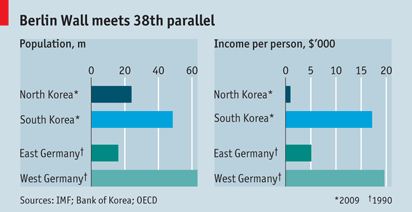
Korea-Germany comparisons

Thursday, December 30th, 2010

This chart comes from a recent article in The Economist:

Read the full article here:
Parallel economies
The Economist
12/29/2010

Share