From 2001 until 2013.
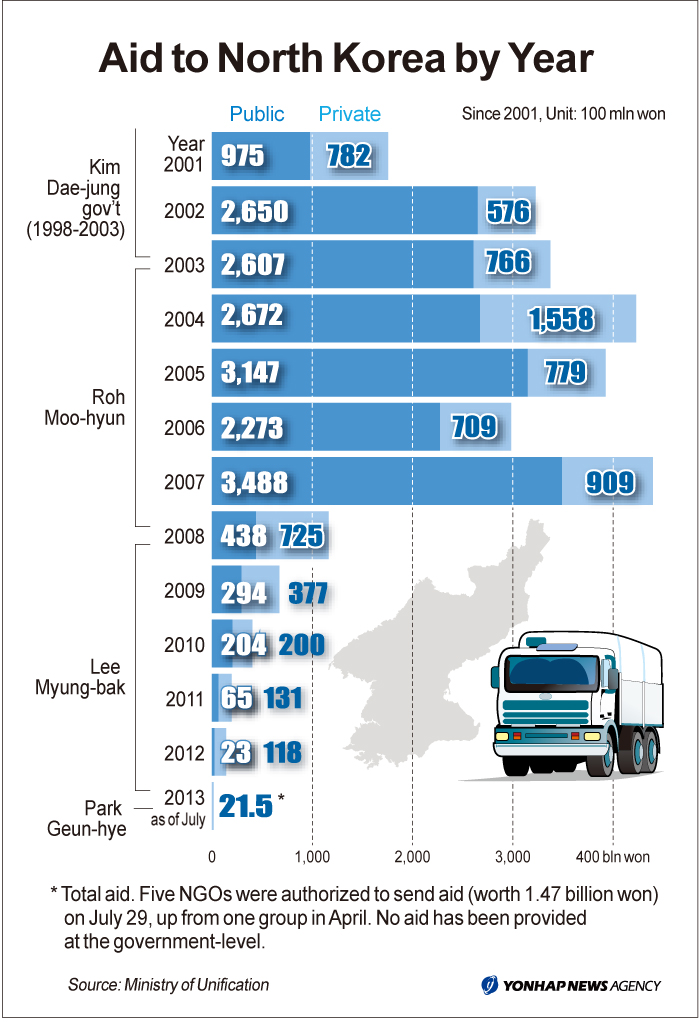

UPDATE 9 (2013-8-16): ROK Red Cross to provide $100,000 flood relief to DPRK. According to Yonhap:
The Korean Red Cross plans to provide North Korea with an emergency fund of US$100,000 to help flood victims in the communist country, an official from the organization said Friday.
“The International Federation of Red Cross and Red Crescent Societies (IFRC) has asked for our participation in supporting the flood-hit North Korea,” the official said.
“In accordance, we’ve decided in humanitarian terms to send $100,000 to the IFRC to provide the victims there with relief goods.” he added.
The money, which comes from the Korean Red Cross’ own funds reserved for inter-Korean exchanges, is expected to be transferred to an IFRC bank account next week, according to the official.
The IFRC data showed that torrential rains since early July have caused extensive flooding and landslides across the impoverished communist country, killing 33 people and injuring 2 others with 18 still missing. An estimated 4,000 families have lost their homes and 50,000 have been displaced.
The international agency said earlier this month that it has allocated 299,744 Swiss franc to help the North Korean victims, with their relief operation to continue until the end of October.
Last year, the Korean Red Cross provided Pyongyang with $100,000 to help those who suffered from heavy precipitations.
UPDATE 8 (2013-8-6): The UN and South Koreans are contributing to flood relief. According to Yonhap:
The World Food Program (WFP) spokeswoman Nanna Skau said corn is being provided to households that have been hit hard by recent flooding caused by torrential rain, Radio Free Asia reported. She added that assistance is being offered because flooding has caused extensive damage to farmlands and irrigation systems.
The radio broadcast monitored in Seoul said distribution of the grain will continue for the next 30 days, with each recipient being allocated 400 grams per day.
The WFP also said support will be provided to 38,067 people in 10 cities and counties in Pyongan, Hwanghae and Hamgyong provinces.
The International Federation of Red Cross and Red Crescent Societies and the U.N. Office for the Coordination of Humanitarian Affairs said torrential rains that caused flooding and landslides left 33 North Koreans dead and displaced roughly 50,000 people from their homes. In places such as Anju in South Pyongan Province, some 80 percent of the city was flooded, resulting in extensive damage to homes and buildings.
Related to the international food effort underway, Korean Sharing Movement, a South Korean non-governmental organization, said it wanted to send emergency food aid to the North and requested permission from Seoul’s Ministry of Unification, which oversees inter-Korean affairs.
The civic groups pointed out that emergency aid shipments have always been permitted in the past regardless of the state of inter-Korean relations.
Cross-border ties have been strained following the North’s detonation of its third nuclear device in February and subsequent tightening of international sanctions. The shutting down of the joint factory park in Kaesong further strained relations.
Seoul has officially maintained that it will allow shipments of humanitarian aid to the North, but made clear it needs to first verify the extent of the flood damage. Officials have cited urgency and ability to make certain that relief will reach those in greatest need as conditions that must be met for aid to be provided. Last week, South Korea approved aid shipments by five local civic organizations.
Reflecting the country’s humanitarian aid policy, the South and North Exchange and Cooperation Promotion Council, which is chaired by the unification minister, approved sending more than US$6.03 million for relief programs organized by the U.N. Children’s Fund (UNICEF).
The money will be used to provide medicine and vaccines as well as improve the level of nutrition provided to small children, pregnant women and the socially disadvantaged. An additional 15.92 million won (US$14,288) will be sent to UNICEF to help manage the aid programs in North Korea.
UPDATE 7 (2013-8-2): From the United Nations:
Exceptionally heavy seasonal rain in mid-July resulted in flooding in many parts of DPRK Korea. Particularly severely affected are the provinces of North and South Pyongan. Many places had over twice the average rainfall for July in three days. There are a reported 33 deaths with 18 people still missing.
The Government has reported that there has been extensive damage to buildings and infrastructure with a current total of 48,688 people made homeless across the country, mostly in the two provinces of North and South Pyonang. Farmland was inundated with 11,567 hectares affected with around 1,125 hectares of farmland washed away or otherwise destroyed.
UN agencies carried out assessment missions on 24 July to two counties in North Pyongang – Pakchon and Taechon and in those two areas confirmed the scale of the flood damage. Further assessment missions will take place this week.
Damage to water systems is widespread and there is already an increased incidence of diarrhoea in some areas. Anju city, which was 80% flooded will only have its pumping stations fully operational again in about two weeks. 30 other communities have had their drinking water systems damaged.
Damage to agricultural land is extensive though estimates of crop damage vary and further assessment missions in the next week should give a more accurate number once the flood waters have fully receded. Apart from the farmland that was physically swept away or buried, damage to the standing crops may not be as extensive as first reports suggested as many fields were flooded by heavy rain rather than by flash flooding and, unless there is further heavy rain, seem likely to largely recover.
Transport infrastructure has suffered with at least 20 bridges and 11km of embankments and 143 areas where roads have been eroded, washed away or blocked by landslides. Government surveys show that 27 schools were completely destroyed in four provinces, with a further 10 being badly damaged. Many others have suffered more minor damage, though currently it is the summer break, so at present schooling is not being disrupted. Medical facilities such as hospitals, clinics and nursing homes also were affected with 3 being destroyed and 14 badly damaged.
UPDATE 6 (2013-8-4): The North Koreans have cut short military exercises to focus on flood relief. According to the AFP:
The communist state has staged summer military drills that partially coincided with the annual Ulchi Freedom Guardian exercise conducted by its rival South Korea and the United States, that usually takes place in August.
“But this year’s summer drill in the North will be scaled back considerably because it needs to focus on repairing floods damages,” the source was quoted as saying.
Floods caused by heavy rains that pummelled the North since early July have destroyed some 6,000 houses, displaced more than 23,000 people and washed away a large swathes of farmlands, the North’s state media said late last month.
The death toll has reached 33 across the nation and some 13,300 hectares of farmlands have been damaged, the International Federation of the Red Cross and Red Crescent Societies (IFRC) said last week, warning of “longer-term impact” on the country’s food security.
Decades of deforestation and decrepit infrastructure have left the impoverished North vulnerable to floods, which led to some 170 deaths last summer.
UPDATE 5 (2013-8-2): The international Red Cross has said it will provide North Korea with an emergency fund of US$320,000 to help flood victims. According to Yonhap:
The international Red Cross has said it will provide North Korea with an emergency fund of US$320,000 to help flood victims in the communist country.
In a report posted on its website Thursday, the International Federation of Red Cross and Red Crescent Societies (IFRC) said it has allocated 299,744 Swiss franc from its disaster relief emergency fund “to help the DPRK Red Cross Society in delivering immediate assistance to 5,000 families or 20,000 beneficiaries.”
DPRK stands for the Democratic People’s Republic of Korea, the North’s official name.
Torrential rains since early July have caused extensive flooding and landslides across the impoverished communist country, killing 33 people and injuring 2 others with 18 still missing, according to the IFRC data. An estimated 4,000 families have lost their homes and 50,000 have been displaced.
In response, the agency plans to spend $120,000 to set up a shelter for 5,000 families in the most affected areas of North and South Pyongan and North Hwanghae Provinces, another $100,000 for utensils, and $40,700 for water, sanitation and hygiene works.
“The operation targets to support affected families with essential items … It also supports the operational cost of the two water treatment units and hygiene promotion activities,” the IFRC said in the report.
The relief operation will continue over the next three months until the end of October, it added.
In the wake of the tragedy in the North, the IFRC dispatched an eight-member group of experts to the affected areas and has conducted damage assessment and led relief work.
The fund is a source of un-earmarked money created by the Federation in 1985 to ensure that immediate financial support is available for its emergency response, according to the agency’s website.
UPDATE 4 (2013-7-31): ROK NGOs start shipping humanitarian aid to DPRK. According to Yonhap:
South Korean non-governmental organizations (NGOs) started shipping out humanitarian aid to North Korea on Wednesday to help alleviate the plight of children and sick people in the impoverished country.
The move comes after Seoul’s unification ministry approved the shipment of goods earlier in the week as a sign that South Korea is open to offering urgent humanitarian assistance to the North in spite of sanctions on the North for its nuclear device detonation in February.
The Korea Association of People Sharing Love, one of five NGOs to gain permission to ship goods, said it has ordered the shipment of bread in China for delivery to child-care centers and orphanages in Sinuiju, a North Korean border city with China.
It said other shipments of food will be made in the coming weeks. The organization was allowed to send US$46,000 worth of bread, baby formulas and nutritional supplements.
Medical Aid for Children, another charity group, said it has held a ceremony in Incheon, west of Seoul, to mark the start of its deliveries of antibiotics and anti-inflammatory drugs.
The group said medical supplies worth 223 million won ($199,700) will be made to a children’s hospital in the North.
Other groups like Green Tree Korea, Okedongmu Children and Stop Hunger said the first of their aid shipments will reach the North next month.
These organization plan to send more than 1.2 billion won worth of warm clothing, blankets, flour, powdered milk to the North in the coming weeks.
The shipments mark the first time in four months that Seoul has approved humanitarian aid to the communist country. The last shipment included tuberculosis medicine sent by the Eugene Bell foundation.
Seoul has imposed a blanket ban on shipments of goods after accusing the North of sinking one of its naval vessels near the South-North sea demarcation line in March 2010.
UPDATE 3 (2013-7-28): South Korea offers flood assistance. According to the New York Times:
South Korea announced $7.3 million worth of humanitarian aid for North Korea on Sunday, a conciliatory gesture that coincided with a call by the South for “one last round” of talks on restarting a jointly operated industrial complex.
The majority of the aid — $6 million — will be provided by the South Korean government and shipped through Unicef, the United Nations children’s agency, which provides vaccines, medicine and nutritional supplements for malnourished children and pregnant women in the impoverished North. Five private humanitarian aid groups from South Korea will provide the remainder; they will also send medicine and food for young children.
The South Korean minister in charge of policy toward the North, Ryoo Kihl-jae, said the aid shipments were not linked to political issues. But the announcement was contained in a statement in which Mr. Ryoo also called for a final round of talks with the North to settle disputes over the Kaesong industrial complex, which has been closed since early April.
There was no immediate response from the North Korean government.
UPDATE 2 (2013-7-25): Christian Friends of Korea (CFK) to provide flood relief. According to Yonhap:
Christian Friends of Korea (CFK), which is already engaged in providing humanitarian assistance to people living in the Hwanghae region, will offer clean drinking water, food and medicine to flood victims, Radio Free Asia reported.
…
The United Nations said that as of Monday, 24 people have been killed because of flooding while many others have been injured. It said a fact-finding mission has been sent to the isolationist country to assess the full extent of the damage so assistance can be provided.
UPDATE 1 (2013-7-23): According to KCNA (2013-7-23):
Flood Damage Grows in DPRK
Pyongyang, July 23 (KCNA) — Flood damage by consecutive downpour and heavy rainfalls is growing in the Democratic People’s Republic of Korea.
According to a survey made between 18:00 July 20 and 18:00 July 22, the flooding left eight people dead throughout the country.
More than 4,500 houses were destroyed or submerged, leaving 17,700 people homeless.
At least 1,000 houses were damaged totally or partially in North Phyongan Province, with 2,300 houses submerged in Unsan County alone.
6,550 hectares of cropland were damaged in North and South Phyongan provinces.
Meanwhile, the torrential rain has brought damage to some 30 school and 15 hospital buildings throughout the country as of July 23, after the start of the rainy season.
ORIGINAL POST (2013-7-23): According to the Daily NK:
The city of Anju in South Pyongan Province, which suffered substantive flood damage in the summer of 2012, has again been hit hard by the rainy season. Francis Markus of the International Federation of the Red Cross (IFRC) released the news via Twitter on the 22nd, asserting that 80% of the city is now under water.
Markus tweeted, “10,000+ ppl displaced, need shelter & clean water in Anju city, w. #DPRK as river bursts banks #RedCross deploys water units,” later adding, “80% of Anju City, #DPRK reported under 2 m of water. #RedCross sending tarps, jerry cans, water purif tabs, hygiene kits etc 4 survivors.”
The city, which lies northwest of Pyongsung, has a population of more than 200,000.
Meanwhile, according to a North Korean meteorological statistics released by Chosun Central News Agency (KCNA) yesterday, close to double the average amount of July rainfall has fallen during the 20 days since the start of the rainy season.
“On July 20, the highest precipitation was recorded in Tongsin, Songwon, Ryongrim and Thaechon counties,” the article noted, going on, “From 21:00 July 19th to 15:00 July 21st, 413mm rainfall was recorded in Tongsin County, 383mm in Songwon County, 380mm in Thaechon County, 322mm in Huichon City, 312mm in Hyangsan County, 304mm in Tongchang County and over 200mm in Kusong City, Sonchon and Nyongbyon counties and Tokchon City.”
On the 19th, IFRC announced that it has dispatched an on-site inspection team to assess conditions on the ground in North Korea. An international relief effort in August 2012 saw the Red Cross deliver water and other essential goods to the people of the flood-damaged city.
Read the full story here:
Pyongan Suffering in Heavy Rains
Daily NK
Kim Tae Hong
2013-7-23
According to Yonhap:
North Korea’s trade with China fell 6 percent on-year in the first six months of this year, apparently hit by Beijing’s tougher stance against Pyongyang’s nuclear program, a senior Seoul diplomat said Monday.
The North’s trade with China stood at US$2.95 billion in the January-June period, compared with $3.14 billion a year earlier, said the diplomat at the South Korean Embassy in Beijing.
Exports to China rose 6 percent to $1.36 billion, while imports declined 14 percent to $1.59 billion, the diplomat said on the condition of anonymity, citing official data.
“The drop in overall North Korea-China trade in the first six months of this year appears to be affected by tighter inspections by Chinese customs authorities,” the diplomat said.
North Korea’s imports of Chinese crude oil slipped 15 percent from a year ago to 250,000 tons during the six-month period, according to the data.
In particular, the North’s imports of food from China plunged 65 percent to 120,000 tons for the January-June period, the data showed.
Coal shipments from North Korea to China rose 18 percent to 8.33 million tons for the six-month period, despite falling coal prices, according to the data. Coal accounted for 54.8 percent of the North’s total exports to China during the period.
“With the Chinese economy expected to slow down in the second half of this year, China’s demand for North Korean coal is likely to decline,” the diplomat said.
China has become increasingly frustrated with North Korea, particularly after the North’s third nuclear test in February. Beijing voted in favor of sanctions by the U.N. Security Council to punish Pyongyang for conducting the nuclear test.
In May, the Bank of China closed accounts with North Korea’s Foreign Trade Bank, which was accused by the U.S. of helping finance the North’s nuclear weapons program.
Read the full story here:
N. Korea’s trade with China drops 6 pct in H1: diplomat
Yonahp
2013-8-12
According to Yonhap (via Global Post):
U.S. exports to North Korea amounted to slightly over US$5 million in the first half of this year, with most of them shipped in June when Pyongyang shifted to a charm offensive, data showed Thursday.
According to the data by the U.S. Department of Commerce, American exports to the communist country totaled $5.1 million in the January-June period, down 25 percent from a year earlier. There were no first-half U.S. imports from North Korea.
U.S. exports to North Korea stood at a mere $1 million in the first five months of the year, but the figure soared to $4 million in June alone, according to the data.
North Korea conducted its third nuclear test in February and had made bellicose threats against the U.S. and South Korea. The unruly nation, however, had appeared to change its course in June by offering talks with them.
Most of the U.S. exports to the North were relief goods, according to media reports.
Citing a department official, the Washington-based Radio Free Asia (RFA) reported that the U.S. exported meat worth $80,000 and $11,000 of fabric in June, with the remainder being free aid such as food and medicine.
The Voice of America (VOA) also said some 95.5 percent of the total exports between the two in the January-June period constitutes free assistance provided by U.S. private institutions.
The U.S. maintains a partial embargo against North Korea, banning its companies, their foreign branches and its people from making any type of commercial transactions, including exports, imports and investments.
Read the full story:
U.S. exports to N. Korea reach US$5.1 mln in H1: data
Yonhap (via Global Post)
2013-8-8
According to Kyodo:
China’s exports to North Korea in the first half of 2013 fell for the first time in four years, customs data showed Monday, a sign that Beijing might have increased pressure on Pyongyang over its continued nuclear weapons program.
During the January-June period, China’s exports to North Korea shrank 13.6 percent from a year earlier to $1.59 billion, mainly due to a drop in crude oil shipments, according to the data released by the General Administration of Customs.
China’s exports of crude oil to North Korea in terms of volume and value declined 14.2 percent to 250,000 tons and 20.2 percent to $270 million, while North Korea’s overall exports to its main economic and diplomatic benefactor rose 5.3 percent to $1.37 billion, the data said.
The last time that China’s exports to North Korea fell in the first six months, as well as for the full year, was in 2009, when global trade slumped in the wake of the surprise collapse of U.S. investment bank Lehman Brothers Holdings Inc.
China has been urged by many countries to exercise more influence on North Korea, particularly after Pyongyang went ahead with its third nuclear test in February in violation of U.N. Security Council resolutions.
See also Voice of America here.
Read the full story here:
China’s exports to N. Korea fall for 1st time in 4 years
Kyodo
2013-7-29
UPDATE 1 (2013-7-29): DPRK imports of Chinese grain drop 8.4% in the first half of 2013. According to Yonhap:
North Korea’s imports of Chinese grain fell 8.4 percent on-year in the first half of 2013 mainly due to a better harvest last fall, a report said Monday.
The report by the Korea Rural Economic Institute (KREI) showed Pyongyang’s imports of flour, rice, corn and other grain products reaching 124,228 tons in the January-June period, compared with 135,648 tons a year earlier.
The state-run institute said that while the country imported more than 20,000 tons of grain on average from February onward, last year’s better harvest and overall improvements in food supply conditions led to the first-half decline.
“Overall, import numbers indicate supply and demand of grain is very stable in North Korea,” said Kwon Tae-jin, a research fellow at KREI who compiled the report.
He said besides grain, the communist country imported 139,161 tons of chemical fertilizers from China in the first half, a drop of 35 percent from 213,871 tons purchased in the same six-month period last year.
ORIGINAL POST (2013-7-29): DPRK imports of Chinese grain fall 14.2% in 2013. According to Yonhap (via Global Post):
Imports of Chinese grain by North Korea fell 14.2 percent on-year in the first five months of 2013 mainly due to a better harvest last fall, a report said Wednesday.
The findings by the Korea Rural Economic Institute (KREI) showed Pyongyang’s imports of flour, rice, corn and other grain products reaching 101,170 tons in the January-May period, down from 117,922 tons the year before.
The institute said numbers fell sharply in May when total grain imports stood at just 21,142 tons, which represents an 18 percent drop from the previous year and an 18.2 percent decrease from April. The communist country brought in 25,850 tons of grain from its neighbor in the preceding month and 25,788 tons in May of 2012.
Kwon Tae-jin, a research fellow at KREI who compiled the report, said the sizable drop in imports was probably caused by better grain output last year, which made it unnecessary for the country to buy the commodity from China.
“It can be a sign that things have improved,” he said. The researcher also speculated that the harvest of such produce as barley, wheat and potatoes, which grow in spring, may have been better than in the past.
The experts, who checked raw data provided by the Korea International Trade Association, said the North imported 42.7 percent more chemical fertilizers in the January-May period of this year vis-a-vis the same time period in 2012.
The country brought in 129,967 tons of fertilizer from China, compared to 91,096 tons the year before. Such an increase may exert a positive effect on farm output.
Kwon said that the spike in fertilizers is a sure sign that the North is giving top priority to pushing up agricultural output.
Related to the latest data, a government source hinted that North Korea’s emphasis on agriculture may be aimed at trying to strengthen the leadership of its new leader Kim Jong-un, who took power after the sudden death of his father Kim Jong-il in late 2011.
“Unlike other economic sectors that require time, agriculture is something that can generate results in a short period of time and have immediate impact on everyday lives,” the official who declined to be identified said.
Read the full story here:
N. Korea’s imports of Chinese grain fall 14.2 pct in 2013
Yonhap (via Global Post)
2013-7-3
It appears the US Central Intelligence Agency has updated its “World Fact Book” data on North Korea (right after the Bank of Korea published their data on the North Korean economy).
According to Yonhap (via Global Post):
North Korea has a population of 24.72 million as of this month, a media report based on data provided by the U.S. Central Intelligence Agency (CIA) showed Saturday.
The numbers released by Radio Free Asia named the communist country as the 49th most populous country in the world among 239 states checked.
It showed that 43.8 percent of the North’s total population was between 25 to 54 years of age, with those under 14 making up 21.7 percent. The CIA report added that those between the age of 15 to 24 accounted for 16 percent of the all people in the country with those over 65 making up 9.5 percent.
The report said the North’s population grew 0.53 percent on-year and that the rate of increase is generally slower than the other countries it checked. It added the country’s birth rate was below average, although the life expectancy of a North Korean reached 69.5 years, up from 69.2 years in 2012. The average life expectancy of a North Korean man stood at 65.6 years, while corresponding numbers for women hit 73.5 years.
Compared to the average life expectancy of people living in South Korea, which stands at 79.5 this year, a North Korean can expect to live 10 years less than a person living in the South.
The findings by the intelligence agency, meanwhile, counted 300,000 more people than figures provided by the Bank of Korea that estimated the North’s population at 24.42 million.
Here is coverage in the Daily NK:
North Korea’s total population as of this month was 24,720,000, according to the CIA, which publishes regular country studies. The figure ranks the North Korean population 49th out of a global total of 239 states. In December last year, the “2012 Chosun Central Yearbook” cited a population of 24,052,000, a figure that it said was correct as of 2008.
43.8% of the current total population falls into the 25-54 age group, the CIA report notes. The 0-14 age group contains 21.7% of the total, while the 15-24 demographic incorporates 16%. According to the CIA, the North Korean population has risen 0.53% over the last year. This population growth rate ranks North Korea at 148th overall, and its relatively low birth rate puts it at 137th.
The life expectancy of a North Korean citizen grew 0.3 years to 69.5 years over the last year, up from last year’s 69.2 years, indicating a trend of steady upward growth. The life expectancy for North Korean males is now 65.6 years, and females 73.5 years. Compared with 2010, the life expectancy of a male has risen by four years, and six for a female. In comparison, a South Korean male born in 2011 could be expected to live for 77 years, and a female 84 years.
Read the full story here:
N. Korea population estimated at 24.7 mln: report
Yonhap (via Global Post)
2013-7-13
North Korean Population and Life Expectancy Rising
Daily NK
Park Seong Guk
2013-7-15
The Bank of Korea has published its estimated aggregate data on the North Korean Economy for 2012.
You can download the report in English here.
You can download the report in Korean here.
It has been cataloged with previous reports (and many others) on my DPRK economic statistics page.
Here is what Reuters analysis of the data:
North Korea’s economy expanded for a second successive year in 2012, South Korea’s central bank said on Friday, bolstering the claims of new leader Kim Jong-un to be pursuing economic growth alongside strengthening the country’s nuclear deterrence.
The economy of the reclusive and impoverished nation grew 1.3 percent in 2012 as nearly all sectors saw improvement compared to a 0.8 percent annual growth the year before, said the Bank of Korea, one of the few sources of estimates about the economic performance of the North, which does not publish data.
Agriculture, farming and fisheries rose 3.9 percent last year in North Korea on the back of expanded use of fertiliser and an increase in pig and chicken farms, according to the Bank of Korea data, compared to a 5.3 percent growth in 2011.
Livestock farming rose 12.3 percent on an annual basis.
North Korean industrial output and manufacturing both expanded for the first time since 2008 after shrinking for three straight years, rising 1.3 percent and 1.6 percent respectively in 2012 compared to a year ago.
Despite the rise in output, North Korea remains one of the poorest countries on earth and its economy is around a thirtieth the size of industrial powerhouse South Korea.
…
The Bank of Korea data showed that North Korea’s total trade was worth $6.81 billion in 2012, with exports up an annual 3.3 percent, mostly on the back of chemical products and animal products. Imports were up 10.2 percent.
Trade with South Korea, which the Bank of Korea exempts from North Korea’s trade statistics, was worth $1.97 billion dollars last year, up 15 percent from a year ago. Almost all of that trade comes from the closed Kaesong industrial park.
Here is coverage by the Institute for Far Eastern Studies (IFES):
The Bank of (South) Korea released a report on the economic growth estimation of North Korea in 2012. North Korean economy recorded positive growth for two consecutive years. Per capita gross national income (GNI) rose by 2.7 percent to 1,371,000 KPW against the previous year. However, the gap between the South and North has not narrowed.
Last year, North Korea’s gross domestic product (GDP) growth was estimated to be 1.3 percent. This is the highest level since the financial crisis of 2008 when it surpassed the South Korean economic growth and reached the 3.1 percent growth.
Agricultural production improvement as well as international aid in heavy oil in 2008 permitted the North Korean economy to rebound brieflybut it began to decline resulting in minus growth in 2009 (-0.9 percent), 2010 (-0.5 percent), and 2011 (0.8 percent).
Agriculture, forestry and fishery industries last year made robust growth as well as manufacturing, engendering the boost in the economy. The construction of the Huichon Power Station was completed last year and it is considered to have attributed to the improvement in the power situation.
In terms of industries that accounted for the growth, agriculture, forestry and fishery made up about 23.4 percent of the nominal GDP, recording a production increase by 3.9 percent. Production of livestock such as swine and poultry husbandry rose by 12.3 percent and rice and corn production also increased due to improved fertilizer supply.
Production in manufacturing (21.9 percent of North Korean GDP) made a 1.6 percent increase. The rate of manufacturing production increased by 2.6 percent in 2008 but began to decline from 2009 at -3.0 percent; 2010, -0.3 percent; and 2011, -3.0 percent.
Production improved in food, tobacco and light industries by 4.7 percent, and heavy chemical industries rose by 0.2 percent. Mining (14 percent of GDP) also rose by 0.8 percent due to improvement in coal production. Electricity, gas and water supply (3.5 percent of GDP) also increased by 1.6 percent from the expansion of hydroelectric and thermal power generation. Service industry (29.4 percent of GDP) rose by 0.1 percent. Government services dropped by 0.2 percent but transportation and communication, wholesale and retail, food and lodging services increased by 2.0 and 2.2 percent, respectively. However, construction (7.8 percent of GDP) fell by 1.6 percent due to the decrease in the civil construction such as road works.
Last year, North Korea’s gross national income (nominal GNI) was estimated to be 33.5 trillion KPW. Compared to South Korea’s 1.28 quadrillion KRW, this is a ratio of about 1 to 38.2. By dividing the GNI by North Korean population, per capita gross national income is calculated to be 1,371,000 KRW. Compared to South Korea’s (25,589,000 KRW) it is 1 to 18.7. This is comparable to the figures recorded in 2011 (1 to 18.6).
North Korea’s foreign trade volume (based on only import and export excluding the inter-Korean trade) increased 7.1 percent to 6.81 billion USD. North Korea’s exports (2.88 billion USD) increased by 3.3 percent, mainly in chemical products (38.0 percent) and animal products (23.6 percent). As for imports (3.93 billion USD), textiles (17.6 percent) and transport equipment (6.2 percent) increased by 10.2 percent.
Last year, the size of trade between North-South Korea rose by 15.7 percent over the previous year at 1.97 billion USD. Import and export to and from the Kaesong Industrial Complex accounted for 99.5 percent of the total amount. North Korea’s export increased 12.1 percent — mainly machinery (28.2 percent) and electrical and electronic equipment (16.1 percent) — and imports to South Korea increased by 17.5 percent — electrical and electronic products (25.8 percent) and textiles (12.8 percent).
Here is additional coverage in the Wall Street Journal‘s Korea Real Time, Bloomberg, Straits Times, Foreign Policy.
Read the full stories here:
North Korea posts 2nd successive year of growth-Bank of Korea
Reuters
Christine Kim
2013-7-12
Institute for Far Eastern Studies (IFES)
2013-7-5
Compared to last year, the activities of Kim Jong Un for the first half of 2013 revealed that he took part in more public activities with working groups rather than senior officials.
According to the ROK Ministry of Unification (MOU), Kim Jong Un has made 95 public appearances, which is an increase of 117 percent compared to the previous year of 81 public activities.
In particular, Kim took part in military related activities the most (29 times) as the U.S. and South Korea held joint military exercises (Key Resolve and Foal Eagle) in the earlier part of this year. His other public activities were economic related (28 times), social and cultural (18 times), political (14 times), and attendance at various performances (8 times).
However, starting from April 1, Chairman Kim’s military-related activities from first quarter to second quarter decreased from 50 to 15 percent while his economy-related activities increased from 10 to 50 percent.
Furthermore, economy-related activities this year entailed visitations to production units in machinery factories, cooperative farms, and business enterprises and complexes. The previous year saw mainly entertainment-related activities.
Compared to his father Kim Jong Il, on his onsite inspections Kim Jong Un was accompanied by an entourage consisting of proportionally more working-level officials rather than senior officials. While his first year inspections were accompanied by senior officials, the group accompanying Kim Jong Un are younger and experienced officials in the field. In particular, Choe Hwi, first vice department director of the Korean Workers’ Party Central Committee, is seen with Kim Jong Un the most. Choe Hwi is a graduate of Kim Il Sung University and served as secretary of the Youth League and senior deputy director of the Korean Workers’ Party politburo.
Meanwhile, South Korea’s Unification Ministry estimated the amount of rice reserve in North Korea remains the same as last year, although there is regional variation. Grain imports are at 75 percent against the previous year, and the food ration and situation range widely by region. The market price for 1 kg of rice is 5,000 KPW, which is valued at approximately 1.667 USD, or about 600 g per one USD or 8,000 KRW.
In addition, the MOU assesses that North Korea is making changes in its economic management under the name of “Our Method of Economic Management,” with relatively heavy focus on agriculture, light, and distribution industries. The North Korean leadership seems to recognize the importance of production output in the economic sector. However, it will be impossible to observe immediate results without improvements in raw materials, power, machines, and equipment.
On the other hand, the MOU analyzes that the North Korean leadership is placing more attention on the agricultural sector and improving production and supply of fertilizer since it shows an immediately visible result in the agricultural sector, especially to the North Korean residents. In this regard, the military is also increasingly emphasizing “self-reliance” and the need for “solving food issues on its own.”
According to Yonhap:
Trade between North Korea and China contracted 2.3 percent on-year in the first five months of 2013 mainly due to Pyongyang importing less from its neighbor, a report showed Tuesday.
The report by the Korea International Trade Association (KITA) showed two-way trade at US$2.45 billion in the January-May period, with North Korea’s exports to China growing 6.5 percent on-year to $1.12 billion. The North’s imports from China, however, dropped 8.5 percent to $1.33 billion.
The trade association said the North shipped $613.6 million worth of coal, making it the top export commodity for the communist country, followed by such raw materials as iron and lead ores.
In exchange, the North bought $265 million worth of crude oil, a decrease of 5 percent from January-May of 2012. The country imported $52 million in large cargo-hauling vehicles, as well as flour and soybean oil from its neighbor.
KITA did not elaborate on the reason for the decrease in overall trade volume and the drop in crude oil imports from China.
Related to economic developments in the North, the U.S. Department of Agriculture said in a report that food conditions in the isolationist country remain one of the most precarious in all of Asia.
In its 2012-2013 food security report, which inspected 22 countries in the region, the North came in at the bottom with Afghanistan and Yemen.
The findings, which are used as reference material for food aid provisions by Washington, claimed that while the North was able to produce 7.5 million tons of grain annually up until the early 1990s, this has since plunged to around 4.3 million tons in 2012.
Read the full story here:
N. Korea-China trade drops 2.3 pct: report
Yonhap
2013-7-2
