Archive for the ‘Political economy’ Category

More on Kim Jong-il’s court economy

Wednesday, April 28th, 2010

According to the Choson Ilbo:

North Korean leader Kim Jong-il’s youngest son and the heir apparent Kim Jong-un is already said to be busy amassing his own slush fund. Despite North Korea’s dire economic difficulties, Kim Jong-il himself is said to have stashed away between US$200-300 million every year to finance his lavish lifestyle and maintain the party elite’s loyalty to him.

With the money, North Korea would be able to import between 400,000 to 600,000 tons of rice, which would be enough to cover half the country’s food shortage of 1 million tons of rice per year.

Key departments within the Workers Party are pressuring agencies under their control to offer “loyalty funds” for the successor, a source familiar with North Korean affairs said. “A separate company has been established under the leadership of Kim Jong-un to secretly amass foreign currency.”

The source said Kim senior uses his slush fund to finance his expensive tastes, build monuments in his own honor and buy gifts for his loyal aides. Faced with increasing difficulties bolstering his slush funds under international sanctions, the Kim is said to have issued an ultimatum to his top officials in February, saying from now on he would judge their loyalty based on the amount they contribute to the fund.

The North is estimated to have imported more than $100 million worth of high-quality liquor, cars and other luxury goods in 2008. And also on the list are pet dogs, which the Kim family are said to adore. Kim buys dozens of German shepherds, Shih Tzus and other breeds from France and Switzerland every year. He also buys dog food, shampoo and other pet products as well as medical equipment for the dogs and has foreign veterinarians check their health.

Before nation founder Kim Il-sung’s birthday on April 15 this year, Kim imported around 200 high-end cars from China at a cost of some $5 million. A North Korean source said secret funds are also used to finance nuclear missile development and other state projects Kim Jong-il orders personally.

It is difficult to estimate the total amount of Kim’s slush fund. Experts can only guess that Kim has stashed huge sums of money in Swiss or Luxembourg bank accounts, as did other dictators like former president of the Philippines Ferdinand Marcos and ex-Iraqi leader Saddam Hussein. The international press estimates Kim’s slush fund to be worth around $4 billion.

Kim started amassing his slush fund as soon as he was picked as the next leader of North Korea in 1974 to be able to buy the loyalty of top officials. A special department within North Korea’s Workers’ Party called Room 39 which manages Kim’s slush fund by collecting the loyalty funds, exporting local staples including pine mushrooms and operating stores in hotels. A large portion of the $100 million to $200 million North Korea makes each year from exporting weapons, producing counterfeit dollars, smuggling fake cigarettes and selling drugs are also put into Kim’s slush fund.

A North Korean source said a lot of the cash profits generated by the joint tourism business with South Korea end up inside Kim’s personal slush fund too, judging by the fact that Daesong Bank and Zokwang Trading, which do business with the South, are both controlled by Room 39.

Early this year, Kim appointed his high school friend Jon Il-chun to head Room 39. Jon was made the chief of a state development bank North Korea opened recently to lure foreign investment. A South Korean government official said there are suspicions that Kim is diverting some of the profits of the state development bank into his own slush fund as well.

Read the full story here:
How N.Korea’s Ruling Family Swells Its Private Coffers
Choson Ilbo
4/28/2010

Share

DPRK goes after Hwang Jang-yop

Wednesday, April 21st, 2010

UPDATE 2:  A third individual has been arrested for going after Mr. Hwang.  According to the AFP:

A third man has been arrested over a plot to assassinate a top ranking defector from North Korea, a report said Saturday.

The man, whose family name is Han, was a former North Korean agent who has been living in South Korea since the 1960s, Yonhap news agency said, quoting prosecutors.

Han was charged with seeking to trace Hwang’s address in a plot to assassinate him, Yonhap said.

Han was recruited said to have been recruited by North Korean agents in 2000, who helped him reunite his family members living in the North.

North Korea has denied involvement in the bid to assassinate Hwang, accusing Seoul of inventing the story to fuel tension.

UPDATE 1:  Seoul convicted the two North Koreans to ten years in prison.  According to the Associated Press:

The Seoul Central District Court handed down 10-year sentences to each of the men after convicting them of violating South Korea’s National Security Law.

The defendants – Kim Myong Ho and Dong Myong Kwan – entered the packed courtroom under heavy security, handcuffed and wearing beige prison clothes. They have seven days to appeal the verdict.

They were arrested in Seoul in April for allegedly planning to kill Hwang Jang-yop, a former senior member of the North’s ruling Workers’ Party who defected to South Korea in 1997. North Korea has denied the assassination plot, accusing South Korea of staging it to intensify anti-Pyongyang sentiment.

The North Koreans posed as ordinary defectors and told investigators they were ordered to report back to Pyongyang on Hwang’s activities in Seoul and to prepare to “slit the betrayer’s throat,” prosecutors have said.

“The efforts to try to locate Hwang’s residence to plot to kill him … is a dangerous act undermining social security and order that must be condemned,” judge Cho Han-chang said.

The defendants did not speak throughout the trial, except when giving barely audible answers to the judge’s questions about their date of birth and place of origin. Their lips were pursed throughout the trial and they looked away from the proceedings.

The men were led away immediately after the verdict was read. Defendants normally are not given time or opportunity to comment on the verdict, court spokesman Kim Sang-woo said.

“If they disagree with the sentencing they can simply file an appeal,” Kim said.

The defendants confessed in their statements to having committed all of the acts they have been charged for and have since shown much remorse, the judge said.

“They have admitted to all of their crimes and even showed a human side, worrying about the safety of their families in North Korea,” Cho said.

High-profile defectors are believed to be key targets for assassination plots. In 1997, a nephew of one of Kim Jong Il’s former wives was killed outside a Seoul apartment, 15 years after defecting to the South. Officials never caught the assailants but believe they were North Korean agents.

Kim Jong Il reportedly has vowed revenge for Hwang’s defection.

The North Koreans made their way from Yanji, China, to Thailand posing as defectors. Thai authorities deported one to South Korea in January and the other in February, according to prosecutors.

ORIGINAL POST: According to the BBC:

South Korea says it has uncovered a plot to assassinate the most senior official ever to have defected from Communist North Korea.

Two North Koreans, said to have been posing as defectors themselves, have been arrested on suspicion of being on a mission to kill Hwang Jang-yop.

Mr Hwang, 87, once a close confidant of North Korean leader Kim Jong-il, defected to the South in 1997.

Pyongyang’s official government website had recently threatened him with death.

The alleged plot to kill Mr Hwang was uncovered when the two men, named by the Yonhap news agency as Kim and Tong, crossed into South Korea from Thailand earlier this year, posing as defectors themselves.

They were questioned by South Korean officials during the debriefing sessions that await all North Korean refugees who make it to Seoul.

A unnamed senior official at Seoul Central District Prosecutors’ Office told reporters they had said their orders were to “slit the betrayer’s throat”, the Associated Press news agency reports.

Mr Hwang, who was once the secretary of the North Korean Workers’ Party, has said he left the country after witnessing the impact of disastrous economic policies which led to widespread famine in the 1990s.

He left close family members behind, many of whom are reported to have been sent to labour camps.

Mr Hwang lives under heavy police protection at an undisclosed location and has remained a harsh critic of Pyongyang.

The Washington Post adds more:

Compounding the perception of an imminent threat from the North, the South’s intelligence service and prosecutors gave a rare public account of a foiled plot.

They said two North Korean army majors defected through Thailand, arriving in South Korea in January and February. But inconsistencies were found in their stories, and the men said under interrogation that they intended to kill Hwang Jang Yop, 87, a former chairman of North Korea’s legislature, the Supreme People’s Assembly.

“The men tried to kill themselves during the interrogation session,” said a spokesman for Seoul prosecutors.

Since defecting in 1997, Hwang has been a thorn in the side of North Korea, publicly condemning the nuclear-armed dictatorship of Kim Jong Il. In recent months, he has traveled to Washington and Tokyo to share his views on strategic thinking in Pyongyang.

Complaining about such trips, North Korea’s Uriminzokkiri Web site warned Hwang that “traitors have always been slaughtered with knives.” But Pyongyang did not comment on the allegation that it had sent assassins to kill him.

North Korea has a record of assassinating its opponents abroad. The wife of South Korean dictator Park Chung-hee was fatally shot in 1974. Seoul says that Kim personally ordered the killings of several members of South Korea’s government in Burma in 1983 and the destruction of a civil airliner in 1987, killing 115.

Read the full stories here:
North Korea ‘plotted to kill high profile defector’
BBC
4/21/2010

South Korea says it foiled assassination plot by North
Washington Post
Christian Oliver
4/22/2010

Share

DPRK spends millions of US$ on fireworks show

Monday, April 19th, 2010

According to the Choson Ilbo:

North Korea spent more than US$5.4 million on fireworks displays along the banks of the Taedong River in Pyongyang on Wednesday to celebrate former leader Kim Il-sung’s 98th birthday the following day.

A North Korean source on Friday said the North had imported about 60 tons of fireworks from China for the display and invited foreign engineers for technical assistance. “They must have spent more than W6 billion for the fireworks and their display, transportation, and labor,” the source said.

The regime temporarily cut power and banned driving in an area near the Juche Tower for the fireworks spectacular to maximize the effect. The North’s state-run Korean Central Television broadcast the fireworks for an hour from 9 p.m. on Thursday, and reran it the following morning.

At the fireworks ceremony, Kim Ki-nam, a close aide to Kim senior and a secretary of the North Korean Workers’ Party’s Central Committee, said, “We put on the fireworks display full of hope today because we have held matchless great men in high esteem generation after generation.” Some interpret this as a hint at the succession from leader Kim Jong-il to his son Kim Jong-un.

You can watch the fireworks show on YouTube: Part 1, Part 2 (the new 10-minute CNC song kicks in at 5:10), Part 3.

Aside: I managed to get a great mp3 of the CNC song.  I am working on a CNC post and you will hopefully be able to donwload  it there.

Share

Propaganda on ice

Friday, April 16th, 2010

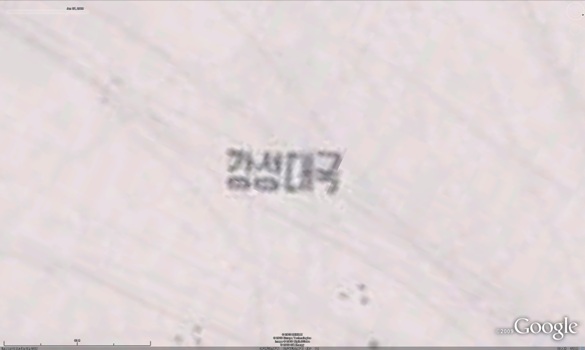
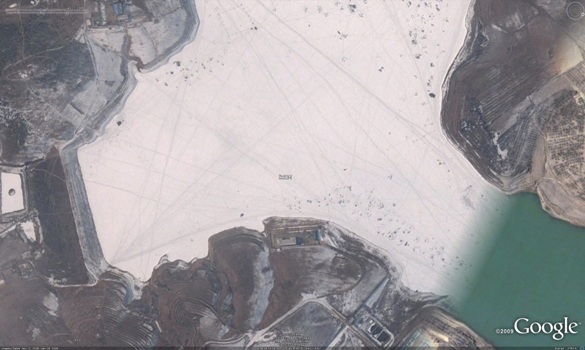
The image below was taken on Jan 27, 2009.  The coordinates are 39° 9’33.50″N, 125°40’35.96″E.  The writing is appx 8.4m tall and 22.7m in width.

kangsong-taeguk-on-ice.jpg

kangsong-on-ice-2.jpg

강성대국 reads “Kangsong Taekuk” which loosely translates to “A strong and prosperous nation”

Share

DPRK imports hundreds of cars in last week

Wednesday, April 14th, 2010

According to the Choson Ilbo:

A North Korean source saw around 30 identical vehicles crossing the bridge across the Apnok (or Yalu) River into Sinuiju at around 9 a.m. The vehicles were the Chinese compact sedan F3 manufactured by BYD, referred to as the “people’s car” in China due to its popularity. Around 100 cars reportedly crossed the border into North Korea on Tuesday alone. Starting last week, North Korea brought in more than 200 cars, including luxury foreign cars, jeeps and large vans. The total value of the imported cars is believed to be around US$5 million.

The North Korean regime often seeks to ensure the loyalty of senior officials by handing out the latest foreign-made cars on Kim Il-sung’s or Kim Jong-il’s birthday, but the Chinese-made cars imported this time are believed to be gifts for the middle ranks. “To my knowledge, the latest cars are gifts for mid-level officials at North Korea’s prosecution and state security agency and have been allocated to specific people in different regions,” the source said.

North Korea watchers believe the cars were bought to boost the morale of such officials, who were hit hard by the botched currency reform in December. “Failing to take care of mid-ranking officials could jeopardize the transfer of power to Kim Jong-il’s third son Jong-un,” said one North Korea expert. “The purpose of the gifts is to appease discontent.”

Judging from the pictures, it looks like the cars were driven across the Sinuiju/Dandong Sino-DPRK Friendship Bridge.  Satellite image here

So it appears the Kim Jong il uses automobiles in the same way foreign governments use international aid in North Korea–to “purchase” influence and support.  If the strategy works on a domestic level (within the DPRK), why does it have so much trouble on an international level?  Feel free to discuss.   

Read the full story here:
Kim Jong-il Imports Hundreds of Cars for Loyal Officials
Choson Ilbo
4/14/2010

Share

SPA meeting last Friday

Sunday, April 11th, 2010

UPDATE 1: Here is what KCNA had to say:

SPA of DPRK Meets

Pyongyang, April 9 (KCNA) — The 2nd Session of the 12th Supreme People’s Assembly of the DPRK was held at the Mansudae Assembly Hall Friday.

It was attended by deputies to the SPA.

Officials of Party, armed forces and power organs, public organizations, ministries and national institutions and those in the fields of science, education, culture and arts, public health and media attended it as observers.

The session discussed the following agenda items: “1. On the work of the DPRK Cabinet in Juche 98 (2009) and its tasks for Juche 99 (2010)”, “2. On the results of the implementation of the DPRK state budget for Juche 98 (2009) and its state budget for Juche 99 (2010)”, “3. On the adoption of the ordinance of the DPRK Supreme People’s Assembly ‘On revising some provisions of the DPRK Socialist Constitution'” and “4. Organizational matter”.

Deputy Kim Yong Il, premier of the Cabinet, in a report on the first agenda item said that last year the indomitable mental power of all the people of the country and production potential were fully displayed and, as a result, the gross industrial output value markedly grew as compared with that in 2008. This year the Cabinet will boost the production of consumer goods and grain by leaps and bounds by putting spurs to the development of light industry and agriculture once again and reenergize the overall production by giving definite priority to the production of electricity, coal, iron and steel and railway transport and, at the same time, energetically organize and conduct the campaign for a great surge with main emphasis on stepping up the technological upgrading and modernization of the national economy, he added.

Deputy Pak Su Gil, vice-premier of the Cabinet and minister of Finance, in a report on the second agenda item said that last year’s state budget revenue was overfulfilled 1.7 percent and the state budgetary expenditure was implemented at 99.8 percent.

He noted that the plan for state budgetary revenue for this year is expected to increase 6.3 percent over last year while the plan for state budgetary expenditure is expected to grow 8.3 percent.

Speakers at the session pointed out that the Cabinet’s work last year and the implementation of its state budget were properly reviewed and summed up, this year’s tasks were clearly laid down and its state budget was correctly shaped. They expressed full support and approval of them.

They manifested their resolution to successfully put into practice the Party’s intention and idea of augmenting the country’s political and military potentials in every way and bringing about a dramatic turn in improving the people’s standard of living in this significant year marking the 65th anniversary of the founding of the Worker’s Party of Korea.

The session adopted the decision of the SPA of the DPRK “On approving the report on the work of the DPRK Cabinet and the results of the implementation of the DPRK state budget for Juche 98 (2009)” and the ordinance of the SPA of the DPRK “On the DPRK state budget for Juche 99 (2010).”

Also adopted there was the ordinance of the DPRK Supreme People’s Assembly “On revising some provisions of the DPRK Socialist Constitution”.

Deputy Pyon Yong Rip was elected secretary general of the Presidium of the SPA to fill vacancy and Deputy Jang Pyong Gyu was appointed as director of the Supreme Public Prosecutors Office at the session.

ORIGINAL POST: We still don’t know exactly what happened, but  below is some information from the meeting.

According to the New York Times:

North Korea’s rubber-stamp legislature convened Friday in the capital, Pyongyang, offering few hints of a major policy shift despite a growing desperation for economic recovery.

The country’s ailing leader, Kim Jong-il, did not show up at the Supreme People’s Assembly, igniting speculation about his health and whereabouts. His absence from the assembly, although not unusual, followed some unconfirmed news reports in South Korea in the past week that he might already have embarked on a clandestine trip to China to win needed aid. South Korean officials questioned those reports, though they had earlier predicted that he might soon visit China, the North’s last remaining major ally.

Outside analysts have been closely monitoring Mr. Kim’s absences or appearances in major state affairs since his 2008 stroke fueled speculation on how long he could stay in power. Mr. Kim, 68, is now struggling with North Korea’s deepening economic woes while preparing to hand over power to a son.

On Friday, the legislative session adopted a second constitutional revision in a year, the country’s state-run news agency, KCNA, reported without providing details. The South Korean news agency Yonhap speculated that the amendment might be intended to help the transfer of power from Mr. Kim to his third son, Kim Jong-un, 27.

Others doubted it.

“I think it may have more to do with the economy or a minor readjustment of the Constitution,” said Kim Yong-hyun, a North Korea expert at Dongguk University in Seoul.

The gatherings of legislators in the North provide outside officials and analysts with a rare opportunity to seek clues to North Korean policies and any changes in its leadership hierarchy.

Kim Jong-il, who is also a legislator, has often skipped the sessions. But he used the meeting last year to demonstrate that he was still in charge despite having suffered a stroke in 2008. After months of being out of sight, he entered the parliamentary hall to the thunderous applause of loyal members, though he looked gaunt and limped slightly.

At the time, the assembly approved the first constitutional revision in 11 years to make one of Mr. Kim’s several official titles — chairman of the National Defense Commission — the supreme ruling post in North Korea. The move reconfirmed his already absolute grip on power.

Analysts had said that the session this year was most likely to focus on reviving North Korea’s moribund economy, a goal the nation had set at the start of the year.

On Friday, KCNA reported that the session passed a budget for the year that promised a 10.1 percent increase in spending for consumer goods industries and a 9.4 percent increase for agriculture.

North Korean reports on Friday’s session made no reference to the country’s tricky relations with South Korea and the United States. But the country’s Foreign Ministry reiterated that the North would continue to build and modernize nuclear weapons.

An unidentified spokesman of the ministry told KCNA that North Korea was willing to “denuclearize the Korean Peninsula” — but only if the United States abandoned its “hostile policy” toward the North.

According to AFP (via Asia One):

North Korea’s rubber-stamp parliament at its annual meeting Friday will focus on ways to improve living standards after a bungled currency change sparked widespread public anger, analysts said.

Members of the Supreme People’s Assembly (SPA) are effectively chosen by the ruling communist party, and they endorse the bills it puts forward without serious debate.

But the day-long session indicates the secretive regime’s priorities and any changes to the line-up among the ruling elite.

Yang Moo-Jin of Seoul’s University of North Korean Studies said legislators would approve institutional and personnel changes to bolster leader Kim Jong-Il’s power and prepare for the eventual succession of his third son Jong-Un.

The North is apparently moving to put the national police agency under the direct control of the National Defence Commission headed by Kim, he said.

It was unclear whether the leader would attend the meeting, as he did last year – looking frail and gaunt after a reported stroke.

Since then the regime has been grappling with serious food shortages and tougher UN sanctions imposed to curb its missile and nuclear ambitions.

The currency revaluation last November 30 wa

Share

Rank on Myers and Demick

Sunday, April 11th, 2010

Michael Rank reviews two great books on the DPRK which were recently published.  The first is The Cleanest Race, How North Koreans See Themselves by B. R. Myers in the Asia Times:

North Korea, one of the poorest countries in Asia, is also the best defended with an army of over one million to protect a population of just 23 million. But it does not only depend on its army to fend off the outside world: it also relies on an extraordinary degree of secrecy to baffle its adversaries and throw them off-guard.

Most Western Pyongyang-watchers are forced to rely on the absurdly obfuscatory Korean Central News Agency (KCNA) and on reports of varying reliability in the English-language South Korean media to discern what is going on, which means that unless they know Korean, which they almost certainly don’t, they have almost no first-hand information of what the North Korean government is really up to.

B R Myers is a rare exception among Western North Korea experts: he has a first-rate grasp of Korean and has heroically spent countless hours reading North Korean newspapers, novels and political tracts in the North Korea Resource Center in the Reunification Ministry in Seoul. This has led him to come to some striking conclusions about the nature of the North Korean regime in a highly original book that anyone interested in what is going on above the 38th parallel simply has to read.

He makes a surprising but convincing case for claiming that the Kims, father and son, play the role of mother figures in North Korean ideology, forever clutching children and even soldiers to their ample bosoms, while the North Korean people are portrayed as a uniquely innocent child-race fondly indulged by the “Parent Leader”.

Myers sets out his main conclusions in a gripping preface in which he condemns North Korea-watchers of all persuasions and backgrounds for having

… tended toward interpretations of the country in which ideology plays next to no role. Conservatives generally explain the dictatorship’s behavior in terms of a cynical struggle to maintain power and privilege, while liberals prefer to regard the DPRK [Democratic People’s Republic of Korea] as a “rational actor”, a country behaving much as any tiny country would in the face of a hostile superpower. Such interest as either camp can bring to bear on so-called soft issues exhausts itself in futile attempts to make sense of Juche Thought, a sham doctrine with no bearing on Pyongyang’s policy-making.
Myers asks why “there is more talk of ideological matters in any issue of Arab Studies Journal than in a dozen issues of North Korean Review? The obvious if undiplomatic answer is that most Pyongyang watchers do not understand Korean well enough to read the relevant official texts.”

While he is highly dismissive of the North Korean ideology of juche (self-reliance), which he dismisses as a smokescreen to baffle foreigners – highly successfully, one might add – Myers insists that the personality cult in which the regime envelopes itself should be taken seriously. “The only institution in the country that did not miss a beat during the famine of the mid-1990s was the propaganda apparatus,” he notes.

Myers is scathing about those who regard the regime as essentially Stalinist or Confucian, and summarizes its worldview as follows: “The Korean people are too pure blooded, and therefore too virtuous, to survive in this evil world without a great parental leader.” This would place Pyongyang on the extreme right of the political spectrum rather than the far left, and Myers notes that “the similarity to the worldview of fascist Japan is striking”.

Mount Fuji was transmogrified into Mount Paektu while the cult of Kim Il-sung bears striking similarities to the Japanese emperor cult. “Like Kim,” Myers writes, “Hirohito appeared as the hermaphroditic parent of a child race whose virtues he embodied; was associated with white clothing, white horses, the snow-capped peak of the race’s sacred mountain, and other symbols of racial purity …” He explains this as partly the result of collaboration among the Korean elite during the Japanese occupation, and quotes a South Korean historian as saying these collaborators regarded themselves as “pro-Japanese [Korean] nationalists”.

Despite the deep influence of Japanese ideology on North Korean thinking, the Japanese are depicted as enemies with whom there can be no reconciliation, and much the same goes for Americans. The author notes that North Korean dictionaries and schoolbooks portray Americans in sub-human terms, as having “muzzles”, “snouts” and “paws”, and while the Korean War of the early 1950s occupies a central place in anti-American propaganda, there is little stress on the US Air Force’s extensive bombing campaign as this “is hard to reconcile with the myth of a protective Leader” and the regime focuses instead on village massacres and other more isolated outrages.

Myers argues that fanatical anti-Americanism is what helps to keep the regime in power, and that far from seeking a positive relationship with the US, “It negotiates with Washington not to defuse tension but to manage it, to keep it from tipping into all-out war or an equally perilous all-out peace”.

Myers must be the only non-Korean on Earth who has taken a serious look at North Korean fiction (he wrote a previous book on the subject), and this affords him some fascinating insights. He highlights the sharp contrast with Soviet Stalinist fiction, in which the Communist Party posed as an educating father, while

… the DPRK’s propaganda is notably averse to scenes of intellectual discipline. Because Koreans are born pure and selfless, they can and should heed their instincts. Often they are shown breaking out of intellectual constraints in a mad spree of violence against the foreign or land-owning enemy. Cadres are expected to nurture, not teach, and bookworms are negative characters. In short: where Stalinism put the intellect over the instincts, North Korean culture does the opposite.
This sharply written, beautifully designed book is richly illustrated with North Korean propaganda posters and photographs. I did not agree with everything the author says – I think he underestimates the influence of Confucianism in North Korea and also underplays the cruelty of the Japanese occupation of Korea – but this is a remarkably perceptive study that everyone with an interest in North Korea, and in the practice and theory of authoritarian regimes generally, should read.

The Cleanest Race, How North Koreans See Themselves – And Why It Matters by B R Myers. Melville House, Brooklyn, NY, 2009. ISBN-10: 1933633913. (Buy on Amazon here)

Michael also reviewed Barbara Demick’s Nothing to Envy in the Guardian:

If Stalin’s Russia was, in Churchill’s words, “a riddle wrapped in a mystery inside an enigma”, North Korea is an impenetrable black hole. The government’s main mouthpiece, the Korean Central News Agency, has a firm policy of reporting almost no news. True, tourists can visit the showcase capital, Pyongyang, for a few days and enjoy some pleasant chat with their affable but carefully selected minders, but they will gain few insights into what makes the country tick and they will have no opportunity to speak to anyone who could be remotely regarded as an ordinary North Korean. As the British ambassador put it with devastating frankness last year, “We get no information from the government whatsoever”, and there are few sources of information in Pyongyang to turn to who are not government officials.

So to find out what North Koreans think about their government and society, one has no choice but to talk to defectors who have managed to escape to South Korea. Los Angeles Times journalist Barbara Demick interviewed about 100 defectors, but in this highly readable book she focuses on half a dozen, all from the north-eastern city of Chongjin , which is closed to foreigners. She decided to concentrate on Chongjin because it is likely to be more representative than Pyongyang, where, for all its drabness and endless power shortages, nobody is starving. The overwhelming impression one gains from the book is of a country mired in poverty and repression, but also of resilience and a will to survive.

North Korean children are taught to sing that “We have nothing to envy in the world”, and until recently people seem to have believed this as they had so little access to information about life outside their own country. But the famine of the 1990s, in which more than a million people might have died, inevitably resulted in a deep questioning and cynicism. “Your general [the demigod Kim Jong-il] has turned you all into idiots,” Oak-hee tells her mother after being released from jail for crossing the border into China.

Oak-hee had watched South Korean television, which made it clear that what they were told back home about exploitation and poverty in the capitalist south was all lies. By now, many officials no longer believe in the government propaganda either, and a prison director tells the women held for escaping to China, “Well, if you go to China again, next time don’t get caught.”

But despite such comments, the book does not argue that the regime is about to collapse, as many defectors and western commentators in the 1990s expected that it would.

One of the most poignant stories in the book is that of two young lovers who dare not tell each other that they are thinking of defecting. Mi-ran is from near the bottom of the North Korean social heap, while Jun-sang comes from a comparatively privileged family, with relatives in Japan. Eventually they meet up again in South Korea, but their relationship is over. Mi-ran is happily married to a southerner but is haunted by the fate of her sisters, who are either in a labour camp or dead, while Jun-sang, who attended an elite Pyongyang university, is facing an uncertain future and worries that he will never see his parents again.

Demick says defectors find it hard to settle in South Korea and are overwhelmed by the myriad choices facing them there, which “can be utterly paralysing for people who’ve had decisions made for them by the state their entire lives”. Surprisingly perhaps, “Many if not most, want to return to North Korea,” Demick claims, and are wracked by guilt over leaving family members there.

But defectors are, by definition, not typical: they are likely to be more disaffected, more resourceful and richer than the average citizen, so this book is hardly the definitive account of everyday life in North Korea. Yet the stories it recounts are moving and disturbing, and it surely tells us far more about real North Korean lives than a fleeting tourist visit to the Stalinist-kitsch theme park that is Pyongyang.

Order Nothing to Envy on Amazon here.

Read the full articles here:
Lifting the cloak on North Korean secrecy
Asia Times
Michael Rank
4/10/2010

Nothing to Envy by Barbara Demick
The Guardian
Michael Rank
4/3/2010

Share

Hwang Jang-yop in Washington

Thursday, April 1st, 2010

According to the Washington Times:

North Korea’s highest-ranking defector and former mentor to leader Kim Jong-il expressed skepticism on Wednesday that recently reported cracks in the country’s Stalinist regime are significant enough to bring it down.

Hwang Jang-yop also said during a visit to Washington that no group inside North Korea is “influential enough to cause a big dent” in Mr. Kim’s iron fist, and the “military is the only force” that could stand up to him.

Mr. Hwang responded to a recent report, based on interviews with 300 North Korean refugees, many of whom were not part of the ruling elite, that cell-phone usage and other modern technology, as well as black market cross-border trading, have begun to undermine support for the regime in Pyongyang.

Very few people have cell phones, and those who are found to be in possession of a cell phone [without permission] are penalized,” he said at the Center for Strategic and International Studies.He suggested that a more effective way to shake Mr. Kim’s rule is to secretly send North Korean refugees now living in South Korea to the communist country’s mountains to wage “ideological warfare.” That proved successful “during the Japanese occupation” in the last century, he said.

The recent paper by Stephen Haggard and Marcus Noland at the Honolulu-based East-West Center reported an increased willingness among North Koreans to defy the government by listening to foreign broadcasts and engaging in clandestine trade across the country’s border with China. Those activities, it said, also have facilitated the flow of information, and in a few cases, the smuggling of cell phones into the reclusive North.

The influx of outside information has helped North Koreans realize that their own government is to blame for the dire state of the country’s economy, rather than believe the state-run propaganda that foreign forces are behind the problems, the report said.

“It is evidence that the informational barrier is increasingly permeable,” it added, noting that “loyalty to the regime is in short supply.”Mr. Hwang, 87, defected in 1997 and is considered the highest-ranking official to turn against Mr. Kim, whom he helped educate as a young man. Although his information about the inner workings of the secretive North Korean system is dated, U.S. intelligence officials deem it important for providing assessments on contemporary activities of Mr. Kim’s regime.

Openly airing his low opinion — and even disgust — of Mr. Kim on Wednesday, the defector said that no good can come out of the North as long as he is in power. Mr. Hwang declined to discuss the leader’s personal life, but he said that Mr. Kim “never speaks badly of the U.S. in private,” though he does so of China.

Here is the audio of Mr. Hwang’s talk. (Thanks to a friend)

Read the full story here:
Defector suggests North Korean shake-up
Washignton Times
Nicholas Kralev
4/1/2010

Share

Why the Sunshine Policy Made Sense

Thursday, April 1st, 2010

Nautilus Institute Policy Forum Online 10-020A: April 1st, 2010
James E. Hoare
4/1/2010

I. Introduction

James E. Hoare was Britain’s Chargé d’Affaires to the DPRK from 2001-2002 and opened the British Embassy in Pyongyang. In this article on the Sunshine policy he writes, “Slowly, the policy was creating a group of people who could see benefits in remaining on good terms with South Korea and who had wider links with the outside world. Engagement has worked in other countries, most noticeably China, and I believe that it was beginning to work in North Korea. There was never going to be a speedy change in attitudes built up over sixty years, but stopping the process after ten was not a wise decision.”

This article was published by 38 North a web site devoted to analysis of North Korea from the U.S.-Korea Institute at SAIS. 38 North will harness the experience of long-time observers of North Korea and others who have dealt directly with North Koreans. It will also draw on other experts outside the field who might bring fresh, well, informed insights to those of us who follow North Korea.

The views expressed in this article are those of the author and do not necessarily reflect the official policy or position of the Nautilus Institute. Readers should note that Nautilus seeks a diversity of views and opinions on contentious topics in order to identify common ground.

II. Article by James E. Hoare

– “Why the Sunshine Policy Made Sense”
By James E. Hoare

At a recent private meeting in London, a former senior United Nations’ official, drawing on experience relating to a wide range of countries, said that transforming a “failing” or “fragile” state was not something that could be done overnight. Those involved needed to think in terms of ten to twenty years rather than weeks or months. Regardless of whether or not one accepts the idea of the Democratic People’s Republic of Korea (DPRK or North Korea) as a failed or even fragile state-and the term is often used in some quarters-the idea that one is in for the long haul in bringing about major modifications in behavior and attitude is certainly a good one to have in mind when dealing with the DRPK. It was such an approach that marked the Republic of Korea’s policy towards the North under former Presidents Kim Dae-jung and Roh Moo-hyun.

Since the Lee Myung-bak government took office in the Republic of Korea (ROK or South Korea) in 2008, it is fashionable to dismiss the policies followed by his predecessors as an expensive failure. Sneers about “ATM diplomacy,” innuendo about Kim Dae-jung’s motives, and references to his successor Roh Moo-hyun’s naivety, are the commonplace of South Korean academic and press comment, and are heard much further afield. “Sunshine” or engagement have become terms of mockery. The Lee government has adopted a more aggressive policy towards North Korea. It has not refused assistance outright, but has couched its offers in such a way that rejection is inevitable-the most recent example is the “grand bargain” proposed in 2009 in which the DPRK must first give up its nuclear program to receive security guarantees and aid. This is then played back as evidence that the North is incorrigible and not deserving of assistance.

The Lee government’s approach is based on an incorrect assessment both of the Sunshine Policy and what went before it. “Sunshine” or “engagement” was not something that sprang from Kim Dae-jung’s fertile brain, though he certainly can be credited with refining and developing the idea. The policies pursued by Kim and Roh lay firmly within a tradition that goes back to President Park Chung Hee in the early 1970s and that was followed by all his successors to a greater or lesser degree. However, it was never easy to engage the North and it did not take much to divert earlier presidents from such a policy. Frustrated or annoyed, they eventually gave up the effort.

The difference after 1998 was that South Korea stuck to “sunshine” even when there were difficulties. Neither Kim nor Roh were starry-eyed and neither expected that the North would be changed overnight. Both responded to Pyongyang’s bad behavior with firmness. But they realized that circumstances had changed with the famine and other problems that hit North Korea in the 1990s. They also realized that for engagement to be successful, it was best to avoid rubbing in the fact that the country faced real problems. Even if the explanations offered for the problems often ignored the North Korean regime’s own part in bringing them about, there was nevertheless an acceptance that help was needed. The unprecedented appeal for outside assistance that brought in UN agencies and resident non-governmental organizations in the late 1990s showed that the South would help without preaching. No doubt the expense and complications of German reunification also gave pause for thought. If the two Germanys, which had not fought a savage war and were far richer, could not achieve a smooth reintegration, how could the two Koreas?

So Kim and Roh did not break off engagement as a result of “bad” behavior or outside criticism of “soft policies.” They accepted that it would take a long time to modify Pyongyang’s policies and that there were likely to be few expressions of thanks. Of course there was no instant transformation. But the new approach provided a window for other countries to establish relations with North Korea. In theory, it had long been the South’s policy to allow if not to encourage such relations, but the reality had been different. From 2000 onwards, that changed. Countries that had hitherto held back for fear of offending Seoul now found themselves encouraged to establish relations with Pyongyang.

Those that did so found a North Korea that seemed eager for change, although very careful about how that eagerness was expressed. But there was a readiness to do things that would have seemed improbable only ten years before. While never quite admitting that the policies pursued under Kim Il Sung and Kim Jong Il might have had defects, those of us working in the North between 2000-2002 found a willingness on the part of officials to admit that they needed assistance and that mistakes had been made. Examples included a vice-mayor who admitted that post-Korean War town planning had many defects that were only then becoming obvious. Officials were willing to admit that the country was in need of a whole range of economic and commercial skills that had hitherto been neglected. Perhaps most telling of all, a country that had responded to the changes in the former Soviet Union, Eastern Europe and China in the early 1990s by calling home all its overseas students now was most anxious to send students abroad once again.

Engagement was thus helping to open North Korean eyes to possibilities beyond juche, but unfortunately, even before the 2002 nuclear crisis, there was relatively little follow-up on these expressions of intent. Pyongyang found difficulty in matching students to the requirements of foreign universities and other training institutions. Some countries that established diplomatic relations preferred to concentrate on human rights issues to the exclusion of other matters. Since several of these were members of the European Union (EU), their approach inevitably affected the EU’s broad approach to North Korea. Even among countries that did not give predominance to human rights, goodwill was rarely transformed into sufficient funding to make a real difference.

That said, in the British case alone, we were able to fund several sessions of economics training, an English-language training program that put initially two-now four -British teachers into DPRK universities to train English teachers, and intensive English courses for a variety of North Korean officials. In addition, non-governmental bodies such as the BBC and Reuters conducted training programs for media staff in modern methods of news presentation and communication skills. Perhaps if the United States had been more supportive of its ally’s engagement policy these efforts would have made a difference. But as the relatively benign approach towards engagement of the Clinton years gave way to hostility under President George W. Bush after 2000 that too had an impact on how far countries such as Britain would support the sunshine policy.

It was South Korea’s approach to engagement that had the greatest impact. Seoul’s aid and other measures taken under the umbrella of the “sunshine” approach brought North and South into contact across many fields. During the period from 1998-2008, the North became known to South Korean citizens in a totally unprecedented way. The process had begun earlier, especially during the Roh Tae-woo presidency (1988-93), but the trickle of information about the North of those years became a flood. And it was not only information but actual contact with North Korea. For some, this meant tightly controlled tours to the Diamond Mountains (Mount Kumgang) or towards the end of the period, to Kaesong at the western end of the Demilitarized Zone. Limited though these were, they were still a glimpse into what had hitherto been unknown and feared. There were also signs that, as the North got used to the idea of such visits, it might open up a little more; the decision to allow the use of visitors’ own cars in March 2008 was one such indication, but there were several others.

Much more important were the wide range of government and non-governmental contacts. Relatively few North Koreans came South but the traffic in the other direction was enormous. On any given day, there were likely to be several thousand South Korean visitors in the North, dealing with aid, trade, cultural, educational and even religious exchanges-both the Protestant and the Roman Catholic churches in the North had regular South Korean officiating ministers as well as hymnbooks and prayer books produced in the ROK. South Korean journalists were also a not uncommon sight. Most of this activity may have been confined to Pyongyang, by not all of it was. South Koreans were visiting many parts of the country, especially in connection with agricultural assistance and other aid-related projects. Nobody was starry-eyed about these visits. South Korean visitors were watched and controlled. But they were able to learn a lot since they could speak and read Korean. If the projects agreed to at the October 2007 summit between Kim Jong-il and Roh Moo-hyun had been implemented by the incoming Lee Myung-bak government, there would have been a huge increase in these types of contacts.

No doubt engagement was expensive and sometimes the means used to bring it about were shady, but it was producing benefits. The South, and to some extent the rest of the world, now has a far better understanding of how North Korea works then it did before engagement began. Within the North, a large number of people have come to see their southern compatriots in a less hostile light and have some, even if limited, understanding of the economic and social structures of South Korea. Perhaps some of the assistance provided was diverted away from its original purpose, but enough rice and fertilizer bags reached areas far away from Pyongyang and enough people were willing to ask questions about the South to show that the impact of engagement extended beyond a small circle of ruling elite. Slowly, the policy was creating a group of people who could see benefits in remaining on good terms with South Korea and who had wider links with the outside world. Engagement has worked in other countries, most noticeably China, and I believe that it was beginning to work in North Korea. There was never going to be a speedy change in attitudes built up over sixty years, but stopping the process after ten was not a wise decision.

Share

Kim’s European bank accounts

Tuesday, March 16th, 2010

According to the Daily Telegraph (UK):

Kim Jong-il, the Supreme Leader of North Korea, has a $4 billion (£2.6 billion) “emergency fund” hidden in secret accounts in European banks that he will use to continue his lavish way of life if he is forced to flee the country.

South Korean intelligence officials told The Daily Telegraph that much of the money was held in Swiss banks until authorities there began to tighten regulations on money laundering.

Mr Kim’s operatives then withdrew the money – in cash, in order not to leave a paper trail – and transferred it to banks in Luxembourg.

The money is the profits from impoverished North Korea selling its nuclear and missile technology, dealing in narcotics, insurance fraud, the use of forced labour in its vast gulag system, and the counterfeiting of foreign currency.

“I believe this is the most extensive money-laundering operation in the history of organised crime, yet the final destination of the funds has not been given the proper attention it deserves,” said Ken Kato, the director of Human Rights in Asia.

“Somewhere in the world, there are bankers who are earning a large sum of money by concealing and managing Kim Jong-il’s secret funds, and at the same time, almost nine million people in North Korea are suffering from food shortages,” he said. “I believe the secret bank accounts are now in Luxembourg, or have recently been transferred from Luxembourg to other tax havens.”

A spokesman for the Luxembourg government said that it was obliged to investigate all transactions involving Stalinist North Korea.

“The problem is that they do not have ‘North Korea’ written all over them,” he added. “They try to hide and they try to erase as many links as possible.”

Read the full article below:
Kim Jong-il keeps $4bn ’emergency fund’ in European banks
Daily Telegraph (UK)
Oliver Arlow
3/14/2010

Share