By Benjamin Katzeff Silberstein
The 7th Party Congress is over, and it turned out to be an affair focused on personal appointments and formalities rather than concrete policy. This post is an attempt to gather some of the news about the congress, some international but mostly domestic coverage and Kim Jong-un’s speeches, particularly that pertaining to economic matters.
Day 1 (5/6/2016) and before
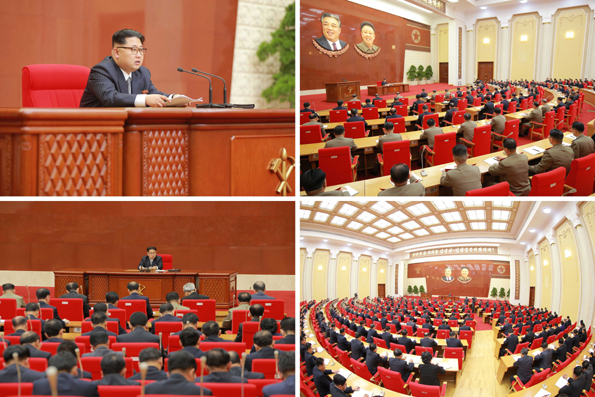
The congress opened on Friday May 6th. This is how Rodong Sinmun covered the opening:
The Seventh Congress of the Workers’ Party of Korea (WPK) opened here with splendor Friday.
Kim Jong Un, first secretary of the WPK, was present there.
The congress was attended by delegates with the right to vote and speak elected at the provincial party conferences and officials of party, armed forces and power organs, economic organs, working people’s organizations and those in the fields of science, education, public health, literature and arts and media nominated at the provincial party conferences as observers.
Also present there were congratulatory groups of Koreans in Japan and the General Association of Koreans in China for celebrating the Seventh Congress of the WPK.
Kim Jong Un made an opening address.
He in his address, reflecting the infinite loyalty and ardent reverence of the delegates, Party members, service personnel of the Korean People’s Army (KPA) and all other people across the country, extended the noblest tribute and greatest glory to the great Comrades Kim Il Sung and Kim Jong Il.
[…]
The congress sent congratulatory messages to the service personnel of the Korean People’s Army and the Korean People’s Internal Security Forces who performed distinguished feats in defending the party congress and to the working people and officials of the institutions, industrial establishments and cooperative farms who performed brilliant labor feats in the 70-day campaign of loyalty.
The congress approved the following agenda items:
1.Review of the work of the C.C., the WPK.
2.Review of the work of the Central Audit Commission of the WPK.
3.On revising the Rules of the WPK.
4.On electing Kim Jong Un to the top post of the WPK.
5.Election to the central leadership organ of the WPK.
The congress started the discussion on the first agenda item.
Kim Jong Un began the report on the work of the C.C., the WPK.
The presentation of the report will go on at the second day-sitting.
In his opening address to the congress, carried by KCNA, Kim Jong-un highlighted both national prosperity and hardship:
Today we are holding the historic Seventh Congress of the Workers’ Party of Korea amid the grand struggle in which the whole Party, the entire army and all the people, filled with iron nerves and confidence to achieve the final victory of the Juche revolution as soon as possible, are making an all-out, general onward march courageously, thwarting all manner of threats and desperate challenges by the imperialists.
[…]
The Seventh Congress of the WPK has been convened at a historic time when the phase of leap forward in implementing the cause of the Juche revolution is being opened up.
The last decades since the Sixth Congress of the WPK were characterized by grim struggle and glorious victory on the part of our Party and people.
During the period under review the situation of our revolution was very grave and complex.
In the unprecedentedly hard times when the world socialist system collapsed and the allied imperialist forces concentrated their anti-socialist offensive on our Republic, our Party and people were compelled to fight against them single-handed.
The imperialists strained the situation constantly for decades to keep our people from living at peace even for a moment and blocked all the pathways to economic development and existence through all manner of blockade, pressure and sanctions.
In the face of harsh and manifold difficulties and ordeals and the hardships and sufferings worse than those during a war, our Party and people were united more firmly around the Central Committee of the WPK, holding the President and the General in high esteem as the centre of unity and leadership, and made strenuous efforts to defend and advance the socialist cause, following only the revolutionary line of Juche put forward by the great leaders as they braved the storm of history without the slightest hesitation or vacillation.
[…]
This year when the Seventh Congress of the WPK is held, our service personnel and people achieved great successes in the first hydrogen bomb test and the launch of earth observation satellite Kwangmyongsong 4 which served as landmarks in the nation’s history spanning 5 000 years, thus raising the dignity and might of Juche Korea to the highest level possible; in high spirits, they conducted a dynamic 70-day campaign of loyalty to perform great feats and make unprecedented labour successes in all fields of socialist construction.
All the service personnel and people throughout the country displayed the spirit of carrying out the policies of the WPK to the death in response to its militant call for launching the 70-day campaign, thereby making the greatest successes and leap forward in all sectors of the national economy and achieving the brilliant result of exceeding the targets of the campaign set by the WPK.
[…]
Kim also spoke about economic achievements, and said that North Korea’s economic plans had been fulfilled ahead of schedule (my emphasis):
During the campaign, the electric-power, coal-mining and metallurgical industries and rail transport sector strove hard for increased output and transport to bring about a surge in production, and many units in different sectors of the national economy including the machine-building, chemical, building-materials and light industries and agriculture raised a strong wind to ensure modernization and domestic production of our style and bring about an upswing in production, thus making the distinguished achievement of carrying out the first half-year and yearly national economic plans ahead of schedule.
Our heroic working class of Kim Il Sung and Kim Jong Il, scientists and technicians waged an unyielding struggle on the principle of giving priority to self-development to develop and manufacture new machines and equipment based on local efforts and technology, thereby presenting them as gifts to the Congress of the motherly Party. Others across the country wonderfully completed lots of major construction projects, which will be highly conducive to developing the economy and improving the people’s living standards, in a short span of time before the Congress to send reports of loyalty to the Central Committee of the WPK.
But reporters from abroad were in Pyongyang a few days before the congress opened and delivered some interesting dispatches. The Washington Post’s Anna Fifield, for example, visited Jangchon Cooperative Farm near Pyongyang on May 4th. Note that no one at the farm seems to have spoken to reporters about Kim Jong-un’s experimental agriculture reforms — if they have been implemented on a large scale, this would seem a good opportunity to express gratitude and pride in them.
The farm, which Kim visited in June, was deemed to be a shining example of progress, given that it is apparently used as a model for other agricultural cooperatives across the country. So reporters were taken down roads bustling with people to the conspicuously deserted complex.
[…]
Apparently, a total of 3,000 people live in this cooperative. But apart from a few people working in greenhouses and a handful more repairing roofs or painting lampposts, almost no one was around. Inside a science building, lab equipment sat like museum pieces.
[…]
What about these garden plots in front of the houses? They were household gardens, the minders said. Never mind that one house had a garden of only cabbages, another of only cucumbers, the next entirely squash.
Agriculture has been one of the areas where there has been significant change in recent years. Kim Jong Un’s regime has changed the quota system to allow farmers to keep between 30 and 60 percent of their crops, either to eat or to sell for profit in the markets. Economic analysts have been watching these changes keenly, part of a broader, if tentative, move toward marketization.
Full article:
A model farm – with few farmers – in North Korea
Washington Post
Anna Fifield
2016-05-04
On the first day, the congress also sent a congratulatory message to “working people and officials” who participated in the 70-day campaign, carried by KCNA:
The 70-day campaign was a great one for consolidating the single-minded unity of the party, army and people of the DPRK as firm as a rock, bringing about a great innovation and leap forward in building a thriving nation, foiling the vicious moves of the hostile forces to put pressure on the DPRK and stifle it and fully demonstrating the dignity and might of the great Paektusan nation, the message said, and went on:
The Central Committee of the WPK together with its Central Military Commission made public joint slogans in order to glorify this year in which its Seventh Congress is to be held as a year of great heyday in building a thriving nation, ardently appealed to all party members to stage the 70-day campaign in the letter to them and clearly indicated the orientation and ways for winning victory in the on-going general advance.
Unprecedented achievements have been made in the above-said campaign thanks to the heroic struggle of the working people and officials who turned out to greet the Seventh Congress of the WPK out of their boundless loyalty and warm patriotism toward the party.
The Seventh Congress of the WPK extended warm congratulations to the working people and officials of the institutions, industrial establishments and co-op farms who creditably fulfilled the tasks before them during the campaign by sharing the thought, will and pace with the party and fully displaying matchless heroism and self-sacrificing spirit.
Day 2 (5/7/2016)
On the second day of the congress, Kim gave a report on the work of the KWP Central Committee:
The demise of Kim Il Sung was the biggest grief and loss to our party and people and the biggest trial for our revolution.
After the greatest loss to the nation, the imperialists and their followers have reached the height in their political and military pressure, moves for provoking a war and economic blockade. To cap it all, the country was hit by severe natural disasters, bringing untold hardships and trial to the economic construction and people’s living.
When the world was concerned about the fate of the DPRK and when the imperialist reactionaries were foolishly trumpeting about “change in line” and “collapse of social system”, leader Kim Jong Il solemnly declared his iron will to invariably defend and carry to completion the revolutionary cause of Juche started by the President no matter how arduous the road of the revolution might be, and wisely led the revolution and construction only as intended by the President and the way he did.
By carrying forward the cause of the President under the wise guidance of Kim Jong Il, the WPK has firmly maintained the Songun revolutionary line, the path of winning the steady victory of the Korean revolution, and enforced the Songun politics in an all-round way.
[…]
As required by the prevailing situation and the developing revolution, the WPK advanced the strategic line of simultaneously pushing forward the economic construction and the building of nuclear force and worked hard for its implementation.
The WPK organized and waged an all-people general onward movement for building a thriving people’s paradise as planned and desired by the great leaders and thus ushered in the new era of the prosperity of the country.
The entire party and all the people have achieved the single-minded unity of the whole society in which they are united closely around the leader in thinking and purpose and sense of moral obligation. This is the great success and feat achieved by our party during the period under review.
Our party and people dynamically waged the drive to implement the strategic line of socialist economic construction to lay firm material and technical foundations of self-supporting national economy and provide a springboard from which to build an economic giant.
In delivering this report, Kim mentioned (for the first time during the congress) the new 5-year plan (2016-2020) (emphasis added):
In order to successfully build a socialist power under the banner of modeling the whole society on Kimilsungism-Kimjongilism, it is necessary to strengthen the people’s government and enhance its function and role and, at the same time, thoroughly carry out the general line of our party to dynamically conduct the three revolutions–ideological, technical and cultural.
It is imperative to carry through the five-year strategy for the state economic development from 2016 to 2020.
Kim had a busy second day, and also delivered a review of the KWP’s work (also carried by KCNA):
As required by the prevailing situation and the developing revolution, the WPK advanced the strategic line of simultaneously pushing forward the economic construction and the building of nuclear force and worked hard for its implementation.
[…]
A big stride has been made in the economic and cultural construction.
Raw materials, fuel and power bases of the self-supporting economy have been reinforced and Juche-based production processes introduced into core fields and the structure of industrial sectors further improved.
Is Kim perhaps alluding to changes in agricultural management in the following section? (my emphasis):
A successful innovation was witnessed in the development of communications service and production processes, technical equipment and operation means have been further modernized in various fields including transport and building-materials industry.
A high-pitched campaign for bringing about a radical turn in seed selection, potato farming, double cropping and scientific farming was waged in the field of agriculture to provide a guarantee for increasing grain production.
Modern stock-breeding bases, fish farms, vegetable greenhouses, mushroom farms and vast thriving orchards were built across the country.
In fisheries a campaign for carrying out the Party’s idea of creating a new history of sea of gold has been waged to make a breakthrough in the development of the fishing industry.
Technical updating and the work for ensuring the local supply of raw and other materials has been positively conducted in factories and enterprises in the field of light industry to ensure increased production and supply of quality consumer goods for people.
Many monumental edifices representing the era of the Workers’ Party to which the Juche-oriented architectural idea was applied were built to lay a solid foundation for socialist economic construction and improvement of the people’s living standards.
Able scientists and technicians grew in number while the material and technical foundation for the scientific researches was consolidated despite economic hardship, bringing about radical development of the science and technology.
Fresh progress was made in the education as required by the IT era with the enforcement of the universal 12-year compulsory education and the establishment of the remote education system.
In another speech, Kim “set forth tasks for completing [the] socialist cause.” KCNA published the speech the same day it was given, and Kim does mention some goals connected to economic matters. This is, to my knowledge, the first statement where Kim actually elaborates somewhat on the five-year plan (my emphasis added):
We should attach importance to talents and attain the goal of turning all people into scientific and technological talents.
It is necessary to lay a firm material and technological foundation of the state and bring about a turn in improving the people’s living standard.
It is necessary to work out a phased strategy for the development of the national economy in a scientific and realistic way and carry out it without fail.
As an immediate task we should thoroughly carry out the five-year strategy for the state economic development from 2016 to 2020.
Note that Kim mentions “external economic relations” before any other matters when discussing the priorities of the five-year plan:
It is necessary to expand and develop external economic relations.
One could speculate whether the following pronouncement alludes to the enterprise management changes under Kim Jong-un — the true meaning of the statement seems to hinge on how one interprets “responsible”:
We should conduct the state unified guidance and strategic management of the economic work in a responsible manner.
The two statements above are the only ones that directly concern economic policy. They are fairly vague, but Kim’s expansions of special economic zones and management reforms come to mind.
Other parts of the speech are not necessarily interesting because of their connection to the economy. This is presumably a reference to the problem of people illegally watching foreign movies and tv-series (my emphasis):
We should usher in an overall efflorescence in the socialist literature and arts.
It is necessary to shatter the imperialist ideological and cultural poisoning and strictly preserve our socialist culture and lifestyle.
We should establish strong moral discipline throughout the society.
It is necessary to further increase the might of the politico-ideological power and military power.
We should more firmly cement the harmonious whole of the party and the popular masses.
We should detect and shatter all moves of the enemies to destabilize our socialism in good time and firmly defend our ideology and social system, class position and single-minded unity.
During the second day, Kim continued his review of the KWP’s work in another speech, and was no stranger to recognizing North Korea’s problems. In affirming North Korea’s “independence,” Kim struck a familiar chord and repeated a suspicion against foreign “aid” that both his grandfather and father often spoke of (my emphasis):
He noted that in the period under review, a radical change was made in the world political structure and correlation of forces and the international circumstances of the Korean revolution remained very complicated.
[…]
For global independence, it is important for each country and nation to maintain their sovereignty, holding aloft the banner of independence against imperialism.
The core of the struggle against imperialism is to frustrate the moves of the U.S. and its followers for aggression and war and defend the global peace and security.
Underscoring the need to conduct a vigorous struggle to get the aggressive military blocs, the root of military confrontation and war, dissolved and the military bases for aggression removed from other countries and thus build a new peaceful world, he continued:
All countries and nations aspiring after independence should never harbor any expectation and illusion about the imperialists’ cunning double-dealing tactics and hypocritical “aid”, but preserve the Juche character and national identity.
The progressive mankind of the world should vigorously struggle for international justice, irrespective of differences in political view, religious belief and economic and cultural development.
It is sometimes difficult to understand how the North Korean regime conceives of the logic behind Byungjin (parallel development of nuclear weapons and the economy), but the following passage gives a hint — with nuclear weapons, the country will be in a stronger position to negotiate its standing in all other areas as well:
Since it retained the status of a full-fledged independent power, a nuclear power, the DPRK will develop its external relations in conformity with the status.
Day 3 (5/8/2016)
On the third day, one of the main statements concerned the work of the auditing commission of the KWP. If one were to speculate, it may not be completely far-fetched to connect this emphasis on internal financial control with the anti-corruption drive launched earlier this year. This is what the designated rapporteur had to say about the work of the commission:
The reporter said the Party Central Auditing Commission confirmed that the party finance has properly performed its mission and duty and all financial activities have been conducted correctly on the principle of the party in the period under review on the basis of the audit data and reports of the review of the work of the auditing commissions submitted to the provincial party conferences.
He underlined the need to steadily improve the party’s financial management as required by the new era of the Juche revolution.
Kim Jong-un made a concluding review on the last day of the congress, also carried by KCNA (emphasis added):
It is necessary to continue to carry out the party’s strategic line of simultaneously pushing forward the economic construction and the building of nuclear force [byungjin].
This strategic line is the most revolutionary and scientific one reflecting the lawful requirements of building a thriving socialist nation and the specific conditions of our country.
Byungjin was also front and center in the decision adopted on the review of the Party by the congress (also carried by KCNA) (emphasis added):
We will consolidate the position of the political and military power and fly the flag of victory on the eminence of the scientific and technological power, an economic giant and a highly civilized nation.
We will take the general line of socialist construction and the principle of self-development as the constant strategic line, win a great victory in building a thriving socialist nation and successfully realize the historic cause of modeling the whole society on Kimilsungism and Kimjongilism.
We will make a new leap forward in the development of the country’s science and technology, open up an era prospering with science and bring about a revolutionary turn in socialist construction in a short span of time.
We will work out the phased strategy for the national economic development in a scientific and realistic manner and carry it out without fail and carry through the five-year strategy for the state economic development from 2016 to 2020 for the present.
We will accelerate the building of a highly civilized socialist country and thus bring up all the people to be able men for the socialist construction with profound knowledge and cultural attainments, and provide them with conditions and environment for leading a wealthy and a highly civilized life to their heart’s content.
International media was not allowed in to witness the congress proceedings for most of the event, but that probably made for more interesting dispatches anyway. Reuters noted the increasing prevalence of electric bikes in Pyongyang:
While pedal-powered bikes still predominate on Pyongyang’s wide avenues, the electric bike trend began in the last year, locals and foreign residents of the North Korean capital said.
On Saturday, a Reuters journalist covering the congress saw six of the bikes in the space of 10 minutes.
“You can carry luggage,” said Kim Chol Jin, a computer science student at Kim Chaek University of Technology, who was riding his electric bike along Mirae Scientists Street.
“My wife bought me this to help shorten my commute,” he told Reuters journalists, who were accompanied by a government guide.
The proliferation of electric bicycles follows another recent local consumer trend: a surge in residential usage of LED light bulbs and solar panels, to get around the country’s chronic electricity shortage.
A bike made by a Chinese company called Anqi was for sale this week in Pyongyang’s Kwangbok Department Store for 2.62 million won – around $330 at the unofficial exchange rate of 8,000 won to the dollar. While that is well beyond the reach of the average North Korean, an expanding gray market economy has given rise to a growing consumer class known as “donju”, or “masters of money”.
Full article:
Power to the people: electric bikes take off in North Korea
Reuters
James Pearson
2016-05-08
Day four (5/9/2016)
The 7th Party Congress concluded with a statement calling for a “general offensive toward complete victory of socialism,” also carried by KCNA (emphasis added):
It stressed that the main idea of the decision made at the 7th Congress of the WPK is to arouse the entire party, the whole country, the entire army and all the people again to the struggle for winning the final victory in the building of a thriving socialist nation as soon as possible [a rather ambiguous timeline, to say the least…] and thus make them wage a general offensive in the period up to the 8th Congress.
The 7th WPK Congress called upon all the servicepersons, youths and other people to launch a Mallima speed campaign of rapid progress and innovation for the implementation of its decision in every sector and unit, the appeal said, adding:
The entire party, the whole country and all the servicepersons and civilians should dash toward the high eminence of a thriving nation at the speed of Mallima.
And if anyone ever thought that the core characteristics of North Korea’s political system were ambiguous:
Never tolerate but mercilessly squash any element contrary to the idea and intention of the respected Comrade Kim Jong Un and any slightest act of breaking our single-minded unity and backbiting at our Party’s policies.
Science and technology were prevalent themes in much of the rhetoric from the congress:
Let us build an economic and highly-civilized power by dint of science and technology and thus make the Democratic People’s Republic of Korea, our beloved motherland, the envy of the whole world.
This whole paragraph is one sentence:
Let us put the nation’s industry and agriculture on a modern, scientific and IT basis our own way and at the earliest date with our technology, efforts and resources and thus raise the level of the national economy to that of the most developed countries under the banner of self-development-first principle for turning everything of the country into wealth of socialism hard to find in other parts of the world, making the latest science and technology our possessions and creating everything with our materials.
Byungjin again:
Let all the people implement more thoroughly and steadily the Party’s line of simultaneously developing the two fronts, each holding arms in one hand and a hammer or a sickle in the other.
The cooperative farm that Washington Post visited got a special shot-out:
Let us raise the level of every factory and farm to that of the January 18 General Machinery Plant and the Jangchon Vegetable Co-op Farm and build every structure into such spectacular edifice as the Sci-Tech Complex and Mirae Scientists Street.
Beyond the congress
How much did this all cost the North Korean state? A Korea University scholar has attempted a calculation, as reported by Yonhap, and lands at a figure of more than $200 million, placing policy choices such as not increasing imports to close the gap between food need and availability, for example:
North Korea probably spent more than US$200 million on the just-ended ruling party congress, which will further burden the already impoverished country, a local scholar who keeps track of developments in the reclusive country said Friday.
Korea University’s Nam Sung-wook made the claim in an analysis of the four daylong Seventh Congress of the Workers’ Party of Korea (WPK) that ended Monday. He described the rare convention as a “political show.”
[…]
n the assessment, the academic argued the communist country spent at least the amount he estimated in the past six months for the “self coronation” of leader Kim Jong-un.
He said the move’s sole aim seems to be the consolidation of the hereditary power succession. The current leader inherited the country after the sudden death of his father in late 2011, while the late Kim Jong-il took over after his own father, the North’s founder Kim Il-sung, died in July 1994.
“Ultimately, the huge amount of money spent will result in a greater burden for North Koreans,” he said.
[…]
In another paper, professor Yang Moon-soo of the University of North Korean Studies in Seoul said the Pyongyang regime will likely pursue a market-friendly economic policy for the time being.
Cho Bong-hyun, a researcher at the state-run Industrial Bank of Korea (IBK), on the other hand, said the five-year economic development plan issued by Kim Jong-un at the party congress will turn out to be a failure and will eventually come to haunt the regime down the road.
Full article:
N. Korea spends over $200 mln on Workers’ Party congress: scholar
Yonhap News
2016-05-13
This blog looks forward to closely following the implementation of the five-year plan!
UPDATE 1: The National Committee on North Korea has posted all of Kim Jong-un’s speeches.
UPDATE 2: Bob Carlin writes about his thoughts on the congress in 38 North.
UPDATE 3: Ruediger Frank writes about the economic aspects of the congress here. Here is the speech (PDF) to which Dr. Frank refers.