Archive for the ‘DPRK Policies’ Category

What Are N. Koreans Up to?

Friday, September 21st, 2007

Korea Times
Marcus Noland, Stephan Haggard
9/21/2007

Last summer North Korea conducted provocative missile and nuclear tests. Yet only four months later, Pyongyang signed on to a roadmap that included a return of international inspectors, a full declaration of contested nuclear activities, closing down existing facilities and ultimately disabling them.

American negotiator Christopher Hill predicted this last step could take place as early as the end of the year.

What are the North Koreans up to?

The cynical, some would say realistic, view in the United States _ advanced by departed Bush administration hawks such as John Bolton _ is that Kim Jong-il is raising false hopes.

The appearance of cooperation has several tactical advantages. Sanctions and ongoing uncertainty have had substantial economic costs. The February agreement was preceded by secret meetings in Berlin to resolve the Banco Delta Asia issue.

In return, the North Koreans closed their nuclear facilities, but they have not firmly committed to the difficult aspects of the agreement _ providing a full accounting of their programs, disabling their programs, and giving up actual stores of fissile material and weapons.

Cooperation also drives wedges between the U.S., South Korea and China. If North Korea appears to be making concessions, it is easier for South Korea and China to continue diplomatic and financial support.

Next month, President Roh Moo-hyun will travel to Pyongyang for a summit with Kim Jong-il. Expect him to come bearing gifts to cement his legacy as a peacemaker.

Other politicians in the presidential race have also offered extraordinarily ambitious and generous programs of support for the North as well.

Recent studies we have done on North Korea’s changing external economic relations are consistent with some of this cynical picture, but also suggest a sliver of hope for more substantial change.

To understand why, requires a brief tour of the miserable history of North Korea over the last two decades. Following the collapse of the Soviet Union, the North Korean economy went into a steep decline ending in full-blown famine.

By our estimates, as many as one million people _ five percent of the entire population _ perished in the mid-1990s. Out of the human ashes of this tragedy, however, the North Korean economy began to undergo a profound transformation.

As households and work units scrambled for food, they engaged in barter, trade and new economic activities.

The desperation of the famine also saw an upturn in illicit activities, from missile sales to drugs and the counterfeiting of U.S. currency. But trade and investment also started to flow across the Chinese border.

Chinese companies, small-scale traders and North Korean firms pursued business opportunities, from large-scale mining operations to the import of South Korean videos.

The regime was always hesitant about the emergence of the market. In July 2002, the government initiated economic policy changes that decriminalized some private activities. But reforms have taken a zig-zag path, always subject to reversal.

Sanctions and closer scrutiny have limited the country’s arms sales and illicit activities.
With these sources of revenue increasingly foreclosed, North Korea has two alternatives _ open the economy and increase normal commercial activities or cooperate primarily to obtain aid. In terms of internal change, these two options may actually push North Korea in opposite directions.

Consider the aid tack. Given the regime’s concerns about internal stability, aid could provide a lifeline, allowing the regime to sustain a modicum of current consumption while forgoing deeper reforms. Under this option, North Korea trades away its nuclear program for assistance precisely to maintain the political and economic status quo.

Alternatively, North Korea could use the resolution of diplomatic tensions to deepen the economic reform process.

The military has been engaged in commercial activities and could potentially benefit from such a course. But real reform will reshuffle power and influence within North Korea in ways that are unpredictable and risky.

So what can we expect from Pyongyang? The nuclear program is the regime’s one major asset and we should not expect them to bargain it away easily.

Rather we should expect prolonged and difficult negotiations as they try to extract tribute for their “Dear Leader.”

In the end, we may eliminate North Korea’s capacity for making additional nuclear weapons, but this will not necessarily be accompanied by economic or political reforms.

An important lesson learned elsewhere in the developing world is that aid is not a substitute for reform.

Ambitious schemes for infrastructure and other investment in North Korea will only generate large economic pay-offs if they are accompanied by genuine opening and a more aggressive embrace of the market.

The key issue, therefore, is how tightly South Korea will link its offer of aid to progress in the resolution of the nuclear issue. Properly conditioned, South Korean aid could be a powerful carrot in the nuclear negotiations, whether it ultimately encourages internal reforms or not.

But if the South Korean offers at the summit are large, unconditional and open-ended, they could permit the regime in Pyongyang to stall the nuclear negotiations while actually discouraging deeper reform.

Share

Class Divergence on the Rise as Market Economics Spred in DPRK

Friday, September 21st, 2007

Institute for Far East Studies (IFES)
NK Brief No. 07-9-21-1
9/21/2007

The recent growth in the private-sector economy in DPRK markets and other areas of society has brought with it some significant social changes worth noting. According to most defectors from the North, following the massive famine suffered in the mid 1990s, the biggest change to emerge in the DPRK was the reshuffling of the social class structure. In North Korean society, there are reportedly five identifiable social classes.

The first of these classes is the ruling class, made up of those elite surrounding Kim Jong Il. This class survives off of Kim Jong Il’s government funds, aid sent from South Korea, and from exploitation of the general public.

The second class is made up of business traders with access to foreign capital. A portion of money earned through foreign currency exchange businesses is turned over to the Kim Jong Il regime, while the rest can amassed in order to lead a relatively comfortable life.

The third class is made up of organized thugs who make their money through public trading and markets. These people control regional markets and local trading by using money and violence to employ extortion tactics much like the Russian mafia

The fourth class scrapes by on government rations. This mercantile class comprises an estimated 20~30 percent of the North’s overall population.

The fifth distinct class in North Korea is made up of commoners who support their way of life through farming private plots and selling goods in markets. An overwhelming majority of the population falls into this class; more than 60 percent of the people in North Korea live hand-to-mouth each day on the fruits of their own labor.

The remainder of the population falls beneath even these classes, because they either lack labor skills or are feeble elderly, handicapped, hospitalized, homeless, or wandering from city to city.

Share

Paul French Discusses North Korea

Tuesday, September 18th, 2007

Frontline Club (h/t Kitten Wars)
1/17/2007

frontline2.JPGPaul French, Director of Access Asia–a market research and business intelligence company specialising in China and North Asia’s economics and markets, spoke to the Economist’s Simon Long about what he has witnessed and learned about North Korea.

He focuses mainly on his perceptions of the US/DPRK relationship, but he also talks about the difficulties of bringing investment capital into the DPRK.

Click on “Frontline club” at the top of the picture above to see the video.

Share

Juche (Self-Reliance) on Translation

Sunday, August 26th, 2007

Korea Times
Andrei Lankov
8/26/2007

Many people know that the official North Korean ideology is called “juche.” But what exactly does this term mean? Furthermore, when and how did it develop?

If we look at a reference book, we will probably come across a statement like “juche or self-reliance, the official ideology of North Korea, was first promulgated by Kim Il-sung in 1955.” While not completely wrong, this definition needs a lot of qualifications.

Indeed, December 1955 was the first instance of Kim Il-sung mentioning the term “juche.” North Korean publications remain vague to this day in describing exactly who Kim Il-sung addressed with his “juche speech,” but contemporaneous Soviet materials seemingly indicate that this was not just a meeting of “Party propaganda workers”, but a gathering of the KWP high-level functionaries who came to listen to Kim’s denunciations of the country’s excessive dependence on the Soviet models in culture and ideology.

However, the “juche speech” can be seen as a starting point in the history of the term only with some major caveats. The 1955 speech remained secret for the next few years, but it was distributed among party cadres, including journalists. Having scrutinized the North Korean newspapers from that period in depth, and being acquainted with the text of the speech, I have seen a number of hidden quotations circa 1956. However, the word `juche’ did not feature prominently in these quotations. In fact, it was hardly mentioned at all. For the journalists and propagandists, the key words of Kim’s speech were `dogmatism’ and `formalism’ which hinted at the excessive use of foreign, that is to say Soviet and Chinese, methods. In 1956 or 1957 nobody, including probably Kim Il Sung himself, thought that juche was going to become the name of the country’s official secular faith.

And what does `juche’ mean? Contrary to the commonly repeated idea, it has nothing to do with `self-reliance’. Juche is a Sino-Korean word, a combination of two Chinese characters that are used in all languages of the region. It means `subject’ or `one’s own identity’. When it was first used in 1955, Kim Il Sung meant that Koreans must assert their identity more aggressively against foreign pressures.

If so, where did the descriptive pseudo-translation of `self-reliance’ come from? In the early 1960s juche began to be re-defined as North Korea’s (or Kim Il-sung’s) own ideology. This happened against the backdrop of the growing Sino-Soviet split. Facing two quarrelling giants, North Korean began to advance its own brand of Marxism-Leninism, one that was allegedly superior to both the Soviet “revisionist” and Chinese “dogmatist” interpretations. At this stage juche was still interpreted as a local form of Marxism, or as a “creative application of the eternal truth of Marxism-Leninism to the North Korean reality.” Thus, juche began to acquire new dimensions and meanings.

This process culminated in April 1965 when Kim Il Sung delivered a lengthy speech in Indonesia. This speech was the first attempt to present the juche idea as a coherent ideology of worldwide significance. At that stage, it mostly targeted Third World countries. Kim Il Sung stressed that juche implied “independence in politics, self-reliance in the economy, self-defence in the military.” Hence, it was from that broadened understanding that the now commonly used “translation” of juche as “self-reliance” probably originated.

However, juche is more than self-reliance. In fact, it has much greater connotations with nationalism, and in later years when economic self-reliance, once much trumpeted in Pyongyang, went out of fashion, the nationalistic essence of juche became even more visible.

In 1972, juche acquired formal standing as the country’s official ideology. Article 4 of the new Constitution mentioned it alongside Marxism-Leninism as the `guiding ideology’ of the DPRK. Marxism survived _ not least due to diplomatic considerations. An open demotion of Marxism-Leninism would definitely trigger serious friction with fellow Communist countries, and thus Marxism temporarily lived on as an appendix to the North Korean state. Only in 1992, after the demise of the Communist bloc, was the reference to Marxism dropped, and juche remained the sole ideological foundation of the DPRK.

Frankly, I am sceptical when my colleagues try to explain North Korea’s actual policies as reflections of juche ideas. The definition of juche has changed so many times that it has essentially become a meaningless label encompassing everything the Kims’ considered useful or praiseworthy at any given stage of the country’s history. Perhaps, only the nationalist component has remained unchanged. But that is another story altogether.

Share

Great Review of ‘Famine in North Korea’

Sunday, August 26th, 2007

noland-haggard.jpgFor several months I have been meaning to post a review of Stephen Haggard and Marcus Noland’s book, Famine in North Korea, but for thousands of reasons it was always pushed back.

Stephen Haggard and Marcus Noland wrote the definitive book on the DPRK’s Arduous March, and it is required reading for any serious North Korea watcher.

Now…Joshua at One Free Korea has written the definitive review of the book, so I will just put links to his posts: Part One, Part Two, Part Three.

Share

Price of Rice and Inflation

Sunday, August 19th, 2007

Korea Times
Andrei Lankov
8/19/2007

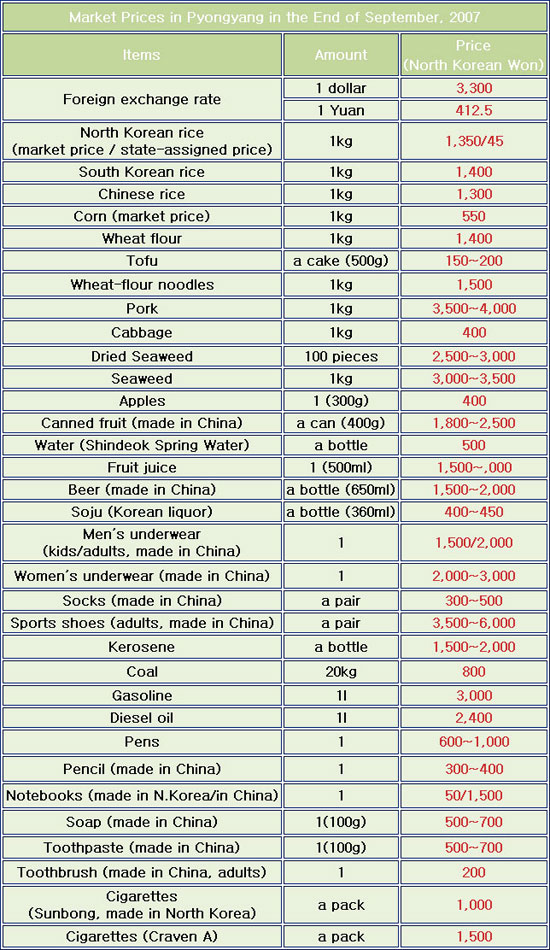
Sometimes even Stalinist propaganda tells the truth. When the North Korean newspapers occasionally told grossly exaggerated horror stories about South Korean inflation, they stressed that nothing like that could possibly happen in North Korea. This was the case indeed. For nearly half a century, from the late 1950s to the late 1980s retail prices in North Korea remained essentially unchanged. One kilogram of rice cost 0.08 won in 1960. It was still the same price in 1990.

This was possible because almost nothing was actually “sold’’ in North Korea. Communist states often rationed goods distributed through retail trade, but in most cases it was only a handful of most prestigious goods that were subjected to rationing _ like, say, cars. North Korea went much further: by the early 1970s, retail trade in the North ceased to exist, being completely replaced by an elaborate public distribution system. Rations depended on a type of work performed, but also on one’s position within a complicated hierarchy of social groups, as well as one’s place of residence (inhabitants of major cities, and Pyongyang in particular, enjoyed much better rations than those in the countryside).

There were some markets, of course, barely tolerated by the government. But until the late 1980s markets were small, with their trade volume being almost negligible. It seems that most people were reasonably satisfied with what they could get from the state distribution system _ of course, it helped that they knew next to nothing about the situation in other countries, so they could not compare.

The situation began to change around 1990 when the old distribution system collapsed under the pressure of an economic crisis. From 1993-94 there were increasing problems with rations, and from around 1996 rations pretty much stopped altogether. Some food was still distributed in major urban centers, but even there the distributed amount was so meager that nobody could survive on rations alone. A large-scale famine ensued, with at least half to one million dead (the oft-cited figure of three million victims seems to be an exaggeration).

People turned to trade and handicrafts, and with this arrival of a market economy inflation became a North Korean phenomenon as well. Even in the 1980s market prices exceeded the official prices in the state shops. By the mid-1990s, the difference was much greater. In theory, rice still cost 0.08 a kilo, but by 2000 its price on the market reached 45-50 won. Official wages remained unchanged, however, so around 2001 the average salary was approximately 20 times less than the income necessary for physical survival. People had no choice but to augment their income.

The government understood that there was no way to restore the old system: a decade of economic crisis had undermined the basic machinery of distribution and obviously the system was beyond repair. Thus, in 2002 the much trumpeted “July 1 Reforms” were introduced.

It’s difficult to describe these measures as “reforms”–the government simply gave official recognition to the situation which had existed for quite a few years.

The distribution system (long defunct) was curtailed. There was a dramatic increase in the retail prices of basic goods and services _ obviously in an attempt to approximate the prices of the market. Thus, that one-kilo of rice which cost 0.08 won since July cost 44 won.

Wages increased as well. Obviously, the wage increase was not even, and some groups have gained _ or lost _ more than others. It was estimated that the average increase in wages has been approximately 2500 percent (that is, 25 times). At the same time, prices have increased 3000-4000 percent (that is, 30-40 times). This necessitated the issue of 1000 won bills _ the largest denomination in North Korean financial history since the 1959 currency reform. Later, 5000 won bills were issued as well.

But the measures had another effect. The increase in salaries meant that the market was instantly flooded with cash. Needless to say, the only outcome could be inflation. Some people speculated that this was the intention of the Pyongyang leaders who hoped to kick-start the economy in such a way. Perhaps. But I would not be surprised if in 15 or 20 years down the track we learn from interviews and talks with the planners of this reform that they did not really expect inflation. Pyongyang economic managers have not had much exposure to market theory, and are sometimes very naive in their understanding of these questions.

Indeed, by October 2002 the market price of rice had increased to 120 won per kilo. In 2003, the price doubled to 250-300 won, and now it is about 1000 won. Inflation has become a part of North Korean life.

What will happen next? Will the North Korean leaders manage to stabilize the situation, or will a new wave of economic crisis wipe out the entire North Korean system? We do not know yet. But it is clear that there is no return to old days when a kilo of rice could be had for 0.08 won _ that is, if you were lucky enough to live in an area where they distributed grain rations in rice, not in maize.

Share

N. Korea urges concerted efforts for economic reconstruction

Wednesday, August 15th, 2007

Yonhap
8/15/2007

North Korea, celebrating the 62nd anniversary of Korea’s liberation from Japan’s 1910-45 colonial rule on Wednesday, called on its people to make concerted efforts to build a strong socialist economy.

The Rodong Sinmun, the official newspaper of the North’s Workers’ Party, said in an editorial that there is no more urgent task than reconstructing the national economy and improving the people’s livelihood.

“On the economic front, the principles of socialism and utilitarianism should be thoroughly observed … All potentials and resources should be fully mobilized to boost production and construction,” said the paper.

“Food problem has to be addressed, while the light industry sector has to be revolutionized in order to mass-produce high-quality consumer products. Economic reconstruction and improvement of public livelihood are the most urgent tasks facing the nation.”

But the editorial still allotted much of its space to eulogizing the accomplishments of the North’s late founding leader Kim Il-sung and his Songun (military first) policy.

“The president’s plan for building a rich and powerful country is being carried out in all fields thanks to the Songun leadership of Kim Jong-il. The country in which the great Songun politics is being successfully applied will make ceaseless creations and leaping progresses and the president’s behest will come true in the socialist country,” said the paper, referring to the elder Kim as the president.

Share

A Mass-Scale Trade Deficit Results after the July 1 Economic Measure

Thursday, July 26th, 2007

Daily NK
Park Hyun Min
7/26/2007
 
In North Korea, despite the additional reform measures on the table after the implementation of the 2002 July 1 Economic Management Reform Measure (July 1 Economic Measure), it appears that a mass-scale trade deficit has resulted.

Choi Soo Young, a Senior Researcher of Korea Institute for National Unification, said through a recently published report called “Five years after the July 1 economic measure, North Korea’s Economy and Process of Transformation” in the July issue of the Reunification Affairs Analysis, “The size of the deficit in North Korea’s revenues and expenditures (with the exception of North and South Korea trade) has increased from 790 million dollars in 2002 to 11 hundred million dollars in 2006.”

Researcher Choi said, “After the July 1 economic measure, North Korea, through regionalization of trade activities, which used to revolve around the Central Planning Administration, by allowing provincial-level offices such as the city and district offices, attempted trade revitalization.” However, to control inflation resulting from structural unemployment and shortage of supply, the North Korean government ignored revenues outside of national planning, which was the cause of the deficit.

After he also pointed out that, “When the North Korean economy’s dependence on China became chronic, the situation has become exacerbated,” he said, “North Korea’s export to China in 2006, compared to 2002, rose 72.7%, but on the other hand, import from China increased 163.8%.”

Between 2002-2004, North Korea’s size of trade deficit with China was only around 2 hundred million dollars, but in 2005 and 2006 each, it expanded to 5.8 hundred million dollars and 7.6 hundred million dollars. Further, North Korea’s reliance on trade with China, augmented from 48.5% in 2004, to 52.6% in 2005, and 56.7% in 2006.

Accordingly, North Korea has to depend on China in order to get equipment, energy, and raw materials for industrial production.

Simultaneously, Choi, from the perspective of macroeconomics on the basis of North Korea’s economic growth rate, North Korea’s economy has recovered from the worst situation and is maintaining a low-growth condition.

He analyzed, “From 1990 to 1998, a continuous 9-year negative economic growth has been recorded, but from 1999 to 2004, a positive growth has been achieved. After the July 1 economic measure, the North Korean economy’s low-growth originated from its verbal effort of increasing productions of agricultural and a portion of its light industry goods and the support of the outside world.”

However, he pointed out that it is not off-target to evaluate that the North has a foundation of undergrowth due to its sustained level of low-growth, that its shortage of food, energy, and raw material goods is continuing, and on the industrial front, productions increase has not shown any movement.

On one hand, researcher Choi said that going beyond the financial deficit, in order to realize a form of annual income and annual expenditures, an establishment of the power of taxation for an increase in tax revenues and restraining of unnecessary financial expenses are needed. Also, he ordered the acquirement of an objective tax system for the assurance of an effective financial plan and a fair tax.

Share

‘Daean’ System and Economic Reforms

Sunday, July 22nd, 2007

Korea Times
Andrei Lankov
7/22/2007

When the North Korean leaders began their rather limited and controversial economic reforms in 2002, one aspect of the reform package did not attract particular attention overseas. It was declared that the CEO of a state-run factory would henceforth manage its activity directly. To Western ears, this sounded rather unremarkable, but North Koreans instantly understood that this meant the abolition of the Daean system. For decades this system was lauded as a unique invention of Kim Il-sung’s managerial genius _ and now it was over.

The system was introduced in the early 1960s, after some earlier experiments. The Daean Heavy Equipment Factory, not far from Pyongyang, served as the major testing ground, and it was the place where, in December 1961, Kim Il-sung gave his August approval to the system.

The Daean system was unusual indeed. The management of a factory was to be conducted in a collegial manner by the “factory management committee”. This committee was presided over, however, not by the company CEO, but by its party secretary. Taking into consideration that most North Korean committees are hardly anything but advisory bodies for their chairpersons, this meant that the daily management of a factory was to be done by its party secretary.

This was a break with the then established communist tradition. In fellow communist countries, the situation was different: while at the national level the party’s primacy was undisputed, it seldom bothered itself with micro-management of daily production. Typically for a communist country, a party secretary at factory level was a sort of priest-like figure, dealing with political education and moral guidance of the personnel rather than with the management of production.

Why did the North Koreans make such a break with tradition? First of all, we must not exaggerate the significance of this break: after all, it did not really matter whether a particular CEO was officially considered a “director” or a “party secretary”. Their background would be roughly the same nonetheless.

However, the introduction of the Daean system had some symbolic meaning. Since the ruling Party was meant to symbolize the “politics,” such that the promotion of its local representative was supposed to drive home the primacy of “politics” over everything else.

Indeed, the North Korean drive to industrialize in the 1950s and 1960s was achieved with a remarkable disregard for the economic incentives, and even rudimentary use of the market economy. In this regard, North Korea once again “out-Stalined” Stalin himself. In the USSR, large premiums and other material benefits were reserved for the most efficient workers. In Kim’s North Korea _ like Mao’s China _ the workers were supposed to work hard largely because of their ideological devotion. A popular slogan insisted: “We must sacrifice ourselves for the sake of the country!” People were required to work long hours, give up their days off, and ignore safety requirements for the sake of an increase in output. The party was responsible for encouraging this _ and thus its representative became the top supervisor under the Daean system.

It is easy to blame Pyongyang for its disregard of human lives and sufferings. However, did it have a choice? Perhaps, but not likely. In the impoverished North Korea of the 1950s, precious few resources were available, and these had to be saved for the most important use. Human lives were cheap and plentiful, while machinery was scarce and expensive. Thus, the choice was made, and then carefully wrapped up in fine-sounding rhetoric.

To an extent, the North Koreans themselves were ready to risk their lives in this mad rush for industrialization. They believed that a few years of frantic effort would create an affluent, successful, and powerful Korea. And many people were indeed willing to give their lives for such a goal _ a minority, perhaps, but a significant one. This enthusiasm soon worn out, but around 1960 it was quite real.

For a while it appeared as if the strategy worked. The North Korean economy in 1955-1970 was growing at the breathtaking speed of 19% a year. Then it was the North, not the South that broke the world’s records pertaining to economic growth.

However, the success proved to be short-lived. By the late 1960s the first signs of stagnation appeared, and by 1980 the Northern economy was lagging hopelessly behind that of the South. Why did it happen? That is another story altogether.

Share

No Changes to the Cost of Rice And Corn at Jangmadang

Friday, July 20th, 2007

Daily NK
Kim Min Se
7/20/2007

A newsletter published on the 18th by “Good Friends” a North Korean aid organization claimed that “On average 10 people die of starvation throughout North Korea.”

However well informed North Korea defectors and North Korean tradesmen who travel to China refute the organization’s claim and argue, “It would be difficult for that to happen.”

The organization published in its newsletter, “Since the end of June, starvation has been occurring in each province throughout North Korea” and informed, “The number of people dying in North Pyongan, Yangkang, Jagang, South and North Hamkyung continues to rise everyday.” 

In particular, Good Friends stated, “In South and North Hamkyung, about 10 people are dying of starvation in each city and province” and “On the whole, the people dying are aged 40~65 years.”

“Though the cause behind the deaths is different for each person, most of the complications are related to malnutrition” informed Good Friends. They added, “A mass famine has not yet begun, however authorities and people feel the threat of the situation” stressing the urgency of North Korea’s food crisis. 

An affiliate of Good Friends said, “Presently, only 20,000 tons of South Korea’s food aid is offered (to North Korea)” and commented, “This rate of aid is too slow in saving the lives of the dying people.” 

However, there are criticisms against this claim. Some argue that Good Friends had excessively inflated North Korea’s food crisis. 

Choi Young Il (pseudonym) questioned this claim by Good Friends after a telephone conversation with his family in North Korea on the 16th. He said, “Even up to two days ago, I spoke to my family on the phone but they didn’t mention anything about a food crisis.” 

Moreover, Choi said, “Alleging that about 10 people on average are dying in the cities and province of South and North Hamkyung is no different to saying that nearly 400 people are dying throughout the whole region of South and North Hamkyung every day” and added, “In that case, this is similar to the early period of mass starvation in the early 90s.” 

“Only looking at North Hamkyung, most of the people living in the border regions live off illegal trade through China and though they may not be living well, I was aware that they got by without having to eat porridge” Choi said and remarked, “I don’t believe the claim that 10 people are dying of starvation every day.” 

On the same day, Hwang Myung Kil (pseudonym) a North Korean citizen who came to Yanji to visit his relatives in China said in a telephone conversation with a reporter, “I cannot believe the rumor that people are starving to death around the border areas of the Tumen River” and commented, “I haven’t even heard stories of more people starving to death in the mines and they live in masses around Musan.”

Hwang said, “Even amongst the people in Musan, there are only a small number of people who live off corn for three meals a day… Nowadays, people look for quality rather than quantity.” Further, he said “Though life is tough, people have found their own way of survival. It’s not to the point of starvation.”

If according to Good Friends, 10 people are dying on average due to starvation, this situation would indicate signs similar to the mass starvation in the early 90s. However, the cost of rice claimed by Good Friends clashes with their claim. 

When North Korea faced their mass crisis in the mid-90s, the cost of corn rose dramatically. In October 1995, 1kg of corn cost 16won, but this doubled to 30won. However, there has not been much change to the cost of food in North Korea.

According to a recent survey by the DailyNK on the cost of goods in North Korea’s Jangmadang (markets), 1kg of corn rice at Hoiryeong markets sells for 450won and 1kg of rice produced in North Korea costs 900won. 

More importantly is the cost of cigarettes. A packet of Sunbong, a North Korean brand of cigarettes sells for 1,000won and “Cat” cigarettes for 1,300won. The cost of a kilo of rice is still cheaper than a packet of cigarettes. 

If North Korea’s starvation was on the brink of a massive food shortage, then it is expected that the cost of rice and corn would escalate dramatically as an onset to the crisis. 

On the other hand, Kim Il Joo (pseudonym) a Chinese tradesman and expert on North Korean markets said, “I can’t say that North Korea’s food situation is smooth, but I don’t think it will get any worse than this.” Kim said “Now you can eat new potatoes and soon new corn will be available on the markets” and added, “Then, I think we will be able to get through another year.”  

Deaths from hunger rise across N. Korea: civic group
Yonhap

7/18/2007

A growing number of people have died of starvation across North Korea since late last month, a South Korean civic group working to defend rights of North Koreans said Wednesday.

“Famine-driven deaths began to occur across North Korea in late June,” Good Friends said in a commentary carried in its weekly newsletter. “In some cities and counties in the provinces of North Pyongan, Ranggang, Jagang and South and North Hamkyong, the number of deaths is on the increase daily.”

In North Hamkyong Province, a daily average of ten people, mostly those aged between 40 and 65, died of starvation, the group added.

“The leading cause of death varied for each case, but most people are dying of famine-driven malnutrition and its complications,” the commentary said.

The price of rice rose steadily this month, with North Korea facing a crisis of massive deaths from hunger, it said.

The group then called on the Seoul government and the international community to send more emergency food aid to help North Koreans, especially through the just-reconnected cross-border railways.

In mid-May, the two Koreas conducted the historic test of the railways, reconnected for the first time since the 1950-53 Korean War. But it remains unclear when regular train service might start.

Share

An affiliate of 38 North