Archive for the ‘International Organizaitons’ Category

World Vision to donate US$1m in assistance

Thursday, January 16th, 2014

According to Yonhap:

 A U.S. private relief agency plans to provide aid worth US$1 million to North Korea this year to help support North Korean children and other vulnerable people, a news report said Thursday.

World Vision Inc. also plans to provide clean water to more than 8,000 North Koreans in provincial areas while providing nutritional assistance to children under the age of six, according to the report by the Washington-based Radio Free Asia.

The Christian organization plans to expand its humanitarian project in other rural areas, the report said.

Read the full story here:
U.S. relief agency to give aid worth US$1 mln to N. Korea
Yonhap
2014-1-16

Share

Economic Cooperation Office for Overseas Koreans

Sunday, December 29th, 2013

According to a recent article in Yonhap, the DPRK has established a new body to facilitate investments from overseas Koreans.

According to the article:

North Korea has established a government agency to facilitate investments in the communist nation by overseas Koreans, with its services to get into full swing by January, an official was quoted Sunday as saying.

Pyongyang established the “economic cooperation office for overseas Koreans” in August to provide support and guidance for investments from Koreans living overseas, the agency’s chief, Pak Kyong-jin, said in an interview with Minjoktongsin, a pro-North Korean website operated by a U.S.-based Korean.

The agency’s establishment is part of efforts to rebuild the economy, Pak said.

“An increasing number of overseas Koreans have been visiting the North to discuss investment issues. We have established the agency to handle these issues exclusively,” he was quoted as saying, adding that the agency will begin operation in earnest in January.

Pak said he would advise potential investors to focus on construction and light industries for the time being, rather than resources development projects that require massive amounts of capital.

I have been unable to locate any articles about this organization in KCNA or Naenara.

The DPRK also has the State Economic Development Commissio/Association for managing special economic zones/economic development zones (except for Hwanggumphyong, Rason, Kumgang, and Kaesong which have their own management committees), and the Joint Venture Investment Company for managing joint venture investments outside of the SEZs (presumably from non-Koreans). There is also a little known group called the Peach Economic Development Group which was recently announced. Their specific jurisdiction is unknown.

It is unclear what relationship (if any) this new organization has with these other offices.

You can read the full article here:
N. Korea establishes agency handling investments from overseas Koreans
Yonhap
2013-12-29

Share

Orascom’s Audit 2013

Monday, December 23rd, 2013

UPDATE: I got the official exchange rate wrong in the initial post. I have corrected it.

ORIGINAL POST: A couple of weeks ago news came out that Orascom was holding off further investment in the DPRK until it was able to repatriate some of its profits. A few days later Orascom issued a press release denying this and asserting that they are looking for new investment opportunities in the DPRK.

This correction raises questions about just how significant Orascom’s profits in the DPRK are. Information on the growth of KoryoLink has been scarce since it was spun off into a subsidiary company (it no longer appears in Orascom shareholder reports)Martyn Williams did us all a favor, however, and found the Jan-Sept 2013 audit for Orascom Telecom Media and Technology Holding (OTMT), the company now holding the KoryoLink portfolio.

I have uploaded the audit to this site, and you can download it here (PDF). It contains the consolidated financial reports for OTMT, including KoryoLink.

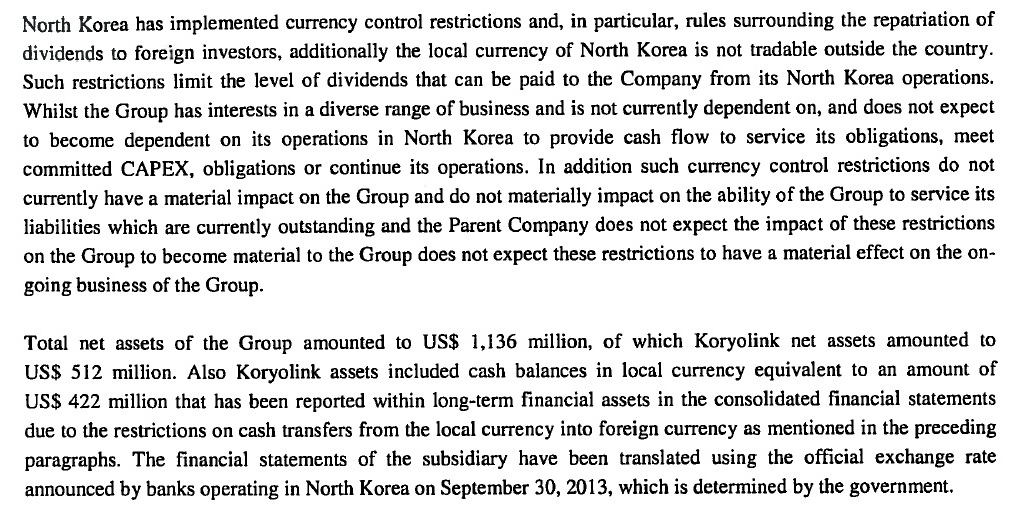
The audit is posted as an image PDF (so the text is not searchable or easily copied into blog posts), but I offer some key data below. The caveat to keep in mind is that all of the USD$ calculations appear to be determined by converting DPRK Won (KPW) at the official rate (appx 100KPW/1US$ and 130KPW/1 Euro). This may be the appropriate accounting standard to employ, but needless to say, this radically overstates the market value of the firm’s position since the current black market rate of the won is approximately 8,000KPW/1US$:

OTMT-screenshot-1-2013-09

US$422 million is $42.2 billion North Korean Won (converted at the official rate). Converted back to US$ at the black market, the total is just US$5,275,000.

OTMT EBITDA (Earnings before income tax, depreciation, amortization) for the period Jan-Sept 2013 are listed as USD$178,962,000. This is just  US$2,237,025 million at the black market rate.

Capital expenditure from Jan – Sept 2013 is listed as USD$40,931, 000 (Appx $665,128 at black market rate).

KoryoLink’s tax exempt status ended on Dec 15, 2013.

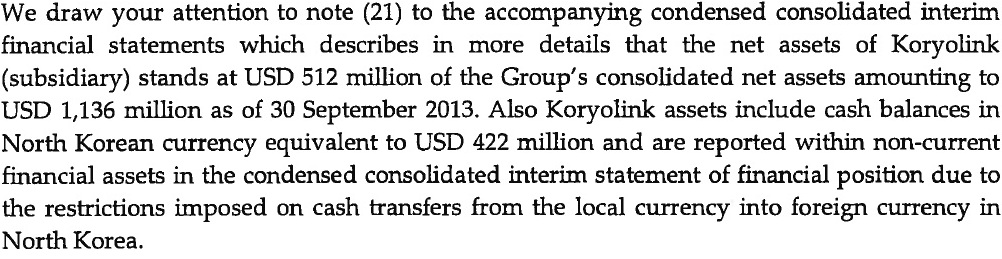
The audit specifically addresses the difficulties of operating in North Korea’s official financial sector:

OTMT-screenshot-2-2013-09

Some additional documents from June of this year can be found here and here. I am not an accountant and already have enough on my plate, so if there are any researchers out there that want to take a crack at this stuff, please do.

Share

Orascom seeks repatriation of profits – or new opportunities?

Friday, December 6th, 2013

UPDATE 1 (2013-12-8): According to an OTMT press release:

Orascom Telecom Media and Technology Holding Denies Reports about Freezing Investment in North Korea

Cairo, December 8th, 2013, Orascom Telecom Media and Technology Holding S.A.E. (“OTMT”) announced today that recent reports in some media sources claiming that OTMT is freezing its investment in North Korea are entirely inaccurate. Where OTMT currently has no plans for new investments in North Korea, the company is open for new opportunities in this market, in which it has been investing for six years. The company has not announced any intentions to freeze investments in the North Korean market.

-END-

About Orascom Telecom Media and Technology

OTMT is a holding company that has investments in companies with operations mainly in Egypt, North Korea, Pakistan, Lebanon and other North African and Middle-Eastern countries. The activities of OTMT are mainly divided into its GSM, media and technology and cable businesses. The GSM activities include mobile telecommunications operations in Egypt, North Korea and Lebanon. The media and technology division consists of OT Ventures/Intouch Communications Service and the OT Ventures Internet portals and other ventures in Egypt, including LINK Development, ARPU+ and LINKonLINE. The cable business focuses on the management of cable networks.

OTMT is traded on the Egyptian Exchange under the symbol (OTMT.CA, OTMT EY).

And according to New York Telecom Exchange:

***Orascom Telecom has refuted recent media reports that it is freezing investment in its North Korean mobile network subsidiary.The company said that the reports “are entirely inaccurate.”In a statement it said that where OTMT currently has no plans for new investments in North Korea, the company is open for new opportunities in this market, in which it has been investing for six years.The company added that it “has not announced any intentions to freeze investments in the North Korean market.”However, it is worth noting that many companies do things without making announcements about them and the statement did not explicitly confirm that it would be spending any more money on its North Korean network, only that it was open to further opportunities.

ORIGINAL POST (2013-12-6): According to the Chosun Ilbo:

Egypt’s Orascom Telecom, the mobile service provider in North Korea, has invested US$200 million into the project so far but has yet to make a dime, according to website Middle East Online.

Orascom chief Naguib Onsi Sawiris was quoted by the U.K.-based website as saying he would make no more investment in North Korea until the company sees some returns.

Orascom started offering 3G mobile services in North Korea in a joint venture with North Korea’s postal service in 2008. The joint venture, Koryo Link, is 75-percent owned by Orascom and 25 percent by the North. It has managed to attract 2 million subscribers.

The Egyptian company invested another $200 million to build the giant Ryugyong Hotel in Pyongyang and set up a joint venture bank.

But North Korea apparently barred Orascom from sending profits from the mobile phone service back to Egypt. “Koryo Link is making profits, but North Korean authorities seem to have blocked remittance of the money,” a source in Beijing said.

The only firm, of which I am aware,  that has been able to repatriate significant sums of hard currency is Pyeonghwa Motors. Most traders take out North Korean goods/products that they can then sell for currency.

Read the full story here:
Egyptian Telecom Halts Investment in N.Korea
Chosun Ilbo
2013-12-6

Share

38 North on the expansion of the DPRK’s mobile phone network

Tuesday, November 26th, 2013

Here is the conclusion:

One should be careful not to jump to a conclusion that North Korea is entering ‘mobile telecommunications revolution.’ North Koreans are still largely denied internet access, and international calls are blocked. Prohibitive top-up rates have made general users reserve their calls for important messages or emergencies. New digital social networking remains an unreachable luxury for the general population and traditional self-censorship prevents politically sensitive conversations on the phone. The government conducts tight surveillance of phone calls and text messages and frequently censors ‘politically inappropriate’ content on them such as South Korean songs and dramas.

However, there are still loopholes that the government cannot perfectly close. For example, a primitive but creative way to make ‘international’ calls supported by illegal Chinese cell phones is in the making, mainly employed now for remittances from defectors in South Korea to their families left in North Korea. However, if brokers can find more profit opportunities, they could surely figure out safer and more creative ways to circumvent technical barriers and the monitoring system. A defector in Seoul has already overcome that technical barrier by connecting to foreign phones with SIM cards bought in Pyongyang. The fact that millions of handheld cameras and digital voice recorders are being circulated should be source of anxiety for the regime. Despite tightly controlled and monitored, the Koryolink network could still potentially widen the loopholes of information flow to and from the outside world.

Read the full article here.

Share

ROK aid to DPRK up 26% in 2013

Sunday, November 17th, 2013

According to Yonhap:

South Korea has sent 17.8 billion won (US$16.7 million) in humanitarian aid to North Korea in 2013, a 26 percent increase from last year, despite the spike in cross-border tensions, the Seoul government said Sunday.

In a report released by the Ministry of Unification, the total amount of aid sent to the communist country, including money donated to international organizations, represents a 26 percent increase from 14.1 billion won offered in 2012.

“Despite criticisms that Seoul has not done enough to help the disadvantaged in the North, the incumbent Park Geun-hye administration has sent more aid to Pyongyang than what was shipped last year when President Lee Myung-bak was in office,” a government official said.

The official, who did not wish to be identified, pointed out that while critics have said the amount is small, people have to take into account the overall aid offered. North conducted its third nuclear test in February and threatened pre-emptive strikes against Seoul and Washington, seriously souring cross-border ties.

Fifteen local charity groups including the Eugene Bell Foundation and Korea Sharing Net provided 4.3 billion won, or a little over 24.1 percent of all aid to the North, with the rest coming from the South Korean government.

Seoul donated 13.5 billion won to the World Health Organization and the United Nations Children’s Fund since President Park took office in late February.

Moving forward, the official said South Korea has no plans to provide direct food aid to the North but that it may consider offering matching funds to private charity organizations wanting to help the North.

The source said while Seoul has no plans to ease its so-called May 24 sanctions that ban all nonhumanitarian economic and social exchanges with the North, it has exercised flexibility and permitted limited cross-border contacts and transactions.

Seoul implemented the ban after it accused the North of sinking one of its warships in the seas off their west coast in 2010. The incident claimed the lives of 46 South Korean sailors.

“The policy of flexibility existed in the past and is nothing new,” he said.

Read the full story here:
S. Korean aid to N. Korea grows 26 pct in 2013 on-year
Yonhap
2013-11-17

Share

DPRK announces Kaesong “High-Tech Industrial Park” and international “Toll Road”

Wednesday, November 13th, 2013

UPDATE 1 (2013-11-13): KCNA reports on a groundbreaking for the new “Latest Science and Technology Development Zone” in Kaesong:

Construction of Kaesong Latest Science, Technology Development Zone Starts

Kaesong, November 11 (KCNA) — The ground-breaking ceremony for building the Latest Science and Technology Development Zone was held in Kaesong City on Monday.

Present there were Jang Su Nam, representative of the Peace and Economy Development Group, officials concerned, builders, employees of the zone and foreign figures concerned and guests.

Jang said in his address that the construction of the zone would help promote the friendship and develop the cooperation among various countries.

He stressed that the DPRK provides foreign businesses with all conditions for investment.

He expressed belief that the construction of the zone would be completed as soon as possible thanks to the positive efforts of the builders and figures concerned.

Then foreign figures made speeches.

They expressed conviction that the construction of the zone would contribute to promoting the economic development in the region and improving the Korean people’s living standard.

They expressed hope that the figures concerned of various countries would support and encourage the successful construction of the zone.

KCNA also published these two articles (2013-10-13):

Building of High-Tech Industrial Park Will Be Conducive to South-South Cooperation: Diplomats

Pyongyang, November 13 (KCNA) — A ground-breaking ceremony for building a high-tech industrial park was held in Kaesong, the DPRK on Monday.

Addressing the ceremony, Diare Mamady, Guinean ambassador to China, said:

Promoting such a project will enhance the confidence building, the economical growth, the trade and other exchanges and improve the overall cooperation with all neighboring countries of the DPRK.

The project is opening a wide way to an integrated cooperation between Asian countries but not limited to that only, it is paving a new route for south-south cooperation, inspiring developing countries in their search of integrated economies to widen their narrow markets and transfer technologies to launch their development.

Shared growth should be the key philosophy of south-south cooperation, which has to be widespread by economical entities like “Peace Economic Development Group”, in view to cultivate and keep sustainable peace, necessary to the well being of nations.

I would like to express all our greetings and extend congratulations to the great leadership of DPRK, to seize this opportunity which is enlightening its constant and sustainable peace policy.

Making a speech at a press conference held at the end of the ground-breaking ceremony, Multi-Kamara Abubakarr, ambassador of Sierra Leone to China, extended his heart-felt congratulations to Kim Jong Un, supreme leader of the DPRK, for making the visionary decision behind the landmark project and accelerating the economic and social development for the country and people.

He continued:

In the light of my experience from 20 odd years-long service in UNDP and roving ambassadorial activities in over 10 Asian countries, I am convinced that the project is of great potential and that the establishment of the park will put an emphasis on promoting economic development in the region and improving the living-standards of the Korean people.

and…

High-Tech Industrial Park to Be Built in Kaesong, DPRK

Pyongyang, November 13 (KCNA) — The Peace Economic Development Group started the construction of a high-tech industrial park in Kaesong City, the DPRK, with a ground-breaking ceremony on Monday.

Present at the ceremony were Jang Su Nam, representative of the group, officials concerned, builders, employees of the park, foreigners concerned and other invitees.

The group is a consortium of China’s Hong Kong, Singapore, Australia, Middle East and Africa.

The park will have an IT center, hotel, dwelling houses, school and other buildings, as well as a power plant.

Heh Teck Siong, general manager of the group, told the ceremony that it was a great honor for the group to take part in the economic development of the DPRK.

He went on to say:

We are the developers of the high-tech industrial park in Kaesong.
The spirit of our group is to build up economic win-win cooperation with global partners and especially with Asian countries.

We believe that the park will contribute to the economic, confidence and security improvement in the region, and the quality of people’s life.

I am pleased to notify to the friends from the world that the park is kicking off.

Jang Su Nam said in his address that the DPRK government has shown deep care for the industrial park, providing all conditions for enterprises of different countries to invest in it.

The completion of the park will encourage the Korean people in the efforts for building a knowledge-based economic power and greatly contribute to deepening friendship and developing cooperative relations among different countries, he added.

He expressed belief that the construction of the park would be completed at an early date thanks to the energetic efforts of its builders and personages concerned.

Here is a link to one of the articles in Korean. The   “Peace Economic Development Group (평화경제개발그룹)” appears to be a different organization than the “Economic Development Commission/Association”. I am not sure how/if they are related.

Television footage of the groundbreaking ceremony can be found here.

ORIGINAL POST (2013-10-18): According to KCNA:

Consortium to Invest in DPRK

Pyongyang, October 17 (KCNA) — A consortium consisting of Jurong Consultants and OKP Holdings of Singapore, P&T Architects & Engineers Ltd. of Hong Kong, China and other well-known companies of the East Asia and the Middle East is taking part in developing projects in the Democratic People’s Republic of Korea.

The consortium agreed with the DPRK’s related organs on collaboration in building the Kaesong Hi-Tech Industrial Park and Highway Toll Road from Capital Airport to Pyongyang City.

The projects will soon begin.

North Korea Tech provides the following links: Jurong Consultants, OKP HoldingsP&T Architects and Engineers. P&T Showed up earlier at

According to AFP:

South Korea’s Unification Ministry spokesman said it had no official comment, but stressed the project had ‘nothing to do with the existing Kaesong zone’.

OKP Holdings said its involvement was “in the preliminary stages”, while Jurong and P&T both declined to comment.

The Kaesong Hi-Tech Industrial Park will be different from the Kaesong Industrial Park–which is rather low-tech by western standards. South Korean citizens, firms, and agencies are forbidden from making high-tech investments in the DPRK by the Wassenar Arrangement, which is why none of the participating firms listed by KCNA are from the ROK.

It is possible that the new Beijing Capital Airport – Pyongyang Toll Road could utilize the new Yalu/Amnok River Bridge.

Share

FIFA supporting development of sport in the DPRK

Thursday, October 31st, 2013

2013-10-31-international-football-school

Pictured Above (Google Earth): The Pyongyang International Football School and support facilities

According to the Korea Herald (Yonhap):

International soccer’s governing body FIFA has provided funds worth $500,000 to build infrastructure to update a soccer academy in Pyongyang, a media outlet reported Thursday.

The International School of Football opened earlier this year and has been training North Korean youths between the ages of 6 and 13, according to a report by Radio Free Asia.

The Washington-based broadcaster said support was given as part of its “goal project” to help build football-related infrastructure in less affluent countries.

FIFA started providing support to the North from 2001 onwards, with around $2 million having been spent so far on six development projects.

Related to the school, North Korean media said its leader Kim Jong-un in June personally designated a name for the new facility that opened on May 31.

Read the full story here:
FIFA gives funds to improve soccer academy in N.K.
Korea Herald (Yonhap)
2013-10-31

Share

Red Cross to increase aid to DPRK in 2014

Wednesday, October 23rd, 2013

According to Yonhap:

The International Federation of Red Cross and Red Crescent Societies (IFRC) said Wednesday that it plans to give US$7.15 million worth of aid to North Korea in 2014, up 7.8 percent from this year.

The organization also said in its updated 2012-15 long-term report that it will allocate $7.96 million for 2015 to help the communist country.

The report showed that the IFRC set aside $6.63 million to help the impoverished country this year, up from $4.40 million spent in 2012.

It said money will be spent on improving public health, sanitation and infrastructure to help the North upgrade its ability to cope with natural disasters.

The report added that Red Cross aims to help around 350,000 North Koreans who are vulnerable to disasters and poverty.

The IFRC, meanwhile, speculated that there were over 3.13 million North Koreans who were displaced form their homes, with 147 having lost their lives due to various natural disasters last year.

The North was hard hit by torrential rains and Typhoon Bolaven in the summer of 2012.

Read the full story here:
Int’l Red Cross aid to N. Korea to rise 7.8 pct in 2014
Yonhap
2013-10-23

Share

DPRK more stable in Kim Jong-un era

Wednesday, September 25th, 2013

According to Yonhap:

North Korea’s political stability has improved over the past couple of years following its power transition, a World Bank report showed Wednesday.

According to the World Governance Indicators (WGI) data compiled by the World Bank, the North’s aggregate indicator of “political stability and absence of violence” came to 0.01 in 2012, up from minus 0.32 a year earlier.

The data reflect perceptions of the likelihood that a government will be destabilized or overthrown by unconstitutional or violent means, including politically motivated violence and terrorism, the organization said.

They are measured based on 31 underlying sources reporting the perceptions of governance of a large number of survey respondents and expert assessments worldwide, with scores ranging from minus 2.5 to plus 2.5, according to the bank.

The level of the communist country’s stability reached minus 0.51 in 1996 when expectations ran high even among serious North Korea observers about the collapse of the regime following the death of its founder Kim Il-sung.

After his son Kim Jong-il took the helm, the figure had been on the rise to reach 0.54 in 2008. But it plunged to minus 0.38 in 2010, which is likely attributable to his faltering health.

Following Kim Jong-il’s death in December 2011, his youngest son Kim Jong-un inherited the power and has since led the country, which would make the country more stable than before when the future was less certain.

North Korea stood in the middle among 215 countries surveyed in terms of political stability in 2012, according to the report.

The WGI paper shows governance indicators for around 200 countries over the period from 1996 to 2012, covering six categories: voice and accountability; political stability and absence of violence; government effectiveness; regulatory quality; rule of law; and control of corruption.

In terms of the remaining five indicators, North Korea ranked low, with its level of voice and accountability, which reflects freedom of expression and citizen participation in selecting their government, coming to minus 2.17, government effectiveness to minus 1.93 and rule of law to minus 1.25, the report showed.

Read the full story here:
N. Korea more politically stable after power shift: World Bank
Yonhap
2013-9-25

Share

An affiliate of 38 North