Archive for the ‘International Organizaitons’ Category

North Korea diaspora in North East Asia

Thursday, February 17th, 2011

The Woodrow Wilson Center’s Asia Program and NKIDP hosted a panel on the North Korean diaspora in North East Asia.

Panelists include:
Apichai Shipper, Visiting Scholar, University of California, Los Angeles;
Hazel Smith,Professor, Cranfield University, U.K.;
Suzanne Scholte,President, Defense Forum Foundation

I have not seen the panel yet, but it is in the queue for this weekend.

Watch the entire event here.

Share

2010 DPRK grain production estimates inconsistent

Monday, February 7th, 2011

Institute for Far Eastern Studies (IFES)
NK Brief No. 11-02-07
2/7/2011

Evaluations of North Korea’s grain output for 2010, and predictions for 2011, varied considerably between international organizations and South Korean agricultural experts. A recent report from the Korea Institute for National Unification (KINU) evaluating North Korea’s economy for 2010 and examining the outlook for 2011 revealed that the World Food Program (WFP) and the UN Food and Agriculture Organization (FAO) estimated a 3.1 percent growth in North Korea’s 2010 grain production over the previous year, at 5.53 million tons. Based on this estimate, the two international organizations stated, “Because North Korea used more fertilizer than in the previous year, and an improved fuel situation [allowed] the use of more agricultural equipment, harvest conditions have improved.”

These international organizations believe that North Korea’s 24.43 million residents need an annual total of 5.35 million tons of grain, estimating that 4.25 tons (148kg per person) are needed for food while an additional 1.1 million tons are needed to seed future crops, for use in industrial manufacturing, and for livestock feed. Therefore, it was predicted that North Korea’s domestic production will fall 870,000 tons short in 2011. Since Pyongyang is expected to be able to import 330,000 tons of grain this year, it will be left with a 540,000 ton grain deficit.

On the other hand, the (South) Korea Rural Economic Institute and experts from other South Korean agricultural research institutions believe that unfavorable weather conditions in 2010, just like those seen in the South, as well as flooding in North Korea meant that grain production fell off last year, especially since the adverse weather and low temperatures struck during prime growing seasons. Therefore, South Korean agricultural experts estimate that North Korean grain production for 2010 was about 200,000 tons less than the year prior. Increased fertilizer distribution accounted for an additional 100,000 tons, but the damage from flooding cost the North the same in crops, and the shortage of assistance meant an additional 200,000 ton shortage.

South Korea’s Rural Development Association estimates North Korea’s 2009/2010 crop yield at 4.11 million tons, and predicts the 2010/2011 yield will drop to 3.9 million tons. South Korean experts also predict that even with international aid and continuing private-sector grain exports to North Korea, Pyongyang will fall 1 million tons short of grain this year. Not only that, the chances that the North’s grain situation will grow even more severe are significant. Rising international grain prices will heavily burden Pyongyang, and while food prices in North Korea’s traditional markets appear stable following the fall harvest, they have risen steadily, and as the lean season approaches, there is a high likelihood that prices will skyrocket soon.

KINU predicts that if there isn’t any significant domestic political upheaval or any serious clashes with other countries in 2011, North Korea’s industrial sector may be able to boost production. As long as international sanctions continue to be enforced against North Korea, Pyongyang’s reliance on China will continue, but that the forced efforts at self-sufficiency and indigenous development are unsustainable.

Share

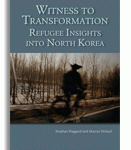
Witness to Transformation: Refugee Insights into North Korea

Monday, January 31st, 2011

I was in Washington today for the release of Haggard’s and Noland’s new book Witness to Transformation: Refugee Insights into North Korea. According to the Peterson Institute’s web page:

Despite its nuclear capability, in certain respects North Korea resembles a failed state sitting uneasily atop a shifting internal foundation. This instability is due in part to the devastating famine of the 1990s and the state’s inability to fulfill the economic obligations that it had assumed, forcing institutions, enterprises, and households to cope with the ensuing challenges of maintaining stability with limited cooperation between the Korean government and the international community. The ineffective response to the humanitarian crisis triggered by the famine resulted in the outflow of perhaps tens of thousands of refugees whose narratives are largely overlooked in evaluating the efficacy of the humanitarian aid program. Witness to Transformation: Refugee Insights into North Korea uses extensive surveys with refugees who now reside in China or South Korea to provide extraordinary insight into the changing pathways to power, wealth, and status within North Korea. These refugee testimonies provide an invaluable interpretation of the regime, its motivations, and its capabilities and assess the situation on the ground with the rise of inequality, corruption, and disaffection in the decade since the famine. Through the lens of these surveys, preeminent North Korean experts Stephan Haggard and Marcus Noland carefully document the country’s transition from a centrally planned economy to a highly distorted market economy, characterized by endemic corruption and widening inequality. The authors chart refugees’ reactions to the current conditions and consider the disparity between the perceived and real benefit of the international humanitarian aid program experienced by this displaced population. Finally, the book examines these refugees’ future prospects for integration into a new society.

I have read the book and found it tremendously helpful for understanding the changing dynamics within the DPRK.

In conjunction with the release of the book, the two authors have launched a new blog.  You can see it here. They have already posted some fantastic data—and we can also see a sense of humor as well!

UPDATE:

1. Here is a link to the presentation given at the event.

2. Here is coverage in the Daily NK.

3. Here is coverage in the AFP.

Share

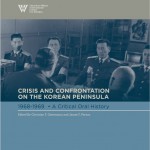
New NKIDP report: Crisis and Confrontation on the Korean Peninsula: 1968-1969

Tuesday, January 25th, 2011

The Wilson Center’s North Korea International Documentation Project (NKIDP) has published another manuscript in the Critical Oral History Conference Series: Crisis and Confrontation on the Korean Peninsula: 1968-1969

Download PDF here

The Donga Ilbo reported on this paper:

Armed North Korean spies caught while trying to storm South Korea’s presidential office to assassinate then President Park Chung-hee on Jan. 21, 1968, are known to have also planned to attack the U.S. Embassy.

When the North seized the American intelligence ship USS Pueblo in waters off the North Korean port of Wonsan two days later, the U.S. planned to immediately mobilize F-4 Phantom fighters to bomb the North. This plan was shelved, however, because the U.S. Air Force lacked devices for loading conventional weapons required for an air strike.

This information was derived from a compilation of declassified documents from 1968-69 titled, “Crisis on the Korean Peninsula and Standoff” obtained exclusively by The Dong-A Ilbo from the Woodrow Wilson International Center for Scholars in Washington Monday.

The documents were compiled after the center held in September 2008 a closed forum with 15 experts and seven former U.S. officials who worked in both Koreas and China in the late 1960s.

Through the forum, the U.S. think tank comprehensively analyzed classified documents 1,285 pages in volume, including those from the former Soviet Union and the Eastern European bloc like the former East Germany and Romania.

Those who attended the forum included Horst Brie, former East German Ambassador to North Korea; Walter Cutler, former political adviser to the U.S. ambassador to South Korea; Thomas Hughes, former director of the Bureau of Intelligence and Research at the U.S. State Department; James Leonard, former chief of the Korea Desk at the State Department; and David Reuter, analyst for Northeast Asia at the U.S. National Security Agency.

Also at the event were Kang In-duk, former South Korean unification minister, and Yoon Ha-jeong, former South Korean vice foreign minister.

Leonard said, “According to multiple documents considered classified at the time, North Korea’s seizure of the USS Pueblo constituted an emergency situation. After the incident was reported to the U.S. Air Force, F-4 Phantoms were to be mobilized within several minutes but did not take off because they only were equipped with devices for loading nuclear weapons but none for loading conventional weapons.”

“The USS Pueblo incident was apparently a disgrace to the U.S.,” he said, adding, “With security concerns heightened at the time and Seoul’s presidential office under attack, the U.S. Defense Department should have been prepared to protect the Pueblo by mobilizing the Air Force when necessary.”

Ultimately, Washington merely mobilized the nuclear aircraft carrier Enterprise and two Aegis destroyers from the U.S. Navy`s 7th Fleet.

Kang, who served as the first chief of the North Korea intelligence bureau at the (South) Korean Central Intelligence Agency, said, “Armed North Korean spies, including Kim Shin-jo, originally had five targets including the U.S. Embassy in Seoul, (South Korean) Army headquarters, Seoul Prison and Seobinggo North Korean Spy Detention Camp.”

“But judging that the targets were too scattered, the North reduced the group of armed spies to 31 from the originally planned 35, and only targeted the presidential office.”

Through interrogation of Kim, Seoul secured intelligence that the spies originally had the U.S. Embassy as a target but it did not inform Washington of this finding.

Cutler, who was stationed in Seoul at the time, said, “We had no prior intelligence that the embassy was a target and thus took no special security measures in this regard.”

Share

KJI and JST meet with Orascom president

Sunday, January 23rd, 2011

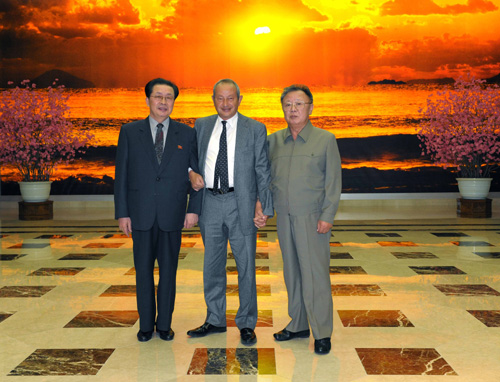
Pictured above (L – R): Jang Song-thaek, Naguib Sawiris, and Kim Jong-il

According to Martyn Williams:

The CEO of Egypt’s Orascom Telecom has been given a rare honor during his current trip to Pyongyang: an audience with Kim Jong-il and dinner hosted by the reclusive leader for the businessman whose firm owns a majority of North Korea’s only 3G cellular network.

Naguib Sawiris arrived in the North Korean capital on Friday and was received on Sunday by Kim Jong-il, the Korea Central News Agency reported on Monday.

Kim Jong-il, “warmly welcomed his DPRK visit taking place at a time when Orascom′s investment is making successful progress in different fields of the DPRK, including telecommunications,” the report said.

Orascom holds a 75 percent stake in Cheo Technology, which operates North Korea’s only 3G cellular network.

The network, the remaining stake in which is held by the government, uses the Koryolink service name. It has seen fast growth in subscribers and currently claims more than 300,000 accounts in just the two years since its launch.

After starting first in Pyongyang, the network has been expanded to cover provincial capitals and smaller cities and a 3G signal is now within reach of 75 percent of the population, the company said in November last year.

The Orascom group has made several other investments in the country. In 2007 it invested in a cement factory and in late 2008, at around the same time it launched the 3G network, it opened a local bank. The company has also been tied to renewed construction work at Pyongyang’s pyramid-shaped Ryugyong Hotel. The iconic building was halted in 1992 and has remained vacant ever since.

According to the AFP:

North Korean leader Kim Jong-Il has met the head of an Egyptian company that provides a mobile phone service in the impoverished communist nation, state media reported Monday.

Naguib Sawiris, chairman and CEO of Orascom Telecom Holding, has been visiting the North since Friday. His company has provided a mobile phone service in the North jointly with a local firm since late 2008.

Kim “warmly welcomed his DPRK (North Korea) visit taking place at a time when Orascom’s investment is making successful progress in different fields of the DPRK, including telecommunications,” the North’s state news agency KCNA said.

Kim had “a cordial talk” with Sawiris and hosted a dinner for him, it added.

Orascom said last year that mobile phone subscriptions in North Korea had more than quadrupled in the space of a year — to 301,199 by the end of September 2010 from 69,261 a year earlier.

However, it said overall “mobile penetration” remains at one percent in the country, which has an estimated per-capita GDP of 1,700 dollars and a population of 24 million.

North Korea strictly controls access to outside information and fixes the tuning controls of radios and televisions to official stations.

It began a mobile phone service in November 2002 but shut it down without explanation 18 months later and began recalling handsets.

But in December 2008 the country introduced a 3G mobile phone network in a joint venture with the Egyptian firm.

The Egyptian group in 2007 sealed a 115 million dollar deal to invest in a North Korean cement plant. It is also reportedly involved in completing construction of the 105-storey Ryugyong Hotel in the capital.

Martyn has more at North Korea Tech.

Share

Daedong Credit Bank press release

Sunday, January 16th, 2011

The Daedong Credit Bank (Based in the Potonggang Hotel in Pyongyang) has issued a press release.

I have made a PDF of it available here.

Here is their web page.

Share

Chinese to boost investment in Rason

Friday, January 7th, 2011

UPDATE  1 (2011-1-19): According to the Wall Street Journal:

A Chinese firm has signed a letter of intent to invest $2 billion in a North Korean industrial zone, representing one of the largest potential investments in Kim Jong Il’s authoritarian state and a challenge to U.S. policy in the region.

The agreement was signed with little fanfare in Pyongyang on Dec. 20—a day otherwise marked by pitched tension on the Korean peninsula following the North’s shelling of a South Korean island—according to documents viewed by the Wall Street Journal. Confirmation of the deal comes as Chinese President Hu Jintao visits Washington this week in a bid to forge closer security and economic ties with the U.S.

U.S. officials said the administration is aware of the possible Chinese investment, but noted that previous projects haven’t gone anywhere. “No investment project will enable North Korea to meet the needs of its people as long as its government continues its destabilizing behavior,” said a senior administration official.

The letter of intent involves China’s Shangdi Guanqun Investment Co. and North Korea’s Investment and Development Group. An assistant to the managing director of Shangdi Guanqun, who identified himself only by his surname, Han, said his company’s planned investment is focused on the Rason special economic zone, situated near North Korea’s border with Russia.

The zone was called Rajin-Sonbong when it was established in 1991, but failed to attract sufficient investment. It was revived, and re-named Rason, following a visit there in 2009 by Mr. Kim.

Mr. Han said the plan is to develop infrastructure, including docks, a power plant and roads over the next two to three years, followed by various industrial projects, including an oil refinery, over the next five to 10 years. He said the company was waiting for a response from the North Korean government before applying for approval from China’s Ministry of Commerce.

“It’s all pending at this stage, and it’s really up to the Korean side to make the decision,” Mr. Han said. He added that the $2 billion figure was what the North Korean side had hoped for, not necessarily what his company could deliver.

The company’s Web site says the company was “under the administration” of a state-owned enterprise, Shangdi Purchase-Estate Corporation. Mr. Han, however, said his company was “100 percent private.”

For the Obama administration, securing China’s cooperation in restraining North Korea’s military and nuclear-proliferation activities is a cornerstone of a warmer bilateral relationship. But the potential investment is a reminder of possible limits of Chinese cooperation.

The U.S. wants to step up sanctions to force Kim Jong Il to give up his nuclear-weapons arsenal and military activities. China, meanwhile, is increasingly promoting business projects and direct investment to influence the North, say Chinese and American analysts, arguing financial pressure hasn’t worked.

China is North Korea’s biggest trading partner and aid donor, but the scale of this deal raises concerns in Seoul that Beijing is running its own version of the “Sunshine” policy under which the South boosted investment in the North from 1998 to 2008.

This policy disconnect is expected to be one of the issues Chinese and U.S. officials discuss this week. “These types of deals pursued by China generally present a real challenge to the sanctions” being effective, said Victor Cha, a North Korea expert who helped oversee Asia policy in George W. Bush’s National Security Council. “The net effect is that it does make it more difficult for these sanctions to have the desired effect.”

Such deals have emerged in the past and have come to nothing, analysts said, and it is possible this one, too, could peter out. A number of similar North Korean economic zones have failed to live up to their billing because of poor infrastructure and corruption, and a lack of economic reform. News of the deal was first reported in the Korean-language press, including the Voice of America’s Korean service.

It is unclear how long the agreement has been in the works. But its Dec. 20 signing came on the day South Korea conducted a closely watched artillery test from Yeonpyeong Island near North Korea.

The test marked a high point in tensions after North Korea’s surprise late November shelling of Yeonpyeong, which killed four South Koreans. Pyongyang had threatened a swift military response should Seoul carry out an announced artillery test on Dec. 20. But the day’s drill came and went amid high security in the South, with the North saying in a statement it “did not feel any need to retaliate.”

Top administration officials have recently both praised and chided the Chinese over the North. On a trip to China last week, Defense Secretary Robert Gates commended the Chinese for their “constructive” role in reducing tensions on the peninsula after Pyongyang’s recent shelling of a South Korean island. Secretary of State Hillary Clinton in a Friday speech pressed China to be more aggressive in helping tamp down the North’s nuclear program.

The proposed investment is among the strongest evidence yet of China’s strategy of using direct investment rather political pressure to push for change in North Korea. Chinese experts say that after North Korea’s first nuclear test in 2006, China tried to make improved bilateral relations dependent on Pyongyang dismantling its nuclear program. But after a second test in 2009, China changed tack.

Beijing now believes, according to Chinese experts, that the North Korean regime won’t respond to political pressure and could collapse completely if China cuts off aid and investment, triggering a flood of refugees into northeastern China, and bringing U.S. troops right up to the Chinese border.

The investment strategy was cemented when China’s Premier Wen Jiabao visited North Korea in October 2009 and signed a slew of economic and trade agreements. One of those agreements was for China to fund construction of a $250 million bridge across the Yalu River that separates the two countries.

Construction of the bridge, which would link China with another North Korean special economic zone, had been slated to start in August. Local officials said in November it appeared to have been put on hold indefinitely. Now they say a ground-breaking ceremony was held Dec. 31.

U.S. officials are particularly concerned about how China’s financial links to North Korea may be facilitating Pyongyang’s weapons programs. In November, Pyongyang showed a visiting American scientist 2,000 centrifuges stationed at a cover site, drastically raising fears about the North’s ability to expand its nuclear-weapons arsenal.

“China’s increased economic support undercuts the rest of the region’s efforts to convince Pyongyang that there will be consequences for further belligerence, nuclear weapons development or transfer of nuclear capabilities,” said Michael Green, who also served as a senior official on Asia during the Bush administration.

Read the full story here:
Chinese Firm to Invest in North Korea
Wall Street Journal
Jay Soloman and Jeremy Page
2011-1-19

ORIGINAL POST (2011-1-7): According to the Joong Ang Ilbo:

A Chinese state-run company recently agreed to invest $2 billion in North Korea’s Rason free trade zone, the JoongAng Ilbo learned yesterday from documents related to the deal.

Shangdi Guanqun Investment Co., Ltd. signed a 10-point memorandum of understanding with Pyongyang’s Investment and Development Group on Dec. 20 in Beijing, the documents showed.

The signing ceremony was attended by Mi Chang, president of Shangdi Guanqun Investment, and Kim Chol-jin, president of the Investment and Development Group.

The goal of the investment, stated in the documents, is to build Rason, a northeastern North Korean city on the East Sea that borders both China and Russia, into the “biggest industrial zone in Northeast Asia” in around 10 years.

The project calls for coal-fired power plants, roads, piers and oil refineries in the North Hamgyong Province city, the documents said.

According to the documents, the deal is “a strategic joint project based on trust between high-level figures” in China and North Korea, which suggests it may have been negotiated by North Korean leader Kim Jong-il during two visits to China last year, on which he met Chinese President Hu Jintao.

The North’s economy has suffered under international sanctions on trade and financial services overseas, imposed after its nuclear weapon tests, and is desperately seeking foreign investment.

China is investing in Rason as an export base to serve markets in Japan, southern China and Southeast Asia.

Rason is a merger of two towns, Rajin and Sonbong, and was designated the first free trade zone in the North in 1991. It was promoted to a “special city,” which means it has fewer restrictions on businesses.

“We have a deep interest in North Korea’s ample natural resources,” an official of Shangdi Guanqun Investment Co., Ltd. told the JoongAng Ilbo. “To facilitate the export of natural resources [from the region], we will invest $300 million first and construct a coal-fire power plant at the coal mine and build a railway, roads, and harbors and piers [near it].”

The Chinese firm’s official said the company opened an office in Pyongyang at the end of last month.

Shangdi Guanqun Investment, established in 1995 by the Chinese government, is a trading firm specializing in oil processing, natural resources and international financial services. It is one of the key companies in China’s 12th five-year economic development plan that starts this year.

North Korea’s Investment and Development Group is in charge of developing the country’s four free trade zones. The other economic special zones are in Kaesong, Mount Kumgang and Sinuiju.

The Shangdi Guanqun Investment official said the company will build an oil refinery in Rason, where it plans to refine crude imported from the Middle East and Russia and sell the output to China or other countries.

I believe this Chinese story also relates to the same project.

Read the full story here:
China backs North’s Rason project
Joong Ang Daily
Ko Soo-suk
2011-1-7

Share

Friday Fun: New year’s close out

Thursday, December 30th, 2010

Item number one: the DPRK’s domestically produced film camera, Hakmujong-1 (학무정-1):

This picture comes via the Russian blog “Show and Tell Pyongyang”. You can read about this camera in the original Russian here.  You can read about it in English (via Google Translate) here. This is the same blog that informed us about the DPRK’s PDA device and the DPRK’s Linux OS, Red Star.  He also has some fabulous pictures of the Kim Jong-suk Pyongyang Silk Mill here.

Item number two: DPRK’s domestic “Coke”:

This photo comes from the collection of Eric Lafforgue.  If you have not already seen his photos, please do yourself a favor and click over.

The soda is “Crabonated” which is a pretty funny typo.  Also worth noting are the lengths they have gone through to copy the Coca-Cola brand–as if they are trying to win back market-share from the foreign firm.  The colors, red, black, silver and white are the same.  The familiar cursive English “C” at the beginning of the word is a close copy.  They even tried to replicate the Coke “wave” by adding a literal wave in a similar curve along the bottom of the advert.

Item number three: DPRK caviar (Okryu Restaurant)

“Thanks to our leader Kim Jong-il we have managed to breed sturgeons.  People from Pyongyang and other provinces can come here to taste caviar and turtle meat.”

See the full video here. Here is a satellite image of the restaurant.

Item number four: Women’s fashion

Uriminzokkiri has posted a clip on DPRK women’s fashion to their Youtube account.  You can see it here.  I have blogged about women’s fashion before here and here.

Item number five: New Koryolink advert (Koryolink is the DPRK’s new 3-G mobile phone service founded by Orascom)

The video comes from this NK web page.  For South Koreans I posted it to my Youtube account.  You can see it here.

Item number six: DPRK verison of The Diary of Anne Frank

Michael Rank has scanned the introduction and uploaded it here.

Item number seven: Happy new year!

Share

DPRK economic activity in 2010

Thursday, December 30th, 2010

Institute for Far Eastern Studies (IFES)
NK Brief No. 10-12-29
12/30/2010

In the New Year’s Joint Editorial issued last January, the North Korean government vowed to improve the lives of the people by focusing on light industry and agriculture. Early in December, the North Korean government-run media reflected on the year’s achievements, stating that advances in industry and improvements in the lives of the people had made unprecedented leaps in 2010.

As North Korea pushes forward with its attempt to “open the doors to a Strong and Prosperous Nation,” Pyongyang has poured significant effort into reviving its economy. In mid-December, the [North] Korean Central News Agency released a report on the 2010 activities of Kim Jong Il, noting that he had made 65 visits to sites related to the nation’s economy, more than twice as many as the 31 visits made to military sites. In 2009, Kim Jong Il made 58 visits to economic sites and 43 visits to military sites, suggesting that the leadership has shifted its focus to the economy this year.

On December 9, the Choson Sinbo published an article in which it highlighted the importance of improving the lives of the people and called an “economic renaissance” critical to the achievement of a “great and prosperous nation.” It also stressed the need for an independent people’s economy as the foundation for such a recovery.

As the North has worked to establish a self-sustaining economy this year, it has highlighted the Kimchaek Iron and Steel Complex as an example of ‘Juche’ production. North Korean media has highlighted the improvements in mining production, in Kimchaek as well as other areas, and has reported that the metals industry has undergone a “revolution” this year. The media has reported surprising production gains at the Hwanghae and Chollima steel complexes, and claim that these production levels have been repeated throughout the country.

Not only has the North celebrated “Juche steel”, but also “Juche textiles” and “Juche fertilizer.” In February, North Korea reopened the modernized “February 8 Vinalon Factory,” highlighting the factory as representative of the country’s independent textile production capacity and likening the new Vinalon factory to a new representation of North Korea’s socialist economy. On March 8, the KCNA called the Vinalon factory the new face of “the brilliant future of the Strong and Prosperous Nation.”

As for “Juche fertilizer,” the North’s media sang the praises of the Namhung Youth Chemical Complex, reporting that the anthracite gas process developed there allowed for steady agricultural production without needing to import fuel or other raw materials, and stated that if the process can be further institutionalized, it should be able to provide for the basic needs of the entire country.

Pyongyang has set as a goal the resolution of the country’s fertilizer shortage by producing one million tons of fertilizer by 2012 in the Hungnam Fertilizer Complex and the Namhung Youth Chemical Complex, stating that for every ton of fertilizer, it can produce ten tons of rice. The media has reported that the North will produce “over ten million tons of grain” in 2012 with the expected million tons of fertilizer.

Improvements in textiles, fertilizer, and other light industries are directly related to raising the standard of living for North Koreans. Kim Jong Il visited the Samilpo factory in Pyongyang in April, and for the rest of the year, state media heralded the advancements made in the factory and called for industries throughout the country to follow in its footsteps. Throughout the year, North Korean media highlighted numerous factories and light industries to illustrate the regime’s efforts at improving the standard of living.

The North Korean government has set a goal of resolving its food, clothing and housing shortages. In order to meet the food demands of the people, the regime seeks to increase grain output by boosting fertilizer production through ‘samilpo’-style factory enhancements. In order to assure everyone is clothed, the regime is relying on the Vinalon factory and increased domestic production. As for housing, the state has set its sights on the construction of 100,000 new houses by the year 2012.

At the forefront of the North’s push for modernization and increased production is its “Computer Numerical Control” (CNC), a vaguely defined idea that has been attributed to Kim Jong Un, the third son and probable successor of Kim Jong Il. As Pyongyang pursues a “strong and prosperous nation” by 2012, state-controlled think-tanks and industries are focusing on CNC as the means for modernization and increased productivity.

Share

DPRK elevates status of national resource development office

Tuesday, December 28th, 2010

Institute for Far Eastern Studies (IFES)
NK Brief No. 10-12-22
12/22/2010

On December 1, the North Korean Supreme People’s Assembly Standing Committee announced an order to elevate the position of the National Resource Development Office, which is overseen by the Cabinet’s Ministry of Extractive Industry, to the Ministry of National Resource Development. According to the Korea Central News Agency, this measure is aimed at increasing development and export of underground resources as international sanctions against the North further limit Pyongyang’s access to foreign capital.

The regime’s focus on increasing earnings can be seen in Kim Jong Il’s on-site guidance trips, as well. The KCNA reported on December 3 that Kim had recently visited Danchon, South Hamgyong Province, touring the Danchon Magnesia Factory, the Danchon Mining Equipment Factory, and the Danchon Port facilities. During his visit to the magnesia factory, Kim Jong Il emphasized the need for increasing the production of quality asphalt. In addition, after receiving a report on the status of implementation of CNC in the Danchon Mining Equipment Factory, he stated, “The factory needs to normalize at a high level of mass production to turn out the necessary numbers of mining and processing equipment.” Upon reviewing the Danchon Port facilities, Kim Jong Il urged staff to work towards ensuring a loud chorus of boat whistles in the port for the upcoming 100th anniversary of the birth of Kim Il Sung in 2012.

U.S. financial sanctions levied against the North have made it difficult for Pyongyang to collect export earnings from its mining efforts, one of its key earners of foreign capital. In May of last year, when sanctions were strengthened in response to North Korea’s second nuclear test, European and even Chinese banks froze money transfers to North Korea. The [North] Korea Magnesia Clinker Manufacturing Group could not collect 4.6 million USD in earnings from the export of zinc to Europe. It appears that the North has tried to compensate for these losses by increasing the export of iron ore from Musan. Exports to China passing through the Musan customs office have more than doubled, rising from 1200 to 2500 tons per day.

The mines of Musan, holding more than seven billion tons of iron ore, are the North’s primary vehicle for earning foreign capital. In 2004, China’s Tonghua Steel and Iron Group signed a contract with North Korean authorities granting the group 50-year development rights at some key North Korean mines, and is planning to invest seven billion Yuan in developing the sites. Beijing plans to use the access to North Korean mines to meet some of the expected 80 million ton shortfall of iron ore in 2010. However, there are rumors that North Korea has canceled the contract with no explanation, causing much speculation about the direction of Pyongyang’s export strategy.

Share

An affiliate of 38 North