Archive for the ‘Light Industry’ Category

In reclusive North, signs of economic liberalization

Wednesday, May 30th, 2007

Hankyoreh
Authored by Ryu Yi-geun and translated by Daniel Rakove

PYONYANG: “Next time, please come back and purchase something,” implored Mr. Hong to the customers leaving his store empty-handed.

“You’re saying you earn more if you sell more?”

“You bet.”

But this reporter was still suspicious. Four days later, I carefully asked our handler for confirmation.

“Of course it’s true,” he assured me. “Even in the same eight-hour workday, he who produces more results gets paid more.”

The concept of receiving compensation in proportion to the amount of sales is one that is now long familiar to North Koreans. Yet what is surprising is the gusto with which North Korean store staff will go to in encouraging South Korean tourists to buy their products, a phenomenon indicative of how great the materialistic impulse has become in the reclusive communist nation.

Constructed in Pyongyang’s central district in 1995, the 47-story Yanggak Hotel seems to float above the Daedong River like an island. Mr. Hong works at a store there on the second floor. There is even a spot next door to exchange money. Though the set prices are written on each product – in Euros – the South Korean customers managed to save a bit through bargaining. The owner was at first insistent that all products be only sold for the listed price, but he finally gave way after a long give and take with the customers. He decided it worthwhile to sell his products slightly cheaper, if only to make a profit. Though most transactions are conducted at the listed price, there were instances at the hotel store and other establishments of selling to tourists at a discounted rate after haggling over the price.

Elements of capitalism are slowly making their way into North Korean life – wrapped in the euphemism of “utility.” After returning from his trip to North Korea from May 14-18, on which he led 130 economic delegates, Min Byeong-seok, Director of the Hankyoreh Foundation for Reunification and Culture proclaimed, “I could unmistakably feel here and there that North Korea is changing.”

It is of course difficult to confirm the presence of change in North Korea. This is in part because the changes are occurring at a low level. After all, there is always a difference in what we look for compared to what we are shown. This is what makes it difficult for someone to declare unreservedly, “North Korea is this,” or “North Korea is that.” There are also parts of North Korea that are difficult to understand due to the biases originating from the political system and values of the observer. Hankyoreh21 managed to get a spot in the group of Pyongyang-bound economic delegates, and recorded below is a compilation of the various things we witnessed.

“My life has gotten so much better since last year.” These words did not seem to be mere propaganda. Whether spoken by our North Korean guide or the various Pyongyang citizens with whom we came in contact, their words were by and large the same. One citizen told us, “My wages increased from 3,000 to 6,000 North Korean won,” and consumer prices “went up about 10-20 percent.” In other words, wages have increased much faster than has the rate of inflation. Yet that man cannot be taken to be the representative Pyongyang laborer, nor does he have the credibility of an economist.

Indeed, it is hard to grasp the level of inflation in North Korea: all one can do is take an educated guess. Lee Do-hyang of the Institute for National Security Strategy said, “These things are evidence that the financial situation is improving and the economy is enduring,” adding, “It seems that the quality of life for common people is taking a turn for the better.” Yet in North Korea, where it is said some US$30 a month is necessary to get by, a 3,000 North Korean won raise is not exactly a windfall: 6,000 North Korean won is about equivalent to $2, and on the black market, $1 sells for 3,000 North Korean won. Thus, the rationing and side jobs that bring in an additional $15-20 a month are an essential source of income.

Pyongyang’s major marketplaces have grown livelier. Stretching between 2,000 and 3,000 pyeong (1 pyeong is 3.3 sq. meters), one large-scale market has taken up a spot next to Kimchaek Industrial School on a once-empty spot along Otangangan Street. In the shape of a high school gym, the market’s two-story building is covered in a blue roof and the exterior is clean. Visible from the Yanggak Hotel, the market was bustling at 6 p.m. on May 16. The Bonghak Market next to the Pyongyang Cosmetics Factory was also busy once the sun set. At least one marketplace has taken shape in each of Pyongyang’s 18 districts. Each one is a symbol of capitalism’s penetration of the socialist, planned economy. The activities in each market are said to be hardly distinguishable from the capitalism found in other countries.

One citizen said, “The people go to the markets more, where the prices are a little bit cheaper than at the nationally operated stores. Even if one doesn’t buy anything, it is fun to look around, what with the variety of goods for sale and the haggling going on.” Most citizens are said to buy their daily necessities at such markets, having become an essential part of daily North Korean life.

Street food vendors started appearing quite a while ago, but their numbers are ever-increasing. The fairly tidy vendors can be seen here and there throughout Pyongyang, selling a variety of goods, including soft drinks, ice cream, bread, rice cakes, and so on. Each product runs between 100-300 North Korean won.

The local People’s Committee gives licenses for the operation of such stands to various companies or the descendants of revolutionaries. A portion of sales is taken by the state and the remainder of the profit goes to the managing company or individual.

Though the residents of Nampo, a port city 40 minutes by bus from Pyongyang, do not seem to be better off than their Pyongyang counterparts, the city is quite lively. On the journey from the major ship repair factory by the port, through the city center, and to the freeway entrance leading to Pyongyang, 50-60 separate street food vendors were spotted. The products they were selling as well as their method of sale were quite diverse. Some vendors – most likely new ones – simply laid out their goods on the ground for sale, showing even to the outsider that North Korea’s markets have hit a growth surge.

Five years have passed since the July 1, 2002 economic measures were instituted by the North Korean government, raising wages as well as the currency’s value. In addition, the price of rice and other necessities was increased, and a system of incentives and limited independent capital was expanded. Yet very few North Korean people have even heard of “the 7/1 measures.” Only after talking for a significant length of time will they mention the notion of “utility” that has been pursued over the last few years.

At the end of Unification Road in the Nagnang district of southern Pyongyang, the Phoenix Clothing Factory is producing clothing on commission. The 1,000-pyeong factory is unceasingly filled with the whirr of sewing machines. U Beom-su, 53, introduced himself to the South Korean observers as the company’s “chief executive,” explaining, “The workers work eight hours a day, but when the fixed day for shipment draws near, we have no choice but to put them on overtime.” The payment system for workers is multi-tiered, with five levels, the salary increasing with rank. Every month, one laborer is chosen from each team of workers as being the most outstanding, and is given bonus compensation. The ‘chief executive’ explained that further incentive payments were rewarded based upon the factory’s production levels on the whole.

It is unclear as to how widespread this model of business is, but director of the Korea Institute for National Unification Lee Bong-jo said that “the seeds of competition are visible.” However, the workers at the Yuwon Shoe Factory and the Pyongyang Cosmetics Factory were flustered when asked about their salaries or the labor system and evaded giving an answer.

The will for liberalization was evident here and there. At the 10th annual Pyongyang Spring International Trade Fair on May 14, 200 companies from 12 countries participated, either to view the product lines or to display their own. The majority were Chinese companies, including its largest electronics firm, Haier, while there were several sections of the exhibition primarily interested in retailing to the foreign visitors themselves, the determination by North Korea to get its products out to foreign markets was apparent.

Many members from the South Korean team of economic representatives also participated. In particular, representatives from Daewoo Shipbuilding & Marine Engineering Co., Ltd, the world’s second largest shipbuilder, as well as the Korea Port Engineering Company, visited the Yeongnam Ship Repair Factory and the Nampo Port to explore the possibility of making investments in those places. In a gesture of consideration, the Northern handlers prepared a separate automobile for the potential investors to explore the grounds, and held a separate consultation session for them beyond the general one for the economic delegates. On multiple occasions, various North Korean officials expressed an interest in attracting South Korean capital. The self-confidence they showed hinted at a sense that they had to some extent resolved the immediate issues of day-to-day subsistence. It may sound strange, but the consensus of those who had also made the trip last year was that the electricity situation had improved. In other words, basic economic conditions seemed to be on the upswing. Perhaps the self-confidence North Koreans showed in displaying their possession of a nuclear weapon has now flowed into the economic sector, thus explaining their will for some liberalization.

Yet simply because there is a will for opening up does not mean liberalization will come easily. One Daewoo source explained, “[We told the North Koreans that] there must be assurances before we invest. They have to provide the same conditions that China does.” At this point, there is probably not a single person who could make such assurances on behalf of the North Koreans. The country is still unprepared to take advantage of the money available to it from the South through the economic cooperation program. The six-party talks also must also make some progress on the nuclear issue. Furthermore, if North Korean – U.S. relations do not improve, then free trade between North and South will remain uncertain indefinitely.

In the case that external matters are settled and the will for liberalization strengthens, then the vitalization of the North Korean economy could quickly pick up with the improvement of infrastructure, such as the electricity grid and logistics, which are pointed to as the largest stumbling blocks. The reporters who arrived first on May 12 witnessed, for instance, how the automatic doors and the elevator on the first floor of the Yanggak Hotel took 30 minutes to warm up. While the houses themselves gave off light after the sun set, the streets between them were completely dark. The mere 20-30 percent rate of operation at factories as estimated by experts is partially accountable to a lack of raw materials, but most of all to the deficiency of electricity.

The rigidity of the economic system only adds to North Korea’s list of woes. Though the director of Pyongyang Cosmetics has requested raw materials and modern machinery, he does not have the full authority to manage the company. Another company has imported the raw materials from China, and he confessed that he knew little of the specifics on the subject. The director of the Daeanchinseon Glass Factory made a similarly vague request for “raw materials.”

The problems go deeper. For one, there was no sign on the part of the North Korean factory managers to think of the visiting economic representatives as business counterparts in the world of capital and industry. For example, even photography by the group of South Korean trade representatives was forbidden within the factory grounds. Another chronic problem is the ease by which North Koreans that are not economic officials or specialists break promises. Furthermore, as often appears in planned economies, there is a single-minded focus on “production” without consideration of whether the product being made is for domestic use or for export. This sort of difficulty was evident at the cosmetics and shoe factories, as well.

Lee Bong-jo, director of the Korea Institute for National Unification, offered some advice to the South: “Knowledge of North Korea must precede any investments there.”

It seems that amongst difficulty, Pyongyang may be carefully seeking change. Though it remains stuck in the dilemma of pursuing liberalization while maintaining regime stability, it is increasingly sending strong signs to the outside world of a will for liberalization. As South Korean Former Minister of Unification Jeong Sye-hyeon said, “It is difficult for North Korea to go backwards.”

Share

Truth Revealed behind Companies in Kaesung

Thursday, May 17th, 2007

Daily NK
Kim Yong Hu
5/17/2007

Kaesong.jpgCompanies in Kaesung Delegate Management over to North Korea

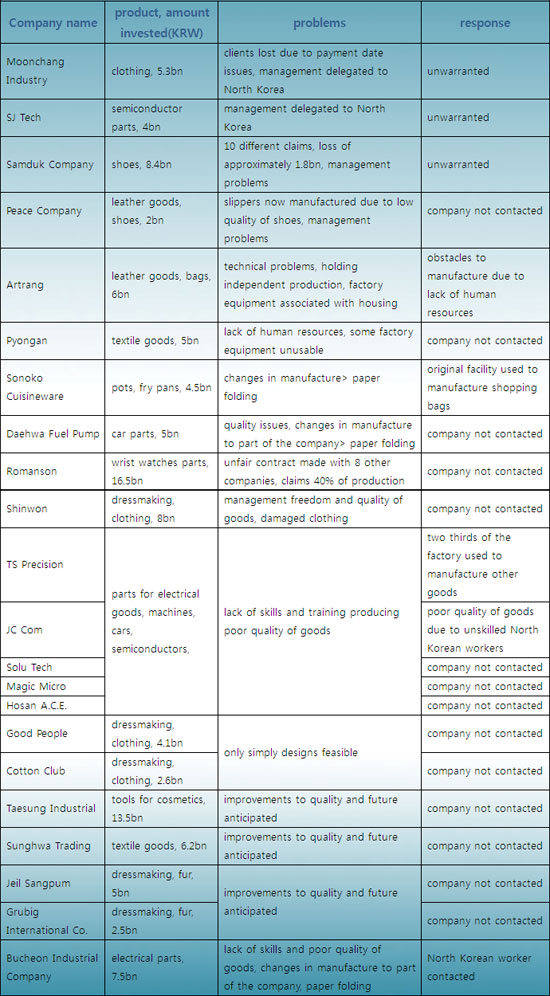
Most of the factories in Kaesung Complex are facing financial problems, a report on the “Situation on 22 factories in Kaesung Industrial Complex” revealed by the Forum for Inter-Korea Relations.

According to the report, most of the companies in Kaesung Complex are facing entrepreneurial difficulties due to restraints in contracts and inadequate resources.

The Forum for Inter-Korea Relations (co-representative Kim Kyu Chul) has been monitoring the South-North economic cooperation. The forum released a report on the 15th which revealed that two companies leasing areas in Kaesung, Moonchang Industry and SJ Tech were facing management difficulties and handed over the right of management to North Korea’s managers. The companies have invested a total of 9bn won.

The Forum bases its evidence on result provided by legal representatives for the 22 companies in Kaesung, collected over a period of 2 years and a North Korean document on the business circumstances in Kaesung to collect difficulties of South Korean managers.

Mr. Kim said, “We confirmed through representatives of two companies leasing areas in Kaesung Complex, Moonchang Industry and SJ Tech that problems were being experienced due to insufficient human resources and freedom of enterprise” and revealed, “Moreover, these companies are facing such severe management difficulties that they have apparently designated the right of management over to the North.”

Regarding this, Director of SJ Tech Lim Hwang Yong said in a conversation with the DailyNK on the 15th, “There is absolutely no evidence to the claim that the companies in Kaesung have handed their business permits over to the North,” strongly denying the act. Similarly, an affiliate of Moonchang Industry commented that the claim was groundless.

In addition, many companies such as Sonoko Cuisineware, Daehwa Fuel Pump, Bucheon Industrial Company made large investments in equipment to manufacture and produce goods, but then again some companies are known to have begun other production such as paper folding. In order to recover from the entrepreneurial ditch, another company has begun manufacturing shopping bags. The total amounts invested by these companies exceed around 17bn won (US$18.3mn).

Regarding this, an affiliate of Sonoko Cuisineware said, “We are merely using our pre-existing equipment to manufacture shopping bags.”

Furthermore, according to the document, a shoe manufacturer Peace Company is using it’s materials initially designed for shoes to produce slippers as it faces management problems during this time. It seems that Peace Company is not able to utilize 100% of its factory materials due to a lack of human resources. Meanwhile, Samduk Comapny has actually made a loss of $1.8mn as a result of 10 different claims made following its entry in Kaesung complex.

Other companies including TS Precision, JC Com, Solu Tech, Magic Micro, HOSAN A.C.E which based their manufacture on electrical parts are currently deliberating in producing other goods, as the goods were found to be below standard due to lack of training and skills by North Korean workers.

An affiliate of TS Precision said, “Our company asked that the workers have basic understanding of maths and English. But no matter how many times we teach the North Korean workers, they do not understand” and revealed, “Currently, only a third of the factory is in operation, while the other materials are being considered to manufacture other goods.”

Lee Hyun Suk of JC Com said, “It is true that the produced goods are of low quality. This is because North Korean workers lack skills as a result of inadequate training” and asserted, “It has been two months since we asked for workers but still we have not been provided with the workers demanded.”

However, he added, “In order to overcome this issue, we are training the North Korean workers ourselves” but refused to comment on whether other goods were being considered for manufacture.

Of all the businesses experiencing management difficulties, Artrang, Pyongan and Sonoko Cuisineware are known to be preparing factory leases.

Mr. Kim revealed, “Companies finding it difficult to increase production with the original factory equipment are known to be leasing areas to other companies.”

He added, “Not only is it illegal for businesses to manufacture goods other than the items listed in the initial contract, it is also illegal to lease the areas to other companies.”

In relation to this, an affiliate of Sonoko Cuisineware said, “Companies other than Sonoko Cuisineware are using the location but after receiving a permit from the Ministry of Unification” and remarked, “However, these companies have not leased the area to help recuperate mismanagement but are rather producing goods needed for our business.”

On the other hand, 7 other companies are showing a glimmer of hope as they conduct regular operations. These companies include Good People, Shinwon, Cotton Club, Taesung Industrial, Sunghwa Trading, Jeil Sangpum and Grubig International Co.

Mr. Kim said, “Though many outsiders perceive Kaesung Complex as a success, the truth of the matter is that most of the companies are experiencing hardships” and asserted, “Unless management, employment, personnel and freedom of contract increases, it is unclear whether these companies will or will not succeed.” 

Share

North Korean Propaganda Festival May Signal Shift in Policy

Thursday, May 10th, 2007

Bloomberg
Bradley Martin
5/10/2007

Since 2002, North Korea has invited visitors every few years to a festival featuring 60,000 dancers, gymnasts, acrobats and musicians, along with card-flippers who create vast pictorial mosaics covering one entire side of the 150,000-seat May Day stadium in the capital, Pyongyang.

The previous performance, in 2005, included noisy and bloody tableaux of North Korean soldiers making mincemeat of enemy soldiers. Last week’s Arirang production — named for a famous Korean love song — was different. Battlefield carnage was replaced with scenes of people seeking higher living standards by rebuilding factories and growing crops.

While North Korea is hardly going pacifist seven months after testing an atomic device, the propaganda shift may signal a significant change in policy, according to expatriate businessmen living in the isolated country. Now that it is a nuclear power, North Korea appears to be directing more resources to improving an economy on its knees after decades of sanctions and isolation, they say.

Korean officials “are now confident they can defend their country,” said Felix Abt, the Swiss president of PyongSu Pharma Joint Venture Co. Ltd., which recently started manufacturing painkillers and antibiotics in Pyongyang. “Their next priority is economic development.”

Consumer Goods

The policy emphasizes light industry to produce consumer goods. It was formally expressed in a joint editorial that was run at the beginning of the year in three major newspapers published by the regime, Abt said.

Getting verifiable information about policies in North Korea is still almost impossible, especially on tightly organized trips for foreigners in which government guides keep visitors on a short leash.

And if the propaganda on display during one of these visits last week can be believed, the government continues to conceive any new economic policy along the lines of a traditional, planned economy, focused on state-owned enterprises where workers are inspired to redouble their efforts and produce miracles of socialist endeavor.

The Arirang show made this abundantly clear. In an act called “Power and Prosperity,” the audience was urged to emulate “youth shock brigade” members and other working people in North Pyongan Province who recently completed Thaechon Youth Power Station No. 4 in spite of catastrophic shortages of food, energy and most other materials that became evident in the early- to-mid-1990s.

`The Power’

The performance illustrated that North Korea needn’t depend on foreign donations, said Kim Song Ho, 32, one of the tour guides assigned to foreign visitors this month. “Our country has the power to live by ourselves,” said Kim, who worked for the World Food Program’s Pyongyang office until the government reintroduced rice rationing in 2005 and told foreign-aid organizations it could manage mainly on its own.

In Thaechon, Kim said, “workers constructed a power station despite the bad situation without any help. Now the slogan is, `We will work like Thaechon Power Station workers.’ We renovated factories, built new factories and now the economy is booming more and more.”

Evidence of such economic change wasn’t included on the tour Kim was guiding. Kim said he would happily show such sites to the foreign visitor another time.

Different Conditions

The development schemes aren’t directly modeled on those of China or Vietnam, locals stressed. “The conditions of the Chinese and Koreans are different,” said Kim Hyon Chol, the 32- year-old chief guide of the tour group. “The biggest difference is that our country is not united.”

The regime has kept its propaganda options open on its military direction.

Billboards in the capital city showed a U.S. and a Japanese soldier both skewered on the same bayonet. And while there was no sequence in the Arirang show celebrating the country’s nuclear explosion or missile tests, a military parade on April 25 to which foreign residents were invited showed off a missile said to be capable of hitting U.S. bases on Guam.

At the Demilitarized Zone, which has divided North from South Korea since the Korean War armistice agreement was signed in 1953, Korean People’s Army Captain Han Myong Gil was asked whether North Korea is safer since its nuclear test. He replied that U.S. and South Korean forces had held huge military exercises even as diplomats talked of trying to bring peace to the Korean peninsula.

`Hostile Attitude’

“The saying goes in Korea, `If there are many clouds, it will soon rain,”’ the 28-year-old career officer said. “We can’t feel safe until the U.S. gives up its hostile attitude.”

Han eventually responded to a question about what he thought of his government’s spending money on a huge military apparatus – – North Korea’s troop strength is the world’s fourth largest — while people don’t have enough food.

“We receive fright and oppression from the U.S., so I cannot hide that our living standard is not high,” Han said. “We were on an arduous march for a long time. Now we are very proud because we defended socialism with the military-first policy. A strong country can defend itself, but the weak will be beaten down.”

Share

National Scientific and Technological Festival Held

Tuesday, May 8th, 2007

KCNA
5/8/2007

The national scientific and technological festival commemorating the 95th birth anniversary of President Kim Il Sung was held from May 3 to 7 at the Three-Revolution Exhibition. 

The 22nd festival of this kind took place in the forms of a symposium on latest scientific and technological achievements, a presentation of results of scientific researches, a presentation of achievements in technical innovation and a diagram show. 

Officials, scientists, technicians and working people across the country presented achievements, experiences and many scientific and technical data attained in the course of the massive technical innovation movement at local scientific and technological festivals. 

At least 570 items of data of scientific and technological results highly appreciated there were made public at 18 sections of the national festival. 

During the festival the participants introduced achievements in agriculture and light industry and valuable scientific and technological data helpful to revitalizing the national economy and lifting to a high level the technical engineering of such major fields as IT and nanotechnology, bioengineering and basic sciences and widely swapped experiences. 

Five persons carried away special prize and 53 top prize at the festival. 

The closing ceremony of the national festival took place on Monday. Present there were Choe Thae Bok, secretary of the C.C., Workers’ Party of Korea, Ro Tu Chol, vice-premier of the Cabinet, Pyon Yong Rip, president of the State Academy of Sciences, and others. 

The decision of the jury of the festival was made public at the closing ceremony and the festival cups, medals and diplomas were awarded to those highly appraised. And prize of scientific and technological merits went to seven officials who had given precious help to scientists and technicians and presented materials of new research results to the festival. 

A closing speech was made by Pak Yong Sin, secretary of the Central Committee of the Korean General Federation of Science and Technology.

Share

Int’l Trade Fair to Open in Pyongyang

Monday, May 7th, 2007

KCNA
5/7/2007
The 10th Pyongyang Spring International Trade Fair will be held at the Three-Revolution Exhibition from May 14 to 17. 

Participating in it will be companies from the DPRK, China, Russia, Syria, the Netherlands, Germany, Bangladesh, Switzerland, Singapore, Australia, Italy, Indonesia, Pakistan, Poland and Taipei of China. 

Machine tools, electric and electronic equipment, vehicles, medicaments, daily necessities, foodstuffs and so forth are to be on display in the fair.

Share

Deal makes train run more likely

Monday, May 7th, 2007

Joong Ang daily
5/7/2007

South Korea agreed late Friday to send North Korea raw materials that it can use in its light industries, but scheduled it to happen June 27 ― after next week’s scheduled test-run of an inter-Korean railroad, the Unification Ministry said.

The South could halt the shipment if the North cancels the test, as it has done several times in the past.

“At the economic talks for the light industry projects and the railroad projects, North Korean officials repeatedly said the train tests will occur this year,” a South Korean official who refused to be named said yesterday. “I am not sure if they had reached a consensus with the military or not, but their statements were very decisive.”

The two Koreas will hold general-level military talks from Tuesday to Thursday to guarantee the safety of passengers and trains that will travel across the demilitarized zone.

On Friday, South Korea agreed to begin the shipment of raw materials, worth $80 million, on June 27.

Share

Koreas fail to agree on details for swapping of raw materials, resources

Thursday, May 3rd, 2007

Yonhap
5/23/2007
Koreas fail to agree on details for swapping of raw materials, resources

South and North Korea on Wednesday failed to settle remaining differences over how to boost cooperation in light industry and natural resource development, the Unification Ministry said.

“The two sides just agreed to continue to discuss details regarding the issue,” the ministry said in a statement. The ministry did not provide details about when they will meet again.

Working-level officials could not agree on the list and price of raw materials the South is to provide the North in exchange for the right to develop natural resources in the communist country.

The North called for more than the South has earmarked for the shipment on the last day of the two-day talks held in the North Korean border city of Kaesong, according to South Korean officials.

Last month, South Korea agreed that it will provide raw materials to the North in June to help revive its threadbare light industry in return for the North’s natural resources. The two Koreas reached a similar swapping agreement in 2005, but it has not been implemented due mainly to the North Korean nuclear dispute.

In the agreement, the rice shipment, which will consist of 150,000 tons of domestic rice and 250,000 tons of imported rice, will be sent to the North late this month in the form of a loan to be paid back over the next 30 years with a 10-year grace period. Seoul hopes to link it with Pyongyang’s promise to take initial steps toward nuclear disarmament.

Last Tuesday, the South Korean government endorsed the spending of funds needed to provide rice and raw materials for light industry to North Korea. The South’s planned shipment of 400,000 tons of rice is worth US$170 million, while the provision of raw materials for light industry is worth $80 million.

In 2005, South Korea agreed to offer raw materials to the North to help it produce clothing, footwear and soap starting in 2006. In return, the North was to provide the South with minerals, such as zinc and magnesite, after mines were developed with South Korean investments guaranteed by Pyongyang.

But the economic accord was not implemented, as North Korea abruptly cancelled the scheduled test runs of inter-Korean railways in May last year, apparently under pressure from its powerful military.

Last Thursday, two trains crossed the Military Demarcation Line for the first time since the end of the 1950-53 Korean War. But critics said the test run of two railways, one in the east and the other in the west, is not likely to lead to the formal opening of the railways or to rail services for a joint industrial complex in Kaesong or for tours of the North’s Mount Geumgang.

As part of efforts to accelerate the formal opening of the inter-Korean rail service, the South plans to sound out the possibility of providing raw materials via reconnected railways during the working-level dialogue or the upcoming ministerial talks.

Koreas hold talks on swapping of raw materials for light industry
Yonhap
5/22/2007

South and North Korea on Tuesday held talks to work out details for boosting cooperation in light industry and natural resource development, the Unification Ministry said.

The aim of the working-level dialogue, being held in the North Korean border city of Kaesong for two days until Wednesday, is to focus on procedures for the South’s shipment of raw materials to the North in exchange for the right to develop North Korea’s natural resources.

During the talks, South and North Korea are scheduled to exchange agreement documents, which will then take effect immediately since the two sides successfully conducted test runs of cross-border railways, a precondition for the implementation of the accord, government officials said.

The South also plans to sound out the possibility of providing the materials via reconnected railways in a prelude to the formal opening of the inter-Korean rail service, according to sources.

“We are studying various ways of speeding up the formal opening of the Gyeongui (Seoul-Sinuiju) and Donghae (East Coast) tracks. The use of the tracks for the promised shipment of light industry raw materials could be an option,” a government source said, asking to remain anonymous because of the sensitivity of the issue.

On Thursday, trains crossed the Military Demarcation Line for the first time since the end of the 1950-53 Korean War. But critics said the test run of two railways, one in the east and the other in the west, is not likely to lead to the formal opening of the railways or to rail services for a joint industrial complex in Kaesong and tours of the North’s Mount Geumgang.

Earlier this month, South Korea said it will ship the first batch of light industry materials to the North via ship on the Incheon-Nampo route, but the mode of transportation for the rest has yet to be decided.

Last month, South Korea agreed that it will provide raw materials to the North in June to help revive its threadbare light industry in return for its natural resources. The two Koreas reached a similar swapping agreement in 2005, but it has not been implemented due mainly to the North Korean nuclear dispute.

In the agreement, the rice shipment, which will consist of 150,000 tons of domestic rice and 250,000 tons of imported rice, will be sent to the North late this month in the form of a loan to be paid back over the next 30 years with a 10-year grace period. Seoul hopes to link it with Pyongyang’s promise to take initial steps toward nuclear disarmament.

Last Tuesday, the South Korean government endorsed the spending of funds needed to provide rice and raw materials for light industry to North Korea. The South’s planned shipment of 400,000 tons of rice is worth US$170 million, while the provision of raw materials for light industry is worth $80 million. The approval will be promulgated on Tuesday.

In 2005, South Korea agreed to offer raw materials to the North to help it produce clothing, footwear and soap starting in 2006. In return, the North was to provide the South with minerals, such as zinc and magnesite, after mines were developed with South Korean investments guaranteed by Pyongyang.

But the economic accord was not implemented, as North Korea abruptly cancelled the scheduled test runs of the railways in May last year, apparently under pressure from its powerful military.

Share

Kaesong Site Expedites S-N Economic Integration

Monday, April 30th, 2007

Korea Times
Ryu Jin
4/30/2007

At a quarter to 7 a.m. on a normal weekday, a rush to work opens the morning of a North Korean town seated just minutes away from the heavily fortified border with South Korea.

Several blue commuter buses, just like ones that can be seen in downtown Seoul, stop in front of a sign reading, “Kaesong Industrial Zone’’ and spew out hundreds of North Korean workers.

As the working time draws near, they hasten their steps toward their respective workplaces, owned and managed by people from across the border. Some 13,000 North Korean workers, mostly women in their 20s and 30s, spend most of the daytime in the small capitalist enclave in the southwestern part of their Stalinist nation.

“Welcome!’’ “Good Morning!’’ Several South Koreans say as they greet their North Korean colleagues in front of the main gate of Shinwon Ebenezer. Hwang Woo-seung, director of the apparel company’s Kaesong branch, says that they have never skipped a day _ regardless of rain or snow _ without such greetings since the factory went into operation in 2004.

Closing hours are by and large around 5 p.m. But almost half of the 13,000 laborers work overtime until 7 p.m. in order to return home early on Saturdays. By the first half of 2008, the number of North Koreans working in the joint industrial park is expected to reach 100,000, according to South Korean officials.

From Seeds to Young Plants

Launched three years ago, the Kaesong Industrial Complex has been a gauge of the situation on the Korean Peninsula, where hundreds of thousands of troops confront each other across the border, which remains as the last flashpoint of the Cold War era.

Operations, for example, had nearly stopped late last year in the wake of a nuclear test by the North. Since the Feb. 13 denuclearization agreement, however, businesses have gone back to normal.

A free trade agreement (FTA) struck in April between South Korea and the United States, which opened up the possibility of the Kaesong products being exported to America as “made in Korea’’ goods, also breathed a fresh enthusiasm into the industrial zone.

Foreign eyes watching the complex are also changing. A growing number of foreign delegates are coming to the zone, and their evaluation has been quite positive. Moody’s Investors Service analysts Thomas Byrne, who visited the site on Feb. 9, said Kaesong is the “optimistic future’’ of South and North Korea.

Currently, 22 firms _ mostly small- and medium-sized ones _ are making clothes, shoes, watches and kitchen pots in the 1 million-pyong (3.3 million-square-meters) pilot site of the Kaesong complex, which will sprawl over a total 20 million-pyong (66 million-square-meters) in the coming years.

Since the first products came out in December 2004, annual output has increased from $14.9 million (13.8 billion won) in 2005 to $73.7 million (68.4 billion won) in 2006.

Despite potential risks stemming from political uncertainty, the zone has an inescapable economic logic _ the cheap labor and land of the North combined with the capital and technology of the South.

Proximity also makes for an attractive alternative for South Korean firms looking to move their plants to China. The distribution cost in Kaesong is one-tenth that of China, land price one-fifteenth and the labor cost one-twentieth, according to statistics.

Some 300 companies are expected to fill up the whole first-stage experimental site by the first half of next year, hiring up to 100,000 North Korean workers.

“It means that an up-and-coming new city is being created in the border area with a total population of about 300,000 to 400,000, when the families of the workers are added,’’ says Kim Dong-keun, chairman of the Kaesong Industrial District Management Committee (KIDMAC).

Kaesong hopes to invite as many as 3,000 companies eventually, employing some 350,000 workers by the mid-2010s, when the fully-fledged complex (roughly the same size of Changwon) is completed with apartment buildings, hotels, shopping centers and even an amusement park and golf courses.

Way to Integration

North Korea, for its part, envisions Kaesong as its own version of Shenzhen, one of the first “special economic zones’’ in China, and hopes that the new industrial site could jump-start its near-bankrupt economy.

Since the mid-1990s, when it was severely hit by great famines amid the first nuclear standoff with the United States, North Korea has remained a wasteland plagued by the so-called triple distresses _ the shortage of food, cash (foreign exchange) and energy.

With the end of the Cold War, North Korea lost hefty aid from China and the now-defunct Soviet Union, which had propped up its flagging economy. In a desperate move, Pyongyang launched an experiment with the free market in July 2002, deregulating prices and hiking salaries.

North Koreans had also anticipated the businesses with South Korea, which started in the wake of the historic inter-Korean summit in 2000, to bring money into the cash-strapped country.

But the ambitious tour project at Mt. Kumgang above the eastern side of the border had been too fainthearted to turn profitable because it was limited only to tourists.

Kaesong was a different story. While South Koreans saw the tour project largely as symbolic, they were ready to offer more financial incentives for companies to invest in the border town.

For the South Korean decision-makers, Kaesong became the site of an experiment to transplant capitalism to the Stalinist state, plagued by an inefficient bureaucracy and pervasive malnutrition.

Of course, the venture poses risks for the tightly controlled hermit kingdom, which has been ruled by hereditary “monarchs’’ _ the late leader Kim Il-sung and his son Kim Jong-il _ for more than half a century. A major city with about 150,000 residents, Kaesong will inevitably be exposed to what the North Korean leadership calls decadent Western culture.

Suh Ye-taik, an executive director of Hyundai Asan, selected by the North as its major business partner, recalls that it was an offer that nobody expected when the North Koreans first proposed Kaesong. Pyongyang originally wanted to develop other places such as Shinuiju and Haeju.

“It was an unexpected offer in political terms,’’ he said. “But we decided to opt for Kaesong in consideration of the proximity and other conditions of location.’’

Kaesong, seated about 140 kilometers south of Pyongyang and some 60 kilometers north of Seoul, is on a point of strategic importance in the case of a military conflict between the two Koreas. North Korea even yielded some kilometers by withdrawing its conventional artillery.

Kim Jong-il, however, seems to be well aware of the fact that his own hold on power depends on reviving the economy. Kim Heung-kwang, a defector from the North who had worked as a professor at Pyongyang Computer Technology University, predicted in a recent thesis to the Korea Institute of Science and Technology Information (KISTI) that North Korea would open up the Internet to individuals as early as 2009.

“Security guarantees and restoration from the economic plight are the top priorities for the survival of the North Korean regime,’’ said Yang Moo-jin, a professor at the University of North Korean Studies in Seoul. “They realize opening is the only way out of their predicament.’’

While Kaesong is a touchstone for economic integration in the unification process, the workplaces in the industrial zone are test boards for cultural and societal assimilation of the two Koreas, which have walked different paths for the past several decades since the 1950-53 Korean War.

Shinwon is a good example. South Korean managers say they now see drastic changes in the attitudes of North Korean workers. People from across the border had kept an awkward silence in the first years. But smiles and small chatter has become part of the atmosphere.

“The quality of the products here is good because the Northern workers are very productive,’’ said Hwang, the head of the apparel company’s Kaesong factory. “They now learn skills much faster than they did in the initial years.’’

They are also getting familiar with dialects from the other side of the border. In the three-storied factory of Stafild that produces medical walking shoes by some 1,800 North Korean workers, visitors overheard “One for all, all for one’’ _ the motto of the Stalinist state.

For Brighter Future

While its ambition is grand and lofty, the Kaesong complex still faces major hurdles _ both from inside and outside. One of the biggest problems is the U.S. economic sanctions against North Korea, which ban the sale or shipment of key strategic goods such as high-tech computers.

Though the South Korean government is trying to attract the investment of some information-technology (IT) companies in the long term, no high-tech firms have so far advanced in to Kaesong.

So, what the zone really needs is a genuine political thaw between North Korea and the U.S., government officials as well as experts point out. A strong inter-Korean relationship is another important factor to affect the joint project.

Labor conditions in Kaesong are a problem of its own. The average wage is only $57.50 per month, which is not provided in cash. North Korean workers receive coupons to get the necessities of life, though their standard of living is much higher than those in other areas of the country.

Largely focused on red brick industries, which led the economic growth of the South until the 1980s, some workplaces in the zone are exposed to dangerous environments and workers are not entitled to the core labor rights, such as the right of collective action.

Foreign investment will be a touchstone of the venture’s success in the long term. South Korea plans to invite U.S. investors to the industrial estate in October in an effort to expedite foreign investment.

“Foreign investment will help stabilize the operation of the industrial complex and will be a good experience for the management of other firms,’’ said Kim Dong-keun, the KIDMAC chairman.

South Korean officials also expect that from now on some large South Korean enterprises will come into the zone to continue the development of the Kaesong industrial park.

“So far, the zone has been occupied largely by small- and medium-sized companies,’’ Unification Minister Lee Jae-joung said at a breakfast lecture late last month. “We expect the international credit rating of Kaesong will improve if leading enterprises move in.’’

On April 27, the National Assembly of South Korea passed a law that supports the industrial zone. Firms operating in Kaesong will be provided with the same benefits enjoyed by the small- and medium-sized companies in other areas such as a 7-percent tax exemption. South Korean workers in Kaesong will also be eligible for the Labor Standard Act and the country’s four major insurance policies.

“Kaesong Industrial Complex is a win-win situation for both the South and the North,’’ Kim said. “Both economies will complement each other through the project and will be the steppingstone to national unification and integration.’’

Share

Gaeseong to be exempt from labor laws

Sunday, April 22nd, 2007

Korea Herald
4/23/2007

South Korea and the United States have agreed not to apply International Labor Organization regulations to an inter-Korean industrial park in North Korea’s border city of Gaeseong, a South Korean lawmaker claimed yesterday.

Kim Won-woong, head of the National Assembly’s unification, foreign affairs and trade committee, said the Gaeseong industrial park is certain to remain an exception to the ILO’s labor rules, paving the ground for Seoul and Washington to designate Gaeseong as an “outward processing zone” (OPZ) on the Korean peninsula.

Gaeseong, located just north of the inter-Korean border, currently houses 23 manufacturing plants, which combine South Korea’s capital with North Korea’s cheap labor.

Under an FTA deal concluded at the beginning of this month, South Korea and the United States agreed to set up a joint OPZ review committee that will identify areas in North Korea that might be designated as OPZs and consider their qualifications if they meet the necessary criteria, including labor and wage practices. But the labor sector was expected to pose a dilemma as North Korea is not a member of the ILO, which stipulates three basic labor rights, namely the right to unionize, collective bargaining and industrial action.

“South Korea and the United States agreed to consider North Korea’s non-ILO member status and unique labor circumstances in the designation of OPZs in the communist state,” said Kim, citing a document he obtained from the Foreign Affairs and Trade Ministry.

In related news, the two Koreas agreed yesterday at the 13th economic cooperation talks in Pyongyang to continue discussing how to fortify the operations at the industrial complex from next month.

Gaeseong park is considered a signature inter-Korean project symbolizing the efforts of expanding exchanges.

South Korea, under the engagement policy of President Roh Moo-hyun, aims to gradually open up North Korea towards market economy for an eventual reform.

Share

North Korea Authorities, “Take Care of Kim Il Sung Birthday Presents to Citizens on Your Own.”

Monday, April 16th, 2007

Daily NK
Kim Young Jin
4/16/2007

The North Korean authorities ordered that the holiday gifts given to North Korean citizens for 4.15 Kim Il Sung’s birthday, Sun Day, be distributed by each provincial body.

The leader of a people’s unit Mr. Choi of a district in Hyesan, Yanggang said in a phone conversation with Daily NK on the 13th, “The order came from the center to supply liquor and sweets through the body.”

He said, “A ‘4.15 subdivision committee’ has been organized in each province and has been going down to the commercial offices and food factories to directly inspect production.” The committee is a team that exists for the people who were temporarily transferred from party and political organizations for the seasonal production of sweets for distributing to children on Kim Il Sung’s birthday

This order’s intention can be interpreted as North Korean authorities trying to raise the holiday atmosphere by sparking competition among the provinces to celebrate Day of the Sun as “the year of victory in Military First Ideology.”

”The manager who cannot even provide one bottle of alcohol is not entitled”

However, the central party provided the order without a realistic plan of action, leaving it in the hands of factory and enterprise offices.

Another well-informed source stated that, “The central party has sparked a competition amongst the provinces to see which municipality provides more.”

On the 80th birthday anniversary of Kim Il Sung in 1992, when the “Supply Diversification” competition was kindled, the news spread that Junchun Commercial Office in Jakang, to where Jung Chun Sil (a member of Supreme People’s Committee) belongs, supplied 13 kinds of socks, candles, matches, and alcohol, but most of the provinces stopped after passing out one bottle of drink.

The well-informed source also stated that more than one bottle of drink could not be distributed this time. Soju is an item which cannot be left out from the holiday provision. Each provincial organization was known to bluff. “Factory managers who cannot provide at least one bottle of drink should forfeit their positions.”

At a food factory producing drinks, 10 hours of electricity was provided and the factory entered production round the clock, but it still had difficulty due to the lack of electricity and raw materials.

Demand-driven supply is also insufficient. After supplying drinks produced at this factory to organizations of influence, coal and mine workers, and laborers who work in dangerous jobs, there is not enough for all citizens.

As a result, authorities are asking factory and enterprises offices themselves to provide the laborers. Most factories are ordering from individual home-brew traders.

Failure in “gift” production for children

In the midst of this, it has been known that units which have taken charge of production of gift-use sweets are in a state of panic.

A part of the provinces used corn taffy and substituted corn instead of flour because of the lack of candy powder (sugar). Also, provisions had to be completed by April 13 to 14th, but the production line could not operate due to the lack of electricity, so goods could not ensure within the planned time.

Until the early 1990s, the central party promised flour, sugar, and other materials, but due to the worsening of financial difficulties, it decreed that provinces themselves take care of these goods. After the 65th birthday anniversary of Kim Il Sung in 1977, North Korea provided sweets to pre-school students who are at least five-years old to 11-year old elementary school students as a way of boosting their devotions but under the pretext of “gifts.”

Defector Mr. Kim reflected, “I can remember, after going up one by one to receive gifts, approaching the portraits of Kim Il Sung and Kim Jung Il and bowing. In 1970-1980, the snacks and sweets were at least 10 different kinds, but now, there is only corn snack and one package of candy.”

Share

An affiliate of 38 North