Archive for the ‘International trade’ Category

Japanese Red Army Hijackers Willing to Return to Tokyo to Face Trial

Tuesday, April 15th, 2008

(UPDATE 2: 1/12/2009) Last of the children of the Japanese Red Army will return to Japan:

The 14-year-old son of one of the Japanese men who hijacked a Japan Airlines airplane and defected to North Korea in 1970 will travel to Japan next week, the last of the children of the hijackers to move to Japan from the country. A supporter of the hijackers’ family members left for Pyongyang on Saturday, where he will meet with the boy and accompany him to Japan via Beijing on Tuesday.

The boy is the son of Moriaki Wakabayashi, 61, who is on the international wanted list for hijacking the plane. The supporter left the Chinese capital after obtaining a special traveling permit from the Japanese Embassy for the boy, who was born in North Korea and does not have a Japanese passport. Family members of the nine hijackers began returning to Japan in 2001. Those remaining in North Korea will be the four of the nine hijackers still living in the country and two wives who are on the international wanted list for their alleged involvement in the kidnapping of Japanese nationals for North Korea. (Japan Today, 1/10/2009)

(UPDATE: 5 days after NKeconWatch posts the press release)

From the Japan Times (h/t OneFreeKorea)

Asked in a telephone conversation whether the hijackers called for help from the European Parliament, Ford said, “The only help they seemed to want was to publicize their offer.”

Ford said the meeting was set up by his North Korean hosts when discussing barriers to the removal of North Korea from the U.S. list of state sponsors of terrorism.

He said he has informed the Japanese government of his meeting with the hijackers.

“This is an opportunity that I hope the Japanese government will take to move closer to normalize relations between Tokyo and Pyongyang,” Ford said.

Of the nine hijackers who sought asylum in the North, three have died and two who later returned to Japan were convicted.

Read the full article here:
EU lawmaker meets North fugitives
Japan Times
4/15/2008

Press Release:
redarmy2.JPG


Monday 7 April 2008

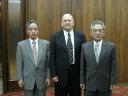
Glyn Ford (Labour MEP for South West England), met in Pyongyang with Moriaki Wakabayashi and Takahiro Konishi two of the four remaining Japanese hijackers in North Korea. Moriaki Wakabayashi and Takahiro Konishi, who hijacked Japan Airlines Yodo Flight 351 from Tokyo to Fukuoka in 1970 declared that they are willing to return to Japan to face trial. 

Following the meeting with the hijackers, Glyn Ford MEP, said: “All four hijackers are now willing to return to Japan.  This offer is only conditional on the dropping of arrest warrants against three of them for possible complicity in the abductions of Japanese citizens to North Korea in the 1980s. Their return would mean that the last remaining obstacle to the US removing its terrorist state designation of North Korea would have been removed consequently allowing progress to be made towards a final settlement of the current nuclear crisis on the Korean Peninsula.”

He continued “This is an opportunity that I hope the Japanese government will take to move closer to normalise relations between Tokyo and Pyongyang. If US Army deserter and defector Robert Jenkins can return to Japan after only serving a token 30 days in jail I see no reason why the Japanese government should refuse to accept an offer that might well lead to the four remaining hijackers, all now in their late 50s and 60s, facing up to 12 years in prison.”

In January Glyn’s book North Korea on the Brink: Struggle for Survival was published by Pluto Press. It will be published in Tokyo in June by Daiichihoki and in Korea by Humanitas.


Share

South Korea continues imports of DPRK coal

Monday, April 14th, 2008

From Yonhap:

A North Korea-registered cargo ship carrying coal arrived in South Korea’s port city of Ulsan Sunday amid increased cross-border tensions, according to maritime police.

The 2,496-ton freighter Changseong carrying a 29-member crew docked at the port, South Gyeongsang province, around 10:20 a.m. earlier in the day.

The ship carried 4,000 tons of coal, the first batch of 12,000 tons to be delivered by April 25, the police said.

And how much are they paying? IFES has the answer…

North Korea, in keeping with rising international coal prices, appears to have hiked up the export price of heating briquettes twice in the last three months. A North Korea insider in Shenyang, China recently reported, “North Korea’s Trade Bureau Price Control Division raised export prices at least twice as this month came around, so the export price soared up to 50 USD per ton,” and, “As the rising international coal price trend continues, there is a high probability that North Korean heating briquette prices will also rise further.”

Last year, North Korean heating briquettes were exported at 30 USD per ton, but as 2008 rolled around and international prices suddenly shot up, DPRK coal prices rose by over 50 percent, putting a significant burden on Chinese importers. However, Chinese importers still prefer DPRK briquettes as shipping costs from alternatives such as Vietnam or Indonesia still make North Korean imports relatively inexpensive.

It has been reported that the DPRK Trade Bureau has approved the export of briquettes to China at below-official prices of 44~45 USD per ton in cases in which there is Chinese capital or equipment has been invested in the coal mine. These charcoal briquettes are North Korea’s largest export item, with China importing 170 million USD-worth in 2007 alone.

So if South Korea was lucky enough to get China’s price (an assumption that might not be the case): 12,000 tons (by April 25) x USD$50/ton= $600,000

Read the full articles here:
N. Korean cargo ship visits Ulsan  
Yonhap
4/13/2008

DPRK coal briquet export prices jump this year
Institute for Far Eastern Studies (IFES)
(NK Brief No. 08-4-10-1)
2008-04-10

Share

Haggard-Noland on North Korea’s economic integration

Tuesday, April 8th, 2008

Stephen Haggard and Marcus Noland published a piece focusing on North Korea’s economic integration.  Download it here: petersoninstitute.pdf

Although not the focus of the piece, here is an excerpt:

A first corollary of the injunction to avoid top-down approaches is that any collective development assistance must be extended in support of economic reform. Experience throughout the developing world demonstrates that assistance will have only marginal effects and may even have negative consequences if not coupled with policy changes. It is not simply that aid sustains the regime; since aid is fungible, even purely humanitarian aid will have that effect. The problem is that too much aid can delay or even undermine the reform process. Whatever the multilateral mechanism that ultimately emerges, it should encourage reform and economic opening in the North.

A second corollary of the injunction against top-down approaches is the importance of engaging the private sector: through trade, foreign direct investment, private capital flows (including remittances), and sheer expertise. Economic rehabilitation will require investment in social overhead capital, which will be led primarily by the public sector. But if North Korea is to evolve toward a self-sustaining market-oriented economy, private-sector involvement will be crucial. Participation of foreign firms means that projects are subject to the market test of profitability, and it encourages North Korean authorities to think of economic engagement in terms of joint gain rather than as political tribute.

(and)

North Korea is in need of depoliticized technical assistance for a whole panoply of issues running from the mundane but critical, such as developing meaningful national statistical capabilities, through basic agricultural and health technologies, to social infrastructure of a modern economy. This infrastructure includes policy mechanisms to manage macroeconomic policy, including through reform of the central bank; specify property rights and resolve commercial disputes; regulate markets, including financial markets as they emerge; establish and implement international trade and investment policies; and so on.

Read the full paper here:
A Security and Peace Mechanism for Northeast Asia: The Economic Dimension
Staphen Haggard and Marcus Noland
Peterson Institute Policy Brief
April 2008

Share

Scrap metal smuggling rampant in North Korea

Friday, April 4th, 2008

Institute for Far Eastern Studies (IFES)
NK Brief No. 08-4-4-1
4/4/2008

As smuggling scrap metal across the DPRK-PRC boarder has become widespread among North Korean residents lately, police are investigating the illegal trade, leading to the arrest of all of the residents in the border region that were involved in the smuggling. On April 1, the Daily NK quoted a source inside North Korea reporting that a group was arrested while transporting six tones of scrap metal to smuggle out to China via the highway connecting Yanggang Province’s Kabsan Town and Hyesan City, and subsequently imprisoned.

Those arrested were from ‘Unit 8’, an office in Hyesan under the direction of the People’s Trading Bureau regional office tasked with delivering and selling gold, food, oil and other goods in China and returning with materials needed in the North.

According to the source, “An order was handed down by the central government at the beginning of March to ‘come down hard on those scrap metal smugglers’, and the police and security force investigation is ongoing.” The source went on to report that in the Kumsandong Fertilizer Factory in Hyesan, “everything metal that wasn’t bolted down is gone, and only the walls of the factory remain…in the future [authorities] will punish scrap metal smugglers severely.”

It appears that scrap metal smuggling began to become popular in 2004, but these days, in the border areas, starving soldiers are using military vehicles to buy scrap metal from regions further from the border, then selling them in the Hyesan-Jangbaek border region. In the Yanggang and North Hamkyung Regions of North Korea, famine first spread in the mid-1990s, at which time emerged the presence of smugglers who quietly amassed copper, aluminum, nickel, and other metals and sold them in China. In response, North Korean authorities attempted to crack down, using public firing squads as a deterrent, but as border guards were in the pockets of smuggling residents of the border region, they became implicated in the cross-border illegal trading, and the crack downs became effectively useless.

Share

North Korea sells rocket launchers to Myanmar

Thursday, April 3rd, 2008

Reuters excerpt: 

North Korea has been selling multiple rocket launchers to military-ruled Myanmar since the two countries restored ties last year in violation of U.N. sanctions, Japan’s NHK public broadcaster reported.

Quoting unspecified diplomatic sources, NHK said in a report late on Wednesday that the launchers were the same type as those deployed near the demilitarized zone separating the Korean peninsula.

The report could not be independently confirmed.

A Security Council resolution passed after North Korea’s 2006 nuclear test blocks trade with the secretive communist country in dangerous weapons, heavy conventional weapons and luxury goods.

Read the whole story here:
North Korea sells rocket launchers to Myanmar: report
Reuters
4/3/2008

Share

DPRK promotes multifaceted trade to boost exports

Thursday, March 27th, 2008

Institute for Far Eastern Studies (IFES)
NK Brief No. 08-3-27-1
3/27/2008

The latest issue of the North Korean publication “Economic Research” (2008, issue no. 1) highlights the need to restructure North Korea’s trade system in order to meet the demands of the capitalist market. The journal quotes Kim Jong Il as saying, “[We] need fresh improvement, in our own manner, of the basic Socialist economy’s trade system of yesterday, meeting the current demands being faced due to the capitalist market.”

Therefore, the journal stresses, “As the socialist market crumbles, and given the demands of the capitalist market as [our] focus shifts to overseas economic relations, what is currently needed for the development of overseas trade is improvement of our own style to the trade system that can ensure large profits.

The journal goes on to recommend that, in order to meet these new demands of the international capitalist market, “the most important thing is improving the import-export system based on the foundation of an self-reliant national economy.” It states that raw materials should not be sold as-is, but rather should be turned into processed goods and then sold, that goods popular on the international market should be manufactured for export, and that niches should be chosen in which North Korean goods can dominate the international market.

However, the journal also says, “If individual offices trade with capitalists outside the scope of government controls, ‘reform’ and ‘opening’ sought by the imperialists would occur, and the nation’s economy could liberalize and capitalize…International trade must take place orderly under the uniform control and guidance of the nation.”

The journal asserts that even though a variety of offices are engaged in trade, they must first receive government permission, follow government guidelines, and operate in a government-created environment. The central government must standardize prices and designs of selected export goods from each trading company.

Share

Stratgeic alliances in North East Asia: Railways, ports, and energy

Tuesday, March 4th, 2008

Writing in today’s Asia Times, Dr. Leonid Petrov analyses the complexity of Russia, Rok, DPRK, and Chinese relations:

Russia and North Korea:

Territorial claims, in one form or another, involve almost all countries adjacent in this region with the exception of Russia and Korea. The Joint Russian Federation-DPRK Commission for the Demarcation of State Borders has recently completed its work by documenting and marking the 17-kilometer frontier. This strip of uninhabited and swampy land in the mouth of the Tumannaya (Tuman-gang) River plays an exceptionally important geopolitical role. It not only provides the two countries with land access to each other, but also prevents Chinese access to the East Sea (Sea of Japan).

China and North Korea: 

Here, some 50km north of the small port that forms the core of North’s Rajin-Seonbong Special Economic Zone, the interests of Russia and China are now at stake. Russia is rapidly repairing the railroad track, and China (in a similarly speedy manner) is constructing a new automobile highway, both leading from their respective borders to the port of Rajin. Russia, investing at least 1.75 billion rubles (US$72 million) into this project, seeks to strongly connect Rajin (and the rest of northern Korea) to its Trans-Siberian Railroad. China, in turn, hopes to divert the growing cargo traffic to its own territory, offering the efficient network of railroads for delivery of South Korean and Japanese goods to Central Asian and European markets. What position will the government of North Korea take in this clash of ambitions?

Russia and South Korea (energy and trade):

In 2007, the volume of the export of “black gold” from Russia to South Korea reached 38.13 million barrels (2.7 times more than in the previous year). The relative proximity of the Russian oil and gas fields is an attractive factor for Korean companies who actively search for alternatives to Middle East oil suppliers. This year South Korea will for the first time start importing natural gas from Russia. The expected volume of delivery during 2008 is 1.5 million tons (or 5.1% of South Korea’s annual demand).

and

Trade relations between Russia and Korea are steadily growing. According to customs statistics, last year Russia recorded the sharpest increase of South Korean imports (56.2% more than in 2006). Due to the inflow of “petro-dollars” the new class of nouveaux riches in Russia began actively buying Korean automobiles, cell phones, television sets and LCD monitors. South Korea exported to Russia goods worth US$8.1 billion (including $3.296 billion of automobiles, $859 million of mobile phone equipment, motor vehicles and spare parts worth $659 million). As for trade with North Korea, in 2006 Russia occupied third place after China and South Korea and absorbed 9% of the total $3.18 billion spent by the North on imports.

More on Russia/South Korea energy talk here. 

The whole article deserves reading here:
Russia lays new tracks in Korean ties
Asia Times
Leonid Petrov
3/5/2008

Share

DPRK 2007 trade statistics from KIEP

Tuesday, March 4th, 2008

The Daily NK covers the release of KIEP’s analysis of North Korea’s external trade in 2007.  I cannot find the report in English, so I have to take the Daily NK’s word for it–insert caveat here.

Here are the highlights:

  • The estimated total value of North Korea’s foreign trade decreased from US$2.996 billion 2006 to US$2.7 billion in 2007.

  • China occupies 70% of the trade volume, up from 56.7 in 2006 (a startling increase).

  • Trade with Japan fell to US$900,000, a decrease of 92% from 2006 (so it appears that some Chinese are getting rich from international trade restrictions).

  • Trade with Thailand fell 42.4% since the nuclear test.

  • Trade with the EU fell by 53.2% since the nuclear test.

To be honest I do not trust these numbers, so if someone comes across the KIEP report in English, please send it to me.

According to the Daily NK, the KIEP report is called: “Economic Prospect of North Korea in 2008” by Cho Myung Chul and Hong Ihk Pyo

The full story can be read here:
North Korea’s Economic Prospect for 2008
Daily NK
Yang Jung A
3/3/2008

Share

DPRK light industrial production grows with ROK material aid

Wednesday, February 13th, 2008

Institute for Far Eastern Studies (IFES)
NK Brief No. 08-2-13-1

2/13/2008

As South Korean materials used in light industry make their way to the North, some DPRK factories appear to returning to normal manufacturing operations. A source in North Korea recently reported, “Raw rubber, talcum (used for soap), perfumes, textiles, and other ROK raw materials made their way to a Sinuiju shoe factory and cosmetics factory, and production has returned to normal.”

South Korea is providing raw materials for light industry worth 80 million USD in return for mined goods from the Danchun and Kumduk areas of North Korea. According to the source, “9 containers of soap powder came to the soap department of the Sinuiju cosmetics factory. The factory is in full operation and most workers are reporting for work…Workers are receiving monthly wages and food rations, and [they] almost never come out to the traditional market.”

The workers at the Sinuiju cosmetics factory are mostly women, and up until now there were no materials or power, so there could be no production and business was off. However, since the middle of last November, as materials began to flow in, this factory was identified as a ‘special’ factory, power was turned back on, and the manufactured goods began to roll out. An inside source also reported that the goods have already begun to turn up on Sinuiju markets. “Sneakers began appearing in Sinuiju’s Chaeya and Chinsun Markets; The quality is good, and the residents have received them well … The response seen is that it is thanks to the South Korean shoe materials that the quality is good. Chinese shoes are not able to compete, and are not selling well.”

The source went on to report that the scent of laundry detergent was nice, and that it was only being used to wash undergarments. “Everyone knows that the light industrial raw materials are from South Korea …Everyone already knows that South Korea has flourished, so they publicly praise ROK goods.”

As production normalizes at the Sinuiju shoe factory, cosmetics factory, and other light industrial factories, factory workers are becoming objects of envy. Among residents, some worry about not being able to enter the factories, because in the factory, monthly wages and rations are received, and some products can be stolen and privately sold.

Goods now found in Sinuiju markets include some given to factory workers based on their piece rates, and some that are snuck out and find their way to vendors. However, in this first stage of production normalization, the North is not yet at a level at which large-scale rationing to the people is possible.

Share

David Kang on North Korean trade potential

Tuesday, February 12th, 2008

Kang: North Korean Trade Potential
Council on Foreign Relations
12/17/2007

Last December, David C. Kang, a professor of government at Dartmouth College and an adjunct professor at Tuck Business School, discussed the North Korean economy for the Council on Foreign Relations. I have excerpted some of his comments below.

His view on the new North-South cargo train service:

It doesn’t have huge economic significance in the overall GDP of North Korea. But it does have major economic significance in the fact that what North Korea had to do in order to let a train go through was an awful lot of adjustment[…]in terms of linking up the railroad, all the ministries had to prepare.  The old [Korean Energy Development Organization] had this problem as well. [W]hen they wanted Americans and South Koreans working in North Korea to build this light-water reactor, [they] had to set up protocols [Post offices, phone calls, where they were going to stay, etc]. It is pretty significant in terms of how much they had to adjust.

He quoted the following figures on North – South trade:

From $200 million in 1998, to now exceeding $1.7 billion in 2007.   South Korea’s total trade volume is $250 billion.

His opinion on the direction of the North Korean economy:

At this point what we’re seeing is very initial steps on the part of North Korea as they try to open up reform and yet maintain control. At the same time, they are being forced into a number of institutional changes and mind-set changes that are the first step forward in this process.

His view of North Korea’s comparative advantage:

Most of the companies that have gone in—the South Korean companies that have gone in—are assembly and light manufactures, such as or textiles and light consumer goods. This is the sort of obvious point of departure. It’s not hugely capital intensive in terms of building factories, and can take advantage of North Korean cheap labor and South Korean technological advantages.

There are a lot of potential mineral resources in North Korea, which would require a whole infrastructure of legal reforms to happen before anyone would take care of them. But at this point the safest bets are the ones that are on the order of assembly and light manufactures in the North and then exporting them out.

His view of South Korea’s long term goals:

If there’s unification, or even better relations, and South Korean companies can use cheap North Korean labor, instead of having to send those factories to China or Vietnam—not only do they speak Korean, they’re culturally similar, and the labor would be cheaper.

[I]f you could reconnect the railroads, from Japan, through Pusan [South Korea], up through North Korea, then out to China and Russia, you would be linking up all these economies in a much more efficient way than they are now. So everybody wants that. But obviously there’s the political problem. And even on the infrastructure side, the North Korean rail system is so old and so decrepit, that basically it would have to be rebuilt from zero. But the potential upsides are massive, in the long run.

His view of China’s engagement:

China has been essentially as deeply involved in economic engagement with North Korea as has South Korea—and by some measures, actually more so. Whereas South Koreans just do this assembling, some Chinese companies are moving in and building full factories in the North. There’s a lot of interest in Chinese-North Korean economic relations on both sides.

Share