Archive for the ‘International trade’ Category

North Korea authorities “Stop Operating Chinese Motorcycles for Commercial Use”

Monday, November 12th, 2007

Daily NK
Kwon Jeong Hyun
11/12/2007

North Korean authorities recently started regulating motorcycle operation in order to control private market.

Motorcycle is most preferred means of transportation especially for North Korean salespersons. And in North Korea, everybody must get a license from the government to operate cars, motorcycles or even bicycles.

North Korean authorities now give license to only Made in DPRK “Bugang Motorcycle,” which is considerably more expensive than those imported from China.

Choi, a 33 years old resident of Sinuiju visiting his relative in Dandong, China, said on last Thursday “getting operator’s license for Made in China motorcycles has become ridiculously difficult.” According to Choi, only domestic motorcycle owners receive license and popular dissatisfaction increased.

It seems that North Korean authorities want to stop growing of private market by making it impossible to operate motorcycle, a vital part of transportation of goods.

Choi added “even before, someone had to bribe police officer to get a license, but now, bribery doesn’t work for Chinese-built motorcycles at all.”

Why people prefer Made in China? “Korean motorcycles manufactured in Pyongyang cost 1,500 US dollars and often break down. However, Chinese ones cost only 600 dollars while perform far better.”

Choi complained that “some people who operated Chinese motorcycle without license got their bikes confiscated.”

The loots were sent to the Army troops on DMZ.

Chinese motorcycle has become prevalent since 2002 when North Korean residents whose relatives lived in China received it as gift and operated for commercial purpose.

According to Choi, “Motorcycle can carry a certain amount of goods to inlands and it is so convenient. Even if motorcycle is expensive, everybody wants to own one. People buy seafood on the coast and bring them to the cities or sell small commodities.”

For alluvial gold, price differs among regions, so transporting it fast with motorcycle is lucrative business.

Lee, defected Pyongyang last year, said “In the past, a few rich people bought used Japanese motorcycles like Honda or Yamaha, but now many people operate Chinese ones for commercial purpose.”

Share

Trade between divided Koreas rises 23 percent in first 10 months

Wednesday, November 7th, 2007

Yonhap
11/7/2007

Bilateral trade between the two Koreas increased by 23 percent in the first 10 months of the year due mainly to an increase in shipments of goods produced at the South Korea-built industrial complex in the communist North, the Unification Ministry said Wednesday.

The two-way trade volume jumped to nearly US$1.44 billion in the January-October period, up from $1.16 billion from a year earlier, according to the ministry.

“The rise mainly comes from a 48 percent increase in the amount of goods shipped from Kaesong,” a ministry official said, adding trade in some other areas, such as minerals and fisheries, increased by nearly 50 percent year-on-year.

Exchanges in non-commercial areas, however, dropped by 18 percent, according to the ministry official.

Seoul hopes cross-border trade will continue to increase over the coming years as the sides are about to launch a second development plan to expand the Kaesong industrial complex, where about two dozen South Korean companies are currently employing some 10,000 North Korean workers.

The joint industrial complex is expected to house over 2,000 South Koreans businesses and employ as many as 500,000 North Koreans when it is fully developed by a target year of 2012.

President Roh Moo-hyun and North Korean leader Kim Jong-il have also agreed to develop the North’s western Haeju area as a special economic district in the second-ever inter-Korean summit held in the North Korean capital of Pyongyang early last month.

Share

North Korean Economy Does Not Have a Basis for Development

Wednesday, November 7th, 2007

Daily NK
Yang Jung A
11/7/2007

Although the North Korean economy has been growing since late 1990s, it is hard to say that the economy has growth on its own.

A senior researcher at the Korea Institute for National Unification, Choi Su Young, released a paper titled “the Latest Tendency of the North Korean Economy” in the October “Finance,” which is issued by Korea Federation of Banks. He pointed out in the paper that “North Korea’s economic reliance on China is getting serious and cited the state’s 1.7 billion dollars in trade with China.”

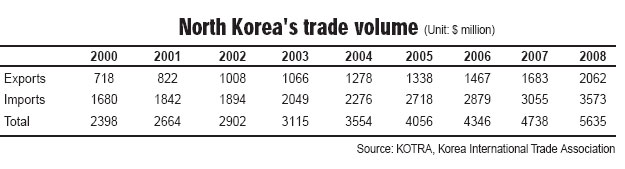
He explained “On one hand, North Korea exports to China in 2006 increased to 72.7% compared with exports in 2002; on the other hand, imports from China increased to 163.8%. This resulted in a recorded deficit of 760 million dollars. The rate of North Korean trade reliance on China was 48.5% in 2004, and it reached 60% last year.”

He relayed that “In the production industry, North Korea has to rely systematically on China’s raw materials, energy, facilities and parts. North Korea is importing its entire amount of petroleum for transportation and production. Chinese influence on the North Korean economy is so absolute that 70-80% of consumer products are made in China.

Mr. Choi insists that “Although foreign aid and South-North economic cooperation were expanding and its reliance on the influx of foreign currency was great, North Korea was staying in low-growth status, which means North Korea does not have the economic foundation for development.

According to the report, the scale of exchange between the South and the North was rapidly increasing through the annual provision of South Korean rice and free fertilizer supporting and South Korean enterprises’ activities at the Kaesung Industrial Complex.

With the exception of South Korea and China, there are no countries willing to invest in North Korea. Most developed countries turn away from North Korea because the standard and environment related to North Korean investment are significantly inferior to the norm.

He explained that “The North Korean investment environment is inconvenient for foreign investors due to obsolete infra-structures, high distribution costs and limited markets. It is unnecessary to mention the international policies related to North Korea.”

Mr. Choi added that “The scale of North Korean foreign trade was 2 billion dollars in 2000 and reached 3 billion dollars in 2006. Exports amounted to 950 million dollars and imports came to a total of 2.05 billion dollars.”

Share

It Costs about $300 for a Visa to China

Monday, November 5th, 2007

Daily NK
Yang Jung A
11/5/2007

Forty-year old Park Sung Jin (pseudonym), a cloth merchant in Chongjin lately went to Tumun in Jilin Province, China under the pretext that he would visit his relatives there. He looked for Chinese business partners and tried to find items he can sell.

It took guts for Mr. Park to venture a trip to China. However, his efforts might turn out to be fruitless.

Mr. Park needed to get a border pass to go to China, and it costs him a great fortune. The pass allowed Mr. Park to visit his pre-determined destination only once. He paid 1 million North Korean won (approx. US$340) for the pass which he applied for in February, 2006 and received in August, 2007. If he wanted to have it within six months, he had to pay about 4,000 Yuan (approx. USD560).

Applicants for the pass also need to bribe the officials of People’s Committee and Security Agency because they are in charge of issuing visas to China. In fact, Mr. Park had to spend extra money on bribery to go to China for business.

Since it was Mr. Park’s first time to apply for the visa, he went through a relatively simple visa procedure. As for those who apply for the visa more than once, more complicated procedure is waiting. They are asked to state what they had done during their first visit to China.

If Mr. Park is issued a passport by any chance, he can go to many places for long periods of time. Unfortunately those over the age of 45 are more likely to get a passport (Mr. Park is forty). Moreover, the eligibility for the issue of a passport is much more complicated and it costs big fortune to get one. For instance, those who apply for the issue of a passport are supposed to pay $40 for application fee. However, the applicants need to spend extra money on bribes and other things, and for the most time end up spending more than $500 to get a passport.

Mr. Park is now busy visiting relatives and business partners. He is determined to make money as much as possible during his stay in China so that he can get his money’s worth upon his return home.

There are more theft incidents in Hoiryeong than ever

Lately, 45-year old An Myong Sook, a resident in Hoiryeong city, never hangs out the wash to dry outside. She tells her 15-year daughter not to forget to lock the doors when she leaves home because there are so many thieves in her neighborhood.

Since last year, the construction of apartments and roads has been underway around her area in order to commemorate the 90th birthday of Kim Jong Suk (the late mother of Kim Jong Il). For the construction, many outside workers came to her area, and some of them have broken into neighboring houses.

After having repaired the road laid behind the statue of Kim Jong Suk, the workers have started building the road between Hoiryeong and Chongjin since June. Many workers came to Hoiryeong from Rajin, Chongjin, Kilju, and Hamheung.

However, ever since the outside workers came to Hoiryeong in June, the number of households which lost their belongings or livestock has increased. The local people of Hoiryeong are increasingly complaining that the increase in rice price and theft has to with the presence of the outside workers.

Accordingly, the North Korean authorities have strengthened the punishment for theft. In the past, stealing was considered as a petty misdemeanor. Nowadays, that guilt of theft is sent to labor training facilities. The authorities confiscate all stolen items sold to the third person.

However, it is difficult to get back basic supplies such as clothes once they are stolen, and therefore every household in Hoiryeong is on the alert for theft.

Share

Freed N. Korean vessel opens new window for U.S.-N. Korea ties

Wednesday, October 31st, 2007

Yonhap
Byun Duk-kun
10/31/2007

A U.S. Navy destroyer helped a North Korean cargo ship escape a hijacking by pirates off the coast of Somalia on Tuesday, an incident which may bode well for the growing detente between the two nations, as sentiments remain upbeat over ongoing talks on the North’s denuclearization.

Officials here noted the incident will work positively in efforts to denuclearize the communist North, as it came just one day before the chief nuclear negotiators of the U.S. and North Korea were to meet for discussions on denuclearization, normalization of ties between the former Cold War foes and other issues.

It was early Tuesday when the USS James E. Williams, operating near Somalia, received a request from the International Maritime Bureau to investigate a North Korea-flagged ship reportedly hijacked by pirates.

The U.S. destroyer reacted with little hesitation, dispatching a helicopter to investigate the reported hijacking and then sailing at full speed to arrive at the site at midday to lend assistance, the U.S. Navy said in a press release.

The 22 crew members of the North Korean freighter eventually regained control of the ship after a firefight with the pirates, while the Williams demanded by radio that the pirates give up their weapons.

Two pirates were reportedly killed in the deadly gunfight, while five others were captured in the tense standoff.

After the hijacking situation was resolved, three injured crew members of the North Korean ship who may have received relatively serious wounds were brought onboard the U.S. destroyer for medical treatment, and were then sent back to their ship in stable condition, a message sent by the U.S. Navy to Yonhap News Agency said. It said the injuries sustained by the three merchant sailors were not life-threatening.

Besides giving first aid, the U.S. warship did not receive any further requests for assistance from the North Korean vessel, the message said.

Washington tried not to brag, saying piracy was a “scourge” in Somalia’s waters and that U.S. vessels were available to intercede when necessary.

“When we get a distress call, we help,” Lydia Robertson, commander of the U.S. Fifth Fleet, was quoted as saying by the AP.

South Korean officials agreed, saying the U.S. would have acted the same way had the incident taken place a year ago. They, however, noted the U.S. would not have acted so swiftly or as willingly had the incident happened before Feb. 13, when Pyongyang agreed to shut down and later disable its key nuclear facilities.

“Piracy is a crime that does not choose its victims by their nationality,” a ministry official said, asking that he remain unidentified.

“The U.S. and NATO forces have long operated missions in the (Somali) area to intercept pirates, so I don’t think the U.S. would have acted any differently had the incident happened a year ago,” said the official, whose job mainly deals with U.S. affairs.

Other officials said the incident demonstrates the changed mood between the former enemies as multilateral talks aimed at denuclearizing the communist North maintain an upbeat mood.

Washington and Pyongyang have held two rounds of working-level talks this year under a six-nation accord signed in February, which binds North Korea to shut down and disable its key nuclear facilities and declare all its nuclear programs.

In return, the communist nation will receive 1 million tons of heavy fuel oil or equivalent assistance, as well as other political benefits such as its removal from the U.S. list of terrorism sponsoring states and the normalization of its diplomatic relations with the U.S. and Japan.

North Korea has already shut down all its key nuclear facilities at Yongbyon and promised earlier this month to disable the Yongbyon complex and submit a full list of its nuclear programs by the end of the year.

Christopher Hill, the top U.S. envoy in six-way talks on ending North Korea’s nuclear ambition, was expected to hold bilateral talks with his North Korean counterpart Kim Kye-gwan in Beijing later Wednesday to discuss various issues including the normalization of ties between their nations, according to officials here.

“The incident will have a positive impact as a result of the efforts by both the U.S. and North Korea to normalize their diplomatic ties,” a ministry official said, asking to remain anonymous.

North Korea has yet to officially acknowledge the U.S. assistance in regaining the freedom of its vessel and treating the ship’s wounded North Korean crew members.

Crew wins deadly pirate battle off Somalia
CNN
10/30/2007

The crew members of a North Korean freighter regained control of their ship from pirates who hijacked the vessel off Somalia, but not without a deadly fight, the U.S. Navy reported Tuesday.

When the battle aboard the Dai Hong Dan was over, two pirates were dead and five were captured, the Navy said.

Three wounded crew members from the cargo ship were being treated aboard the guided-missile destroyer USS James E. Williams.

The captured pirates were being held aboard the North Korean vessel, the Navy said.

The bandits had seized the ship’s bridge, while the crew kept control of the steering gear and engines, the Navy said.

The Koreans moved against the attackers after the Williams — responding to reports of the hijacking — ordered the pirates to give up their weapons, according to the Navy.

When the crew members stormed the bridge, the deadly battle began. After the crew regained control, Navy sailors boarded the Dai Hong Dan to help with the injured.

North Korea and the United States have no diplomatic relations.

The incident took place about 70 miles northeast of the Somali capital, Mogadishu, the Navy said.

It is the second incident of piracy reported in recent days. A second U.S. Navy destroyer was searching waters off Somalia for pirates who hijacked a Japanese-owned ship, military officials said.

Over the weekend, gunmen aboard two skiffs hijacked the Panamanian-flagged Golden Nori off the Socotra archipelago near the Horn of Africa, said Andrew Mwangura, a spokesman for the Kenyan-based Seafarers’ Assistance Program.

The guided-missile destroyer USS Arleigh Burke has been pursuing the pirates after entering Somali waters with the permission of the troubled transitional government in Mogadishu, U.S. officials said Monday. In recent years, warships have stayed outside the 12-mile limit when chasing pirates.

Two military officials familiar with the details confirmed the ongoing operation.

The Navy’s pursuit of the pirates began Sunday night when the Golden Nori radioed for help. The Burke’s sister ship, the USS Porter, opened fire and sank the pirate skiffs tied to the Golden Nori’s stern before the Burke took over shadowing the hijacked vessel.

When the shots were fired, it was not known the ship was filled with highly flammable benzene. U.S. military officials indicate there is a great deal of concern about the cargo because it is so sensitive.

Benzene, which U.S. authorities have declared a known human carcinogen, is used as a solvent and to make plastics and synthetic fabrics.

Four other ships in the region remain in pirate hands, the Navy said.

U.S. and NATO warships have been patrolling off the Horn of Africa for years in an effort to crack down on piracy off Somalia, where a U.N.-backed transitional government is struggling to restore order after 15 years of near-anarchy.

On Monday, the head of the transitional government resigned as his administration — backed by Ethiopian troops — battled insurgents from the Islamic movement that seized control of Mogadishu in 2006.

Hospital officials reported 30 dead in three days of clashes on the city’s south side.

In June, the ship USS Carter Hall fired warning shots in an attempt to stop a hijacked Danish cargo ship off Somalia, but the American vessel turned away when the pirated ship entered Somali waters.

In May, a U.S. Navy advisory warned merchant ships to stay at least 200 miles off the Somali coast. But the U.S. Maritime Administration said pirates sometimes issue false distress calls to lure ships closer to shore.

The pirates often are armed with automatic rifles and shoulder-fired rockets, according to a recent warning from the agency.

“To date, vessels that increase speed and take evasive maneuvers avoid boarding, while those that slow down are boarded, taken to the Somali coastline and released after successful ransom payment, often after protracted negotiations of as much as 11 weeks,” the warning advised.

The agency issued a new warning to sailors in the Gulf of Aden, between Somalia and Yemen, after Sunday’s hijacking.

Share

Inter-Korean trade climbs 12.7 pct to US$1.23 bln in January-September period

Wednesday, October 31st, 2007

Yonhap
10/31/2007

South Korean trade with North Korea rose 12.7 percent from a year earlier to US$1.23 billion for the first nine months of this year, a report said Wednesday, amid progress in talks on the North’s nuclear programs.

During the January-September period, South Korea exported $700 million worth of goods to North Korea and imported $530 million, the Korea International Trade Association said in the report.

Share

Odd couple: The royal and the Red

Wednesday, October 31st, 2007

Asia Times
Bertil Lintner
10/31/2007

North Korean Premier Kim Yong-il is scheduled to pay a four-day visit to Cambodia in early November, underscoring the curious close relationship between one of the world’s last communist dictatorships and one of Asia’s most ancient monarchies.

Kim Yong-il, who should not be confused with the North Korean supremo, “Dear Leader” Kim Jong-il or any of his relatives, will hold talks with Cambodia’s retired king Norodom Sihanouk, the Cambodian Foreign Ministry said in a statement posted on its website.

The North Korean premier will also hold “official talks” with his Cambodian counterpart Hun Sen, and “pay courtesy calls” on Senate president Chea Sim, and the president of the National Assembly, Heng Samrin, according to the statement.

Cambodia has long served as a link between North Korea and Southeast Asia and beyond, so it is plausible to assume that trade and related issues will be on the agenda. For years the two countries ran a joint shipping company, and before the China-led six party talks, Cambodia had offered to mediate over Pyongyang’s contentious nuclear program.

Kim Yong-il’s visit to Cambodia is not the first by a North Korean dignitary in recent years. Kim Yong-nam, president of North Korea’s rubber-stamp parliament, the Supreme People’s Assembly, also visited the country in 2001 at the invitation of Sihanouk, who had then not yet abdicated in favor of his son, Norodom Sihamoni, the current serving monarch.

Kim Yong-nam now functions as de facto head of state, as Kim Jong-il’s father, “Great Leader” Kim Il-sung was elevated to the position of “eternal president” before his death in 1994, making North Korea not a monarchy, but rather the world’s only necrocracy.

As incongruous as it may seem, Cambodia is North Korea’s oldest ally in Southeast Asia. It all began when Sihanouk met Kim Il-sung in 1961 at a Non-Aligned Movement meeting in Belgrade and a personal friendship developed between the two leaders. When Sihanouk was ousted in a coup in 1970, Kim Il-sung not only offered him sanctuary in North Korea but also had a new home built for him about an hour’s drive north of Pyongyang.

A battalion of North Korean troops worked full-time on it for almost a year, and when it was finished, only specially selected guards were allowed anywhere near the 60-room palatial residence. Overlooking the scenic Chhang Sou On Lake and surrounded by mountains, the Korean-style building even had its own indoor movie theater. Like the Great Leader’s son, Kim Jong-il, Sihanouk loves movies.

Sihanouk has both directed and acted in his own romantic feature movies and a few more were made in North Korea, with Cambodian actors strutting their stuff against the backdrop of Korea’s snow-capped mountains.

French wines and gourmet food were flown in via China, and Sihanouk and his entourage were treated as royals would have been in any country that respects monarchy – as North Korea evidently does.

By contrast, North Korea has maintained less cordial relations with neighboring communist Vietnam, which still exerts behind-the-scenes pressure on Cambodia. Kim Yong-il will nonetheless also visit Hanoi during his diplomatic tour of Southeast Asia.

Throughout the Vietnamese occupation of Cambodia, North Korea refused to recognize the regime that Hanoi installed in Phnom Penh in January 1979 – and that despite immense pressure at the time put on Pyongyang from Moscow. During a meeting between Kim Il-sung and Sihanouk seven years later on April 10, 1986, in Pyongyang, the Great Leader reassured the then prince that North Korea would continue to regard him as Cambodia’s legitimate head of state.

When Sihanouk returned to Phnom Penh in September 1993, after United Nations-led mediation to end Cambodia’s civil conflict, he arrived with 35 North Korean bodyguards, commanded by a general from Kim Il-sung’s presidential guards. They are still there, now guarding Sihanouk as well as the new king, Sihanomi, who is not as close to North Korea as his father, but has paid at least one visit to Pyongyang.

Sailing buddies
Sihanouk and the Cambodian royals showed their gratitude to the North Koreans when in the late 1990s they set up a privately-owned shipping registry, the Cambodia Shipping Corporation (CSC). The flag of convenience was used by the North Koreans, and it enjoyed royal protection as it was headed by Khek Vandy, the husband of Sihanouk’s eldest daughter, Boupha Devi.

CSC was also partly owned by a Phnom Penh-based North Korean diplomat and for a few years aggressively marketed itself as a cheap and efficient “flag of convenience” service for international shippers. A series of embarrassing maritime incidents, including the interception in June 2002 of a Cambodian-registered – though not North Korean owned – ship by the French navy, in a joint operation with US, Greek and Spanish authorities, of a massive haul of cocaine off the West African coast prompted Hun Sen’s government to cancel CSC’s concession and reportedly give it to a South Korean company, the Cosmos Group.

At the time, International Transport Federation general secretary David Cockroft told the Cambodia-based fortnightly newspaper the Phnom Penh Post that “they’ll need to be able to walk on water, because nothing short of a miracle will clean up the name of Cambodian shipping”. Indeed, little appeared to change, including North Korea’s use of Cambodia’s flag of convenience for controversial shipments.

In December 2002, a Cambodian-registered, North Korean-owned ship named So San was intercepted by Spanish marines, working on a US tip, in the Arabian Sea. It was found to be carrying 15 Scud-type missiles, 15 conventional warheads, 23 tanks of nitric acid rocket propellant and 85 drums of unidentified chemicals under a cargo of cement bags.

The destination of the weaponry was said to be Yemen, and following protests from both Yemen and North Korea – and intervention by the US, which apparently did not want to antagonize Yemen, a supposed ally in Washington’s “war on terror” – the ship was allowed to continue to Yemen. Later revelations indicated that the cargo was ultimately delivered to Libya, which caused considerable embarrassment in Washington.

Premier Kim Yong-il is likely to be quite familiar with the CSC, as he served as minister for land and marine transport from 1994 until the Supreme People’s Assembly appointed him to the premiership in April this year. But since the scandal-ridden CSC was reorganized five years ago, Cambodia’s economic importance to Pyongyang would appear to have waned, and North Korea’s only known activity in the country today is in the restaurant business, including eateries in Phnom Penh and Siem Reap.

Yet as a diplomatic link to the wider region, Cambodia is still important to North Korea. In April 2003, the Cambodian government, at the urging of Sihanouk, had plans to send an envoy to Pyongyang in a bid to persuade the North Korean leadership to be more flexible about talks on its nuclear program, which at that time had stalled.

The mission never materialized, but North Korea no doubt remembers that its trusted ally Cambodia tried first to mediate – and that Phnom Penh in future could still serve as a gateway for improved contacts with the outside world. It remains to be seen what message Kim Yong-il will bring to Phnom Penh, but it is reasonable to assume that his visit will, despite the official announcements, be confined merely to “courtesy calls” and royal audiences.

Bertil Lintner is a former correspondent with the Far Eastern Economic Review and the author of Great Leader, Dear Leader: Demystifying North Korea under the Kim Clan. He is currently a writer with Asia-Pacific Media Services.

Share

Economic Implications of Summit Agreement

Tuesday, October 30th, 2007

Nautilus Institute
Stephan Haggard and Marcus Noland
10/30/2007

The success of economic cooperation projects depends on the intentions of North Koreans.

The Arabs have a proverb: “He who foretells the future lies.” The recent summit announcement may make many people liars, not the least its authors. The problem with the summit announcement is that its ultimate impact depends on three major unknowns: the attitude and commitment of the next South Korean president; the willingness of the North Koreans to embrace reforms; and progress-or lack thereof-on resolving the North Korean nuclear issue.

The summit and the nuclear controversy are inextricably linked, even if Roh Moo-hyun and Kim Jong-il may have wished to downplay it, and the summit announcement must be evaluated in the context of the nuclear matter. The nuclear issue provides a great opportunity for North-South reconciliation but also sets limits on how fast progress on other fronts can be made.

On the one hand, aid from Seoul may act as inducement for Kim Jong-il to resolve the nuclear issue; this has long been the claim of proengagement politicians. On the other hand, Seoul will receive little support for its diplomacy from the United States, Japan, and other countries if it moves forward aggressively on economic cooperation before the North Korean regime shows a genuine willingness to abandon its nuclear weapons program.

Indeed, the risk is that aid from the South could reduce economic incentives on the North to cooperate and undercut the negotiations. Pyongyang’s celebration of the first anniversary of its nuclear test underscores that achieving this goal could prove an arduous march of its own.

Yet there are signs of hope. The summit document did make a reference, however brief, to resolving the nuclear question and in the context of the six-party talks the North Koreans have-almost simultaneously-agreed to a timetable for the dismantlement of existing nuclear facilities. The summit agreement also contains some important confidence building measures, including most notably a commitment to address conflicts over the disputed boundary in the West Sea that has led to military engagements in the past.

However, all parties have to date studiously avoided mention of what will be done with North Korea’s stocks of nuclear weapons and fissile material. And talk of a final peace settlement to replace the armistice puts the cart before the horse; in the absence of a resolution to the nuclear question it would make little sense to negotiate a broader peace agreement.

If these issues can be resolved the next hurdle is North Korea’s willingness to embrace economic reform. The summit document lays out a number of economic cooperation projects that could be beneficial to both North and South Korea: reestablishment of trans-Korean transportation links; expansion of the Gaeseong Industrial Complex and its replication in other locations; and cooperation in specific industries such as shipbuilding where complementarities would seem to exist between North and South Korean capabilities. All of these are positives.

Yet the projects, while desirable, will have a limited impact as long as North Korea avoids the challenge of broader opening and reform. North-South discussions appear to have avoided the basic building blocks of a market economy-operation of markets, enterprise management, agricultural reform-which would allow the North Koreans to make the most of the aid that they will receive. The long history of aid to other developing countries suggests that aid can be futile, even counterproductive, in the absence of complementary reforms.

Moreover, South Korea’s engagement-in contrast to China’s-remains bottled up in physically and economically delimited projects such as Gaeseong and the Mount Geumgang tourism venture. This situation is regrettable because it is only by broadening contacts with profit-oriented South Korean firms that their North Korean counterparts will learn about the operation of a market economy. Pyongyang continues to resist broader opening, presumably due to concerns that more contact with South Korea could be politically destabilizing.

South Korean analysts are already calculating the costs and benefits of the program outlined in the summit announcement, with one press account describing the costs as “astronomical.” Even the high-end estimates, on the order of $11 billion and more, are a mere drop in the bucket compared to the ultimate costs of rehabilitating the North Korean economy and providing a stable basis for eventual unification. If nothing else, such analyses should stimulate a serious discussion in South Korea of the long-term costs and benefits of different contingencies on the peninsula including the possibility of regime collapse, a discussion that, regrettably, has largely been avoided.

The resolution of outstanding security issues on the peninsula is an important precondition for broader reforms to really work. It is unlikely that foreign investors from the United States, Japan, or Western Europe are going to take a serious interest in the country in the absence of a resolution of the nuclear question. The summit announcement is unlikely to have much of an impact on the passage of the Korea-US free trade agreement (KORUS FTA) in the US Congress. But if North and South Korea push forward with the phase II expansion of the Gaeseong complex in the absence of resolution of the nuclear issue, it would make passage of the KORUS FTA agreement in the US Congress more difficult.

Ultimately, these issues will be laid at the doorstep of the next South Korean president. One contender, Lee Myung-bak, has already expressed reservations about the open-ended nature of South Korean commitments. But whoever enters the Blue House in February 2008, the president-elect will have to make their own decisions on how to approach the North and may not be bound by a document negotiated by an unpopular lame duck president. The 2007 summit announcement may end up like the 1991 North-South Denuclearization Accord, amounting to little more than a statement of good intentions rather than a map for subsequent policy.

The two agreements differ in one significant respect, however. The big budget projects of the summit announcement may create constituencies in South Korea in favor of expanded engagement for purely self-interested reasons. The next South Korean president may confront South Korean corporations lobbying for expansion of contact for the contracts or subsidies they bring regardless of the broader political or diplomatic ramifications.

Ultimately the success of the program sketched out in the summit announcement will depend on the intentions of the North Koreans. Pyongyang could use the assistance offered by the Seoul to leverage its own reform program. However, it could take the aid and simply retreat into its shell, avoiding real reform and a verifiable resolution to the nuclear issue. Only time will tell.

Share

Cut the Telephone Cables

Monday, October 29th, 2007

Daily NK
Kwon Jeong Hyun
10/29/2007

It has become known that the North Korean authorities’ search for a household that paid 5,000 won for telephone usages per month has come to a close. Upon finding the residence, the authorities cut the telephone lines to prohibit the outflow of inside information.

Kim Choen Mo (pseudonym), a North Korean trader traveling through Dandong, China on business, said on the 28th that “The Social Security Agency, the Postal Service Office and the People’s Unit are cooperatively managing this case.”

Mr. Kim quoted an affiliate of the Postal Service Office saying, “If someone pays a large amount in phone bills, it means that they are making a living in trade. Therefore, the order was made to block the leakage of inside information and to block trade as well.”

In 1997, North Korea started introducing a telephone system using fiber-optic cables in big cities such as Pyongyang, Shinuiju, Chongjin, Hamheung, Sariwon and Pyongsung. Under the orders of Kim Jong Il to modernize the telecommunication system, the cables from China were set up in Pyongyang and other big counties and provinces. People were permitted for the first time to install telephones in their houses, and residents in big cities became increasingly reliant on phone usage.

After 10 years, however, the order was handed down to cut the cables off houses where phone usage exceeded 5,000won a month.

In 2002 North Korean authorities introduced a mobile communication system, but since the Yongchoen explosion incident in 2004, mobile phone usage has been banned.

Share

Kim Jong-il Interested in Vietnam-Style Reform Policy

Sunday, October 28th, 2007

Korea Times
Jung Sung-ki
10/28/2007

North Korean leader Kim Jong-il has expressed intention to model after the Vietnam-style economic reform and openness policy, dubbed “Doi Moi,” a report said Sunday.

Vietnam adopted the reform policy in 1986 to establish a market economy such as liberalization of trade and finance with foreign countries, decentralization of state economic management and reliance on the private sector as an engine of economic growth.

Kim made the remarks during a meeting with Nong Duc Manh, secretary-general of Vietnam’s Communist Party, in Pyongyang last week, Yonhap News reported, citing the Sunday edition of the weekly Yazhou Zhoukan, a Hong Kong-based international Chinese business daily. The newspaper carried an interview with Vietnamese Foreign Minister Pham Gia Khiem who accompanied the secretary general on his Pyongyang visit.

“Chairman Kim highly evaluated the achievements Vietnam’s Doi Moi has made in the past 20 years while meeting with Secretary General Manh,” Khiem was quoted as saying, adding the North Korean leader accepted Manh’s proposal for Kim’s visit to Hanoi.

The ongoing visit to Hanoi by North Korean Prime Minister Kim Yong-il aims to prepare for Kim’s visit to Vietnam, the report said.

The North Korean premier, who arrived in Hanoi Friday, visited several industrial and tourist sites in Vietnam, including Halong Bay, one of the biggest tourist attractions for foreigners, reports said.

Diplomatic sources in Hong Kong, however, were quoted as saying it is remarkable that Kim Jong-il expressed an interest in Doi Moi, but it is not likely for the communist North to closely follow the reform program.

The reason why the North is eyeing Vietnam’s economic program could have something to do with China’s lukewarm attitude to Pyongyang’s efforts to build special economic zones near the North’s border with China, they said.

Hanoi’s reform has often been referred to as a model for North Korea’s underdeveloped economy to emulate.

Chief U.S. nuclear envoy Christopher Hill said during a visit there in May that North Korea should “move on in the way that Vietnam has done so well.”

North Korea, Vietnam agree to boost bilateral ties
Yonhap

10/27/2007

North Korea and Vietnam said Saturday they have agreed to forge closer cooperation in the sectors of agriculture, culture and tourism, in their first high-level meeting in five years.

The agreement was reached after a meeting of visiting North Korean Premier Kim Yong-il and Vietnamese Prime Minister Nguyen Tan Dung.

Kim, who is in charge of economic policy, arrived in Hanoi on Friday for a five-day stay, as part of the first leg of a tour to Southeast Asian nations that include Malaysia, Cambodia and Laos.

Vietnam has shifted to a market economy since the mid-1980s and Hanoi’s reform is seen by many as a model for North Korea’s underdeveloped economy to emulate.

Share

An affiliate of 38 North