Archive for the ‘International trade’ Category

DPRK spends millions of US$ on fireworks show

Monday, April 19th, 2010

According to the Choson Ilbo:

North Korea spent more than US$5.4 million on fireworks displays along the banks of the Taedong River in Pyongyang on Wednesday to celebrate former leader Kim Il-sung’s 98th birthday the following day.

A North Korean source on Friday said the North had imported about 60 tons of fireworks from China for the display and invited foreign engineers for technical assistance. “They must have spent more than W6 billion for the fireworks and their display, transportation, and labor,” the source said.

The regime temporarily cut power and banned driving in an area near the Juche Tower for the fireworks spectacular to maximize the effect. The North’s state-run Korean Central Television broadcast the fireworks for an hour from 9 p.m. on Thursday, and reran it the following morning.

At the fireworks ceremony, Kim Ki-nam, a close aide to Kim senior and a secretary of the North Korean Workers’ Party’s Central Committee, said, “We put on the fireworks display full of hope today because we have held matchless great men in high esteem generation after generation.” Some interpret this as a hint at the succession from leader Kim Jong-il to his son Kim Jong-un.

You can watch the fireworks show on YouTube: Part 1, Part 2 (the new 10-minute CNC song kicks in at 5:10), Part 3.

Aside: I managed to get a great mp3 of the CNC song.  I am working on a CNC post and you will hopefully be able to donwload  it there.

Share

DPRK to make appearance at Shanghai Expo

Monday, April 19th, 2010

UPDATE 4: Here is the DPRK Pavilion’s web page (h/t NKNews.org).

UPDATE 3: A video of the DPRK pavilion at the Shanghai expo can be seen here.

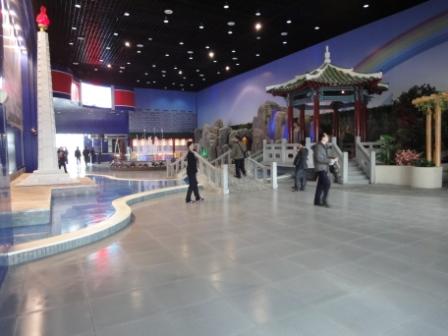
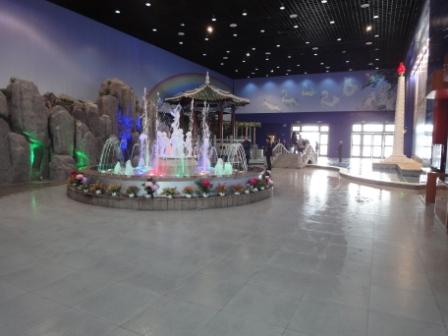
UPDATE 2: Voice of America offers a description of the interior of theD PRK’s Pavilion:

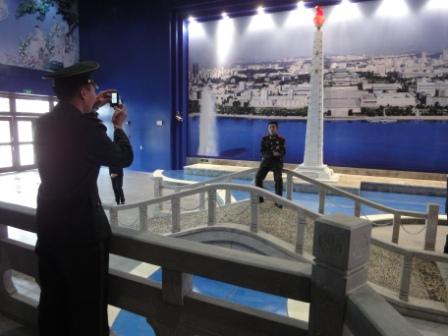
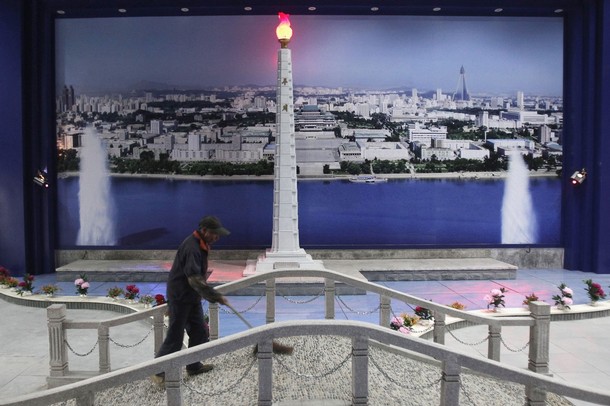
Inside, there is a replica of Pyongyang’s Juche Statue, a small waterway that represents the North’s Taedong River, a traditional bridge and large fountain with colored lights.

On top of the fountain, a group of white marble statues of naked boys encircle two others. One boy holds the other up in the air as he lifts a dove into the sky.

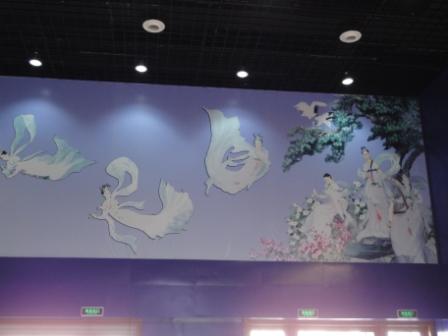
In one corner, there is a small cave that contains a reproduction of a mural from the North’s Koguryo Tombs, a World Heritage site.

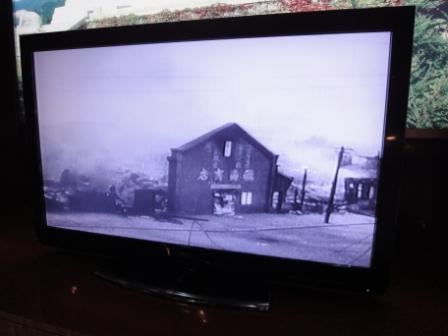
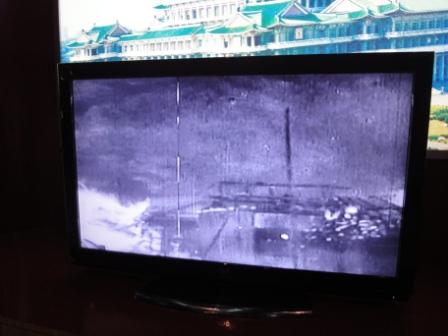
Along a wall, beneath the phrase “Paradise for the People,” a row of television sets plays videos depicting everyday life in North Korea.

Some of the videos show North Koreans leisurely bowling, playing golf and ice skating. Although some of the footage appears to be recent, other shots seem to be decades old.

Many who visited the pavilion Tuesday say that aside from the fact that there were no lines to get in, they wanted to visit because, as they put it, North Korea is so mysterious.

UPDATE 1:  The Shanghai Expo has posted some information on the DPRK’s Pavilion. Here are some of the details:

Theme: Urban Development of Pyongyang, the Capital of DPR Korea (Prosperous Pyongyang based on the River Taedong Culture)

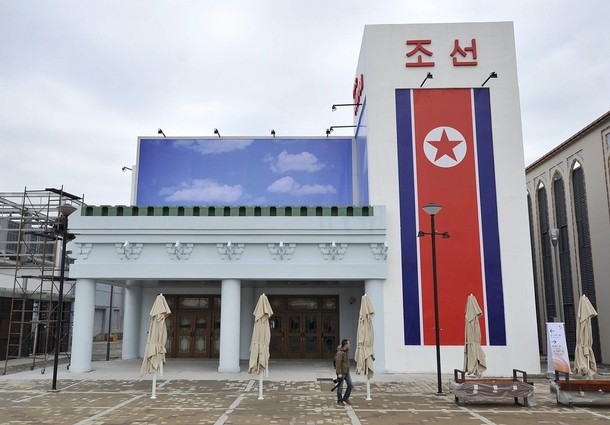
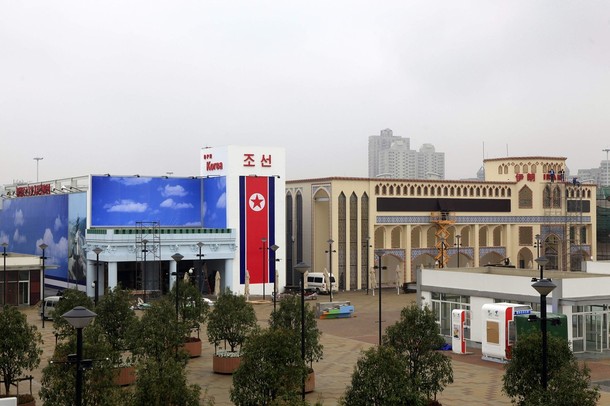
Pavilion Features: The pavilion perfectly merges national characteristics of DPRK together with its modern beauty. Outer walls are decorated with national flags and a winged steed bronze statue. Main items exhibited in the pavilion include Juche Tower, Taedong River, Korean-style pavilions, rockeries and small stone caves. All of them present a prosperous and modern Pyongyang based on the traditions of DPRK, where education, science, culture and sports have achieved great development during its long history.

Pavilion Highlights
Highlight 1: The Juche Tower Model — 4.5-meter-high model of Juche Tower is exhibited in the pavilion.
Highlight 2: Symbol of Taedong River — winding river flows across the pavilion, reminding people of the stretching Taedong River.
Highlight 3: National Section and Stone Caves — national section and stone caves are exhibited on the right side of the pavilion. Inside the cave the world heritage of tomb murals in Jiangxi County and paintings of DPRK style are displayed.

Here are some photos of the DPRK’s pavilion (h/t Daylife):

expo1.jpg expo2.jpg expo3.jpg

And here are some photos from the Shanghai Scrap blog:

shanghai-expo-4.jpg shangahi-expo-5.jpg shanghai-expo-6.jpg shanghai-expo-7.jpg shanghai-expo-8.jpg shanghai-expo-9.jpg shanghai-expo-10.jpg shanghai-expo-11.jpg shanghai-expo-12.jpg shanghai-expo-13.jpg shanghai-expo-14.jpg shanghai-expo-15.jpg

ORIGINAL POST: According to the PRC’s People’s Daily:

China welcomes countries including the Democratic People’s Republic of Korea (DPRK) to participate in the 2010 Shanghai World Expo, a Foreign Ministry spokesman said Tuesday.

DPRK Chamber of Commerce Vice-Chairman Ri Song Un told Xinhua on March 18 that the country had already finished preparatory work for the 2010 Shanghai World Expo, its first Expo appearance.

Situated in an area of 5.28 square kilometers at the core the city of Shanghai to exhibitions, events and forums, the six-month expo starting from May 1 will attract about 200 nations and regions and international organizations’ participation, as well as 70 million visitors from home and abroad.

Read the full story here:
China welcomes DPRK in attending Shanghai World Expo: FM spokesman
People’s Daily
3/30/2010

Share

The DPRK’s illicit international activities

Sunday, April 18th, 2010

The Strategic Studies Institute has published a paper on the DPRK’s illicit activities.  You can download the paper here (PDF). It has been added to my DPRK Economic Statistics page.  Here is the forward:

The authors of this monograph have exposed a key piece of the puzzle which helps to provide a better understanding of North Korea’s surreptitious international behavior. For years, North Korea’s military provocations have been obvious to the world, however, much of its decisionmaking is shrouded in secrecy, particularly that of a wide-range of clandestine activities. This monograph is unique in the way that it sheds light on the illicit activities of the regime, and how those illegal activities are used to support its military programs and the government itself.

From drug trafficking to counterfeiting, from money laundering to cigarette smuggling, North Korea’s Central Committee Bureau 39 is an active participant in the criminal economy of the region with tentacles extending well beyond Asia. The authors discuss how these activities have negative strategic consequences for a number of stakeholders and nations throughout the region while describing how such activities provide critical funding streams for military programs and regime supporters.

As a result, North Korea is not just a “rogue state,” but practices what is essentially criminal sovereignty whereby it organizes its illegitimate activities behind the shield of non-intervention while using the tools of the state to perpetrate these schemes abroad. The authors argue that this arrangement has important links to succession issues within the regime. They also argue that policy makers who are concerned with the development of future policies and strategies aimed toward North Korea must view those new policies from a different perspective than that used in the past.

This paper draws heavily on information from Kim Kwang-jin who is working at the Committee for Human Rights in North Korea. Without Mr. Kim’s contributions, much of this activity would remain unknown to us.  You can make a donation to support Mr. Kim’s work here in the US at this web page.

Share

An update on the DPRK’s economic relations

Sunday, April 18th, 2010

Francoise Nicolas has written a data-driven survey on the DPRK’s changing trade and investment relationships.  The paper can be downloaded here (PDF).  This paper has also been added to my DPRK Economic Statistics page.  Here is the paper’s conclusion:

This brief analysis of the current external economic relations of the DPRK leads to a number of conclusions.  First, the North Korean economy maintains very limited exposure to the outside world and, as a result, to external influence.  In terms of volume North Korea’s trade is miniscule, even in relation with the size of its economy.  This is also the case for foreign direct investment inflows.

Secondly, although North Korea is less isolated than often thought, its trade and investment flows are very heavily polarized both geographically and sectorally, limiting de facto their potential impact.  In contrast to what was the case during the Soviet era, North Korea’s main economic partners are not ideological partners but neighboring economies, namely China and South Korea.  They are major partners in trade as well as in FDI.  Russia still plays a non negligible role but is in no way comparable to what was the case before the demise of the Soviet bloc.

Thirdly, North Korea’s external economic relations are very much dictated by political considerations.  Politics accounts both for the choice of partners and for the nature of the economic relations.

Fourthly, and more importantly, the very distinct nature of the DPRK’s connection with the rest of the world, and primarily with its two major economic partners, sets it apart from other transition economies and in particular from China, but also from Vietnam.  In the case of North Korea, economic openness, although announced time and again as an official objective, cannot be seen as an instrument for enhancing competitiveness or as part of a development strategy.  The recent, renewed signs of reform in the direction of increased openness should thus be interpreted with utmost caution.

Fifthly, the structure of the country’s external trade is indicative of an economy in survival mode.  The substantial aid component in the inter-Korean trade and FDI relationship undoubtedly further substantiates such a claim.  Surprisingly, relations between North Korea and China are more often based on a market-economy logic, although this only holds true for trade flows and not FDI flows.  The Probability of change through trade appears still very limited.

Lastly, the role the European Union may play in the region remains very much an open question but the margin of maneuver is limited.  Given the state of play described earlier, it would be extremely naive to believe that a European engagement strategy vis-à-vis the DPRK could contribute to economic change.  In addition the country’s lack of attractiveness for potential investors is a further obstacle.  However, the persistent uncertainty and the lack of visibility over the political and economic evolution of the DPRK should not deter European investment in the region and, far to the contrary, should provide a strong incentive to closely monitor the economic moves made in Pyongyang.

Share

DPRK acquires new Tupolev

Tuesday, April 13th, 2010

Hat tip to a reader:

The Russian website Аргументы и факты reported that at a ceremony in the Russian city of Ulyanovsk on March 4th the Russian company Aviastar-CP handed over a new Tu-204-100B airplane to a delegation from Air Koryo.  Also present was a team representing the “Ilyushin Finance Leasing Company” through which the plane was handed over to the Korean airline. The report relates that, “Late at night, the aircraft took off for the flight to Pyongyang from Ulyanovsk’s Vostochnyy Airport.”  It also states that this is the second “new-generation” Russian aircraft delivered to the DPRK by Aviastar.  It is expected to operate on routes between the DPRK and Russia and Southeast Asia as well as within the DPRK.

Here is the story in Russian.

Here is the story in English via Google Translate.

Here is a photo of the first Air Koryo Tupolev that went into service on May 1, 2008.

Share

Scott Snyder on Rason

Monday, April 5th, 2010

Scott Snyder wrote a good piece on recent developents in Rason fo rthe Jamestown Foundation’s China Brief:

The Rajin-Sonbong region in North Korea (also known as Rason following a 2004 administrative reorganization by central authorities) is an underdeveloped backwater near the far northeastern tip of the Korean peninsula bordering Jilin province of China and Primorsky Krai of Russia. Although the area is far from the nerve center of the North Korean regime, Pyongyang, Rajin-Sonbong has strategic significance as the northern-most year-round ice free port in Northeast Asia and therefore is an attractive geostrategic transit point for the shipment of goods to landlocked Northeastern China and the Russian Far East. For this reason, recent reports of new Russian and Chinese investment deals following a rare personal visit by North Korea’s supreme leader, Kim Jong Il, to Rajin-Sonbong in December of last year merit closer scrutiny.

Rajin-Sonbong has been the focal point of periodic efforts by Pyongyang to experiment with economic reforms since it named the area a free economic trade zone in late 1991. At that time, the Rajin port was an essential piece of a UN-sponsored regional development effort known as the Tumen River Area Development Project (TRADP)—which encompasses areas within China, Mongolia, Russia and South Korea—but the project never attracted sufficient international investment to take off. The spotlight returned to Rajin-Sonbong briefly in 1996 when North Korea sponsored an investor forum there in an attempt to stir up interest in a revamped set of investment laws for the region, but few investors came and North Korea’s famine later that year diverted attention away from the effort. 

(more…)

Share

NOKO Jeans update

Sunday, April 4th, 2010

The guys at NOKO Jeans did an interview discussing the process of launching a business venture in the DPRK.  Read the interview here.

The group also posted some very nice pictures of their train ride to Pyongayng here.  The whole set is worth checking out, but here is one that I liked:

py-noko-jeans.jpg

And who says entrepreneurship is dead in Europe?  One of the guys on the team put his images into a photo album which he is selling on line here.

Share

RoK goods popular with DPRK women

Sunday, April 4th, 2010

According to the Choson Ilbo:

South Korean goods remain popular among well-to-do North Koreans, especially women, Open Radio for North Korea station reported on March 25.

The defector-run radio station said one North Korean official bought South Korean goods including a robot vacuum cleaner, air conditioner, heater, underwear, and cosmetic goods worth US$3,000 in December last year. He was quoted as saying his wife asked him to buy them and was very happy with them, so her circle of friends asked him to buy the same things for them.

South Korean goods are apparently no longer confiscated in customs. The official said customs officers do not mind as long as the goods are for personal use and not for sale. Control by Chinese customs is stricter than in North Korea.

It said South Korean robot vacuum cleaners are thought to be cheaper than Japanese ones, and the batteries last longer. South Korean underwear and cosmetic goods suit North Koreans better than those imported from other countries.

Read the full story here:
Rich N.Korean Women Lead Craze for S.Korean Goods
Choson Ilbo
4/3/2010

Share

Why the Sunshine Policy Made Sense

Thursday, April 1st, 2010

Nautilus Institute Policy Forum Online 10-020A: April 1st, 2010
James E. Hoare
4/1/2010

I. Introduction

James E. Hoare was Britain’s Chargé d’Affaires to the DPRK from 2001-2002 and opened the British Embassy in Pyongyang. In this article on the Sunshine policy he writes, “Slowly, the policy was creating a group of people who could see benefits in remaining on good terms with South Korea and who had wider links with the outside world. Engagement has worked in other countries, most noticeably China, and I believe that it was beginning to work in North Korea. There was never going to be a speedy change in attitudes built up over sixty years, but stopping the process after ten was not a wise decision.”

This article was published by 38 North a web site devoted to analysis of North Korea from the U.S.-Korea Institute at SAIS. 38 North will harness the experience of long-time observers of North Korea and others who have dealt directly with North Koreans. It will also draw on other experts outside the field who might bring fresh, well, informed insights to those of us who follow North Korea.

The views expressed in this article are those of the author and do not necessarily reflect the official policy or position of the Nautilus Institute. Readers should note that Nautilus seeks a diversity of views and opinions on contentious topics in order to identify common ground.

II. Article by James E. Hoare

– “Why the Sunshine Policy Made Sense”
By James E. Hoare

At a recent private meeting in London, a former senior United Nations’ official, drawing on experience relating to a wide range of countries, said that transforming a “failing” or “fragile” state was not something that could be done overnight. Those involved needed to think in terms of ten to twenty years rather than weeks or months. Regardless of whether or not one accepts the idea of the Democratic People’s Republic of Korea (DPRK or North Korea) as a failed or even fragile state-and the term is often used in some quarters-the idea that one is in for the long haul in bringing about major modifications in behavior and attitude is certainly a good one to have in mind when dealing with the DRPK. It was such an approach that marked the Republic of Korea’s policy towards the North under former Presidents Kim Dae-jung and Roh Moo-hyun.

Since the Lee Myung-bak government took office in the Republic of Korea (ROK or South Korea) in 2008, it is fashionable to dismiss the policies followed by his predecessors as an expensive failure. Sneers about “ATM diplomacy,” innuendo about Kim Dae-jung’s motives, and references to his successor Roh Moo-hyun’s naivety, are the commonplace of South Korean academic and press comment, and are heard much further afield. “Sunshine” or engagement have become terms of mockery. The Lee government has adopted a more aggressive policy towards North Korea. It has not refused assistance outright, but has couched its offers in such a way that rejection is inevitable-the most recent example is the “grand bargain” proposed in 2009 in which the DPRK must first give up its nuclear program to receive security guarantees and aid. This is then played back as evidence that the North is incorrigible and not deserving of assistance.

The Lee government’s approach is based on an incorrect assessment both of the Sunshine Policy and what went before it. “Sunshine” or “engagement” was not something that sprang from Kim Dae-jung’s fertile brain, though he certainly can be credited with refining and developing the idea. The policies pursued by Kim and Roh lay firmly within a tradition that goes back to President Park Chung Hee in the early 1970s and that was followed by all his successors to a greater or lesser degree. However, it was never easy to engage the North and it did not take much to divert earlier presidents from such a policy. Frustrated or annoyed, they eventually gave up the effort.

The difference after 1998 was that South Korea stuck to “sunshine” even when there were difficulties. Neither Kim nor Roh were starry-eyed and neither expected that the North would be changed overnight. Both responded to Pyongyang’s bad behavior with firmness. But they realized that circumstances had changed with the famine and other problems that hit North Korea in the 1990s. They also realized that for engagement to be successful, it was best to avoid rubbing in the fact that the country faced real problems. Even if the explanations offered for the problems often ignored the North Korean regime’s own part in bringing them about, there was nevertheless an acceptance that help was needed. The unprecedented appeal for outside assistance that brought in UN agencies and resident non-governmental organizations in the late 1990s showed that the South would help without preaching. No doubt the expense and complications of German reunification also gave pause for thought. If the two Germanys, which had not fought a savage war and were far richer, could not achieve a smooth reintegration, how could the two Koreas?

So Kim and Roh did not break off engagement as a result of “bad” behavior or outside criticism of “soft policies.” They accepted that it would take a long time to modify Pyongyang’s policies and that there were likely to be few expressions of thanks. Of course there was no instant transformation. But the new approach provided a window for other countries to establish relations with North Korea. In theory, it had long been the South’s policy to allow if not to encourage such relations, but the reality had been different. From 2000 onwards, that changed. Countries that had hitherto held back for fear of offending Seoul now found themselves encouraged to establish relations with Pyongyang.

Those that did so found a North Korea that seemed eager for change, although very careful about how that eagerness was expressed. But there was a readiness to do things that would have seemed improbable only ten years before. While never quite admitting that the policies pursued under Kim Il Sung and Kim Jong Il might have had defects, those of us working in the North between 2000-2002 found a willingness on the part of officials to admit that they needed assistance and that mistakes had been made. Examples included a vice-mayor who admitted that post-Korean War town planning had many defects that were only then becoming obvious. Officials were willing to admit that the country was in need of a whole range of economic and commercial skills that had hitherto been neglected. Perhaps most telling of all, a country that had responded to the changes in the former Soviet Union, Eastern Europe and China in the early 1990s by calling home all its overseas students now was most anxious to send students abroad once again.

Engagement was thus helping to open North Korean eyes to possibilities beyond juche, but unfortunately, even before the 2002 nuclear crisis, there was relatively little follow-up on these expressions of intent. Pyongyang found difficulty in matching students to the requirements of foreign universities and other training institutions. Some countries that established diplomatic relations preferred to concentrate on human rights issues to the exclusion of other matters. Since several of these were members of the European Union (EU), their approach inevitably affected the EU’s broad approach to North Korea. Even among countries that did not give predominance to human rights, goodwill was rarely transformed into sufficient funding to make a real difference.

That said, in the British case alone, we were able to fund several sessions of economics training, an English-language training program that put initially two-now four -British teachers into DPRK universities to train English teachers, and intensive English courses for a variety of North Korean officials. In addition, non-governmental bodies such as the BBC and Reuters conducted training programs for media staff in modern methods of news presentation and communication skills. Perhaps if the United States had been more supportive of its ally’s engagement policy these efforts would have made a difference. But as the relatively benign approach towards engagement of the Clinton years gave way to hostility under President George W. Bush after 2000 that too had an impact on how far countries such as Britain would support the sunshine policy.

It was South Korea’s approach to engagement that had the greatest impact. Seoul’s aid and other measures taken under the umbrella of the “sunshine” approach brought North and South into contact across many fields. During the period from 1998-2008, the North became known to South Korean citizens in a totally unprecedented way. The process had begun earlier, especially during the Roh Tae-woo presidency (1988-93), but the trickle of information about the North of those years became a flood. And it was not only information but actual contact with North Korea. For some, this meant tightly controlled tours to the Diamond Mountains (Mount Kumgang) or towards the end of the period, to Kaesong at the western end of the Demilitarized Zone. Limited though these were, they were still a glimpse into what had hitherto been unknown and feared. There were also signs that, as the North got used to the idea of such visits, it might open up a little more; the decision to allow the use of visitors’ own cars in March 2008 was one such indication, but there were several others.

Much more important were the wide range of government and non-governmental contacts. Relatively few North Koreans came South but the traffic in the other direction was enormous. On any given day, there were likely to be several thousand South Korean visitors in the North, dealing with aid, trade, cultural, educational and even religious exchanges-both the Protestant and the Roman Catholic churches in the North had regular South Korean officiating ministers as well as hymnbooks and prayer books produced in the ROK. South Korean journalists were also a not uncommon sight. Most of this activity may have been confined to Pyongyang, by not all of it was. South Koreans were visiting many parts of the country, especially in connection with agricultural assistance and other aid-related projects. Nobody was starry-eyed about these visits. South Korean visitors were watched and controlled. But they were able to learn a lot since they could speak and read Korean. If the projects agreed to at the October 2007 summit between Kim Jong-il and Roh Moo-hyun had been implemented by the incoming Lee Myung-bak government, there would have been a huge increase in these types of contacts.

No doubt engagement was expensive and sometimes the means used to bring it about were shady, but it was producing benefits. The South, and to some extent the rest of the world, now has a far better understanding of how North Korea works then it did before engagement began. Within the North, a large number of people have come to see their southern compatriots in a less hostile light and have some, even if limited, understanding of the economic and social structures of South Korea. Perhaps some of the assistance provided was diverted away from its original purpose, but enough rice and fertilizer bags reached areas far away from Pyongyang and enough people were willing to ask questions about the South to show that the impact of engagement extended beyond a small circle of ruling elite. Slowly, the policy was creating a group of people who could see benefits in remaining on good terms with South Korea and who had wider links with the outside world. Engagement has worked in other countries, most noticeably China, and I believe that it was beginning to work in North Korea. There was never going to be a speedy change in attitudes built up over sixty years, but stopping the process after ten was not a wise decision.

Share

Hermit economics hobbles Pyongyang

Wednesday, March 31st, 2010

Aidan Foster-Carter writes in the Financial Times about some poor decision-making coming out of Pyongyang:

Great Leader? Pyongyang’s fawning hagiography not only grates, but is singularly unearned. Even by its own dim lights, North Korea’s decision-making is going from bad to worse.

Last year saw two spectacular own goals. Missile and nuclear tests were a weird way to greet a new US president ready to reach out to old foes. The predictable outcome was condemnation by the United Nations Security Council, plus sanctions on arms exports that are biting.

Domestic policy is just as disastrous. December’s currency “reform” beggars belief. Did Kim Jong-il really fail to grasp that redenomination would not cure inflation, but worsen it? Or that brazenly stealing people’s savings – beyond a paltry minimum, citizens only got 10 per cent of their money back – would finally goad his long-suffering subjects into rioting? Forced to retreat, officials even apologised. One scapegoat was sacked – and possibly shot.

By his own admission, Mr Kim does not do economics. In a speech in 1996, when famine was starting to bite, the Dear Leader whined defensively that his late father, Kim Il-sung, had told him “not to get involved in economic work, but just concentrate on the military and the party”.

That awful advice explains much. Incredibly, North Korea was once richer than the South. In today’s world, this is the contest that counts. “It’s the economy, stupid” is no mere slogan, but a law of social science.

Having taken an early lead, Kim senior threw it all away. He built the world’s fourth largest army, crippling an economy that he refused to reform, viewing liberalisation as betrayal. His own personality cult was and is a literally monumental weight of unproductive spending.

Used to milking Moscow and Beijing, in the 1970s North Korea borrowed from western banks – and promptly defaulted. That was not smart; it has had to pay cash up front ever since.

Pyongyang also resorts to less orthodox financing. In 1976 the Nordic nations expelled a dozen North Korean diplomats for trafficking cigarettes and booze. In December a Swedish court jailed two for smuggling cigarettes. More than 100 busts worldwide over 30 years, of everything from ivory and heroin to “supernotes” (fake $100 bills), leave scant doubt that this is policy.

Yet morality aside, it is stupid policy. Pariahs stay poor. North Korea could earn far more by going straight. The Kaesong Industrial Complex (KIC), where South Korean businesses employ Northern workers to make a range of goods, shows that co-operation can work. Yet Pyongyang keeps harassing it, imposing arbitrary border restrictions and demanding absurd wage hikes.

Now it threatens to seize $370m (€275m, £247m) of South Korean assets at Mount Kumgang, a tourist zone idle since a southern tourist was shot dead in 2008 and the north refused a proper investigation. Even before that, Pyongyang’s greed in extorting inflated fees from Hyundai ensured that no other chaebol has ventured north. Contrast how China has gained from Taiwanese investment.

In this catalogue of crassness, the nadir came in 1991 when the dying Soviet Union abruptly pulled the plug on its clients. All suffered, but most adapted. Cuba went for tourism; Vietnam tried cautious reform; Mongolia sold minerals. Only North Korea, bizarrely, did nothing – except watch its old system crumble. Gross domestic product plunged by half, and hunger killed up to a million. Now famine again stalks the land. The state cannot provide, yet still it seeks to suppress markets.

All this is as puzzling as it is terrible. China and Vietnam show how Asian communist states can morph towards capitalism and thrive. Kim Jong-il may fear the fate of the Soviet Union if he follows suit. True, his regime has survived – even if many of its people have not. Yet the path he is on is patently a dead end. Mr Kim’s own ill-health, and a belated bid to install his unknown third son as dauphin, only heighten uncertainty. Militant mendicancy over the nuclear issue – demanding to be paid for every tiny step towards a distant disarmament, then backsliding and trying the same trick again – will no longer wash. North Korea has run out of road; the game is finally up.

What now? A soft landing, with Mr Kim embracing peace abroad and reform at home, remains the best outcome. But if he obdurately resists change, we need a plan B. The US and South Korea have contingency plans for the north’s collapse. So does China, separately. Tacit co-ordination is urgent, lest future chaos be compounded by a clash of rival powers – as in the 1890s. Koreans have a rueful proverb: when whales fight, the shrimp’s back is broken.

But Beijing will not let it come to that. China is quietly moving into North Korea, buying up mines and ports. Some in Seoul cry colonialism, but it was they who created this vacuum by short-sightedly ditching the past decade’s “sunshine” policy of patient outreach. President Lee Myung-bak may have gained the Group of 20 chairmanship, but he has lost North Korea.

Nor will Mr Kim nuzzle docile under China’s wing, though his son might. As ever, North Korea will take others’ money and do its own thing. In early 2010 new fake “super-yuan” of high quality, very hard to detect, started appearing in China. They wouldn’t, would they?

Read the full article here:
Hermit economics hobbles Pyongyang
Financial Times
Aidan Foster-Carter
3/30/2010 

Share