Archive for the ‘International trade’ Category

ROK has transferred approx. $1B since 1998

Wednesday, October 18th, 2006

From the Joong Ang:
Ministry: North got $1 billion since 1998
10/18/2006
Lee Young-jong
Ser Myo-ja

The Unification Ministry yesterday defended itself against accusations that the Roh Moo-hyun administration and its predecessor, that of Kim Dae-jung, were at least partly responsible for giving the North the cash it needed to fund its nuclear weapons programs.

Ministry data released yesterday said that South Korea sent nearly $1 billion in cash to the North from March 1998 until August of this year. The ministry said those payments were in connection with “legitimate economic activities.” Nearly half of that cash flow, it said, was from tourism receipts at North Korea’s Mount Kumgang resort, and almost all the remainder was a $500 million payment by Hyundai Group to North Korea for exclusive rights to run the tours.

When Hyundai Group first began the tour program in 1998, Lim Dong-won, then the Blue House senior secretary for security affairs, ordered the Unification Ministry to devise ways of monitoring the payments to ensure that they were not diverted to military uses. But a Unification Ministry official recently admitted the obvious: “There was and is no way to see how the North spent the money,” he said.

The same is true in the other inter-Korean programs, although the amounts are relatively smaller. Nearly $21 million has been paid to the North in the Kaesong Industrial Complex project, including the wages of 800 North Korean workers there. The few million dollars remaining in the total were payments for South Koreans to attend events such as the annual Arirang Festival.

The ministry’s statement yesterday said the Hyundai payment of $500 million was made in August 2000. In fact, it was made in June, just before the first inter-Korean summit that month, and a special counsel who looked into the then-secret payment described it as an inducement for North Korea to agree to the summit. Seven persons were later convicted of violating Korea’s foreign exchange laws in connection with the matter.

Critics on the right believe the ministry’s estimates are woefully incorrect; the Grand National Party, for example, has put the amount at $8.4 billion over the past eight years.

The ministry also challenged the Grand National Party’s argument that South Korea had spent nearly 2.2 trillion won ($2.3 billion) for a failed light-water reactor project in North Korea.

The ministry said the figure was only about 1.4 trillion won.

It also noted that that project was an international one and had begun under the Kim Young-sam administration in 1994. Only a tiny part of that funding involved cash payments to North Korea, the ministry said.

Share

Is DPRK preparing for another ‘Arduous March’?

Tuesday, October 17th, 2006

From the Daily NK:
If a Second Tribulation March Arrives?
10/17/2006
Han Young Jin

On the 14th, the Rodong Shinmun, a N. Korean state newspaper, urged “We must take a strong conviction in regards to socialism and go out to fight with faith and optimism.” On the 13th, the Minju Chosun (Democratic Korea), the government organ, claimed “Even if we have to face the second and third ‘Tribulation March,’ you need not worry. Rather we must fight with overt confidence and audacity.”

Ever since the nuke experiments government channels have been using this propaganda This suggests that North Korean authorities were already prepared for sanctions by the international community.

People’s mentality “If you trust the nation, you will die of starvation”

During the first “Tribulation March” in the mid-90’s, about 300,000 people died over a period of 3 years from starvation. What would happen if the second tribulation march was to occur as a result of the U.N. North Korea resolution? How would it differ from the first?

The reason that 300,000 people died from starvation lies in the fundamental man-made disaster, where Kim Jong Il’s political ideology of “government teachings” and development of reform were abandoned after his death to “revival of one’s own strength.”

Beginning with munitions workers, about 50,000 people who trusted and were loyal to the government, including many intellectuals such as scientists and technicians died of starvation.

When comparing the past to the present, the people of the 90’s trusted only in their government as they did not have any other knowledge. Thus they were hit with a sudden blow, however this time it is different, as the North Korean people are already filled with “immunity.”

Above all, North Korean people are now aware of their own existence and are saying “If you trust the nation, you will die from starvation.” At the time, people tacitly in trade knew that they would not die of hunger. Today, high officials have changed their mentality and have abandoned the ideology of being the “People’s emissary” to ‘I must devise a plan to live, while I have the power.’

Since 2000, irrespective of whether or not the nation distributed rations in the fall, people have begun to devise their own ways to live. While city dwellers are living off their trade, villagers are providing their own rations through cultivation and farming off mountains.

After the 7.1 economic measures, capitalism was steadily introduced and the people’s spontaneity increased. Hence, this time it seems that the mass starvation of the mid-90’s may be escaped.

However, as a result of long term malnutrition, it is possible that many deaths will occur from disease and infectious epidemics.

A complete breakdown in industry and infrastructure

According to data from the World Food Program (WFP) and Food and Agriculture Organization (FAO), North Korea’s output of grain in 95~96 was 4,070,000 tons and 2,874,000 tons in 96~97. This is a significantly low figure compared to the necessary amount of 6,400,000 tons.

Even today, little has changed. Last year, the typhoon caused an output of 4,800,000 tons of crop. Hence, the insufficient rations of the 90’s ‘Tribulation March’ period, is similar to this time.

During the first tribulation march, there was no electricity so factories ceased operations and workers began to sell equipment taken from their workplace in trade of rations. What happened was a collapse in the main infrastructure of factories.

The worker’s riot in 1996 that arose from suppression of operations at the Yellow Sea Iron Works, also originated from workers taking factory materials to trade for food. A defector from ‘September Iron Works’ in Pyongan said “During the tribulation march, everyone took materials from work to trade. If it occurs again, people will most probably dig up the main support.”

The infrastructure collapse of the 90’s was near to impossible to rebuild by North Korea alone. Since 1998, the economy has somewhat stabilized, however full reconstruction has never been acheived and rather only parts of the country has recovered.

The key point will be when China participates in the North Korea sanctions

If the second tribulation march was to occur, the main point will be commerce with China. Last March, Professor Xuwenji of Northeast Asia Research and Development Institute, Jilian University visited North Korea. He said “About 70% of North Korean markets are made up of Chinese products, 20% of products are made in North Korea and the remaining 10% is either Japanese or Russian products.”

Currently, daily necessary products such as toothbrushes, toothpaste, and soap, welding rods and even tires at North Korean markets are all made in China. In the case that the trade of daily necessities is disconnected, this will undoubtedly affect North Korea dramatically. In the end, the key point is to what extent China will compliantly follow the North Korea resolution.

The number of Chinese enterprises trying to evade North Korean investments is also variable. After North Korea’s nuclear experiment, rumors spread that Chinese banks beginning from Dandong had ceased remitting funds to North Korea and that many Chinese businesses had begun to suspend or terminate North Korean investments.

If commerce is suspended between North Korea and China, North Korea will not be able to satisfy all of its necessary daily products by relying on illicit trade.

There are also rumors that barbed wire will be placed bordering the region of the Yalu River, which will further affect smuggling of goods. As official trade between the two countries becomes illegal and daily necessities cannot be supplied from China through smuggling, the North Korean people will experience yet another fatal blow to their lives.

Furthermore, if North Korea does proclaim its second tribulation march and returns to the times of the mid-90’s, the Kim Jong Il regime could be greatly affected.

Above all, as the mentality of the people has changed, no longer will they listen submissively to the government. Rather, they will be more inclined to find ways to sustain their own life existence and make all attempts to defect to China. Amongst these circumstances, there may even be bloodshed between soldiers and the people.

Also, if high ranking military officials and soldiers decide that they cannot possibly live amongst these circumstances, it is possible that they will abandon their barracks. One thing is certain they will not simply sit around and wait to die from starvation. If high ranking military officials and soldiers did withdraw from their barracks on the mass, it is possible that the Kim Jong Il regime will face a threat to destruction.

Share

Sanctions only hurt those on bottom-no matter where imposed III

Tuesday, October 17th, 2006

From the Korea Herald:
Sanctions will cripple N.K. economy: KIEP
10/17/2006
Kim So-hyun

The international sanctions to be imposed on North Korea will further cut into the country’s moribund trade volume and drag it deeper into recession, a South Korean think tank said in a report released yesterday.

The sanctions – being taken under a U.N. Security Council resolution – will likely reduce the North Korean economy to a state worse than in the mid-1990s when millions died of hunger, the Korea Institute for International Economic Policy said.

“The North Korean economy is expected to contract much more severely than in the so-called ‘marching in torment’ times (in the mid-1990s),” the KIEP report said. “More financial sanctions and a block on foreign capital inflow will deepen the shortage of foreign currency, resulting in a wider gap between market and official exchange rates.”

The official exchange rate of the North Korean currency was 137 won to the U.S. dollar in the first half of 2005. However, the dollar was traded for between 1,900 won and 2,600 won in the market, up to 19 times higher than the official rate.

The prohibition of financial transactions and capital inflow is regarded as the most powerful punitive measure since it has been cited by Pyongyang as one of the main reasons for boycotting six-party talks and pressing ahead with its reported test of a nuclear device.

“Although trade accounts for less than 15 percent of North Korea’s gross domestic production, trade and support from neighboring countries allowed its economy to inch up a bit recently,” said Choi Soo-young of the Korea Institute for National Unification.

“Whereas the North could ask for international help when it suffered natural calamities such as draughts in the mid-1990s, it now has to live without such generous aid.”

Since the U.N. resolution bans direct or indirect supply of weapons or any materials that could contribute to the North’s weapons of mass destruction programs, a reduction in Chinese imports of related materials could trigger stagnation in the nation’s machinery, electronics and chemicals output, the KIEP report said.

“The trade volume between North Korea and China has surged by some 30 percent a year since 1999, and this has accelerated the North’s economic growth by 3.5 percentage points annually,” KIEP researcher Chung Seung-ho said.

China accounts for about 40 percent of North Korea’s relatively small volume of trade. South Korea, Thailand, Russia and Japan each take up 26 percent, 8.1 percent, 5.7 percent and 4.8 percent, respectively, according to Chung.

It remains to be seen whether neighboring countries will take individual measures in addition to the sanctions under the U.N. Security Council resolution.

The United States, Japan and Australia are considering harsher measures of their own while South Korea and China seem reluctant to follow suit.

“As China’s involvement in the sanctions is likely to be only symbolic, the level of South Korean participation will determine the degree of the North’s economic decline,” KINU’s Choi said.

China could consider reducing its uncompensated grants to North Korea, which soared 162 percent to $38 million last year, according to KIEP.

“China is expected to partially or entirely stop the trade of machinery and electronics that could be related to weapons of mass destruction in North Korea, but it wouldn’t go as far as forbidding private commercial trade across the border,” the report said.

“Stopping the supply of crude oil, for which North Korea depends entirely on China, is unlikely.”

Share

Business as usual in China/DPRK trade

Tuesday, October 17th, 2006

From the Asia Times:
Business as usual across the Yalu
10/17/2006
Ting-I Tsai

Pyongyang’s proclaimed successful nuclear test, which has sparked anger and fear around the world and prompted passage of more UN sanctions, is not deterring Chinese business people living on the border from doing business with North Korea. They are confident that Beijing will not enforce really harsh punishments.

“For North Korea, reform and development is still its goal. It is just a matter of time. We are still keen on doing business there,” said Zeng Chengbiao, chairman of the Zhongxu Group which is based in Shenyang, capital of Liaoning province. Zeng has been planning to operate a department store in Pyongyang and is also interested in investing in mining there. Zeng said his company is preparing to announce a major investment after the Chinese Lunar New Year in February.

Zeng is a typical example of the hundreds of Chinese business people who remain enthusiastic about trading with or investing in North Korea, despite the international furor and unconfirmed reports about Pyongyang’s running out of electricity and food while major players in the Security Council debate punishments for North Korea’s nuclear test.

A sense of normality in Pyongyang and continuing routine bilateral interactions with China could be the reasons for these businessmen’s calm. “Everything is the same as usual. Lots of my clients are in town for business [after the test’s announcement],” said an anonymous Beijing-based trader, who has dealt with North Koreans for more than a decade.

In the Chinese city of Dandong on the North Korean border, and even in Pyongyang, Chinese businesspeople and citizens all claim confidence. “I checked with my friends at the customs, and they said that goods are in and out as usual,” said Liu Yen, a church worker from Dandong.

In Pyongyang, Chinese traders are still answering calls made to their North Korean 10-digit mobile phones, hoping to find more sources for soybean oil, sugar, monosodium glutamate and flour. Michel Ji, representative of Jilin Cereals, Oil, Foodstuffs, Import and Export Group in Pyongyang, who has been traveling back and forth between the two nations for four years, said that his company has imported up to10 million tons of sugar, MSG and oil from North Korea. Prices of products from China, he said, are still too high.

“There will definitely be sanctions, but none of them will affect people’s livelihoods,” Ji said.

Since Pyongyang initiated economic reforms in July 2002, Chinese businessmen have crowded into North Korea – perhaps the last virgin territory for capitalism. China’s non-financial direct investment in North Korea was about US$14.37 million in 2005 and $14.1 million in 2004, according to the Chinese Commerce Ministry.

Bilateral trade reached almost $1.4 billion in 2004, and jumped to about $1.6 billion in 2005, while during the first eight months of 2006 it hit $1 billion.

Some 40 Chinese companies from Liaoning province alone have just returned from North Korea after attending the second Pyongyang Autumn International Commercial Exhibition. A Pyongyang-Tianjin joint-venture bicycle manufacturing company, which reportedly produces 300,000 bicycles annually, dominates North Korean’s bicycle market, while more companies are waiting for the two governments’ approvals for investing in the slowly opening nation.

Shortly after Pyongyang’s announcement of its nuclear test, Tokyo declared a total ban on North Korean imports and prohibited North Korean-flagged ships from entering Japanese ports. North Korean nationals are also prohibited from entering Japan, with few exceptions.

Over the weekend, the Security Council approved the US-sponsored resolution for imposing punishing sanctions against North Korea. The sanctions demand that the North abandon its nuclear weapons program and orders all countries to prevent North Korea from importing or exporting any material for weapons of mass destruction or ballistic missiles. It orders nations to freeze assets of people or businesses connected to these programs and bans individuals from traveling there.

Furthermore, the resolution calls on all countries to inspect cargo leaving and arriving in North Korea to prevent any illegal trafficking in unconventional weapons or ballistic missiles. The final draft was softened from language authorizing searches, but was still unacceptable to China – the North’s closest ally – which said it would not carry out any searches.

“China will not go too far,” predicted Cui Yingjiu, a Beijing-based retired academic who was Kim Jong-il’s classmate during his studies at Pyongyang’s Kim Il-sung University in the early 1960s. Aside from concern about China’s national interests, analysts in Beijing also doubt the significance of any harsh punishment, as they believe the North Korean economy is relatively independent.

“They can still live by simply eating grass. What would these economic sanctions really do?” said Niu Jun, professor at the Peking University’s School of International Relations, who visited North Korea in July.

Shortly after the UN resolution passed, US ambassador to the UN John Bolton told reporters that the next step was to start work on implementing the resolution. But none of the current moves are scaring away Chinese businessmen.

Share

Australia to ban N Korean ships

Monday, October 16th, 2006

BBC
10/16/2006

Australia is to ban North Korean ships from entering its ports in response to its claimed nuclear bomb test, the foreign minister has announced.

Alexander Downer told Parliament the move would help Australia make a “quite clear contribution” to other sanctions agreed by the UN on Saturday.

The UN resolution imposes both weapons and financial sanctions on the North, but despite the unanimous vote, disagreements have emerged between the members of the council.

Beijing has indicated that it still has reservations about carrying out the extensive cargo inspections that Washington says are called for in the resolution.

Ship inspections

Australia is one of the few countries to have diplomatic relations with North Korea, but its trade ties are limited. In 2005, imports amounted to A$16m ($12m).

“If we are to ban North Korean vessels from visiting Australian ports then I think that will help Australia make a quite clear contribution to the United Nations sanctions regime.”

Japan, which banned North Korean ships from its ports last week, is looking at whether it can provide logistical support for US vessels if they start trying to inspect cargo ships going to or from North Korea.

The restrictions imposed by Japan’s pacifist constitution may require the government to pass new laws to allow that to happen.

In a further diplomatic drive, US Secretary of State Condoleezza Rice is due to arrive in Japan on Wednesday.

She reportedly intends to reassure the country that Washington will provide adequate protection in the event that North Korea obtains a viable nuclear weapon – a message she will later take to South Korea.

‘Heavy responsibility’

The UN resolution against North Korea was agreed after lengthy negotiations.

It imposes tough weapons restrictions, targets luxury goods and imposes a travel ban on some North Korean officials.

It also allows the inspection of cargo vessels going in and out of North Korea for banned materials, although the resolution was weakened slightly at China and Russia’s insistence, to make this provision less mandatory.

Beijing’s UN envoy, Wang Guangya, said immediately after the vote that China urged countries to “refrain from taking any provocative steps that may intensify the tension”.

Both Russia and China are concerned that inspections could spark naval confrontations with North Korean boats.

But the US ambassador to the UN, John Bolton, told American television that China had voted for the sanctions and therefore “China itself now has an obligation to make sure that it complies.”

Share

Sanctions only hurt those on bottom-no matter where imposed II

Monday, October 16th, 2006

From Reuters:
North Korea’s Kim Jong-il can withstand sanctions
10/16/2006
Jonathan Thatcher

North Korea’s elite, from one of the world’s poorest countries, may soon have trouble importing the fine cognac they reportedly favor but they are unlikely to buckle under new U.N. sanctions, analysts said on Monday.

Longer term, the resolution unanimously agreed by the U.N. Security Council on Saturday will pinch an already damaged economy but it is the masses who will likely be most hurt.

“The regime has shown it doesn’t mind if its people feel the pain,” said one diplomat in Seoul of the North Korean government, which is routinely accused of human rights abuses and up to 10 percent of whose population died during famine in the 1990s.

Under the Security Council resolution over Pyongyang’s reported nuclear test, nations can stop cargo going to and from North Korea to check for weapons of mass destruction.

It blocks trade with the secretive country in dangerous weapons, heavy conventional weapons and luxury goods. And it asks governments to freeze funds connected with its WMD program.

“The practical effect is questionable,” said Professor Nam Sung-wook of Korea University, an expert on North Korea.

“They (the countries supporting sanctions) are in bed together but they’re all dreaming different dreams,” he said.

Analysts said that the way China — the nearest the isolated North has to an ally — interprets the sanctions will be very different from Japan, which has demanded tough action.

In an interview with Reuters at the weekend, former President Kim Dae-jung and architect of        South Korea’s policy of engagement with the North, said the sanctions would have little effect.

“North Korea is already very familiar with poverty. The country can also get support, at least in order to survive, from countries such as China.”

The U.N. World Food Program’s Asia regional director, Anthony Banbury, said his concern was that the overall environment, including action by the North, was making it more difficult to reach people just as aid needs rise.

“I can guarantee you that right now there are severe food shortages. There is no question that there are large numbers of North Koreans … who are facing quite severe food problems,” he said by telephone from Bangkok.

RISK OF DANGEROUS VACUUM

The diplomat said no one, least of all China or South Korea, wanted a sudden collapse of North Korea’s government that could create an even more dangerous vacuum in a country with one of the world’s largest standing armies.

“In the short-run, I don’t think the sanctions will have a significant impact. They’ll have political and symbolic implications,” said Park Young-ho, a senior researcher at the Korea Institute for National Unification.

But over time there will be a negative impact on the economy and that, Park said, could put North Korean leader Kim Jong-il and his government under greater pressure to rattle the world with another test.

Peter Beck, Korea analyst in Seoul with the International Crisis Group, said he doubted the U.N. resolution would have any noticeable impact other than to give the North an excuse to ignore the        United Nations and conduct a second nuclear test.

“I do not think it will have any impact on putting pressure on the regime or increasing the prospects for regime change,” Beck said.

Share

On your bike, Dongjie

Saturday, October 14th, 2006

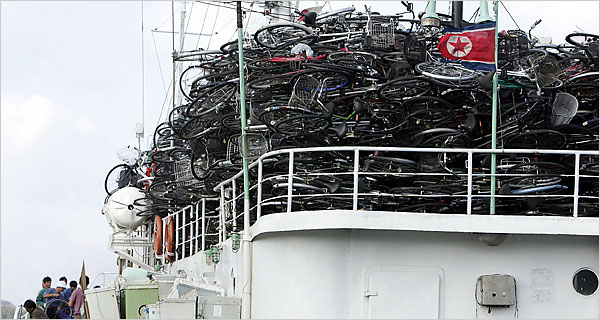
bikes.jpgThere was a great picture in the New York Times today.  The article was about the politics of a UN trade embargo in response to the nuclear test.  I was disappointed that the article was not about the story of the bikes being exported from Japan.  Who is importing them into the DPRK?  How are the funds transferred?  Is there a title? How are they being distributed in the DPRK?  Who is insuring them?  Who is buying them and where did they get the money?  This would have been a far more interesting article.  

Although stories of counterfitting currency and cigarattes, or exporting missles and drugs dominate news headlines, one story that never gets covered in the media, probably because it is so mundane, is how thousands of traders, motivated by nothing but self-interest and survival, are undertaking significant risks which are easing the hardships of the poor citizens of North Korea.  Will stopping this sort of trade make anyone better off? 

Image caption: Bicycles being loaded Friday onto a North Korean ship in Maizuru, west of Tokyo. A proposed Security Council resolution would restrict cargo. 10/14/2006

Share

The search for Pyongyang’s pressure point

Friday, October 13th, 2006

Financial Times
10/13/2006
Anna Fifield

As the countries of the United Nations wrangle over the sanctions to be imposed on North Korea following its nuclear test this week, doubts are being cast on the effectiveness of whatever measures are agreed.

With China and South Korea fearing the collapse of their volatile neighbour, and with a large proportion of North Korea’s income coming from illegal trade, even targeted sanctions would have a limited impact. The regime has already survived the death of its founder and a famine that killed up to 10 per cent of its population.

Rüdiger Frank, a North Korean economy specialist at the University of Vienna, said: “I don’t think there is any more room for more sanctions from the usual suspects. To be effective, China and South Korea have to join.

“But a nuclear North Korea is even more risky in case of collapse than just a humanitarian catastrophe, so why would they increase the chance of a collapse.”

North Korea says its missile launches in July and the nuclear test were “self-defence” in response to US financial sanctions imposed in September last year to curb alleged counterfeiting and money laundering.

Now the US, Europe and Japan are all calling for a tough UN resolution and authorisation for countries to interdict shipments to and from North Korea, both of which China is opposing.

The dispute over the extent of sanctions reflects differences over the purposes of the measure. While the US and perhaps Japan are eyeing regime change, China and South Korea would be happy with a change in behaviour.

Marcus Noland, of Washington’s Institute for International Economics, said economic sanctions were seldom effective in changing behaviour.

“If the sanctions were going to have any shot at working they would have to be comprehensive sanctions, as suggested by Japan,” he said. “That package was big enough to potentially have an impact and it also had the benefit of simplicity, but they would also imply a significant degree of hardship for ordinary people.”

But the suggested targeted sanctions were too weak to be effective and because of their complexity, they almost invited circumvention, Mr Noland said.

“Weak sanctions may be counterproductive because President Bush and President Roh [of South Korea] warn that they will not tolerate a nuclear test but they are not imposing the penalties or incentives to back it up. That might tempt North Korea to push the envelope even further,” he said.

Much of the crisis can be traced back to North Korea’s dire economic situation. The differences between the North and South Korean economies could not be more stark. The mineral-rich north had always been the industrial heartland and the more fertile South was traditionally the rice bowl.

Indeed, the South’s gross domestic product did not overtake the North’s until the early 1970s but now at $700bn (£377bn, €558bn), it is about 40 times larger than that of the North’s.

Economic reforms that Pyongyang begrudgingly introduced in 2002, which liberalised prices and wages, have led to some changes in North Korea’s decrepit economy and trade has grown exponentially.

The South’s Korea Trade Investment Promotion Agency estimates the value of North Korea’s legal foreign trade crossed the $3bn mark last year, the highest since the Soviet Union collapsed in 1991, with trade with China comprising more than half of the total.

But it is North Korea’s sizeable illegal trade that will further dilute any economic sanctions. Analysts suggest North Korea earns about one-third of its revenues from aid, one-third from conventional exports and the remainder from criminal activities.

Crime is such a fundamental part of North Korea’s economy that David Asher, co-ordinator of the US State Department’s North Korea working group from 2003 to 2005, calls the country the “Soprano state”.

“North Korea is perhaps the only country in the world whose embassies and overseas personnel are ex-pected to contribute income to the ‘Party Centre’, not rely on central government funds for their operations,” said Mr Asher in a speech at the Wilson Centre last November.

Several North Korean diplomats have been caught carrying narcotics through eastern European countries in recent years. In 2004, a North Korean ship carrying $150m worth of heroin was seized in Australia.

Pyongyang has also been producing and distributing counterfeit US dollars, cigarettes and pharmaceuticals, especially the erectile dysfunction drugs Viagra and Cialis.

Counterfeit cigarettes are said to depart regularly from the North Korean ports of Rajin and Nampo for shipment through China and South Korea to the rest of the world, and tobacco companies have identified factories producing counterfeit cigarettes in North Korea.

But the international community is now most concerned about the prospect of North Korea trading missile and weapons of mass destruction technology, a concern that is only likely to be heightened with sanctions.

Jon Wolfsthal, of the Centre for Strategic and International Studies in Washington, said: “North Korea is probably going to want to hold on to their precious weapons technology. But if the US squeezes them, that increases the risk that they might sell weapons to ensure their survival.”

Share

N. Korea says more sanctions from Japan will spur ‘strong countermeasures’

Thursday, October 12th, 2006

Yonhap:
10/12/2006

A senior North Korean official said Thursday his country will take “strong countermeasures” against Japan if it implements new sanctions against the communist country, Japan’s Kyodo News said.

“We will take strong countermeasures,” Song Il-ho, North Korea’s ambassador on diplomatic normalization talks with Japan, said in an interview with Kyodo News. “The specific contents will become clear if you keep watching. We never speak empty words.”
The threat came after Japan decided to impose additional economic sanctions against North Korea for its claimed nuclear test Monday, imposing a ban on all imports from the communist country and banning its ships from entering Japanese ports. North Korean nationals will be prohibited from entering Japan, according to Japanese officials.

The sanctions are in addition to the measures already in place following Pyongyang’s missile tests in July, prohibiting the flow of funds and technology from Japan to 15 entities suspected to have links with North Korea’s weapons of mass destruction programs.

Japan’s additional measures are “more serious in nature” compared to sanctions imposed or considered by other countries, Song said. Pyongyang will take countermeasures by calculating Japan’s failure to adequately repent for its colonization of the Korean Peninsula from 1910 to 1945, he added.

He also said Pyongyang is watching closely what Japanese Prime Minister Shinzo Abe, who took office last month, plans to do regarding relations between the two countries.

“We are watching his words and actions since becoming prime minister in a careful manner,” Song was quoted as saying.

Share

North finds reinsurance a source of hard cash

Tuesday, September 19th, 2006

Joong Ang Daily
Lee Young-jong, Shin Eun-jin, Sohn Hae-yong
9/20/2006

North Korea has filed claims with British and Russian reinsurance companies after four disasters in the North, and seeks millions of dollars in compensation, a source in Seoul said yesterday. His comments were confirmed by government officials.

The sources said the claims were filed by Minjok Insurance General Company, and asked for payments related to two rail crashes and two other incidents.

Reinsurers help policy-issuing insurance companies spread the risk involved in their policies to other insurance companies around the world. Companies buy “packages” composed of parts of many policies, and share in both the policy payments and claims made under those policies.

The reinsurers reportedly received permission from Pyongyang to conduct investigations at the accident sites before paying the claims; those visits have already taken place, these sources said, adding that the visits were made to places normally off-limits to foreigners.

One of the incidents was the sinking of a passenger ship traveling between Wonsan and Heungnam, both east-coast ports. Half of the ship’s 200 passengers lost their lives, Minjok reportedly told its reinsurers. Industry officials here estimated that the insurance payment would be in the millions of dollars. Another incident was a train accident in South Hamkyong province in April, which resulted in the deaths of 270 soldiers and 400 civilians. Rumors had circulated in Seoul about the latter accident, but those rumors were dismissed at the time by South Korean government officials.

Another train crash occurred near Nampo, a west-coast port, in April. Dozens were reportedly killed in that crash. Little is known about a helicopter crash near Pyongyang in May, these sources said.

“North Korea has been in a bad plight since September 2005, after its assets in Banco Delta Asia in Macau were frozen and the United States announced financial sanctions,” a Seoul official said. “It is my understanding that the North is also trying to press claims linked to flood damage this summer.”

One observer said the North’s rare disclosure of disasters indicates how serious Pyongyang’s cash crunch is. “It means that Pyongyang is more interested in gaining tangible benefits despite the risk of airing its dirty linen in public,” said Yang Moo-jin, a North Korea-watcher at the University of North Korean Studies in Seoul.

Others said Pyongyang may be learning to tweak global financial systems. “North Korean entities have been involved in competition to earn foreign currency, and now one of them is focusing on loss recovery through insurance,” said Lee Yeong-hun, a North Korea economic specialist at the Bank of Korea.

Experts said reinsurance payments to the North are outside the scope of any financial sanctions. “The North is operating all of its legitimate dollar-earning channels at full capacity,” a Seoul official said.

Share
