Archive for the ‘Illicit activities’ Category

N. Korea Has 3 Stimulant Drug Factories

Monday, March 19th, 2007

Korea Times
3/19/2007

Japan’s National Police Agency (NPA) has reported that it suspects there are at least three secret factories producing illicit stimulant drugs in North Korea, the Yomiuri Shimbun reported Saturday.

The Japanese daily said that Hiroto Yoshimura, deputy commissioner general of the NPA, mentioned the suspicion of the facilities during his speech as a Japanese representative at the U.N. Commission on Narcotic Drugs’ closed-door meeting in Vienna on Wednesday.

The commission is under the U.N. Office on Drugs and Crime.

Two of the three factories are located in areas where pharmaceutical factories were situated when the Korean Peninsula was under Japanese colonial control, Yomiuri reported quoting sources.

It is highly possible that North Korea has been using the factories to produce the drugs, according to the report.

It is the first time that the NPA has mentioned at an international conference the locations of stimulant drug factories in North Korea.

Over smuggling of North Korea’s stimulant drugs, the NPA reexamined seven cases uncovered from 1997 to May last year, in which about 1,500 kilograms of stimulant drugs were seized.

As a result, the NPA determined in July that Pyongyang was involved in an organized way on the grounds:

_ Spy boats of North Korea’s secret agency have been used as a means of transportation.

_ North Koreans arrested for smuggling made confessions hinting they had been acting under the instructions of the North Korean government.

According to the authorities, the drugs seized are divided into three types, based on analyses made of the contents. Due to differences in impurities and crystalline elements, the police are increasingly under the belief the drugs were produced at different locations.

Further, the authorities analyzed confessions of suspects arrested for smuggling stimulant drugs, data from intelligence satellites and the moves of covert operations boats and cargo vessels that transported the drugs.

The police strongly believe buildings in Wonsan in North Korea’s east and Chongjin in the northeast are drug factories.

Both places are where the Japanese pharmaceutical factories were located before World War II.

Also, it has been confirmed that stimulant drugs were sent from a port at Nampo near Pyongyang and there is a building suspected to be a drug factory near the port.

In addition, the NPA has obtained information there is another factory along the Yalu River near the border with China.

In November, the NPA reported at an international conference in Bangkok on controlling drugs in the Asia-Pacific area of North Korea’s state involvement in stimulant drug smuggling.

Share

Unfreezing North’s funds now up to Macao, says U.S.

Friday, March 16th, 2007

Joong Ang daily
5/16/2007

One obstacle to successfully concluding nuclear talks with North Korea may have been removed Wednesday in Washington when the U.S. Treasury Department concluded an 18-month investigation into a Macao-based bank suspected of money laundering activities on behalf of Pyongyang.

As part of its action against Banco Delta Asia, the U.S. will cut all ties between the small lender and the American financial system, a move that clears the way for Macao authorities to release $25 million in frozen North Korean assets held by the bank.

The money has been a major issue in the six-party talks with North Korea.

Stuart Levey, undersecretary for terrorism and financial intelligence, told reporters that it was now up to Macao to decide what to do with the frozen accounts.

“I think we still have some consultations to go but I think we won’t get ourselves into a situation where the BDA will pose a stumbling block to the six-party process, so what was important about the announcement was the treasury went final on this ruling,” Christopher Hill, Washington’s chief envoy to the six-party talks, said yesterday.

The Treasury Department said in a press release, “Abuses at the bank included the facilitation of financial transactions related to illicit activities, including North Korea’s trade in counterfeit U.S. currency, counterfeit cigarettes and narcotics.” Mr. Levey said, “In fact, in exchange for a fee, the bank provided its North Korean clients access to the banking system with little oversight or control.”

By barring the family-owned Banco Delta Asia from transactions with U.S. banks, the firm is essentially cut off from the global monetary system.

“Do you think I look worried? I’ll take it as it comes,” Delta Asia Group (Holdings) Ltd. Chairman Stanley Au told a television reporter in Beijing. Mr. Au is close to senior leaders in Beijing.

In taking the action, U.S. anti-money laundering laws are enforced and the talks with North Korea are no longer in peril over a relatively small amount of money.

Sources had said earlier that once the investigation was completed, Washington would leave the final decision to unfreeze some of the $25 million to Beijing, which has sovereignty over Macao. Kim Gye-gwan, the North’s chief representative to the six-party talks, demanded earlier that all the money be freed. North Korean officials who met with Mohammed ElBaradei, head of the International Atomic Energy Agency, earlier this week reiterated that demand as a precondition to taking initial steps to implement a deal to denuclearize the North.

That is a message to the Chinese, a South Korean government official said yesterday. “Pyongyang wants to get back as much as possible so they are telling Beijing what they want,” said the official. “If the amount released is below Pyongyang’s expectation it could still hamper the negotiations.” Another government official said that Beijing needed to come up with a “magic number” that could save face for both Pyongyang and Washington.

“If they release all of it, that would mean Washington created a fuss about nothing but they can’t go too low either,” said the official. “And as host of the nuclear talks China wants the thing to move on.”

Asked yesterday by reporters whether he expected all of the money to be released, Kim Myong-kil, deputy chief of North Korea’s U.N. mission, said, “As far as I know there was an agreement to do that.”

The implementation of a broad agreement reached in September 2005, under which Pyongyang committed to scrap its nuclear programs in exchange for security guarantees and energy aid, hit a wall almost immediately when Washington designated Banco Delta Asia a “primary money laundering concern” in the same month. U.S. banks and other financial institutions cut ties with the bank, thus severing a vital link between the isolated North and global finance.

Pyongyang agreed last month to take initial steps to implement the 2005 agreement only after Washington indicated that the bank issue would be resolved.

Analysts have speculated that the frozen funds ― as well as the proceeds of counterfeiting and other activities ― have been used by North Korean leader Kim Jong-il to lavish goodies on his inner circle.

The six-party talks are set to resume Monday in Beijing.

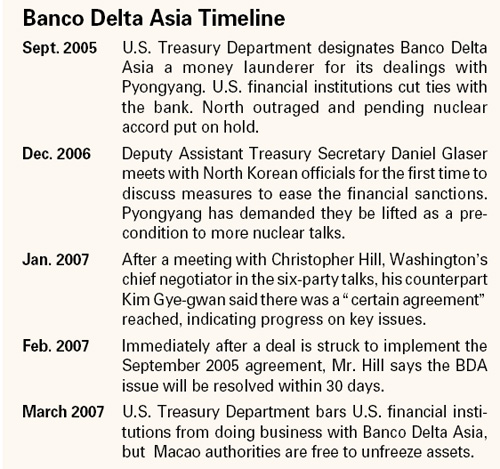
The small bank with the big problem

Once virtually unknown outside of Macao, Banco Delta Asia is a small family-owned bank that has had a big impact on nuclear negotiations with North Korea. The bank emerged from the shadows when it was designated in September 2005 as a “primary money laundering concern” under Section 311 of the U.S. Patriot Act by the State Department. The designation put control of the bank in the hands of Macao authorities who have reviewed procedures at the bank to prevent money laundering. Established in 1935, the bank has a total of 15 branches in locations such as Hong Kong and Japan. In 2004, it listed deposits of $423 million and loans of $1.4 billion. Bank executives had a long-standing relationship with the North, the U.S. says.

Reportedly, up to $12 million of the $25 million in frozen North Korean money could be from legal activities, and that could be a ball park figure of how much may be released. Washington has now barred all U.S. financial institutions from conducting business with the bank, but the eventual fate of the firm rests with Chinese-controlled Macao. Sources said recently that among the findings by the Treasury department, transactions were confirmed with the Pyongyang-based Tanchon Commercial Bank, which has been identified by Washington as the main North Korean financial agent for arms and ballistic missile deals.

Click bleow for a timeline.

bancodelta.jpg

Share

Treasury Reportedly Set to Act to Free North Korean Money

Wednesday, March 14th, 2007

NY Times
Steven R. Weisman
3/14/2007

The Treasury Department is expected to move formally this week to bar American banks from engaging in transactions with a bank in Macao linked to North Korea, clearing the way for North Korea to regain possession of money at the bank frozen since 2005, a Bush administration official said Tuesday.

American officials see such a step by the Treasury, which has been expected for weeks, as a crucial part of the recent deal to disarm North Korea’s nuclear program. The deal, announced last month, requires North Korea to disarm its nuclear facilities in return for economic and energy benefits.

The Chinese government effectively froze about $25 million connected to North Korea a year and a half ago, when the Treasury Department listed Banco Delta Asia, a small family-owned bank in Macao, as a “primary money laundering concern.” As much as half of the money is expected to be returned to North Korea.

American officials charged in 2005 that the bank was helping North Korea conduct counterfeiting, narcotics trafficking and transactions related to its nuclear weapons program, a charge that North Korea and the bank denied.

The initial Treasury announcement put American banks on notice that after further investigation, the department would decide whether to bar United States banks formally from facilitating transactions with the bank.

However, the practical effect was to make all United States banks voluntarily cease transactions with Banco Delta Asia.

Without the ability to acquire dollars, Banco Delta Asia collapsed. Macao froze all its funds related to North Korea, and most of its other customers withdrew their money in a run on the bank. The bank was then taken over by the authorities in Macao, a semiautonomous province of China.

Subsequently, American and Chinese authorities pored over more than 300,000 documents describing the transactions with North Korea. These included accounts of 20 North Korean banks, 11 North Korean trading companies, 9 North Korean citizens and 8 Macao-based companies that did business with North Korea, according to bank records filed with the Treasury Department.

The Treasury announcement expected this week would formalize what is already in place. It would probably mean that the bank could do only a modest amount of business, without the benefit of dollar transactions.

But it would mean that the Chinese government would be in a position to return some of the funds to North Korea that are not linked to counterfeiting, drugs, nuclear arms or other illicit activities.

For example, some of the funds belong to a North Korean unit of British American Tobacco, American officials say, and those funds are expected to be returned to the company, which is owned by British interests.

When the North Korea nuclear deal was announced last month, no mention was made of returning funds to North Korea from the bank, but American officials now say that the return of those funds was a major incentive for North Korea to reach an accord.

The disarmament agreement was negotiated with the United States, China, South Korea, Japan and Russia as part of what were called six-party talks.

Christopher R. Hill, the assistant secretary of state for East Asian and Pacific affairs and the central envoy in the talks, said this month that North Korea was “concerned about the fact that we were able to go after an important node of their financing” but that the United States would continue to monitor its illicit activities.

Share

South will give money directly to North Korea

Sunday, March 11th, 2007

Update: the money went missing.

South Korea criticizes North Korea for failing to disclose how aid was used
Herald Tribune
2/11/2008
 

South will give money directly to North Korea
Joong Ang Daily

Lee Young-jong and Ser Myo-ja
3/12/2007

Although South Korea does not allow cash to be given directly to North Korea, it made a deal of its own.

The two countries announced Saturday that Seoul would give Pyongyang cash to buy video conference equipment. A South Korean official said yesterday the amount will be $400,000.

North Korea will use the money to set up video conference calls between families separated during the Korean War, according to a joint statement issued Saturday by the two countries.

The South Korean government has strictly banned humanitarian groups ― as well as all residents ― from giving cash to the North due to concerns the money could be spent for other purposes.

“We decided to assist the North to smoothly resolve the separated family issue,” the official said, adding that the government will thoroughly monitor the spending of the money and the use of the equipment.

The cash payment agreement was first made at a Red Cross meeting in June 2006, but never publicly announced. The money was not exchanged because North Korea conducted a missile test the next month, temporarily freezing inter-Korean relations.

After progress in the recent six-party talks designed to make North Korea nuclear-free, South Korean Red Cross officials pledged again on Saturday at a meeting at a Mount Kumgang resort to give Pyongyang the money, the official said on condition of anonymity.

According to the joint statement, the two Koreas agreed that video conference call reunions will be expanded. The two Koreas also agreed a video conference call reunion center will be built in Pyongyang, separately from the reunion center under construction at Mount Kumgang, and that Seoul will provide construction material and equipment. The material and money will be released at the end of March, the agreement said.

Neither the joint statement nor the press release specified the amount of money, but the Seoul official said it will be $400,000. The construction material to be provided to the North is worth another $3.5 million, he said.

The South Korean government was unable to give the video conference call equipment, such as liquid crystal display monitors and computers, directly to the North because of United States regulations banning the export of dual-use goods to North Korea. Under the United States export administration regulations, strategic goods that include more than 10 percent of United States-made components or technology, are banned for export to state sponsors of terrorism, which include North Korea.

According to the official, South Korea advised the North to purchase the items from China with the cash. Washington could make an exception to the export ban, presumably at Seoul’s request, but it would take time to do so.

In addition to the cash, the $3.5 million worth of goods, such as trucks, construction materials, air conditioners, heaters and cables, will be provided to build a video conference call center in Pyongyang.

At the Red Cross talks, the North also agreed to resume the construction of the reunion center on Mount Kumgang on March 21. The two Koreas began the construction in August 2005, but the work stalled last July. The buildings are about 30 percent complete.

Last week’s Red Cross meeting was scheduled for only one day, for about two hours. Due to the North’s persistent demands for cash and materials, the talks went on for a second day, the government official said.

Share

Chairwoman of Women’s Union Caught With Drugs Unsettles Hoiryeong

Thursday, March 1st, 2007

Daly NK
Kim Young Jin
3/1/2007

Chairwoman for Hoiryeong City’s North Korean Democratic Women’s Union, Suh Kyung Hee’s husband “K” has been dealing with drugs since the moment he managed his company, Maebong Company. However, as central authorities began to centralize businesses since last year, the company closed its doors and “K” adopted his driver “L” as drug runner and his daughter as the treasurer in charge of distributing illicit drugs to smugglers at wholesale costs to districts such as Musan, Hoiryeong and Onsung.

According to a source in Hoiryeong, K and his driver L had been in confrontation with one another since January. In the past K had procured his drugs from Chongjin and moved them to a base in Hoiryeong. Then, the drugs would be either sold to border smugglers or sold to Chinese tradesmen.

Here is where the conflict surfaced. While, L was in charge of delivering the drugs from Chongjin to Hoiryeong, K became suspicious that L was secretly hoarding the drugs elsewhere. Hence, K conducted an investigation trailing L’s steps at which a disagreement arose.

In early Feb, L voluntarily went to North Hamkyung Security Agency in Chongjin and exposed that Chairwoman Suh’s family had been disclosing in drug dealings. The motive behind L indicting Chairwoman Suh’s family is still unknown.

Some argue that the reason L went straight to the district security office and not the city office in Hoiryeong was because of Chairwoman Suh’s hierarchical position in Hoiryeong city. If L had carelessly reported this case to the city office, it is possible that L would have simply lost his self-dignity.

At present, it seems that rumors about this case are spreading rapidly across Hoiryeong creating unsettling feelings in the city.

People of Hoiryeong city are muttering “High officials must also be shown the seriousness of law,” criticizing Chairwoman Suh’s family for concealing such large amounts of dollars and yuan also Chairwoman Suh, who as the leader of the Women’s Union would advocate severe punishment for female defectors.

100g of North Korean drugs sell for 12,000 yuan

North Korean citizen Park Jong Shim (pseudonym, Sanup-dong, Hoiryeong) who lives in the same suburb as Chairwoman Suh, said in a telephone conversation with a reporter on the 26th “The whole city is raucous because of Chairwoman Suh’s story” and informed “Some people say that the power of law will be enforced properly this time as the district security agency has been involved. On the other hand, some question whether or not those people with so much money and power will be punished according to law, despite the district office being involved.”

Hoiryeong citizen Kang Eun Soon (pseudonym) who defected to China in January said “If I think about the times when Chairwoman Suh would go around making a racket, my teeth rattle.” Like second nature, Chairwoman Suh would prowl around advocating, “With the slightest nudge, Hoiryeong women jump to China, not only defiling their bodies but dishonoring the land where mother Kim Jong Sook (Kim Jong Il’s mother) was born.”

Kang said “Usually, Suh would conduct political meetings through her Women’s Union and argue that the reason there was so many public trials for border crossers and illegal acts in Hoiryeong was due to the fact that women could not look after their family. She would say that Hoiryeong women were obsessed over money and would go to any lengths to get this becoming shallow-minded people.”

“Even if a verdict was made stating that Chairwoman Suh was not linked to the drug dealings, she would still not be able to maintain her position because of all the things she has said in the past,” Kang added.

The drug known as “ice” made in North Korea is sold to Korea, Japan and even Macau through the intermediary of China. The drug “ice” as known to defectors, originated from the Heung Nam Pharmaceutical Company.

Though the going rate for “ice” differs according to quality, 100g of high-quality ice is 12,000 yuan, 9,000~10,000 yuan for standard and 7,000 yuan for low-quality ice.

In accordance with North Korea’s legislation Article 218 amended in April 2004, any person found producing or trading drugs is sentenced to a maximum of 5 years time at the Labor Education Camp. If this act has been repeated on numerous occasions or the drug dealings were large scale, a person could be sentenced to 5~10 years at the Labor Education Camp. If the conditions are even more severe, the law clearly states that a person could then be sentenced to more than 10 years time at the Labor Education Camp or sent to the Labor Education Camp for life.

Share

US Concludes Probe Into NK-Linked Bank in Macau

Tuesday, February 27th, 2007

Korea Times
2/27/2007

U.S. officials said Monday they had wound up their probe into a Macau bank accused of laundering millions of dollars of illicit North Korean funds, Agence France-Presse reported.

The U.S. move raised expectations that sanctions placed on the lender may soon be lifted, AFP said in its dispatch from Hong Kong.

AFP quoted Daniel Glaser, an assistant to the U.S. Treasury Department’s deputy secretary, as saying that a team of U.S. officials had met Macau financial authorities during their one-day visit.

“We’ve completed our investigation,’’ Glaser was quoted as telling reporters at a hastily convened press briefing in nearby Hong Kong hours after the talks ended.

“Everything that we have seen throughout this investigation has confirmed and reinforced the concerns we initially expressed in September 2005,’’ he added.

The talks follow a deal announced two weeks ago between the U.S., the two Koreas, Japan and Russia on initial steps towards dismantling Pyongyang’s nuclear program.

As part of the agreement, the U.S. Treasury team probing Banco Delta Asia (BDA) and other banks believed to have links to North Korea said they would begin talks that would lead to the lifting of sanctions.

“All of this work has put us in a position where we can begin to take steps resolve the BDA matter,’’ Glaser was quoted as saying, adding that he had discussed the matter with North Korean and Macanese authorities.

However, he would not say when a decision would be made on lifting the sanctions, nor on what would happen to some $24 million worth of bank assets frozen by the Treasury.

“I don’t think it would be responsible for me to get into a specific timetable, but we do intend to take steps to resolve the matter and we do intend to do that in a timely fashion and to do it as soon as possible,’’ Glaser said.

BDA has been under administration in Macau since the Treasury announced its inclusion on the watch list in 2005.

The government stepped in after fearful depositors began withdrawing funds at a rate that threatened to destabilize the southern Chinese territory’s financial system.

AFP said that in December the bank admitted to buying gold bullion produced by North Korea.

According to the AFP report, the bank also admitted to continued dealings with Tanchon Commercial Bank for three months after the North Korean lender was blacklisted.

Promising never again to deal with North Korea, BDA has appointed an outside compliance officer and hired Hong Kong-based consultants to upgrade its computer system.

Macau’s authorities, meanwhile, with the backing of China’s central government in Beijing, have instituted tough new laws against money laundering and counterfeit currency.

Share

North Korea Enacts Law Against Money Laundering

Tuesday, February 20th, 2007

Korea Times
Park Song-wu
2/20/2007

The National Intelligence Service (NIS) on Tuesday confirmed that North Korea recently enacted a law that prohibits money laundering.

The standing committee of the North’s Supreme People’s Assembly adopted the legislation last October to ban financial transactions involving illegal earnings, the agency said in a press release.

The enactment apparently aimed at settling the U.S. financial sanctions on a bank in Macau that was blacklisted by Washington in September 2005 for its suspicious role in helping the North conduct illicit financial activities, it said.

Under the latest six-party agreement, reached on Feb. 13, the United States is to resolve financial sanctions within 30 days on North Korean assets worth $24 million that have been frozen in the Macau bank.

The NIS also confirmed that the North has a highly enriched uranium (HEU) program.

NIS officials made the confirmation during a closed-door National Assembly session as the Beijing deal on initial actions to implement the denuclearization of North Korea came under criticism for not mentioning the HEU program.

After ending the session, a lawmaker said on condition of anonymity that the NIS officials confirmed the existence of the HEU program in the North.

When North Korea’s uranium enrichment program came to the fore in 2002, Washington and Pyongyang accused each other of violating the 1994 agreed framework that eventually collapsed.

Seoul and Washington are reportedly sharing the view that Pyongyang has an HEU program, for which the North began purchasing large quantities of centrifuge-related equipment in 2001.

But what is not yet clear is whether the North has begun to produce weapons-grade uranium.

In a separate Assembly session, Minister of Foreign Affairs and Trade Song Min-soon also faced the same question from lawmakers on why the Beijing agreement did not mention the HEU program.

He avoided speaking specifically on the sensitive issue that triggered the second nuclear crisis in October 2002. But he said it will be addressed as the latest agreement invoked section one of the joint statement adopted in September 2005.

“The Beijing deal is about initial steps, and it’s not a complete roadmap toward the denuclearization,” Song said. “But the recent agreement requires the North to declare all of its nuclear programs.”

In section one of the September statement, the North committed to abandoning “all nuclear weapons and existing nuclear programs” and returning at an early date to the treaty on the nonproliferation of nuclear weapons treaty (NPT) and to International Atomic Energy Agency (IAEA) safeguards.

The main opposition Grand National Party (GNP) also expressed doubts over Pyongyang’s willingness to abide by its pledges to implement initial measures for the denuclearization of North Korea.

Rep. Kim Yong-kap of the conservative party found problems with the deal reached in Beijing on Feb. 13 since key components of it, especially on the disablement of the North’s nuclear facilities, are overly “abstract.”

“Despite the North’s agreement to disable its 5 megawatt reactor in Yongbyon, it later changed the wording into a temporary stoppage of operations,” Kim said.

The North’s media promptly reported the result of latest six-party talks, but did not use the term “disablement.” Seoul officials interpreted it as an attempt to mislead North Koreans so they do not lose their pride.

“In addition, there is no deadline on the disablement. I am simply doubtful of the deal’s practicality,” he said.

According to a Chosun Ilbo-Gallup Korea poll, conducted on Feb. 19, 77.9 percent of respondents predicted that the North would not keep its pledges, while 15.8 percent of the 1,006 respondents trusted the North.

But Song said the Beijing deal was a good chance to reaffirm Pyongyang’s willingness for an early denuclearization.

He also dismissed the GNP’s claim that Seoul is determined to share the largest financial burden of aiding the North to achieve a second inter-Korean summit in the run-up to the December presidential election.

“We will not bear all the burden because all five parties have agreed to provide economic aid on the principle of equality and equity,” he said. “And the provision of assistance will be made in line with the principle of action for action.”

As a first step toward denuclearization, North Korea is to shut down its nuclear-related facilities at Yongbyon while allowing United Nations nuclear inspectors back to the nuclear complex to seal them off.

Seoul’s top nuclear negotiator, Chun Yung-woo, said in Beijing on Feb. 13 that the deal is working under an “incentive system.”

For shutting down the Yongbyon complex, the North would receive the equivalent of 50,000 tons of heavy fuel oil in emergency relief aid. An additional 950,000 tons of heavy oil or equivalent aid will be provided to the country upon its completion of disabling other nuclear-related facilities.

Share

Kim Jong-il’s Son Sells Weapons Abroad: Report

Tuesday, February 13th, 2007

Korea Times
1/13/2007

Kim Jong-nam, believed to be the eldest son of North Korean leader Kim Jong-il, has taken charge of the overseas sales of North Korean military weapons.

The junior Kim, 35, went back to Pyongyang via a Koryo Air flight from Beijing on Tuesday after getting a lot of media attention during his three-day stay in the Chinese capital.

According to the Segye Times, a vernacular daily, Jong-nam has made profits for his country by selling military weapons such as Scud medium-range missiles and SA-16 surface-to-air missiles overseas.

He invested money in real estate and overseas banks offering high interest rates in several countries including Britain, Switzerland, Hong Kong, Macau and Singapore, said the report based on comments from an expert on North Korean affairs in Japan.

On Sunday Kim was spotted by Japanese television crews at Beijing International Airport. His appearance in Beijing sparked interest among North Korea watchers, as the six-party talks over the North’s nuclear weapons programs were being held there.

Reports said Kim was on a three-day layover on his way back home to attend his father’s 65th birthday party, which falls on Friday.

Wearing a Reebok baseball cap and blue jeans as well as a gold necklace, Kim showed off his foreign language skills in brief interviews with the news media including Japan’s Fuji television.

Asked whether he speaks Japanese, he answered in Japanese that he didn’t understand the language. He also said he speaks a little bit of English and French as he studied in Europe for several years.

Kim said he meets with his father “sometimes” but did not elaborate on their relationship.

According to reports Kim stayed at his favorite hotel, the Kempinski Hotel located adjacent to the South Korean embassy in Beijing during his short visit.

The Toronto Globe and Mail reported earlier this month that the North Korean leader’s son has been spending most of his time for the past three years at casinos, saunas and luxury hotels in Macau, the former Portuguese enclave near Hong Kong.

Kim was photographed in the city by a newspaper as he left his favorite hotel, the Mandarin Oriental.

According to the South China Morning Post, he has frequently visited Macau’s casinos and often goes out drinking late at night.

There have been rumors that fell out of favor with his father in 2001 when he embarrassed the regime in a bizarre incident in Japan.

Kim was briefly detained at Tokyo’s airport where he tried to enter Japan on a fake Dominican Republic passport. He was on his way to visit Tokyo Disneyland, reports said.

Share

North Korea Reexports Drugs Through China to 3rd World Countries

Saturday, February 3rd, 2007

Daily NK
2/3/2007

Though the number of North Korean drug smuggling cases is on the decline, a U.S. report claims that the number of Chinese crime gangs reexporting North Korean drugs to 3rd world countries is on the rise.

Radio Free Asia (RFA) conducted an interview with Researcher Raphael Pearl of the U.S. Congressional Research Service (CRS) on the 30th regarding his claims in a report “Drug Trafficking and North Korea: Issues for U.S. Policy.

In the report Pearl spoke of an incident where Australian authorities captured a North Korean vessel “Pongsu” in April 2003 which was amidst transporting $160mn worth of heroin and said that this case had “enhanced international attention” on the issue of North Korean drug smuggling and since then the number of drug smuggling incidents had generally declined.

Since 1976, there have been a total of 50 cases where 20 different countries were caught in foreign relations with North Korea for drug trafficking. However, within the last 2 years, the majority of cases of drug smuggling were found in China’s Shenyang, Dalian and Dandong. Further, links to North Korean authorities have yet to be verified regarding these cases.

Pearl said that despite the fact North Korean drug trafficking has declined on the whole there have been cases where North Korean drugs were mistaken for drugs made in China. Also, he said that through the intervention of Chinese crime gangs, North Korean drugs were being reexported to 3rd world countries.

Some argue that the reason drug incidents have declined is due to the fact North Korean authorities have reduced their direct participation in the manufacture of goods. However, more and more Chinese crime gangs are intervening in the manufacture of North Korean drugs and smuggling, he said. In other words, there is a high possibility that North Korean drugs are being reexported through the intercession of China.

Pearl said that North Korean authorities are attempting to compensate the losses from a decline in drug smuggling with the manufacture and smuggling of fake cigarettes, medicines and small weapons. He also emphasized and confirmed the pivotal role of illegal acts such as exporting fake cigarettes and drugs in contributing to North Korea’s economy and income.

In the report, Pearl expressed his concerns on North Korea, giving the example that parts of farming areas had been used to cultivate drugs even amidst a poverty stricken country and indicated that the money from illegal acts such as drug smuggling and counterfeit currency could further add to the development of missiles and nuclear weapons.

He also expressed concern over the issue of segregating North Korean authorities especially with foreign groups being associated with North Korean drug smugglers.

Share

Will Economic Sanctions Have Impact on N. Korea?

Tuesday, January 23rd, 2007

Korea Times
Chang Se-moon
1/23/2007

Obviously, it is important to know the correct answer to this question. Sanctions that have no impact on North Korea’s economy will not change the behavior of North Korean leaders. If sanctions do have a significant impact, the possibility that North Korean leaders may be tempted to resolve the pending security issues through negotiations exists.
In answering the question, however, we need to keep in mind what the British economist John Maynard Keynes (1883-1946) said: “The theory of economics does not furnish a body of settled conclusions immediately applicable to policy. It is a method rather than a doctrine, an apparatus of the mind, a technique of thinking which helps its possessor draw correct conclusions.’’ In plain English, Keynes stressed an unbiased economic way of thinking that could help us draw correct conclusions. In other words, until we review all the facts with an open mind we should not make up our minds.

This is exactly what we will do by assessing the impacts of economic sanctions on North Korea.

The first question that comes to mind is which sanctions are we talking about. If we review U.S. sanctions on North Korea since the outbreak of the Korean War in 1950, there would be too many sanctions imposed on North Korea to be practical. There are three important sanctions that are still in effect, however. One is the U.S. denial of a Most Favored Nation (MFN) trade status on North Korea’s exports.

This sanction was imposed on North Korea’s exports to the United States on September 1, 1951, following the outbreak of the Korean War. MFN tariffs are the lowest tariffs that are levied on imports to the U.S. Over 99 percent of imports to the United States qualify for the MFN tariffs. Without MFN status, tariffs on North Korean exports to the United States are so high that North Korea simply cannot even imagine exporting anything to the United States.

The second of the three important sanctions stemmed from the bombing of Korean Air 858 by North Korean agents on November 29, 1987. The explosion killed 115 innocent passengers and crew members. On January 20, 1988, North Korea was placed on the list of countries that supported international terrorism according to the U.S. Export Administration Act of 1979.

The importance of this sanction is that placement on the list has made it impossible for North Korea to borrow money from international financial institutions including the World Bank and the International Monetary Fund. Like the denial of MFN status, the placement of North Korea on the list of countries supporting international terrorism continues to this date.

The third of these three key sanctions relates to tightening of North Korea’s illegal financial transactions, which culminated in Banco Delta Asia’s termination of business dealings with North Korea as of February 16, 2006. You may know that Banco Delta Asia had long been suspected of handling North Korea’s illicit activities overseas such as laundering of counterfeit U.S. dollars and sales of illegal drugs

Banco Delta Asia is located in Macao, which is a Special Administrative District of China. Tightening of North Korean financial transactions was extended to North Korean trade during 2006. This added pressure on North Korea originated from U.N. Resolution 1540 following North Korea’s test-launching of long-range missiles on July 5, 2006, as well as from U.N. Resolution 1718 which followed North Korea’s nuclear test on October 9, 2006.

Are these sanctions having an impact on North Korea’s economy? Perhaps, a more accurate question is whether these sanctions are placing enough pressure on North Korean leaders to reconsider the possibility of returning to the negotiation table?

One aspect is the status of North Korea’s trade deficit. As you probably know, North Korea buys from other countries much more than it sells to other countries. When the amount of imports exceeds the amount of exports it’s called a trade deficit. North Korea’s annual trade deficit averaged about $800 million from 2003 to 2005. This figure does not include North Korea’s trade deficit against South Korea, since South Korea appears to consider any financial support to the North as a long-term investment rather than a trade deficit.

How has North Korea been paying for the trade deficit? The ways have been unique. Almost the entire deficit appears to have been financed by weapons sales, illicit activities, and funds flowing from South Korea through joint projects.

In fact, a study by the Korean Institute for Defense Analysis indicates that full implementation of U.N. Resolution 1718 would cause North Korea to lose just about the same amount ($700 million to $1 billion) by stopping exports of weapons and illegal drugs and counterfeit money.

The Economist Intelligence Unit is quoted to have estimated in 2003 that “North Korea earned as much as $100 million a year from counterfeit money, while in 2005, a U.S. task force estimated that “$45 million to $60 million in Pyongyang’s counterfeit currency (primarily in U.S. $100 bills) is in circulation,’’ reportedly, including some in Seoul’s Namdaemun Market.

Assuming that recently added sanctions will cause North Korea to lose about $800 million that it has been earning overseas each year, the next interesting question is how North Korea will pay for the annual trade deficit of $800 million in the future? If North Korea does not pay for its imports, other countries will refuse to sell products to North Korea and the North Korean economy will suffer.

North Korea cannot borrow from world financial institutions because of the 1988 U.S. sanctions that branded North Korea as one of countries supporting international terrorism. They cannot use the money from foreign direct investment because China and Korea are the only two countries that have been willing to invest in North Korea, but the combined amount is not even close to paying for the annual trade deficit.

Think of it this way. If you borrow money every year, and lenders believe that your ability to pay off the debt is rapidly declining, will lenders continue to lend you money? Not likely. With sanctions adversely affecting North Korea’s ability to pay for imports, North Korea will find it increasingly difficult to buy what it needs. The breaking point may not be imminent, but the future is predictable.

This is what I think will happen. North Korea will ask China to increase its foreign direct investment in North Korea by giving China more incentives for such investment. These incentives may include low taxes and free land. North Korea will ask South Korea to send more money.

For instance, as of July 1, 2004, Hyundai Asan and North Korea set the entrance fee to Mt. Kumkang at $10 for a day trip, $25 for a two-day trip and $50 for a three-day trip. On May 1, 2005, these fees were raised to $15, $35, and $70. On July 1, 2006, these fees were raised again to $30, $48, and $80. This is just one way.

North Korea may also ask South Korea to lend it a large sum of money with an empty promise of paying it back. This explains in part why it is so important for North Korea to have leaders of the South Korean government who are friendly to North Korea.

These desperate acts are likely to be very short of paying for the majority of the annual trade deficit. If sanctions continue to be effective, the likelihood of North Korea returning to the negotiation table increases. Economics is rarely boring, especially when it deals with real problems.

Share

An affiliate of 38 North