Archive for the ‘Illicit activities’ Category

The Political Economy of North Korea: Implications for Denuclearization and Proliferation

Tuesday, June 16th, 2009

Stephan Haggard and Marcus Noland
East-West Center Working Papers
Economics Series, No. 104
Download paper here (PDF)

Abstract:
Despite North Korea’s turn away from economic reform and the constraints of the second nuclear crisis, the country has in fact become more economically open. But it has emphasized closer economic relations with China and other trading partners that show little interest in political quid-pro-quos, let alone sanctions. Yet the U.S. can still exercise economic leverage by going aggressively after third-party financial intermediaries. This particular form of sanction does not require multilateral coordination, since foreign banking institutions that conduct significant business in the United States have a strong interest in avoiding institutions that the United States Treasury has identified as money laundering or proliferation concerns.

There is some evidence that North Korea moderated its missile proliferation activities during periods when rapprochement with the United States, and to a lesser extent Japan, was a priority, but in the absence of such interest and as legitimate trade, investment, and aid dry up, the incentives to intensify proliferation activities increase.

The internal organization of the North Korean economy has important implications for any policy seeking transformation via engagement. The economy is structured in such a way that outside economic ties are still largely monopolized by stateowned enterprises and other gatekeepers, such as the military. Under such circumstances, the precise design of engagement policies requires very close scrutiny. Even nominally commercial relations can be exploited if the North Korean counterparties believe that they are ultimately political in nature, subsidized and thus vulnerable to blackmail. If economic ties are truly commercial in nature, those choosing to trade and invest with North Korea do so at their own risk. Under these circumstances, private actors will make economic decisions fully factoring in political risk, and North Korea will bear the costs if it chooses to renege on commitments or fails to provide a supportive policy environment.

Paper prepared for the conference on “North Korean Nuclear Politics: Constructing a New Northeast Asian Order in the 21st Century,” University of Washington, June 4-5, 2009. We would like to thank the Smith Richardson, MacArthur, and Korea Foundations for financial support and Jennifer Lee for research assistance.

UPDATE: A shorter version of this paper can be found here.

Share

Tunnels, Guns and Kimchi: North Korea’s Quest for Dollars – Part II

Thursday, June 11th, 2009

Yale Global
Bertil Linter
6/11/2009

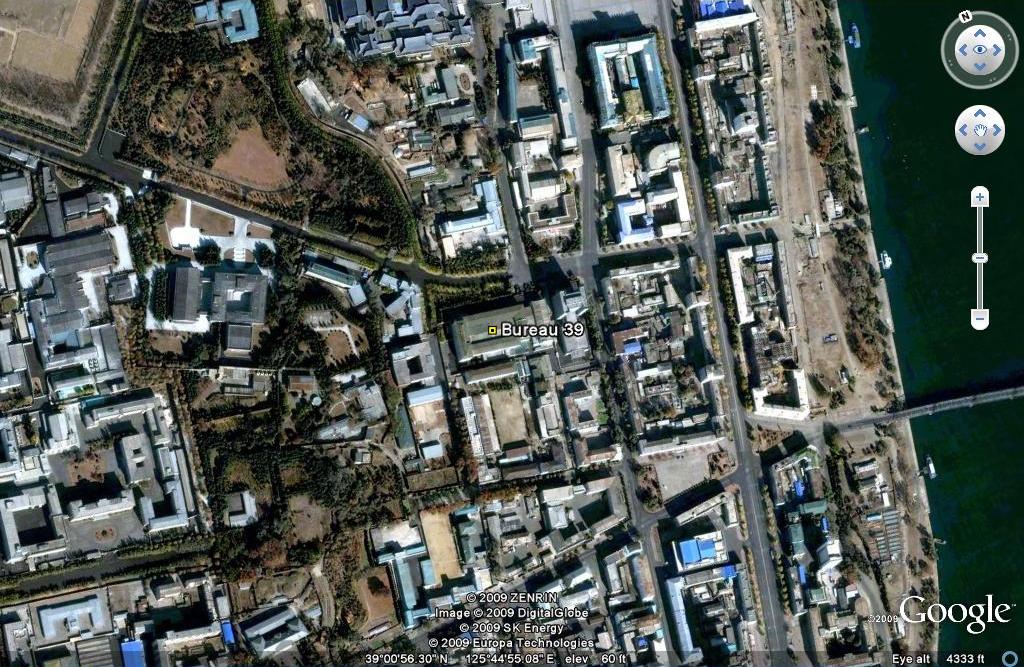
BANGKOK: The global economic meltdown has claimed an unexpected victim: North Korea’s chain of restaurants in Southeast Asia. Over the past few months, most of them have been closed down “due to the current economic situation,” as an Asian diplomat in the Thai capital Bangkok put it. This could mean that Bureau 39, the international money-making arm of the ruling North Korean Workers’ Party – which runs the restaurants and a host of other, more clandestine front companies in the region – is acutely short of funds. Even if those enterprises were set up to launder money, operational costs and a healthy cash-flow are still vital for their survival. And, as for the restaurants, their main customers were South Korean tourists looking for a somewhat rare, comfort food from the isolated North of the country. The waitresses, all of them carefully selected young, North Korean women dressed in traditional Korean clothing, also entertained the guests with music and dance.

But thanks to the global economic crisis, not only has the tourist traffic from South Korea slowed, the fall in the value of won has also reduced their buying power. The South Korean won plummeted to 1,506 to the US dollar in February, down from 942 in January 2008. No detailed statistics are available, but South Korean arrivals in Thailand – which is also the gateway to neighboring Cambodia and Laos – are down by at least 25 percent.

Though staunchly socialist at home, the North Korean government has been quite successful in running capitalist enterprises abroad, ensuring a steady flow of foreign currency to the coffers in Pyongyang. North Korea runs trading companies in Thailand, Hong Kong, Macau and Cambodia, which export North Korean goods – mostly clothing, plastics and minerals such as copper – to the region. At the same time, they import various kinds of foodstuffs, light machinery, electronic goods, and, in the past, dual-purpose chemicals, which have civilian as well as military applications. Those companies were – and still are – run by the powerful Daesong group of companies, the overt arm of the more secretive Bureau 39.

North Korea embarked on its capitalist ventures when, in the late 1980s and early 1990s, the country was hit by a severe crisis caused by the disruption in trading ties with former communist allies. More devastatingly, both the former Soviet Union in 1990 and China in 1993 began to demand that North Korea pay standard international prices for goods, and that too in hard currency rather than with barter goods. According to a Bangkok-based Western diplomat who follows development in North Korea, the country’s embassies abroad were mobilized to raise badly needed foreign exchange. “How they raised money is immaterial,” the diplomat says. “It can be done by legal or illegal means. And it’s often done by abusing diplomatic privilege.”

North Korea’s two main front companies in Thailand, Star Bravo and Kosun Import-Export, are still in operation. In the early 2000s, Thailand actually emerged as North Korea’s third largest foreign trading partner after China and South Korea.

Bangkok developed as a center for such commercial activities and Western intelligence officers based there became aware of the import and sale of luxury cars, liquor and cigarettes, which were brought into the country duty-free by North Korean diplomats. In a more novel enterprise, the North Koreans in Bangkok were reported to be buying second-hand mobile phones – and sending them in diplomatic pouches to Bangladesh, where they were resold to customers who could not afford new ones. In early 2001, high-quality fake US$100 notes also turned up in Bangkok and the police said at the time that the North Korean embassy was responsible as some of its diplomats were caught trying to deposit the forgeries in local banks. The North Korean diplomats were warned not to try it again.

The restaurants were used to earn additional money for the government in Pyongyang – at the same time, they were suspected of laundering proceeds from North Korea’s more unsavory commercial activities. Restaurants and other cash-intensive enterprises are commonly used as conduits for wads of bills, which banks otherwise would not accept as deposits.

For years, there have been various North Korean-themed restaurants in Beijing, Shanghai and other Chinese cities. But the first in Southeast Asia opened only in 2002 in the Cambodian town of Siem Reap. It became an instant success – especially with the thousands of South Korean tourists who flocked to see the ancient ruins of Angkor Wat. It was so successful that Pyongyang decided to open a second venue in the capital Phnom Penh in December 2003. A fairly large restaurant in the capital’s Boulevard Monivong, which offered indifferent Korean staple kimchi and other dishes and live entertainment by North Korean waitresses, closed earlier this year for lack of business.

In 2006, yet another Pyongyang Restaurant – as the eateries were called – opened for business in Bangkok. It was housed in an impressive, purpose-built structure down a side alley in the city’s gritty Pattanakarn suburb, far away from areas usually frequented by Western visitors but close to the North Korean embassy and the offices of its front companies in the Thai capital. This was followed by an even grander restaurant in Thailand’s most popular beach resort, Pattaya, which was also housed in a separate building with a big parking lot outside for tour buses. A much smaller Pyongyang restaurant opened in Laos’s sleepy capital Vientiane, but that one became popular not with South Korean tourists, but with Chinese guest workers and technicians. The Vientiane restaurant may be the only North Korean eatery that is still in operation.

After years of watching North Korea’s counterfeiting and smuggling operations, the United States began tightening the screws on Pyongyang’s finances in September 2005. This occurred after Banco Delta Asia, a local bank in Macau, was designated as a “financial institution of primary money-laundering concern.” The bank almost collapsed, and North Korea’s assets were frozen. The money was eventually released as part of an incentive for North Korea’s concession in the Six-Party talks and returned to North Korea via a bank in the Russian Far East. But, coupled with UN sanctions, the damage to North Korea’s overseas financial network was done – including the ability of Pyongyang’s many overseas front companies to operate freely. For example, the two-way trade between Thailand and North Korea peaked at US$343 million in 2006 – but then began to decline. It was down to US$100 million in 2007, and US$70.8 million in 2008.

Now with North Korea conducting a second nuclear test and firing off missiles, Washington has raised the possibility of the re-listing of North Korea as a state that supports terrorism. If that were to happen, many private companies would become hesitant to deal with Pyongyang and its enterprises for fear of being blacklisted by the US Treasury.

With its various money-making enterprises coming unstuck, Pyongyang is increasingly under pressure. The worldwide financial crisis has already put North Korea in a tight corner. There was never anything to suggest that the money earned by North Korea’s economic ventures abroad were to be used for social development at home, or to be spent on basic necessities such as putting food on the tables of the country’s undernourished people. Now, there won’t even be food for sale to South Korean tourists in the region.

Share

DPRK general named in counterfeit scheme

Tuesday, June 2nd, 2009

According to Fox News:

A top North Korean general and close advisor to the country’s leader, Kim Jong-Il, has been named by U.S. and foreign intelligence agencies as a key figure in the production of high-quality counterfeit $100 bills, called supernotes, according to documents and interviews cited by The Washington Times.

North Korean Gen. O Kuk-ryol, who was recently promoted to the country’s powerful National Defense Commission, is said to be in charge of creating the false $100 bills, which are produced to look nearly indistinguishable from authentic U.S. banknotes. Several members of the general’s family are also believed to be involved, the Washington Times reported.

A government report obtained by the Washington Times from a diplomatic source names Gen. O as one of the regime’s most powerful military figures, and the key person in charge of facilitating the succession of Kim Jong-Il by his third son, Kim Jong-un. The North Korean leader suffered a stroke in August, and his appearance in recent months suggests he is in ill-health.

The information about the general in the report was confirmed by a senior U.S. Intelligence official as well as by additional officials with knowledge of North Korean activities, the Washington Times reported.

North Korea has been linked to counterfeiting for many years, but the recent report is unusually detailed in its account of how North Korea is using illegal activities to raise funds for the regime and its reclusive leader. The new details were released as the United Nations considers new economic sanctions against North Korea for an underground test of a nuclear weapon last week.

The North Koreans deny the allegations. 

You can read previous posts about counterfeiting here.

An organization chart of the DPRK leadership can be seen here in PDF format.  Michael Madden constructed a biography of Gen. O which you can view here.

The Washington Times was founded by the Rev. Sun Myung Moon, who met Kim il Sung, and was responsible for the construction of the Potonggang Hotel in Pyongyang and Pyonghwa Motors in Nampo.

You can find the full Washignton Times story here:
N. Korea general tied to forged $100 bills
Washington Times
Bill Gertz
6/2/2009

Share

DPRK not about to collapse

Sunday, May 31st, 2009

Newsweek has an interesting article which makes the case that the DPRK economy is not as bad as the public tends to think.  According to the article:

…North Korea isn’t broke—and its economy has been moving away from collapse in recent years-. The Hermit Kingdom may not be getting rich—the CIA estimates its GDP at roughly $40 billion, ranking 96th in the world. But it’s not failing either, and for the past decade, its economy has grown at an average rate of about 1.5 percent a year, according to South Korean statistics. While Seoul estimates that the North’s GDP shrank by 2.3 percent last year, some analysts say it actually expanded, arguing that South Korea’s recent figures on the North are deflated for political purposes.

To understand how the Dear Leader has managed this, you must first drop a few of the myths surrounding his country. First, the North Koreans haven’t been living in caves for the past two decades, nor is their economy de-industrializing, as is sometimes reported. Instead, with help from Beijing, Pyongyang has revamped its outdated infrastructure in recent years and repaired the mining facilities that were battered by massive floods during the mid-’90s. It now aims to shift from recovery to growth, with a focus on steel production, mining and light-industrial manufacturing.

Second, the North doesn’t have to rely on the black market to support itself. True, Pyongyang has sold missiles to Iran, Syria and Pakistan, and annual revenue from such exports is roughly $100 million, but analysts say that other illicit activities like drug trafficking and counterfeiting add very little to that sum. According to a former U.S. diplomat in East Asia who asked not to be named discussing sensitive intelligence, during the Bush years Washington investigated the oft-heard counterfeiting accusations, and found that the notes in question had actually been produced privately by former Chinese military officials, in China. “The Treasury Department couldn’t find a single shred of hard evidence pointing to North Korean production of counterfeit money,” the American says.

The biggest myth is that North Korea remains isolated. Despite supposedly comprehensive sanctions, Pyongyang today has diplomatic and commercial relations with more than 150 countries, including most European Union members. North Korea trades its abundant gold reserves—estimated at 1,000 to 2,000 tons—in cities like London, Zurich and Hong Kong, and buys and sells shares on the New York Stock Exchange via a legitimate London-based brokerage firm it essentially owns. While there are no figures on the volume of such transactions, the former U.S. diplomat says that such activities are “a substantial source of hard currency for North Korea.” In recent years, European firms have also begun eyeing investment opportunities there; In 2004, the London-based energy firm Aminex signed a 20-year deal with Pyongyang for exclusive rights to explore on- and offshore oil-and-gas deposits. Other companies are looking for ways to exploit the North’s cheap labor supply, and while most of these deals have yet to take off for technical and political reasons, ties to the outside world are expanding. In 2008, the country’s overall trade rose 30 percent from the previous year, reaching a record $3.8 billion, including imports of $2.7 billion, according to Seoul’s Korea Trade-Investment Promotion Agency.

North Korea has proved adept at avoiding restrictions: when Tokyo slapped it with sanctions five years ago, Pyongyang simply reshuffled its deals, turning to the BRIC economies as well as South Korea and Singapore. Meanwhile, China now accounts for nearly three quarters of North Korea’s total trade, sending it crude oil, petroleum and manufactured goods in exchange for coal, steel and rare metals like tungsten and magnesite. The North’s natural resources have become a major growth engine: the Musan mine in the country’s northwest is now said to be one of the largest iron-ore fields in Asia, and could eventually yield 10 million tons of ore a year.

Finally, there’s the southern connection. Despite deteriorating relations between Seoul and Pyongyang, factories at the joint Kaesong Industrial Complex are still operating at full gear, earning the North about $35 million annually—enough for eight or nine No-dong missiles. And that figure was projected (before the current crisis hit) to jump to $100 million by next year, says Lim Eul Chul of Seoul’s Kyungnam University.

I should point out that the CIA estimate of the DPRK’s GDP is among the highest.  Most other estimates are below $30 billion for 2008.

Read the full article here:
How Kim Affords His Nukes: The myth of a failing economy.
Newsweek
5/30/2009

Share

The end of six party talks or playing hard to get?

Tuesday, April 14th, 2009

UPDATE 2: Financial markets do not seem to care.  According to Reuters:

Financial markets in Seoul and Tokyo were not affected by North Korea’s announcement, with investors seeing it as more of the sabre-rattling they have come to expect from Pyongyang.

UPDATE 1: According to the Wall Street Journal, the DPRK has ordered nuclear inspectors to leave the country (again):

North Korea ordered International Atomic Energy Agency inspectors out of the country Tuesday. The decision ends international monitoring of a research reactor at Yongbyon and in theory could allow reprocessing of fuel rods to produce plutonium. The IAEA is expected to announce the eviction in the next hour.

The on-again, off-again inspections at the 5-megawatt Experimental Nuclear Reactor Plant and the Nuclear Fuel Fabrication Plant at Yongbyon resumed in October, soon after the U.S. announced it would remove North Korea from the State Department list of countries that sponsor terrorism.

The IAEA issued a press statement here. 

ORIGINAL POST:
The UN Security Council has published its presidential statement condemning th DPRK’s missile launch (read the full text of the statement here), and the media is widely reporting on the contents:

The United Nations Security Council has condemned North Korea’s April 5th rocket launch and demanded that Pyongyang not conduct further tests, saying that it would expand sanctions against North Korea.

The Security Council’s presidential statement is a level below a resolution — which has the power of force to back it up. But several ambassadors, including U.S. envoy Susan Rice, said the statement is legally binding, nonetheless. “The United States views presidential statements, broadly speaking, as binding. In this instance, it is more than binding in that it adds to an existing Chapter 7 sanctions regime. So in our view, there is no doubt that the measures that will be imposed as a consequence of this presidential statement by the 24th or 30th of April will occur and will be binding,” he said.

Monday’s statement goes further, saying there will be additional strengthening of measures in resolution 1718 and activates the dormant sanctions committee set up under that resolution.

“It is not extending the number of sanctions. It is not doing that. What it is doing is broadening the base of sanctions under the existing resolution. That is what we have agreed to do in principle and we have agreed to do it in a tight timeline by end of this month. So we are tightening the sanction screw a notch against North Korea,” said British Ambassador, John Sawers.

The statement calls for the designation of entities that would be subject to asset freezes and the prohibition of the transfer of some goods into or out of North Korea.

Turkish Ambassador Baki Ilkin, chairman of the sanction committee, said no countries have officially submitted their list yet. But several ambassadors said they are putting them together. (Voice of America)

This morning, the DPRK annonced it will withdrawl from 6 party talks:

Fuming at the U.N. Security Council for condemning its recent missile launch, North Korea said Tuesday it will restart its plutonium factory, junk all its disarmament agreements and “never participate” again in six-country nuclear negotiations.

It called the Security Council’s statement a “brigandish,” “wanton” and “unjust” infringement of its sovereignty. It said that six-party nuclear talks with the United States, South Korea, Japan, Russia and, even its closest ally, China, had “turned into a platform” for forcing the North to disarm itself and for bringing down its system of government.

“We have no choice but to further strengthen our nuclear deterrent to cope with additional military threats by hostile forces,” North Korea’s Foreign Ministry said in a statement released by its state news agency.

If it follows through on Tuesday’s bluster, North Korea will walk away from six years of slow, fitful but sometimes productive negotiations that have led to substantial disablement of the North’s main nuclear reactor and partial disclosure of the scale of its weapons program.

“We will actively consider building our own light-water nuclear reactor, will revive nuclear facilities and reprocess used nuclear fuel rods,” the ministry said. Experts have said the North does not have the equipment or skills to make an advanced light-water reactor.

China, host of the six-party talks, called for restraint and calm on Tuesday, asking all countries to return to the discussions, even after North Korea announced it would never do so.

“We hope the relevant parties could proceed from the perspective of the overall interest of the region, so as to work together to safeguard the progress of the six-party talks,” Chinese foreign ministry’s spokeswoman Jiang Yu said at a news briefing.

Japan also urged North Korea to return to the talks and the Russia government said it regretted Pyongyang’s decision.

Analysts in Seoul said that North Korea, with its threat to pull out of the six-party talks, appeared to be up to its familiar tactics of brinkmanship — creating a crisis in order to be rewarded for helping to solve it.

“North Korea can use today’s walkout as a negotiating chip with the United States in the future,” said Koh Yu-whan, a profession of North Korean studies at Dongguk University in Seoul.

“North Koreans have learned from past experience that when they create worst-case scenarios they get closer to solving their problems,” said Chun Hyun-joon, a North Korea specialist at the Korea Institute for National Unification. (Washington Post)

Here is the full KCNA comment:

DPRK Foreign Ministry Vehemently Refutes UNSC’s “Presidential Statement”
 
Pyongyang, April 14 (KCNA) — The DPRK Foreign Ministry issued a statement Tuesday flatly rejecting the brigandish “presidential statement” which the U.S. and its followers finally released by abusing the UNSC to condemn the DPRK’s launch of satellite for peaceful purposes.

Saying that throughout history the UNSC has never taken issue with satellite launches, the statement continues:

First, the DPRK resolutely rejects the unjust action taken by the UNSC wantonly infringing upon the sovereignty of the DPRK and seriously hurting the dignity of the Korean people.

Second, there would be no need to hold six-party talks which the DPRK has attended.

Now that the six-party talks have turned into a platform for infringing upon the sovereignty of the DPRK and seeking to force the DPRK to disarm itself and bring down the system in it the DPRK will never participate in the talks any longer nor it will be bound to any agreement of the six-party talks.

Third, the DPRK will bolster its nuclear deterrent for self-defence in every way.

It will take the measure for restoring to their original state the nuclear facilities which had been disabled under the agreement of the six-party talks and putting their operation on a normal track and fully reprocess the spent fuel rods churned out from the pilot atomic power plant as part of it.  

Read the full stories here:
North Korea orders UN nuclear inspectors to leave
Reuters
Jon Herskovitz
4/14/2009
North Korea Expels Nuclear Inspectors After Leaving Six-Party Talks
Wall Street Journal
David Crawford, Evan Ramstad
4/14/2009

Security Council condemns DPR Korea’s recent launch
UN Security Council Press Release
4/13/2009

UN Condemns North Korea Rocket Launch 
Voice of America
Margaret Besheer
4/13/2009

N. Korea Says It Will Boycott Nuclear Talks, Restart Weapons Plant
Washington Post
Blaine Harden
Washington Post Foreign Service
4/14/2009

Share

DPRK’s shipping infrastructure

Friday, March 6th, 2009

This week, Paul Eckert of Reuters informs us of an interesting study by Hazel Smith, titled, North Korean Shipping: A Potential for WMD Proliferation?.

According to the Reuters article:

British North Korea expert Hazel Smith said her detailed study of North Korean merchant shipping showed a fleet of only 242 aging vessels faces too much scrutiny in the world’s ports to be a significant conduit for weapons of mass destruction.

“We can’t really find very much hard evidence of North Korean ships involved in smuggling WMD or components of WMD,” Smith, of Cranfield University, told a Washington meeting of think tank East-West Center.

The weapons of mass destruction trade North Korea conducts, such as missile sales to Iran or Pakistan, is more likely moved by aircraft or allied vessels than on highly suspect North Korean-owned or -flagged ships, her report said.

Her findings, based on tracking ship movements using Lloyds Shipping Register and other insurance databases, call into question the efficacy of the Proliferation Security Initiative, a U.S.-led network of countries launched in 2003 to stop illicit weapons of mass destruction shipments because that effort focuses on shipping, she said.

Anti-proliferation efforts should instead focus on strengthening port controls and negotiating North Korean entry into international arms control treaties as part of a broader disarmament diplomacy with Pyongyang, Smith said.

HIGHLY SUSPECT SHIPS

North Korea’s fragmented merchant shipping industry has only a handful of directly state- or provincial-owned vessels, with most run by small owner operators, who lost state subsidies in the early 1990s, said the study.

With underpaid seamen, dilapidated vessels and dire cash and food shortages in North Korea, “it wouldn’t be surprising if crew and management would grasp opportunities to earn cash on the side from port calls,” Smith told the East-West Center, which published her report.

But even countries friendly toward North Korea such as China, Russia and Vietnam impose strict inspections on North Korean merchant ships, which are frequently stopped and even detained for serious safety violations, said the report.

In four publicly known cases between 1992-2003 in which North Korean vessels were stopped on suspicion of shipping WMD components or chemicals, none were prosecuted because the cargo was either undetermined, legal or “dual-use,” with legal applications Smith said.

You can download a PDF version of Prof. Smith’s paper here.  Below is the abstract:

The possibility that North Korean ships may be smuggling weapons of mass destruction is a matter of intense concern in the Asia Pacific region and beyond. The few reported incidents of North Korean ships involved in WMD transport are ambiguous; some ships have been engaged in legal weapons trade and some carried “dual-use” goods suitable for use in nonmilitary applications, like agriculture. Ownership of the North Korean merchant fleet is largely private and highly fragmented; most of its ships are small, old, and in poor repair, and are often subject to rigorous scrutiny in foreign ports. The inability of the government to effectively regulate the low-cost, substandard shipping industry creates the risk and incentives to smuggle goods, including WMD. Anti-proliferation efforts should abandon the divisive and unsuccessful Proliferation Security Initiative and concentrate on negotiating North Korea’s entry into international arms control treaties, maintain stringent port controls, and negotiate technical assistance to reduce the vulnerability of the North Korean shipping industry.

You can listen to an interview with Hazel Smith here.

Read the full article here:
N.Korea ships smuggle goods, but not WMDs: report
Reuters  (Via Washington Post)
Paul Eckert
3/5/2009

Share

US might not have a DPRK envoy, but…

Sunday, February 1st, 2009

US slaps sanctions on DPRK companies
According to the Associated Press (Via CBS):

The United States is imposing sanctions on several Chinese, Iranian and North Korean companies for violating arms export regulations governing missile technology and other proliferation activities.

The sanctions are largely symbolic as they bar the companies from trade with the U.S. that they were not likely involved in. Although they were in the works for some time, the Obama team signed off on the sanctions on Jan. 21, a day after it took office, signaling a continuing tough stance from Washington on weapons technology transfers.

U.S. Slaps Sanctions On Overseas Companies
Associated Press (via CBS)
2/2/2009

Here is a link to the text from the US Federal Register
Below is a summary:

SUPPLEMENTARY INFORMATION: Pursuant to Section 73(a)(1) of the Arms Export Control Act (22 U.S.C. 2797b(a)(1)); Section 11B(b)(1) of the Export Administration Act of 1979 (50 U.S.C. app. 2410b(b)(1)), as carried out under Executive Order 13222 of August 17, 2001 (hereinafter cited as the “Export Administration Act of 1979”); and Executive Order 12851 of June 11, 1993; the U.S. Government determined on January 15, 2009 that the following foreign entities had engaged in missile technology proliferation activities that require the imposition of missile sanctions described in Section 73 of the AECA (22 U.S.C. 2797b)  and Section 11B of the EAA (50 U.S.C. Appx 24710b) on these entities:

Korea Mining and Development Corporation (KOMID) (North Korea) and  its sub-units and successors
–Mokong Trading Corporation (North Korea) and its sub-units and successors
–Sino-Ki (North Korea) and its sub-units and successors

And from the Donga Ilbo:

This is the eighth time for the mining company, which has been closely watched by Washington as an exporter of Pyongyang’s ballistic missiles and conventional weapons, to get U.S. sanctions.

The company was slapped with sanctions in 1992, 1998, 2000, 2003, January and August in 2007, and August last year.

Ex-IRA figure faces US counterfeiting charge
According to the Associated Press:

Irish police arrested former Workers Party leader Sean Garland, 74, outside the entrance of the fringe party’s Dublin headquarters — more than three years after he jumped bail in the neighboring British territory of Northern Ireland while facing a similar U.S. extradition warrant there.

Garland had been living openly in the Republic of Ireland — which typically refuses to extradite citizens to face criminal charges outside the European Union — since he left Belfast and abandoned a bail of 30,000 British pounds (about $53,000 at the time) following his October 2005 arrest.

U.S. authorities that year indicted Garland with receiving, smuggling and laundering millions in “superdollars” — so called because of their expert design — that the government of North Korea allegedly began distributing in the late 1980s to weaken the American currency. If extradited and convicted, Garland could face up to five years in prison and a $250,000 fine.

Only one of the past two-dozen extradition requests from the U.S. Justice Department has been approved by Irish judges, who generally oppose extradition, citing America’s harsher sentences and penal system.

Under [Garland’s] leadership, the Workers Party appealed in 1986 to the Communist Party of the Soviet Union for funds. According to the 2005 U.S. indictment, Russian officials encouraged Garland and other Official IRA activists to take counterfeit U.S. $100 bills produced by North Korea.

Read the full story here:
Ex-IRA figure faces US counterfeiting charge
Associated Press
Shawn Pogatchnik
1/30/2009

NK Defectors’ Groups to Get US Gov’t Aid
According to the Korea Times:

The U.S. Department of State will directly provide groups organized by North Korean defectors here with financial support for the first time, according to reports Sunday.

Thus far, Washington has funded local groups working for improvement of North Korean human rights via the National Endowment for Democracy (NED), a private organization supporting freedom around the world.

The move was construed as part of increased U.S. efforts to shed light on humanitarian issues in the Stalinist state.

The State Department posted a notice on the Human Rights Democracy Fund (HRDF) last September and about 50 organizations reportedly applied for the program.

Among the beneficiaries, Free North Korea Radio and the Coalition for North Korean Women’s Rights were granted $500,000 and $300,000, respectively.

The groups will receive a certain amount of money every month for two to three years in accordance with their performance.

Kang Su-jin, founder and representative of the coalition, said she thinks that the U.S. department aims at nurturing North Korean defectors as future leaders through the direct funding.

An official of the department was quoted as saying on condition of anonymity by Radio Free Asia (RFA) that a total of $3 million has been set aside for the program.

But the official refused to elaborate on grantees, saying the issue was “very sensitive.”

Read the full story here:
NK Defectors’ Groups to Get US Gov’t Aid
Korea Times
Kim Sue-young
2/1/2009

Share

The NSA Smuggling Ring

Wednesday, December 17th, 2008

Daily NK
Lee Sung Jin
12/17/2008

Recently in the North Korea-China border region, North Korean smuggling groups associated with the National Security Agency have been actively operating.

A source from Yangkang Province relayed in a phone conversation with the Daily NK on the 16th, “On the 9th in Songjeon-ri, Kim Jong Sook County in Yangkang Province, a van ferried on a raft fell into the water, so the border guards and the National Security Agents tried to get it out in the middle of the day. The van was being smuggled from China by the ‘national smuggling group.'”

The “national smuggling group,” or “NSA smuggling group,” which earned its epithet from the North Korean citizens, is directly operated by the National Security Agency and is composed of soldiers, well-to-do merchants, Chinese emigrants, and Chinese relatives of officials.

The group was organized in the fall of last year and has been in operation since then. The source added that its size, members, and range of traded items have significantly increased.

The source stated further, “In Hyesan alone there were at least three smuggling groups by the end of the summer, but with the passing by of the fall harvesting season, there are now about seven in operation. With the National Security Agency making profit from these groups, the No. 8 Bureau of the Chosun (North Korea) People’s Army (in charge of mobilizing war supplies) even formed a group last summer.”

In particular, it has become known that the No. 8 Bureau, under the patronage of the National Security Agency, sold a massive supply of medicinal herbs secured in North Korea to the Chinese merchants in exchange for Chinese rice.

The source emphasized, “Usually, there are four or five active members of a smuggling group. In the past, they only smuggled at night, but the groups have lately been taking advantage of quiet places during the day to hand over goods.”

He said, “When the groups engage in smuggling, the commander or vice-commander of the border guard unit will go on duty. After the National Security Agency calls the border unit, the smuggling group(s) goes out at a pre-determined time and hands over the goods.”

Goods that are currently handled by the groups are not only marine products or scrap iron, but are increasingly high-priced goods such as gold or drugs, because they can be traded for cash.

The source explained, “The smuggling groups have to give approximately 30 million North Korean won (approximately USD8,500) per person a month to the state, but ordinary smuggling does not suffice to make such a sum of money. The state severely punishes trading drugs or gold, but given the exorbitant sum which has to be paid to superiors, there has been a tendency to engage in the trading of such goods.”

He noted, “Nowadays, each unit acquires the necessary goods, so the border smuggling channel created by private individuals for trading has also been used by the national organization.”

Share

Petrov on DPRK-Australian relations

Wednesday, September 24th, 2008

The Nautilus Institute has published an aritcle by Leonid Petrov on 60 years of Australian/DPRK relations.

Topics covered: on again/off agian diplomatic history, Australian foreign policy, bilateral relations, DPRK engagement with Australia, Pong Su (drug smuggling), denuclearization, economic sanctions, DPRK canberra embassy closing.

You may read the article on line here.

You may download a PDF of the article here: petrov-australia-dprk.pdf

Share

DPRK drug smuggling well established

Saturday, September 6th, 2008

According to the Daily NK, the drug smuggling in the DPRK has matured from a small scale disorganized enterprise into a into a high-powered cartelized industry.  Whereas in the past, competition from lots of smugglers led to higher crime levels, cartelization has calmed things down.  Additionally, powerful cadres are involved in the trade now, meaning many local officials are powerless or disinterested in interfering with the trade.

As for the prices:

Mr. Kim explained specifically that “In 2006, one kilogram of Bingdu (氷毒), which means Philopon, so called ‘ice’ in North Korea, sold at 1.2-1.5 million won (approx. USD375-469) and one kilogram of opium sold at five million won (approx. USD1,563). As the regulation of narcotics was strengthened in 2007, one kilogram of Bingdu went up to eighteen million won (approx. USD5,625) and opium sold for ten million won (approx. USD3125) in September, 2007.”

He added that “Until 2006, the most expensive house in the downtown of a provincial capital sold for eight million won, but after drug prices rose, the price of those houses went up to fifteen million won (approx. USD4,688). Currently, here in North Hamkyung Province, one kilogram of ‘Bingdu’ sells for ten thousand dollars and opium sell for five thousand dollars. The prices of houses of the highest quality also rose from two thousand to three thousand won.

Read the full article here:
Drug Smugglers in Collusion with Cadres
Daily NK
8/13/2008

Share

An affiliate of 38 North