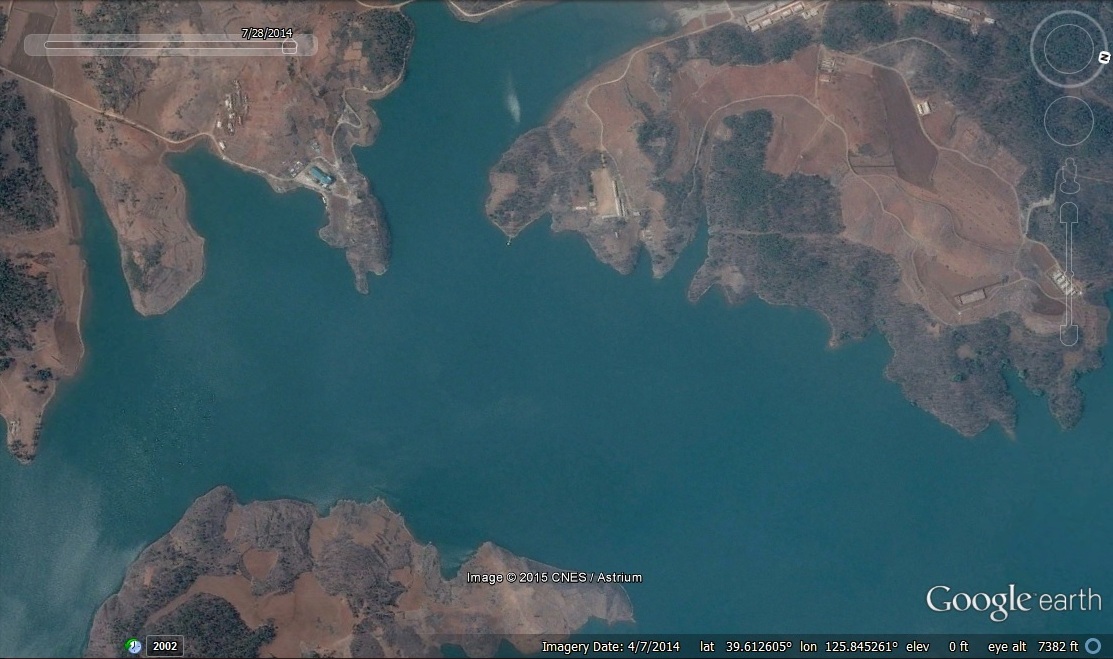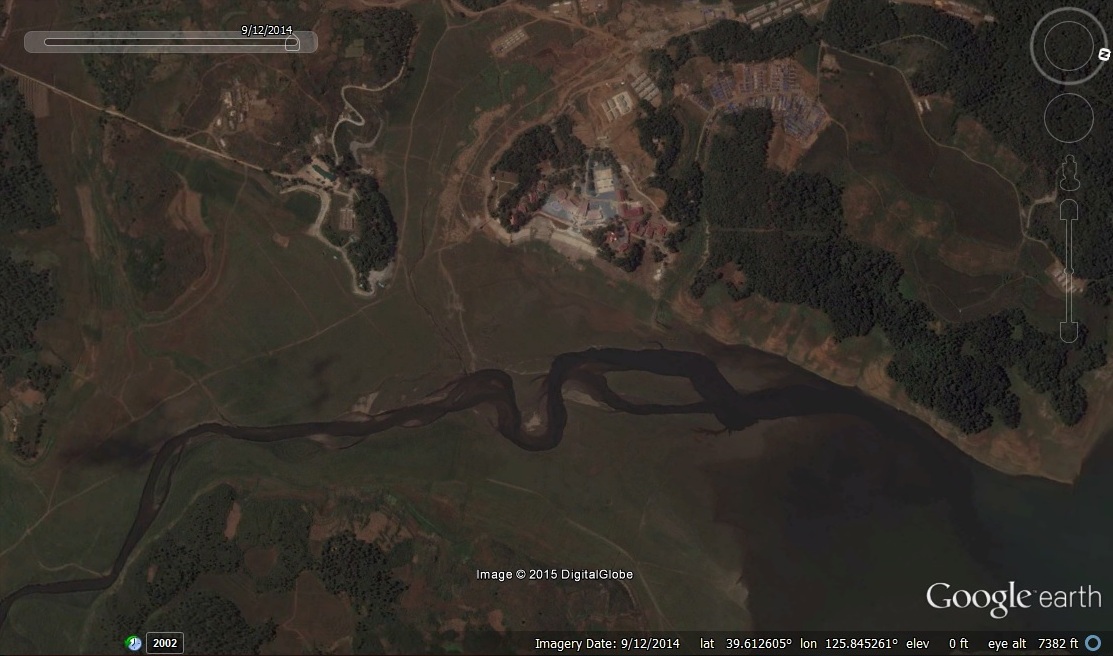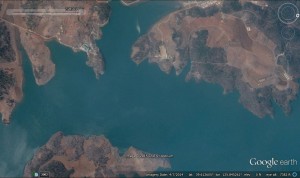
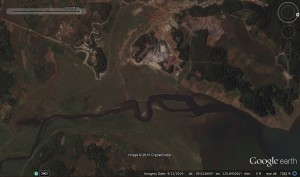
Pictured above in Google Earth: (Top) Lake Yongphung 2014-4-7 (Bottom) Lake Yongphung 2014-9-12
UPDATE 27 (2015-8-13): Reliefweb reports CERF aid to the DPRK for drought relief:
Central Emergency Response Fund allocates US$6.3 million for Drought Response in DPR Korea
A long period of abnormally dry weather affecting DPR Korea has resulted in drought, impacting agricultural production, reducing access to water and leading to a deterioration of health, nutrition and sanitary conditions. Approximately 18 million people, dependent on Public Distribution System rations are affected and at risk of food insecurity, malnutrition and waterborne diseases.
As the United Nations and humanitarian partners step up their support to national relief efforts in the lead up to the peak of the lean season, US$6.3 million was allocated from the Central Emergency Response Fund (CERF) to respond to urgent needs. This funding enables UN agencies to rapidly scale up response operations and provide 1.3 million people, including 790,000 women and children, with life-saving assistance in four of the most affected provinces of South Hwanghae, North Hwanghae, South Pyongan and South Hamgyong.
“The availability of CERF funds allows us to kick-start life-saving response to communities affected by drought”, said the United Nations Resident Coordinator to the DPR Korea, Mr. Tapan Mishra. “The critical funds will help reduce incidence of diarrhoea and other non-communicable diseases, caused by a lack of access to safe water. The funds will also be used to combat malnutrition exacerbated by a lack of access to food, water and the increase incidence of waterborne diseases.”
CERF funds are insufficient to meet the urgent needs of all the affected communities, particularly where chronic humanitarian needs are exacerbated by the drought. DPR Korea remains critically underfunded, with only 36 per cent of funding received for humanitarian programmes in 2015.
“Additional funding sources continue to be urgently required as humanitarian operations in DPR Korea remain underfunded,” emphasized Mr. Mishra. “Humanitarian and political issues must be kept separate in order to ensure we can respond to the needs of the most vulnerable, especially women and children.”
Xinhua also reported on this (2015-8-19):
The UN Central Emergency Response Fund (CERF) has 6.3 million U.S. dollars for drought response in the Democratic People’s Republic of Korea (DPRK), and UN agencies and humanitarian partners are stepping up their support to national relief efforts in the lead up to the peak of the lean season, a UN spokesperson told reporters here Tuesday.
“The resident and humanitarian coordinator for the DPRK, Tapan Mishra, said that a long period of abnormally dry weather affecting the country has resulted in drought, impacting agricultural production, reducing access to water and leading to a deterioration of health, nutrition and sanitary conditions,” UN associate spokesperson Vannina Maestracci said at a daily news briefing.
“An estimated 18 million people, dependent on Public Distribution System rations, have been affected and are at risk of food insecurity, malnutrition and waterborne diseases,” she said.
Rainfall figures and information from humanitarian agencies and the government indicated that parts of the DPRK are already facing serious drought. North Hwanghae, South Hamgyong and South Hwanghae are most affected provinces by the decline in rainfall, the UN Children’s Fund (UNICEF) said in early July.
UNICEF officials have recently met with local health officials in affected provinces who confirm reports of significant increases in diarrhea among children, as the absence of rain threatens access to safe water and sanitation.
“Lack of rain reduces access to clean water and undermines effective hygiene, putting children’s lives at risk,” said UNICEF Regional Director Daniel Toole. “The UNICEF has already received reports that the incidence of diarrhea, globally a leading cause of death among young children — has increased seriously in the first six months of 2015 in the drought-affected provinces.”
The UNICEF has released prepositioned emergency supplies to help those in the worst-affected provinces, including water purification tablets, water storage containers and health supplies for children with severe acute malnutrition. Training on how to treat children with severe acute malnutrition has also been stepped up.
The UN agency will take time to ensure life-saving water. Hygiene, medical supplies, and the expertise to use them, are available at the levels required should the drought continue.
The drought-affected provinces are key sources of DPRK staple food crops. The UNICEF warned if the main harvest fails in those provinces food may become scarce across the country, which could dramatically increase the numbers of children at serious risk.
An earlier report indicated that CERF had delivered US$2m to the DPRK in the first half of 2015. According to VOA (2015-1-26):
U.N. humanitarian chief Valerie Amos has allocated about $100 million from the Central Emergency Response Fund (CERF) to boost relief work in 12 countries, including North Korea.
But only about $2 million will be given to the communist country for the first half of this year, a 70 percent plunge from the beginning of last year.
The decrease comes as the need for emergency assistance has risen sharply in Syria and surrounding countries.
UPDATE 26 (2015-8-11): Reliefweb (UN Office for the Coordination of Humanitarian Affairs) has published an update on the status of the 2015 drought:
For the last eighteen months, a long period of abnormally dry weather has affected DPR Korea (DPRK) affecting agricultural production, reducing access to water and leading to a deterioration of health, nutrition and sanitary conditions.
According to official meteorological data, all provinces in DPRK have experienced less rainfall than the average, however the difference in the level of rainfall was most severe in May and June. In May 2015, total rainfall was 57% below the average. A partial failure of the early harvest of 18% is expected. If weather conditions persist, the main crop harvest (September/October) is also likely to be severely impacted.
Provinces produce specific crops, with some producing more than provincial requirements and some with less. Provinces then import or export depending on their production levels which is then complemented by the Government food ration provided through the Public Distribution System (PDS). As the drought has severely affected the major food producing provinces this has impacted the whole country.
You can download the full report (PDF) here.
UPDATE 25 (2015-7-15): Writing in 38 North, Randall Ireson asks if the drought is over…
After a month of concern, DPRK farmers have received substantial rains in the last few days, which will at the very least break the current drought. Except for Sinuiju on the Chinese border, weather stations in the western farming region have reported between 3.5 and 7.5 inches of rain between July 10 and 14, with similar amounts falling in Kangwon province.
This is very good news, and will provide adequate moisture for the main crops for the immediate future. The next week is expected to be dry, but another smaller weather system is expected over the weekend. If rainfall for the remainder of the year is at or near normal amounts, adverse effects of the recent dry months will be limited. But July rainfall is still less than half of normal, and crops will need substantial rain into August to insure normal development.
Read the full story here.
UPDATE 24 (2015-7-14): According to Marcus Noland:
Well, the rains came and it appears that the worst will be avoided. According to the Ministry of Unification, after May rains only reached 55 percent of their normal levels, precipitation picked up in June, reaching 90 percent of the norm. While the fall harvest may be adversely affected, the normal June-July monsoon type rains are most critical for most crops (see figure 1 of the GIEWS Update if you’re really into it).
This doesn’t mean North Korea is completely out of the woods or some might not suffer. UNICEF is reporting an upsurge in children’s diarrhea, a leading cause of death among children worldwide. According to UNICEF Regional Director Daniel Toole, “Lack of rain reduces access to clean water and undermines effective hygiene, putting children’s lives at risk.” The agency reports increases in childhood diarrhea: a 71 percent increase in North Hwanghae province; a 34 percent increase in South Hamgyong province; and a 140 percent increase in South Hwanghae province for the first six months of the year. As I observed in an earlier post, the sensitivity of the population to such shocks is heightened by the pre-existing poor nutritional status of many children in North Korea.
To make matters worse, the FAO reported last week that authorities had cut the July distributions through the public distribution system (PDS) to “310 grams per person per day, a 25 percent decrease from the previous month. Between January and June 2015, the average food ration was 410 grams per person per day.” This isn’t good news, but not clear how bad this news is either: the PDS had become largely irrelevant for much of the population, particularly the most vulnerable groups which have more or less operated outside of it for 20 years. Nevertheless, even though most North Korean households do not rely on the PDS for most of their consumption needs, a cut in rations does hurt at the margin, and could be propagated throughout the society if those who do get food via the PDS turn to the market, putting upward pressure on prices there.
UPDATE 23 (2015-7-10): In an IFES report, the DPRK asserts that food production has increased over the last few years due to agricultural adjustment policies like the 6.28 Measures or the 5.30 Measures.
Despite Drought Last Year, Food Production Increased Due to Field Responsibility System
North Korea experienced its biggest drought in 100 years last year. However, North Korea claims that this did not affect its food production. North Korean authorities are claiming the main factor behind the increased food production is the will of farmers to produce more after the expansion of the “field management system,” or pojon tamdangje.
In an interview with the weekly newspaper, Tongil Sinbo, Chi Myong Su, director of the Agricultural Research Institute of the Academy of Agricultural Sciences of the DPRK commented, “the effectiveness of field management system (pojon) from cooperative farm production unit system (bunjo) is noticeable and succeeded in increasing grain production despite the adverse weather conditions.”
The field management system under the bunjo management system or the subworkteam management system divides the work unit consisting of 10-25 people into smaller units of 3-5 people, responsible for farming a smaller unit of a field. This is a measure to increase the “responsibility and ownership of farmers.”
From the July 1st Economic Management Improvement Measures enforced in 2002, the autonomy of cooperative farms and enterprises expanded. The “field management system” was piloted from early 2004 in Suan, North Hwanghae Province and Hoeryong, North Hamgyong Province, but was suspended soon afterward. However, this system is reported to have been implemented widely after the first National Conference of Subworkteam Leaders in the Agricultural Sector was held in Pyongyang in February 2014.
Economic principles behind the field responsibility system are stated as, “under the sub-work team structure, a smaller subworkteam consisting of 2 to 3 families or 3 to 4 people depending on the scale and means of production, is responsible for a specific field or plot (pojon) from planting to harvest stage to inspire farmers with enthusiasm for production by distributing the shares of production in accordance with the output of production planning.”
The newspaper added, “Despite the adverse weather conditions last year, the high grain yield was possible due to implementation of scientific farming methods and field management system to increase enthusiasm of farmers,” and “based on this experience, many cooperative farms across the country will expand subworkteam management system to field management system.”
Director Chi stated, “Since the field management system was implemented, farmers’ labor capacity increased to 95 percent. The planting time for corn and rice that took 20 to 30 days in the past is shortened to 10 to 15 days. In the autumn season, grain threshing that took 50 days is now only taking 10 days. This is changing the farming landscape.”
In addition, the distribution shares for farmers increased as well as the state’s procurement last year. This is attributed to “socialist distribution principles that distributed grains produced to farmers in-kind based on their efforts after excluding a specified amount of grain procured by the state.”
He added, “There are quite a number of farming households that received several decades worth of distribution after a year of farming. There is an increasing number of families with growing patriotism to increase the amount of grain procurement to the state.”
UPDATE 22 (2015-7-10): The South Korean Ministry of Unification reports that the drought has eased. According to Yonhap:
The Unification Ministry said Friday that a severe drought that hit North Korea appears to have considerably eased since June as rainfall has almost reached last year’s level in many areas.
North Korea has been grappling with what it called the worst drought in 100 years, sparking concerns about food shortages. South Korea earlier predicted that the North’s crop production could fall by as much as 20 percent if the lack of rain continues into early July.
The ministry said the dry spell seems to have eased in North Korea though several areas in the northeast and midwest provinces are still suffering from the drought.
“North Korea had suffered from severe drought across the nation until May. But it seemed that since July, the situation has considerably eased,” Jeong Joon-hee, ministry spokesman, said in a press briefing.
“But some provinces such as Hwanghae and Hamgyeong provinces are still grappling with prolonged drought, which warrants a close watch,” he added.
The ministry said that the average precipitation in May reached 54.5 percent of that recorded a year earlier. But in June, the rainfall increased to hit almost 90 percent of the level recorded in the same period last year.
Seoul earlier said that it is willing to provide support for North Korea in coping with the drought if the country makes a formal request. There has been no request from Pyongyang.
“Currently, the South government is not considering providing food aid to the North,” said a ministry official, asking not to be named.
UPDATE 21 (2015-7-10): VOA reports that food rations have been cut:
Drought-hit North Korea has reduced food distribution, an official of the U.N. Food and Agriculture Organization (FAO) said Thursday.
Cristina Coslet, FAO’s Global Information and Early Warning System officer in charge of Far East Asia, told VOA the North Korean government informed the agency that the country’s food ration for July was 310 grams per person per day, a 25 percent decrease from the previous month. Between January and June 2015, the average food ration was 410 grams per person per day.
Coslet said a severe drought is affecting the country’s crop production.
“We assume that this is mainly because early planted crops – wheat, barley, potato – decreased considerably,” said Coslet in a phone interview with VOA.
Coslet expected this year’s production of potatoes and winter wheat to drop by more than 20 percent from the previous year.
The FAO official said the early season harvest is relatively small, but it is an important food source for North Koreans.
“Spring crops are vital for food security, being an important food source for the lean season, which stretches from May to September,” said Coslet.
Coslet added, however, that it is still too early to estimate the final harvest, as rainfall in the coming weeks is crucial.
Despite the dismal forecast, the communist country is not known to have sought food assistance from U.N. agencies or Western countries.
UPDATE 20 (2015-7-9): Stephan Haggard offers analysis here.
UPDATE 19 (2015-7-9): UNICEF is worried about the impact of drought. According to the AFP:
A serious drought in North Korea requires urgent action to prevent the deaths of children already weakened by widespread malnutrition, the U.N. children’s fund, UNICEF, warned Thursday.
“The situation is urgent. But if we act now — by providing urgently needed expertise and pre-positioning supplies — we can save lives,” said UNICEF East Asia Regional Director Daniel Toole.
“If we delay until we are certain of crop failures, it may well be too late to save the most vulnerable children,” Toole said in a statement.
North Korea is currently suffering what its official media described last month as the “worst drought in 100 years.” It has severely impacted main rice-growing areas.
According to the U.N. World Food Program, early-harvest crops, mainly wheat and barley, have already been affected.
UNICEF said its personnel had recently met with local health officials in affected provinces who confirmed reports of significant increases in diarrhoea among children.
“Lack of rain reduces access to clean water and undermines effective hygiene, putting children’s lives at risk,” Toole said.
Concern about the impact of the drought is heightened by the existing poor nutritional status of many children in North Korea.
A 2012 study showed one-quarter of all North Korean children had symptoms of chronic malnutrition — a condition usually caused by a combination of unsafe water and poor sanitation, low food intake, and inadequate access to health services.
Toole said responding to the current drought crisis was difficult given North Korea’s isolation and the lack of funding for children-focused programs in the country.
But UNICEF has released pre-positioned emergency supplies to help those in the worst-affected provinces, including water purification tablets, water storage containers and health supplies for children with acute malnutrition.
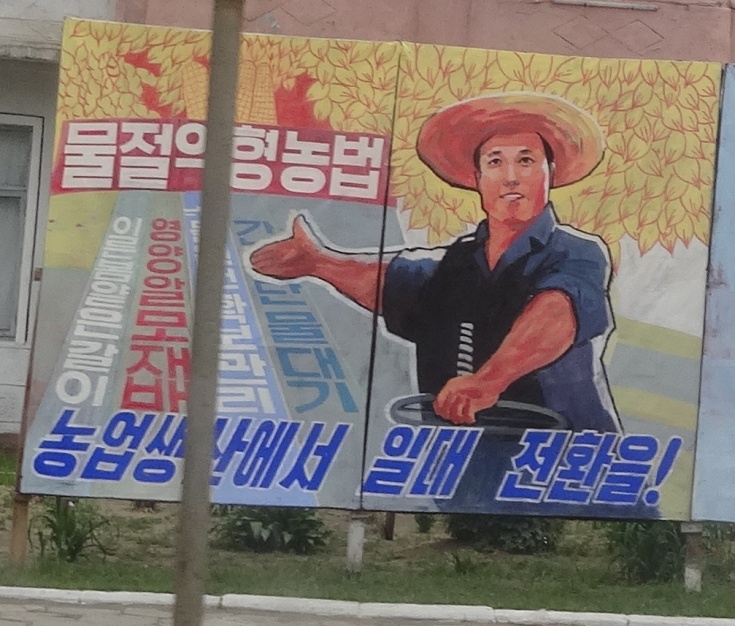
UPDATE 18 (2015-7-9): A visitor to North Korea has sent this third drought poster. This poster was never published in Rodong Sinmun or KCNA. I have worked to translate it as best as possible, but still not quite there:
z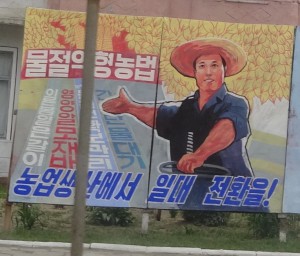 z
z
물절약형농법=An Agricultural Methods to Save Water
밍른봉 얕은갈이=Shallow tillage in early spring
영양알모재배 (?)=Cultivation methodology?
물원전학보관리 (?)=Management of water resources?
간단물대기=Simple irrigation
농업생산에서 일대 전환을!=A complete change/shift through agricultural production!
UPDATE 17 (2015-7-3): Associated Press covers drought in Unpha.
UPDATE 16 (2015-7-1): UN OCHA posts this document on the drought.
UPDATE 15 (2016-6-26): Associated Press covers drought in Hwangju County:
The protracted drought is heightening worries about North Korea’s ability to feed its people. Two-thirds of North Korea’s 24 million people faced chronic food shortages, the United Nations said earlier this month while asking donors for $198 million in humanitarian aid for the country.
Even in South Phyongan and North and South Hwanghae provinces, which are traditionally North Korea’s “breadbasket,” thousands of hectares (acres) of crops are withering away despite good irrigation systems, local officials said.
Reservoirs are drying up, creating irrigation problems for farmers, said Ri Sun Pom, chairman of the Rural Economy Committee of Hwangju County.
A group of female soldiers with yellow towels tied around their heads fanned out across a farm in Kohyon-ri, Hwangju county, North Hwanghae province, with buckets to help water the fields. An ox pulled a cart loaded with a barrel of water while fire engines and oil tankers were mobilized to help transport water.
The North Korean villages of Kohyon-ri and Ryongchon-ri were among several areas that journalists from The Associated Press visited in recent days.
Pak Tok Gwan, management board chairman of the Ryongchon Cooperative Farm in North Korea, said late last week that the farm could lose half its corn without early rain.
Mountainous North Korea, where less than 20 percent of the land is arable, has relied on outside food aid to help make up for a chronic shortage since natural disasters and outmoded agricultural practices led to a famine in the 1990s. North Korean farmers still face shortages of fuel, tractors, quality seeds and fertilizer, the U.N. said in a report earlier this month. Many irrigation systems rely on electrically powered pumping stations in a country with unstable power supplies, the report noted.
On Tuesday, North Korean state media reported record-high temperatures in Pyongyang and other cities in the southwest.
UPDATE 14 (2015-6-25): Yonhap offers a comprehensive story on the drought:
N. Korea claims worst drought in 100 years
SEOUL (Yonhap) — North Korea has claimed again it is suffering from the worst drought in 100 years, while some foreign experts expressed skepticism, saying that the North may be exaggerating the situation in hopes of getting international aid.
The (North) Korean Central News Agency (KCNA) said on June 16 the worst drought in 100 years continues in the country, causing great damage to its agricultural fields.
The KCNA said rice-transplanting has been finished in more than 441,560 hectares of paddies across the country as of June 8, but at least 136,200 hectares of them are becoming parched.
The granaries in North and South Hwanghae provinces and South Pyongan and South Hamgyong provinces have been badly damaged, it claimed.
“Drought dries up rice-seedlings in nearly 80 percent and 58 percent of paddy fields in South and North Hwanghae provinces,” the North’s mouthpiece said, adding that the water level of reservoirs is at its lowest, while rivers and streams are getting dry.
North Korea experts expect the country’s grain production this year to drop substantially if the drought continues through July, which could deal a further blow to its chronic food shortage problem.
A severe drought may reduce North Korea’s rice harvest by 12 percent this year from a year earlier, a report by the Food and Agriculture Organization of the U.N. showed on June 20, warning of the worsening food shortage in the impoverished country.
The latest FAO report put North Korea’s rice production at an estimated 2.3 million tons for this year, compared with the country’s rice harvest of 2.6 million tons a year earlier.
The estimated production may be less than the average amount of rice produced annually over the past five years, it added.
About one-fourth of North Korea’s total 544,000 hectares of rice paddies are being affected by the drought, the report also noted.
The drought may also eat into the country’s production of double crop products, like potatoes, wheat and barley, according to the report, which put the estimated amount at 277,000 tons this year.
North Korea’s North Hwanghae Province, which accounts for a majority of crop production, is sustaining severe damage from the drought, the report said.
North Korea is also reported to be suffering from severe electricity shortages as power generation in hydro power plants, which account for more than 60 percent of the North’s electricity generation, has been hit hard by the drought.
Reuters reported on May 30 that many hydro power plants in North Korea have suspended operation, reducing the nation’s power generation by half.
According to the U.S. Energy Information Agency, North Korea’s electricity generation stood at 19 billion kilowatts in 2012, less than 5 percent of South Korea’s electricity generation in the same year.
There are also reports that North Korea’s claim of the “worst drought in 100 years” was exaggerated.
The drought now gripping North Korea is not yet a “catastrophe,” a U.S. agricultural expert said on June 18, suggesting that the socialist country may be exaggerating the situation.
The report came days after the South’s unification ministry forecast that the North’s grain production will likely drop by up to 20 percent this year from 2014 if a shortage of rainfall continues until early July.
“We need to be a bit cautious before anticipating a new disaster,” said Randall Ireson in an article carried by the website 38 North, citing previous examples in which the North warned of a disaster, but the situation later improved.
“Early last year, the DPRK government also warned about a drought crisis, but later rains allowed a recovery — while rice production fell about 10 percent from 2013, maize production hit a new high,” he said.
In 2012, the North also claimed another “worst drought in a century,” but ultimately a harvest of 4.92 million tons of grain equivalent, which is consistent with the surrounding years, ensued, the expert said.
“The KCNA article claims that no rain has fallen in South and North Hwanghae provinces. That is hyperbole,” he said, adding that precipitation data show a total of 181 millimeters at Haeju and 102 mm at Sariwon since March.
“While substantially below the historical average (330 mm for Haeju, unavailable at Sariwon), it is hardly ‘no rain,'” he said.
Rain has also fallen in the last few days in what could be the beginning of an annual monsoon season, he said.
“So while one has a right to be concerned, it’s not yet a catastrophe. If the rains of the last few days presage the arrival of the monsoon, then all may turn out fine. If there’s no change in the next couple of weeks, then we should start to worry,” he said.
The U.S. State Department also has ruled out a plan to give aid to North Korea in relation with the current drought.
The Voice of America reported on June 3, quoting a department spokesman, that the department has no plan to offer aid to North Korea at present and North Korea has not asked the U.S. for help yet.
Meanwhile, South Korea said it is ready to support North Korea, Seoul’s pointman on inter-Korean affairs has said.
Unification Minister Hong Yong-pyo said on June 24 that Seoul is willing to offer the necessary support to the North if the North’s situation deteriorates, but added that the South will wait for Pyongyang’s request.
“At a time when the two Koreas are coping with drought, I think that this situation can be a chance to promote cooperation,” Hong said in a meeting with a group of reporters. “If North Korea faces tougher situations, South Korea is willing to provide the necessary support to North Korea.”
He did not elaborate on the kinds of support.
Seoul, however, does not have any immediate plans to make such a proposal to the North pre-emptively, he said, hinting that Seoul needs Pyongyang’s request for help.
“The South is carefully reviewing how to approach this matter,” he added.
In 2014, the North reported its lowest amount of rainfall in 15 years and the United Nations has warned that North Korea is likely to suffer from serious food shortages this year.
The North has relied on international handouts since 1995 to help feed its people in the face of chronic food shortages.
A U.N. report showed that about 70 percent of North Korea’s 24.6 million people suffer from food shortages and 1.8 million, including children and pregnant women, are in need of nutrition.
Meanwhile, Hong expressed regret over the North’s boycott of the upcoming Summer Universiade in South Korea due to political reasons, saying that the sports competition could be a good chance for dialogue.
The North issued a rare statement on June 15 that it is ready to hold dialogue with Seoul if certain conditions are met, including the suspension of the South’s joint military drills with the United States. North Korea, however, took tough measures less than 10 days after the dialogue proposal, including the boycott of the Universiade and sentencing two South Koreans it has detained to lifetime compulsory labor, accusing them of spying for South Korea’s intelligence agency.
UPDATE 13 (2015-6-23): Associated Press publishes images of drought in Nampho.
UPDATE 12 (2015-6-22): Anna Fifield reports in the Washington Post that the chances of a famine returning are slim.
UPDATE 11 (2015-6-22): Marcus Noland offers analysis here.
UPDATE 10 (2015-6-20): Drought may cut N. Korea’s 2015 rice harvest by 12 pct: FAO. According to Yonhap:
A severe drought may reduce North Korea’s rice harvest by 12 percent this year from a year earlier, a report by the Food and Agriculture Organization of the U.N. showed Saturday, warning of the worsening food shortage in the communist country.
The recent FAO report put North Korea’s rice production at an estimated 2.3 million tons for this year, compared with the country’s rice harvest of 2.6 million tons a year earlier.
The estimated production may be less than the average amount of rice produced annually over the past five years, it added.
About one-fourth of North Korea’s total 544,000 hectares of rice paddies are being affected by the drought, the report also noted.
The drought may also eat into the country’s production of double crop products, like potato, wheat and barley, according to the report, which put the estimated amount to 277,000 tons this year.
North Korea’s North Hwanghae province, which accounts for a majority of crop production, is sustaining severe damage from the drought, the report said.
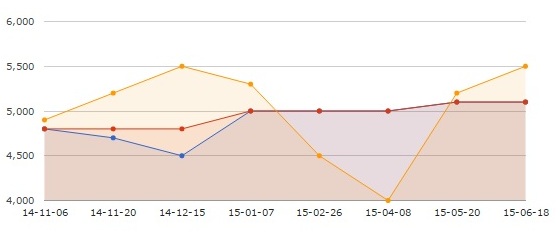
UPDATE 9 (2015-6-19): The Daily NK is reporting in an article price information that is different than its exchange rate/rice price table. Here is a small table that shows the difference:

The exchange rate and rice price differences are not all that significant, and could be related to variations in when they were collected. However, the article text implies that potatoes are the only crop seeing more significant price increases at the moment (and only in Hyesan):
According to an inside source, the cost of potatoes in Yangkang Province’s Hyesan Agricultural Market is approximately 2,000 KPW per kg. This represents a massive 1,300 KPW rise when compared to last year’s prices. It’s quite rare to see the cost of potatoes shoot up to the 2,000 KPW mark. This has sent residents into a minor panic. For the same price, it would have been possible to buy about three times as many potatoes this same time last year. This is putting a strain on many residents’ ability to put together a nutritious meal. At the Hyesan jangmadang, corn is selling for 1,800 KPW per kg. Next to that figure, it’s plain to see that the relative cost of potatoes is exorbitantly high. Residents can protest, but at the end of the day, they don’t have any better options.
The article lists other prices, but does not explain any price changes, so I do not know if they have significnatly increased:
Moving along, the cost of 1 kg of corn was 2,400 KPW in Pyongyang and Sinuiju and 2,600 KPW in Hyesan. One kg of pork was selling at 14,000 KPW in Pyongyang, 14,300 KPW in Sinuiju, and 15,000 KPW in Hyesan. Gasoline was trading at 9,450 KPW per kg in Pyongyang and Sinuiju and at 8,450 KPW per kg in Hyesan. Finally, 1 kg of diesel fuel was selling at 5,100 KPW in Pyongyang and 5,200 KPW in Sinuiju and Hyesan. This has been a weekly rundown on North Korea’s latest market prices.
And if you noticed in the above two quotes, the article gives two prices for the price of corn in Hyesan (1,800 and 2,600), so I am not sure what to make of that.
UPDATE 8 (2015-6-18): Marcus Noland offers analysis here and here.
UPDATE 7 (2015-6-18): China Says it is willing to help drought-hit North Korea (Reuters):
China’s Foreign Ministry said on Thursday that the government was willing to help drought-stricken North Korea, after the isolated country said it was suffering its worst drought in a century.
“Our sympathy goes out to the People’s Republic of Korea that is suffering from extremely serious drought, and it is our hope that the government and people will overcome the disaster as soon as possible,” spokesman Lu Kang told a daily news briefing, using North Korea’s official name.
“China is willing to provide the aid that is needed by the Democratic People’s Republic of Korea,” he added, without providing details.
The US says it has no plans to assist the DPRK in the event of a drought. According to Yonhap:
The United States said Wednesday it has no plans to provide food aid to North Korea amid concern food shortages in the impoverished communist nation could significantly worsen due to what the country calls the worst drought in a century.
…
“I’ve seen the reports about the drought. I don’t have any specific information about the validity of the drought,” U.S. State Department spokesman John Kirby said at a regular briefing in response to a question about the North’s report.
Asked if the U.S. would consider providing food aid, Kirby said, “I’m not aware of any such plans. No.”
UPDATE 6 (2015-6-18): In 38 North, Randall Ireson reports we should take a care when assessing the impact of North Korea’s drought.
The KCNA article claims that no rain has fallen in South and North Hwanghae provinces. That is hyperbole. Precipitation data show a total of 181 mm at Haeju and 102 mm at Sariwon since March. While substantially below the historical average (330 mm for Haeju, unavailable at Sariwon), it is hardly “no rain.” In both locations there were substantial rains in the last several days (61 mm in Haeju, 48 mm in Sariwon). Other locations show a similar pattern of sharply lower rainfall than average, but a recent uptick: Pyongyang has had 143 mm since March, 27 mm in the last week, compared to a March-June average of 230 mm. Anju reported 202 mm since March, 78 mm last week, against a March-June average of 320 mm.[7] So while one has a right to be concerned, it’s not yet a catastrophe. If the rains of the last few days presage the arrival of the monsoon, then all may turn out fine. If there’s no change in the next couple of weeks, then we should start to worry.
Read the full report here.
UPDATE 5 (2015-6-18): The Daily NK reports that the price of rice is basically constant in Pyongyang and Sinuiju this year, though the price shows significant variation in Hyesan:
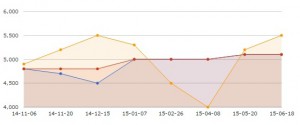
UPDATE 4 (2015-6-16): KCNA reports drought this year:
The worst drought in 100 years continues in the DPRK, causing great damage to its agricultural field.
According to data available, rice-transplanting has been finished in over 441 560 hectares of paddy fields across the country as of June 8, but at least 136 200 hectares of them are parching up.
The granaries including North and South Hwanghae provinces and South Phyongan and South Hamgyong provinces have been badly damaged.
Drought dries up rice-seedlings in nearly 80 percent and 58 percent of paddy fields in South and North Hwanghae provinces.
According to the State Hydro-meteorological Administration, no rainfall has been witnessed in North and South Hwanghae provinces.
Water level of reservoirs stands at the lowest, while rivers and streams getting dry.
Other crops are planted in paddy fields of drought-stricken areas as part of the campaign to reduce damage.
UPDATE 3 (2015-6-11): WFP on standby for possible N. Korea drought. According to Yonhap:
The United Nations food agency is closely monitoring the weather conditions in North Korea in order to send emergency assistance there in case of a protracted dry spell, the agency’s regional director in Asia said Wednesday.
South Korea said a day earlier that food production in North Korea may fall by 20 percent on-year if the current drought continues until early July.
“The concern is going to grow week by week until we get closer to the traditional July harvest,” David Kaatrud of the World Food Program (WFP) told Yonhap News Agency in an interview. “So our role is to not only be vigilant … but also stand ready should assistance be required to change our operation toward relief related to any type of food insecurity.”
Last month, North Korea received less than 60 percent of the average monthly rainfall recorded between 1981 and 2010. Precipitation reached a 15-year low last year, with the U.N. warning of severe food shortages should the dry weather there continue.
The WFP has mainly focused on providing nutrition to the most vulnerable, or about 2.4 million children and women, for the past two years.
It recently extended the two-year project, slated to end this month, through the end of 2015.
“We need enough time to refine the intervention we’re doing now,” he said. “The broad contours of what we will be doing next would be very similar to what you see now — it will continue to be focused on a targeted nutrition intervention because that’s what’s required there.”
He reiterated that the WFP was ready to shift its targeted intervention to a more widespread one in case of a severe food crisis.
“But we don’t have any indications (of that) yet,” he said.
The North has relied on international assistance since 1995 to help feed its people in the face of chronic food shortages.
About 70 percent of its people lack food and 1.8 million, including children and pregnant women, are malnourished, according to U.N. data.
The WFP is the U.N.’s largest humanitarian aid arm, accounting for more than 60 percent of the world’s food assistance.
South Korea’s contributions to WFP operations globally reached US$31 million last year.
The two sides held their first annual consultations Wednesday, cementing their commitment for the Zero Hunger Challenge pioneered by U.N. Secretary-General Ban Ki-moon. The challenge aims to ensure that every person has a right to adequate food.
UPDATE 2 (2015-6-9): N. Korea’s crop production may fall 20% in drought. According to Yonhap:
North Korea is likely to see its food production fall by up to 20 percent this year from 2014 if a shortage of rainfall continues until early July, a Unification Ministry official said Tuesday.
In May, precipitation in North Korea reached 57 percent of the average rainfall recorded between 1981 and 2010, according to the official.
In 2014, the North reported its smallest rainfall in 15 years and the United Nations has warned that North Korea is likely to suffer from serious food shortages this year due to drought.
North Korea’s crop production could decline by 15 to 20 percent this year compared to last year if it continues to see a rainfall shortage until early July, the official said.
The North is expected to see its food production fall by only 5 to 10 percent if the lack of rainfall continues into early June. In that case, North Korea is believed to be focusing on producing maize as an alternative to rice.
“This year, the supply of fertilizer is not smooth, compared with last year,” said the official, asking not to be named.
The North has relied on international handouts since 1995 to help feed its people in the face of chronic food shortages.
A U.N. report showed that about 70 percent of North Korea’s 24.6 million people suffer from food shortages and 1.8 million, including children and pregnant women, are in need of nutrition.
Last year, the North suffered from a severe drought in the spring, but managed to produce crops at a level similar to that of 2013 due mainly to the use of preserved water.
The official said that the North’s agricultural reforms might have helped it maintain the food production last year, but this year’s situation may bode ill, given that fertilizer availability is worse.
In 2012, the North announced the so-called “6.28 measures” that centered on allowing farmers to keep 30 percent of their production quota plus any excess over the quota. Last year, it unveiled a new set of reforms that call for raising the farmers’ portion to 60 percent.
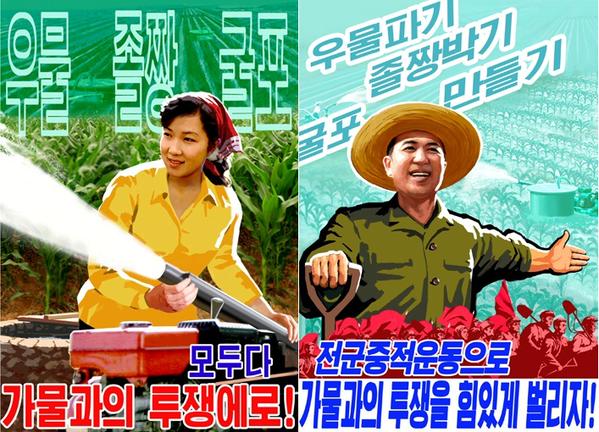
UPDATE 1 (2015-6-3): KCNA reports that two posters have been produced to instruct/motivate people to overcome hardships brought on by drought:
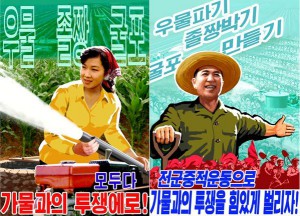
According to Anna Fifield at the Washington Post, the posters say “Everybody fight against the drought!” and “Let’s all fight powerfully against the drought!”.
ORIGINAL POST (2015-5-31): On 2015-5-11 I reported in Radio Free Asia that many of North Korea’s reservoirs have shown a fall in water levels from 2012 to 2014. This was more evidence of a drought that had struck the country in 2014, and that if it continued, it could affect food and electricity production.
On May 30, Reuters reports that the UN is warning of another drought:
A drought in North Korea could lead to huge food shortages this year, the top U.N. official in the country told Reuters in an interview.
Rainfall in 2014, the lowest in records going back 30 years, was 40-60 percent below 2013 levels, and reservoirs are very low, said Ghulam Isaczai, the U.N. resident coordinator.
“We’re extremely concerned with the impact of drought which will affect the crop this year severely. And we might be faced with another major incident of food availability or even hunger,” said Isaczai. “It is going to create a huge deficit between the needs and what is available.”
If El Nino weather conditions bring more drought this year, the situation in 2016 could be even worse, he warned.
“This is currently the rice-planting season. Normally they submerge the land almost a week or two in advance. But this year, I’ve seen it myself – they’re doing it in the dry, actually planting rice. So what we’re hearing right now is that they’re switching to maize and corn because that requires less water.”
Some farmers, already struggling with a shortage of fuel and equipment, have resorted to using buckets to water seedlings, he said. The effect of North Korea’s lack of agricultural infrastructure such as irrigation systems was visible on the border, where “dry and harsh” North Korean land met green fields in China.
A famine in the 1990s killed as many as 1 million North Koreans but recently many international donors have been reluctant to help because of Pyongyang’s restrictions on humanitarian workers and international concerns over its nuclear ambitions.
“Let’s not make aid political,” Isaczai said.
ELECTRICITY HIT
The United Nations provides nutritional supplements to schools and hospitals but does not have the funds to supply rice for North Korea’s 24.6 million population, 70 percent of whom are already classed as “food insecure”.
“How are they going to fill this gap? I think they have reached out to some countries – to India, to China, to Russia,” Isaczai said.
The lack of water has dried up rivers and streams and has also hit electricity supply, which was at its worst in winter when hydroelectric power was restricted to reserve water for the rice-planting season.
“What the government confirmed to me is that they’re operating at 50 percent of capacity in terms of power generation. A lot of it is now related to water,” the U.N. official added.
Blackouts in Pyongyang last anything from 8-9 hours to a whole 24 hours and many hospitals are unable to operate.
Isaczai said he thought the food situation would not be as bad as in previous major droughts, since communities were now more resilient and might have some reserves.
New farming rules – which allow smaller, family-sized teams to run farms – meant more efficiency and ownership, he said, with families allowed to keep livestock and farmers able to keep surplus crops.
“Also there are small markets emerging in rural areas, like kind of farmers’ markets where people can barter or trade or sell things.”
Some people were also selling food on the street, which might be a few eggs or apples, enabling families to supplement the food they get from the national ration system.
The reforms may not be fast or widespread, Isaczai said, and the impact may take three to five years to be felt.
The government also set a target last year of building 20,000 greenhouses, he said, which would make more vegetables available and diversify diets, but the country needs help to build them.
Read the full story here:
U.N. warns of coming hunger in North Korea
Reuters
Tom Miles
2015-5-30