Archive for the ‘Special Economic Zones’ Category

Ready to Run

Friday, May 4th, 2007

Joong Ang Daily
5/4/2007

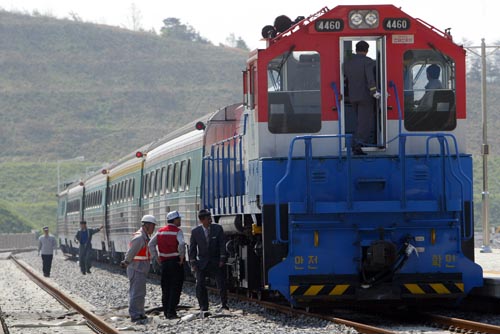
train.jpgAt Jejin Station on the east coast of South Korea, railroad officials yesterday checked a train to be used in the scheduled test of the restored inter-Korean railroads on May 17. In the pilot operation to reconnect the East Coast Line and the Gyeongui Line, trains from both sides will cross the demilitarized zone. North Korea has broken a promise to hold similar trial runs three times in the past.

Share

The North Korean Economy: Between Crisis and Catastrophe

Thursday, May 3rd, 2007

American Enterprise Institute Book forum
4/17/2007

A couple of weeks ago, I had the opportunity to attend a book forum at the American Enterprise Institute on Nicholas Eberstadt’s new book, The North Korean Economy: Between Crisis and Catastrophe.  It was very informative to hear three different perspectives on the direction of North Korea’s economic reform.

Panelists included:

Nicholas Eberstadt, AEI
Andrei Lankov, Kookmin University
Deok-Ryong Yoon, Korea Institute for International Economic Policy

In summary, Mr. Eberstadt and Mr. Lankov are pessimistic about the North Korean leadership’s desire to enact reforms–knowing that information leakages will undermine their political authority.  As Mr. Lankov pointed out, the North Korean nomenklatura are all children and grandchildren of the founders of the country who are highly vested in the current system.  They have no way out politically, and as such, cannot reform.

They argue that the economic reforms enacted in 2002 were primarily efforts to reassert control over the de facto institutions that had emerged in the collapse of the state-run Public Distribition System, not primarily intended to revive the economy.  Lankov does admit, however, that North Korea is more open and market-oriented than it has ever been, and  Mr. Yoon was by far the most optomistic on the prospects of North Korean reform.

Personally, I think it makes sense to think about North Korean politics as one would in any other country–as composed of political factions that each seek their own goals.  Although the range of policy options is limited by current political realities, there are North Koreans who are interested in reform and opening up–even if only to earn more money.  In this light, even if the new market institutions recognized in the 2002 reforms were acknowledged only grudgingly, they were still acknowledged, and their legal-social-economic positions in society are now de jure, not just de facto.  The North Korean leadership might be opposed to wholesale reform, but that is economically and strategically different than a controlled opening up on an ad hoc basis–which is what I believe we are currently seeing. Anyway, dont take my word for it, check out the full commentary posted below the fold:

(more…)

Share

Uri Party lawmakers leave for N. Korea to propose new economic projects

Wednesday, May 2nd, 2007

Yonhap
5/2/2007

A group of lawmakers from the pro-government Uri Party left for North Korea on Wednesday with a package of new proposals to boost economic and sports exchanges, including the construction of a second joint industrial park.

The five-member delegation, accompanied by agricultural and coal industry officials, will meet with top North Korean officials, including the North’s No. 2 leader Kim Yong-nam, during its four-day visit until Saturday, party officials said.

High on the agenda of the meetings will be the South’s proposals to create another South Korea-developed industrial complex such as one under operation in Kaesong; designate the mouths of the North’s Imjin River and the South’s Han River as a “joint security area”; and jointly collect sand from their beaches and build a cross-border canal linking Seoul and Kaesong.

The sides will also discuss the North’s proposed entry into the International Monetary Fund and the World Bank, the hosting of a joint academic forum and the possibility of North Korean footballers playing in the South Korean professional league, he said.

“I hear some critics asking what right our party has to do this, but we can play a role as a messenger between officials of the South and the North about important current issues,” Rep. Kim Hyuk-kyu, the delegation’s leader, said before departing at Incheon International Airport.

There have been a series of visits to North Korea by Uri Party lawmakers in recent months, prompting speculation that they were laying the groundwork for a summit between President Roh Moo-hyun and North Korean leader Kim Jong-il. The first and only inter-Korean summit, which took place in 2000, generated a series of economic and cultural exchanges.

Kim said the summit issue was not on the agenda, but acknowledged the delegation will respond if Pyongyang brings it up.

Accompanying the lawmakers are Nam Kyong-woo, livestock director of the National Agricultural Cooperative Federation, and Kim Weon-chang, head of the state-run Korea Coal Cooperation.

Share

Labor Day in North Korea? First Improvements in the Standard of Living Needed

Tuesday, May 1st, 2007

Daily NK
Han Young Jin
5/1/2007

There is great interest over May 1st in North Korea. Every year, laborers from factories and businesses gather to unite and celebrate the special day.

The origin of May Day is well known throughout North Korea. Indifferently, in North Korea, the 1992 Korean Dictionary published by the Social Science Institute based on Pyongyang even states that May 1st was founded to commemorate the day in 1889 when the working class battled against the capitalists inciting a rally between the two classes in Chicago. This riot as we know today is the Haymarket Riot.

Unfortunately, this is propaganda used by North Korea is contradictory to the reality behind North Korea’s sweat shop labor. Even if North Korean laborers work every day for a month, they are not given rations properly yet their wages are extremely low.

According to wage specifications received last November for the wages of North Korean laborers in Kaesong Industrial Complex, each worker is entitled to 7,000won monthly. This includes wage and day-off allowances as well as “bonuses.” On the black market, US$1 equals 3,000won, so in actual each worker receives no more than US$2 a month.

The $57 sent by South Korean enterprises for each individual worker somehow falls into the hands of North Korean authorities. For this reason, some argue that South Korean businesses should develop a system to stop the exploitation of North Korean workers by paying workers directly.

Workers sent overseas are no different. Defector, Kim Tae San who was once the owner of a shoe factory in Czechoslovakia said, “North Korea laborers working in the Czech shoe factoriy generally have a ‘Loyalty to the authorities fund’ and this is where most of their money is pocketed. Most of the workers are merely left with $10~13 to live on a month.”

If this is the case for individual laborers in foreign countries, we can only fathom what the situation may be like for workers within North Korea.

In reality, the actual monthly wage for laborers in North Korea is approx. 5,000won. While the distribution system remains still, this amount of money is soon depleted after the purchase of 5kg of rice, as each kilo is worth 1,000won. Though miners are paid a little extra, the amount of money received is nonetheless insufficient.

The idea of exploitation by the capitalist is taking a new form in North Korea. The General Federation of Korean Trade Union which is supposed to represent the rights of a worker has merely become a sub-branch of the North Korean Workers’ Party.

Even the managers in the factories are governmental officials and deliberately antagonize the laborers. They are not concerned about the welfare of North Korean laborers nor do they have interest in better working conditions of laborers. Rather, they are too busy living off the money produced by the workers.

A defector in South Korea said, “In North Korea, the jobs without distributed rations and rice are spread everywhere. The People’s Safety Agency regulates people by forcing them to work in such factories.”

As it was in the past May Day’s principle is the guarantee for the exclusive rights of workers for a basic standard of living. In celebration of the upcoming May Day, a petition will be signed in Changwon city, South Kyungsang in South Korea for South-North Korean laborers and a May 1st workers unification rally for South and North Korean laborers as a symbol of the 6.15 Mutual Declaration.

Instead of raising their voices at political problems, they have to combine their voices for the preservation of rights of North Korean laborers according to the basic principles of May Day.

No doubt the biggest priority for laborers in North Korea is to solve the issue of living standards. Democratic Unions, a South Korean labors’ union must unite to pave the way and ensure the basic livelihood of North Korean workers. By doing this, we will be helping North Korean laborers.

Share

Kaesong Site Expedites S-N Economic Integration

Monday, April 30th, 2007

Korea Times
Ryu Jin
4/30/2007

At a quarter to 7 a.m. on a normal weekday, a rush to work opens the morning of a North Korean town seated just minutes away from the heavily fortified border with South Korea.

Several blue commuter buses, just like ones that can be seen in downtown Seoul, stop in front of a sign reading, “Kaesong Industrial Zone’’ and spew out hundreds of North Korean workers.

As the working time draws near, they hasten their steps toward their respective workplaces, owned and managed by people from across the border. Some 13,000 North Korean workers, mostly women in their 20s and 30s, spend most of the daytime in the small capitalist enclave in the southwestern part of their Stalinist nation.

“Welcome!’’ “Good Morning!’’ Several South Koreans say as they greet their North Korean colleagues in front of the main gate of Shinwon Ebenezer. Hwang Woo-seung, director of the apparel company’s Kaesong branch, says that they have never skipped a day _ regardless of rain or snow _ without such greetings since the factory went into operation in 2004.

Closing hours are by and large around 5 p.m. But almost half of the 13,000 laborers work overtime until 7 p.m. in order to return home early on Saturdays. By the first half of 2008, the number of North Koreans working in the joint industrial park is expected to reach 100,000, according to South Korean officials.

From Seeds to Young Plants

Launched three years ago, the Kaesong Industrial Complex has been a gauge of the situation on the Korean Peninsula, where hundreds of thousands of troops confront each other across the border, which remains as the last flashpoint of the Cold War era.

Operations, for example, had nearly stopped late last year in the wake of a nuclear test by the North. Since the Feb. 13 denuclearization agreement, however, businesses have gone back to normal.

A free trade agreement (FTA) struck in April between South Korea and the United States, which opened up the possibility of the Kaesong products being exported to America as “made in Korea’’ goods, also breathed a fresh enthusiasm into the industrial zone.

Foreign eyes watching the complex are also changing. A growing number of foreign delegates are coming to the zone, and their evaluation has been quite positive. Moody’s Investors Service analysts Thomas Byrne, who visited the site on Feb. 9, said Kaesong is the “optimistic future’’ of South and North Korea.

Currently, 22 firms _ mostly small- and medium-sized ones _ are making clothes, shoes, watches and kitchen pots in the 1 million-pyong (3.3 million-square-meters) pilot site of the Kaesong complex, which will sprawl over a total 20 million-pyong (66 million-square-meters) in the coming years.

Since the first products came out in December 2004, annual output has increased from $14.9 million (13.8 billion won) in 2005 to $73.7 million (68.4 billion won) in 2006.

Despite potential risks stemming from political uncertainty, the zone has an inescapable economic logic _ the cheap labor and land of the North combined with the capital and technology of the South.

Proximity also makes for an attractive alternative for South Korean firms looking to move their plants to China. The distribution cost in Kaesong is one-tenth that of China, land price one-fifteenth and the labor cost one-twentieth, according to statistics.

Some 300 companies are expected to fill up the whole first-stage experimental site by the first half of next year, hiring up to 100,000 North Korean workers.

“It means that an up-and-coming new city is being created in the border area with a total population of about 300,000 to 400,000, when the families of the workers are added,’’ says Kim Dong-keun, chairman of the Kaesong Industrial District Management Committee (KIDMAC).

Kaesong hopes to invite as many as 3,000 companies eventually, employing some 350,000 workers by the mid-2010s, when the fully-fledged complex (roughly the same size of Changwon) is completed with apartment buildings, hotels, shopping centers and even an amusement park and golf courses.

Way to Integration

North Korea, for its part, envisions Kaesong as its own version of Shenzhen, one of the first “special economic zones’’ in China, and hopes that the new industrial site could jump-start its near-bankrupt economy.

Since the mid-1990s, when it was severely hit by great famines amid the first nuclear standoff with the United States, North Korea has remained a wasteland plagued by the so-called triple distresses _ the shortage of food, cash (foreign exchange) and energy.

With the end of the Cold War, North Korea lost hefty aid from China and the now-defunct Soviet Union, which had propped up its flagging economy. In a desperate move, Pyongyang launched an experiment with the free market in July 2002, deregulating prices and hiking salaries.

North Koreans had also anticipated the businesses with South Korea, which started in the wake of the historic inter-Korean summit in 2000, to bring money into the cash-strapped country.

But the ambitious tour project at Mt. Kumgang above the eastern side of the border had been too fainthearted to turn profitable because it was limited only to tourists.

Kaesong was a different story. While South Koreans saw the tour project largely as symbolic, they were ready to offer more financial incentives for companies to invest in the border town.

For the South Korean decision-makers, Kaesong became the site of an experiment to transplant capitalism to the Stalinist state, plagued by an inefficient bureaucracy and pervasive malnutrition.

Of course, the venture poses risks for the tightly controlled hermit kingdom, which has been ruled by hereditary “monarchs’’ _ the late leader Kim Il-sung and his son Kim Jong-il _ for more than half a century. A major city with about 150,000 residents, Kaesong will inevitably be exposed to what the North Korean leadership calls decadent Western culture.

Suh Ye-taik, an executive director of Hyundai Asan, selected by the North as its major business partner, recalls that it was an offer that nobody expected when the North Koreans first proposed Kaesong. Pyongyang originally wanted to develop other places such as Shinuiju and Haeju.

“It was an unexpected offer in political terms,’’ he said. “But we decided to opt for Kaesong in consideration of the proximity and other conditions of location.’’

Kaesong, seated about 140 kilometers south of Pyongyang and some 60 kilometers north of Seoul, is on a point of strategic importance in the case of a military conflict between the two Koreas. North Korea even yielded some kilometers by withdrawing its conventional artillery.

Kim Jong-il, however, seems to be well aware of the fact that his own hold on power depends on reviving the economy. Kim Heung-kwang, a defector from the North who had worked as a professor at Pyongyang Computer Technology University, predicted in a recent thesis to the Korea Institute of Science and Technology Information (KISTI) that North Korea would open up the Internet to individuals as early as 2009.

“Security guarantees and restoration from the economic plight are the top priorities for the survival of the North Korean regime,’’ said Yang Moo-jin, a professor at the University of North Korean Studies in Seoul. “They realize opening is the only way out of their predicament.’’

While Kaesong is a touchstone for economic integration in the unification process, the workplaces in the industrial zone are test boards for cultural and societal assimilation of the two Koreas, which have walked different paths for the past several decades since the 1950-53 Korean War.

Shinwon is a good example. South Korean managers say they now see drastic changes in the attitudes of North Korean workers. People from across the border had kept an awkward silence in the first years. But smiles and small chatter has become part of the atmosphere.

“The quality of the products here is good because the Northern workers are very productive,’’ said Hwang, the head of the apparel company’s Kaesong factory. “They now learn skills much faster than they did in the initial years.’’

They are also getting familiar with dialects from the other side of the border. In the three-storied factory of Stafild that produces medical walking shoes by some 1,800 North Korean workers, visitors overheard “One for all, all for one’’ _ the motto of the Stalinist state.

For Brighter Future

While its ambition is grand and lofty, the Kaesong complex still faces major hurdles _ both from inside and outside. One of the biggest problems is the U.S. economic sanctions against North Korea, which ban the sale or shipment of key strategic goods such as high-tech computers.

Though the South Korean government is trying to attract the investment of some information-technology (IT) companies in the long term, no high-tech firms have so far advanced in to Kaesong.

So, what the zone really needs is a genuine political thaw between North Korea and the U.S., government officials as well as experts point out. A strong inter-Korean relationship is another important factor to affect the joint project.

Labor conditions in Kaesong are a problem of its own. The average wage is only $57.50 per month, which is not provided in cash. North Korean workers receive coupons to get the necessities of life, though their standard of living is much higher than those in other areas of the country.

Largely focused on red brick industries, which led the economic growth of the South until the 1980s, some workplaces in the zone are exposed to dangerous environments and workers are not entitled to the core labor rights, such as the right of collective action.

Foreign investment will be a touchstone of the venture’s success in the long term. South Korea plans to invite U.S. investors to the industrial estate in October in an effort to expedite foreign investment.

“Foreign investment will help stabilize the operation of the industrial complex and will be a good experience for the management of other firms,’’ said Kim Dong-keun, the KIDMAC chairman.

South Korean officials also expect that from now on some large South Korean enterprises will come into the zone to continue the development of the Kaesong industrial park.

“So far, the zone has been occupied largely by small- and medium-sized companies,’’ Unification Minister Lee Jae-joung said at a breakfast lecture late last month. “We expect the international credit rating of Kaesong will improve if leading enterprises move in.’’

On April 27, the National Assembly of South Korea passed a law that supports the industrial zone. Firms operating in Kaesong will be provided with the same benefits enjoyed by the small- and medium-sized companies in other areas such as a 7-percent tax exemption. South Korean workers in Kaesong will also be eligible for the Labor Standard Act and the country’s four major insurance policies.

“Kaesong Industrial Complex is a win-win situation for both the South and the North,’’ Kim said. “Both economies will complement each other through the project and will be the steppingstone to national unification and integration.’’
Share

Cable Cars to Run on Mt. Geumgang

Monday, April 30th, 2007

Korea Times
Kim Yon-se
4/30/2007

Hyundai Group is gearing up to activate its inter-Korean businesses as negative factors, such as North Korea’s nuclear test last October, have started to settle down.

As early as this year, Hyundai Asan, the group’s tourism unit, plans to operate cable cars on Mount Kumgang to attract more South Korean tourists. The company has been in talks with North Korea to run cable cars on part of the mountain.

“It usually takes about one year or more to complete the construction of a cable car system. We launched the construction last year,” a company official said, suggesting that tourists could enjoy the service in 2007 or early 2008.

He said cable cars will run between the mountain’s top and the Sejonbong ridge, one of Mount Kumgang’s peaks. As the peak is located near the East Sea, tourists will enjoy scenic views of the mountain and sea simultaneously.

Hyundai Asan has set the goal of attracting 400,000 tourists, including South Koreans and foreigners, to Mount Kumgang this year, compared with 234,446 last year.

Its rosy outlook comes largely from the six-party agreement to dismantle North Korea’s nuclear programs in February. Hyundai Asan officials say the event will help normalize inter-Korean businesses.

“The landmark accord will enable our inter-Korean projects, including Mount Kumgang tours and the Kaesong Industrial Complex, to get revitalized,” the official said.

Along with the scheduled opening of tours to inner Mount Kumgang from May 27, Hyundai Asan has decided to hire more than 10 fresh employees.

As the number of tourists fell to fewer than 250,000 in 2006 from 301,822 in 2005 and 272,820 in 2004, the company had to conduct layoffs and cut monthly payments to some employees amid deteriorating profitability last year.

Now the company plans to restore the salary level and pay delayed bonuses in a bid to encourage workers.

The tour project accounts for about 70 percent of Hyundai Asan’s total sales. It has set a sales target of 300 billion won for 2007.

Hyundai is also poised to push ahead with a plan to begin tours to Kaesong, a North Korean historical city near the border that is home to the South Korean-invested industrial complex. It plans to hold working-level meetings with the North in order to hasten the start of the tours.

Share

Medical doctors from two Koreas start working together in Kaesong

Thursday, April 26th, 2007

Yonhap
4/26/2007

Medical doctors from South and North Korea on Thursday started working together at a hospital inside an industrial complex just north of the inter-Korean border, officials said.

“We will make efforts to develop it into a general hospital in Kaesong. I thank a lot of people who help us,” said Jeong Geun, secretary-general of Green Doctors, which is in charge of running the medical facilities inside the Kaesong industrial complex.

Since Green Doctors established facilities for emergency medical services in January 2005, it has provided free medical services for about 20,000 workers from South and North Korea. It plans to open a general hospital in Kaesong by early 2008. 

The doctors held a ceremony in front of the medical facilities and about 200 officials from the two Koreas were present, Jeong said.

So far, there have been piecemeal inter-Korean exchange programs for medical doctors, but this marks the first time that doctors from the two Koreas have worked together at the same hospital since the end of the 1950-53 Korean War.

According to officials, the South will handle dental, surgical and internal disease affairs, while the North will specialize in eye care, oriental medicine, obstetrics and gynecology.

Medical officials from the two sides have been preparing for the launch of the joint medical services for several months, and about 30 medical staff, including nurses and paramedics from the two sides, will provide assistance for the medical team.

The complex, located just north of the demilitarized zone dividing the two Koreas, is a jointly-operated project in which South Korean businesses produce goods through the employment of cheap North Korean labor. Twenty-one South Korean factories employ about 11,160 North Korean workers in Kaesong. 

Share

S. Korea to invite U.S. companies to IR meeting in Kaesong

Tuesday, April 24th, 2007

Yonhap
4/24/2007

The South Korean government said Tuesday that it plans to invite U.S. companies to an investor relations (IR) gathering at the Kaesong industrial complex in North Korea this year.

The event, planned for October, will permit American businessmen to see firsthand the growth of the industrial park that is being built with South Korean capital, the Ministry of Commerce, Industry and Energy said.

The complex is one of the crowning achievements of the June 2000 summit meeting between the leaders of South and North Korea.

More than 20 South Korean companies are making shoes, clothing, watches and mechanical parts in the industrial park just north of the 248-kilometer-long demilitarized zone separating the two Koreas.

“The IR trip is not directly related to the recently agreed-upon free trade pact between South Korea and the United States,” said Hong Suk-woo, deputy minister for trade and investment.

Washington said it does not consider Kaesong part of South Korea and cannot extend preferential treatment to products made there.

In addition to the IR trip, the official said plans are under way to arrange one or two TV programs to be aired with English captions to provide information to foreign businessmen.

“The government is also considering a 24-hour English-language radio broadcasting that can provide timely information to foreign living in South Korea,” Hong said. China, Japan and Germany have such radio programs.

He said the ministry and related agencies plan to set up joint project teams to aggressively target specific companies for investment in the country.

“Government ministries, 16 regional administrations and the Korea Trade-Investment Promotion Agency will form teams that will work as one to attract investments,” he said.

The deputy minister said the 16 regional governments plan to set up three foreign corporate investment teams each by the end of the month so they can begin contacting prospective partners. Particular attention will be paid to attract investment in hightech areas including chemicals, electronics, semiconductors and machinery.

He said without going into details that some foreign companies have expressed interest in investing in South Korea.

Hong said the government expects foreign direct investment to reach $11 billion by the year’s end, roughly the same as last year’s $11.2 billion.

Share

North Korea Must Stop “Sucking the Gains” Out of Kaesung

Tuesday, April 24th, 2007

Daily NK
Kim Song A
4/24/2007

Will keeping the abandonment of Kaesung Industrial Complex in secret resolve anything?

It has been revealed that 4 out of 23 enterprises that were supposed to enter Kaesung Industrial Complex during the first rounds have abandoned their locations. Additionally, 4 other enterprises have placed their reservations on hold.

Since August 2005, there are only 7 companies which have commenced operations on the divided grounds of Kaesung Complex.

Of the remaining 8 enterprises which are undergoing the preparations for new constructions, 1~2 companies are considering renouncing their spots and are requesting that thorough investigations are made on Kaesung which now celebrates it’s 3rd anniversary.

In particular, affiliates of Kaesung have been carefully revealing the government’s recent strong ambition to complete the constructions for a 3,306 square km by the 30th of this month, initially a 1,750 square km, knowing that they could be severely affected.

However, the problem is that whenever these incidents occur, rather than finding ways to solve the issue, the government is wasting its efforts in keeping it a secret.

An employee working on Kaesung’s landscape revealed the following information in an interview with a reporter, “Supplementary areas are being designed. This is not advisable. It would be better to wait until the other constructions are complete.”

Despite contractors having to start construction within 6 months of signing a contract, it has now been 18 months and nothing has been begun, while fees for breach of contract are still being paid. No wonder enterprises have abandoned entering Kaesung Complex.

For the past 2 years, North Korea has had many opportunities to earn foreign currency through South Korean business and Kaesong. But the Korean government remains in futile and bewilderment.

Even today, South and North Korea have not been able to make complete amends regarding Kaesung Complex regarding work conditions, wages, entry and exit permits and inspections. Nonetheless, North Korea continues to make requests and one-sidedly takes action though the agreement has not yet been fulfilled.

The fact that North Korea has begun charging fees for issuing passports to long-term South Korean workers has still not been discussed, greatly caused by the government’s indolent preparatory measures.

Businesses are in a position where they cannot invest in Kaesung as know one knows what requests North Korea will make. Last week, 22 enterprises gathered in appeal against all the mishaps that had occurred and demanded that the government take action.

Above all, enterprises and NGO’s argue that North Korea must change its attitude towards the economic agreement. North Korea’s mentality is limited to “sucking the gains,” which has caused companies to leave the region, despite the advantages and the development potential of the Kaesung.

Furthermore, entrepreneurs argue that no matter how many laws are placed regarding Kaesung, North Korea will never change.

Regarding Kaesung, the South Korean government urges that “This is the future of small-medium sized businesses and the key to connecting the South and North for a peace industry.” Regardless, entrepreneurs contend that they will be unable to make any profits and argue that the “slogan is great but the content empty.”

While disregarding the concerns that “South Korea has been caught by North Korea” and hence is immobilized in the Kaesung’s preliminary measure, the South Korean government has arrived at this point. Though it is hard to make assumptions as Kaesung is still in its early stages.

However, the future of a unified Kaesung complex looks bleak as we are continuously faced with a situation where even work instructions are divided. The government should stop praising Kaesung as “hope” but realize and create another plan for entrepreneurs to be at ease and focus on business.

Share

North Korean resort gives solace to South

Monday, April 23rd, 2007

Star Bulletin
Jim Borg
4/23/2007

The Mount Kumgang project has become a place of spiritual if not political reconnection

Amid ongoing international tensions, North Korea has embraced Western-style tourism at its most famous natural attraction, Mount Kumgang.

Thousands of Korean and foreign tourists flock each month to a modern resort under development by South Korea’s Hyundai Asan Corp., which paid $1 billion for exclusive rights to the business.

After $400 million in additional expenditures since 1998, Hyundai Asan has created not only a tourism hub, but the epicenter for reunification efforts on the peninsula.

“Through the Kumgang tourism business, the reconciliation process has begun between the North and the South,” says Young-Hyun Kim, the company’s on-site general managing director.

Star-Bulletin reporter Jim Borg visited the stunning locale last week as part of a journalism exchange sponsored by the East-West Center and the Korea Press Foundation.

MOUNT KUMGANG, North Korea »

Mist rose from the high mountain pool under the thundering waters of Kuryong Falls, adding to the chilly dampness of the day.

Four hours after an unsmiling North Korean soldier scrutinized our passports and waved us on, we stood at the top of a trail traveled each month by thousands of tourists from both sides of the border, all in search of a spiritual reconnection with their ancestral land.

On a divided peninsula technically still at war, Mount Kumgang has become part of a bold experiment in rapprochement. As their political leaders stagger toward the stated goal of reunification, North and South Korea have carved a modern resort out of this imposing landscape along the Sea of Japan.

Despite international tensions over North Korea’s nuclear program and missile launches last July, South Korea’s Hyundai Asan Corp. is pressing ahead with plans to develop this 922-square-mile expanse a short drive north of the Demilitarized Zone.

Already in place are three multistory hotels, a beach lodge for families, 34 single-family cabins, camping facilities, four North Korean restaurants, six South Korean restaurants, duty-free shops, convenience stores, a hot-spring spa, shows featuring acrobats and folk music, and stone-paved trails punctuated by snack tables. A swimming beach adjoins the floating Hotel Haekumgang in nearby Kosung Bay.

A railway links the two countries here. North Korea, for obscure reasons, has yet to green-light the trains, and border stations remain eerily empty, but Hyundai Asan’s Ha-Jung “Dan” Byun expresses confidence that that hurdle will be cleared soon.

“Everything is connected,” he says. “Everything is ready. What we are waiting for is the final confirmation between the two governments.”

Byun, general manager for planning and foreign investor relations, greeted U.S. reporters visiting Mount Kumgang last week as part of a program sponsored by the East-West Center. This is the first time that the Korea-United States Journalism Exchange, now in its third year, has sent reporters into North Korea.

One of the lessons that emerged is that business interests seem to be succeeding where diplomacy has often failed.

Hyundai Asan, an enterprise separate from the automotive and shipbuilding giants, paid $1 billion to North Korea for exclusive business rights at Mount Kumgang and, farther west, the Kaesong Industrial Complex, where South Korean technology meets cheap North Korean labor.

Scandal clouded the early years of the association, when corruption and embezzlement charges presumably prompted the company’s chairman, Chung Mong-hun, to commit suicide in 2003 by leaping from his 12th-floor office in Seoul. Asked whether Hyundai Asan’s largesse could be viewed as helping to finance North Korea’s weapons programs, Byun said the firm believes the lump sum payments in 1999-2000 were used for economic revitalization.

But even elsewhere along the Demilitarized Zone, a remnant of the 1950-53 Korean War, conflict has bred commerce, drawing tourists to souvenir shops and a carnival park called Peace Land. Tourists and South Korean schoolchildren are taken by tram into a tunnel dug under the DMZ by the North Koreans and discovered in 1978.

Peace Land is a short drive from Seoul, up a highway where billboard-type advertising masks barricades rigged with explosives to stop invading tanks.

South Koreans seem at ease with this dichotomy, taking North Korean anti-U.S. rhetoric and military posturing in stride in an atmosphere of care-free prosperity.

THE BEDROCK for North Korea’s burgeoning tourism is a collection of crags that seem to reach skyward like fingers pressed in prayer. Mile-high Birobong Peak caps this Yosemite-esque experience.

The brochure for Mount Kumgang shows colorful photos in every season, but even in a chilly drizzle the three-hour trek was breathtaking. A river spilled down the narrow canyon to collect in crystal green pools.

“The water is pure and clear,” observed Yong-Sik Im, 41, who came to the mountain with 31 other residents of Namgu village. He recalled singing a song about Mount Kumgang as a schoolboy and always longed to visit.

South Korean hikers here are essentially pilgrims.

At Kumgang they see harmonious manifestations of heaven, earth and water, symbolized on the national flag. The mountain’s yin-yang mix of strength and fluidity has even inspired some movements in the Korean martial art of tae kwon do.

Byun said most South Koreans hope to visit this spot at least once before they die. More than 1.4 million have come since 1998, with a highway route open since 2003.

The site has also been used for meetings arranged by the Red Cross between family members separated by the border. Special accommodations for those families are due to open next year.

THE NORTH KOREAN security guards and snack vendors we met along the trail were polite, if cool, and talked little about their lifestyles except to say they are satisfied.

The exception was one particularly articulate female worker, obviously briefed on the six-nation nuclear talks and other current events, who criticized the United States for aggression. At least one North Korean said the United States deserved the Sept. 11, 2001, attacks because of chronic warmongering.

Most of the North Korean workers, including the waitresses at the Okryukwan restaurant, where lunch was served after the hike, refused to be photographed. But over this caution hovered a palpable aura of promise.

Maybe it arises from the $400 million that Hyundai Asan has already spent on development above the $1 billion for rights.

About 1,500 people make a living here: 95 with Hyundai Asan, another 162 with other South Korean companies, about 780 North Koreans and 450 ethnic Koreans recruited by the North Koreans in China.

But don’t try to spend your South Korean currency in the North Korean shops.

Only U.S. dollars are accepted.

Share

