Archive for the ‘Special Economic Zones’ Category

N. Korean airline to be used to ferry S. Korean tourists to Mt. Paektu

Sunday, December 16th, 2007

Yonhap
12/16/2007

North Korea’s state-run airline is likely to be used to ferry South Korean tourists to the North’s Mount Paektu, a government official said Sunday.

The official, who declined to be identified, said Air Koryo planes may be used to carry tourists, owing to concerns about safety related to Samjiyeon Airport, about 30 kilometers southeast of the mountain.

He did not elaborate on the nature of safety concerns, but said it may be inappropriate for South Korean flag carriers like Korean Air and Asiana to use the airport.

Tours to the 2,744-meter-high mountain, held sacred by many Koreans, are the result of the summit meeting between South Korean President Roh Moo-hyun and North Korean leader Kim Jong-il in early October.

He added that flights would probably use Seoul’s Gimpo International Airport, fly over Gangwon Province, head out into the East Sea before turning north toward Mount Paektu, on the North Korea-Chinese border.

The official said Gimpo has been selected as it can easily handle greater numbers of people than provincial air terminals, and the high level of airport security that can be maintained.

Hyundai Asan, which is responsible for organizing tours to North Korea, said direct flights linking Gimpo and Mount Paektu should begin in May, 2008.

The company currently organizes tours to Mount Geumgang on the east coast, and the historic city of Kaesong just north of the demilitarized zone separating the two Koreas on the west coast.

Share

North Korea Google Earth (Version 7)

Friday, December 14th, 2007

The most authoritative map of North Korea on Google Earth
North Korea Uncovered v.7
Download it here

koreaisland.JPGThis map covers North Korea’s agriculture, aviation, cultural locations, manufacturing facilities, railroad, energy infrastructure, politics, sports venues, military establishments, religious facilities, leisure destinations, and national parks. It is continually expanding and undergoing revisions. This is the sixth version.

Additions to the latest version of “North Korea Uncovered” include: A Korean War folder featuring overlays of US attacks on the Sui Ho Dam, Yalu Bridge, and Nakwon Munitians Plant (before/after), plus other locations such as the Hoeryong Revolutionary Site, Ponghwa Revolutionary Site, Taechon reactor (overlay), Pyongyang Railway Museum, Kwangmyong Salt Works, Woljong Temple, Sansong Revolutionary Site, Jongbansan Fort and park, Jangsan Cape, Yongbyon House of Culture, Chongsokjong, Lake Yonpung, Nortern Limit Line (NLL), Sinuiju Old Fort Walls, Pyongyang open air market, and confirmed Pyongyang Intranet nodes.

Disclaimer: I cannot vouch for the authenticity of many locations since I have not seen or been to them, but great efforts have been made to check for authenticity. These efforts include pouring over books, maps, conducting interviews, and keeping up with other peoples’ discoveries. In many cases, I have posted sources, though not for all. This is a thorough compilation of lots of material, but I will leave it up to the reader to make up their own minds as to what they see. I cannot catch everything and I welcome contributions.

Share

First Train in 56 Years Crosses Border

Tuesday, December 11th, 2007

Korea Times
Jung Sung-ki
12/11/2007

The first regular freight service for over half a century began Tuesday operating across the heavily fortified border between South and North Korea.

The daily freight service is the first tangible result of an inter-Korean summit in October between President Roh Moo-hyun and North Korean leader Kim Jong-il. The two leaders agreed on a package of cross-border economic cooperation projects including the train operation.

The last regular rail operation was in 1951, a year after the three-year Korean War broke out.

The freight service, agreed upon at the inter-Korean prime ministers’ talks last month, will connect South Korea with the joint industrial complex in Gaeseong, in the North.

Earlier this month, the militaries of both Koreas signed a written security guarantee for the cross-border service at working-level talks in the truce village of Panmunjeom, clearing a major hurdle for the agreement.

The new service is expected to slash the cost of transporting products to and from the business complex, just north of the border, considered a major achievement of Seoul’s “sunshine” policy of engaging the North over the past decade.

Several South Korean firms are operating in the economic zone, dubbed a testing ground for mixing South Korean capitalism and technology with North Korea’s cheap labor.

Previously, trucks moved raw materials and finished goods back and forth across the border.

South Korean officials hope the cargo train service will lay the groundwork for a regular train service for passengers and the railway will be linked through North Korea to the Trans-China and Trans-Siberian railroads.

A 12-car train carrying curbstones and other construction materials left left South Korea’s Dorasan Station at 8:20 a.m. and arrived at North Korea’s Panmun Station 20 minutes later. A joint ceremony was held at the North Korean station around 11 a.m. with the attendance of some 180 officials from both Koreas.

The train returned to the South later in the day with goods including shoes, clothes and watches made at the industrial complex.

“We are reconnecting the last vein that has been severed for 56 years,” Lee Chul, president of the Korea Railroad, told reporters at Dorasan Station. “This looks like a humble start, but I hope this link will serve as a stepping stone for the inter-Korean railways to be connected to Europe through the Trans-Siberian railway.”

Lee also expressed hope that South and North Koreans could travel together vial rail to Beijing to cheer for next year’s Summer Olympics.

Trains will run daily on weekdays from Dorasan Station in Munsan to Panmun, carrying up to 10,000 tons of cargo on each run. The train service begins at 9 a.m. and returns from the North Korean station at 2 p.m. Trains are restricted to a maximum speed of 60 kilometers per hour when traversing the closely guarded frontier.

The original agreement was to connect a 25 kilometer section of track from Munsan to Bondgong in the North, next to the industrial complex, but the plan was modified because of the lack of loading facilities at Bongdong Station, according to Unification Ministry officials.

In May, two trains crossed the border on two reconnected tracks on the western and eastern sides of the peninsula in a one-off test run.

The two Koreas are technically still at war since the 1950-53 Korean War ended in a truce, not a peace treaty.

Share

Builder to Set Up Venture With North

Tuesday, December 11th, 2007

Korea Times
Ryu Jin
12/11/2007

Namkwang Engineering & Construction, a South Korean company which has recently been stepping up efforts for inter-Korean economic projects, plans to form a joint venture with a North Korean firm for construction works in the North and other countries.

Namkwang E&C CEO Lee Dong-chul told reporters Tuesday that his company, along with 516 Construction Company in the North, will seek to win construction orders in foreign countries including Angola as well as North Korean cities such as Gaeseong and Pyongyang.

“We signed a memorandum of understanding (MOU) for joint projects with the North Korean firm late last month,’’ he said in a press meeting. “They could be operated in the form of a joint venture, depending on the final agreement to be signed early next year.’’

Lee added that Namkwang would largely provide capital and construction technologies to the proposed joint-venture company while the North Korean firm would supply labor.

Founded about 50 years ago, 516 Construction Company is the only construction firm in the North Korean border city of Gaeseong where an inter-Korean industrial complex is located. It has constructed apartments in the city with more than 3,000 workers.

“Currently, the firm is building a steel-frame factory in the Gaeseong Industrial Complex including reinforced concrete, tiles and plaster work under a contract with us,’’ Lee said. “Maybe we can take part in construction works in Angola and Libya jointly.’’

Namkwang, which recently got government approval for cross-border projects, has invested some 7.6 billion won ($8.23 million) since October to build the steel-frame factory which would be used for the second-phase construction of the Gaeseong Industrial Complex.

Lee said that his company would also redouble efforts to get more orders for overseas construction in such countries as Angola, Libya and Vietnam next year. Namkwang has received orders worth $1.1 billion along with NIEC, a joint venture in Angola, since 2005.

Established in 1947, Namkwang has carried out a lot of large-scale projects in South Korea and also advanced to foreign countries such as Saudi Arabia, Iraq and the Philippines for construction of buildings, roads, dams and harbors on the back of its unique technology.

Share

N. Korean leader boosts Mount Paektu inter-Korean tourism project: report

Saturday, December 8th, 2007

Yonhap
12/8/2007

North Korean leader Kim Jong-il has given warm encouragement to local workers developing Mount Paektu, the highest point on the peninsula that will be opened to South Korean tourists next year, the North’s broadcaster said Saturday.

South and North Korea agreed to open a direct flight route between Seoul and the North’s Mount Paektu during their second summit in October. The inter-Korean tour, set to start in May, is organized by South Korea’s Hyundai Group.

Kim “expressed his gratitude to officials and workers who have wholeheartedly supported the development of the Mount Paektu area,” the Korean Central Broadcasting Station, monitored in Seoul, said, naming technicians, researchers and factory workers involved in the project.

Hyun Jeong-eun, chairwoman of the Hyundai Group, agreed with North Korea during her visit to Pyongyang in early November to start in May sightseeing tours of the North’s 2,744-meter mountain, located on its border with China. A group of South Korean government officials and researchers have conducted an on-site inspection.

Mount Paektu will be the third inter-Korean tourism project organized by Hyundai Asan, a unit of the Hyundai Group in charge of North Korea business. North Korea opened its border city of Kaesong to South Korean tourists early this week, following the launch of a tourism program to the North’s east coast mountain of Geumgang nine years ago.

The Mount Paektu and Kaesong tour projects are part of agreements South Korean President Roh Moo-hyun and North Korean leader Kim Jong-il reached during their summit that sought to boost economic cooperation and reduce tension.

Share

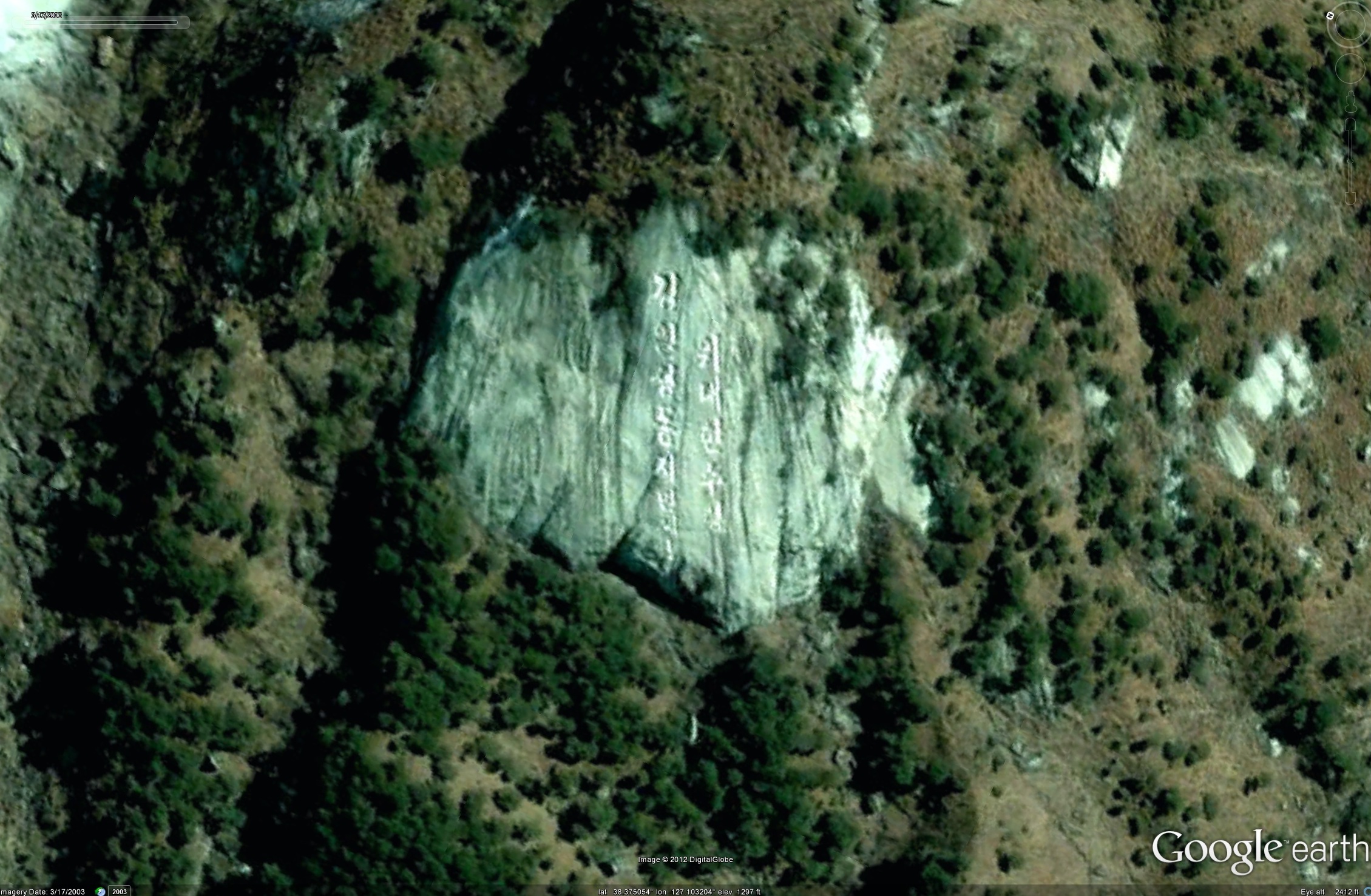
The Great Leader Comrade Kim Il Sung will always be with us!

Friday, December 7th, 2007

Click on the image to see a larger picture. Google Earth Coordinates:   38.374935°, 127.103343°

As many readers know, I have been mapping out North Korea on Google Earth for some time.  I have found numerous propaganda slogans displayed on hills and mountainsides throughout the country, but this recent discovery is by far the best example.  I would like to see this carving from the ground, so if anyone has pictures, please send them to me.

Share

Koreas sign security guarantee for planned cargo railway service

Wednesday, December 5th, 2007

Yonhap
12/5/2007

South and North Korea signed a security guarantee Wednesday for daily cross-border freight train service scheduled to start next week, the first substantial measure to follow up on agreements by the two countries’ leaders at their October summit, the Defense Ministry said.

The move came at a one-day meeting at the truce village of Panmunjom, which coincided with a separate meeting of deputy prime ministers of the divided nations here on boosting economic cooperation in line with the deal between South Korean President Roh Moo-hyun and his North Korean counterpart Kim Jong-il.

The cargo train will carry raw materials and manufactured goods between South Korea and the North Korean border city of Kaesong, where South Korea operates an industrial park for a number of its small labor-intensive plants.

The agreement calls for guaranteeing safe passage of the cargo rail service linking Munsan Station in the South to Bongdong Station, which serves as a gateway to the Kaesong industrial park, as agreed at the second inter-Korean defense ministerial talks.

“It will take effect at midnight on Dec. 11,” the ministry said at a briefing on the results of the talks. “The train will be allowed to run at a speed of 20-60km per hour. Train drivers and other crew will be banned from taking photos in the other side’s area.”

But the talks did not address the date for the next round of general-grade talks between the two sides or how to improve the operation of the Kaesong industrial complex, including ways to facilitate transportation, customs clearance and telecommunication services, according to the ministry.

The defense chiefs of the two Koreas agreed to support inter-Korean economic cooperation projects in their rare meeting last week in Pyongyang.

The two Koreas plan to run a cargo train every day on the reconnected rail line between Munsan and Bongdong starting on Tuesday. The 19.8-km route between the two border towns was severed during the 1950-53 Korean War.

The cargo service is expected to facilitate the movement of goods to and from the Kaesong industrial complex, a joint venture between the technology-savvy South and the labor-abundant North.

Share

Koreas agree on daily schedule for inter-Korean freight train

Sunday, December 2nd, 2007

Yonhap
12/2/2007

The two Koreas have agreed on the daily schedule for a cross-border freight train that will resume service later this month for the first time in over 50 years, the South Korean Unification Ministry said on Sunday.

The prime ministers of South and North Korea met in Seoul last month and agreed to restart the railway service, which will traverse the heavily armed border, on Dec. 11. The train will run between the South’s Munsan station and the North’s Bongdong station as a follow-up to the October summit between their leaders in Pyongyang.

The ministry said a freight train will depart from Munsan at 9:00 a.m. each weekday and reach the North Korean border station of Panmun before returning to the South at 2:00 p.m.

The train, which will not operate during weekends, will extend its route to Bongdong once the construction of a cargo-handling facility there is completed, the ministry said. The Bongdong station serves as a gateway to an inter-Korean industrial park in Kaesong.

The soon-to-be-resumed service is expected to facilitate transportation of raw materials and manufactured goods between South Korea and the North’s Kaesong park, the ministry said.

The 19.8-km route between the two Koreas was severed in the midst of the 1950-53 Korean War and has since remained closed.

Share

First-ever South Korean wedding held in North Korea

Sunday, December 2nd, 2007

Yonhap
Nam Kwang-sik
12/2/2007

The first South Koreans to tie the knot in North Korea wed in a ceremony at Mount Geumgang, a scenic North Korean mountain frequented by South Korean tourists, tour company Hyundai Asan said on Sunday.

Choe Jeong-in, a 32-year-old employee of Hyundai Asan, and Cho Ah-ra, 24, who works for one of Hyundai Asan’s business partners, married in a ceremony at a Mount Geumgang hotel on Saturday, three years after they first met while working at the North Korean resort.

Share

Internet to Open inside Gaeseong Site

Friday, November 16th, 2007

Korea Times
Yoon Won-sup
11/16/2007

The prime ministers of the two Koreas have agreed to set up Internet, wire and mobile phone services including mobile phones in the Gaeseong Industrial Complex in North Korea.

They also agreed to allow free movement of people and vehicles of the South in the complex starting next month in order to expand inter-Korean economic cooperation.

The agreement was made between Prime Minister Han Duck-soo and his North Korean counterpart Kim Yong-il Friday.

The rare talks between the prime ministers, the first in 15 years, went smoothly.

The North Korean delegates were very favorable to suggestions made during the three-day talks in Seoul, according to sources.

Particularly, Han and Kim took a stroll together in the morning and toasted each other with soju at dinner, Thursday, boasting of their friendship.

President Roh Moo-hyun hosted a lunch for the delegations, Friday, and thanked them for reaching an agreement. The North Korean delegates returned to Pyonyang by plane afterwards.

The two prime ministers issued a joint statement after the talks, which were aimed to follow up agreements reached at the second inter-Korean summit held in Pyongyang from Oct. 2-4.

They agreed to create a committee for a special zone of peace and cooperation in the West Sea coastal area under which five subcommittees will be set up to deal with an economic zone in Haeju, North Korea; the common use of Haeju port and the southern part of the Han River estuary in South Korea; the safe passage of private ships near Haeju; and a common fishing area in the West Sea.

The first committee meeting, chaired by a minister-level official, will be held in Gaeseong next month.

They also agreed to have a premier-level meeting and vice premier-level economic cooperation committee’s meeting every six months, one in Pyongyang in the first half of 2008 and the other in Seoul.

A cross-border freight and cargo railway linking Munsan in the South and Bongdong in the North will start operation from Dec. 11.

Working-level talks will be held in Gaeseong for two days from Tuesday to finalize the agreement on the cross-border train service, according to the statement.

As part of reconciliation measures, South Korea will help North Korea repair the Gaeseong-Sinuiju railway and Gaeseong-Pyongyang highway in 2008.

Han and Kim agreed to start the construction of shipyards in Anbyeon and Nampo next year.

For family members displaced since the 1950-53 Korean War, the two Koreas will allow exchanges of video calls starting next year and complete the construction of a family reunion center at Mount Geumgang next month.

A series of talks will be held next month to discuss the launch of a tourism program to Mount Baekdu, as well as the use of the North’s Pyongyang-Shinuiju railway to transport a joint supporters group from the two Koreas to the 2008 Beijing Olympic Games.

“The agreement is the first step toward enhancing inter-Korean relations through the virtuous circle of peace and economy,” Unification Minister Lee Jae-joung said.

Lee said the joint statement contained implementation measures for the summit accords, except the military measures that guarantee the cooperative plans.

Apparently mindful of the importance of these, he added: “The coming inter-Korean defense ministers’ talks will deal with the implementation.” The military talks are slated for Nov. 27-29 in Pyongyang.

Share