Archive for the ‘Economic reform’ Category

Kaesong goods to find export market in India

Saturday, February 14th, 2009

The South Korean and Indian governments are finalizing a trade concession agreement that will lower Indian import tariffs on some goods produced in the Kaesong Zone. According to India’s Economic Times:

Sounds odd, but some select North Korean goods may soon get special trade concession in India after New Delhi signs a trade pact with South Korea. In fact, the North Korean city of Gaesung will emerge as a major beneficiary as part of the terms and conditions of the India-South Korea comprehensive economic partnership agreement (CEPA), which is likely to be signed soon, sources close to the development told SundayET. The North Korean city is located just 60 km north of Seoul, the capital of South Korea.

Though Indian negotiators initially showed reluctance to such a deal, South Koreans were very keen as many of their companies have invested heavily in the region and set up many factories in that city, using cheap North Korean labourers. Goods produced at Gaesung include low-end engineering products, leather goods, jewellery, chemicals and textiles.

When contacted, commerce secretary GK Pillai confirmed to SundayET that India would extend the same concession to goods produced at Gaesung too. “It’s a matter of 30-40 products which are not very high-end. Those are not cars or steel. Yes, Gaesung is in North Korea, but it’s very much a part of South Korea’s economic co-operation plan. Both the Indian and the Korean (South Korean) governments have agreed to the CEPA, and it should be coming into effect from June or July this year,” he said.

Once the partnership agreement is signed, it will be the first such instance in which India recognises the outward processing concept and gives the same status to goods produced outside the negotiating country with those produced inside. Though Mr Pillai said there was no issue regarding Gaesung, sources close to the development added that India was not very keen on allowing those products.

“India was opposed to the idea as other countries too may demand the same model later. What if a country entering into a trade agreement with India chooses a place in Bangladesh or Pakistan for outward processing,” said a senior government official.

The trade volume between India and North Korea is quite insignificant if it’s compared with that of India-South Korea. During FY08, India’s import from North Korea was worth a mere $161 million, which was 2.6% of that from South Korea. In case of exports, the figures are somewhat better. The total export from India to North Korea was $850 mn in FY08 which was 29% of India’s export to South Korea.

The Bank of Korea, the South’s central bank and most cited source of DPRK economic statistics, estimates North Korea’s gross exports (to all countries except South Korea) in 2006 and 2007 at $950 and $920 (USD in millions) respectively.  They estimate the DPRK’s imports in these years at $2,050 and $2,020 (USD in millions) respectively

According to the data in this article, North Korea’s exports to India ($161 million) are a non-trivial 17.5% of its total exports (assuming the 2007 number is approximately current and changes in inflation and exchange rates are trivial).  The DPRK’s imports from India, $850 million in 2008 (according to the article), are a whopping 42% of North Korea’s estimated 2007 total imports.  Either India is now one of the DPRK’s major trading partners, or there was a short-term spike in DPRK-India trading activity, or these numbers are fishy.

Setting this debate aside, a further question arises—how will these transactions be recorded?  Since the DPRK has a trade relationship with India, will goods from Kaesong be flown/shipped from the DPRK to India and counted as North Korean trade, or will goods be shipped from Kaesong to South Korea and then sent to India—to be counted as South Korean trade? 

My suspicion is that the Kaesong goods will be counted as South Korean merchandise trade since this is a South Korea-India trade deal.  If the goods are recorded as South Korean, agreements of this sort will make it much more difficult in the future to determine the DPRK’s trade volume using mirror statistics.  This is because the country of origin records kept by the DPRK’s trading partners will show goods produced in the Kaesong zone as originating in South Korea.  As a result, the DPRK’s merchandise exports could go underestimated.

Read the full story here:
Ever heard of Gaesung? Gear up for its products
The Economic Times
Shantanu Nandan Sharma
2/15/2009

Share

North Korea’s transformation: A legal perspective

Thursday, February 12th, 2009

The Institute for Far Eastern Studies (IFES) published an interesting paper (with the above title) on legal reform in the DPRK.  Below are some highlights.  Links to the entire paper at the bottom.

As citizens have been left without state provisions for subsistence since the state did not have the material resources to supply the people through its central rationing system, the vast majority of individuals and organizations had to support themselves. Legitimizing commercial and market activity and expanding the scope of private ownership were a part of this effort. One of the most important laws reflecting this transformation is the Damage Compensation Law (sonhae bosang-beop), which is the North Korean version of a general torts law. This law holds an individual or any legal entity liable for its tort when damage is inflicted. Monetary compensation is the rule, while restoration is allowed when possible.

Under the socialist system, where the state is responsible for the provision of a citizen’s livelihood, tort law was of little use. Even in the case of death, one’s family would not suffer economically since the state provided sustenance rations. However, with the collapse of the public distribution system, the North Korean authorities could no longer maintain their socialist system. Since an individual now has to rely on his or her own devices, the loss of the employment, for example, directly inflicts a financial burden on the individual or family. Therefore, damage to property or person should be compensated for by the responsible party. Therefore, the new damage compensation law acts as a new mechanism for the protection of private property, and strengthens individual responsibility for negligent acts that inflict damage on others.

and…

Relaxation of law and order, along with the laxity of organizational control due to economic difficulties, changed individual attitudes toward government authorities and organizations in which these individuals were members. Individuals became more independent from the state and its organizations, since both the state and more directly engaged organizations lost important means of control over individuals in society due to the lack of resources and the inability to provide basic necessities to the people.

Under these circumstances, individual victims had no appropriate method to seek compensation for damage through an official dispute resolution process. This has led to an environment in which self-remedy has become the rule, rather than the exception. Although new criminal law punishes those who have used force in asserting their rights, there is no effective means of dispute resolution outside of taking advantage of officials willing to look the other way in exchange for favors, or hiring thugs to more directly resolve disagreements. Citizens can buy justice through bribes, and law enforcement officials are especially helpful in these endeavors when their palms are greased. This is much more economical as well as effective than bringing a case to the relevant official agency, which is generally incapable of resolving problems and instead further exploits the situation.

On courts and lawyers…

For example, the most prominent role of the court in North Korea, where other types of lawsuit are very unusual, was to handle divorce settlements, since divorce through simple agreement of the two parties was not allowed. Ordinary citizens went so far as to perceive settlement of divorce to be the most important role of the court. Criminal cases were also unusual. Political crime is handled through a non-judicial process, while many deviances are resolved through unofficial processes within more local organizations. The role of the court in resolving disputes was negligible, aside from divorce. Since the role of law enforcement agencies is to protect the state and secure the socialist system, the most important qualification for them is not legal expertise, but rather, loyalty and devotion to the North Korean ideology and system.

On the other hand, the Lawyer’s Act of 1993 prescribes the required qualifications of a lawyer. Those who are eligible to work as lawyers are those who are certified legal professionals, those who have working experience of no less than 5 years in legal affairs, or those who have a professional license in a certain area and have passed the bar examination after a short-term course in legal education. This qualification for working as a lawyer signifies that the state wants to equip the judicial system with legal professionals. Although there is no explicit professional qualification for a judge or prosecutor, we may assume that legal professionals have been elected or recruited in practice. This trend is likely to be reinforced as these social changes continue to unfold.

New provisions were also introduced to reinforce the judicial system. For example, interference with a law enforcement official’s performance of duties is now a punishable offence ; Threatening a witness or exacting revenge has been criminalized ; Non-execution of judgment will now be punished. Although the introduction of these provisions was an expression of the government’s effort to bring in a more effective judicial system, it would not be an easy task under the vague status of transformation. The state is very cautious and reluctant to undertake bold or fundamental changes due to concerns about political instability. Therefore, it takes time for various coherent mechanisms to fully support a market system.

You can download the entire paper in PDF format here.

You can read it on the IFES web page here.

Share

Orascom update: 6,000 in 2 weeks.

Thursday, February 5th, 2009

Martyn Williams writes in The Standard:

Koryolink, the North Korean 3G cellular network established in mid-December by Egypt’s Orascom Telecom, has attracted several thousand subscribers in the first two weeks since it began accepting applications in January.

“We didn’t start sales until about two weeks ago,” said Naguib Sawiris, chairman of Orascom Telecom in a telephone interview. “So far we have about 6,000 applications. The important point is that they are normal citizens, not the privileged or miliary generals or party higher-ups. For the first time they have been able to go to a shop and get a mobile phone.”

Orascom has a single shop in Pyongyang and is in the process of expanding its sales network, he said.

But while Koryolink’s first customers might not have high-profile official jobs, they are among the more wealthy in society and price, particularly of the handsets, stands as an obstacle to greater penetration.

“The price is quite high,” said Sawiris. “The government has put a big tax on handsets and it’s making it difficult for everyone to participate but we are having negotiations with the government to reduce that.”

The handsets Koryolink is offering, localized Korean versions of phones from China’s Huawei, cost between US$400 and $600 after the government levy has been added and there’s also calling charges.

The cheapest subscription costs 850 North Korean won per month. That’s about US$6 at the official exchange rate but only 24 cents at the current black market rate used by many citizens and traders. Calls on this tariff are charged at 10.2 won per minute. The highest package costs 2,550 won per month and call rates are 6.8 won per minute.

But all calls can be monitored:

With the launch of the Koryolink network the state continues to have the ability to monitor what its citizens are saying and can eavesdrop on calls if it wants, said Sawiris.

“That’s the right of the government,” he said.

How long to get the project moving?

It took about a year from that initial contact to reach an agreement and another nine months to get the network installed.

“We were quite worried about 2 things: the time it would take and the fact that they would really let normal citizens purchase lines.”

The full article is worth reading here:
North Korean 3G service attracts 6,000 in 2 weeks
The Standard
Martyn Williams
2/5/2009

Share

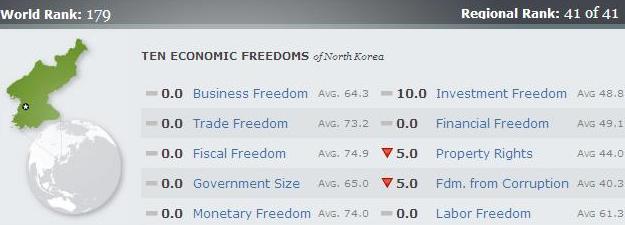
North Korea – last in economic freedom in 2009

Thursday, February 5th, 2009

The purpose of these types of indexes is to put pressure on world governments to improve their economic policies.  Unfortunately, the DPRK has come in last place for as long as I have been paying attention….

From the 2009 Index of Economic Freedom:

econ-freedom2009.JPG

North Korea’s economic freedom score is 2, making its economy the least free in the 2009 Index. North Korea is ranked 41st out of 41 countries in the Asia-Pacific region.

North Korea does not score well in any single area of economic freedom, although it does score some minimal points in investment freedom and property rights. The Communist Party controls and commands almost every aspect of economic activity. Since the early 1990s, North Korea has replaced the doctrine of Marxism’Leninism with the late Kim Il-Sung’s juche (self-reliance) as the official state ideology. Yet the country’s impoverished population is heavily dependent on government subsidies in housing and food rations even though the state-run rationing system has deteriorated significantly in recent years.

North Korea devotes a disproportionately large share of GDP to military spending, further exacerbating the country’s already poor economic situation. Normal foreign trade is minimal, with China and South Korea being the most important trading partners. Trade with India is increasing. No courts are independent of political interference, and private property (particularly land) is strictly regulated by the state. Corruption is rampant but hard to distinguish from regular economic activity in a system in which arbitrary government control is the norm.

The Democratic People’s Republic of Korea is one of the world’s most oppressed and closed societies, and its Communist rulers have repressed basic human rights and nationalized all industry since the country’s founding in 1948. In the 1990s, floods and droughts exacerbated systemic shortcomings and led to severe famine and millions of civilian deaths. North Korea’s economy is mainly supported by international aid and trade with its major trading partners, China and South Korea.

Business Freedom
0.0
The overall freedom to start, operate, and close a business is extremely restricted by North Korea’s national regulatory environment. The state regulates the economy heavily through central planning. Economic reforms implemented in 2002 allegedly brought some changes at the enterprise and industrial levels, but entrepreneurial activity is virtually impossible.

Trade Freedom
0.0
The government controls all imports and exports, and formal trade is minimal. North Korean trade statistics are limited and compiled from trading partners’ data. Most trade is de facto aid, mainly from North Korea’s two main trading partners, China and South Korea. Non-tariff barriers are significant. Inter-Korean trade remains constrained by North Korea’s unwillingness to implement needed reform. Given the minimal level of trade, a score of zero was assigned.

Fiscal Freedom
0.0
No data on income or corporate tax rates are available because no effective tax system is in place. The government plans and manages almost every part of the economy. Given the absence of published official macroeconomic data, such figures as are available with respect to North Korea’s government expenditures are suspect and outdated.

Government Size
0.0
The government owns virtually all property and sets production levels for most products, and state-owned industries account for nearly all GDP. The state directs all significant economic activity. Large military spending further drains scarce resources.

Monetary Freedom
0.0
Price and wage reforms introduced in July 2002 consisted of reducing government subsidies and telling producers to charge prices that more closely reflect costs. Without matching supply-side measures to boost output, the result has been rampant inflation for many staple goods. Because of the ongoing crisis in agriculture, the government has banned sales of grain at markets and returned to rationing. A score of zero was assigned.

Investment Freedom
10.0
North Korea generally does not welcome foreign investment. A small number of projects may be approved by top levels of government; however, the scale of these investments is also small. Numerous countries employ sanctions against North Korea, and ongoing political and security concerns make investment extremely hazardous. Internal laws do not allow for international dispute arbitration. One attempt to open the economy to foreigners was North Korea’s first special economic zone, located at the remote Rajin-Sonbong site in the Northeast. Wage rates in the special zone are unrealistically high because the state controls the labor supply and insists on taking a share of wages. More recent special zones at Mt. Kumgang and Kaesong are more enticing. Aside from these few economic zones where investment is approved on a case-by-case basis, foreign investment is prohibited.

Financial Freedom
0.0
North Korea is a command-and-control economy with virtually no functioning financial sector. Access to financing is very limited and constrained by the country’s failed economy. The central bank also serves as a commercial bank and had more than 200 local branches in 2007. The government provides most funding for industries and takes a percentage from enterprises. Foreign aid agencies have set up microcredit schemes to lend to farmers and small businesses. A rumored overhaul of the financial system to permit firms to borrow from banks instead of receiving state-directed capital has not materialized. Because of debts dating back to the 1970s, most foreign banks will not enter North Korea.

Property Rights
5.0
Property rights are not guaranteed. Almost all property, including nearly all real property, belongs to the state, and the judiciary is not independent. The government even controls all chattel property (domestically produced goods as well as all imports and exports).

Freedom From Corruption
5.0
After the mid-1990s economic collapse and subsequent famines, North Korea developed an immense informal market, especially in agricultural goods. Informal trading with China in currency and goods is active. There are many indicators of corruption in the government and security forces. Military and government officials reportedly divert food aid from international donors and demand bribes before distributing it.

Labor Freedom
0.0
As the main source of employment, the state determines wages. Since the 2002 economic reforms, factory managers have had limited autonomy to set wages and offer incentives, but highly restrictive government regulations hinder any employment and productivity growth.

Share

Korea Business Consultants Newsletter (1/09)

Wednesday, February 4th, 2009

Korea Business Consultants has published their January newsletter.

Here is a link to the PDF.

Topics covered:
New Year Joint Editorial
Year of DPRK-China friendship
UNDP to resume DPRK operations
Buddhist Leader to Head DPRK’s ROK Affairs
DPRK Railroad Engineers Study in Russia
Housing Construction Progresses Apace
Orascom Opens Bank in Pyongyang
DPRK Tackles Clothing Shortage
“DPRK Harvest Best in Years”
China to Invest in NK Coal
US$ 3.75 Million in Australian Aid for DPRK
The Principles of the DPRK’s Foreign Trade
ROK Farmers Send Rice to DPRK
New SNG Kaesong Plant Idle
“Inter-Korean Trade Slides Due to Weak ROK Won”
ROK to Build Nursery in Kaesong Complex
DPRK Opens Consulate in Dandong
DPRK, China Foreign Officials Meet
Seoul Forum Highlights DPRK Films
“NK Martial Arts Team Best in World”
PUST Opening Delayed
DPRK TV Takes Note of Park Ji-sung
The Korean War

Share

North Korea’s real estate black market

Sunday, January 25th, 2009

Some great qualitative information on the DPRK’s underground real estate market from Radio Free Asia:

Central authorities are investigating the practice in all of North Korea’s major cities and have confiscated the homes of “dozens” of local officials in the city of Chongjin, one well-informed source who asked not to be named said.

Private ownership or sale of homes is forbidden by the North Korean state, which assigns dwellings to its citizens based on its own determination of need.

“Most government officials build their residences in the North Korean equivalent of suburbs, in areas that are close to the city but still have a rural flavor,” the source, a Chinese merchant who does business in North Korea, said.

“They sell them when they retire.”

“If someone sells a 50-pyong (1,800-square foot) house in such an upscale neighborhood, he can then buy a house that is three or four times bigger in a different area,” the merchant said.

Party and state officials receive permits and order state-run construction companies to build homes in suburban areas near the sea, the merchant said.

He added that the value of real estate privately sold in North Korean port cities is now appreciating at twice the rate of real estate sold elsewhere in the country.

High-quality materials, including expensive appliances and wallpaper, are often used in the building of officials’ homes, according to a North Korean defector originally from Chongjin but now living in South Korea.

“Small but elegant” patios are sometimes also included, he said.

To justify the construction and occupancy of a larger space, local officials build multi-unit structures and fill them with relatives or people of more modest means, the defector said. 

When the officials retire, they pay the other occupants to move and then sell the entire structure.

North Korean authorities have now sent “task forces” to each of North Korea’s major cities to investigate real estate deals by local officials, the border merchant said, adding that a 40-member group was recently sent to Chongjin, where the homes of dozens of officials were seized.

An official in the city’s Songpyong Ward has reportedly been demoted and reassigned to a more backward part of the country, and fines equal to the actual value of transactions have been imposed on citizens who bought or sold homes.

Some thoughts:
1. IFES reported that private real estate transactions were quite common last september.

2. This report, combined with previous accounts, indicates that, although illegal, the DPRK’s real estate market is quite rational.  Construction quality and location influence housing prices.  According to the Daily NK, the qality of the chairman of the neighborhood people’s committee also influences the price.

3. Could the effort to crack down on these transactions be part of the plans to achieve a “Strong and prosperous nation” by 2012?

Read more here:
North Korean Economy Watch: real estate posts

North Korea’s Black-Market Housing
Radio Free Asia
Jung Young
1/23/2009

Private sector real estate activity booming in the DPRK
Institute for Far Eastern Studies (IFES)
NK Brief No. 08-9-4-1
9/4/2008

Who Is the Chairperson of the People’s Unit?
Daily NK
Moon Sung Hwee
8/18/2008

Share

Economic rationality in the DPRK

Saturday, January 24th, 2009

Writing in the Daily NK, guest author “Benji” and an astute reader offer us this little glimpse of economic rationality in North Korean culture.

benji-pektu.jpg

Commenting on the photo above, “Benji” notes:

“A North Korean soldier in front of an amazing view from [Mt. Pektu].  Minutes later, he was to offer me one of his cigarettes.”  

An astute reader made the following comment:

“The cigarette from the Soldier probably wasn’t the kind offer it seemed to be. North Koreans use cigarettes as currency. When they see a western tourist they offer their substandard north korean cigarettes in the hope of receiving western thus more valuable ones in exchange, or if they are especially lucky chinese Double Hapiness

The pictures and story are worth reading here:
Sacred and Stunning Mountain, Baekdu
Daily NK
“Benji”
1/22/2009

Share

Sinuiju SAR: Take 4

Friday, January 23rd, 2009

sinuiju2.JPGOn September 20, 2002, the DPRK’s Supreme People’s Assembly announced the creation of the Sinuiju Special Administrative Region (SAR) (KCNA announcement here).

The project was to be headed by a Chinese-born, naturalized Dutch citizen, Yang Bin…who was arrested by Chinese authorities shortly after the Sinuiju SAR was announced.  Western analysts interpreted this move as a signal that China was not supportive of either the project or the selection of Mr. Bin as its chief executive.  Needless to say the future of the project lay in doubt.

However, according to a Yonhap report (here), as of March 2007 the North Koreans still seemed interested in launching some kind of SAR/SEZ in Sinuiju, though the location had been moved from the city proper to two islands in the Yalu River, Bidan and Wihwa.

In August 2007, IFES and the Choson Ilbo reported that preparations were already underway in Sinuiju to convert the city center into a SAR/SEZ.  However, after this initial media hit, most of the news coming out of Sinuiju was related to Jang Song Taek’s 2008 anti-corruption campaign which brought most of the trading companies along the Chinese border back under the control of the Ministry of Finance.

This week, Japan’s Yomuri reports from Shenyang, China, that the Sinuiju SAR is still on and will be located on Wihwa Island:

“The zone will only cover Wi Hwa Island, which will be much easier to control, and only Chinese will be allowed to freely visit,” one of the sources said. “The plan solely aims at expanding trade with China. North Korea isn’t planning any measures that would involve a dramatic opening up.”

According to Chinese statistics, the total value of trade between China and North Korea from January to October last year was 2.12 billion dollars, up 31.7 percent from a year earlier.

Meanwhile, a diplomatic source said, “The move to beef up border trade with China is also aimed at putting pressure on South Korea.”

(FYI: Use of the phrase “beef up” is a pretty good sign that the diplomatic source was an American.)

I know the story of “The Boy Who Cried Wolf.”  I will remain skeptical about the new SEZ until I see evidence of construction myself.

You can read the full Yomuri article here:
N. Korea plans free trade zone on island
Daily Yomuri
Toru Makinoda
1/23/2009

Share

Jeju to offer pig farm to DPRK

Monday, January 19th, 2009

The people of Jeju Island have shipped tangerines to the DPRK for about 10 years.  Now they are offering a pig farm:

According to Yonhap:

South Korea’s Jeju Island will send equipment to build a pig farm in Pyongyang on Friday to raise the island’s local specialty, black pigs, officials said.

Black pigs, or “heuk-doe-ji” in Korean, are native to the semi-tropical island. They are covered in black hair, and the meat is popular for being chewy and rich in nutrients.

Jeju will send farm equipment worth 220 million won (US$159,190), such as pens, feeders, heat lamps and ventilators, later on Friday aboard a ship also carrying tangerines and carrots as part of the island’s annual aid to the North. When the farm is completed, possibly by May, the island will ship 100 black pigs that can farrow.

“We expect this will help provide nutrition for children and the elderly in the North and pass down our breeding expertise. Jeju Island is a clean area free from animal infectious diseases,” Kang Won-myoung, a provincial official handling the pig project, said over the telephone.

The Jeju provincial government set up the “South-North Black Pig Breeding Cooperation Project” with North Korea when a group of Jeju citizens and officials visited Pyongyang in late 2007. The project was suspended for about a year amid frozen inter-Korean relations until North Korea formally requested to start the farming last September, the island officials said.

The “Jeju Black Pig Farm” will be built inside Pyongyang Pig Farm, North Korea’s largest such facility, established in 1972.

A Norwegian company recently tried to invest in a pig farm in the DPRK.  Unfortunately it did not work out.  Read their story here starting on page 86.  

The DPRK is working to increase meat production as part of its 2012 “Kangsong Taeguk” campaign

Read the full story here:
S. Korea’s Jeju Island to build ‘black pig’ farm in Pyongyang
Yonhap
1/16/2009

Share

2008 Top Items in the Jangmadang

Thursday, January 1st, 2009

Daily NK
Park In Ho
1/1/2009

The marketplace has become an extremely important ground in North Korean people’s lives. 70 percent of North Korean households in the city live off trade, handicrafts and transportation businesses related to trade. If the jangmadang works well, people’s living situation is good, otherwise it is not. In the situation where the food distribution system has broken down, the whole economic existence of the populace is bound up in jangmadang trade.

Trade is bound to generate successful merchants but also failures, due to a lack of know-how or confiscation of products by the People’s Safety Agency (PSA), or simply because a competition system operates. These failures in the jangmadang do not have any second opportunity to rise again so they frequently choose extreme acts like defection, criminality or suicide. Failure is serious.

However, the revitalization of markets has caused great changes in North Korean people’s values. The individual-centered mentality among the people is expanding and the belief that money is the best tool is also spreading. Due to such effects, the North Korean communist authorities in 2008 made the regulation to prohibit women younger than 40 years old from doing business, but of course the people use all necessary means to maintain their survival.

Daily NK investigated the 2008 top ten items in the jangmadang, so as to observe developments in North Korean society.

1. Rice in artificial meat, the first instance of domestic handicraft

Since 2000, the most ubiquitous street food has been “rice in artificial meat,” which is made from fried tofu with seasoned rice filling. This food is found everywhere on North Korean streets. One can find women who sell this snack in alleys, at bus stops and around stations. It costs 100 to 150 North Korean Won.

Meanwhile, the most popular street food is fried long-twisted bread. Individuals make the fried bread at home and sell it on the street. The length of the fried bread is around 20 centimeters and it sells for 100 won.

In around 2005 corn noodles were popular on the streets, but now street-stands for noodles have largely disappeared due to the existence of a permanent store controlled by the state.

These days, if one can afford to eat corn noodles, at approximately 1,000 won for a meal, one can safely say that one is living comfortably.

2. Car battery lights North Korea

The reason why North Korean people like car batteries is that the authorities provide a reliable electricity supply during the daytime, when consumption is less than at night, but at night they don not offer it. The authorities shut down the circuit from around 8 PM to 9PM, and from 12 AM to 2 AM: when the people watch television the most.

As a result, the people charge their car batteries during daytime and use it at night. A 12V battery can run a television and 30-watt light bulb. If they utilize a converter, they can use a color television, which needs more electricity.

Ownership of batteries is a standard of wealth. Officials use electricity from batteries in each room. They usually draw thick curtains in their rooms, to prevent light shining through that might draw attention to their status.

3. The strong wind of South Korean brand’ rice-cooker, Cuckoo

A South Korean brand pressure rice-cooker called Cuckoo appeared as a new icon for evaluating financial power among North Korean elites.

It has spread from the three Chinese northeast provinces into North Korea. In North Korea, Chinese rice and third country aid rice, dry compared to Korean sticky rice, generally circulates, but if the lucky few use this rice-cooker, they can taste sticky rice the way Korean people like it.

There are Cuckoo rice-cookers from South Korean factories that arrive through Korean-Chinese merchants, and surely other Cuckoo products from Chinese factories. These two kinds of rice-cookers, despite having the same brand name, sell for different prices.

The Chinese-made Cuckoo sells for 400,000-700,000 North Korean Won (approximately USD114-200), while the South Korean variety costs 800,000-1,200,000 (approximately USD229-343). A Cuckoo rice-cooker tallies with the price of a house in rural areas of North Korea. According to inside sources, they are selling like wildfire.

4. An electric shaver only for trips

The electric shaver is another symbol of wealth.

It is not that they use electric shavers normally, because one cannot provide durability. At home, North Korean men generally use disposable shavers with two blades made in China or a conventional razor. However, when they take a business trip or have to take part in remote activities, they bring the electric shaver.

There are North Korean-made shavers but most are imported from China. Among Chinese products, you can see “Motorola” products and fake-South Korean products with fake labels in Korean. A Chinese-made electric shaver is around 20,000-40,000 North Korean Won.

5. Chosun men’s fancy shoes

Dress shoes are one of the most important items for Chosun men when they have to participate in diverse political events, loyalty vows or greeting events at Kim Il Sung statues on holidays. Right after the famine in the late 1990s, it was considered a symbol of the wealth, but now general workers, farmers and students are wearing dress shoes.

The shiny enameled leather shoes with a hard heel cannot be produced in North Korea because of a lack of leather. The North Korean authorities provide the National Security Agency (NSA) and officers of the People’s Army with dress shoes, which are durable but too hard and uncomfortable.

Shoes for general citizens and students are mostly made in China and some are produced in joint enterprises in Rajin-Sunbong. The price of shoes ranges from 30,000 to 100,000 Won depending upon the quality.

6. Cosmetics prosper despite the economic crisis

Cosmetics and accessories for women are getting more varied. Lately, false eyelashes have appeared in the jangmadang in major cities. Chinese cosmetics are mainly sold, alongside fake South Korean brands. In Pyongyang, Nampo, Wonsan and Shinuiju Chinese and even European cosmetics are on sale.

“Spring Fragrance,” a North Korean luxury cosmetics brand, is famous for being Kim Jong Il’s gift that he presents to women soldiers or artists when he visits military units or cultural performances. It costs more than 200,000 North Korean won.

Lotions for women, made in China, are approximately 2,000-4,000 won, foundation cream is 3,000-5,000 won, and lipstick is from 500 won to 2,000 won. Hand cream is 3,000-5,000 won.

7. Hana Electronics recorder, the biggest state-monopoly production

“Hana Electronics” was originally set up to produce CDs and DVDs of North Korean gymnastic performances or other artistic performances, so as to export them foreign countries. The company has been producing DVD players since 2005.

Due to the state monopoly, the DVD player of the Hana Electronics dominates the market. North Korean people call a VCR and a DVD player a “recorder.” Since around 2005, after the booming interest in South Korean movies and dramas, the players have been selling very well.

At the beginning, North Korean visitors to China brought the DVD or CD players into North Korea, but as they got popular among the people, Chinese-made players were imported from China and since 2006 they have been really popular in every jangmadang.

Accordingly, since 2006, the authorities have started blocking the importation of the Chinese player and are selling the Hana Electronics players, which sell for around a 20 or 30 percent higher price than Chinese players in state-run stores. Now, they can be sold in the jangmadang by private merchants and comparatively free from inspection by the PSA. The prices are 130,000-150,000 won.

8. Bicycles are basic, the motorcycle era is here now

In major cities, numbers of motorcycles are increasing. Especially in border regions where smuggling with China is easier than in other cities, motorcycles are common.

The motorcycles are ordinarily used for mid or long distance business. Most motorcycles are made in China and some are Japanese second-handed products, which sell for 1.5-2.5 million won. 125cc new products are over 5 million won. The cheapest second-handed motorcycle is 500,000 won.

9. Vinyl floor covering for the middle class and vinyl for the poor

Demand for vinyl floor coverings and vinyl has been increasing since the late 1990s, when residential conditions improved. In the late-1990s people had to use sacks of cement or Rodong Shinmun (newspaper) as a floor covering, but now they are using vinyl floor coverings.

Uses for vinyl are unimaginably diverse: from a basic protection against wind and cold to when people take a shower at home in the vinyl tunnel hung on the ceiling of the bathroom.

Depending on the thickness and width, there are four or five kinds of vinyl in the jangmadang for from 150 to 500 won. Vinyl floor covering is a Chinese product selling for from 3,000 to 10,000 won.

Share