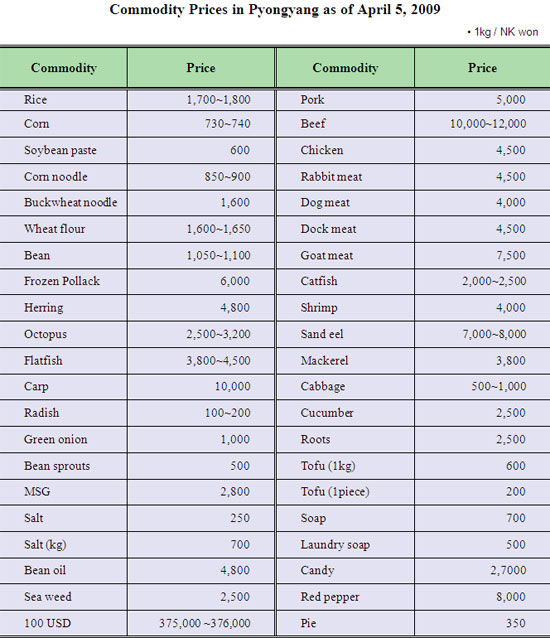
Chris Green of the Daily NK offers the following price data (click on image to see full size):
Source:
The Good, the Bad and the Optimistic
Daily NK
Chris Green
5/8/2009

Chris Green of the Daily NK offers the following price data (click on image to see full size):
Source:
The Good, the Bad and the Optimistic
Daily NK
Chris Green
5/8/2009
This week, The South Korean government announced that if the North unilaterally files formal charges against a detained South Korean worker it will reevaluate regulations for its citizens to enter the zone which would require each border crosser to obtain a written guarantee of his safety from Pyongyang before leaving South Korea. Although the number of South Korean workers allowed to cross the DMZ was reduced after the North’s missile launch, this would effectively prevent South Korean managers from entering the Kaesong Zone and would likely bring an end to operations there. According to Yonhap:
South Koreans may be barred from visiting North Korea if the communist country takes legal action against a Hyundai Asan employee who has been unlawfully detained by Pyongyang, a government source said Sunday.
The Hyundai employee, who works at the Kaesong Industrial Complex and is identified only by his family name of Yu, has been held for 28 days for allegedly criticizing Pyongyang’s political system and trying to lure a North Korean female worker to defect to the South.
The worker in his 40s has yet to be interviewed by South Korean authorities to determine the exact nature of the detention.
“Under the special arrangement governing the Kaesong complex, the two Koreas must reach an understanding on how to deal with serious offenses involving South Koreans (that carry punishments) exceeding warnings, fines and expulsions,” the source, who declined to be identified, said.
“If Pyongyang takes unilateral action to indict the worker, it will be a violation of the fundamental rules related to cross-border interactions and will compel Seoul to rethink its stance on allowing South Korean to visit the North,” the source stressed.
The bilateral agreement makes clear that Pyongyang should respect the rights of South Korean workers, dwellings and property in Kaesong and the special tourist region in Mount Kumgang on the east coast. The latter has been closed since the shooting death of a female tourist by North Korean guards last July.
He said that if protection for South Koreans nationals cannot be ensured, Seoul will be compelled to review its policies on allowing visits from scratch.
“If this is the case, even employees working at Kaesong will have to get individual, written permission from North Korea that they will not be detained,” the official said.
Such a move could effectively make it hard for South Koreans to go to North Korea, crippling normal operations at the complex just north of the demilitarized zone that separates the two countries.
As of March, 101 South Korean factories operated in the complex, employing about 39,000 North Korean workers. The Kaesong park opened in 2005 and produces labor-intensive goods such as clothing, kitchen wares and watches. (Yonhap)
Given the trajectory of North-South relations this year, it is no surprise that inter-Korean trade dropped 30% in March. According to Yonhap:
Monthly trade between South and North Korea fell more than 30 percent on-year in March, as tensions ran high over South Korea-U.S. joint military exercise, government data showed Monday.
The two Koreas exchanged goods and services worth US$108.74 million over the last month, down 31.1 percent from $157.9 million in the same period in 2008, the data from the Unification Ministry said.
North Korea sealed the border three times in March, disrupting South Korean production in a joint industrial complex in the North’s border town of Kaesong. Pyongyang imposed the ban in retaliation against a joint military exercise South Korea staged with the United States from March 9 to 20 south of the border.
Pyongyang blasted the joint exercise as a rehearsal for a “second Korean War,” while the two allies say the annual drill is purely defensive.
More than 100 South Korean firms operate in the Kaesong industrial venture, just an hour’s drive from Seoul, joining their capital and technology with North Korea’s cheap but skilled labor.
North Korea demanded the South raise wages, pay fees for land use and revise existing contracts for the Kaesong venture during inter-Korean government talks last week, the first official dialogue in more than a year. Seoul is gathering opinion from South Korean firms and plans to respond to the North Korean demand as early as this week.
Hyundai Asan, which has seen a dramatic reversal of fortune in the last year, has launched a new tourism project to make up some of its lost revenue. Unable to offer trips to Kaesong and Kumgangsan, they are still trying to capitalize on the mystery of the DPRK:
Hyundai Asan said its new programme includes one-day tours costing 46,000 won (34 dollars) per person to border areas at Paju and Yeoncheon, north of Seoul.
Two-day tours to the border area at Yanggu, 175 kilometres northeast of Seoul, and to Mount Sorak on the east coast, will cost 118,000 won.
“Along with trips to front-line fences, tourists will be allowed to see wildlife and other places which remained untouched for decades,” a Hyundai Asan official told AFP.
Visitors will not be allowed inside the DMZ itself.
Hyundai Asan said the new programme would help ease its financial woes, which began when a South Korean woman tourist was shot dead when she strayed into a military zone at Kumgang last July.
The Seoul government halted tours to Kumgang after the shooting, while Pyongyang barred the one-day tours to Kaesong city as relations worsened.
The company’s other major joint project, the joint industrial complex near Kaesong city, is also facing problems due to sour cross-border ties.
The communist North has expelled hundreds of South Korean staff and restricted access to the Seoul-funded complex.
On March 30 it detained a Hyundai Asan employee for allegedly criticising the North’s regime and trying to persuade a local woman worker to defect.
Read the full stories below:
Gov’t warns it can bar S. Koreans from visiting N. Korea
Yonhap
4/26/2009
Inter-Korean trade drops 30 percent in March during political tension
Yonhap
4/27/2009
South Korean firm to start tours along North Korea border
Channel News Asia
4/27/2009
According to Yonhap (excerpts):
The two Koreas met Tuesday for their first government-level talks in more than a year, during which the North demanded negotiations begin on operational changes at the joint complex in its border town of Kaesong. Pyongyang said it will reconsider all “special benefits” that have been granted to South Korean firms, such as low wages for North Korean employees and free land use.
The proposed measure, if actualized, is expected to deal a serious blow to more than 100 South Korean firms in Kaesong, mostly small manufacturers producing garments, utensils, watches and other labor-intensive products and already struggling to survive the global economic downturn.
Under a contract signed between Hyundai and the North Korean government in 2000, South Korean firms pay their North Korean employees between US$70-$80 on average a month, but the wages are wired directly to North Korean government bank accounts. The annual wages last year amounted to $26 million, according to ministry data. About 39,000 cheap but skilled North Korean workers are employed there.
North Korea also said it will begin charging land fees starting next year. North Korea initially set a 10-year grace period on rent when the complex opened, allowing the South Korean firms to use its land in Kaesong for free until 2014.
The [South Korean Unification] minister criticized North Korea’s prolonged detention of a South Korean worker as “against justice.” Pyongyang officials did not answer questions about the Hyundai Asan employee during Tuesday’s talks, he said.
The inter-Korean talks opened after a half-day delay due to procedural disputes but lasted only 22 minutes, during which the two sides exchanged documents laying out their demands and positions.
Read the full story here:
S. Korea reviewing N. Korea’s call to revise industrial contracts: minister
Yonhap
4/22/2009
Institute for Far Eastern Studies (IFES)
NK Brief No. 09-4-22-1
2009-04-22
Since 3G cellular phones were first offered in North Korea last December, more than 20,000 customers have signed up for service. According to a recent report by the Choson Sinbo’s Pyongyang correspondent, the North’s cellular network is capable of providing voice and SMS services to as many as 126,000 customers in the Pyongyang area and along the highway between Pyongyang and Hyangsan, and is available to North Korean residents as well as foreigners in the North.
Anyone can procure a cell phone in the North by submitting required information on an application to a service center, along with an application fee of 50 Yuan, or approximately one Euro, or 130 Yen. Currently, telephones are selling for between 110 Euros for basic handsets, to as much as 240 Euros for phones with cameras and other functions. When a phone is turned on, a white ‘Chollima’ horse graphic appears over ‘Koryolink’ in blue, all with a red background. The trademark is said to mean, “The Choson spirit, moving forward at the speed of the Chollima to more quickly and more highly modernize the information and communication sector.”
To use one’s phone, a pre-paid phone card must be purchased. Three types of phone cards are sold for 850 won (A), 1700 won (B), and 2500 won (C), with ‘B’ and ‘C’ cards offering 125 and 400 minutes ‘free air time’, respectively. In order to see to it that its customer base continues to grow, the communications company plans to adjust prices, and offer services such as television and data transmission. Video and picture transmission and other technological preparations have already been made.
As has been previously reported, the service is provided by CHEO Technology Joint Venture Company, owned by the Choson Posts and Telecomm Corporation (KPTC) and Egypt’s Orscom Telecom Holding. There are now two service centers within Pyongyang. In December of last year, only one International Communications Center was established, but as service grew, a temporary sales office was set up in mid-March. The North Korean government purports to provide cellular service as part of its plan to improve the lives of the masses, and the number of subscribers is climbing daily. CHEO Technology plans to extend the coverage area to every major city, along all highways and along major rail routes throughout the country by the end of the year, with the ultimate goal of providing cellular service to every residential area in the nation by 2012.
Andrei Lankov writes in Newsweek:
North Korea will never follow the Chinese path because its circumstances are profoundly different. The biggest factor is the existence of a rich and free South Korea across the border. Southerners share the same language and culture as the dirt-poor North, but their per capita income is at least 20 times higher—and at the moment, average North Koreans are ignorant of the gap. The regime’s self-imposed isolation is so draconian that even owning a tunable radio set is a crime. If North Korea started reforming, it would be flooded with information about South Korea’s prosperity. This would make North Koreans less fearful of the authorities and more likely to push for unification with their far richer cousins, just as the East Germans pushed to rejoin the West.
Knowing all this, North Korea’s rulers will do whatever they can to maintain control. Given the weakness of its Stalinist economy, this means coming up with new ways to squeeze aid from the outside world. In order to keep the money flowing—with as few conditions as possible—Kim is likely to continue engaging in risky brinkmanship and blackmail. To survive, Pyongyang has to be, or appear to be, dangerous and unpredictable.
But such tactics could easily lead to disaster. The only way to avoid this is to replace the regime.
That’s easier said than done: Military options are unthinkable. And sanctions won’t work either, since China and Russia are unlikely to cooperate fully. Even if Moscow and Beijing did go along, the only likely result would be a lot of dead farmers. North Korea’s great famine of 1996–99 demonstrated that the locals do not rebel when oppressed, even under terrible circumstances. North Koreans are terrified, disorganized and still largely unaware of any alternative to their misery.
But there’s a way to change that equation. The past 15 years have seen the spontaneous growth of grassroots markets in the North and partial disintegration of state controls. Rumors of South Korean prosperity have begun to spread, assisted by popular smuggled DVDs of South Korean movies. The world’s most perfect Stalinist regime is starting to disintegrate from below.
The best way to speed things up is for Washington and its allies to push for active engagement with the North in the form of development aid, scholarships for North Korean students and support for all sorts of activities that bring the world to North Korea or take North Koreans outside their cocoon. Such exchanges are often condemned as a way of appeasing dictators, but the experience of East Europe showed that an influx of uncensored information from the outside is deadly for a communist dictatorship.
Pyongyang understands the danger of such exchanges, but it needs money and technology badly enough that it might allow them nonetheless—so long as they fill its coffers and don’t look too dangerous. This is even more the case when exchanges ostensibly benefit members of the elite. For example, a scholarship program to study overseas would go mostly to students from top families. Yet this wouldn’t limit its impact: experience of the outside world will change these young people and turn some of them into importers of dangerous information. A similarly small step helped to unravel the Soviet Union: the first group of students allowed to study in the U.S., in 1957, numbered just four and were carefully selected. Yet two grew up to become leading reformers, and one of them—Alexander Yakovlev—is often credited as having been the real mastermind behind perestroika.
Read the full article here:
Newsweek
Andrei Lankov
4/18/2009
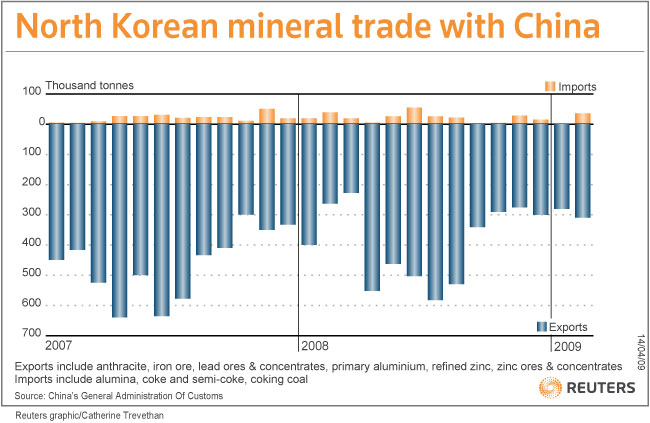
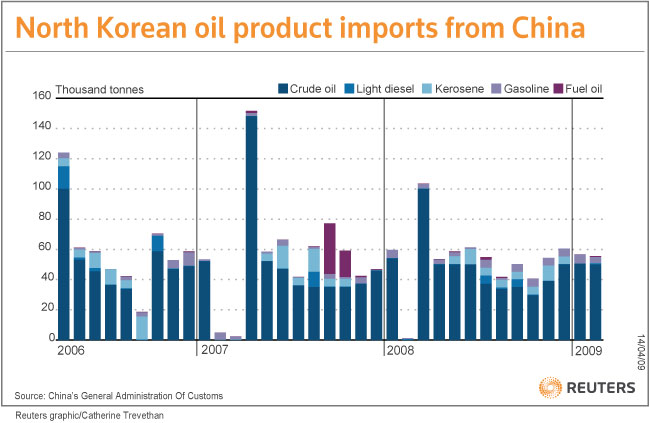
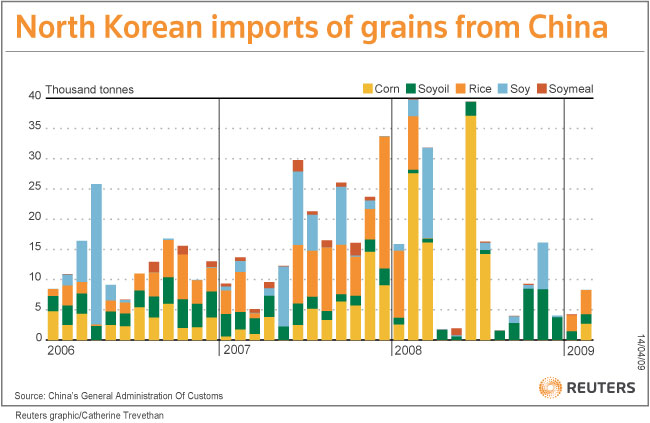
Writing in Reuters, Lucy Hornby and Tom Miles point out that the DPRK faces greater economic uncertainty from falling commodity prices than from new sanctions. Below I have posted excerpts and charts:
Lower commodity prices may prove more painful to North Korea than the tightened sanctions, which will likely blacklist certain firms known to deal in military goods.
“Sanctions won’t have a big effect, they won’t change their actions,” said Shi Yinhong, a professor of international relations at Renmin University in Beijing.
“There will be no impact on trade with China, which is mostly grains and basic materials … Sanctions may have some influence on luxury goods, but only a weak effect on overall trade volume.”
The isolated country’s $2 billion annual trade with China, equal to about 10 percent of the North’s annual GDP, is its most important economic relationship.
North Korea profited from strong prices for minerals and ores over the last few years, ramping up exports of zinc, lead and iron ore to resource-hungry China.
Most of those exports have dropped again since last summer, in line with sharp decreases in metals prices buffeted by the global economic crisis.
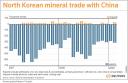
The North’s mineral deposits could be worth $2 trillion, according to an estimate by the South’s Korea Resources Corporation. But dilapidated infrastructure and a broken power grid hinder mining and the transport of minerals out of the country.
The irregular pattern of North Korea’s alumina imports implies that its smelter only runs in fits and starts. Other ore exports are equally ragged, possibly indicating that North Koreans are only digging the easily accessible ores.
Chinese companies that have tried to invest in North Korean mines complain of constant changes in regulations and report that the North tries to tie mining access to commitments to build mills and other industrial projects.
“China and North Korea are friendly neighbors and we will continue to develop friendly cooperative relations with North Korea,” Chinese foreign ministry spokeswoman Jiang Yu said on Tuesday after the North’s withdrawal from the six-party talks.
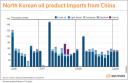
Diplomats’ expectations that China might use trade to influence its prickly neighbor rose when China cut off crude oil shipments in September of 2006, as North Korea prepared to test a nuclear bomb. It had tested ballistic missiles that July.
In fact, energy trade data shows that China is reluctant to apply trade pressure. Increased oil products shipments offset the brief cut in crude supplies in 2006.
“The imposition of these sanctions (in 2006) has had no perceptible effect on North Korea’s trade with the country’s two largest partners, China and South Korea,” wrote Marcus Noland, of the Washington-based Peterson Institute for International Economics.
Data since early 2006 show that Chinese crude shipments have in fact been overwhelmingly consistent, at 50,000 tons a month.
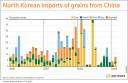
North Korea has imported very little Chinese grain since the 2008 harvest, reflecting the better harvest. Flooding and a disastrous harvest in 2006 and 2007 required heavy imports of grains from China in those years.
Chinese corn shipments to North Korea since August have dropped to 2,670 tons, from 136,595 tons in the previous twelve months and 32,186 tons in the year before that.
Rice and soybean shipments show a similar pattern.
Read the full story below:
Little leverage left for North Korea sanctions
Reuters
4/14/2009
Lucy Hornby and Tom Miles
According to Radio Free Asia:
Following North Korea’s April 6 rocket launch, South Korea began limiting the number of its citizens allowed to cross the border to the Kaesong Industrial Zone, which was set up just inside North Korea amid thawing relations between the two sides in 2004.
“We plan on maintaining the minimum personnel needed to run the Kaesong operations,” South Korean Unification Ministry spokeswoman Lee Jong-joo said.
“The South Korean government has requested enterprises invested in Kaesong to maintain their staff at the minimum level necessary to avoid disruption of production and business operations in the complex.”
South Koreans trying to travel to Kaesong this week were surprised to find their entry permits revoked by the South in the wake of the rocket launch, with the number of South Koreans working in the zone cut to a little above the minimum needed for basic operations.
“Eight persons initially received permission to travel to Kaesong, but eventually only three were allowed to take the trip, and actually most South Korean managerial staff had to stay behind,” a Kaesong-based South Korean entrepreneur said.
‘Skills gap’
“The big issue here is that the skill level of North Korean workers is insufficient, and that’s why South Korean management is essential.”He warned of negative economic consequences if management personnel were unable to reach the zone from the South.
“Banning South Korean managerial staff from traveling to Kaesong will inevitably have a negative impact on production in the complex,” the entrepreneur said.
Tensions have further escalated over the March 30 detention of a South Korean employee of the Kaesong-based Hyundai Asan factory, allegedly for encouraging North Koreans to defect and criticizing the communist regime.
Hyundai’s company president visited Kaesong for a second time this week to press North Korean officials for the employee’s release, but he was refused permission to see the employee, identified only by his surname, Yoo.
Unification Minister Hyun In-taek warned that Seoul wouldn’t tolerate further detention of the employee.
Warning to North
“In the case of Mr. Yoo, the Hyundai Asan employee in the custody of the North Korean authorities, we will react vigorously to any unreasonable extension of the detention of the South Korean,” Hyun told a foreign affairs, trade, and unification committee in Seoul.He also warned against “any punitive measures exceeding what was agreed upon between the two Koreas, such as a warning or expulsion to South Korea.”
The South has ruled out the possibility of closing the joint industrial park despite rising tensions with the North, however.
In March, in protest against a joint South Korea-U.S. military exercise, the North blocked the border crossing to the industrial complex several times, affecting production in some factories.
Experts have called for bilateral talks to hash out a clear framework for the running of Kaesong, to prevent economic fallout from political events in future.
“South and North Korea need to discuss and consult on the relevant systemic and legal issues associated with inter-Korean economic cooperation in the area,” said Hong Ik-pyo, researcher at the Korea Institute for International Economic Policy.
Read the full story here:
Korean Tensions Hit Zone
Radio Free Asia
J.W. Noh
4/10/2009
Writing in the Wall Street Journal, Evan Ramstad offers some information on China’s investments in North Korea:
The diplomatic minuet is taking place after China increased trade with North Korea over the past four years. Last year, trade between China and North Korea jumped 41% to $2.79 billion, with most of that coming from increased exports by China.
On Tuesday, truck traffic between the two countries resumed after a break Monday for a Chinese holiday. Dozens of trucks made the crossing in Dandong, a major city along the North Korean border.
China has been North Korea’s chief political and economic sponsor since the Soviet Union collapsed nearly 20 years ago. For much of that time, it served as donor of last resort, making up the difference when energy, food and donations to North Korea dropped off from other countries. That often amounted to $100 million to $200 million in aid.
China broke from that pattern in 2005 by boosting its exports and widening its trade surplus with North Korea. Outside experts view China’s trade surplus as the chief measure of its economic aid to North Korea because North Korea has no measurable debt instrument and little ability to narrow the trade gap.
Chinese companies, sometimes with help from the Chinese government, are investing heavily in North Korea’s mining industry, construction and light manufacturing such as textiles. Chinese consumer goods line store shelves and market stalls in North Korea.
Many executives of Chinese companies in North Korea say it’s a difficult place to operate. Among the challenges: getting money out of the country. China helped Panda Electronics Group, based in Nanjing, start a computer assembly factory with Taedong River Computer Corp. in North Korea five years ago.
North Korea’s currency, the won, can’t be converted. To move money out of the country, Panda must buy commodities in North Korea and sell them in China for cash, an executive said.
The increased business activity in North Korea reflects China’s desire to treat North Korea more as a “normal country” rather than a socialist brother entitled to unlimited assistance, scholars and analysts in China say. They say China also hopes its companies in North Korea will encourage the North’s government to open its economy as China began to do in the 1980s.
Wang Kai, a manager of Liaoning Fuxin Tianxin Technology and Development Co., says the company decided to build a pipe-making factory in North Korea because the country’s economy has few places to go but up.
“North Korea’s situation and economic status are pretty similar to China’s before the start of the opening up and reform policy,” Mr. Wang said in an interview before the rocket launch.
Others note China’s desire is to prevent North Korea’s collapse, which might pour refugees into China’s northeast.
The increased business is yielding a payoff in political influence for China in Pyongyang that’s become more important since North Korean dictator Kim Jong Il was incapacitated by illness in August. One signal that Mr. Kim was back in control came when he met in late January with a delegation of visiting diplomats from Beijing.
Read the full story here:
Economic interests shape Beijing’s Pyongyang Policy
Wall Street Journal Online
Evan Romstad
4/8/2009
Granted that information from the DPRK is nearly impossible to verify, it seems likely that the DPRK government continues to encounter difficulties implementing its most restrictive market regulations. They have tried repeatedly to impose rules which dictate who may work in the markets, how to allocate vending slots, what goods may be sold in the markets, what prices may be charged, and when markets may open.
With each new rule vendors and entrepreneurs respond by fighting back against the authorities (sometimes violently) or simply moving to the black market, which (as in other communist countries) composes a significant portion of the nation’s GDP.
The DPRK’s most recent market regulation (issued in the autumn of 2008) is the 10-day rule—prohibiting markets from opening except every tenth day. This rule was supposed to take effect in March 2009, yet it has not been successfully implemented—even in the areas where Pyongyang exercises the most control (large cities).
According to the Daily NK:
The North Korean authorities issued a decree in October, 2008 aimed at shifting the existing market system over to a 10-day market system and restricting the range of items being sold, but by mid-March of this year there was no market where the decree had been properly implemented.
Decrees attached to the entrances to markets were all removed and only the specific list of restricted goods is posted there. However, secondhand goods have been strictly regulated in some regions, so conflicts between citizens have arisen.
Each story about the failure of market restrictions stresses the inconsistency with which the rules are imposed across the country. In other words, local conditions predict the effectiveness of Pyongyang’s dictates. This is perhaps due to the DPRK’s market governance structure. Local markets are controlled by a local Market Management Office which is in turn subordinate to each City People’s Committee. According to the Worker’s Party organizational chart (view here), each City People’s Committee is subordinate to a Provincial People’s Committee (PPC), and all PPCs are subordinate to the Central Committee of the Workers Party.
This governance structure puts three layers of bureaucracy between the Central Committee and the actual markets, perhaps allowing local leaders to exercise significant discretion over market operations. True, random inspection units from the central authorities can make surprise visits, but their numbers are likely too small to enforce country-wide compliance, particularly when local officials can benefit from accomodating traders.
Still, these kinds of stories are both disconcerting and pleasing. Why disconcerting? Because the expectation by “Western” analysts (including myself) that market legitimization signaled a stable policy shift by Pyongyang has proven unjustified. The good news, however, is that the DPRK’s markets are proving surprisingly robust.
In 2003, North Korean authorities “legalized” markets throughout the country by converting previously existing “farmers’ markets” into “combined general markets” and allowing all traders sell their wares. After the legislation was passed, markets began to spring up in neighborhoods across the country–even in Pyongyang.
Although it is clear now that this was a politically defensive move on the part of the central government, North Koreans now reportedly spend more than 80 percent of their incomes in these markets. Despite authorities’ efforts to assert more control over the markets, they have (paradoxically) become the social safety net of socialist Korea.
The Daily NK offers some recent food price data from the DPRK:
A defector named Kim, who keeps in touch with his family in the North, reported Monday in a telephone conversation with Daily NK, “The current food prices remain stable, according to sources from Hoiryeong and Pyongyang.”
Mr. Kim explained, “Rice sells in the Hoiryeong jangmadang at between 1,600 and 1,800won, around 200 won lower than before. Other grains and foods have fallen too. Pork sells for 2,800 to 3,000 won per kilogram and corn for 600 won per kilogram. An egg sells for 350 to 500.”
He added that, “Pork sold for about 5,000 won around lunar New Year’s Day and now it sells at half the price. Egg prices have risen a bit; they used to sell for 250 to 350 won. In Pyongyang, the price of rice, which was 2,200 won per kilogram in mid-January, is 1,700 won now. Corn per kilogram fell from 900 won to 750 won.”
He accounted for the lower food prices: In January, to greet the 60th anniversary of the friendship between North Korea and China, Chinese rice came in through Nampo port, so rice prices fell and provision of food increased. Since last year, the authorities have been able to deliver provisions to workers in a few major cities like Shinuiju.
He also relayed news that, “In February, a month’s provisions, 14 kilograms, were delivered to workers and their dependents; corn was provided through food distribution offices.”
Mr. Kim predicted that the situation will be at its worst in May and June of this year, although the food situation is comparatively much better than last year. No matter how good the last harvest was, though, it is not so significant for those who have to buy their food in the jangmadang.”
“Since 1995, food prices have always soared in May and June, the spring shortage season. After the spring this year they will soar again.”
In March or April, food in stock runs out and potatoes, barley, and other vegetables are not harvested until June. Therefore, rising food prices are a chronic spring phenomenon.
Pyongyang must feel reasonably confident, or they want us to think they feel reasonably confident, about current and anticipated food stocks. As reported last week, the DPRK has requested that all foreign NGOs and aid agencies responsible for distributing food aid to cease operations and head home.
Mr. Kim does offer some good news from North Korea’s markets (Jangmadang).
For some time we have heard news that the North Korean government is attempting to turn the clock back on local markets by regulating who may work in them (older women), when they may open, what they may sell, and at what price. All of these restrictions are supposedly part of a plan to break them down and reorient the population towards receiving goods from state-owned shops and the Public Distribution System. These measures could be part of the “2012 Kangsong Taeguk” plans, or they might simply be part of a longer-term political strategy.
It is rumored that these kinds of regulations have lead to violent backlashes because the socialist economy is not capable of supporting the population, and (paradoxically) markets are considered the social “safety net”. As a result, these market regulations are often ignored or “bypassed” by local officials and then quietly rescinded. Mr. Kim offers anecdotal evidence that regulation of the markets has still proven unsuccessful:
“Decrees to close the jangmadang were posted at the entrances but in January they were all removed and the jangmadang operated as usual.”
Let’s hope that this is the fate of more recent regulations as well.
Read more below:
Previous posts on food.
Previous posts on North Korea’s markets.
Food Prices in North Korean Markets Stabilize
Daily NK
Yoo Gwan Hee
3/23/2009