Archive for the ‘Economic reform’ Category

DPRK legal efforts to strengthen planned economy follow currency reforms

Monday, April 5th, 2010

Institute for Far Eastern Studies
NK Brief No. 10-04-05-1
4/5/2010

It has recently been verified that following the currency reforms at the end of last year, North Korea passed 11 laws revising and reforming the system of government control over the economy. Among these measures is a law banning the black market sales of grain.

The North’s food administration law, revised last November 3, clearly bans the black market trade and smuggling of grains, and sets the punishment for such activities as the confiscation of the grains in question. In addition, an order was passed down stating that when food supplies are rationed to a labor management office, they are to be distributed in accordance with a worker’s efforts, position, and productivity. On the same day, a new agricultural law was passed that stated if organizations and groups that were granted land for private plots failed to meet state-set harvest quotas, the plots could be confiscated.

In November and December of last year, North Korea also enacted the Real Estate Management Law, Goods Consumption Standard Law, Construction Materials Import Law, Import/Export Country of Origin Law, Waterworks Law, Labor Quantity Law, Farm Law, Sewer System Law, and the Mariner Law. Among these, the Labor Quantity Law sets the number of laborers per hourly production demands, stipulates labor contracts, and determines remuneration in accordance with worker performance. This law is unprecedented in that it allows the responsible organization or business managers or supervisors administrative and even penal authority by giving them power over labor evaluations and payment.

The Farm Law allows each farm to retain some of its harvest, and making it responsible for selling its goods to the state, while on the other hand, forbidding illegal agricultural production. This law, by strengthening state control over agricultural goods, appears to be an effort to restart the Public Distribution System.

The Real Estate Law, a mechanism to collect user fees, stipulates, “Real estate cannot be lent or left to different individuals, groups, organizations or enterprises without the permission of the applicable authority.” Along with this, the law on consumption includes a clause that links consumption of particular goods with those goods’ production in order to prevent waste, as well as a clause designed to reduce or eliminate the use of imported goods.

The law on the import of construction materials gives the government leverage in all aspects of such activity, including planning, processing, transfer, inspection, construction and testing. In addition, if someone from an enterprise or organization imports construction goods without government authorization, changes an import plan, distributes, transports, or wastes construction wares, he or she is subject to administrative punishment.

Ultimately, economic legislation enacted or revised after the currency reform appears to be aimed at strengthening the planned economic system while increasing government control over public revenue and encouraging efforts to recover without outside assistance.

Share

Scott Snyder on Rason

Monday, April 5th, 2010

Scott Snyder wrote a good piece on recent developents in Rason fo rthe Jamestown Foundation’s China Brief:

The Rajin-Sonbong region in North Korea (also known as Rason following a 2004 administrative reorganization by central authorities) is an underdeveloped backwater near the far northeastern tip of the Korean peninsula bordering Jilin province of China and Primorsky Krai of Russia. Although the area is far from the nerve center of the North Korean regime, Pyongyang, Rajin-Sonbong has strategic significance as the northern-most year-round ice free port in Northeast Asia and therefore is an attractive geostrategic transit point for the shipment of goods to landlocked Northeastern China and the Russian Far East. For this reason, recent reports of new Russian and Chinese investment deals following a rare personal visit by North Korea’s supreme leader, Kim Jong Il, to Rajin-Sonbong in December of last year merit closer scrutiny.

Rajin-Sonbong has been the focal point of periodic efforts by Pyongyang to experiment with economic reforms since it named the area a free economic trade zone in late 1991. At that time, the Rajin port was an essential piece of a UN-sponsored regional development effort known as the Tumen River Area Development Project (TRADP)—which encompasses areas within China, Mongolia, Russia and South Korea—but the project never attracted sufficient international investment to take off. The spotlight returned to Rajin-Sonbong briefly in 1996 when North Korea sponsored an investor forum there in an attempt to stir up interest in a revamped set of investment laws for the region, but few investors came and North Korea’s famine later that year diverted attention away from the effort. 

(more…)

Share

Pramod Mittal eyes stake in DPRK mines

Sunday, April 4th, 2010

According to the Economic Times of India:

Pramod Mittal, the younger sibling of steel tycoon LN Mittal and head of Global Steel Holdings, is negotiating with the North Korean government for a stake in the country’s Musan Iron Ore mines, estimated to hold reserves of more than seven billion tonnes. The move by Global Steel is aimed more at accessing the mineral resource, as the ore is in sharp demand with steelmakers expanding capacity and iron ore miners moving to a quarterly price regime to meet growing markets in Asia and Africa.

Mr Mittal, who is chairman of Global Steel, a closely-held company of the Mohan Lal Mittal family, had visited Pyongyang last week to talk to senior government officials to work out the modalities of a share of Musan’s reserves. The ML Mittal family consists of elder son LN Mittal, Pramod Mittal and younger brother Vinod Mittal, who looks after the Mumbai-based Ispat Industries. When contacted, Pramod Mittal declined to comment. “Our visit to North Korea is to further business interests. We are not looking for any stake in Musan,” he told ET .

According to people familiar with the development, Global Steel could likely be negotiating with Pyongyang for development rights to Musan for a fixed peiod, where Global Steel would do the mining and get to buy an agreed portion of the reserves. Typically, in the mining industry, such development rights are for a long term period of 20 to 50 years.

Global Steel, which is registered in the tax haven Isle of Man, has steelmaking operations in Bulgaria and Nigeria and a 20-year management contract to operate Zimbabwe Iron & Steel. Although Global Steel has a small steelmaking capacity of just more than 2 million tonnes, iron ore from Musan would not be used for Global Steel’s operations. Global Steel also owns two coal blocks in Mozambique where ArcelorMittal, controlled by elder brother LN Mittal, also has coal mines. While the Mittal family has maintained that Global Steel has no link to ArcelorMittal, the world’s largest steel company has been reportedly keen on Global Steel’s assets.

Two years ago, North Korea had granted development rights on Musan to China’s Tonghua Iron & Steel Group for a period of 50 years. However, Pyongyang recently terminated that agreement without offering any reason. People connected with the issue said Global Steel is negotiating with Musan on the amount of investment needed for developing the mines and also on building infrastructure, which is integral to any mining activity.

While the talks with Pyongyang is at an initial stage, under the previous agreement with Tonghua, the Chinese company had reportedly agreed to put in about 7 billion yuan, and had also planned to produce 10 million tonnes of iron ore each year. Of the total investment, about $240 million was for building roads and railways from Musan to Tonghua in China. The Musan iron ore mines are close to the Chinese border. The secretive North Korean government has recently been sending out feelers to global mining companies for developing its vast mineral deposits, said to contain one of the world’s largest reserves, closely rivalling Brazil.

The Musan Mine is the DPRK’s largest and satellite imagery of it can be seen here.

Here is a story about Tonghua’s Musan deal

Read the full story here:
Pramod Mittal eyes stake in North Korea’s Musan mines
The Economic Times
MV Ramsurya
4/5/2010

Share

Jin Hualin, Yanbian University, on Chinese investment in DPRK.

Sunday, April 4th, 2010

Jin Hualin, dean of the College of Economics and Management at Yanbian University, talks about Chinese investment in Rason in China’s Global Times.  Here is an excerpt:

GT: If China does continue to rent Rajin harbor for another 10 years, what will the effects be?

Jin: China has reached an agreement to rent a pier at Rajin Port for another decade. A Dalian-based Chinese company has invested 26 million yuan ($3.8 million) in the reconstruction of Rajin Port No.1 Pier. Park also said that China may enjoy more favorable conditions there, such as more berths.

I think Chinese companies’ participation is good for promoting the North Korean economy and building logistical infrastructure in the area, which is beneficial to China, North Korea and the Northeast Asian countries.

When the Sino-Mongolia route is finished, raw materials and natural resources from Mongolia can be shipped to Japan and South Korea via Rajin harbor, and then China’s northeastern regions and North Korea can both benefit.

GT: What should China do to promote Northeast Asian cooperation and devel-opment?

Jin: I suggest Chinese governments at all levels consider the following issues. They should accelerate trade and tourism and build cooperation on logistics, and support Chinese companies going global and investing in North Korea.

Actually, China now has many companies capable of investing abroad. The point is foreign countries’ investment environment.

We should strengthen cooperation on education with North Korean universities and colleges, sending students to study there and exploring research in new areas together.

We can also strengthen regional cooperation. We can designate China’s Hunchun city and North Korea’s Rason city as pilot cities and permit China’s commercial banks to open yuan-based accounts in Rason’s commercial banks.

Relations between Northeast Asian countries are subtle and complicated because of geopolitical contradictions, different political systems, the influence of the Cold War, historical issues, territorial disputes and sentiments caused by historical and territorial issues.

Mutual distrust fundamentally hinders cooperation. China needs to take the responsibility to promote regional cooperation and make it institutionalized and legally guaranteed as soon as possible.

GT: How do you evaluate the political and economic risks for Chinese companies going into North Korea? What advantages do Chinese companies have?

Jin: There are always political and economic risks involved in trade between different countries. The first major solution is to establish a mutual investment guarantee agreement, so that the two countries’ economic cooperation will be protected legally.

We hope that North Korea can keep the stability and consistency of its policies and issue development policies that is in line with international conventions. As long as North Korea adopts consistent policies, Chinese companies won’t encounter great political and economic risks there.

China and North Korea are believed to enjoy good mutual trust. China has experience from its reform and opening-up and plenty of investment capability. North Korea has a good educational foundation, low labor costs, and rich natural resources.

Chinese companies are active participants in investing in North Korea and I believe they’ll do well there.

Read the full interview here. Hat tip to Adam.

Share

DPRK-PRC plan two more Yalu River dams

Sunday, April 4th, 2010

UPDATE: According to Michael Rank:

Two power stations are under construction on the Yalu river between China and North Korea, a Chinese website reports.

They are both small plants with an installed capacity of 40,000 kilowatts and both are situated near the border town of Ji’an 集安 in southwestern Jilin province, near the border with Liaoning.

The dams are set to be finished in 2013. Negotiations concerning construction have been protracted: a preliminary agreement was reached in July 2004, followed by a further agreement in August 2008 and a final accord last January.

The Wangjianglou or Lintu 望江楼(林土)dam will be based on the Chinese side of the river with investment totalling 600 million yuan ($88 million), while the Wenyue or Changchuan 文岳(长川)dam will be based on the North Korean side with investment put at $500 million ($73 million). The report did not say how power, or costs, would be shared between the two countries.

A ceremony marking the beginning of construction was held on March 31, attended by North Korean vice-minister of electricity industry Kim Man-su and Jilin vice-governor Chen Weigen.

The plants will each produce 154 million kilowatt-hours per year. The Wangjianglou dam is 397 metres long and 16 metres high, while Wenyue is 602.7 metres long and 15.5 metres high. They are 36 and 24 km from Ji’an, respectively and are 1.5 and 5.5 km from North Korean railway stations (Rinto린토 and Mun’ak 문악 – these are the Korean names of the dams).

These dams are very small scale compared with the world’s largest dams, which run into thousands of megawatts (440 kW is just 0.44 MW).

ORIGINAL POST: According to the AFP:

China and North Korea will build two hydro-electric dams on the Yalu River that marks their border, Chinese state media reported on Thursday.

The dams will cost a total of 1.1 billion yuan (161 million dollars) and generate a combined 308 million kilowatt hours of electricity when completed, China Central Television reported.

The announcement came amid reports that North Korean leader Kim Jong-Il would soon visit China in a trip that could revive talks on ending Pyongyang’s nuclear drive.

Xinhua news agency said one dam would be built at Wangjianglou in China’s northeastern Jilin province and the other at Changchuan.

Electricity from the dams would help “drive economic growth in Jilin and North Korea,” it added.

It was not immediately clear how the two sides would share the cost of the projects or the electricity.

Construction would begin this year.

North Korea, desperately poor after decades of isolation and Stalinist economic policies, is heavily dependent on China for trade and aid.

South Korea’s government said this week there was a “high level of possibility” that Kim would pay a visit to China, the reclusive regime’s closest ally.

The South’s Yonhap news agency cited diplomatic sources saying he might leave for China as early as Thursday or Friday.

China’s foreign ministry declined to confirm the reports.

After an October visit to Pyongyang by Chinese Premier Wen Jiabao, Kim said his nation would rejoin the six-nation denuclearisation talks which the North stormed out of in April of last year.

The talks group hosts China, the two Koreas, Japan, the United States, and Russia.

Adam Cathcart offers a translation of the Xinhua dispatch:

中朝两国在鸭绿江新合建的两座水电站开工   // China and North Korea to Begin Construction on Two New Shared Hydroelectric Plants

Huanqiu Shibao, April 2, 2010 [translated by Adam Cathcart]

新华网吉林频道3月31日电(记者李双溪)31日, 中国与朝鲜在界河鸭绿江上共同建设的两座水电站开工。这两座电站总投资为11亿元人民币 ,建成后年发电量达3.08亿千瓦时。其中,望江楼(朝鲜称林土)电站计划投资6亿元,发电厂位于中方一侧,电站主要由混凝土重力坝、泄水闸、电站厂房及变电站等部分组成。On Jilin’s newschannel on 31 March, Xinhua’s reporter Li Shuangxi broadcast that China and North Korea would start joint construction on two hydropower plants in the border areas of the Yalu River. Investment on these two power plants will total 1.1 billion yuan, and the year after completion, they are projected to have a power generation capacity of 308 million kilowatts.  Among these plants are the Wangjiang Station (called Lintu by the Koreans), which is slated for 6oo million RMB of investment.   The power plant on the Chinese side will be a concrete gravity dam with a sluice gate and substation components.

[Lots of details follow on dam dimensions, projected electric output…It seems clear that China will bear all of the cost, though.]
2004年7月中朝双方审查通过了两座电站的初步设计,2006年中国有关部门批准了建设方案。2010年1月,双方在朝鲜签署了《中朝建设鸭绿江望江楼和文岳电站第九次会议纪要》,一致同意两电站开工建设。 In July 2004, China and the DPRK jointly reviewed the preliminary design of the two power stations.   In 2006, the Chinese authorities approved the construction plan.  In  January 2010, the two sides signed an agreement in North Korea known as the “Minutes of the Ninth Meeting on Sino-North Korean Construction of Yalu River Dams at Wangjianglou and Wenbing,” in which it was agreed to commence with the construction of the two power stations.

发源于长白山主峰、总长约795公里鸭绿江水能资源丰富,流经过吉林省和辽宁省。 目前在吉林省境内中朝双方已建有云峰、渭源两座水电站。 望江楼、文岳电站将成为双方共同受益的水电站,对开发鸭绿江、拉动吉林省和朝鲜的经济增长将起到积极的促进作用。Originating in the main peak of the Changbai Mountain range, with a total length of 795 km, the Yalu River is a rich resource flowing through Jilin and Liaoning provinces.  Currently, on the borders of Jilin Province, China and the DPRK have already built two jointly benefitted-from hydropower plants called Yunfeng and Weiyuan.  The Wangjianglou and Wenbing power stations will be built for of mutual benefit, developing the Yalu River, driving forward continued economic development between Jilin province and North Korea, playing a positive role.

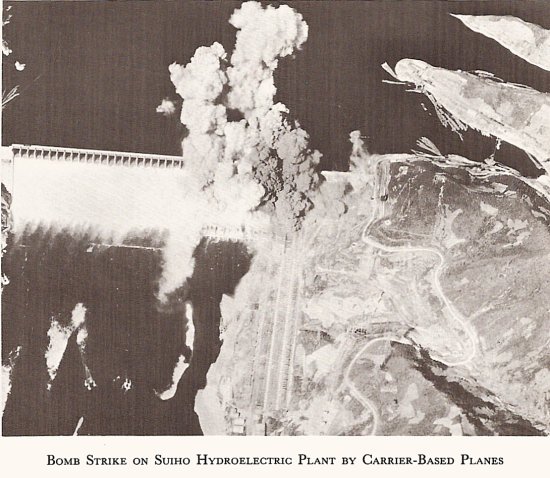
I am not sure where these dams are going just yet.  The DPRK and China already share 4 dams across the Yalu. Here are satellite images of them (Dam 1, Dam 2, Dam 3, Dam 4).  Unfortunately I do not know the names of most of them, but Dam 2 is now known as the Suphung Dam.  It used to be called the Suiho Dam and it was bombed during the Korean war:

Read the full story here:
China, N.Korea plan Yalu hydropower dams: reports
AFP
4/1/2010

Share

DPRK looking to greater Chinese investment

Thursday, April 1st, 2010

According tot he Washington Post:

Squeezed by food shortages and financial sanctions, North Korean leader Kim Jong Il appears to be reaching out to China and Chinese investors in a way that could mark an extraordinary opening in the insular nation’s shuttered economy.

Kim might soon travel to China, according to the office of South Korea’s president and U.S. officials. They cited preparations that appear to be underway in the Chinese border city of Dandong and in Beijing. The Chinese Foreign Ministry said Thursday it does not have information on whether Kim will visit China.

“The North is now planning to open foreign-owned factories not just in closed-off special economic zones, but in major cities like Nampo and Wonsan,” Lim said. Until now, the government has confined nearly all foreign business operations to sealed-off economic zones, such as Kaesong near the South Korean border. “The military is closely cooperating with the State Development Bank to try to increase foreign investment.”

Although the repressive power of the army and security forces remains strong, the North’s command-style economy is a ruin. There were unconfirmed reports of starvation deaths in some areas this winter.

Kim, 68, and showing the effects of a 2008 stroke, is in the early stages of handing power over to his untested 27-year-old son, Kim Jong Eun. But the legitimacy of the succession — and of the state itself — is being weakened by the growth of the markets and increased public access to foreign media.Refugee surveys show that many North Koreans blame Kim’s government for food shortages, corruption and incompetence.

In South Korea and China, there is widespread skepticism about North Korea’s willingness to create modern banking systems and enforce laws that allow foreign companies to operate under standardized accounting rules.

Companies that have invested in North Korean mineral ventures have complained for years of corruption and outright theft by the government.

Read the full story here:
Overtures to China may signal opening of North Korea’s economy
Washington Post
Blaine Harden
4/2/2010

Share

Why the Sunshine Policy Made Sense

Thursday, April 1st, 2010

Nautilus Institute Policy Forum Online 10-020A: April 1st, 2010
James E. Hoare
4/1/2010

I. Introduction

James E. Hoare was Britain’s Chargé d’Affaires to the DPRK from 2001-2002 and opened the British Embassy in Pyongyang. In this article on the Sunshine policy he writes, “Slowly, the policy was creating a group of people who could see benefits in remaining on good terms with South Korea and who had wider links with the outside world. Engagement has worked in other countries, most noticeably China, and I believe that it was beginning to work in North Korea. There was never going to be a speedy change in attitudes built up over sixty years, but stopping the process after ten was not a wise decision.”

This article was published by 38 North a web site devoted to analysis of North Korea from the U.S.-Korea Institute at SAIS. 38 North will harness the experience of long-time observers of North Korea and others who have dealt directly with North Koreans. It will also draw on other experts outside the field who might bring fresh, well, informed insights to those of us who follow North Korea.

The views expressed in this article are those of the author and do not necessarily reflect the official policy or position of the Nautilus Institute. Readers should note that Nautilus seeks a diversity of views and opinions on contentious topics in order to identify common ground.

II. Article by James E. Hoare

– “Why the Sunshine Policy Made Sense”
By James E. Hoare

At a recent private meeting in London, a former senior United Nations’ official, drawing on experience relating to a wide range of countries, said that transforming a “failing” or “fragile” state was not something that could be done overnight. Those involved needed to think in terms of ten to twenty years rather than weeks or months. Regardless of whether or not one accepts the idea of the Democratic People’s Republic of Korea (DPRK or North Korea) as a failed or even fragile state-and the term is often used in some quarters-the idea that one is in for the long haul in bringing about major modifications in behavior and attitude is certainly a good one to have in mind when dealing with the DRPK. It was such an approach that marked the Republic of Korea’s policy towards the North under former Presidents Kim Dae-jung and Roh Moo-hyun.

Since the Lee Myung-bak government took office in the Republic of Korea (ROK or South Korea) in 2008, it is fashionable to dismiss the policies followed by his predecessors as an expensive failure. Sneers about “ATM diplomacy,” innuendo about Kim Dae-jung’s motives, and references to his successor Roh Moo-hyun’s naivety, are the commonplace of South Korean academic and press comment, and are heard much further afield. “Sunshine” or engagement have become terms of mockery. The Lee government has adopted a more aggressive policy towards North Korea. It has not refused assistance outright, but has couched its offers in such a way that rejection is inevitable-the most recent example is the “grand bargain” proposed in 2009 in which the DPRK must first give up its nuclear program to receive security guarantees and aid. This is then played back as evidence that the North is incorrigible and not deserving of assistance.

The Lee government’s approach is based on an incorrect assessment both of the Sunshine Policy and what went before it. “Sunshine” or “engagement” was not something that sprang from Kim Dae-jung’s fertile brain, though he certainly can be credited with refining and developing the idea. The policies pursued by Kim and Roh lay firmly within a tradition that goes back to President Park Chung Hee in the early 1970s and that was followed by all his successors to a greater or lesser degree. However, it was never easy to engage the North and it did not take much to divert earlier presidents from such a policy. Frustrated or annoyed, they eventually gave up the effort.

The difference after 1998 was that South Korea stuck to “sunshine” even when there were difficulties. Neither Kim nor Roh were starry-eyed and neither expected that the North would be changed overnight. Both responded to Pyongyang’s bad behavior with firmness. But they realized that circumstances had changed with the famine and other problems that hit North Korea in the 1990s. They also realized that for engagement to be successful, it was best to avoid rubbing in the fact that the country faced real problems. Even if the explanations offered for the problems often ignored the North Korean regime’s own part in bringing them about, there was nevertheless an acceptance that help was needed. The unprecedented appeal for outside assistance that brought in UN agencies and resident non-governmental organizations in the late 1990s showed that the South would help without preaching. No doubt the expense and complications of German reunification also gave pause for thought. If the two Germanys, which had not fought a savage war and were far richer, could not achieve a smooth reintegration, how could the two Koreas?

So Kim and Roh did not break off engagement as a result of “bad” behavior or outside criticism of “soft policies.” They accepted that it would take a long time to modify Pyongyang’s policies and that there were likely to be few expressions of thanks. Of course there was no instant transformation. But the new approach provided a window for other countries to establish relations with North Korea. In theory, it had long been the South’s policy to allow if not to encourage such relations, but the reality had been different. From 2000 onwards, that changed. Countries that had hitherto held back for fear of offending Seoul now found themselves encouraged to establish relations with Pyongyang.

Those that did so found a North Korea that seemed eager for change, although very careful about how that eagerness was expressed. But there was a readiness to do things that would have seemed improbable only ten years before. While never quite admitting that the policies pursued under Kim Il Sung and Kim Jong Il might have had defects, those of us working in the North between 2000-2002 found a willingness on the part of officials to admit that they needed assistance and that mistakes had been made. Examples included a vice-mayor who admitted that post-Korean War town planning had many defects that were only then becoming obvious. Officials were willing to admit that the country was in need of a whole range of economic and commercial skills that had hitherto been neglected. Perhaps most telling of all, a country that had responded to the changes in the former Soviet Union, Eastern Europe and China in the early 1990s by calling home all its overseas students now was most anxious to send students abroad once again.

Engagement was thus helping to open North Korean eyes to possibilities beyond juche, but unfortunately, even before the 2002 nuclear crisis, there was relatively little follow-up on these expressions of intent. Pyongyang found difficulty in matching students to the requirements of foreign universities and other training institutions. Some countries that established diplomatic relations preferred to concentrate on human rights issues to the exclusion of other matters. Since several of these were members of the European Union (EU), their approach inevitably affected the EU’s broad approach to North Korea. Even among countries that did not give predominance to human rights, goodwill was rarely transformed into sufficient funding to make a real difference.

That said, in the British case alone, we were able to fund several sessions of economics training, an English-language training program that put initially two-now four -British teachers into DPRK universities to train English teachers, and intensive English courses for a variety of North Korean officials. In addition, non-governmental bodies such as the BBC and Reuters conducted training programs for media staff in modern methods of news presentation and communication skills. Perhaps if the United States had been more supportive of its ally’s engagement policy these efforts would have made a difference. But as the relatively benign approach towards engagement of the Clinton years gave way to hostility under President George W. Bush after 2000 that too had an impact on how far countries such as Britain would support the sunshine policy.

It was South Korea’s approach to engagement that had the greatest impact. Seoul’s aid and other measures taken under the umbrella of the “sunshine” approach brought North and South into contact across many fields. During the period from 1998-2008, the North became known to South Korean citizens in a totally unprecedented way. The process had begun earlier, especially during the Roh Tae-woo presidency (1988-93), but the trickle of information about the North of those years became a flood. And it was not only information but actual contact with North Korea. For some, this meant tightly controlled tours to the Diamond Mountains (Mount Kumgang) or towards the end of the period, to Kaesong at the western end of the Demilitarized Zone. Limited though these were, they were still a glimpse into what had hitherto been unknown and feared. There were also signs that, as the North got used to the idea of such visits, it might open up a little more; the decision to allow the use of visitors’ own cars in March 2008 was one such indication, but there were several others.

Much more important were the wide range of government and non-governmental contacts. Relatively few North Koreans came South but the traffic in the other direction was enormous. On any given day, there were likely to be several thousand South Korean visitors in the North, dealing with aid, trade, cultural, educational and even religious exchanges-both the Protestant and the Roman Catholic churches in the North had regular South Korean officiating ministers as well as hymnbooks and prayer books produced in the ROK. South Korean journalists were also a not uncommon sight. Most of this activity may have been confined to Pyongyang, by not all of it was. South Koreans were visiting many parts of the country, especially in connection with agricultural assistance and other aid-related projects. Nobody was starry-eyed about these visits. South Korean visitors were watched and controlled. But they were able to learn a lot since they could speak and read Korean. If the projects agreed to at the October 2007 summit between Kim Jong-il and Roh Moo-hyun had been implemented by the incoming Lee Myung-bak government, there would have been a huge increase in these types of contacts.

No doubt engagement was expensive and sometimes the means used to bring it about were shady, but it was producing benefits. The South, and to some extent the rest of the world, now has a far better understanding of how North Korea works then it did before engagement began. Within the North, a large number of people have come to see their southern compatriots in a less hostile light and have some, even if limited, understanding of the economic and social structures of South Korea. Perhaps some of the assistance provided was diverted away from its original purpose, but enough rice and fertilizer bags reached areas far away from Pyongyang and enough people were willing to ask questions about the South to show that the impact of engagement extended beyond a small circle of ruling elite. Slowly, the policy was creating a group of people who could see benefits in remaining on good terms with South Korea and who had wider links with the outside world. Engagement has worked in other countries, most noticeably China, and I believe that it was beginning to work in North Korea. There was never going to be a speedy change in attitudes built up over sixty years, but stopping the process after ten was not a wise decision.

Share

Hermit economics hobbles Pyongyang

Wednesday, March 31st, 2010

Aidan Foster-Carter writes in the Financial Times about some poor decision-making coming out of Pyongyang:

Great Leader? Pyongyang’s fawning hagiography not only grates, but is singularly unearned. Even by its own dim lights, North Korea’s decision-making is going from bad to worse.

Last year saw two spectacular own goals. Missile and nuclear tests were a weird way to greet a new US president ready to reach out to old foes. The predictable outcome was condemnation by the United Nations Security Council, plus sanctions on arms exports that are biting.

Domestic policy is just as disastrous. December’s currency “reform” beggars belief. Did Kim Jong-il really fail to grasp that redenomination would not cure inflation, but worsen it? Or that brazenly stealing people’s savings – beyond a paltry minimum, citizens only got 10 per cent of their money back – would finally goad his long-suffering subjects into rioting? Forced to retreat, officials even apologised. One scapegoat was sacked – and possibly shot.

By his own admission, Mr Kim does not do economics. In a speech in 1996, when famine was starting to bite, the Dear Leader whined defensively that his late father, Kim Il-sung, had told him “not to get involved in economic work, but just concentrate on the military and the party”.

That awful advice explains much. Incredibly, North Korea was once richer than the South. In today’s world, this is the contest that counts. “It’s the economy, stupid” is no mere slogan, but a law of social science.

Having taken an early lead, Kim senior threw it all away. He built the world’s fourth largest army, crippling an economy that he refused to reform, viewing liberalisation as betrayal. His own personality cult was and is a literally monumental weight of unproductive spending.

Used to milking Moscow and Beijing, in the 1970s North Korea borrowed from western banks – and promptly defaulted. That was not smart; it has had to pay cash up front ever since.

Pyongyang also resorts to less orthodox financing. In 1976 the Nordic nations expelled a dozen North Korean diplomats for trafficking cigarettes and booze. In December a Swedish court jailed two for smuggling cigarettes. More than 100 busts worldwide over 30 years, of everything from ivory and heroin to “supernotes” (fake $100 bills), leave scant doubt that this is policy.

Yet morality aside, it is stupid policy. Pariahs stay poor. North Korea could earn far more by going straight. The Kaesong Industrial Complex (KIC), where South Korean businesses employ Northern workers to make a range of goods, shows that co-operation can work. Yet Pyongyang keeps harassing it, imposing arbitrary border restrictions and demanding absurd wage hikes.

Now it threatens to seize $370m (€275m, £247m) of South Korean assets at Mount Kumgang, a tourist zone idle since a southern tourist was shot dead in 2008 and the north refused a proper investigation. Even before that, Pyongyang’s greed in extorting inflated fees from Hyundai ensured that no other chaebol has ventured north. Contrast how China has gained from Taiwanese investment.

In this catalogue of crassness, the nadir came in 1991 when the dying Soviet Union abruptly pulled the plug on its clients. All suffered, but most adapted. Cuba went for tourism; Vietnam tried cautious reform; Mongolia sold minerals. Only North Korea, bizarrely, did nothing – except watch its old system crumble. Gross domestic product plunged by half, and hunger killed up to a million. Now famine again stalks the land. The state cannot provide, yet still it seeks to suppress markets.

All this is as puzzling as it is terrible. China and Vietnam show how Asian communist states can morph towards capitalism and thrive. Kim Jong-il may fear the fate of the Soviet Union if he follows suit. True, his regime has survived – even if many of its people have not. Yet the path he is on is patently a dead end. Mr Kim’s own ill-health, and a belated bid to install his unknown third son as dauphin, only heighten uncertainty. Militant mendicancy over the nuclear issue – demanding to be paid for every tiny step towards a distant disarmament, then backsliding and trying the same trick again – will no longer wash. North Korea has run out of road; the game is finally up.

What now? A soft landing, with Mr Kim embracing peace abroad and reform at home, remains the best outcome. But if he obdurately resists change, we need a plan B. The US and South Korea have contingency plans for the north’s collapse. So does China, separately. Tacit co-ordination is urgent, lest future chaos be compounded by a clash of rival powers – as in the 1890s. Koreans have a rueful proverb: when whales fight, the shrimp’s back is broken.

But Beijing will not let it come to that. China is quietly moving into North Korea, buying up mines and ports. Some in Seoul cry colonialism, but it was they who created this vacuum by short-sightedly ditching the past decade’s “sunshine” policy of patient outreach. President Lee Myung-bak may have gained the Group of 20 chairmanship, but he has lost North Korea.

Nor will Mr Kim nuzzle docile under China’s wing, though his son might. As ever, North Korea will take others’ money and do its own thing. In early 2010 new fake “super-yuan” of high quality, very hard to detect, started appearing in China. They wouldn’t, would they?

Read the full article here:
Hermit economics hobbles Pyongyang
Financial Times
Aidan Foster-Carter
3/30/2010 

Share

Threat of confiscation is lowering prices?

Monday, March 29th, 2010

According ot the Daily NK:

The current rice price downturn in North Korea has been caused by the fact that wholesalers and individuals dumped rice and corn in bulk onto the market in order to avoid it being confiscated by the authorities, according to sources inside the country.

A source from North Hamkyung Province reported on the 26th that the rice price in Chongjin had dropped even further.

Recently, the authorities reportedly announced that food distribution would be normalized and that grain stored by individuals would be confiscated. Therefore, citizens started releasing their stored food onto the market in order to avoid confiscation, generating oversupply.

The source said on a telephone conversation with the Daily NK on the 26th, “In the Youth Park Market in Shinam-district, Chongjin, rice is now 480 won and corn 210 won per kilo.

The source said, “The Army security apparatus has been confiscating food stored by foreign currency earning organizations. It is a part of the implementation of their plan to lower food prices to state-designated levels.”

One North Korean resident told The Daily NK last week, “Prices have been fluctuating since the redenomination, but now a notice has been handed down from the Cabinet saying that prices will be stabilized by April 1. It says the Cabinet will deal with this confusion in the people’s economy.”

The source added, “In inspections by the Prosecutors Department of the Ministry of the People’s Armed Forces and Defense Security Command, foreign currency earning apparatus affiliated with military units stationed in Chongjin and another five organizations were revealed to be storing around 260 tons of grains, which was confiscated. Around 90 tons of grain stored by the No. 9 Division was also taken and managers were interrogated by the inspections group.”

With the downturn in food prices, the exchange rate in Chongjin also went down to 690 won to the dollar.

Confiscation Threat Spurs Grain Market Flood
Daily NK
Jin Hyuk Su
3/29/2010

Share

North Korean restaurants in Asia

Monday, March 29th, 2010

According to Slate:

North Korean government-run restaurants have existed for years in the regions of China adjacent to the DPRK’s northern border, but the 21st century has seen an expansion of the business into other parts of Asia. In 2002, the first Southeast Asian branch of Pyongyang opened in the Cambodian tourist hub of Siem Reap, and it became an immediate hit with South Korean tour groups visiting the nearby temples of Angkor. The success of the restaurant, reportedly opened by Ho Dae-sik, the local representative of the DPRK-aligned International Taekwondo Federation, led to the opening of the Phnom Penh branch in 2003. This was followed by more elaborate establishments in Bangkok and the popular Thai beach resort of Pattaya, as well as a small branch in the Laotian capital, Vientiane.

Little is known of how the restaurants operate, but experts say they are closely linked with other overseas operations run by the reclusive regime in Pyongyang. Bertil Lintner, author of Great Leader, Dear Leader: Demystifying North Korean Under the Kim Clan, says that in the early 1990s, North Korea was hit by a severe economic crisis caused by the disruption in trading ties with its former Communist allies. At that time, both the Soviet Union and China began to demand that Pyongyang pay for imports in hard currency rather than barter goods, forcing it to open “capitalist” foreign ventures to make up funding shortfalls. He says the restaurants are part of this chain of trading companies controlled by Bureau 39, the “money making” (and money-laundering) arm of the Korean Workers’ Party.

“The restaurants are used to earn additional money for the government in Pyongyang—at the same time as they were suspected of laundering proceeds from North Korea’s more unsavory commercial activities,” he says. “Restaurants and other cash-intensive enterprises are commonly used as conduits for wads of bills, which banks otherwise would not accept as deposits.”

According to reports from defectors, the eateries are operated through a network of local middlemen who are required to remit a certain amount every year to the coffers in Pyongyang. Kim Myung Ho, a North Korean defector who ran a restaurant in northern China, reported in 2007 that each establishment, affiliated with “trading companies” operated by the government, was forced to make annual fixed payments of between $10,000 and $30,000 back to the North Korean capital. “Every year, the sum total is counted at the business headquarters in Pyongyang, but if there’s even a small default or lack of results, then the threat of evacuation is given,” Kim told reporters from the Daily NK, a North Korean news service run by exiles and human rights activists.

A year ago, the Pyongyang restaurants in Cambodia and Thailand suddenly closed their doors, only to reopen again after a six-month hiatus. Lintner cited an Asian diplomat in Bangkok saying the restaurants, like all “capitalist” enterprises, were hit hard by the global economic crisis, but locals familiar with the establishment in Phnom Penh offered another explanation. One worker at a nearby business said Pyongyang closed after a dispute with a Cambodian customer who tried to take one of its North Korean waitresses out for “drinks” after dinner.

If true, it would not be the first time. In 2006 and 2007, Daily NK reported several incidents in which waitresses from North Korean restaurants in China’s Shandong and Jilin provinces tried to defect, forcing the closure of the operations. Kim Myung Ho added that two or three DPRK security agents live onsite at each restaurant to “regulate” the workers and that any attempts at flight result in the immediate repatriation of the entire staff.

Read the full story here:
Kingdom Kim’s Culinary Outposts
Slate
Sebastian Strangio
3/27/2010

Share
